
Temperature variation of the Electric Field Gradient in

- Slides: 17
Temperature variation of the Electric Field Gradient in Mercuric Chloride Jonathan Keartland Eric Newby School of Physics and Materials Physics Research Institute, University of the Witwatersrand
Introduction • A literature survey showed that there was comparatively little nuclear quadrupole resonance (NQR) work done on Hg. Cl 2 since the 1970 s, and there were no low temperature studies • There has been a recent re-awakening of interest in NQR in similar materials, particularly the behaviour at relatively high temperatures • Recent work on this material includes high temperature Raman studies, and NQR may be used to probe lattice dynamics
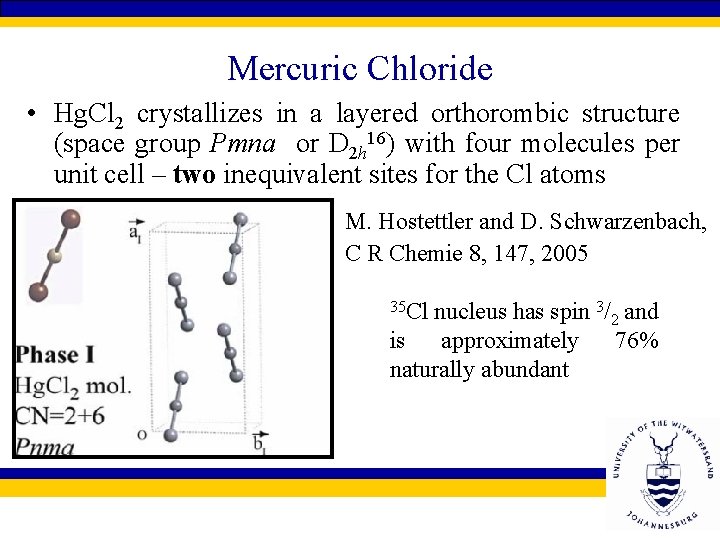
Mercuric Chloride • Hg. Cl 2 crystallizes in a layered orthorombic structure (space group Pmna or D 2 h 16) with four molecules per unit cell – two inequivalent sites for the Cl atoms M. Hostettler and D. Schwarzenbach, C R Chemie 8, 147, 2005 35 Cl nucleus has spin 3/2 and is approximately 76% naturally abundant
Previous NQR studies in Hg. Cl 2 • First investigation by Dehmelt and Kruger (1955) established the NQR frequencies for the Cl nuclei at room temperature (approximately 22 MHz) • Measurements of the temperature dependence of the quadrupolar resonance frequencies followed during the 1960 s; more recently studies of the values of the electric field gradient parameters (all above 77 K) • Dinesh and Smith (1972) reported the first (and only) measurements of the spin-lattice relaxation time and attempted to relate these to the lattice dynamics
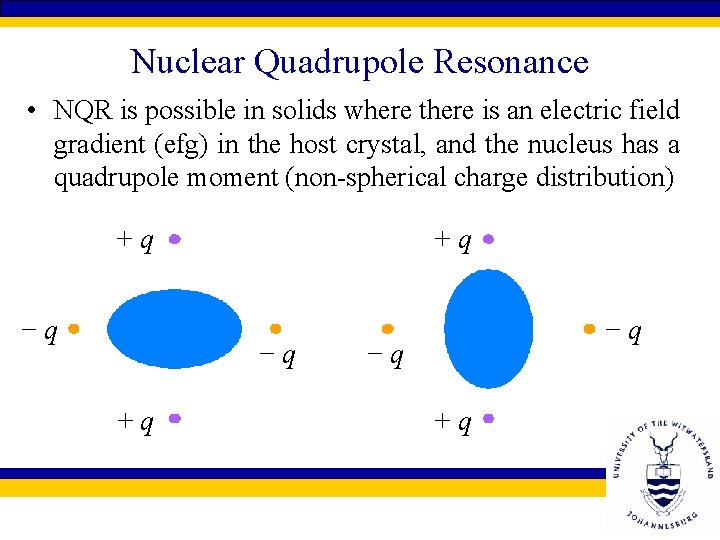
Nuclear Quadrupole Resonance • NQR is possible in solids where there is an electric field gradient (efg) in the host crystal, and the nucleus has a quadrupole moment (non-spherical charge distribution) +q −q −q +q
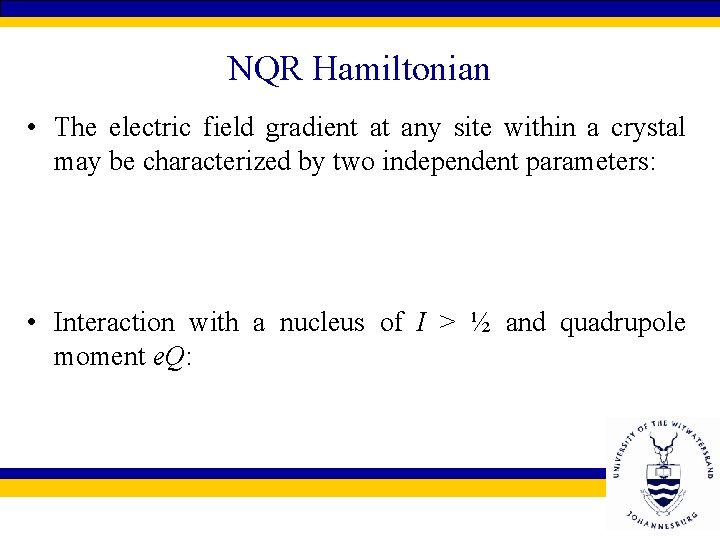
NQR Hamiltonian • The electric field gradient at any site within a crystal may be characterized by two independent parameters: • Interaction with a nucleus of I > ½ and quadrupole moment e. Q:
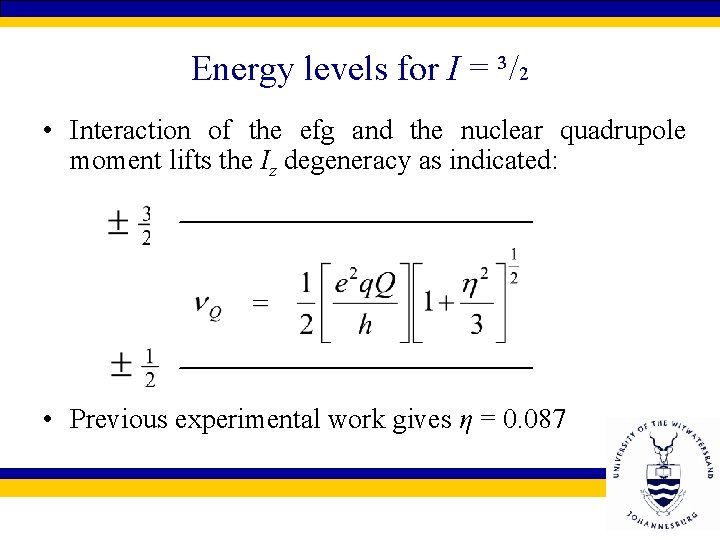
Energy levels for I = ³/2 • Interaction of the efg and the nuclear quadrupole moment lifts the Iz degeneracy as indicated: • Previous experimental work gives η = 0. 087
Measurement of νQ • Pure pulsed nuclear quadrupole spin-echoes obtained from the standard π/2 -π sequence were employed to determine νQ • νQ can be determined (at a fixed temperature) by changing the applied rf frequency until the off-resonance ‘beat’ pattern disappears • This allows νQ to be determined to a precision of 1 k. Hz, which is smaller than any drift in the temperature of the sample
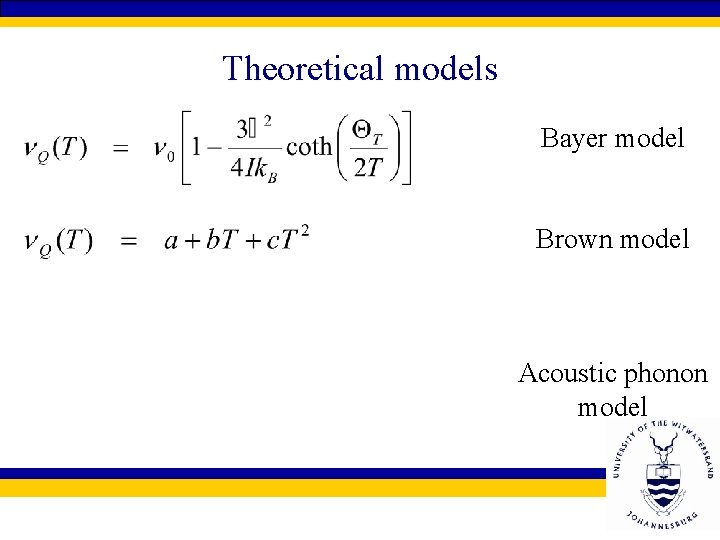
Theoretical models Bayer model Brown model Acoustic phonon model
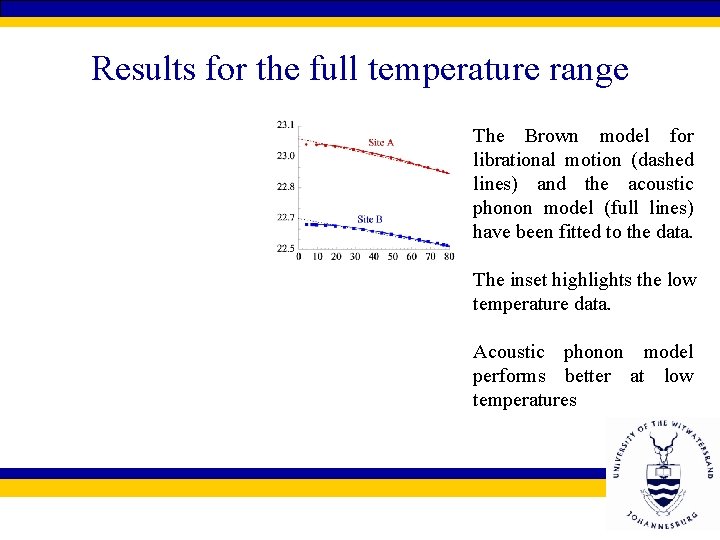
Results for the full temperature range The Brown model for librational motion (dashed lines) and the acoustic phonon model (full lines) have been fitted to the data. The inset highlights the low temperature data. Acoustic phonon model performs better at low temperatures
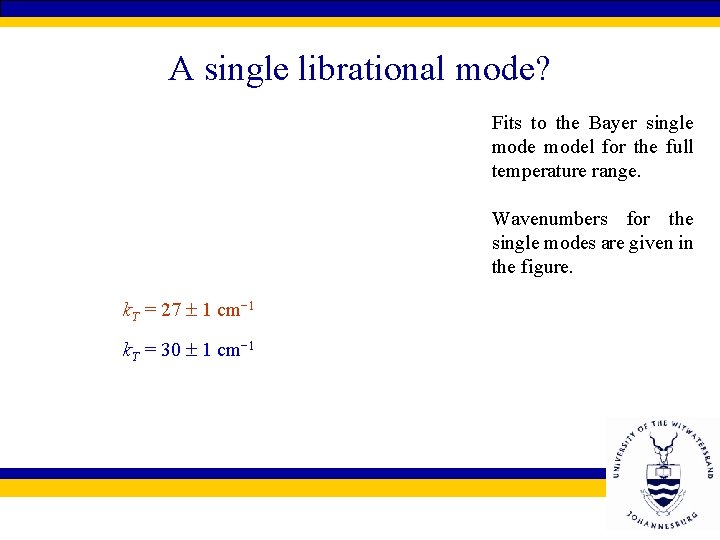
A single librational mode? Fits to the Bayer single model for the full temperature range. Wavenumbers for the single modes are given in the figure. k. T = 27 1 cm− 1 k. T = 30 1 cm− 1
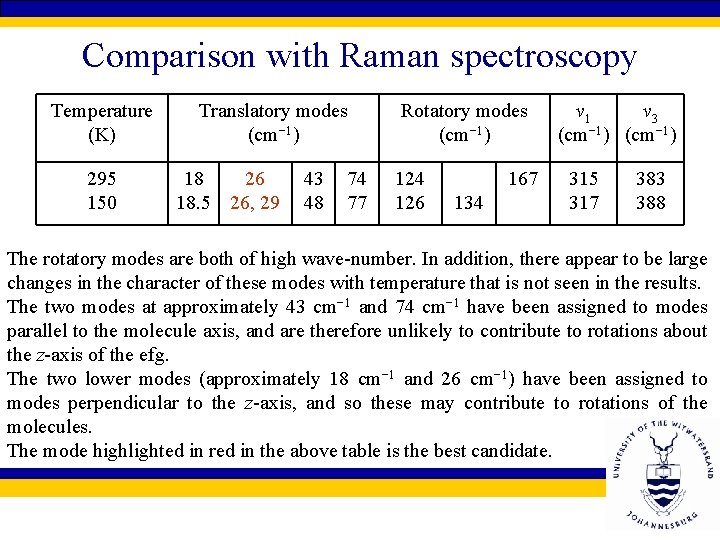
Comparison with Raman spectroscopy Temperature (K) 295 150 Translatory modes (cm− 1) 18 26 18. 5 26, 29 43 48 74 77 Rotatory modes (cm− 1) 124 126 167 134 ν 1 ν 3 (cm− 1) 315 317 383 388 The rotatory modes are both of high wave-number. In addition, there appear to be large changes in the character of these modes with temperature that is not seen in the results. The two modes at approximately 43 cm− 1 and 74 cm− 1 have been assigned to modes parallel to the molecule axis, and are therefore unlikely to contribute to rotations about the z-axis of the efg. The two lower modes (approximately 18 cm− 1 and 26 cm− 1) have been assigned to modes perpendicular to the z-axis, and so these may contribute to rotations of the molecules. The mode highlighted in red in the above table is the best candidate.
Latest Raman spectroscopy results Results for the mode at approximately 26 cm– 1 over the entire temperature range are fitted to a second order polynomial.
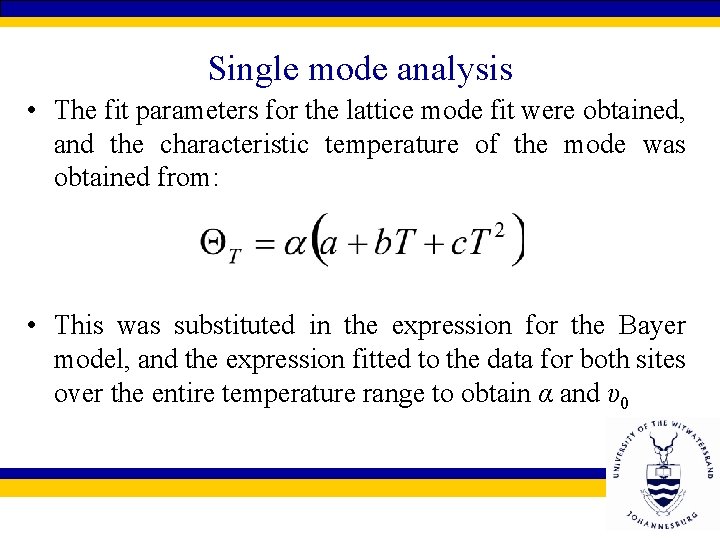
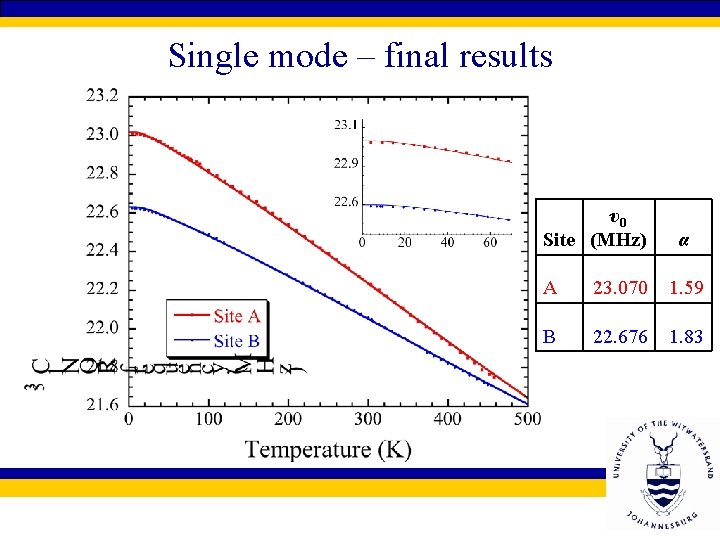
Single mode analysis • The fit parameters for the lattice mode fit were obtained, and the characteristic temperature of the mode was obtained from: • This was substituted in the expression for the Bayer model, and the expression fitted to the data for both sites over the entire temperature range to obtain α and υ0
Single mode – final results υ0 Site (MHz) α A 23. 070 1. 59 B 22. 676 1. 83
Conclusions • The temperature dependence of the efg in Hg. Cl 2 has been determined using NQR methods • Various models have been tested against the experimental data, including librational and vibrational models • The Brown model (librations) and the acoustic phonon model both show discrepancies at extreme temperatures • A single model based on Raman results suggests that a mode with k ~ 26 cm− 1 dominates the modulation of the efg with temperature
Acknowledgements Thanks are due to the following • School of Physics and MPRI for financial support • Charles Kasl for initial help with running the Helium Continuous Flow Cryostat • Physics workshop for technical support, in particular Andrew Carpede • Administrative support staff