
Temperature Variability in Titans Upper Atmosphere The Role
Temperature Variability in Titan’s Upper Atmosphere: The Role of Wave Dissipation Lecturer: Xing Wang 1, 2 Supervisors: Prof. Jun Cui 1, 4, 5 and Dr. Yuan Lian 3 May 27, 2019 Xining, Qinghai ✉wangxing@nao. cas. cn 1 Key Laboratory of Lunar and Deep Space Exploration, National Astronomical Observatories, Chinese Academy of Sciences, Beijing 100101, People’s Republic of China 2 School of Astronomy and Space Science, University of Chinese Academy of Sciences, Beijing 100049, People’s Republic of China 3 Aeolis 4 School 5 Chinese Research, Pasadena, California 91107, United States of America of Atmospheric Sciences, Sun Yat-sen University, Zhuhai, Guangdong 519082, People’s Republic of China Academy of Sciences Center for Excellence in Comparative Planetology, Hefei, Anhui 230026, People’s Republic of China
Outline ☛ Introduction ☛ Linear Gravity Wave Model ☛ Results ☛ Conclusions ☛ References 2019/5/27 第十八届全国日地空间物理学研讨会 第四会场 行星物理 2
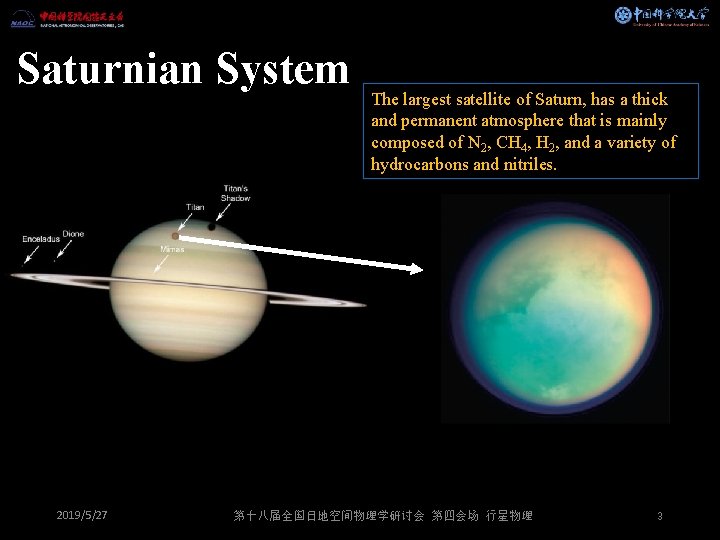
Saturnian System 2019/5/27 The largest satellite of Saturn, has a thick and permanent atmosphere that is mainly composed of N 2, CH 4, H 2, and a variety of hydrocarbons and nitriles. 第十八届全国日地空间物理学研讨会 第四会场 行星物理 3
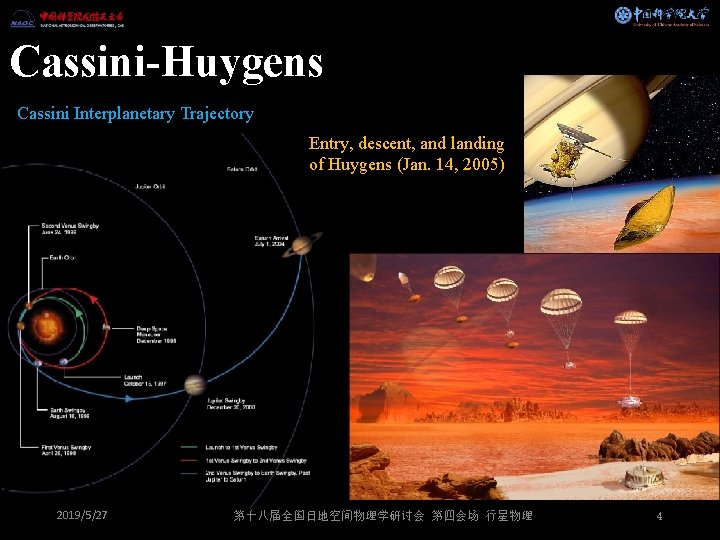
Cassini-Huygens Cassini Interplanetary Trajectory Entry, descent, and landing of Huygens (Jan. 14, 2005) 2019/5/27 第十八届全国日地空间物理学研讨会 第四会场 行星物理 4
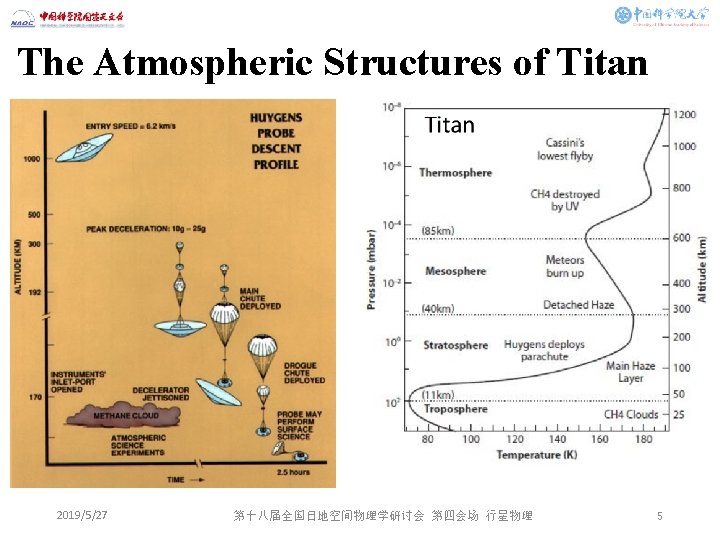
The Atmospheric Structures of Titan 2019/5/27 第十八届全国日地空间物理学研讨会 第四会场 行星物理 5
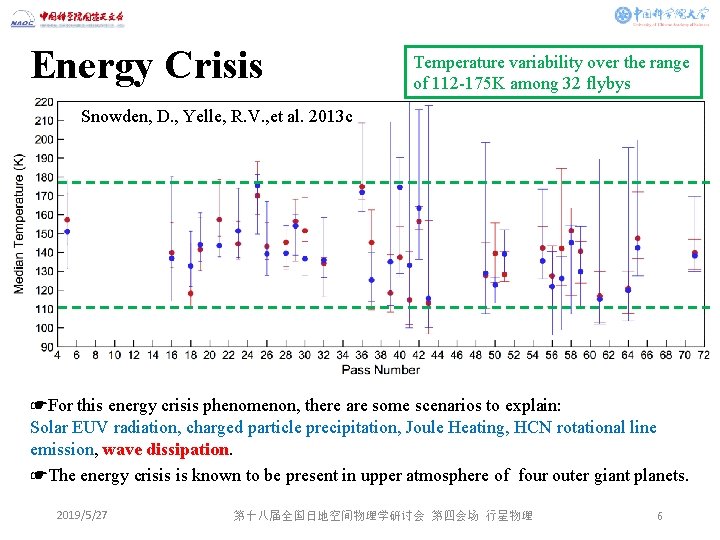
Energy Crisis Temperature variability over the range of 112 -175 K among 32 flybys Snowden, D. , Yelle, R. V. , et al. 2013 c ☛For this energy crisis phenomenon, there are some scenarios to explain: Solar EUV radiation, charged particle precipitation, Joule Heating, HCN rotational line emission, wave dissipation. ☛The energy crisis is known to be present in upper atmosphere of four outer giant planets. 2019/5/27 第十八届全国日地空间物理学研讨会 第四会场 行星物理 6
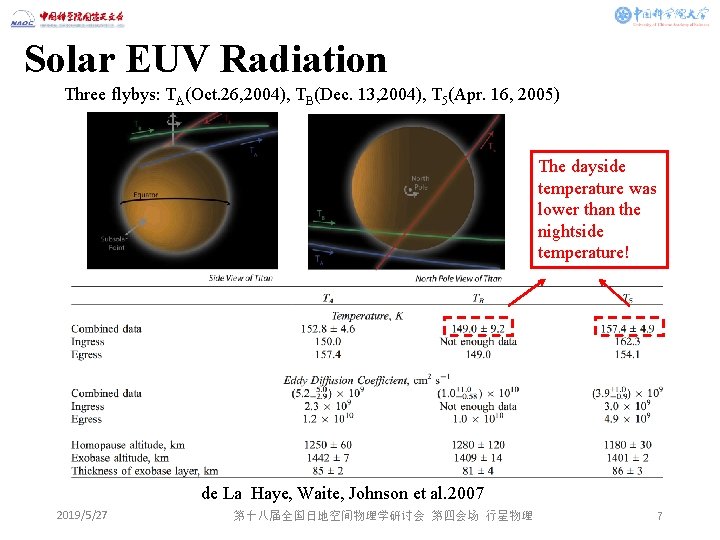
Solar EUV Radiation Three flybys: TA(Oct. 26, 2004), TB(Dec. 13, 2004), T 5(Apr. 16, 2005) The dayside temperature was lower than the nightside temperature! de La Haye, Waite, Johnson et al. 2007 2019/5/27 第十八届全国日地空间物理学研讨会 第四会场 行星物理 7
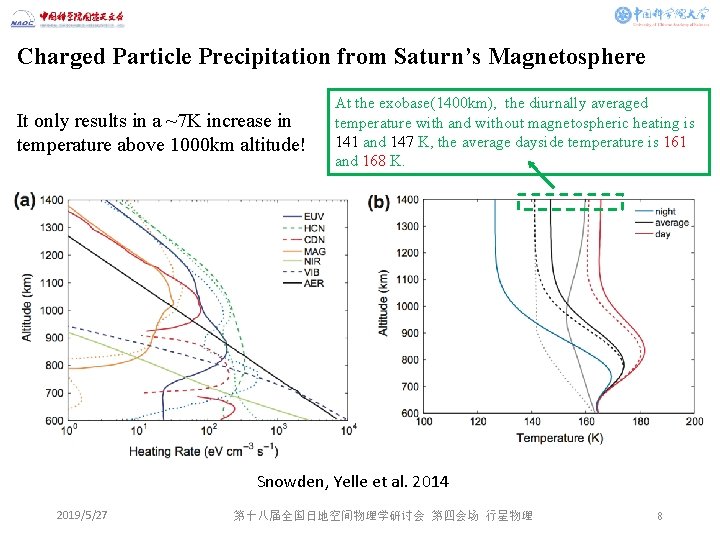
Charged Particle Precipitation from Saturn’s Magnetosphere It only results in a ~7 K increase in temperature above 1000 km altitude! At the exobase(1400 km), the diurnally averaged temperature with and without magnetospheric heating is 141 and 147 K, the average dayside temperature is 161 and 168 K. Snowden, Yelle et al. 2014 2019/5/27 第十八届全国日地空间物理学研讨会 第四会场 行星物理 8
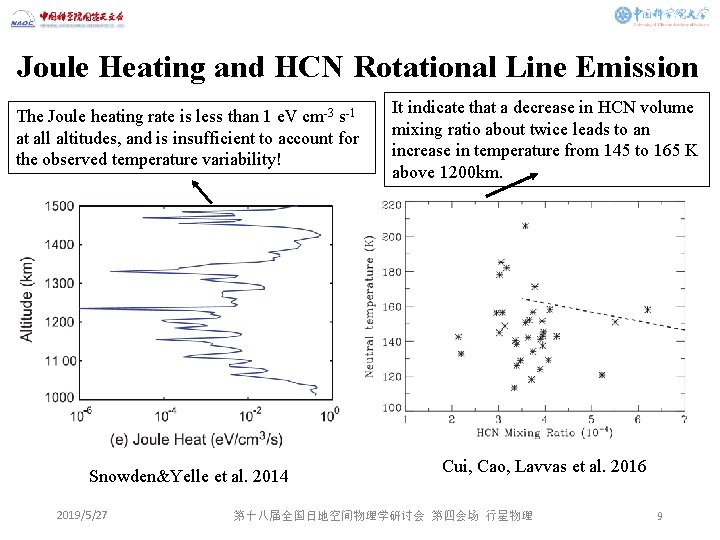
Joule Heating and HCN Rotational Line Emission The Joule heating rate is less than 1 e. V cm-3 s-1 at all altitudes, and is insufficient to account for the observed temperature variability! Snowden&Yelle et al. 2014 2019/5/27 It indicate that a decrease in HCN volume mixing ratio about twice leads to an increase in temperature from 145 to 165 K above 1200 km. Cui, Cao, Lavvas et al. 2016 第十八届全国日地空间物理学研讨会 第四会场 行星物理 9

Wave Dissipation Wave structures were revealed by the Huygens Atmosphere Structure Instrument (HASI) data; Fulchignoni et al. 2005 2019/5/27 Typical density perturbations of 10% in the upper atmosphere were inferred from the INMS measurements of N 2 and CH 4; Muller-Wodarg et al. 2006 第十八届全国日地空间物理学研讨会 第四会场 行星物理 10
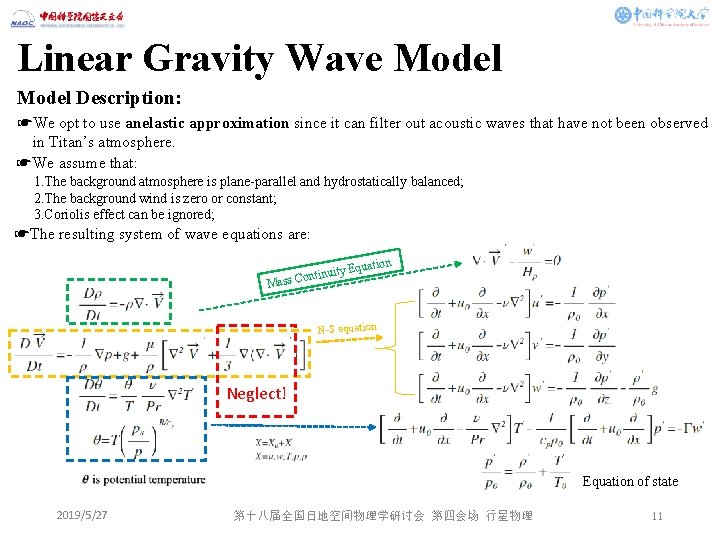
Linear Gravity Wave Model Description: ☛We opt to use anelastic approximation since it can filter out acoustic waves that have not been observed in Titan’s atmosphere. ☛We assume that: 1. The background atmosphere is plane-parallel and hydrostatically balanced; 2. The background wind is zero or constant; 3. Coriolis effect can be ignored; ☛The resulting system of wave equations are: inuity ss Cont Ma n Equatio N-S equation Neglect! Equation of state 2019/5/27 第十八届全国日地空间物理学研讨会 第四会场 行星物理 11
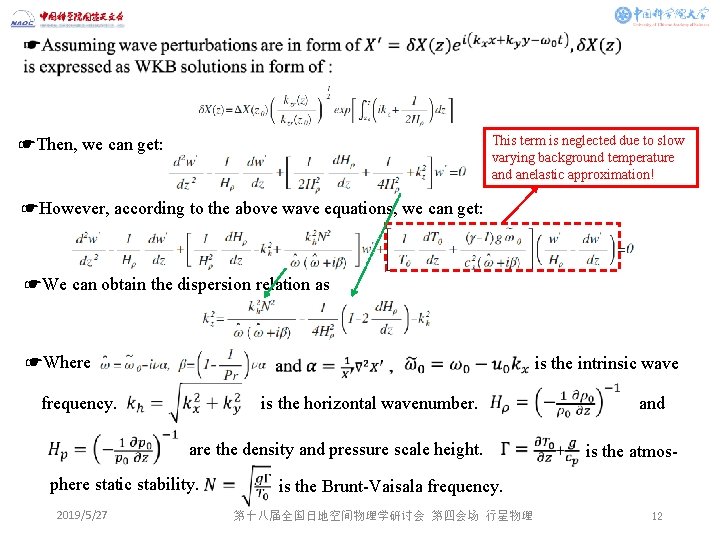
This term is neglected due to slow varying background temperature and anelastic approximation! ☛Then, we can get: ☛However, according to the above wave equations, we can get: ☛We can obtain the dispersion relation as ☛Where is the intrinsic wave frequency. is the horizontal wavenumber. are the density and pressure scale height. phere static stability. 2019/5/27 and is the atmos- is the Brunt-Vaisala frequency. 第十八届全国日地空间物理学研讨会 第四会场 行星物理 12
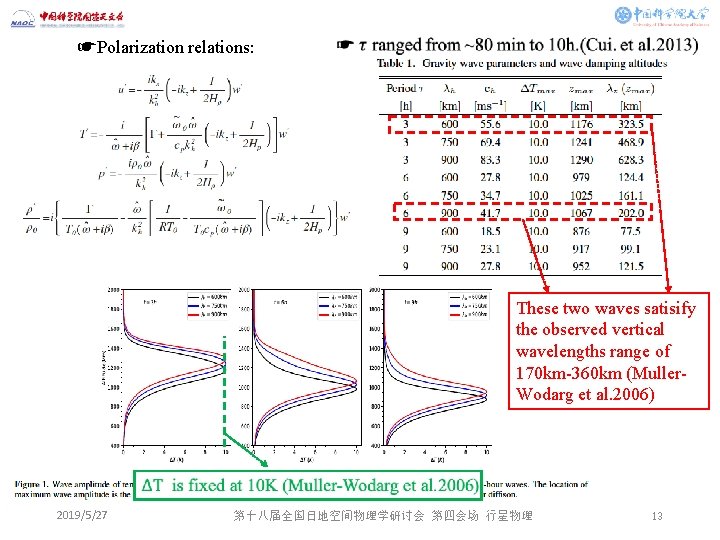
☛Polarization relations: These two waves satisify the observed vertical wavelengths range of 170 km-360 km (Muller. Wodarg et al. 2006) 2019/5/27 第十八届全国日地空间物理学研讨会 第四会场 行星物理 13
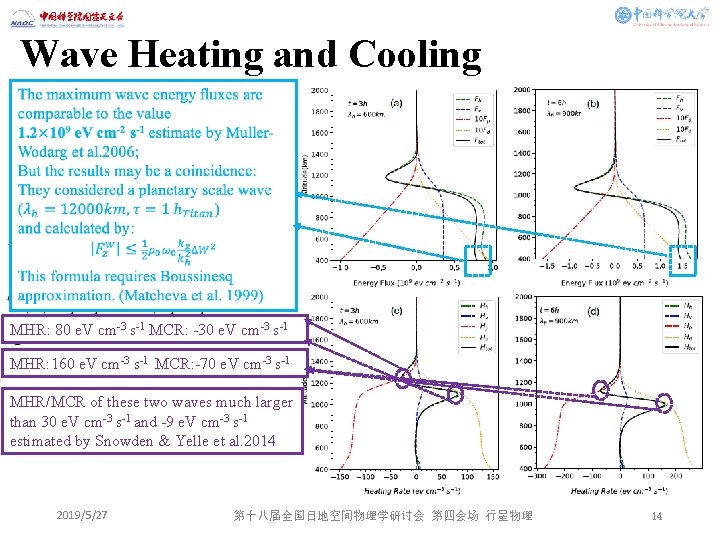
Wave Heating and Cooling ☛The total wave heating / cooling rates (Hickey et al. 2000 and Schubert et al. 2003): is the sensible heat flux; is the energy flux associated with viscous dissipation; is the work done per unit time by the wave-induced pressure -3 s-1 MCR: -30 e. V cm-3 s-1 MHR: 80 e. V cm gradients; MHR: 160 e. V cm-3 iss-1 the MCR: -70 e. Vper cm-3 s-1 work done unit time by of thethese wave-induced MHR/MCR two waves. Eulerian much larger drift. than 30 e. V cm-3 s-1 and -9 e. V cm-3 s-1 estimated by Snowden & Yelle et al. 2014 2019/5/27 第十八届全国日地空间物理学研讨会 第四会场 行星物理 14
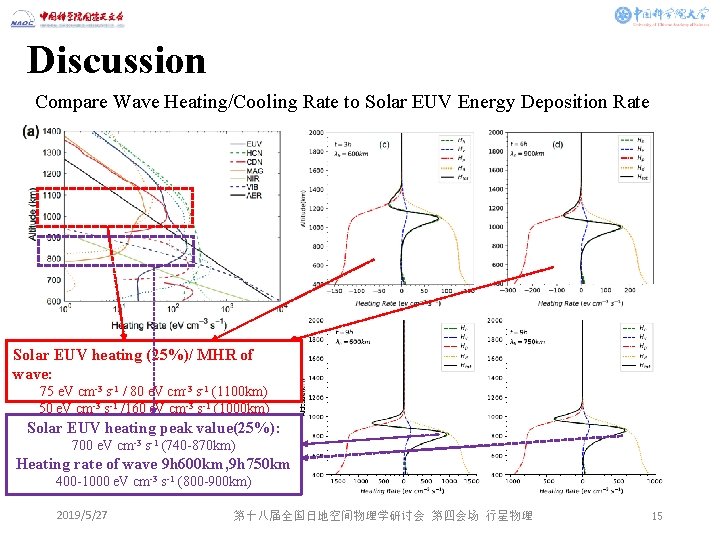
Discussion Compare Wave Heating/Cooling Rate to Solar EUV Energy Deposition Rate Solar EUV heating (25%)/ MHR of wave: 75 e. V cm-3 s-1 / 80 e. V cm-3 s-1 (1100 km) 50 e. V cm-3 s-1 /160 e. V cm-3 s-1 (1000 km) Solar EUV heating peak value(25%): 700 e. V cm-3 s-1 (740 -870 km) Heating rate of wave 9 h 600 km, 9 h 750 km 400 -1000 e. V cm-3 s-1 (800 -900 km) 2019/5/27 第十八届全国日地空间物理学研讨会 第四会场 行星物理 15
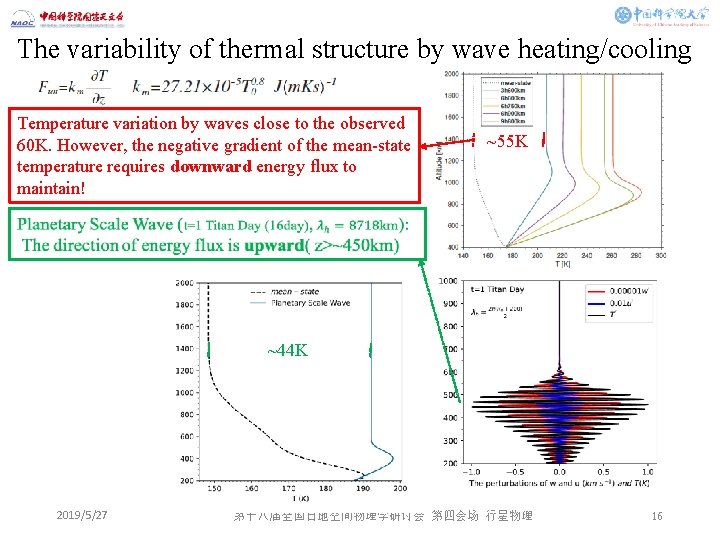
The variability of thermal structure by wave heating/cooling Temperature variation by waves close to the observed 60 K. However, the negative gradient of the mean-state temperature requires downward energy flux to maintain! ~55 K ~44 K 2019/5/27 第十八届全国日地空间物理学研讨会 第四会场 行星物理 16
Conclusions ☛ Solar EUV radiation, charged particle precipitation, Joule Heating, HCN rotational line emission, none of them contributes to the observed temperature variability; (~60 K) ☛ Our calculations of GW’s max heating rate larger than solar EUV heating; ☛ Temperature variation by GW close to the observed 60 K, but the directions of energy fluxes are opposite to the gradient of the mean-state temperature; ☛ The Planetary Scale Wave may be conform to it, this needs further research. 2019/5/27 第十八届全国日地空间物理学研讨会 第四会场 行星物理 17
References 1. Coustenis, A. , Achterberg, R. K. , Conrath, B. J. , et al. 2007, Icarus, 189, 35 2. Cui, J. , Yelle, R. V. , Mu ller-Wodarg, I. C. F. , Lavvas, P. P. , & Galand, M. 2011, Journal of Geophysical Research (Space Physics), 116, A 11324 3. Cui, J. , Lian, Y. , & Mu ller-Wodarg, I. C. F. 2013, Geophys. Res. Lett. , 40, 43 4. Cui, J. , Yelle, R. V. , Li, T. , Snowden, D. S. & Mu ller-Wodarg, I. C. F. 2013, EPSC, 593 5. Cui, J. , Yelle, R. V. , Li, T. , Snowden, D. S. , & Mu ller-Wodarg, I. C. F. 2014, JGR 119, 490 6. Cui, J. , Cao, Y. -T. , Lavvas, P. P. , & Koskinen, T. T. 2016, Ap. JL, 826, L 5 7. de La Haye, V. , Waite, J. H. , Johnson, R. E. , et al. 2007, JGR 112, A 07309 8. de La Haye, V. , Waite, J. H. , Cravens, T. E. , et al. 2008, JGR 113, A 11314 9. Del Genio, A. D. , Straus, J. M. , & Schubert, G. 1978, GRL. , 5, 265 -267. 10. Einaudi, F. , & Hines, C. O. 1970, Canadian Journal of Physics, 48, 1458 -1471 11. Fels, S. B. 1982, Journal of the Atmospheric Sciences, 39, 1141 -1152 12. French, R. G. , & Gierasch, P. J. 1974, Journal of Atmospheric Sciences, 31, 1707 13. Fritts, D. C. , Wang, L. , & Tolson, R. H. 2006, JGR, 111, A 12304 14. Fulchignoni, M. , Ferri, F. , Angrilli, F. , et al. 2005, Nature, 438, 785 15. Harris, I. , & Priester, W. 1965, Journal of the Atmospheric Sciences, 22, no. 1, 3 -10 16. Hines, C. O. 1974, Geophysical Monograph Series, 18, AGU 17. Hinson, D. P. , & Jenkins, J. M. 1995, Icarus, 114, 310 18. Holton, J. R. , & Zhu, X. 1984, Journal of the Atmospheric Sciences, 41, 2653 -2662 19. Koskinen, T. T. , Yelle, R. V. , Snowden, D. S. , et al. 2011, Icarus, 216, 507 20. Hickey, M. P. , Walterscheid, R. L. , & Schubert, G. 2000, Icarus, 148, 266 21. Hickey, M. p. , Walterscheid, R. L. , & Schubert, G. 2011, JGR, 116, A 12326 22. Lian, Y. , & Yelle, R. V. 2019, Icarus, 329, 222 -245 23. Lindzen, R. S. 1981, Journal of Geophysical Research, 86, 9707 -9714 2019/5/27 第十八届全国日地空间物理学研讨会 第四会场 行星物理 18
References 24. Matcheva, K. I. , & Strobel, D. F. 1999, Icarus, 140, 328 25. Mu ller-Wodarg, I. C. F. , Yelle, R. V. , Borggren, N. , & Waite, J. H. 2006, JGR. 111, A 12315 26. Mu ller-Wodarg, I. C. F. , Yelle, R. V. , Cui, J. , & Waite, J. H. 2008, JGR, 113, E 10005 27. Newman, C. E. , Lee, C. , Lian, Y. , Richardson, M. I. , & Toigo, A. D. 2011, Icarus, 213, 636 -654 28. Parish, H. F. , Schubert, G. , Hickey, M. P. , & Walterscheid, R. L. 2009, Icarus, 203, 28 29. Schubert, G. , Hickey, M. P. , Walterscheid, R. L. 2003, Icarus, 163, 398 -413 30. Snowden, D. , Yelle, R. V. , Cui, J. , et al. 2013, Icarus, 226, 552 31. Snowden, D. , & Yelle, R. V. 2014, Icarus, 228, 64 32. Strobel, D. F. 2006, Icarus, 182, 251 33. Vadas, S. L. , & Fritts, D. C. 2005, Journal of Geophysical Research, 110, D 15103 34. Waite, J. H. , Niemann, H. , Yelle, R. V. , et al. 2005, Science, 308, 982 35. Waite, J. H. , Young, D. T. , Cravens, T. E. , et al. 2007, Science, 316, 870 36. Walterscheid, R. L. 1981, Geophys. Res. Lett. , 8, 1235 37. Westlake, J. H. , Bell, J. M. , Waite, J. H. , Jr. , et al. 2011, JGR, 116, A 03318 38. Woods, T. N. 2005, Journal of Geophysical Research, 116, A 03318 39. Yelle, R. V. 1991, Ap. J, 383, 380 40. Young, L. A. , Yelle, R. V. , Young, R. , Seiff, A. , & Kirk, D. B. 1997, Science, 276, 108 2019/5/27 第十八届全国日地空间物理学研讨会 第四会场 行星物理 19

Thanks for Your Listening! You can download this documentation by scanning the QR code: 2019/5/27 第十八届全国日地空间物理学研讨会 第四会场 行星物理 20
- Slides: 20