
TEMPERATURE TEMPERATURE is a measure of the average


- Slides: 16
TEMPERATURE
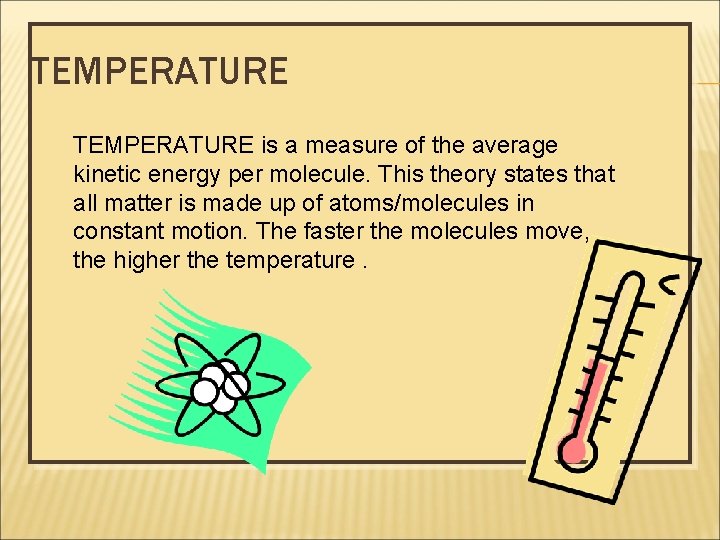
TEMPERATURE is a measure of the average kinetic energy per molecule. This theory states that all matter is made up of atoms/molecules in constant motion. The faster the molecules move, the higher the temperature.
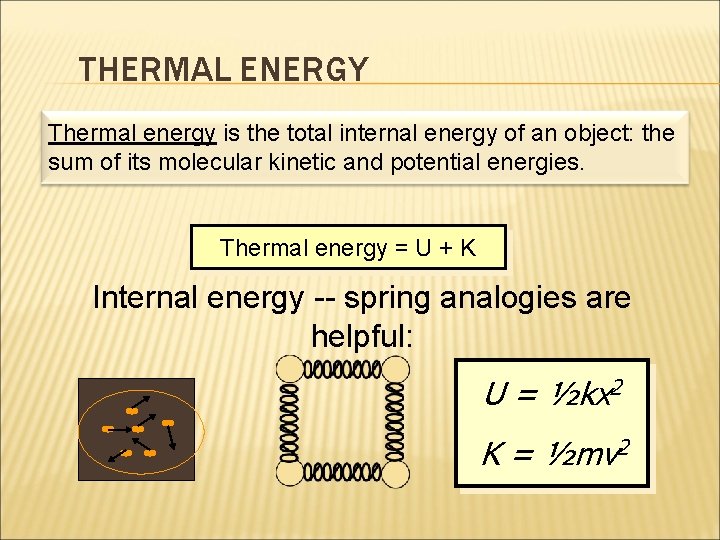
THERMAL ENERGY Thermal energy is the total internal energy of an object: the sum of its molecular kinetic and potential energies. Thermal energy = U + K Internal energy -- spring analogies are helpful: U = ½kx 2 K = ½mv 2
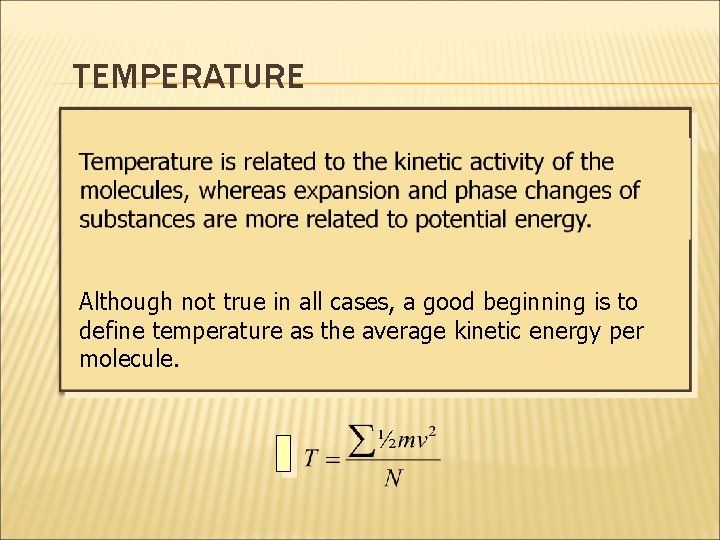
TEMPERATURE Although not true in all cases, a good beginning is to define temperature as the average kinetic energy per molecule.
TEMPERATURE When the temperature of an object increases, the particles that compose the object begin to move faster. They either vibrate more rapidly, rotate with greater frequency or move through space with a greater speed. Increasing the temperature causes an increase in the particle speed.
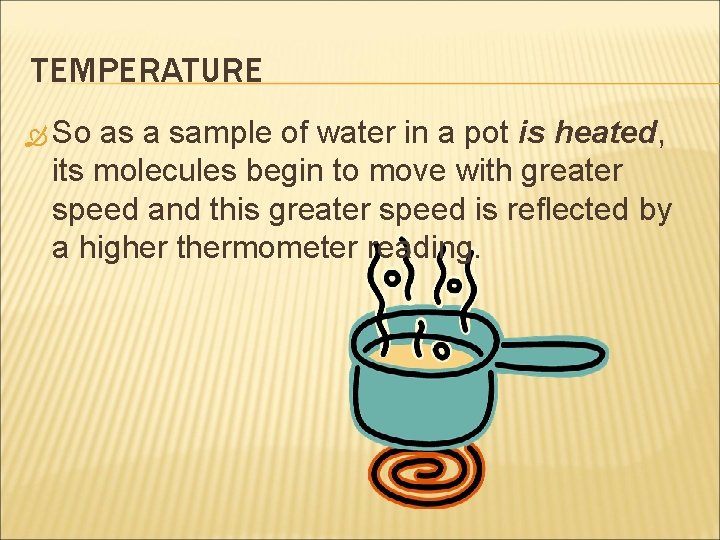
TEMPERATURE So as a sample of water in a pot is heated, its molecules begin to move with greater speed and this greater speed is reflected by a higher thermometer reading.
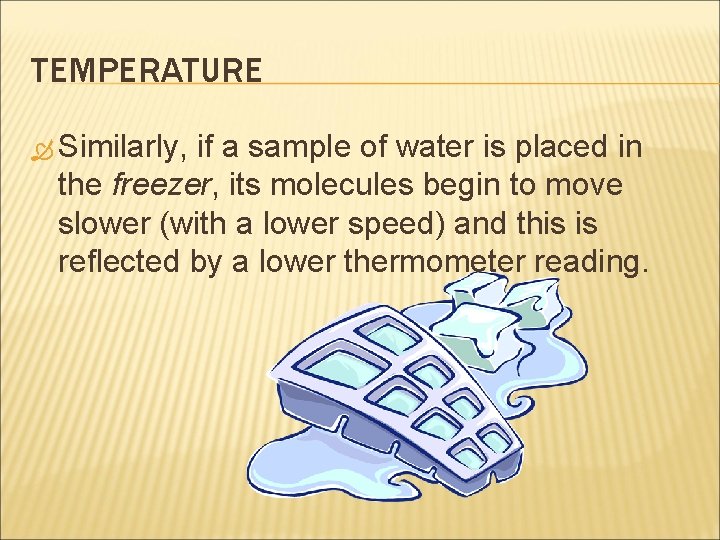
TEMPERATURE Similarly, if a sample of water is placed in the freezer, its molecules begin to move slower (with a lower speed) and this is reflected by a lower thermometer reading.
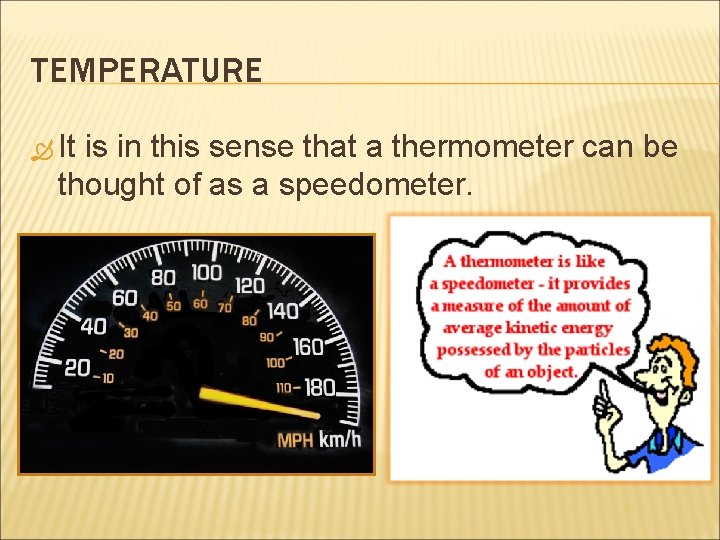
TEMPERATURE It is in this sense that a thermometer can be thought of as a speedometer.
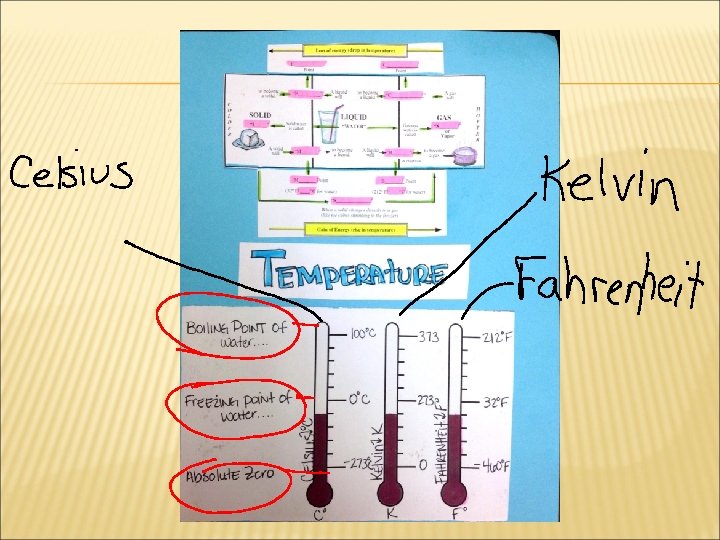
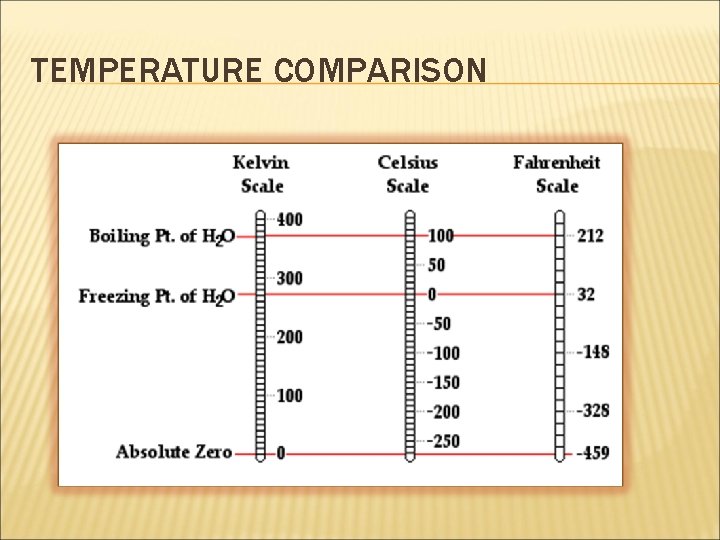
TEMPERATURE CONVERSION Fahrenheit to Celsius C = (F – 32 )/1. 8 Celsius to Fahrenheit F = 1. 8 C + 32 Celsius to Kelvin K = C + 273
TEMPERATURE CONVERSION (CONT) Example 1: What is the temperature in Fahrenheit if an object has a temperature of 135⁰C? Using F = 1. 8 C + 32 F = 1. 8(135) + 32 F = 243 + 32 F = 275⁰F
TEMPERATURE COMPARISON
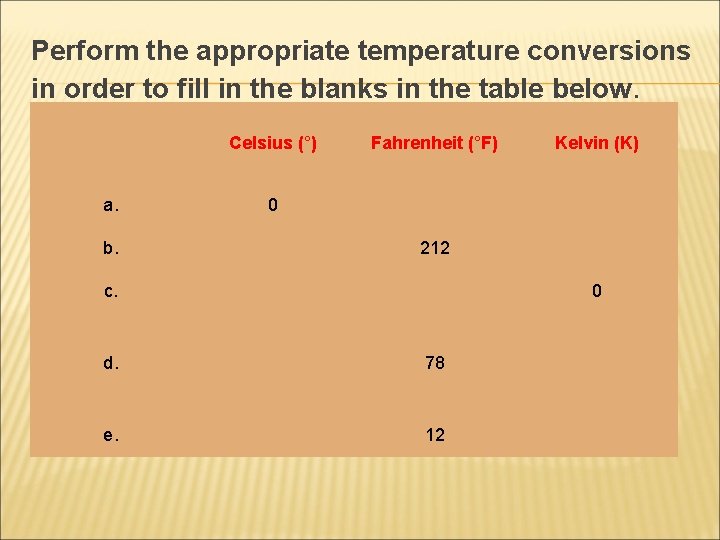
Perform the appropriate temperature conversions in order to fill in the blanks in the table below. Celsius (°) a. 0 Fahrenheit (°F) Kelvin (K) b. 212 c. d. 78 e. 12 0
TO BE CONT……….