
Temperature How hot or cold something is n
- Slides: 11
Temperature How hot or cold something is. n What make something hot? n Particles that me up matter are in constant motion n They have kinetic energy n When you heat something the particles move faster n Temperature measures average KE n
Temperature Measured with thermometers n Most materials expand when heated. n That is how most thermometers work n Liquid thermometers have a large bulb hooked to a narrow tube. n When the liquid expands it rises up the tube. n Won’t work if too hot or cold n
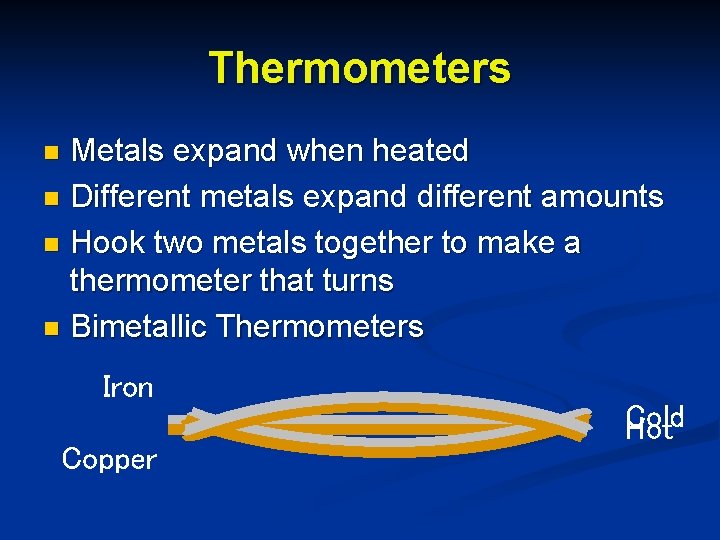
Thermometers Metals expand when heated n Different metals expand different amounts n Hook two metals together to make a thermometer that turns n Bimetallic Thermometers n Iron Copper Cold Hot
Thermometers Bimetallic thermometers are used in thermostats n Digital thermometers use the fact that electricity conducts differently at different temperatures. n
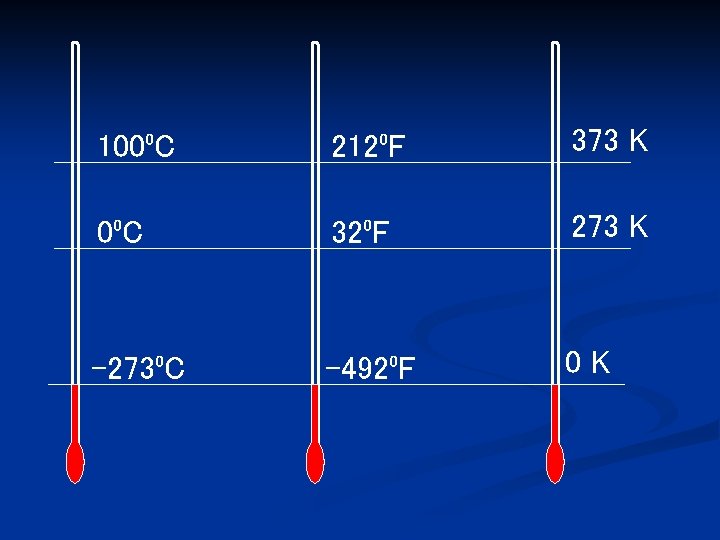
Temperature As the temperature get lower the molecules move slower n Kinetic energy goes down n Lowest possible temperature would be when molecules stop moving n Absolute zero n
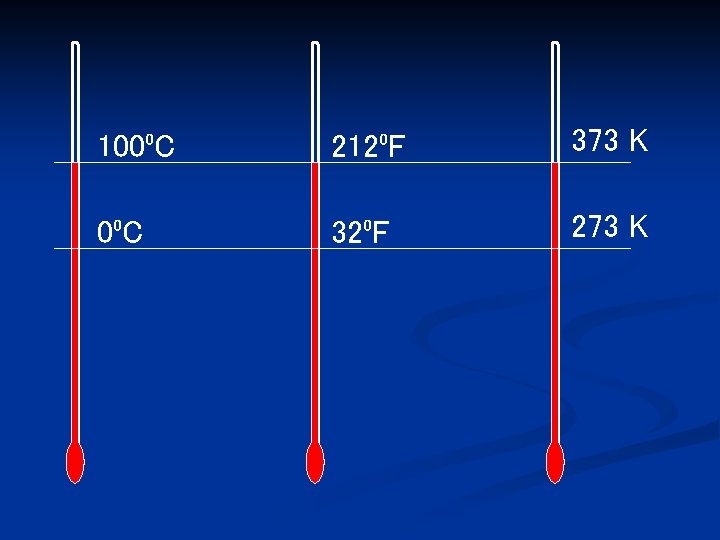
Temperature Scales Three different ones get used n Fahrenheit- the one we use n Celsius- metric standard n Kelvin- starts at absolute zero but same degree size as Celsius n
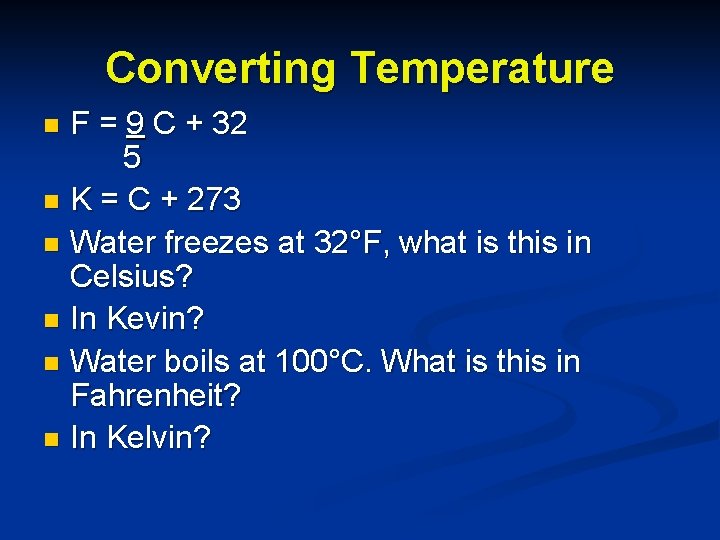
Converting Temperature F = 9 C + 32 5 n K = C + 273 n Water freezes at 32°F, what is this in Celsius? n In Kevin? n Water boils at 100°C. What is this in Fahrenheit? n In Kelvin? n
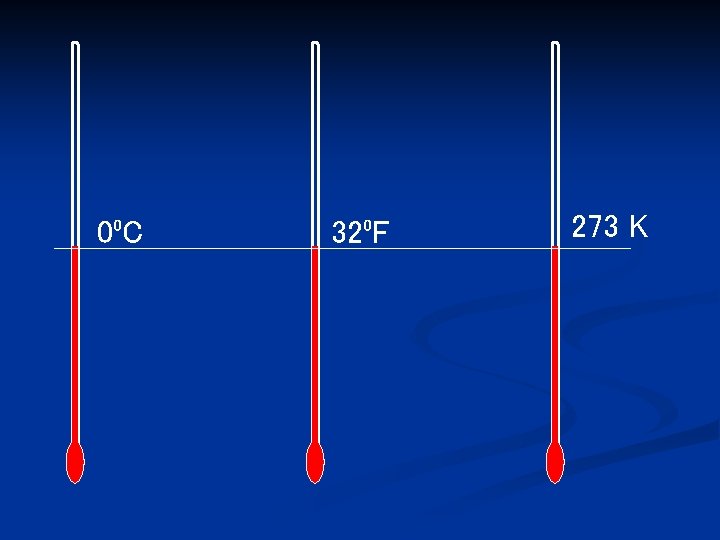
0⁰C 32⁰F 273 K
100⁰C 212⁰F 373 K 0⁰C 32⁰F 273 K
100⁰C 212⁰F 373 K 0⁰C 32⁰F 273 K -273⁰C -492⁰F 0 K
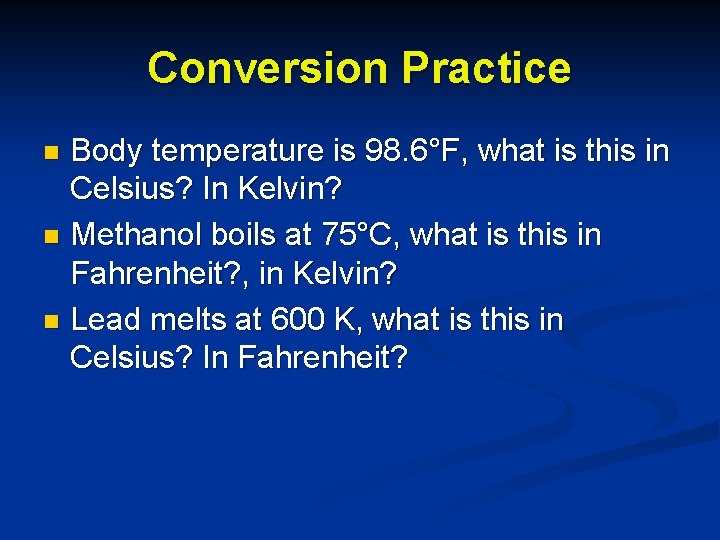
Conversion Practice Body temperature is 98. 6°F, what is this in Celsius? In Kelvin? n Methanol boils at 75°C, what is this in Fahrenheit? , in Kelvin? n Lead melts at 600 K, what is this in Celsius? In Fahrenheit? n