
Temperature Heat and Expansion Chapter 21 Remember back
Temperature, Heat, and Expansion Chapter 21
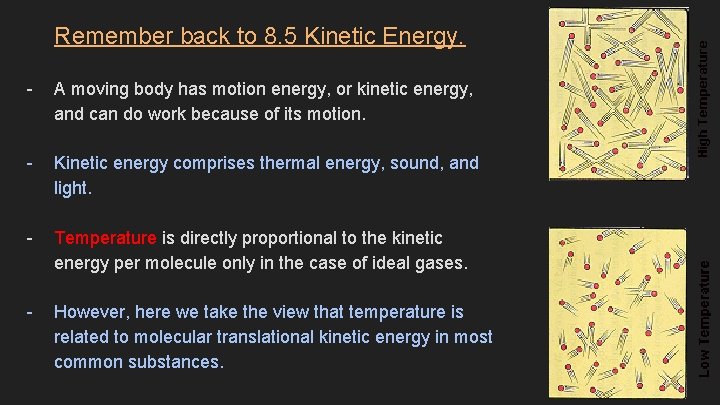
Remember back to 8. 5 Kinetic Energy. - A moving body has motion energy, or kinetic energy, and can do work because of its motion. - Kinetic energy comprises thermal energy, sound, and light. - Temperature is directly proportional to the kinetic energy per molecule only in the case of ideal gases. - However, here we take the view that temperature is related to molecular translational kinetic energy in most common substances.
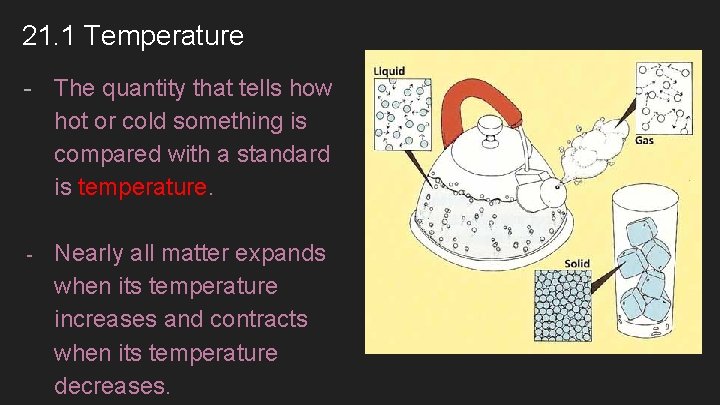
21. 1 Temperature - The quantity that tells how hot or cold something is compared with a standard is temperature. - Nearly all matter expands when its temperature increases and contracts when its temperature decreases.
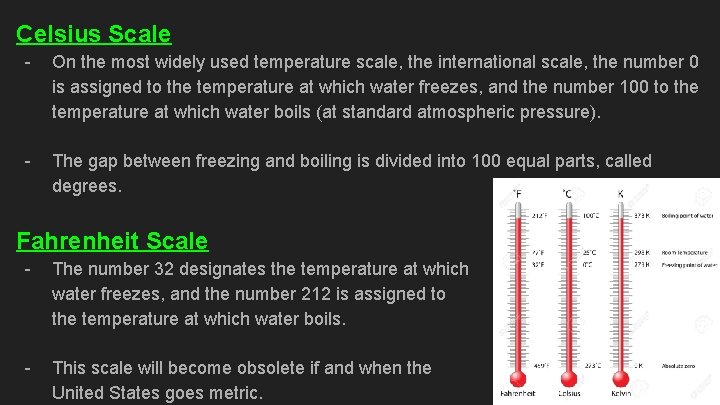
Celsius Scale - On the most widely used temperature scale, the international scale, the number 0 is assigned to the temperature at which water freezes, and the number 100 to the temperature at which water boils (at standard atmospheric pressure). - The gap between freezing and boiling is divided into 100 equal parts, called degrees. Fahrenheit Scale - The number 32 designates the temperature at which water freezes, and the number 212 is assigned to the temperature at which water boils. - This scale will become obsolete if and when the United States goes metric.
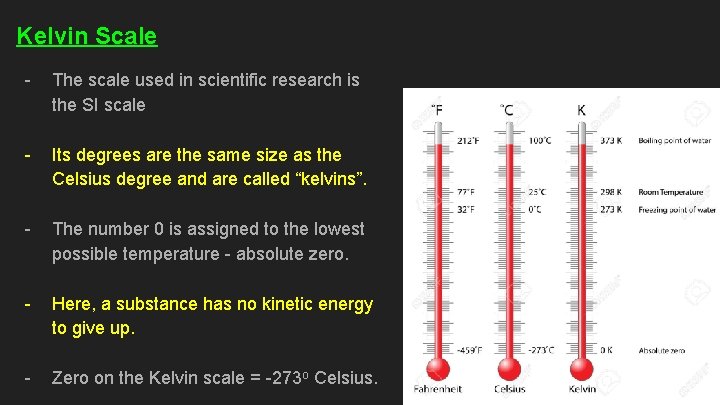
Kelvin Scale - The scale used in scientific research is the SI scale - Its degrees are the same size as the Celsius degree and are called “kelvins”. - The number 0 is assigned to the lowest possible temperature - absolute zero. - Here, a substance has no kinetic energy to give up. - Zero on the Kelvin scale = -273 o Celsius.
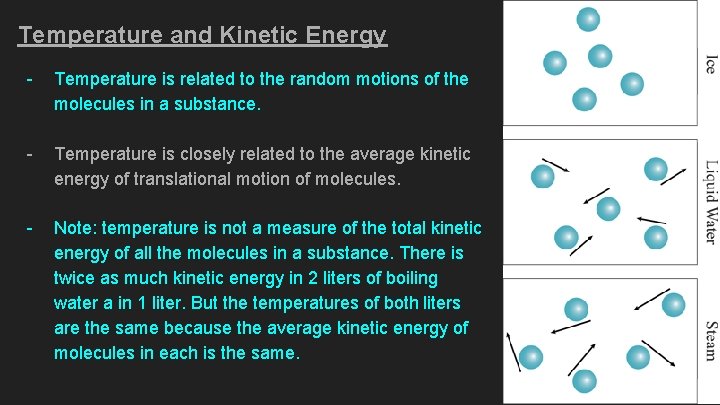
Temperature and Kinetic Energy - Temperature is related to the random motions of the molecules in a substance. - Temperature is closely related to the average kinetic energy of translational motion of molecules. - Note: temperature is not a measure of the total kinetic energy of all the molecules in a substance. There is twice as much kinetic energy in 2 liters of boiling water a in 1 liter. But the temperatures of both liters are the same because the average kinetic energy of molecules in each is the same.
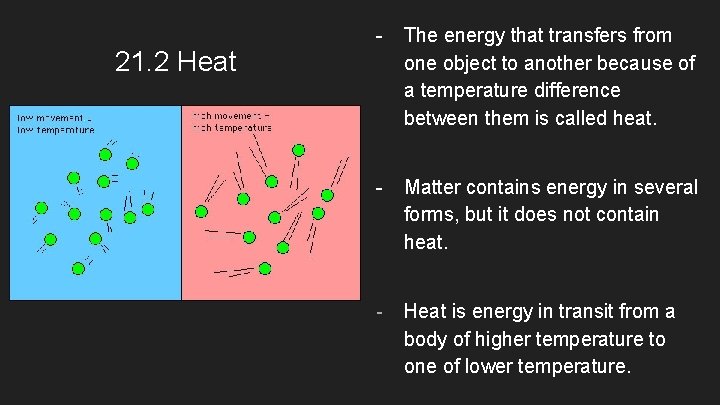
21. 2 Heat - The energy that transfers from one object to another because of a temperature difference between them is called heat. - Matter contains energy in several forms, but it does not contain heat. - Heat is energy in transit from a body of higher temperature to one of lower temperature.
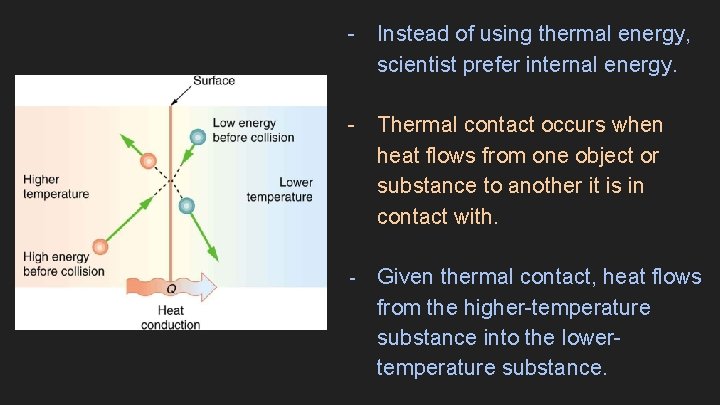
- Instead of using thermal energy, scientist prefer internal energy. - Thermal contact occurs when heat flows from one object or substance to another it is in contact with. - Given thermal contact, heat flows from the higher-temperature substance into the lowertemperature substance.
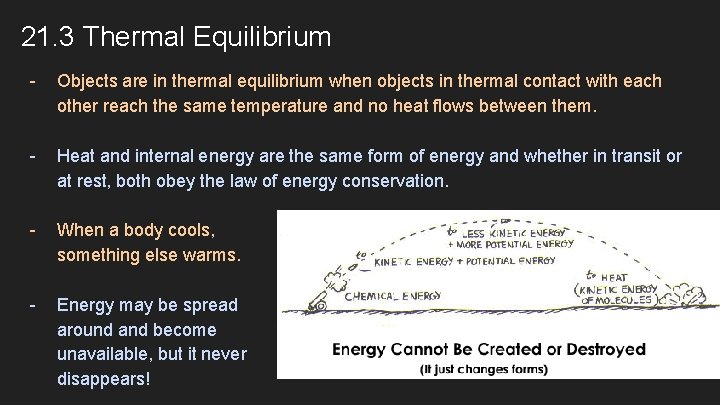
21. 3 Thermal Equilibrium - Objects are in thermal equilibrium when objects in thermal contact with each other reach the same temperature and no heat flows between them. - Heat and internal energy are the same form of energy and whether in transit or at rest, both obey the law of energy conservation. - When a body cools, something else warms. - Energy may be spread around and become unavailable, but it never disappears!
Check Questions 1. You heat a half-cup of tea and its temperature rises by 4 o. C. How much will the temperature rise if you add the same amount of heat to a full cup of tea? 2. Where does the internal energy go when a cup of hot tea cools?
Check Questions 1. 2 o C 1. It goes into warming the surroundings. Soon the tea will be cooler and the surroundings warmer. They will achieve thermal equilibrium at a common intermediate temperature.
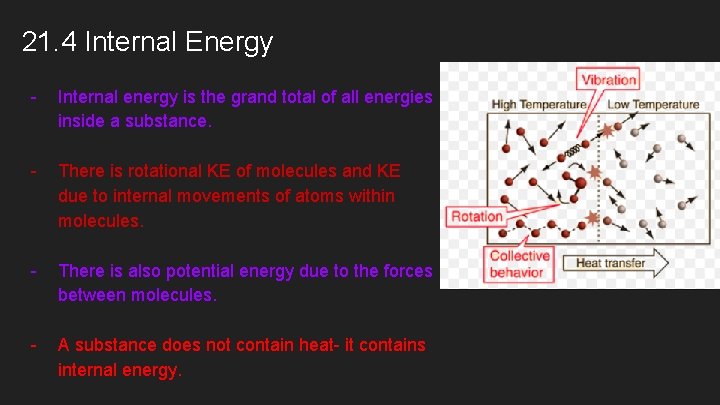
21. 4 Internal Energy - Internal energy is the grand total of all energies inside a substance. - There is rotational KE of molecules and KE due to internal movements of atoms within molecules. - There is also potential energy due to the forces between molecules. - A substance does not contain heat- it contains internal energy.
21. 5 Measurement of Heat - The unit of heat is defined as the heat necessary to produce some standard, agreed-on temperature change for a specified mass of material. - The most commonly used unit of heat is the calorie - defined as the amount of heat required to raise the temperature of 1 gram of water by 1 o. C. - The kilocalorie is 1000 calories = the heat required to raise the temperature of 1 kilogram of water by 1 o. C. - The US is in a period of transition to the SI system, where a quantity of heat is measured in joules, the SI unit for all forms of energy. - The relationship between calories and joules is that 1 calories = 4. 184 J.
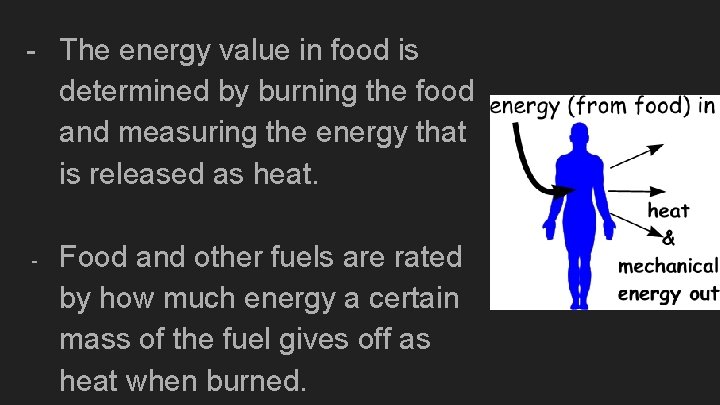
- The energy value in food is determined by burning the food and measuring the energy that is released as heat. - Food and other fuels are rated by how much energy a certain mass of the fuel gives off as heat when burned.
21. 6 Specific Heat Capacity - Specific heat capacity, or specific heat, is the quantity of heat required to raise the temperature of a unit mass of a substance by one degree Celsius. - Consider the difference between touching an empty iron frying pan that has been placed on a hot stove for one minute and doing the same water in it. - The empty pan has the higher temperature. You could safely place your hand in the water even if it were on the stove for several minutes. The water absorbs more energy for less rise in temperature. - Which has a higher specific heat capacity - water or sand?
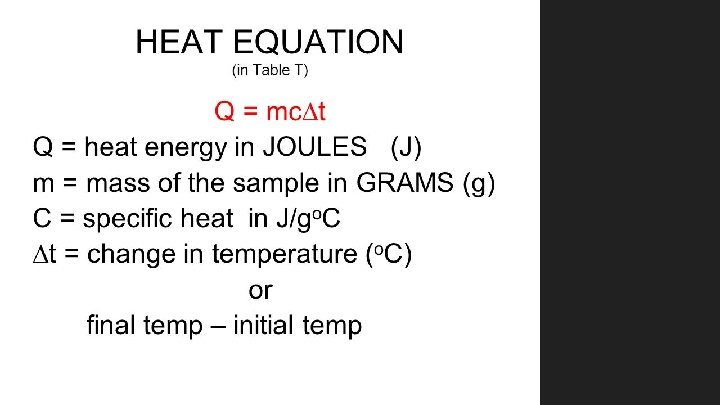
Computational Example: Heating Water When we know the specific heat capacity, c, for a particular substance, the quantity of heat, Q, involved when the mass, m, of the substance undergoes a temperature change, ΔT, is Q = mcΔT. In words, heat transferred = mass x specific heat capacity x temperature change. Suppose we wish to know the number of calories needed to raise the temperature of 1 liter of water by 15 o. C. The specific heat capacity for water, c, is 1 cal/go. C, and the mass of 1 liter of water is 1 kilogram, which is 1000 grams. Since c is expressed in calories per gram o. C, we express the mass of water, m, in grams. Then…
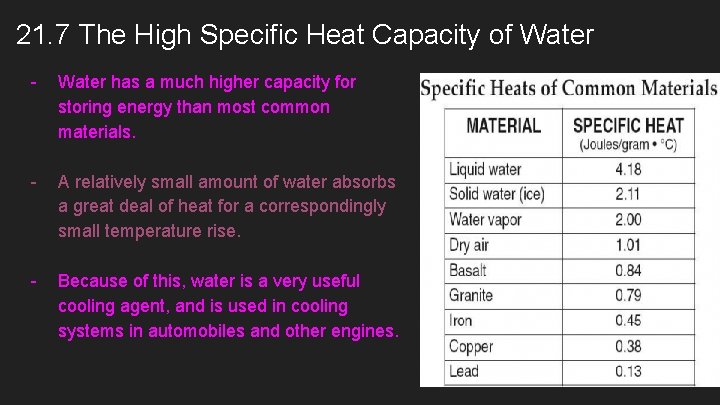
21. 7 The High Specific Heat Capacity of Water - Water has a much higher capacity for storing energy than most common materials. - A relatively small amount of water absorbs a great deal of heat for a correspondingly small temperature rise. - Because of this, water is a very useful cooling agent, and is used in cooling systems in automobiles and other engines.
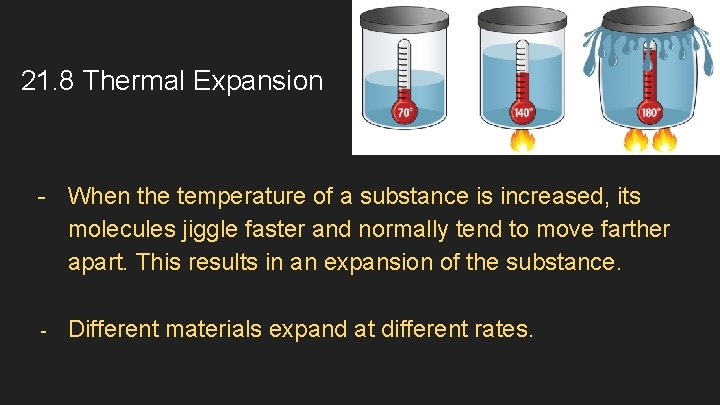
21. 8 Thermal Expansion - When the temperature of a substance is increased, its molecules jiggle faster and normally tend to move farther apart. This results in an expansion of the substance. - Different materials expand at different rates.
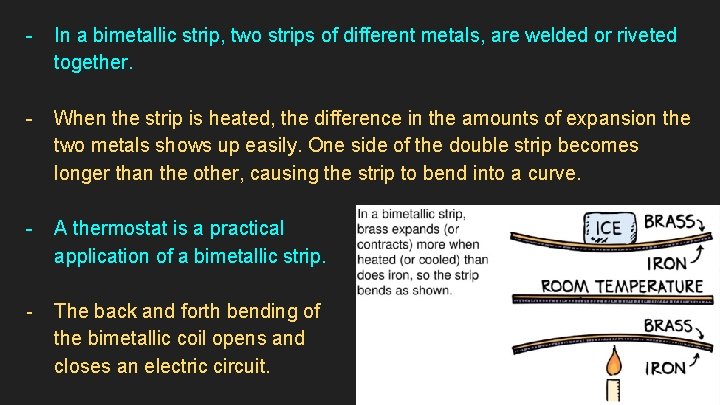
- In a bimetallic strip, two strips of different metals, are welded or riveted together. - When the strip is heated, the difference in the amounts of expansion the two metals shows up easily. One side of the double strip becomes longer than the other, causing the strip to bend into a curve. - A thermostat is a practical application of a bimetallic strip. - The back and forth bending of the bimetallic coil opens and closes an electric circuit.
Check Questions 1. Why is it advisable to allow telephone lines to sag when stringing them between poles in summer? 1. How would the calibration of a thermometer differ if the glass expanded more than the mercury? 1. Why should you not fill your car up with gas to the fullest in the summer?
21. 9 Expansion of Water

Check Questions 1. Will a sample of 4 o. C water expand, contract, or remain unchanged in volume when it is heated? _________ 2. Will a sample of 4 o. C water expand, contract, or remain unchanged in volume when it is cooled? _________ 3. Why would water, instead of alcohol or mercury, be a poor liquid for a thermometer when near-freezing temperatures are to be measured?
Concept Summary 1. Temperature is the measurement that tells how warm or cold something is. a. Temperature is directly proportional to the average translational kinetic energy of the molecules within an ideal gas. 2. Heat is energy that transfers between two thing due to a temperature difference. a. Matter does not contain heat; rather, it contains internal energy. 3. Specific heat is a measure of how much heat is required to raise the temperature of a unit mass of a substance by one degree. a. Water has a much higher specific heat than other common substances.
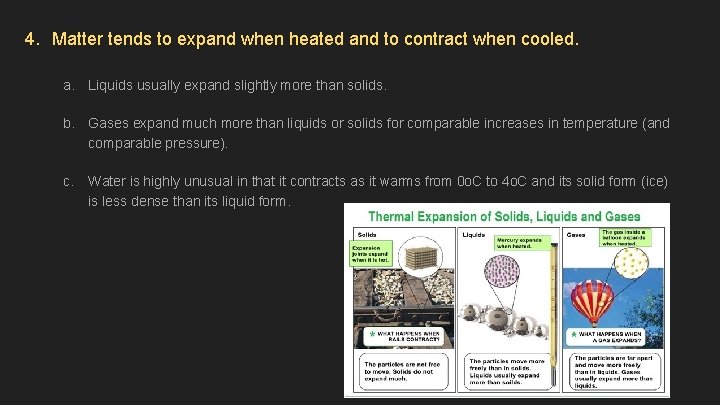
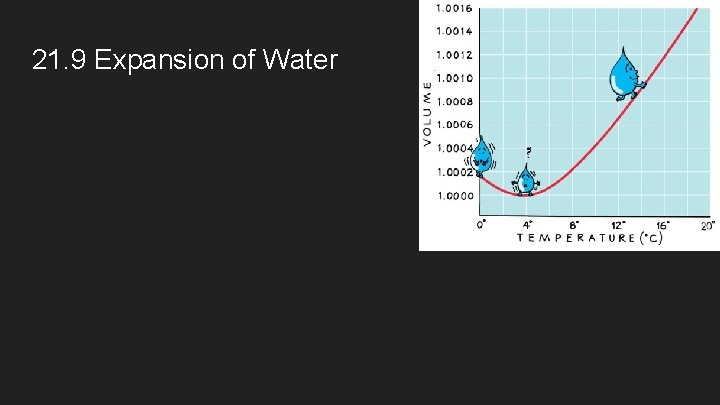
4. Matter tends to expand when heated and to contract when cooled. a. Liquids usually expand slightly more than solids. b. Gases expand much more than liquids or solids for comparable increases in temperature (and comparable pressure). c. Water is highly unusual in that it contracts as it warms from 0 o. C to 4 o. C and its solid form (ice) is less dense than its liquid form.
- Slides: 26