
Temperature Driving Force Concentric Pipe Heat Exchangers CBE
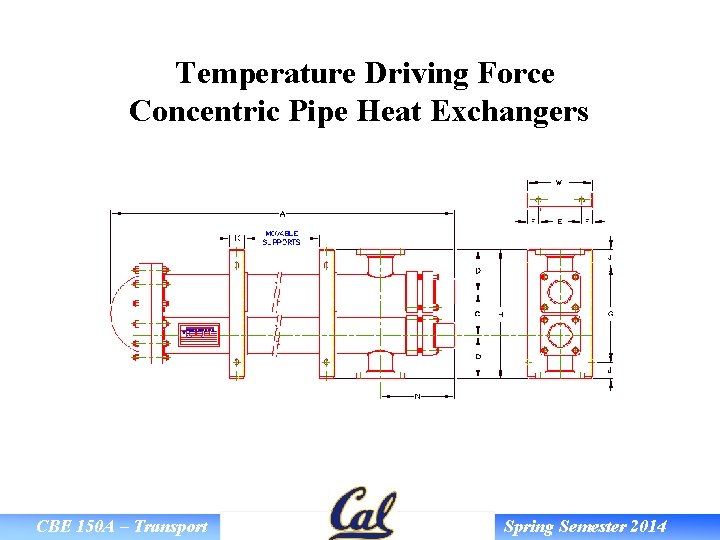
Temperature Driving Force Concentric Pipe Heat Exchangers CBE 150 A – Transport Spring Semester 2014

Concentric Pipe Heat Exchange Goals: By the end of today’s lecture, you should be able to: · Write the heat transfer rate equation and the fluid enthalpy balances for concentric pipe heat exchangers. · Describe the temperature profiles and calculate the true mean ∆T for parallel and countercurrent flow exchangers. · Use the heat transfer rate equation and the fluid enthalpy balances to make design calculations for concentric pipe heat exchangers. CBE 150 A – Transport Spring Semester 2014
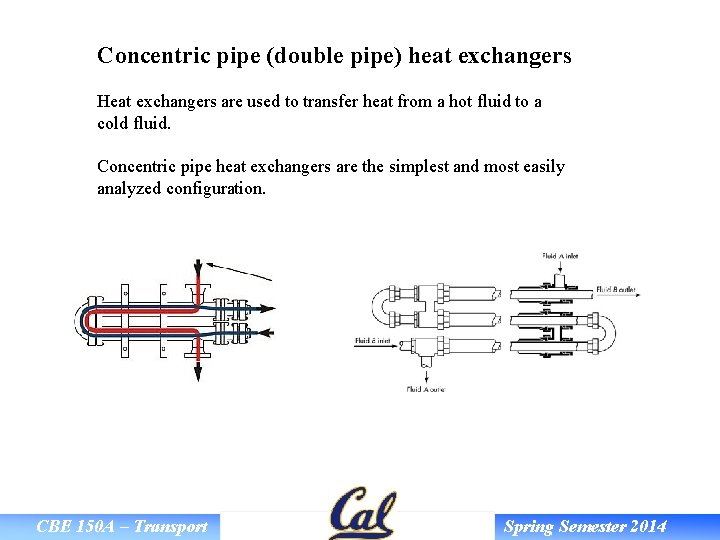
Concentric pipe (double pipe) heat exchangers Heat exchangers are used to transfer heat from a hot fluid to a cold fluid. Concentric pipe heat exchangers are the simplest and most easily analyzed configuration. CBE 150 A – Transport Spring Semester 2014
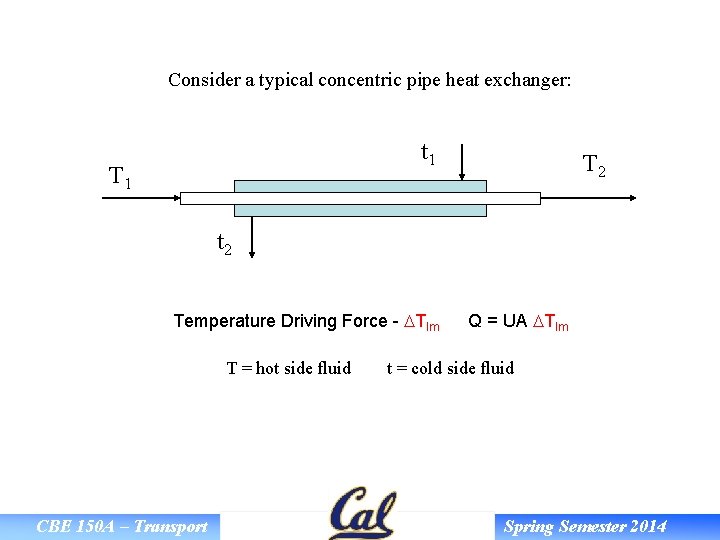
Consider a typical concentric pipe heat exchanger: t 1 T 2 t 2 Temperature Driving Force - DTlm T = hot side fluid CBE 150 A – Transport Q = UA DTlm t = cold side fluid Spring Semester 2014
Temperature driving force derivation Assumptions: (1) (2) (3) (4) Ui is constant (Cp)hot and (Cp)cold are constant heat loss to the surroundings is negligible flow is steady state and parallel The overall heat transfer coefficient (U) does change with temperature, but the change is gradual. Thus, this assumption will hold for moderate temperature ranges. CBE 150 A – Transport Spring Semester 2014
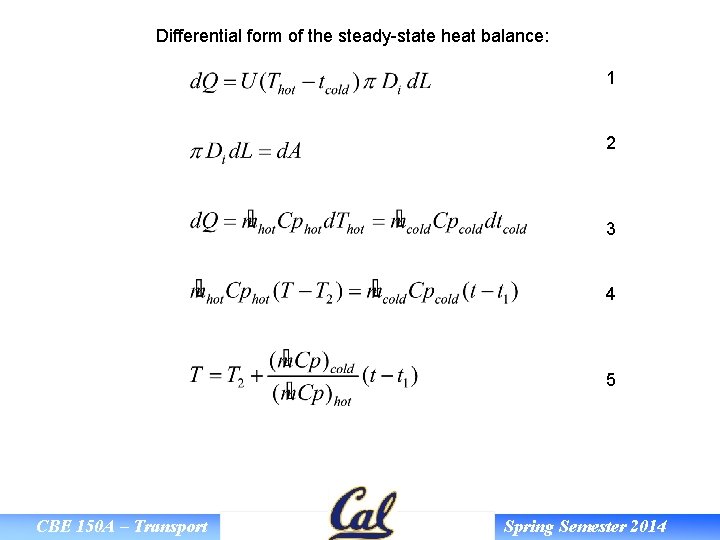
Differential form of the steady-state heat balance: 1 2 3 4 5 CBE 150 A – Transport Spring Semester 2014
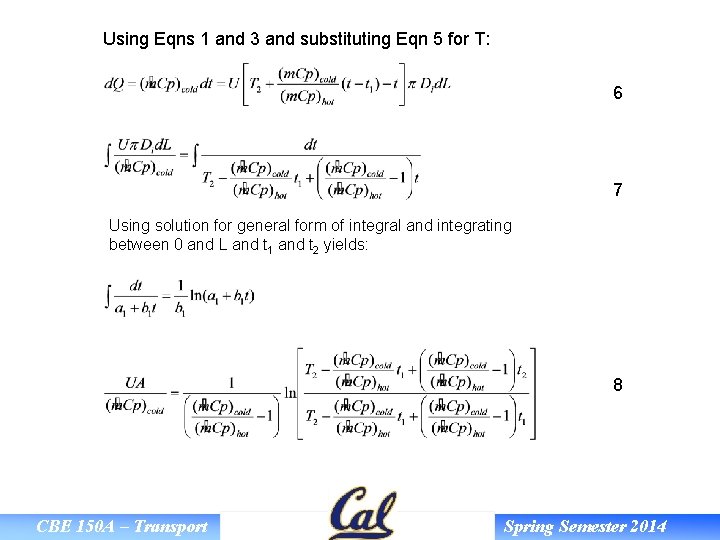
Using Eqns 1 and 3 and substituting Eqn 5 for T: 6 7 Using solution for general form of integral and integrating between 0 and L and t 1 and t 2 yields: 8 CBE 150 A – Transport Spring Semester 2014
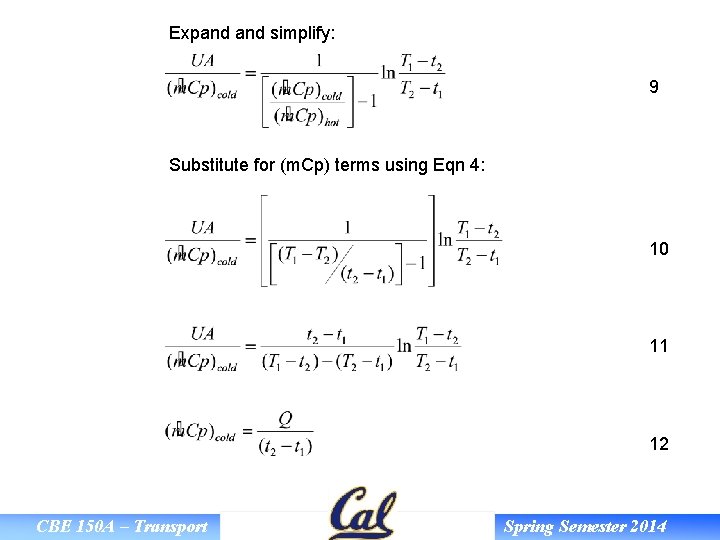
Expand simplify: 9 Substitute for (m. Cp) terms using Eqn 4: 10 11 12 CBE 150 A – Transport Spring Semester 2014
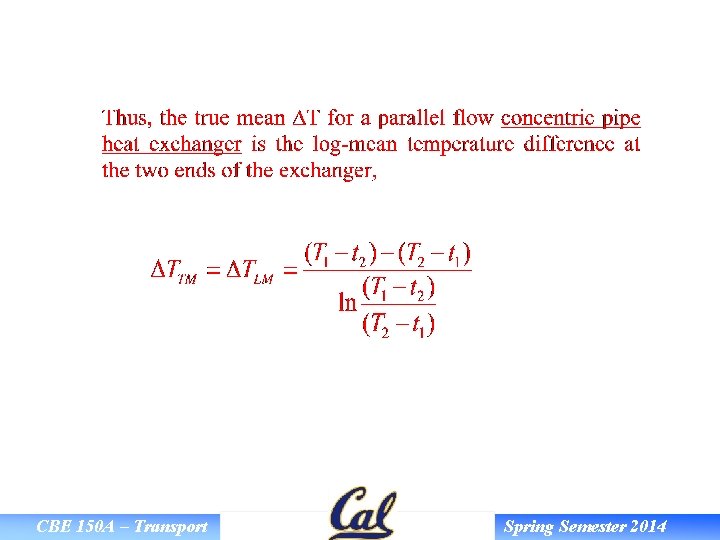
CBE 150 A – Transport Spring Semester 2014

Also, regardless of the exchanger design, if a phase change occurs, such as condensation or boiling (and the liquid is not subcooled or superheated), then: (Th)in = (Th)out and or (Tc)in = (Tc)out DTTM = DTLM Therefore, for concentric pipe heat exchangers and pure fluid condensers or evaporators, DTTM = DTLM. As we will find out later, this is NOT the case for shell-and-tube heat exchangers. CBE 150 A – Transport Spring Semester 2014
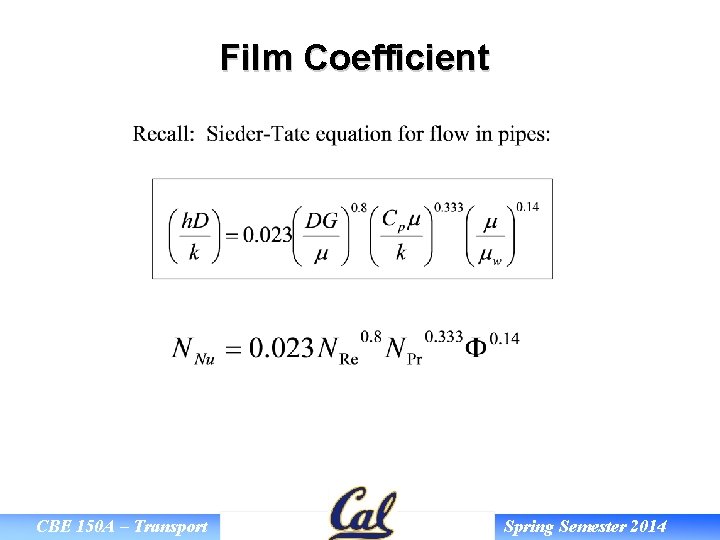
Film Coefficient CBE 150 A – Transport Spring Semester 2014
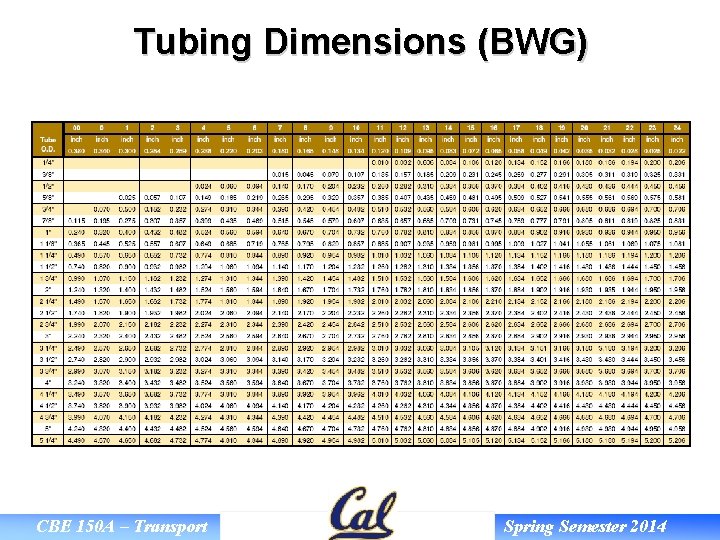
Tubing Dimensions (BWG) CBE 150 A – Transport Spring Semester 2014
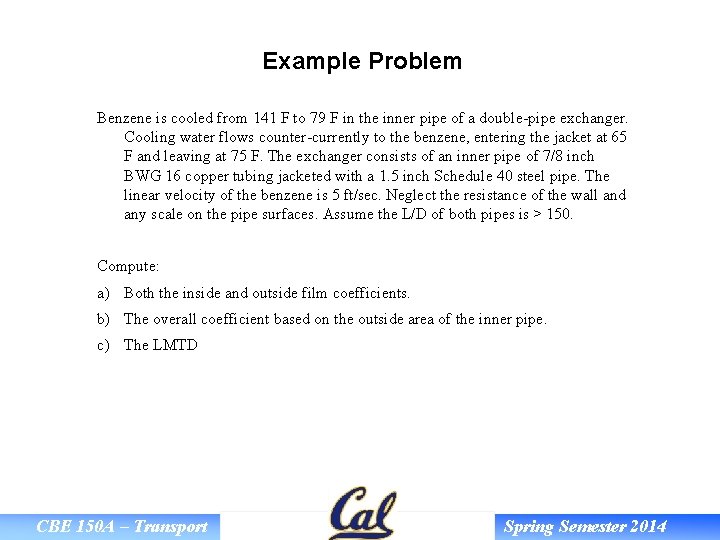
Example Problem Benzene is cooled from 141 F to 79 F in the inner pipe of a double-pipe exchanger. Cooling water flows counter-currently to the benzene, entering the jacket at 65 F and leaving at 75 F. The exchanger consists of an inner pipe of 7/8 inch BWG 16 copper tubing jacketed with a 1. 5 inch Schedule 40 steel pipe. The linear velocity of the benzene is 5 ft/sec. Neglect the resistance of the wall and any scale on the pipe surfaces. Assume the L/D of both pipes is > 150. Compute: a) Both the inside and outside film coefficients. b) The overall coefficient based on the outside area of the inner pipe. c) The LMTD CBE 150 A – Transport Spring Semester 2014
- Slides: 13