
Temperature Dependent Molecular Conduction measured by the Electrochemical
Temperature Dependent Molecular Conduction measured by the Electrochemical Deposition of Platinum Electrode in Lateral Configuration (Applied Physics Letters, 2004 (in press)) B. Kim*, S. J. Ahn*, J. G. Park*, S. H. Lee*, E. E. B. Campbell**, Y. W. Park* * School of Physics, Seoul National University, Korea ** Department of Experimental Physics, Gothenburg University and Chalmers University of Technology, Sweden Nano. Transport Laboratory
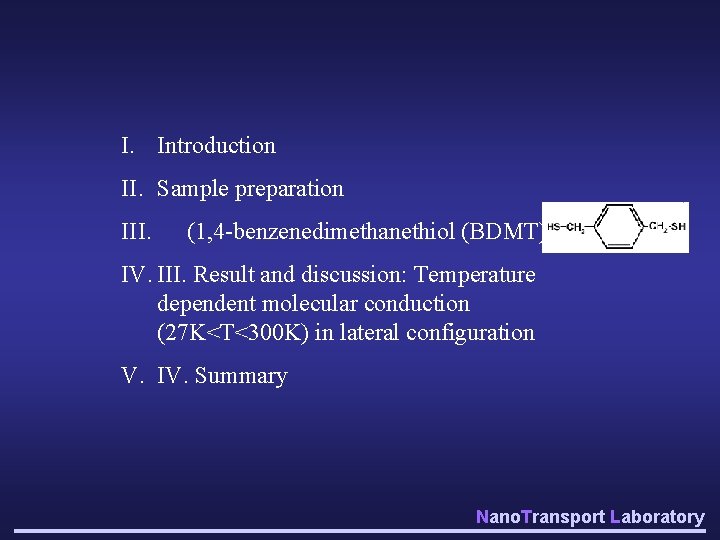
I. Introduction II. Sample preparation III. (1, 4 -benzenedimethanethiol (BDMT) ) IV. III. Result and discussion: Temperature dependent molecular conduction (27 K<T<300 K) in lateral configuration V. IV. Summary Nano. Transport Laboratory
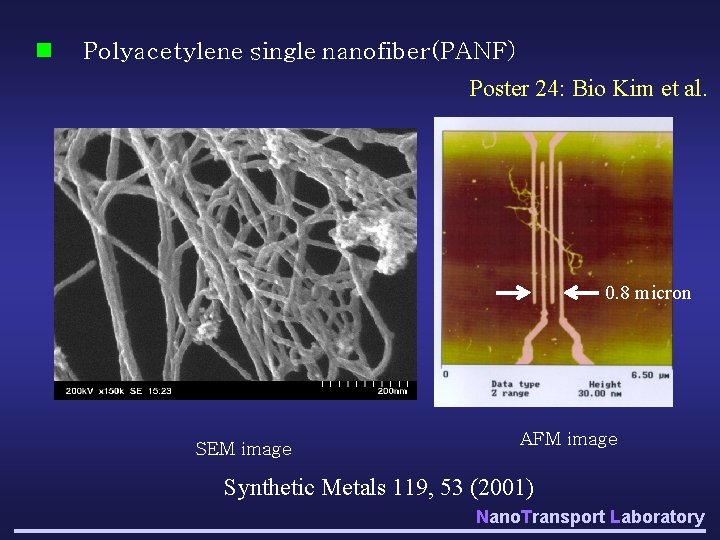
n Polyacetylene single nanofiber(PANF) Poster 24: Bio Kim et al. 0. 8 micron SEM image AFM image Synthetic Metals 119, 53 (2001) Nano. Transport Laboratory
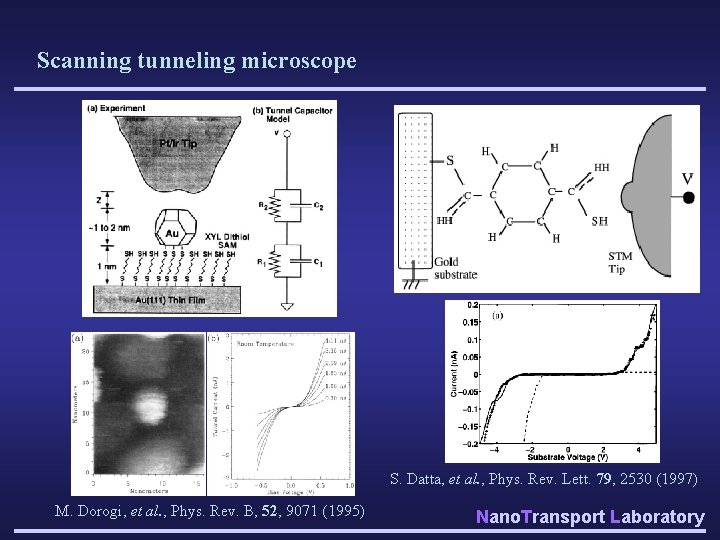
Scanning tunneling microscope S. Datta, et al. , Phys. Rev. Lett. 79, 2530 (1997) M. Dorogi, et al. , Phys. Rev. B, 52, 9071 (1995) Nano. Transport Laboratory
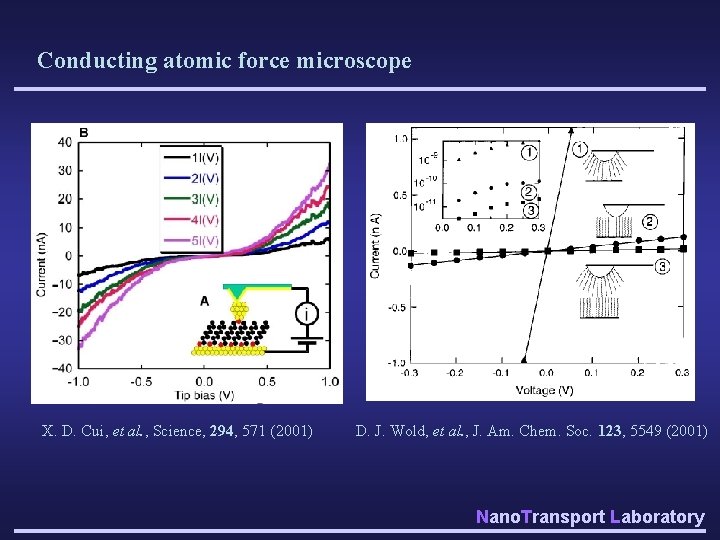
Conducting atomic force microscope X. D. Cui, et al. , Science, 294, 571 (2001) D. J. Wold, et al. , J. Am. Chem. Soc. 123, 5549 (2001) Nano. Transport Laboratory
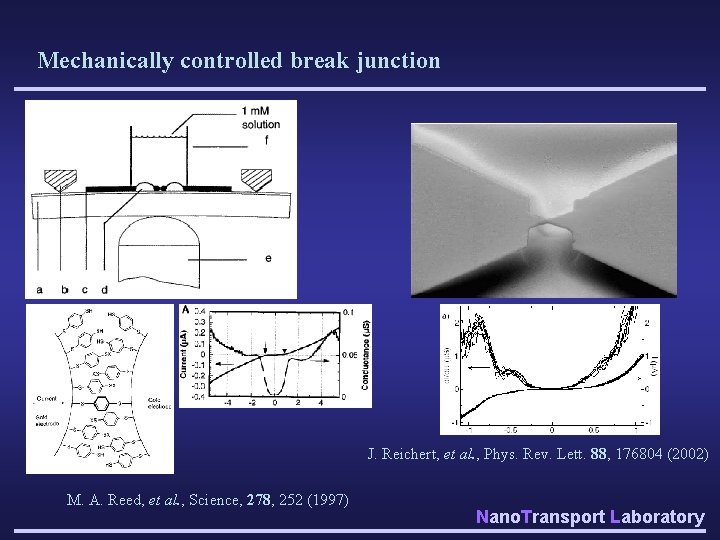
Mechanically controlled break junction J. Reichert, et al. , Phys. Rev. Lett. 88, 176804 (2002) M. A. Reed, et al. , Science, 278, 252 (1997) Nano. Transport Laboratory
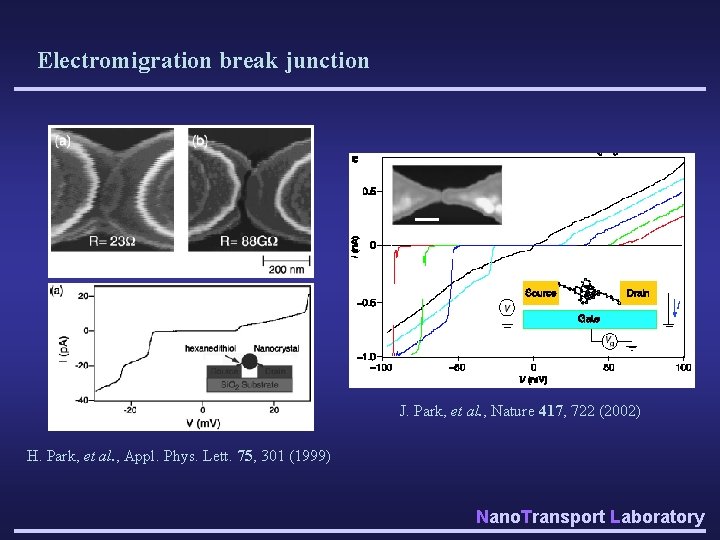
Electromigration break junction J. Park, et al. , Nature 417, 722 (2002) H. Park, et al. , Appl. Phys. Lett. 75, 301 (1999) Nano. Transport Laboratory
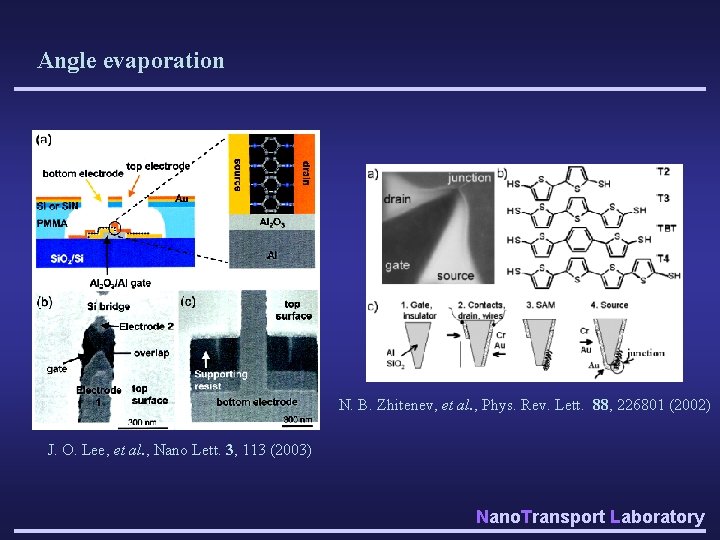
Angle evaporation N. B. Zhitenev, et al. , Phys. Rev. Lett. 88, 226801 (2002) J. O. Lee, et al. , Nano Lett. 3, 113 (2003) Nano. Transport Laboratory
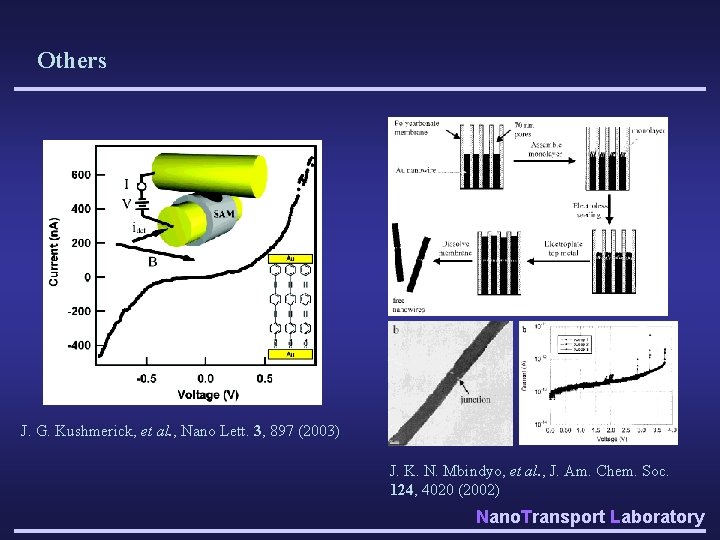
Others J. G. Kushmerick, et al. , Nano Lett. 3, 897 (2003) J. K. N. Mbindyo, et al. , J. Am. Chem. Soc. 124, 4020 (2002) Nano. Transport Laboratory

Molecular conduction measured by the electromigration technique 1. Electromigration H. Park, et al. , Nature 407, 57 (2000) 2. Electrode design 200 nm 2㎛ 20 nm height of Au electrode without adhesion layer Nano. Transport Laboratory
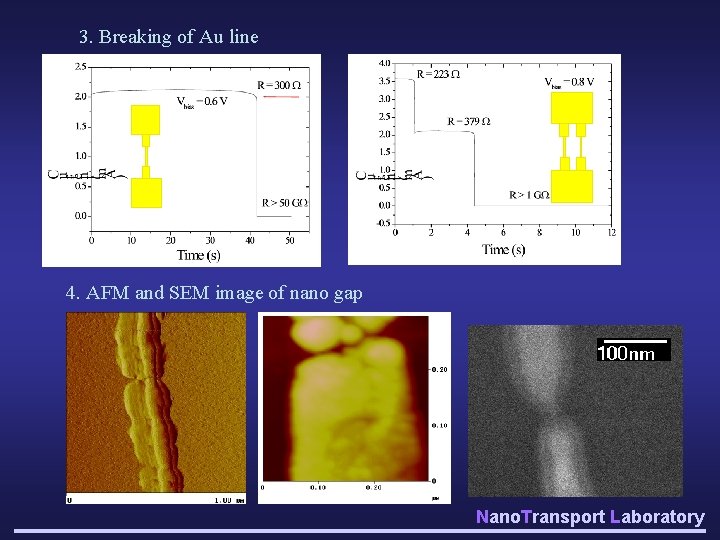
3. Breaking of Au line 4. AFM and SEM image of nano gap Nano. Transport Laboratory
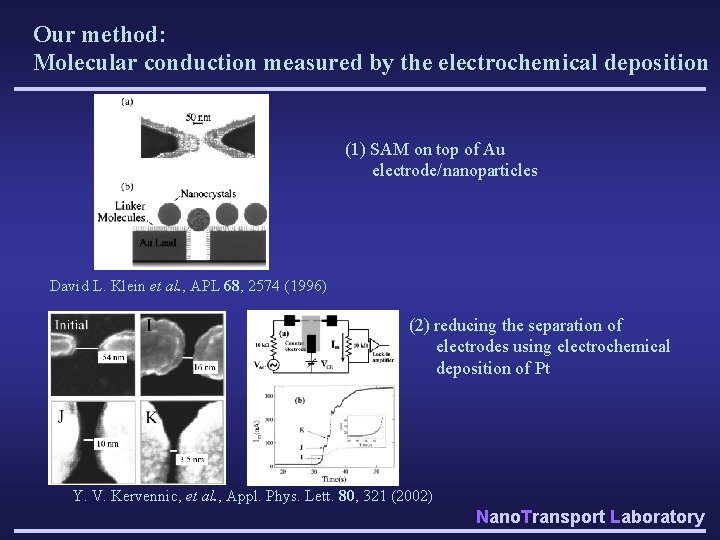
Our method: Molecular conduction measured by the electrochemical deposition (1) SAM on top of Au electrode/nanoparticles David L. Klein et al. , APL 68, 2574 (1996) (2) reducing the separation of electrodes using electrochemical deposition of Pt Y. V. Kervennic, et al. , Appl. Phys. Lett. 80, 321 (2002) Nano. Transport Laboratory
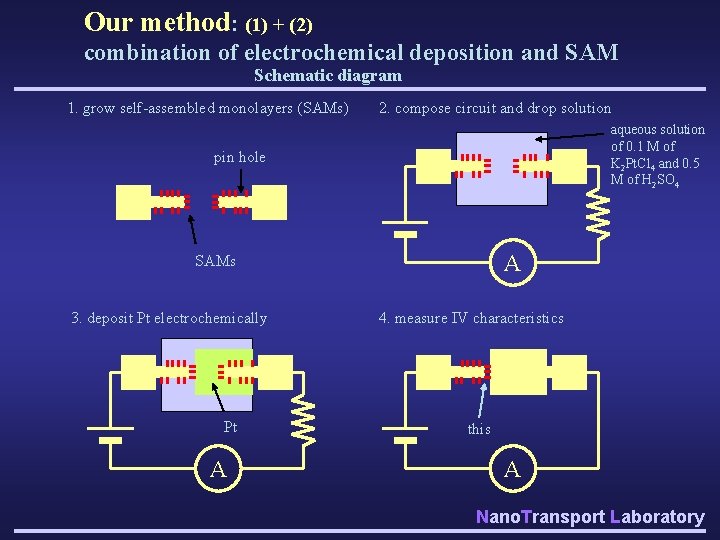
Our method: (1) + (2) combination of electrochemical deposition and SAM Schematic diagram 1. grow self-assembled monolayers (SAMs) 2. compose circuit and drop solution aqueous solution of 0. 1 M of K 2 Pt. Cl 4 and 0. 5 M of H 2 SO 4 pin hole A SAMs 3. deposit Pt electrochemically Pt A 4. measure IV characteristics this A Nano. Transport Laboratory
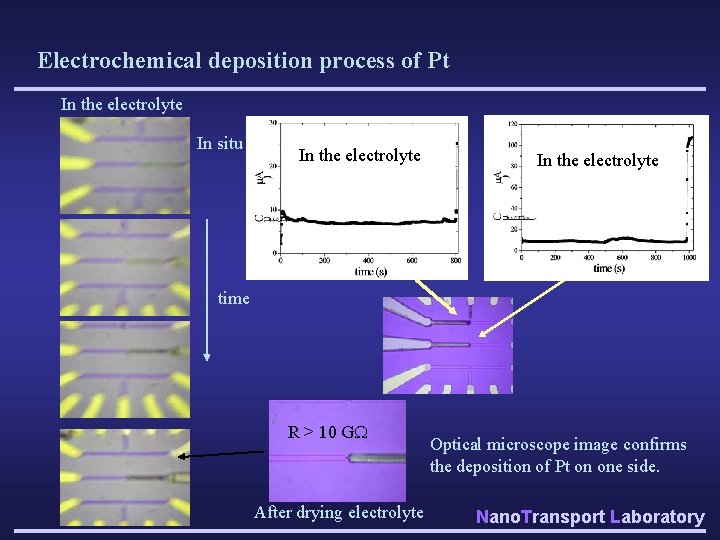
Electrochemical deposition process of Pt In the electrolyte In situ In the electrolyte time R > 10 G After drying electrolyte Optical microscope image confirms the deposition of Pt on one side. Nano. Transport Laboratory
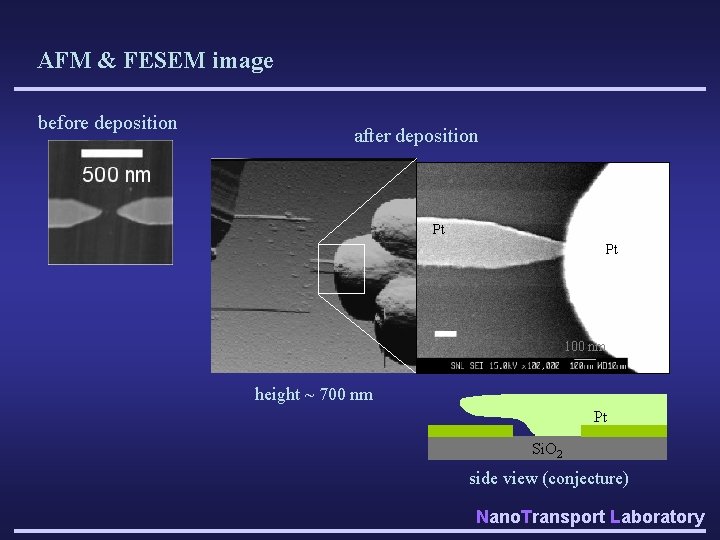
AFM & FESEM image before deposition after deposition Pt Pt 100 nm height ~ 700 nm Pt Si. O 2 side view (conjecture) Nano. Transport Laboratory
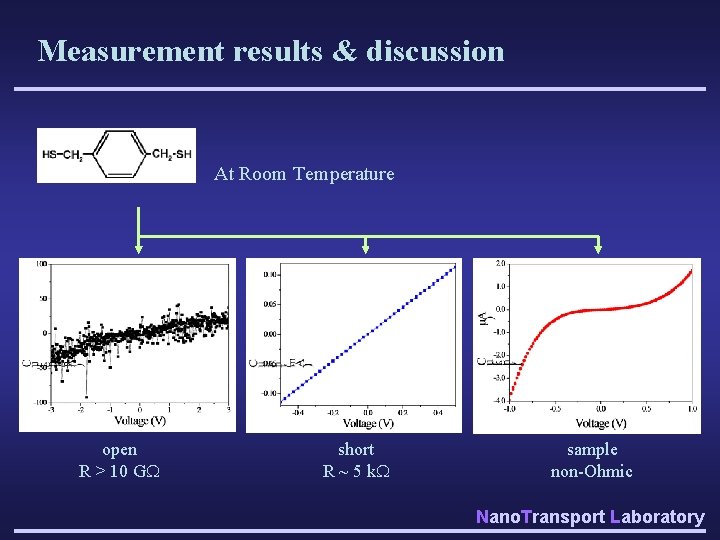
Measurement results & discussion At Room Temperature open R > 10 G short R ~ 5 k sample non-Ohmic Nano. Transport Laboratory
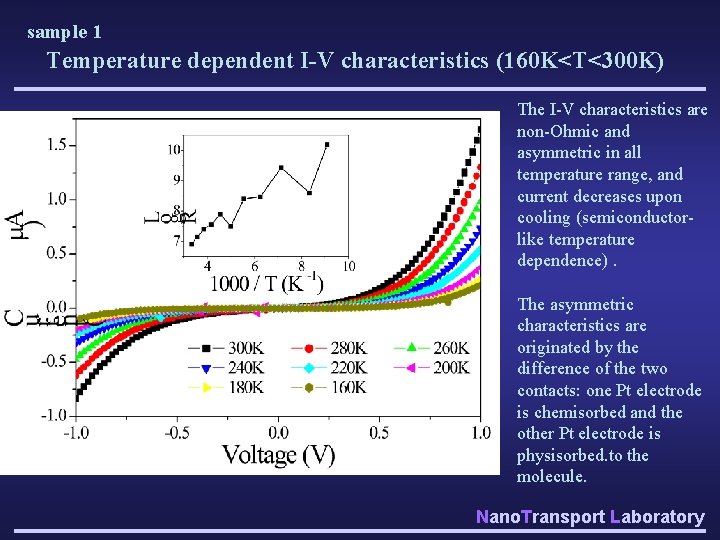
sample 1 Temperature dependent I-V characteristics (160 K<T<300 K) The I-V characteristics are non-Ohmic and asymmetric in all temperature range, and current decreases upon cooling (semiconductorlike temperature dependence). The asymmetric characteristics are originated by the difference of the two contacts: one Pt electrode is chemisorbed and the other Pt electrode is physisorbed. to the molecule. Nano. Transport Laboratory
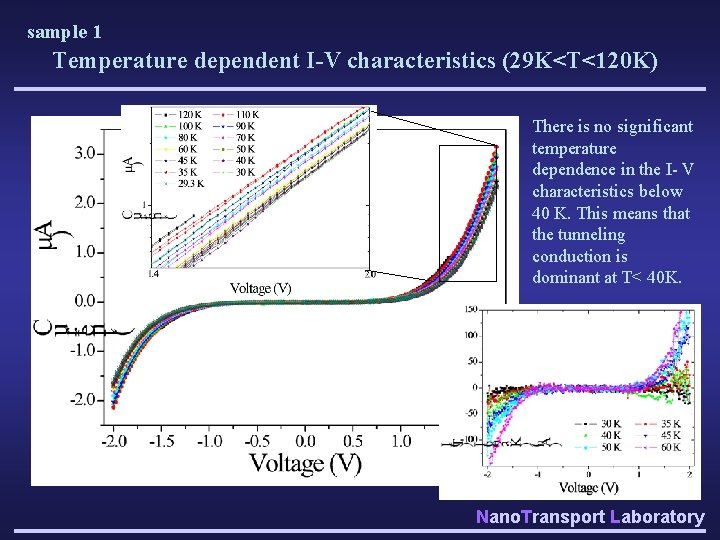
sample 1 Temperature dependent I-V characteristics (29 K<T<120 K) There is no significant temperature dependence in the I- V characteristics below 40 K. This means that the tunneling conduction is dominant at T< 40 K. Nano. Transport Laboratory
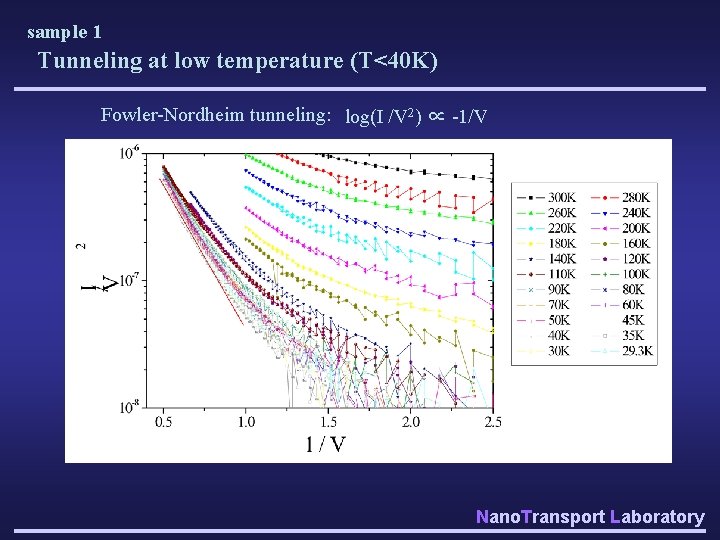
sample 1 Tunneling at low temperature (T<40 K) Fowler-Nordheim tunneling: log(I /V 2) ∝ -1/V Nano. Transport Laboratory
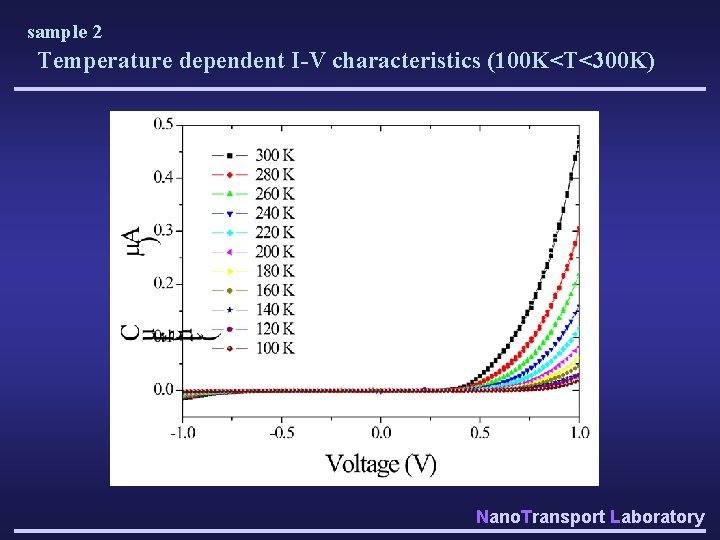
sample 2 Temperature dependent I-V characteristics (100 K<T<300 K) Nano. Transport Laboratory
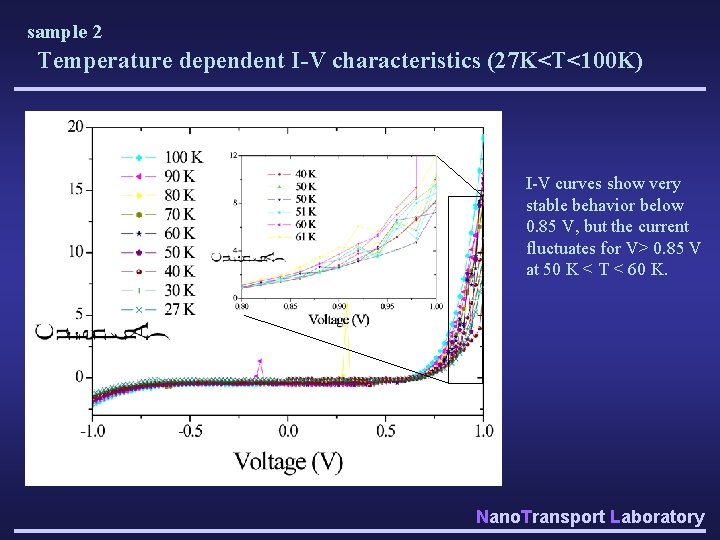
sample 2 Temperature dependent I-V characteristics (27 K<T<100 K) I-V curves show very stable behavior below 0. 85 V, but the current fluctuates for V> 0. 85 V at 50 K < T < 60 K. Nano. Transport Laboratory
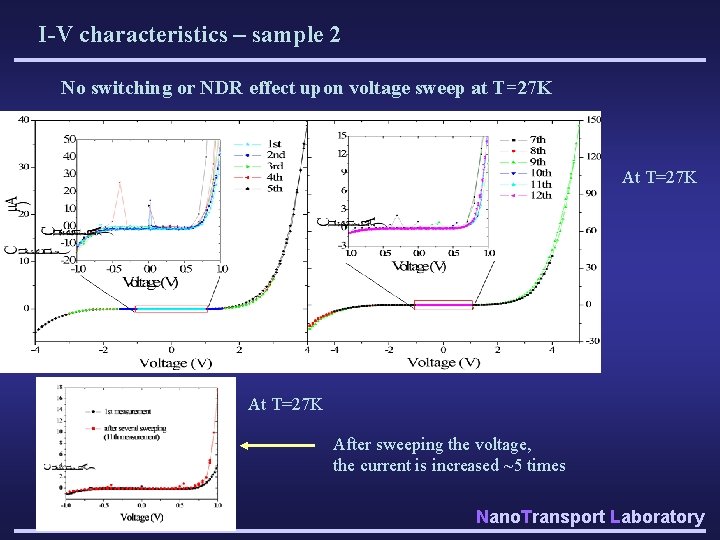
I-V characteristics – sample 2 No switching or NDR effect upon voltage sweep at T=27 K At T=27 K After sweeping the voltage, the current is increased ~5 times Nano. Transport Laboratory
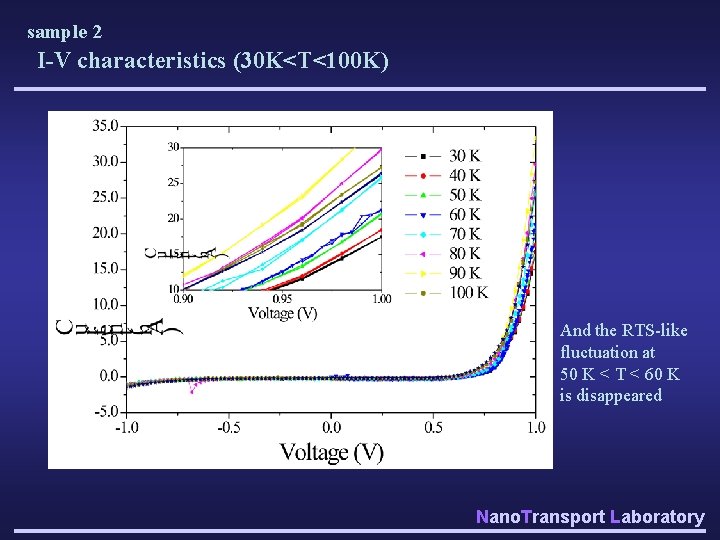
sample 2 I-V characteristics (30 K<T<100 K) And the RTS-like fluctuation at 50 K < T < 60 K is disappeared Nano. Transport Laboratory
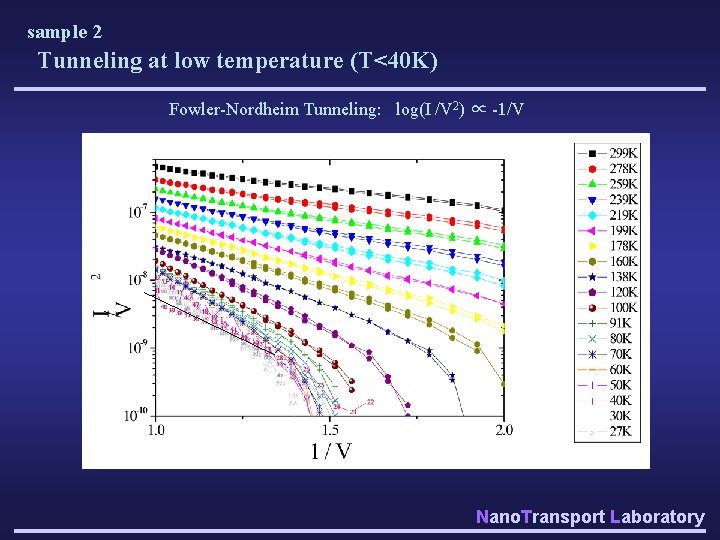
sample 2 Tunneling at low temperature (T<40 K) Fowler-Nordheim Tunneling: log(I /V 2) ∝ -1/V Nano. Transport Laboratory
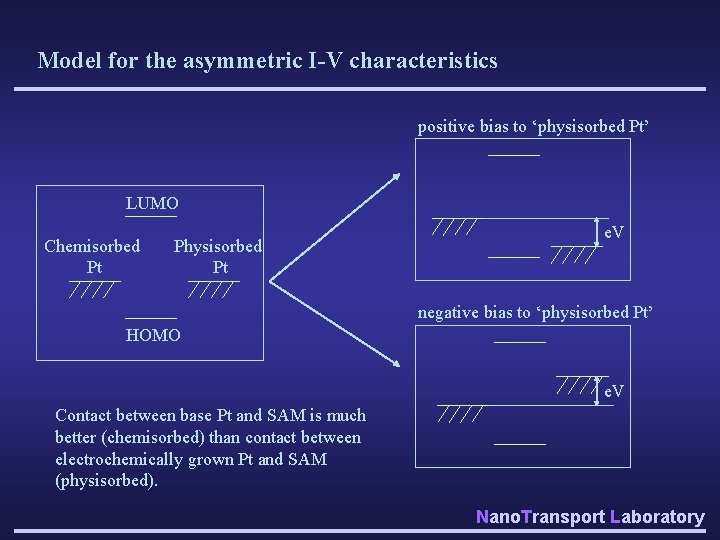
Model for the asymmetric I-V characteristics positive bias to ‘physisorbed Pt’ LUMO Chemisorbed Pt Physisorbed Pt e. V negative bias to ‘physisorbed Pt’ HOMO e. V Contact between base Pt and SAM is much better (chemisorbed) than contact between electrochemically grown Pt and SAM (physisorbed). Nano. Transport Laboratory
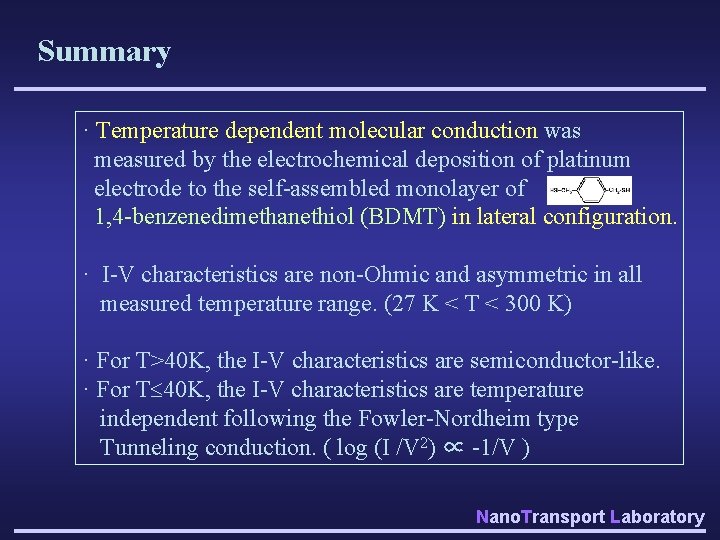
Summary · Temperature dependent molecular conduction was measured by the electrochemical deposition of platinum electrode to the self-assembled monolayer of 1, 4 -benzenedimethanethiol (BDMT) in lateral configuration. · I-V characteristics are non-Ohmic and asymmetric in all measured temperature range. (27 K < T < 300 K) · For T>40 K, the I-V characteristics are semiconductor-like. · For T 40 K, the I-V characteristics are temperature independent following the Fowler-Nordheim type Tunneling conduction. ( log (I /V 2) ∝ -1/V ) Nano. Transport Laboratory
Acknowledgement: This work was supported by the National Research Laboratory (NRL) program of the Ministry of Science and Technology (MOST), Korea. Work done in Sweden was supported by the Sweden Strategic Research Fund (CARAMEL consortium) and STINT. Partial support for Yung Woo Park was provided by the Royal Swedish Academy of Science. Nano. Transport Laboratory
- Slides: 27