
Temperature Blackbody Radiation Heated gas radiates electromagnetic energy
Temperature
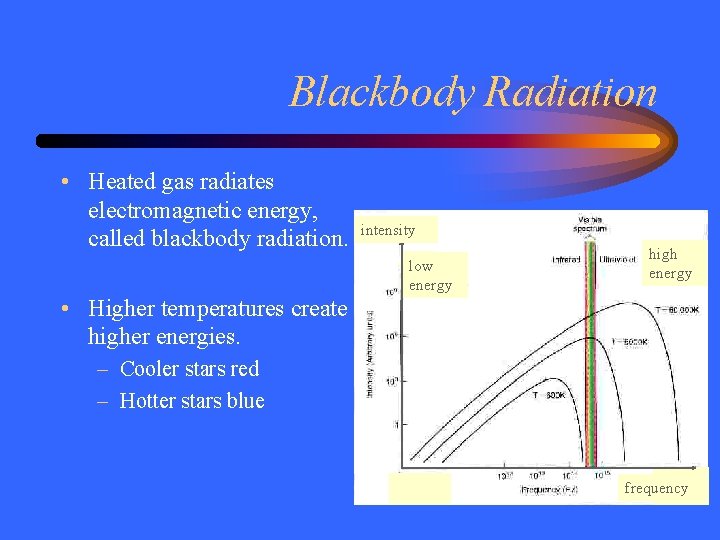
Blackbody Radiation • Heated gas radiates electromagnetic energy, called blackbody radiation. • Higher temperatures create higher energies. intensity low energy high energy – Cooler stars red – Hotter stars blue frequency
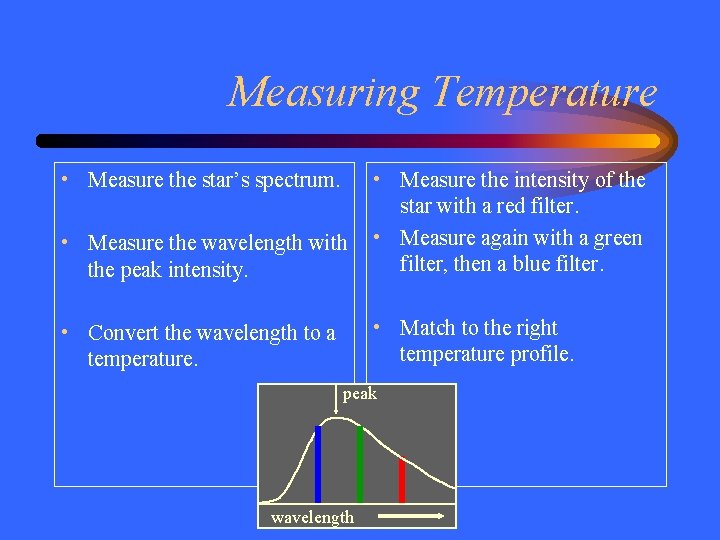
Measuring Temperature • Measure the star’s spectrum. • Measure the wavelength with the peak intensity. • Measure the intensity of the star with a red filter. • Measure again with a green filter, then a blue filter. • Convert the wavelength to a temperature. • Match to the right temperature profile. peak wavelength
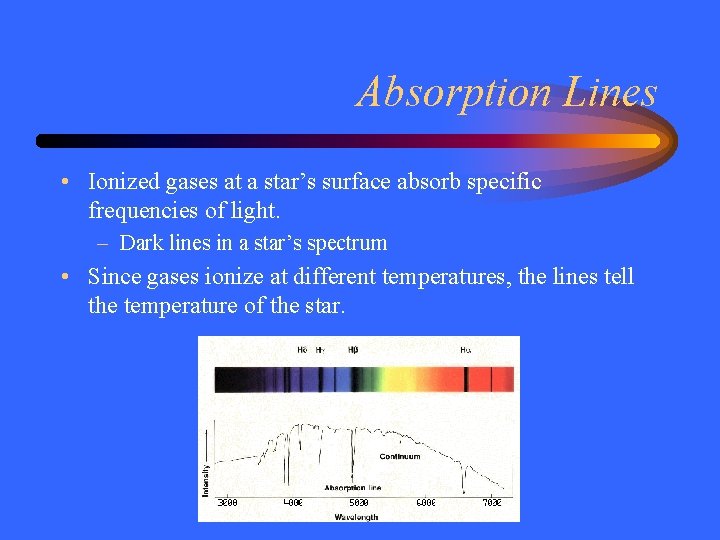
Absorption Lines • Ionized gases at a star’s surface absorb specific frequencies of light. – Dark lines in a star’s spectrum • Since gases ionize at different temperatures, the lines tell the temperature of the star.

Spectral Types • The types of spectra were originally classified only by hydrogen absorption, labeled A, B, C, …, P. • Eventually arranged by temperature. – O, B, A, F, G, K, M – Our Brother Andy Found Green Killer Martians Type v. O v. B v. A v. F v. G v. K v. M Temperature 35, 000 K 20, 000 K 10, 000 K 7, 000 K 6, 000 K 4, 000 K 3, 000 K
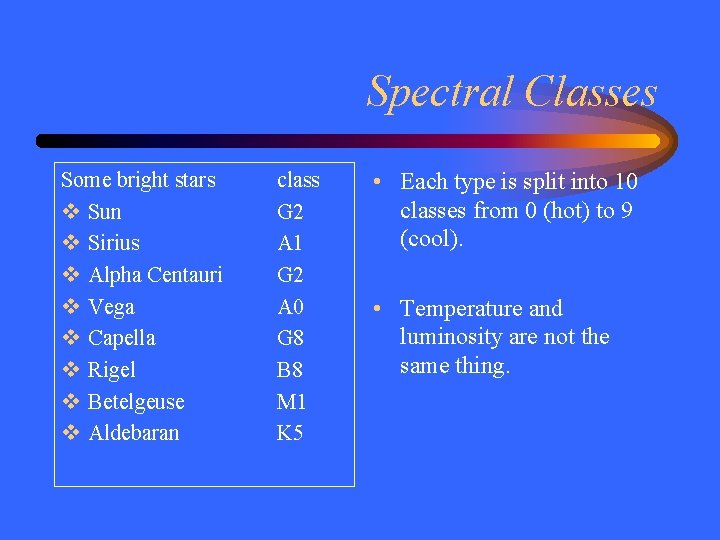
Spectral Classes Some bright stars v Sun v Sirius v Alpha Centauri v Vega v Capella v Rigel v Betelgeuse v Aldebaran class G 2 A 1 G 2 A 0 G 8 B 8 M 1 K 5 • Each type is split into 10 classes from 0 (hot) to 9 (cool). • Temperature and luminosity are not the same thing.
- Slides: 6