
Temperature behaviour of threshold on broad area Quantum
Temperature behaviour of threshold on broad area Quantum Dot-in-a-Well laser diodes By: Bhavin Bijlani
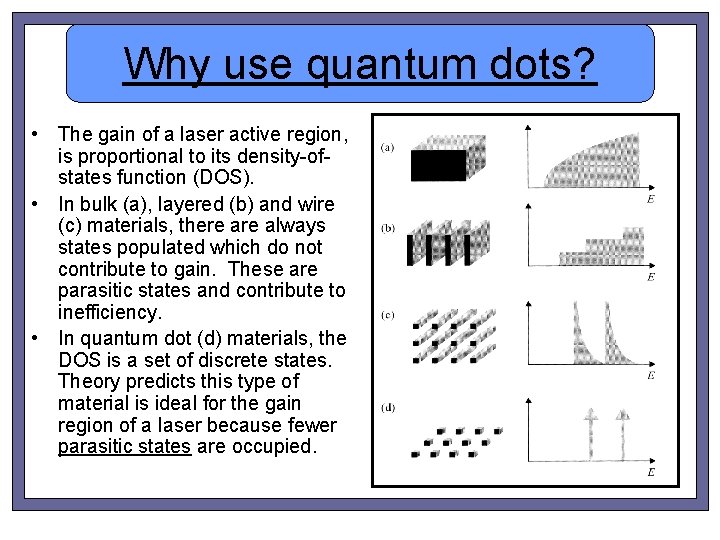
Why use quantum dots? • The gain of a laser active region, is proportional to its density-ofstates function (DOS). • In bulk (a), layered (b) and wire (c) materials, there always states populated which do not contribute to gain. These are parasitic states and contribute to inefficiency. • In quantum dot (d) materials, the DOS is a set of discrete states. Theory predicts this type of material is ideal for the gain region of a laser because fewer parasitic states are occupied.
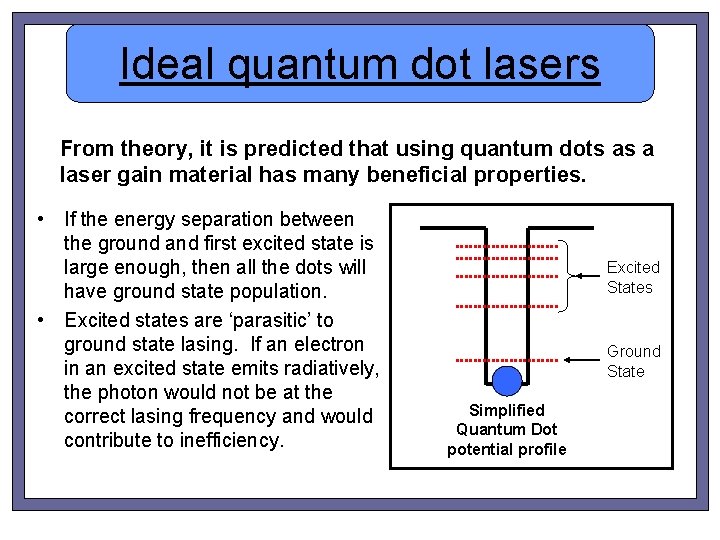
Ideal quantum dot lasers From theory, it is predicted that using quantum dots as a laser gain material has many beneficial properties. • If the energy separation between the ground and first excited state is large enough, then all the dots will have ground state population. • Excited states are ‘parasitic’ to ground state lasing. If an electron in an excited state emits radiatively, the photon would not be at the correct lasing frequency and would contribute to inefficiency. Excited States Ground State Simplified Quantum Dot potential profile
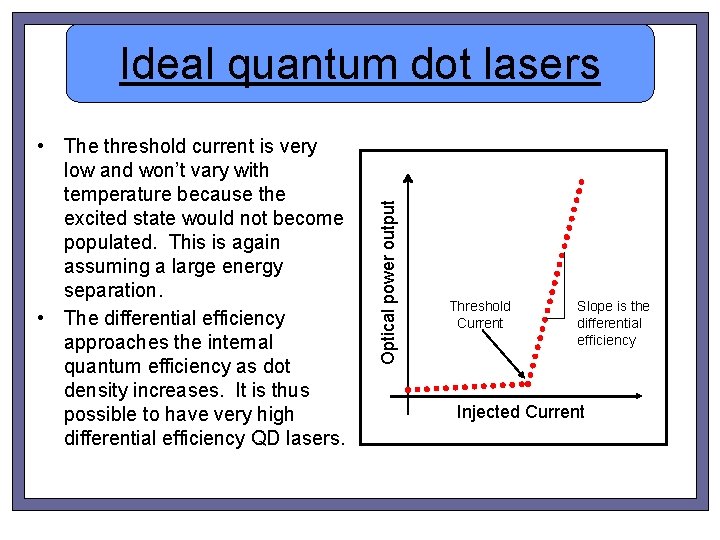
• The threshold current is very low and won’t vary with temperature because the excited state would not become populated. This is again assuming a large energy separation. • The differential efficiency approaches the internal quantum efficiency as dot density increases. It is thus possible to have very high differential efficiency QD lasers. Optical power output Ideal quantum dot lasers Threshold Current Slope is the differential efficiency Injected Current
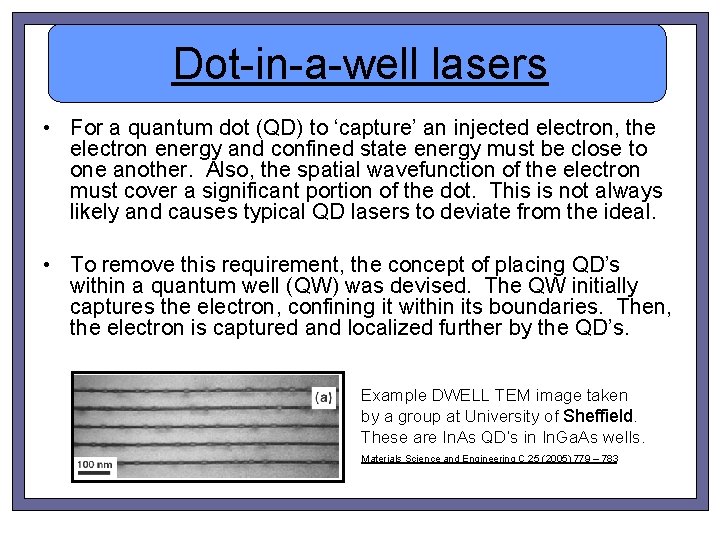
Dot-in-a-well lasers • For a quantum dot (QD) to ‘capture’ an injected electron, the electron energy and confined state energy must be close to one another. Also, the spatial wavefunction of the electron must cover a significant portion of the dot. This is not always likely and causes typical QD lasers to deviate from the ideal. • To remove this requirement, the concept of placing QD’s within a quantum well (QW) was devised. The QW initially captures the electron, confining it within its boundaries. Then, the electron is captured and localized further by the QD’s. Example DWELL TEM image taken by a group at University of Sheffield. These are In. As QD’s in In. Ga. As wells. Materials Science and Engineering C 25 (2005) 779 – 783
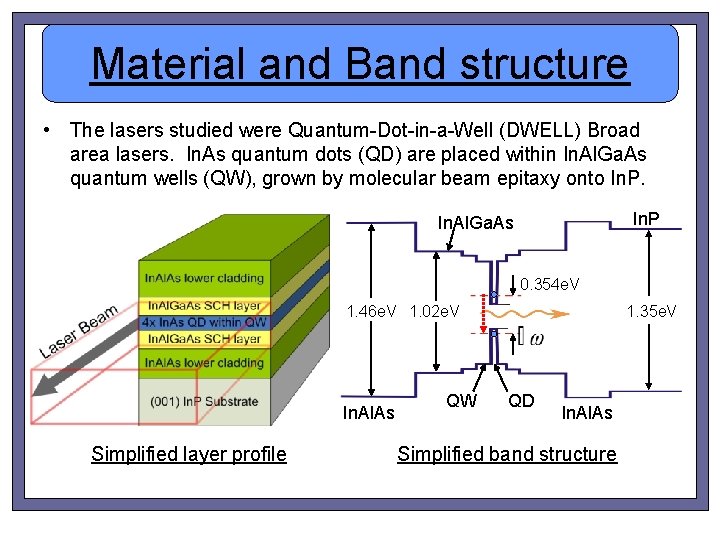
Material and Band structure • The lasers studied were Quantum-Dot-in-a-Well (DWELL) Broad area lasers. In. As quantum dots (QD) are placed within In. Al. Ga. As quantum wells (QW), grown by molecular beam epitaxy onto In. P In. Al. Ga. As 0. 354 e. V 1. 46 e. V 1. 02 e. V In. Al. As Simplified layer profile QW 1. 35 e. V QD In. Al. As Simplified band structure

Threshold characterization • The temperature dependence of laser threshold between two temperatures is usually defined by the characteristic temperature, T 0. This term is defined by the equation below. • A larger T 0 signifies a weak dependence of threshold on temperature. Conversely, a small T 0 signifies a strong variation of the threshold current with temperature. • Typical In. Ga. As. P quantum well lasers have room temperature (RT) T 0 values around 60 K. Ga. As quantum well lasers can have RT T 0 values well over 100 K.
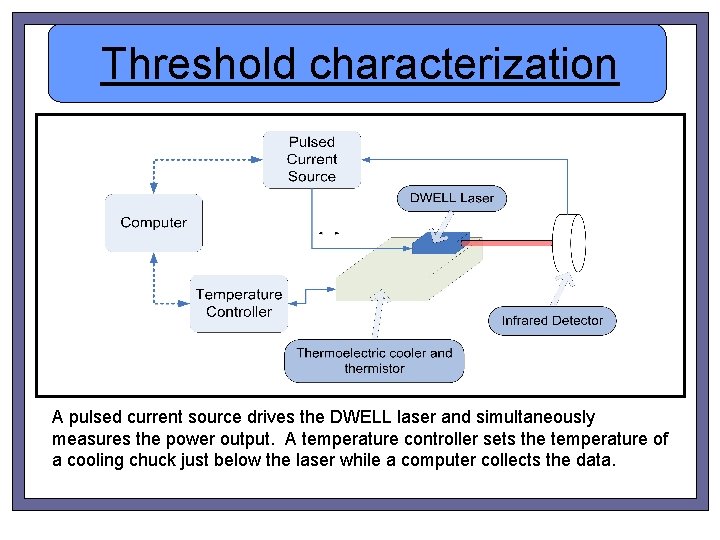
Threshold characterization A pulsed current source drives the DWELL laser and simultaneously measures the power output. A temperature controller sets the temperature of a cooling chuck just below the laser while a computer collects the data.
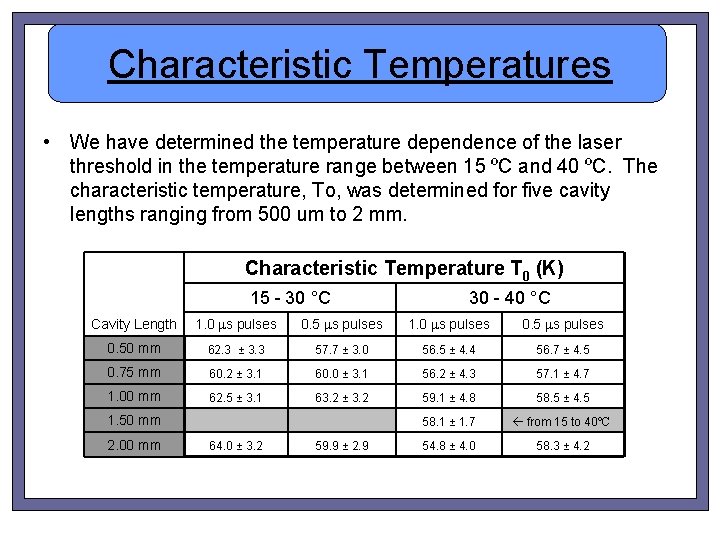
Characteristic Temperatures • We have determined the temperature dependence of the laser threshold in the temperature range between 15 ºC and 40 ºC. The characteristic temperature, To, was determined for five cavity lengths ranging from 500 um to 2 mm. Characteristic Temperature T 0 (K) 15 - 30 °C 30 - 40 °C Cavity Length 1. 0 μs pulses 0. 50 mm 62. 3 ± 3. 3 57. 7 ± 3. 0 56. 5 ± 4. 4 56. 7 ± 4. 5 0. 75 mm 60. 2 ± 3. 1 60. 0 ± 3. 1 56. 2 ± 4. 3 57. 1 ± 4. 7 1. 00 mm 62. 5 ± 3. 1 63. 2 ± 3. 2 59. 1 ± 4. 8 58. 5 ± 4. 5 58. 1 ± 1. 7 from 15 to 40°C 54. 8 ± 4. 0 58. 3 ± 4. 2 1. 50 mm 2. 00 mm 64. 0 ± 3. 2 59. 9 ± 2. 9
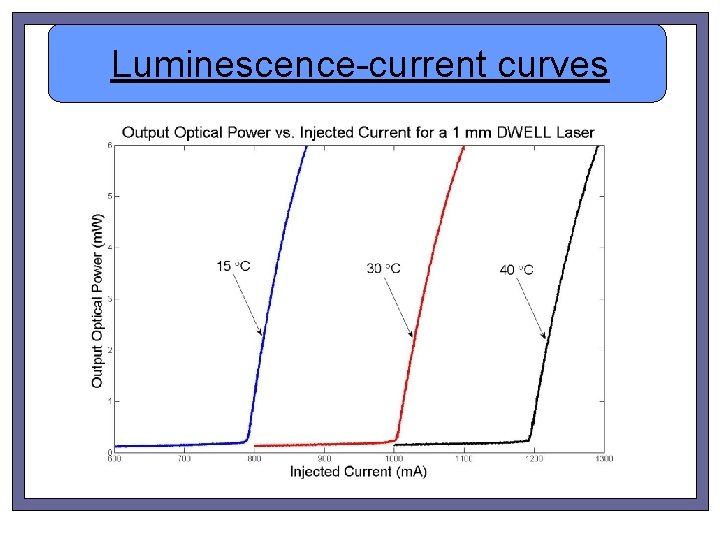
Luminescence-current curves

Threshold versus Temperature
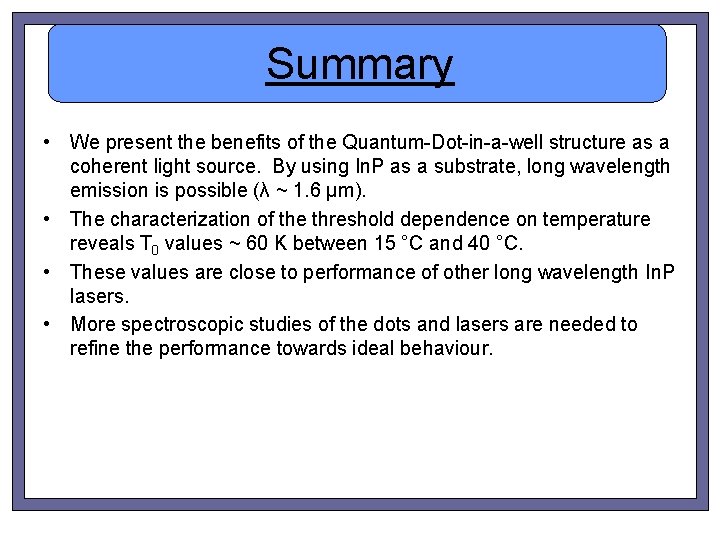
Summary • We present the benefits of the Quantum-Dot-in-a-well structure as a coherent light source. By using In. P as a substrate, long wavelength emission is possible (λ ~ 1. 6 μm). • The characterization of the threshold dependence on temperature reveals T 0 values ~ 60 K between 15 °C and 40 °C. • These values are close to performance of other long wavelength In. P lasers. • More spectroscopic studies of the dots and lasers are needed to refine the performance towards ideal behaviour.
- Slides: 12