
Temperature and Heat Whats the difference Write a
- Slides: 40
Temperature and Heat What's the difference? Write a definition of each and then compare with your neighbor.
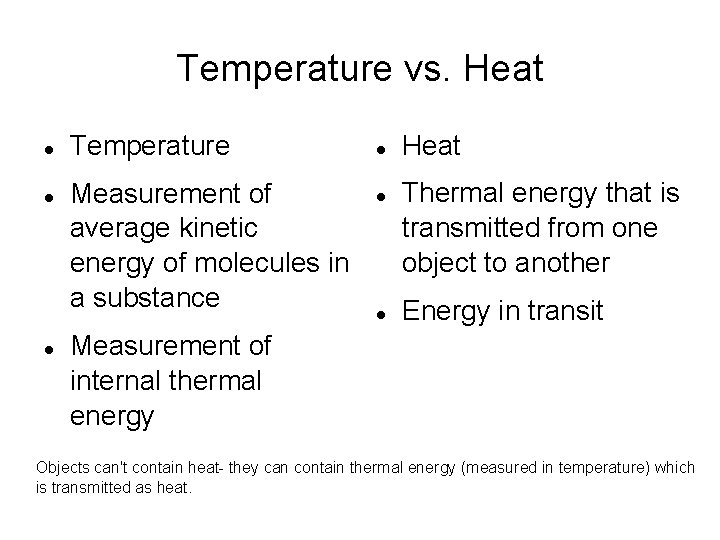
Temperature vs. Heat l l l Temperature Measurement of average kinetic energy of molecules in a substance l l l Heat Thermal energy that is transmitted from one object to another Energy in transit Measurement of internal thermal energy Objects can't contain heat- they can contain thermal energy (measured in temperature) which is transmitted as heat.
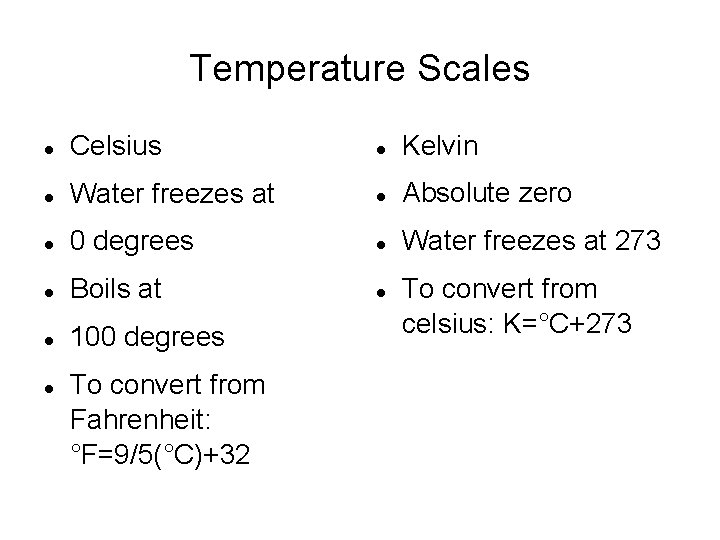
Temperature Scales l Celsius l Kelvin l Water freezes at l Absolute zero l 0 degrees l Water freezes at 273 l Boils at l l 100 degrees l To convert from Fahrenheit: °F=9/5(°C)+32 To convert from celsius: K=°C+273
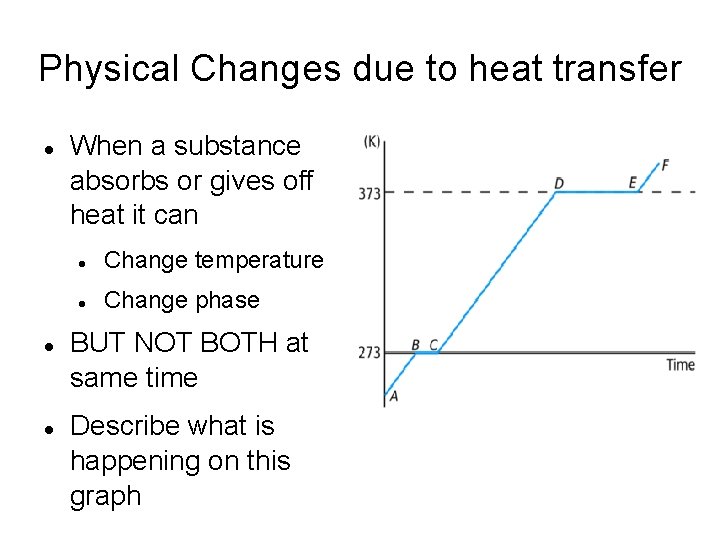
Physical Changes due to heat transfer l l l When a substance absorbs or gives off heat it can l Change temperature l Change phase BUT NOT BOTH at same time Describe what is happening on this graph
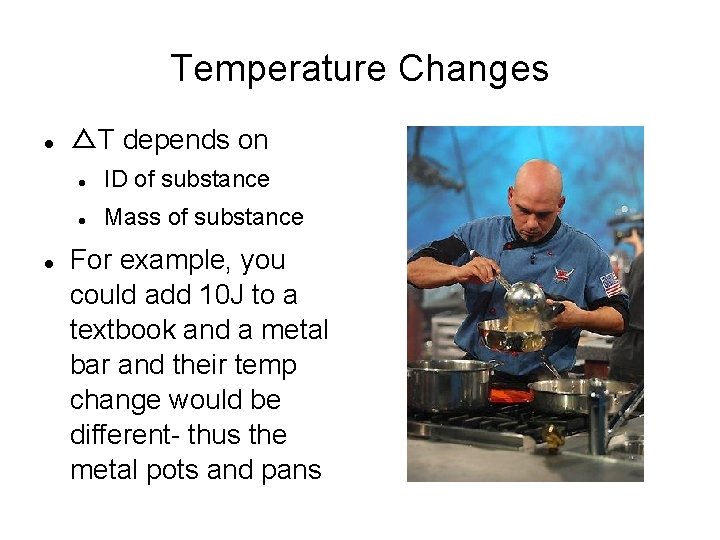
Temperature Changes l l △T depends on l ID of substance l Mass of substance For example, you could add 10 J to a textbook and a metal bar and their temp change would be different- thus the metal pots and pans
Specific Heat • Specific heat= capacity of a substance to store heat • Depends on chemical composition • Technically= the amount of heat (Joules) required to raise the temp of a unit mass of the substance by 1 degree • Kind of like “thermal inertia” • SO which do you think has a higher specific heat: water or aluminum? 6
Specific Heat (c) • Specific heat measured in J/g°C but sometimes also see it in calories/g°C • Calorie is a unit of heat based on water: 1 calorie is heat to raise temp of 1 g of water by 1°C • So specific heat of water is 1 cal/g°C which is equivalent to 4. 186 J/g°C • Compare this to aluminum which has a specific heat of 0. 215 cal/g°C or 0. 900 J/g°C • Aluminum transfers heat much more easily! 7
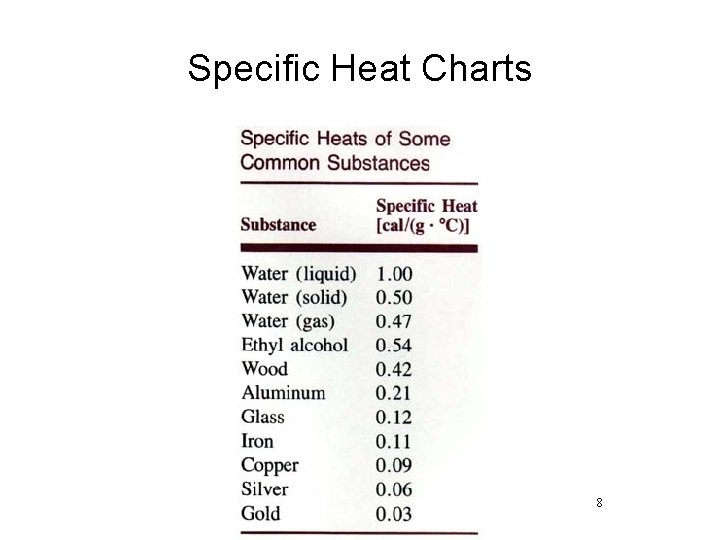
Specific Heat Charts 8
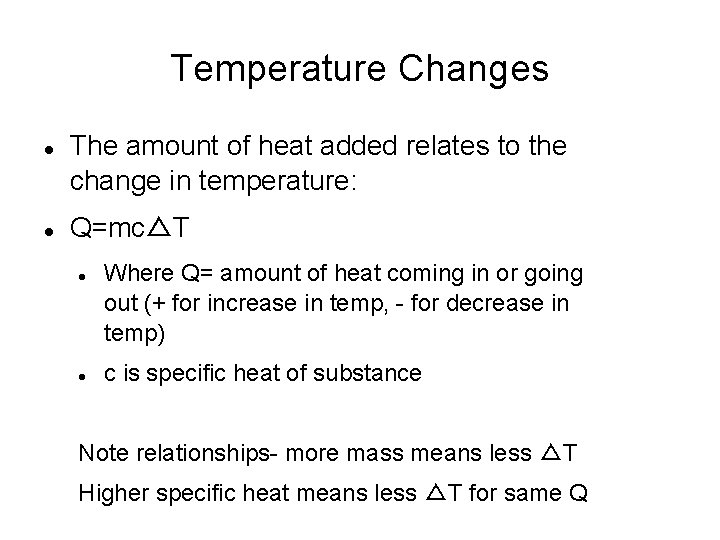
Temperature Changes l l The amount of heat added relates to the change in temperature: Q=mc△T l l Where Q= amount of heat coming in or going out (+ for increase in temp, - for decrease in temp) c is specific heat of substance Note relationships- more mass means less △T Higher specific heat means less △T for same Q
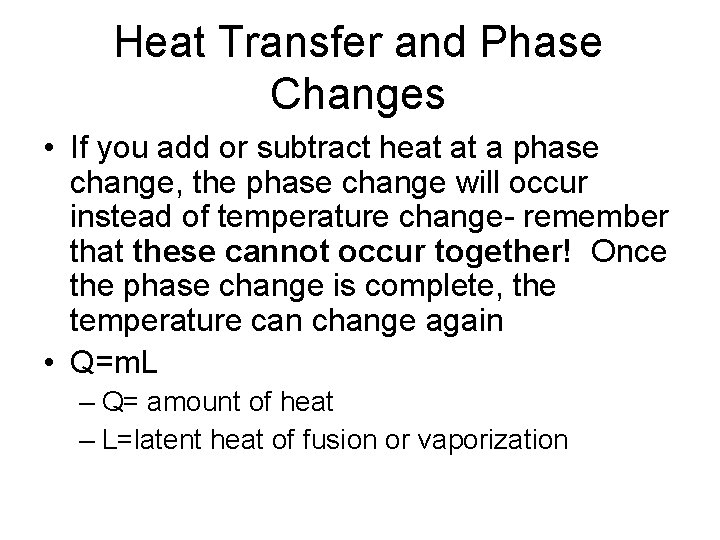
Heat Transfer and Phase Changes • If you add or subtract heat at a phase change, the phase change will occur instead of temperature change- remember that these cannot occur together! Once the phase change is complete, the temperature can change again • Q=m. L – Q= amount of heat – L=latent heat of fusion or vaporization
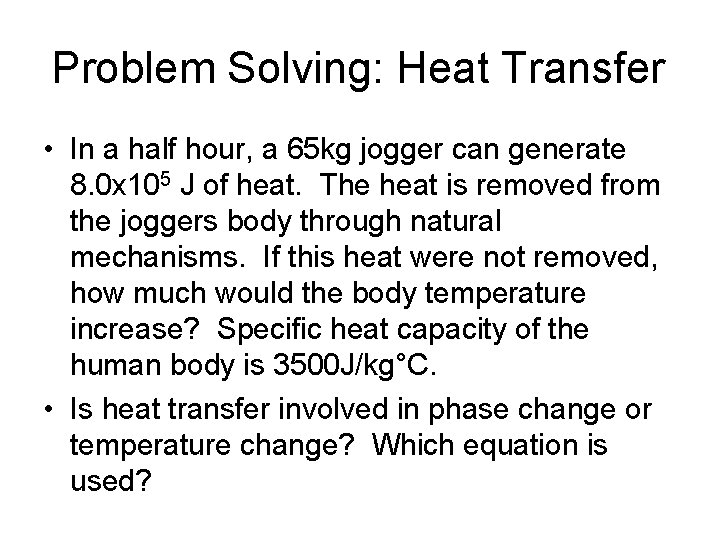
Problem Solving: Heat Transfer • In a half hour, a 65 kg jogger can generate 8. 0 x 105 J of heat. The heat is removed from the joggers body through natural mechanisms. If this heat were not removed, how much would the body temperature increase? Specific heat capacity of the human body is 3500 J/kg°C. • Is heat transfer involved in phase change or temperature change? Which equation is used?
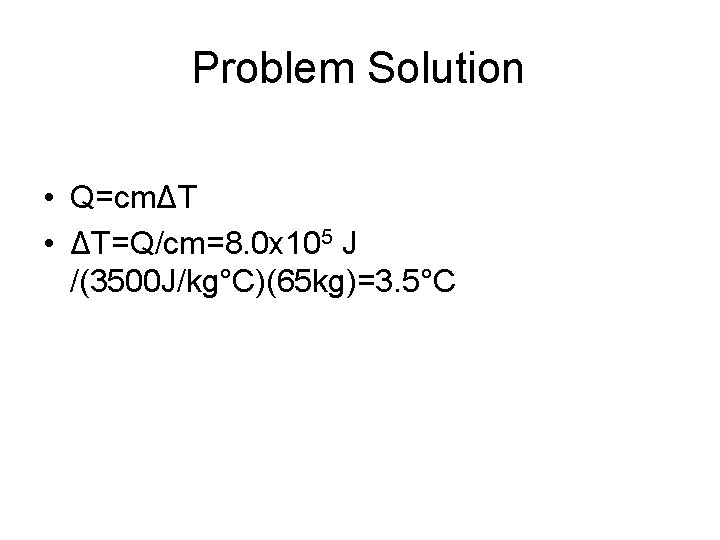
Problem Solution • Q=cmΔT • ΔT=Q/cm=8. 0 x 105 J /(3500 J/kg°C)(65 kg)=3. 5°C
Problem solving with phase changes • Phase changes are reversible • Note which phase change- are you using latent heat of vaporization or fusion? • Are you increasing temperature outside of phase change? If so, you need to solve both parts separately • Try # 10 on HW 13
Heat Transfer and Thermal Expansion • When substance changes temperature it also changes size • Most things expand as they increase temperature but not… • Water between 4°C-0°C • Each material has a coefficient of linear expansion=α and change in length equals: • ΔL=αLiΔT • Using this formula, what is the unit then for the coefficient of thermal expansion, α? • 1/°C
Problem Solving: Thermal Expansion • A metal ball has a diameter that is slightly greater than the diameter of a hole that has been cut into a metal plate. The coefficient of linear expansion for the metal in the ball is greater than that for the plate. Which one (or more) of the following procedures can be used to make the ball pass through the hole? • A: raise the temperatures of the ball and plate by the same amount • B: lower the temperatures of the ball and plate by the same amount • C: heat the ball and cool the plate • D: cool the ball and heat the plate
Solution: thermal expansion • B and D • Since the coefficient of linear expansion of the ball is greater than the plate, it will shrink more per change in temperature as the temperature of both is lowered. Also, by cooling the ball you will decrease its size and by heating the plate you will increase the size of the hole.
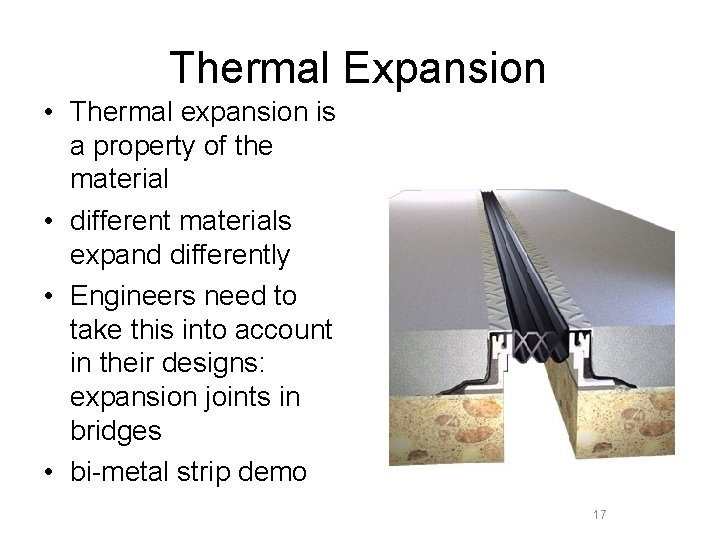
Thermal Expansion • Thermal expansion is a property of the material • different materials expand differently • Engineers need to take this into account in their designs: expansion joints in bridges • bi-metal strip demo 17
Thermal expansion • This is how thermostats work- bimetallic strips in refrigerators, ovens, etc. open and close a switch as the bimetallic strip bends one way or the other due to temp changes • If you have a metal lid on a glass jar that is stuck on too tight, how can you use this to get the lid off? 18
Volume Thermal Expansion • Similar to linear expansion, the expansion of volume with an increase in temp is related to the initial volume, the change in temperature, and a proportionality constant • This is primarily useful with liquids since they don’t expand linearly • The coefficient of volume expansion = β • ΔV=βVoΔT
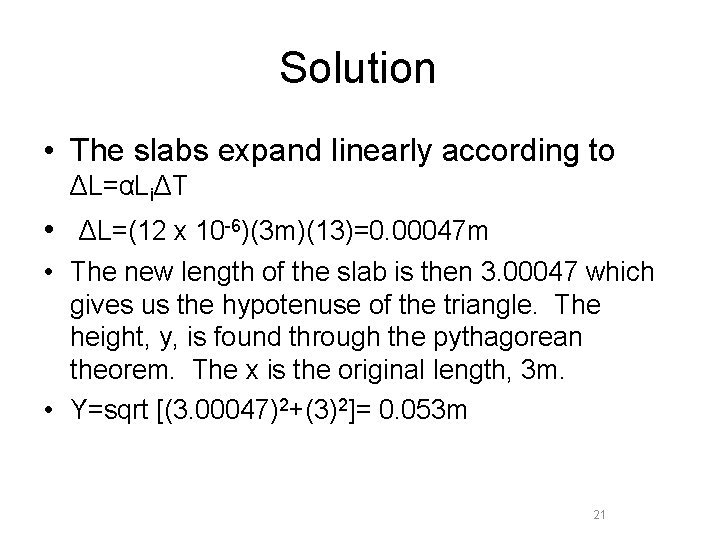
Problem solving- thermal expansion • A concrete sidewalk is constructed between two buildings on a day when the temperature is 25 degrees celsius. The sidewalk consists of 2 slabs, each 3 m in length and negligible thickness. As the temperature rises to 38 degrees, the slabs expand but no space is provided for thermal expansion. Concrete has a coefficient of linear expansion of 12 x 10 -6 The buildings don’t move so the slabs buckle upward. Determine the vertical distance (y) that the slaps stick up after buckling. • Hint- DRAW! 20
Solution • The slabs expand linearly according to ΔL=αLiΔT • ΔL=(12 x 10 -6)(3 m)(13)=0. 00047 m • The new length of the slab is then 3. 00047 which gives us the hypotenuse of the triangle. The height, y, is found through the pythagorean theorem. The x is the original length, 3 m. • Y=sqrt [(3. 00047)2+(3)2]= 0. 053 m 21
How does heat transfer? • You’ve heard this before… • Conduction, convection, radiation • Remember them?
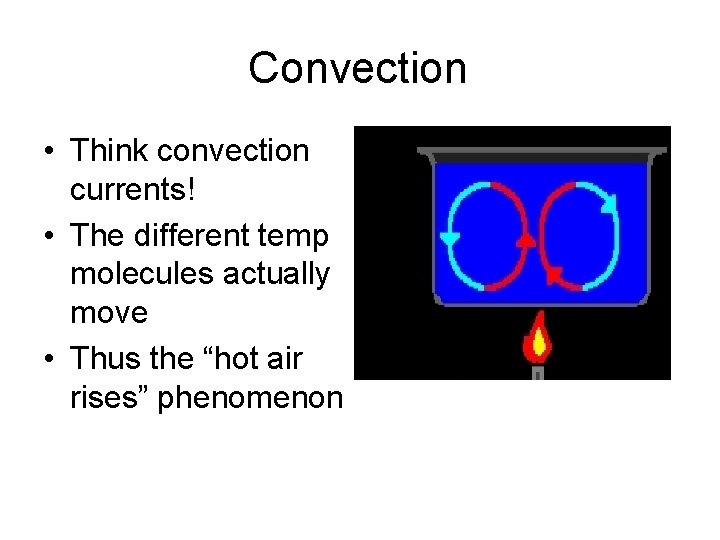
Convection • Think convection currents! • The different temp molecules actually move • Thus the “hot air rises” phenomenon
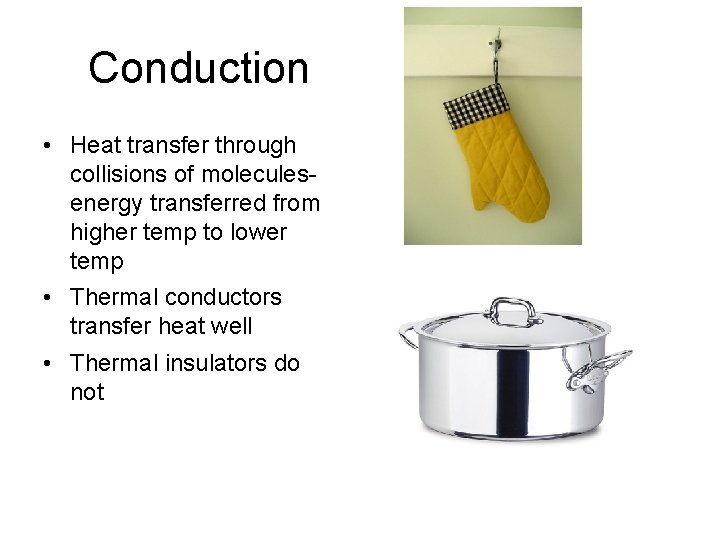
Conduction • Heat transfer through collisions of molecules- energy transferred from higher temp to lower temp • Thermal conductors transfer heat well • Thermal insulators do not
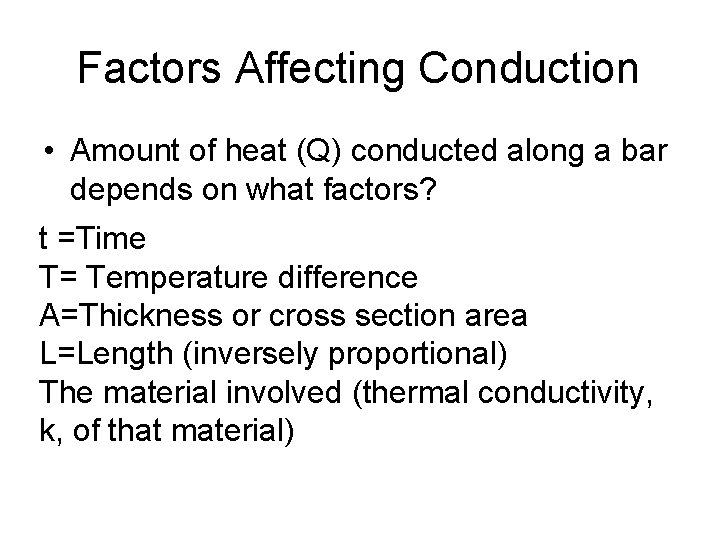
Factors Affecting Conduction • Amount of heat (Q) conducted along a bar depends on what factors? t =Time T= Temperature difference A=Thickness or cross section area L=Length (inversely proportional) The material involved (thermal conductivity, k, of that material)
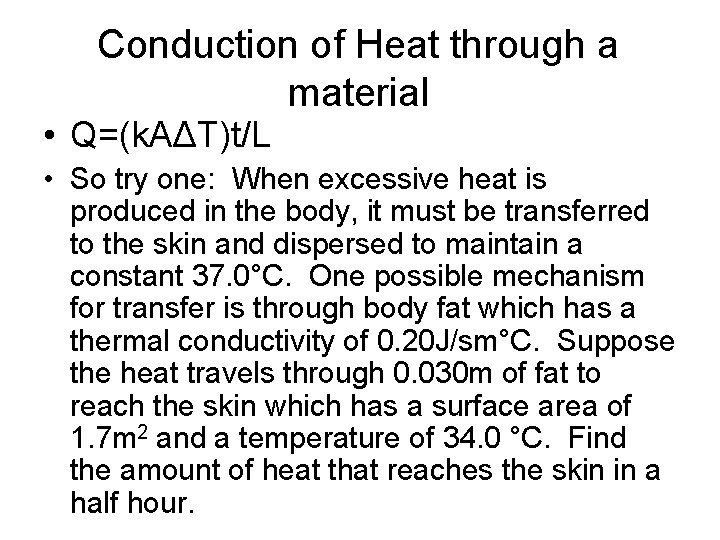
Conduction of Heat through a material • Q=(k. AΔT)t/L • So try one: When excessive heat is produced in the body, it must be transferred to the skin and dispersed to maintain a constant 37. 0°C. One possible mechanism for transfer is through body fat which has a thermal conductivity of 0. 20 J/sm°C. Suppose the heat travels through 0. 030 m of fat to reach the skin which has a surface area of 1. 7 m 2 and a temperature of 34. 0 °C. Find the amount of heat that reaches the skin in a half hour.
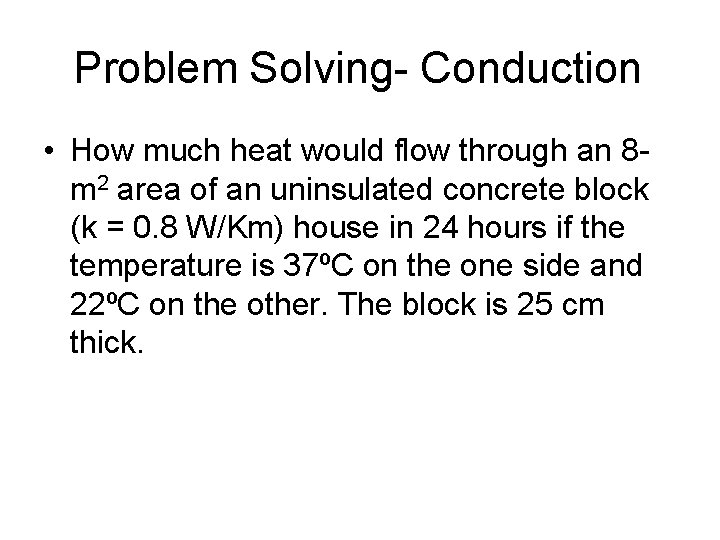
Problem Solving- Conduction • How much heat would flow through an 8 m 2 area of an uninsulated concrete block (k = 0. 8 W/Km) house in 24 hours if the temperature is 37ºC on the one side and 22ºC on the other. The block is 25 cm thick.
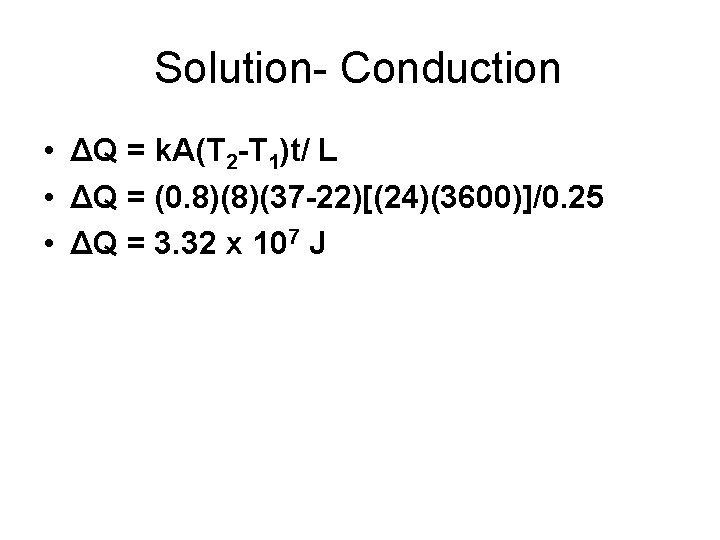
Solution- Conduction • ΔQ = k. A(T 2 -T 1)t/ L • ΔQ = (0. 8)(8)(37 -22)[(24)(3600)]/0. 25 • ΔQ = 3. 32 x 107 J
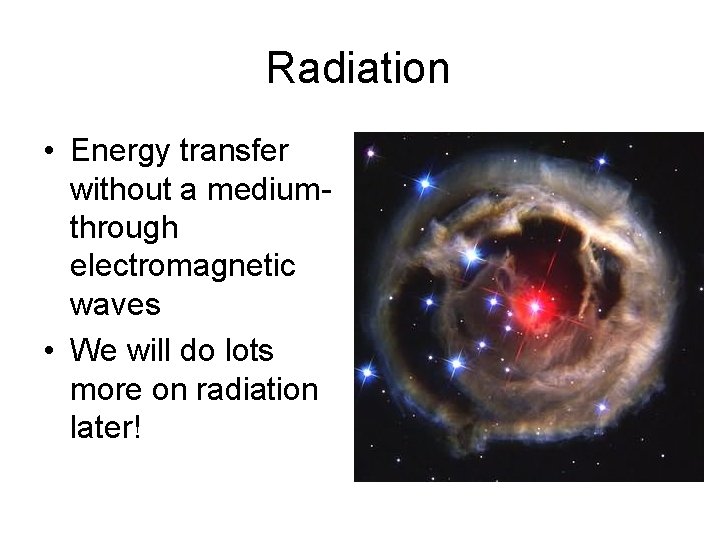
Radiation • Energy transfer without a medium- through electromagnetic waves • We will do lots more on radiation later!
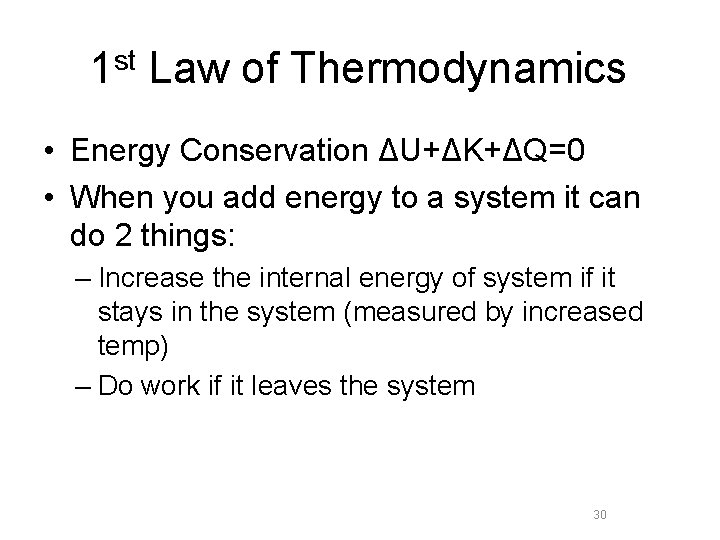
1 st Law of Thermodynamics • Energy Conservation ΔU+ΔK+ΔQ=0 • When you add energy to a system it can do 2 things: – Increase the internal energy of system if it stays in the system (measured by increased temp) – Do work if it leaves the system 30
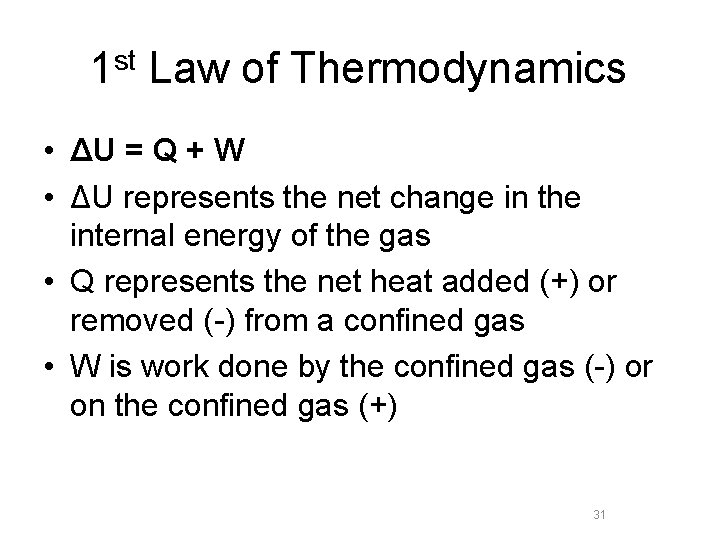
1 st Law of Thermodynamics • ΔU = Q + W • ΔU represents the net change in the internal energy of the gas • Q represents the net heat added (+) or removed (-) from a confined gas • W is work done by the confined gas (-) or on the confined gas (+) 31
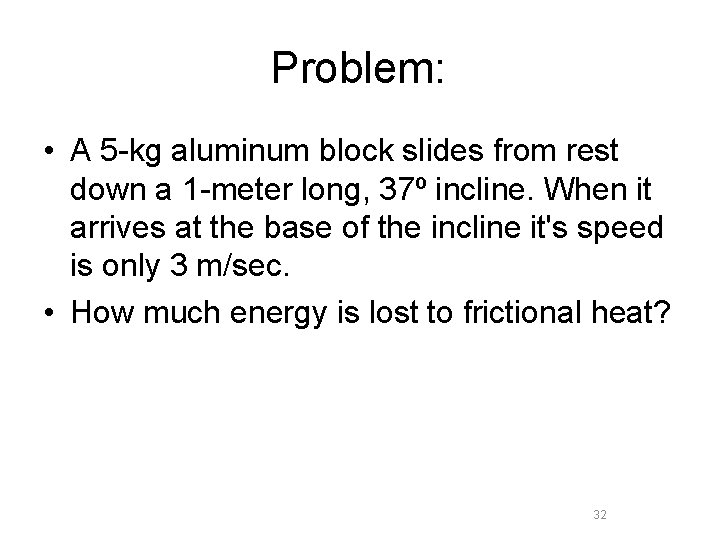
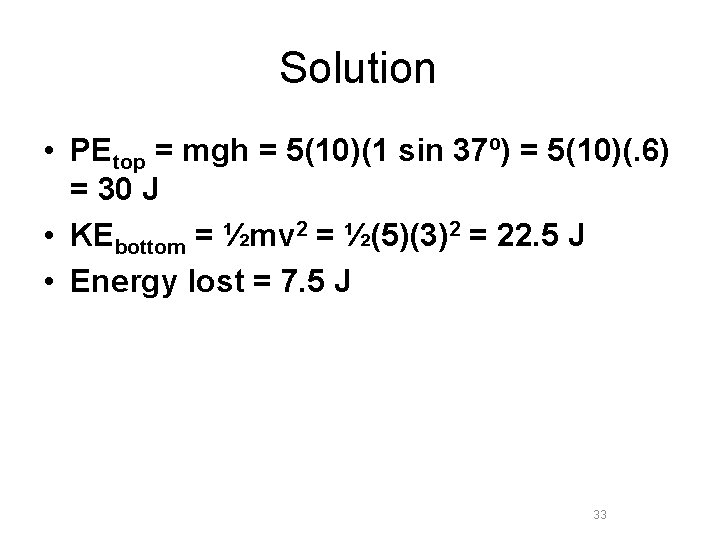
Problem: • A 5 -kg aluminum block slides from rest down a 1 -meter long, 37º incline. When it arrives at the base of the incline it's speed is only 3 m/sec. • How much energy is lost to frictional heat? 32
Solution • PEtop = mgh = 5(10)(1 sin 37º) = 5(10)(. 6) = 30 J • KEbottom = ½mv 2 = ½(5)(3)2 = 22. 5 J • Energy lost = 7. 5 J 33
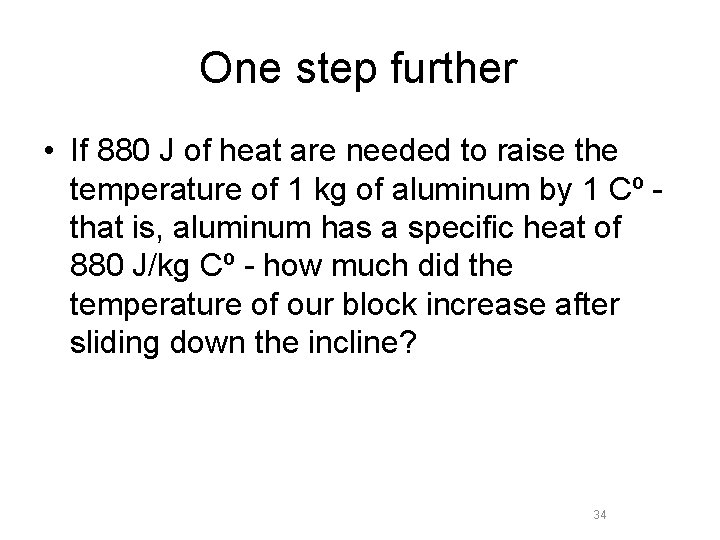
One step further • If 880 J of heat are needed to raise the temperature of 1 kg of aluminum by 1 Cº - that is, aluminum has a specific heat of 880 J/kg Cº - how much did the temperature of our block increase after sliding down the incline? 34
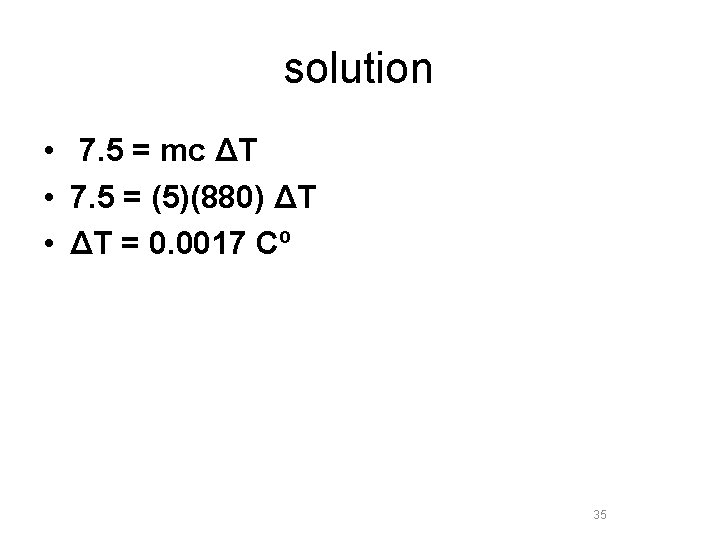
solution • 7. 5 = mc ΔT • 7. 5 = (5)(880) ΔT • ΔT = 0. 0017 Cº 35
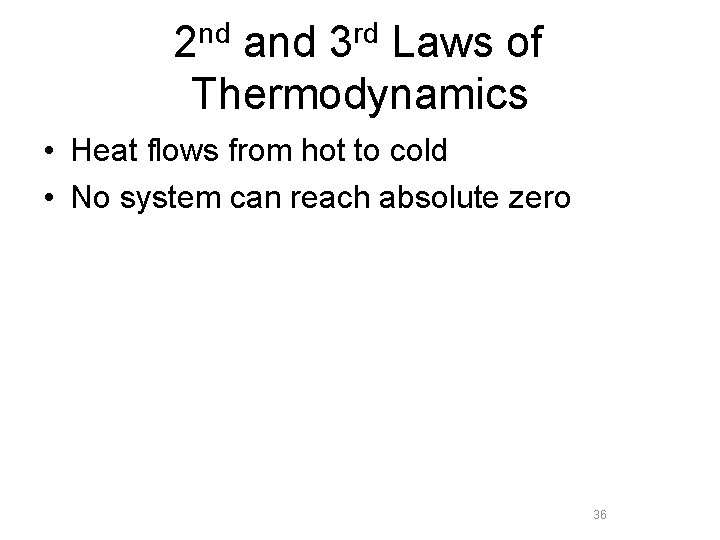
nd rd 2 and 3 Laws of Thermodynamics • Heat flows from hot to cold • No system can reach absolute zero 36
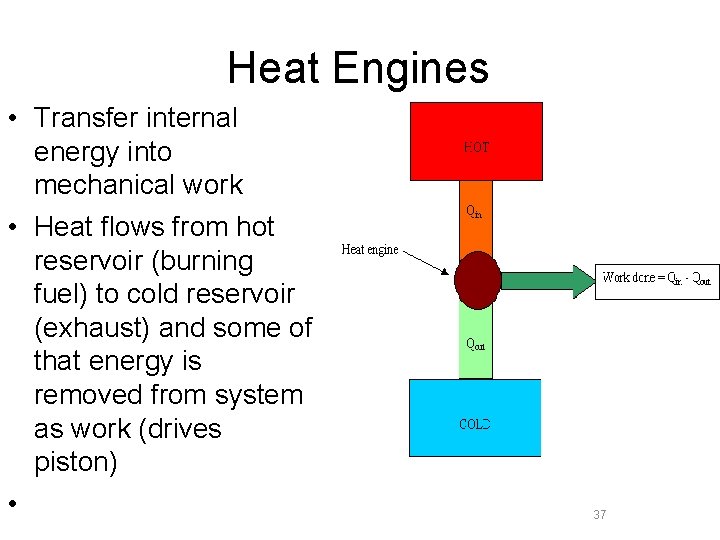
Heat Engines • Transfer internal energy into mechanical work • Heat flows from hot reservoir (burning fuel) to cold reservoir (exhaust) and some of that energy is removed from system as work (drives piston) • 37
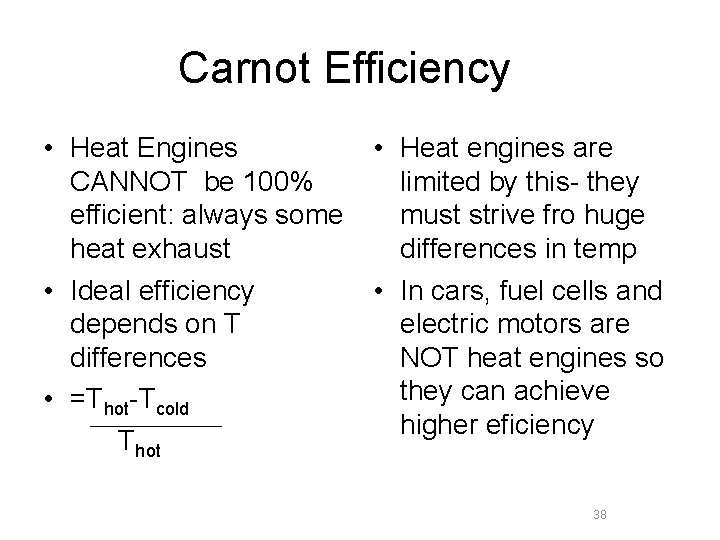
Carnot Efficiency • Heat Engines • Heat engines are CANNOT be 100% limited by this- they efficient: always some must strive fro huge heat exhaust differences in temp • Ideal efficiency • In cars, fuel cells and depends on T electric motors are differences NOT heat engines so they can achieve • =Thot-Tcold higher eficiency Thot 38
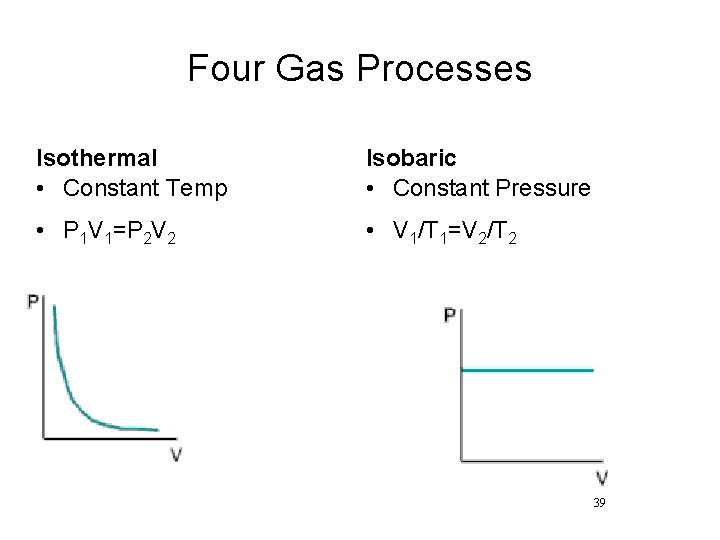
Four Gas Processes Isothermal • Constant Temp Isobaric • Constant Pressure • P 1 V 1=P 2 V 2 • V 1/T 1=V 2/T 2 39
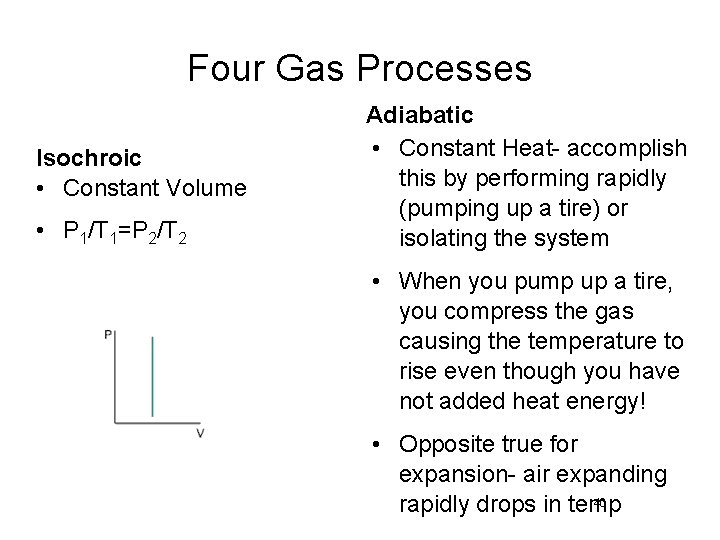
Four Gas Processes Isochroic • Constant Volume • P 1/T 1=P 2/T 2 Adiabatic • Constant Heat- accomplish this by performing rapidly (pumping up a tire) or isolating the system • When you pump up a tire, you compress the gas causing the temperature to rise even though you have not added heat energy! • Opposite true for expansion- air expanding 40 rapidly drops in temp