
Temperature and Heat Objectives Temperature Boyles and Charles
Temperature and Heat Objectives: • Temperature • Boyle’s and Charles’ Law • Heat • Specific Heat • Thermal Expansion
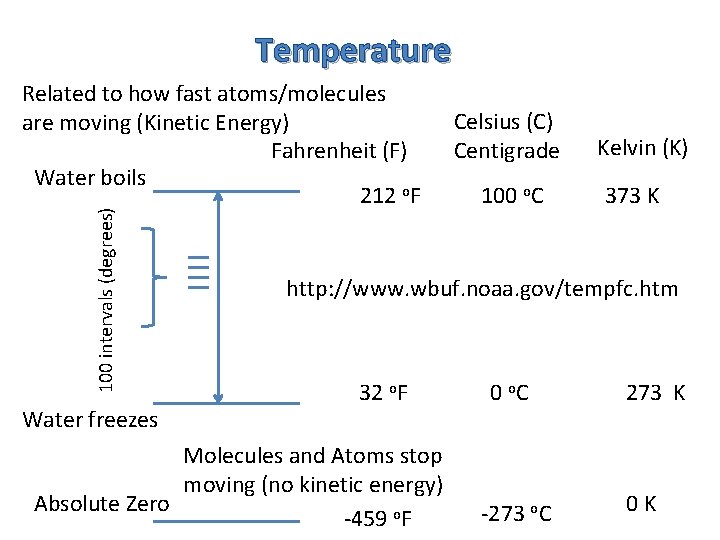
Temperature 100 intervals (degrees) Related to how fast atoms/molecules are moving (Kinetic Energy) Fahrenheit (F) Water boils 212 o. F Water freezes Celsius (C) Centigrade 100 o. C Kelvin (K) 373 K http: //www. wbuf. noaa. gov/tempfc. htm 32 o. F Molecules and Atoms stop moving (no kinetic energy) Absolute Zero -459 o. F 0 o. C -273 o. C 273 K 0 K
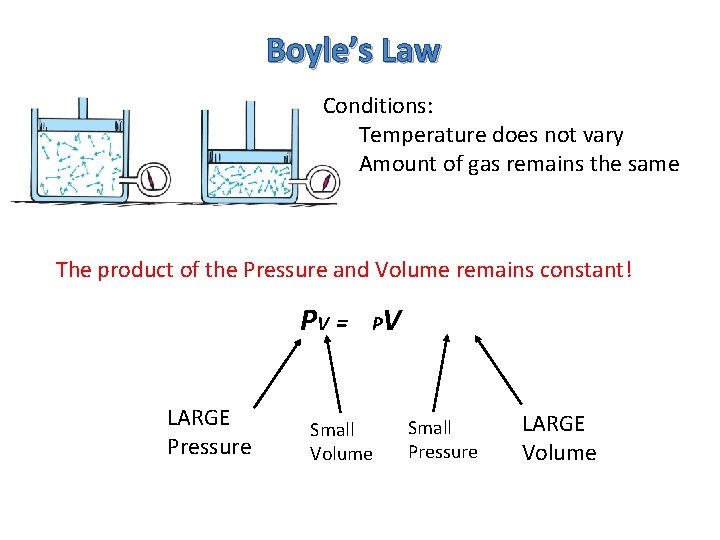
Boyle’s Law Conditions: Temperature does not vary Amount of gas remains the same The product of the Pressure and Volume remains constant! PV = LARGE Pressure P Small Volume V Small Pressure LARGE Volume
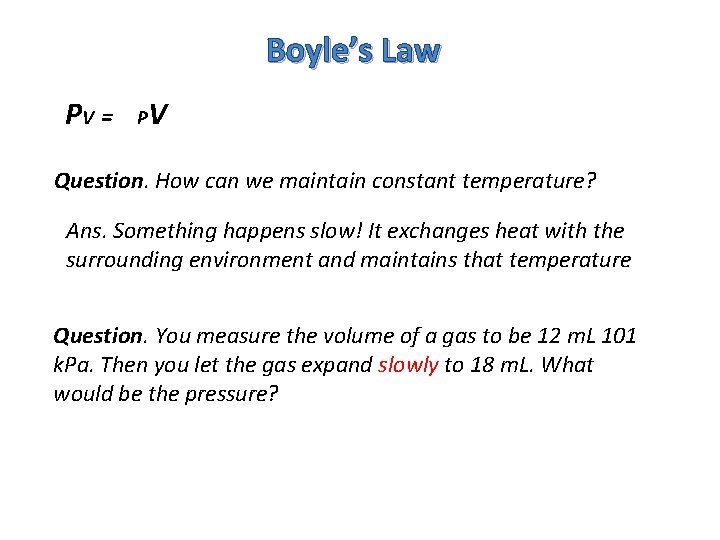
Boyle’s Law PV = P V Question. How can we maintain constant temperature? Ans. Something happens slow! It exchanges heat with the surrounding environment and maintains that temperature Question. You measure the volume of a gas to be 12 m. L 101 k. Pa. Then you let the gas expand slowly to 18 m. L. What would be the pressure?
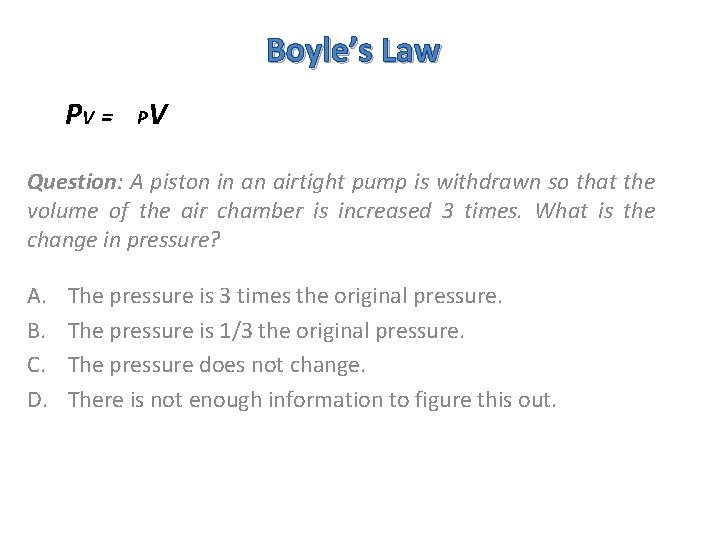
Boyle’s Law PV = P V Question: A piston in an airtight pump is withdrawn so that the volume of the air chamber is increased 3 times. What is the change in pressure? A. B. C. D. The pressure is 3 times the original pressure. The pressure is 1/3 the original pressure. The pressure does not change. There is not enough information to figure this out.
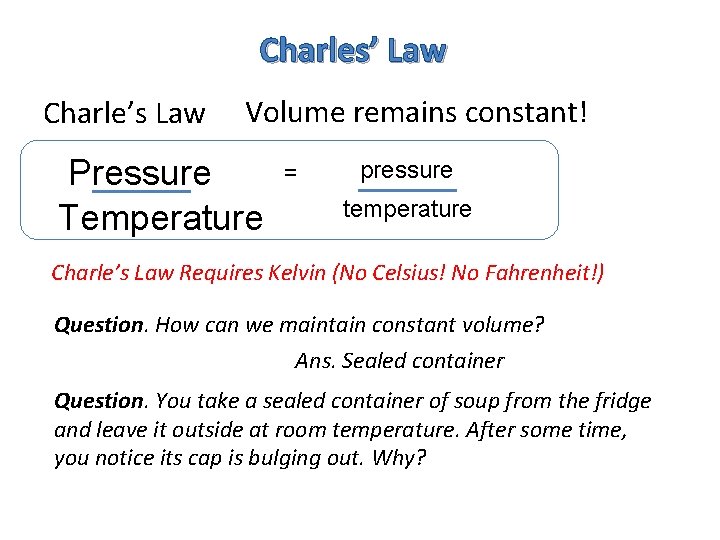
Charles’ Law Charle’s Law Volume remains constant! Pressure Temperature = pressure temperature Charle’s Law Requires Kelvin (No Celsius! No Fahrenheit!) Question. How can we maintain constant volume? Ans. Sealed container Question. You take a sealed container of soup from the fridge and leave it outside at room temperature. After some time, you notice its cap is bulging out. Why?
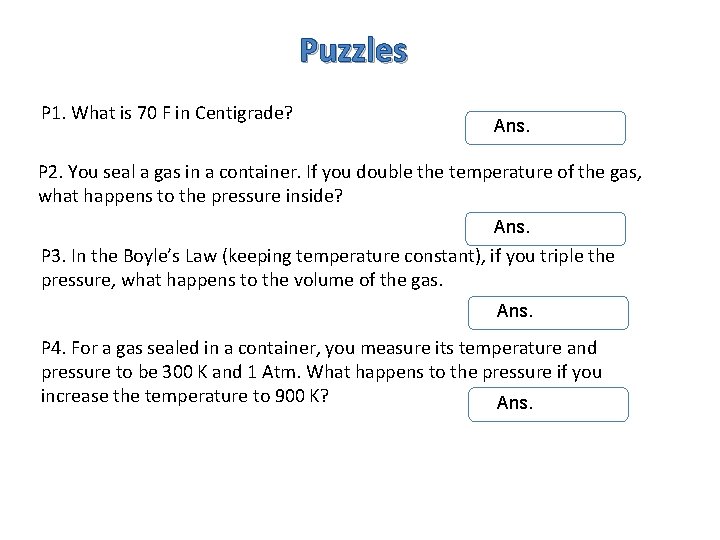
Puzzles P 1. What is 70 F in Centigrade? Ans. P 2. You seal a gas in a container. If you double the temperature of the gas, what happens to the pressure inside? Ans. P 3. In the Boyle’s Law (keeping temperature constant), if you triple the pressure, what happens to the volume of the gas. Ans. P 4. For a gas sealed in a container, you measure its temperature and pressure to be 300 K and 1 Atm. What happens to the pressure if you increase the temperature to 900 K? Ans.
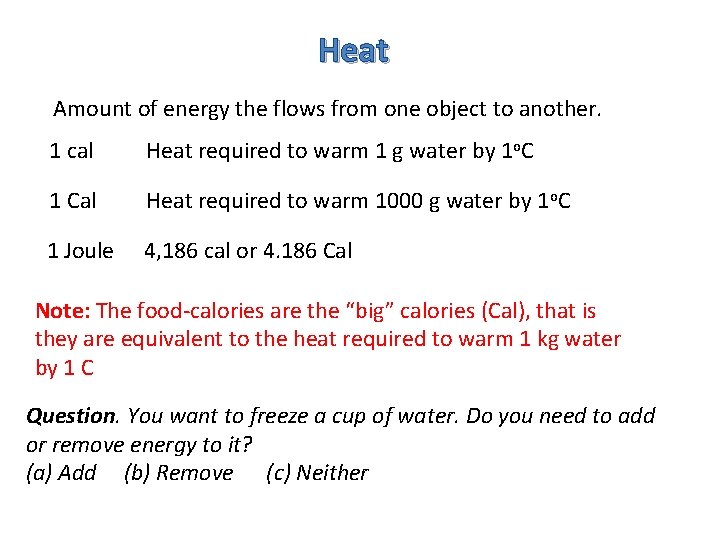
Heat Amount of energy the flows from one object to another. 1 cal Heat required to warm 1 g water by 1 o. C 1 Cal Heat required to warm 1000 g water by 1 o. C 1 Joule 4, 186 cal or 4. 186 Cal Note: The food-calories are the “big” calories (Cal), that is they are equivalent to the heat required to warm 1 kg water by 1 C Question. You want to freeze a cup of water. Do you need to add or remove energy to it? (a) Add (b) Remove (c) Neither
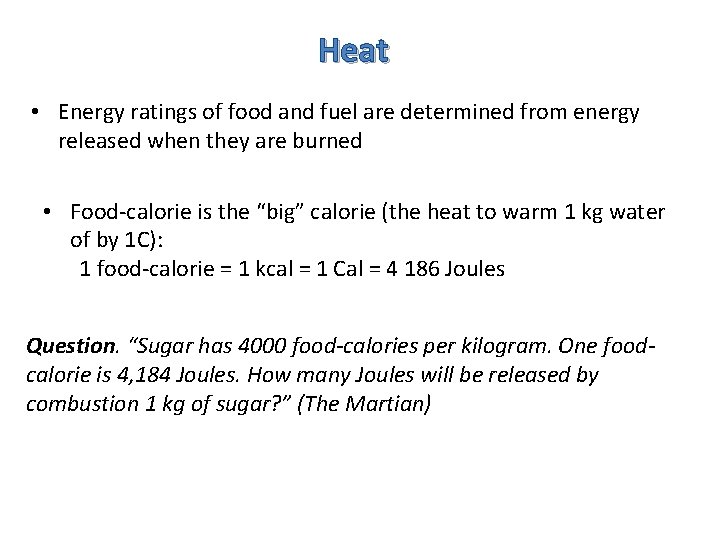
Heat • Energy ratings of food and fuel are determined from energy released when they are burned • Food-calorie is the “big” calorie (the heat to warm 1 kg water of by 1 C): 1 food-calorie = 1 kcal = 1 Cal = 4 186 Joules Question. “Sugar has 4000 food-calories per kilogram. One foodcalorie is 4, 184 Joules. How many Joules will be released by combustion 1 kg of sugar? ” (The Martian)
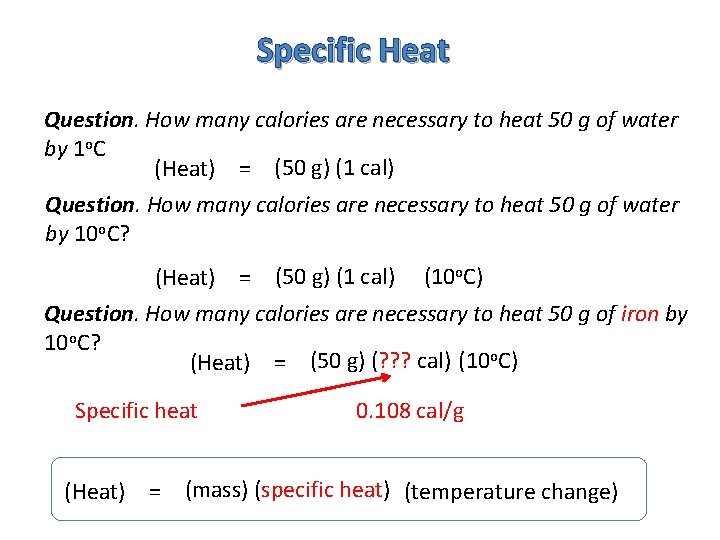
Specific Heat Question. How many calories are necessary to heat 50 g of water by 1 o. C (Heat) = (50 g) (1 cal) Question. How many calories are necessary to heat 50 g of water by 10 o. C? (Heat) = (50 g) (1 cal) (10 o. C) Question. How many calories are necessary to heat 50 g of iron by 10 o. C? (Heat) = (50 g) (? ? ? cal) (10 o. C) Specific heat 0. 108 cal/g (Heat) = (mass) (specific heat) (temperature change)
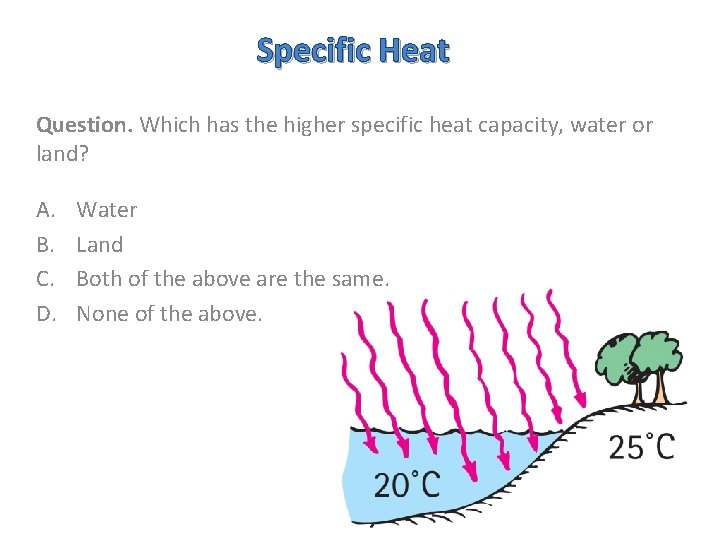
Specific Heat Question. Which has the higher specific heat capacity, water or land? A. B. C. D. Water Land Both of the above are the same. None of the above.
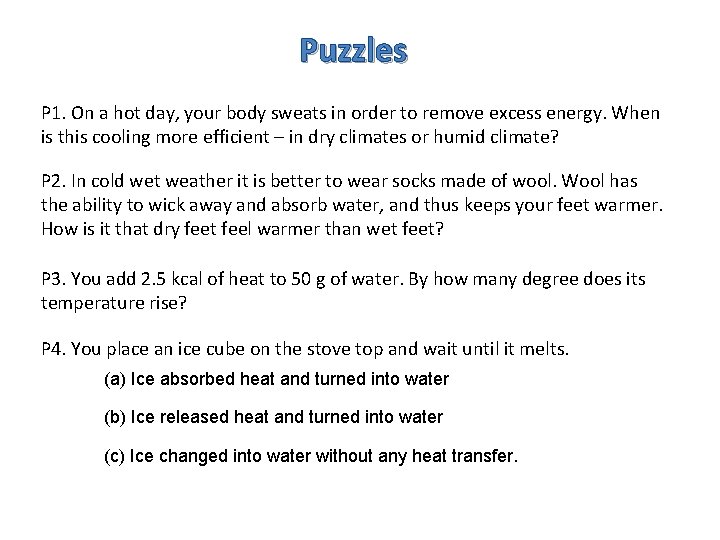
Puzzles P 1. On a hot day, your body sweats in order to remove excess energy. When is this cooling more efficient – in dry climates or humid climate? P 2. In cold wet weather it is better to wear socks made of wool. Wool has the ability to wick away and absorb water, and thus keeps your feet warmer. How is it that dry feet feel warmer than wet feet? P 3. You add 2. 5 kcal of heat to 50 g of water. By how many degree does its temperature rise? P 4. You place an ice cube on the stove top and wait until it melts. (a) Ice absorbed heat and turned into water (b) Ice released heat and turned into water (c) Ice changed into water without any heat transfer.
- Slides: 12