
TEM515 STATISTICAL ANALYSES WITH COMPUTER APPLICATION Lecture Series
- Slides: 30
TEM-515: STATISTICAL ANALYSES WITH COMPUTER APPLICATION Lecture Series 1: Introduction to Data Collection Lecture 1: Introduction to Statistics Instructor: Dr. Zahara Batool Date: 28 January 2015
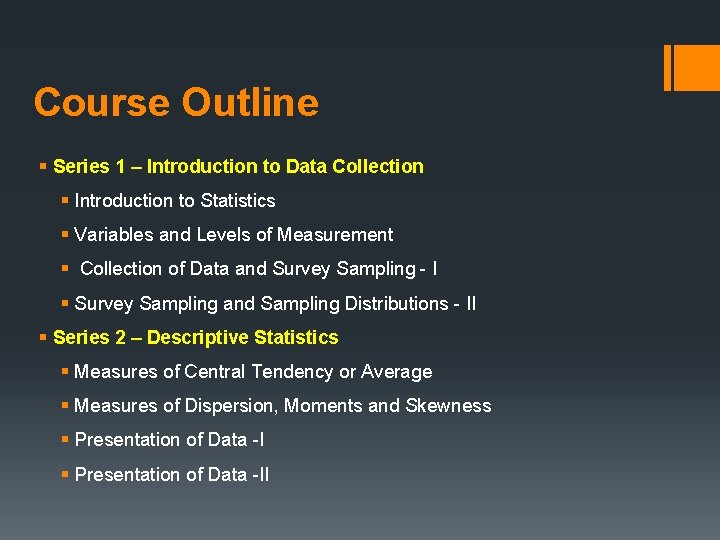
Course Outline § Series 1 – Introduction to Data Collection § Introduction to Statistics § Variables and Levels of Measurement § Collection of Data and Survey Sampling - I § Survey Sampling and Sampling Distributions - II § Series 2 – Descriptive Statistics § Measures of Central Tendency or Average § Measures of Dispersion, Moments and Skewness § Presentation of Data -II
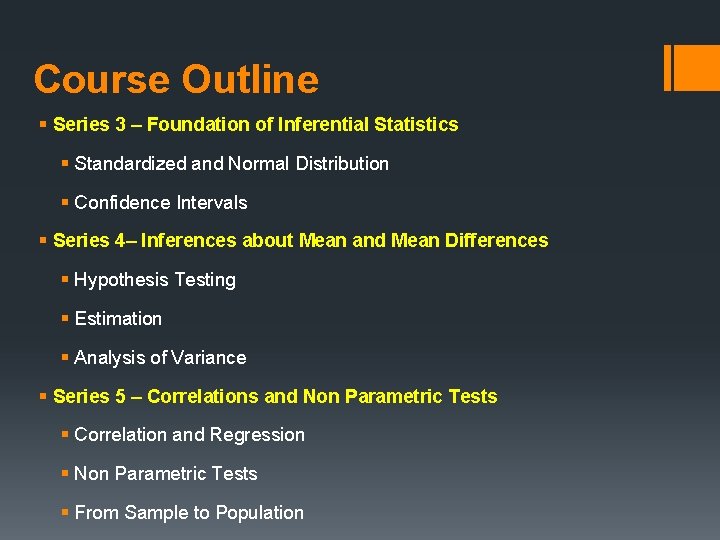
Course Outline § Series 3 – Foundation of Inferential Statistics § Standardized and Normal Distribution § Confidence Intervals § Series 4– Inferences about Mean and Mean Differences § Hypothesis Testing § Estimation § Analysis of Variance § Series 5 – Correlations and Non Parametric Tests § Correlation and Regression § Non Parametric Tests § From Sample to Population
Resources § Introduction to statistical theory (part -1) (Chaudhry and Kamal, 2009) § Introduction to statistical theory (part -2) (Chaudhry and Kamal, 2009) § PASW Statistics 17 Made Simple (Kinner and Gray, 2009) § SPSS 16. 0 Statistical Procedures Companion (Norusis, 2008)
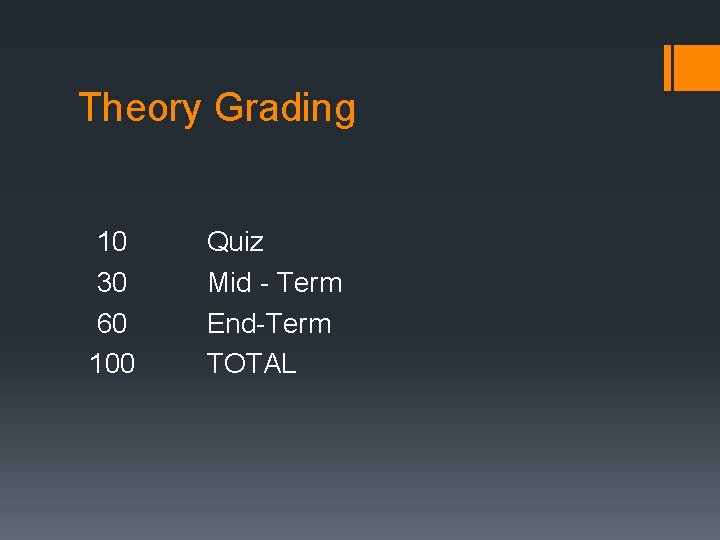
Theory Grading 10 30 60 100 Quiz Mid - Term End-Term TOTAL
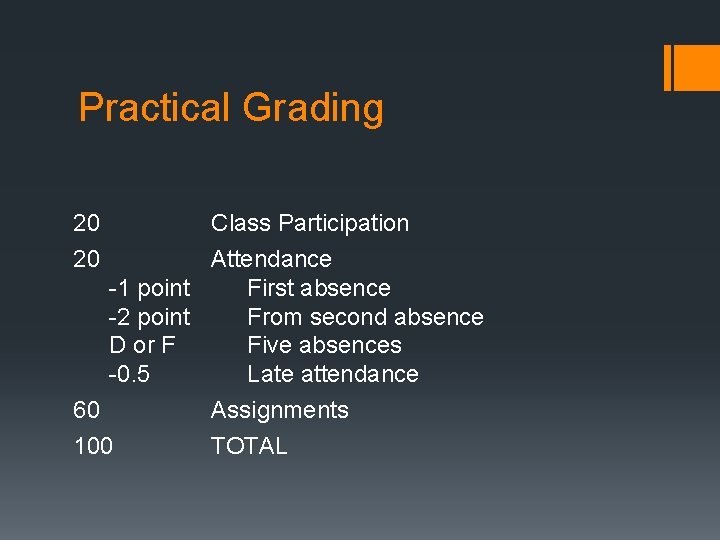
Practical Grading 20 20 Class Participation Attendance -1 point First absence -2 point From second absence D or F Five absences -0. 5 Late attendance 60 Assignments 100 TOTAL
Lecture 1 Content Outline § Meaning of Statistics § Population and Statistics § Descriptive and inferential statistics § Method and Design of Research Studies § Use of Statistical information § Statistical Notation
Meaning of Statistics § Statistics is the study of how to collect, organize, analyse, and interpret numerical information from data. § The word ‘statistics’ come from the Latin word status, meaning a political state, originally meant information useful to the state.
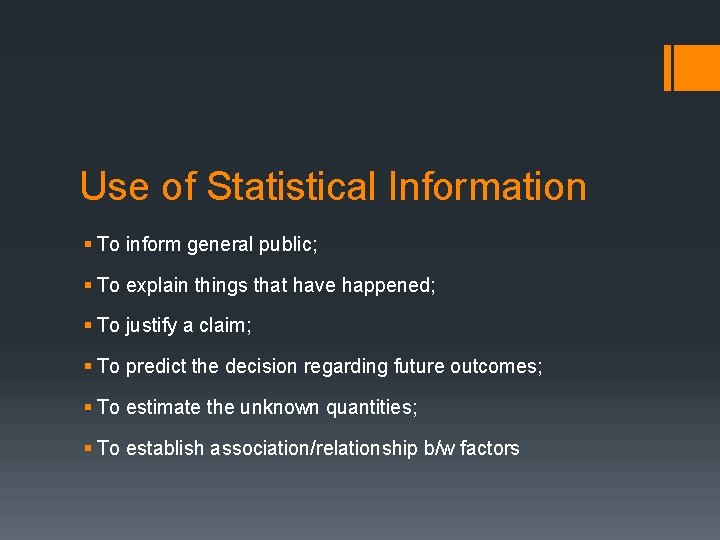
Use of Statistical Information § To inform general public; § To explain things that have happened; § To justify a claim; § To predict the decision regarding future outcomes; § To estimate the unknown quantities; § To establish association/relationship b/w factors
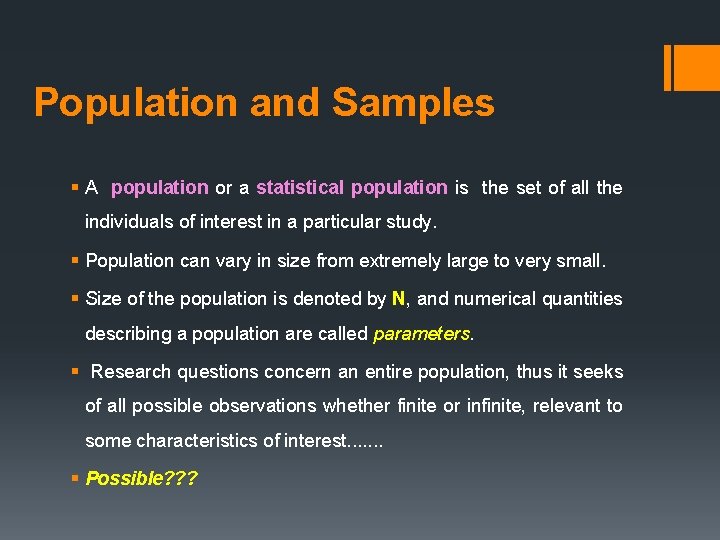
Population and Samples § A population or a statistical population is the set of all the individuals of interest in a particular study. § Population can vary in size from extremely large to very small. § Size of the population is denoted by N, and numerical quantities describing a population are called parameters. § Research questions concern an entire population, thus it seeks of all possible observations whether finite or infinite, relevant to some characteristics of interest. . . . § Possible? ? ?
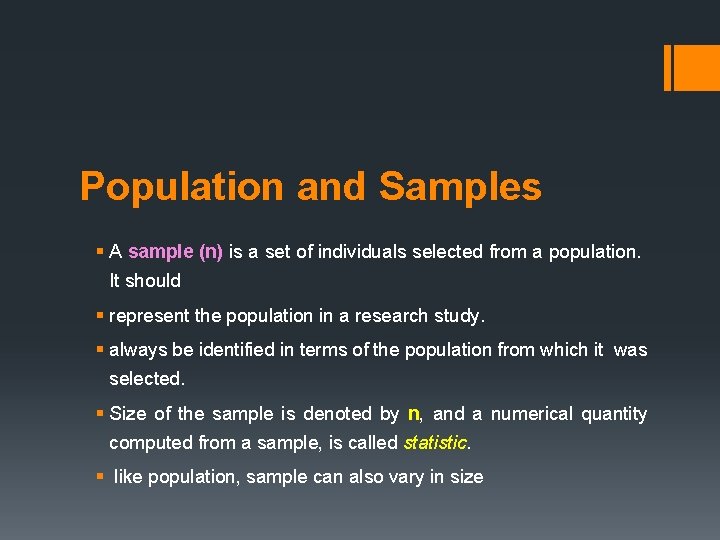
Population and Samples § A sample (n) is a set of individuals selected from a population. It should § represent the population in a research study. § always be identified in terms of the population from which it was selected. § Size of the sample is denoted by n, and a numerical quantity computed from a sample, is called statistic. § like population, sample can also vary in size
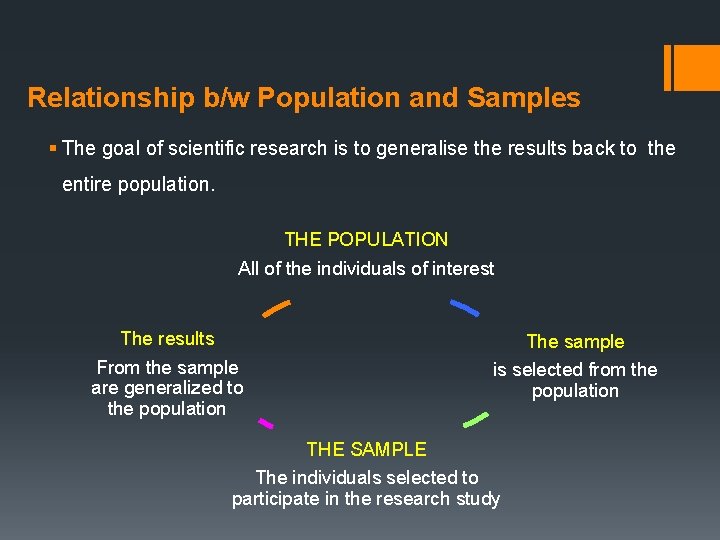
Relationship b/w Population and Samples § The goal of scientific research is to generalise the results back to the entire population. THE POPULATION All of the individuals of interest The results The sample From the sample are generalized to the population is selected from the population THE SAMPLE The individuals selected to participate in the research study
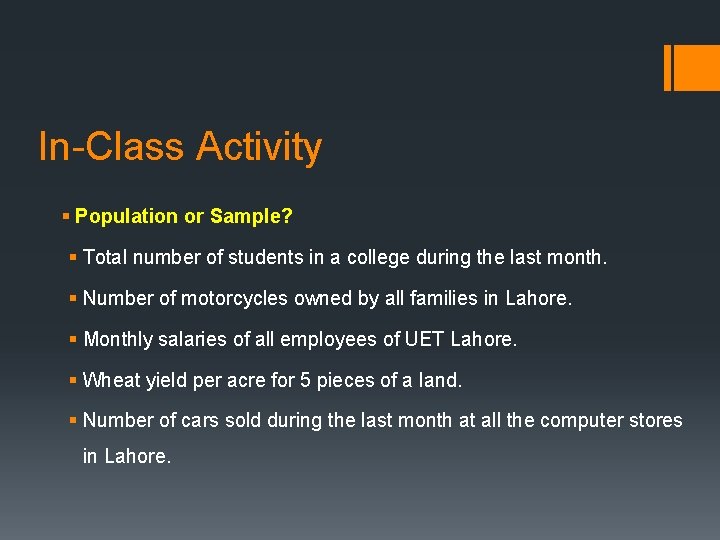
In-Class Activity § Population or Sample? § Total number of students in a college during the last month. § Number of motorcycles owned by all families in Lahore. § Monthly salaries of all employees of UET Lahore. § Wheat yield per acre for 5 pieces of a land. § Number of cars sold during the last month at all the computer stores in Lahore.
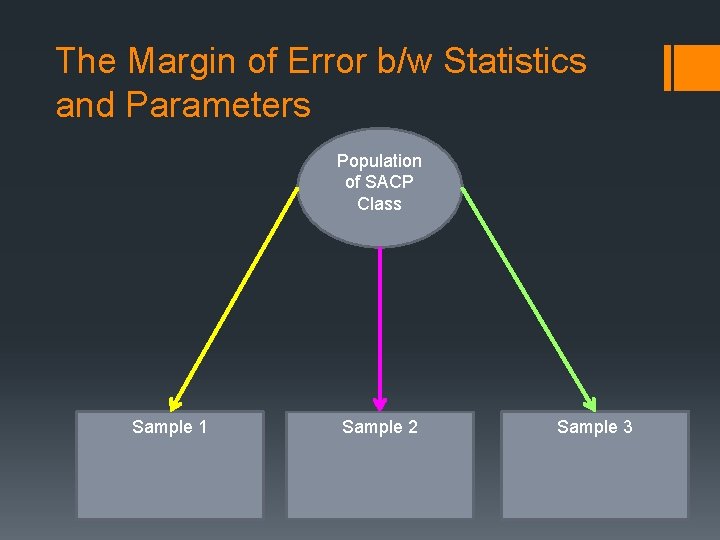
The Margin of Error b/w Statistics and Parameters Population of SACP Class Sample 1 Sample 2 Sample 3
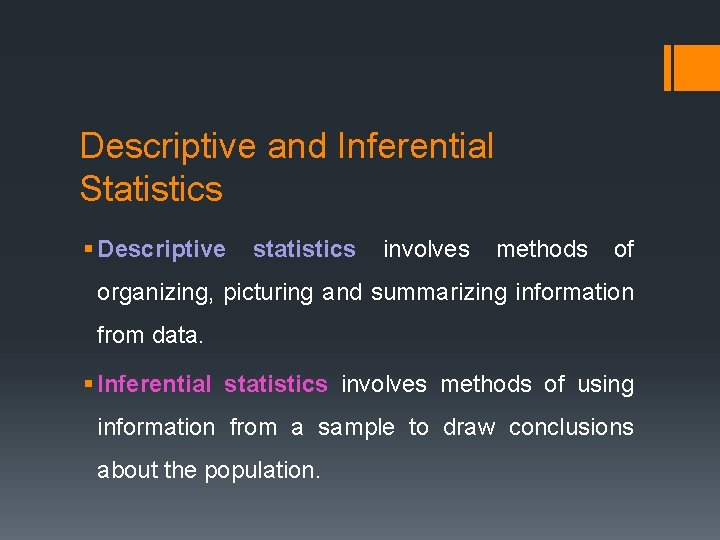
Descriptive and Inferential Statistics § Descriptive statistics involves methods of organizing, picturing and summarizing information from data. § Inferential statistics involves methods of using information from a sample to draw conclusions about the population.
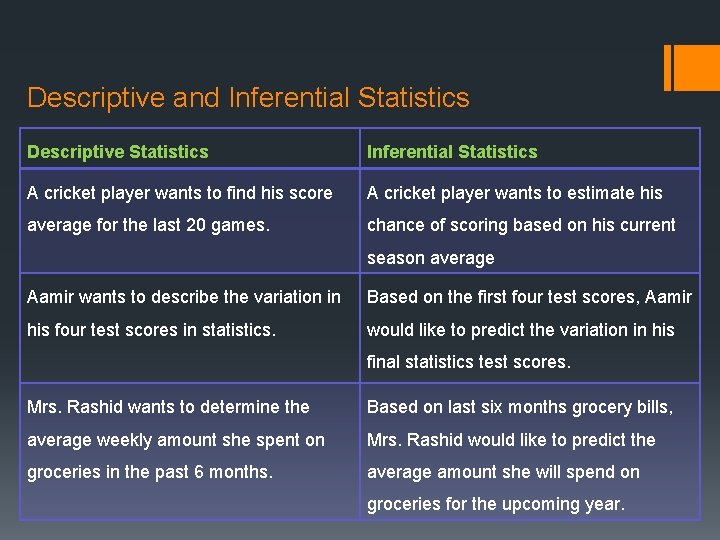
Descriptive and Inferential Statistics Descriptive Statistics Inferential Statistics A cricket player wants to find his score A cricket player wants to estimate his average for the last 20 games. chance of scoring based on his current season average Aamir wants to describe the variation in Based on the first four test scores, Aamir his four test scores in statistics. would like to predict the variation in his final statistics test scores. Mrs. Rashid wants to determine the Based on last six months grocery bills, average weekly amount she spent on Mrs. Rashid would like to predict the groceries in the past 6 months. average amount she will spend on groceries for the upcoming year.
Characteristics of Statistics § Statistics deals with the behaviour of aggregates or large groups of data. It has nothing to do with what is happening to a particular individual or object of the aggregate. § Statistics deals with aggregates of observations of the same kind rather than isolated figures. § Statistics deals with variability that obscure underlying patterns. No two objects in this universe are exactly alike. If they were, there would have been no statistical problem. § Statistics deals with uncertainties as every process of getting observations whether controlled or uncontrolled, involves deficiencies or chance variation. That is why we have to talk in terms of probability.
Characteristics of Statistics (contd. ) § Statistics deals with those characteristics or aspects of things which can be described numerically either by counts or measurements. § Statistics deals with those aggregates which are subject to a number of random causes, e. g. the height of persons are subject to a number of causes such as race, age, diet, habits, climate and so forth. § Statistical laws are valid on the average or in the long run. There is no guarantee that a certain law will hold in all cases. Statistical inference is therefore made in the face of uncertainty. § Statistical results might be misleading and incorrect if sufficient care in collecting, processing and interpreting the data is not exercised or if the statistical data are handled by a person who is not well versed in the subject matter of statistics.
Relationship between variables § Variable A variable is a characteristic or condition that changes or has different values for different individuals. § Constant A constant is a characteristic or condition that does not vary but is the same for every individual. There a variety of research methods for obtaining observations and investigating the relationship between variables.
The Scientific Method and the Design of Research Studies § The correlation method § The experimental method § The independent and dependent variables
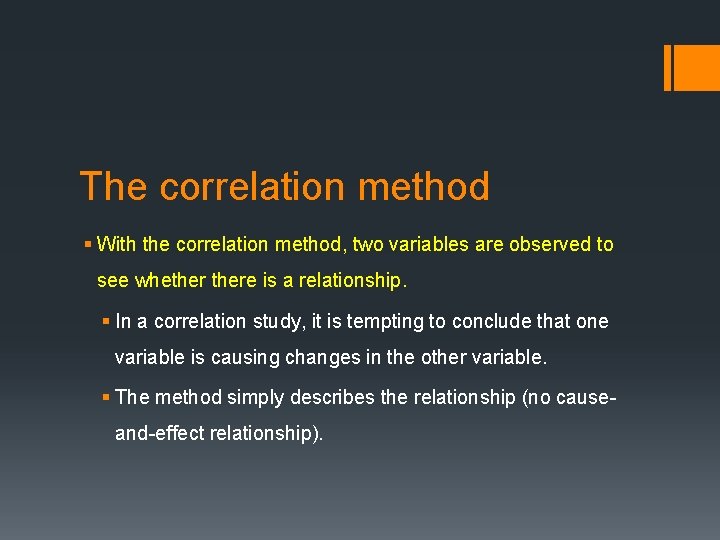
The correlation method § With the correlation method, two variables are observed to see whethere is a relationship. § In a correlation study, it is tempting to conclude that one variable is causing changes in the other variable. § The method simply describes the relationship (no causeand-effect relationship).
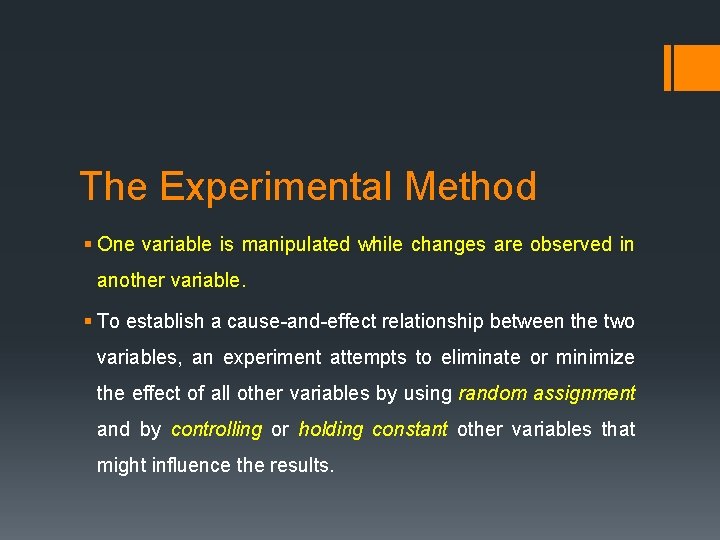
The Experimental Method § One variable is manipulated while changes are observed in another variable. § To establish a cause-and-effect relationship between the two variables, an experiment attempts to eliminate or minimize the effect of all other variables by using random assignment and by controlling or holding constant other variables that might influence the results.
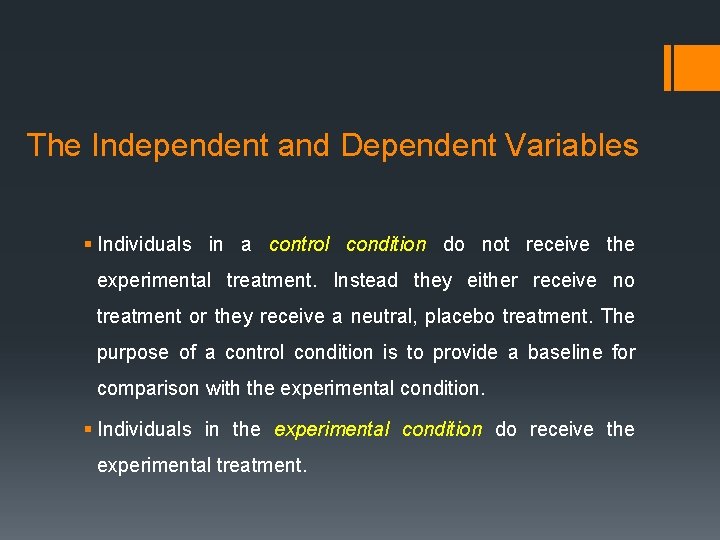
The Independent and Dependent Variables § Individuals in a control condition do not receive the experimental treatment. Instead they either receive no treatment or they receive a neutral, placebo treatment. The purpose of a control condition is to provide a baseline for comparison with the experimental condition. § Individuals in the experimental condition do receive the experimental treatment.
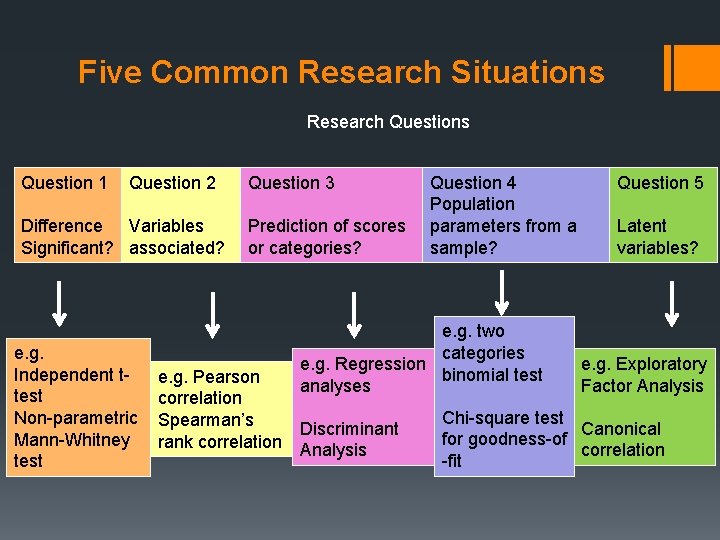
Five Common Research Situations Research Questions Question 1 Question 2 Difference Variables Significant? associated? e. g. Independent ttest Non-parametric Mann-Whitney test Question 3 Prediction of scores or categories? Question 4 Population parameters from a sample? e. g. two categories e. g. Regression binomial test analyses e. g. Pearson correlation Spearman’s Discriminant rank correlation Analysis Question 5 Latent variables? e. g. Exploratory Factor Analysis Chi-square test Canonical for goodness-of correlation -fit
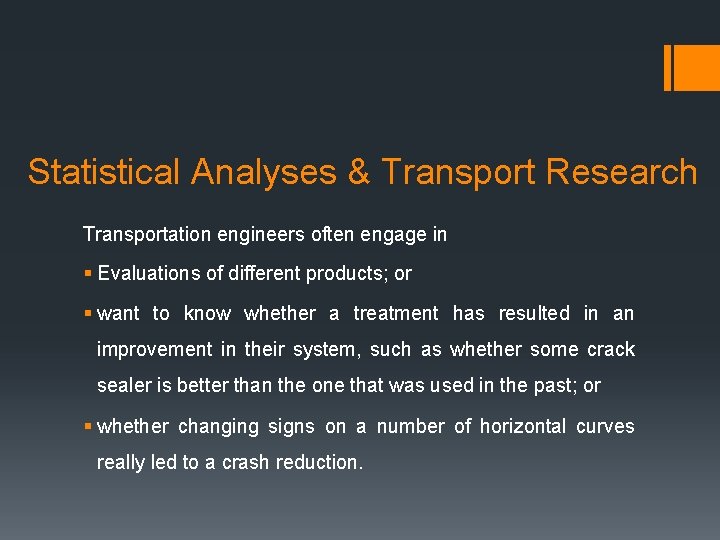
Statistical Analyses & Transport Research Transportation engineers often engage in § Evaluations of different products; or § want to know whether a treatment has resulted in an improvement in their system, such as whether some crack sealer is better than the one that was used in the past; or § whether changing signs on a number of horizontal curves really led to a crash reduction.
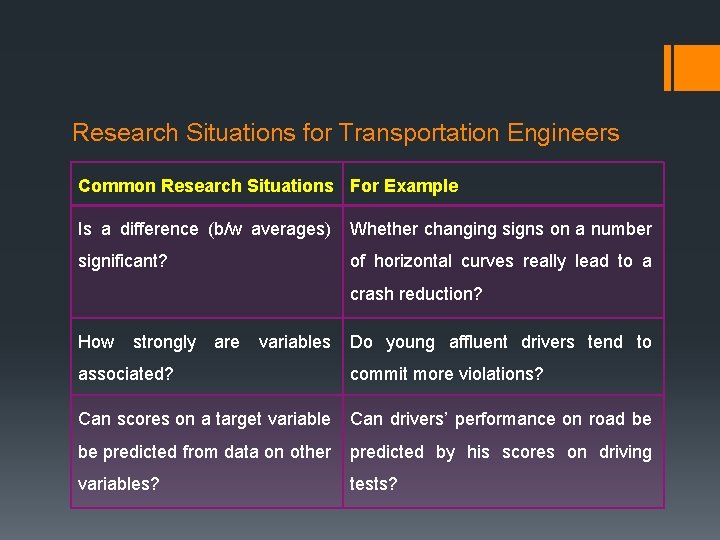
Research Situations for Transportation Engineers Common Research Situations For Example Is a difference (b/w averages) Whether changing signs on a number significant? of horizontal curves really lead to a crash reduction? How strongly are variables Do young affluent drivers tend to associated? commit more violations? Can scores on a target variable Can drivers’ performance on road be be predicted from data on other predicted by his scores on driving variables? tests?
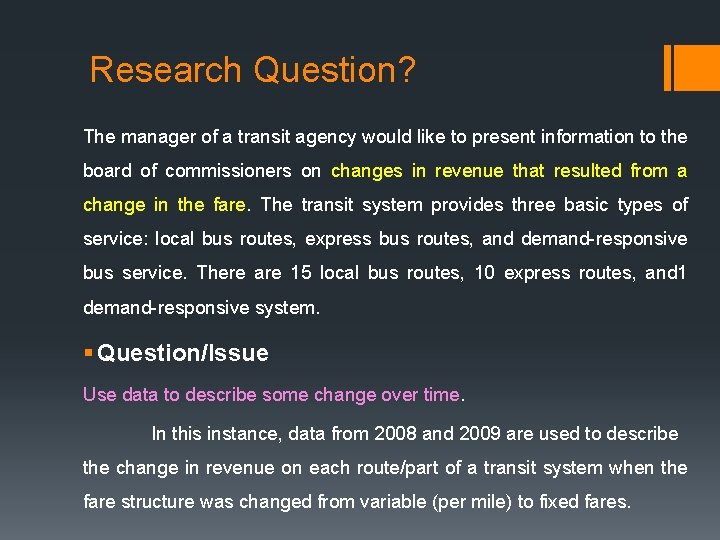
Research Question? The manager of a transit agency would like to present information to the board of commissioners on changes in revenue that resulted from a change in the fare. The transit system provides three basic types of service: local bus routes, express bus routes, and demand-responsive bus service. There are 15 local bus routes, 10 express routes, and 1 demand-responsive system. § Question/Issue Use data to describe some change over time. In this instance, data from 2008 and 2009 are used to describe the change in revenue on each route/part of a transit system when the fare structure was changed from variable (per mile) to fixed fares.
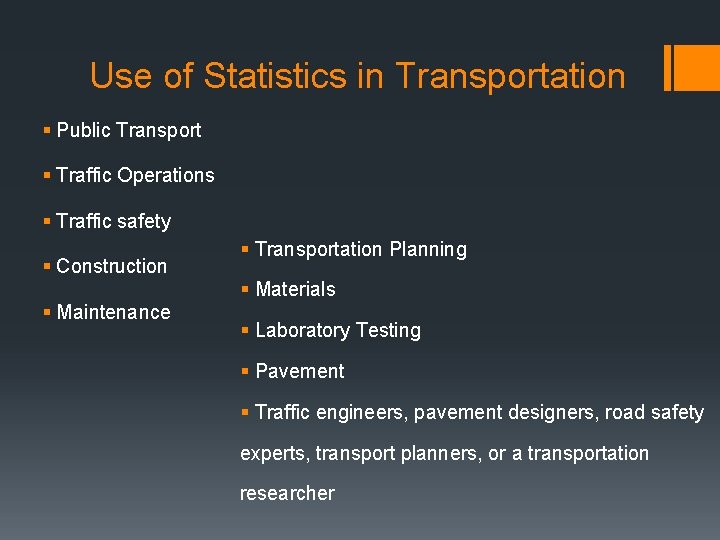
Use of Statistics in Transportation § Public Transport § Traffic Operations § Traffic safety § Construction § Maintenance § Transportation Planning § Materials § Laboratory Testing § Pavement § Traffic engineers, pavement designers, road safety experts, transport planners, or a transportation researcher
Further Reading § Chapter 1 Statistics for behavioral sciences with study guide (Gravetter and Wallnau, ) § Chapter 1 Introduction to statistical theory (part -1) (Chaudhry and Kamal, 2009)
Lecture 1: Introduction to Statistics Thank you for listening