
TELPAS and TELPAS Alternate Updates 2019 Title III
- Slides: 45
TELPAS and TELPAS Alternate Updates 2019 Title III Symposium Esmeralda Cavazos, Manager Lois Neumeyer, Program Specialist Student Assessment Division 1
TELPAS and TELPAS Alternate Updates This session will include information on the following: § General Updates § TELPAS § 2019 TELPAS Results § TELPAS Alternate § 2019 TELPAS Alternate Results 2
General Updates 3
Language Proficiency Assessment Committee (LPAC) Training and Resources § A separate LPAC training will be provided to Education Service Centers (ESCs) in mid-October. • ESCs will provide this training to the districts in their region. § LPAC resources will be streamlined such as combining the STAAR and TELPAS/TELPAS Alternate Decision-Making Guides. § The LPAC’s authority for accommodation decisions have been revised in the policy documents to include only: • • • Content and Language Supports Extra Time (Same Day) Oral/Signed Administration 4
TELPAS 5
Texas English Language Proficiency Assessment System (TELPAS) The TELPAS assessment components include the following: § Grades K-1 • holistically rated observational assessments of listening, speaking, reading and writing § Grades 2 -12 • • • multiple-choice online reading tests in six grade clusters (2, 3, 4 -5, 6 -7, 8 -9, 10 -12) online listening and speaking tests in four grade clusters (2 -3, 4 -5, 6 -8, 9 -12) holistically rated student writing collections 6
Technology Changes for TELPAS Upd ate § Communication was sent on July 15, 2019 to inform to district and education service center testing coordinators about upcoming technology changes. § Technology updates for the 2019 -2020 school year include the following: • • An update of the Test. Nav application was released on July 19, 2019. After that date, all users must install the updated version prior to any 2020 administration activities. It is recommended that the old version be deleted before downloading and installing the new version. Support Ending for Certain Operating Systems and Devices 7
TELPAS Manuals: Raters and Test Administrators NEW § Based on feedback from the field and advisory groups, the TELPAS manuals organization will be updated in the 2019 -2020 school year. • • § TELPAS Rater Manual will only be online and not shipped to districts. TELPAS Test Administrator Manual will be online as well as printed and shipped to districts. Both manuals will be posted on the TELPAS Resources webpage and in the District and Campus Coordinator Resource (DCCR). 8
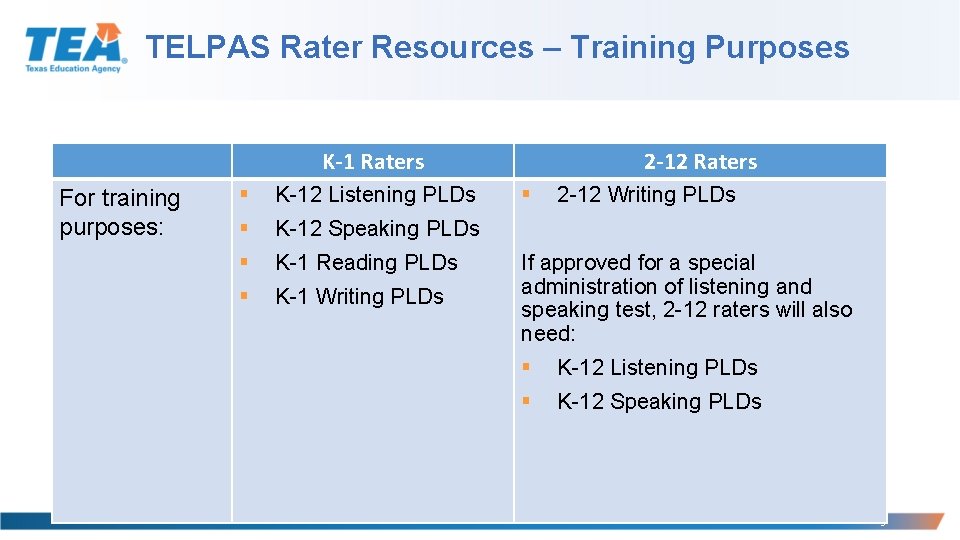
TELPAS Rater Resources – Training Purposes K-1 Raters For training purposes: § K-12 Listening PLDs § K-12 Speaking PLDs § K-1 Reading PLDs § K-1 Writing PLDs 2 -12 Raters § 2 -12 Writing PLDs If approved for a special administration of listening and speaking test, 2 -12 raters will also need: § K-12 Listening PLDs § K-12 Speaking PLDs 9
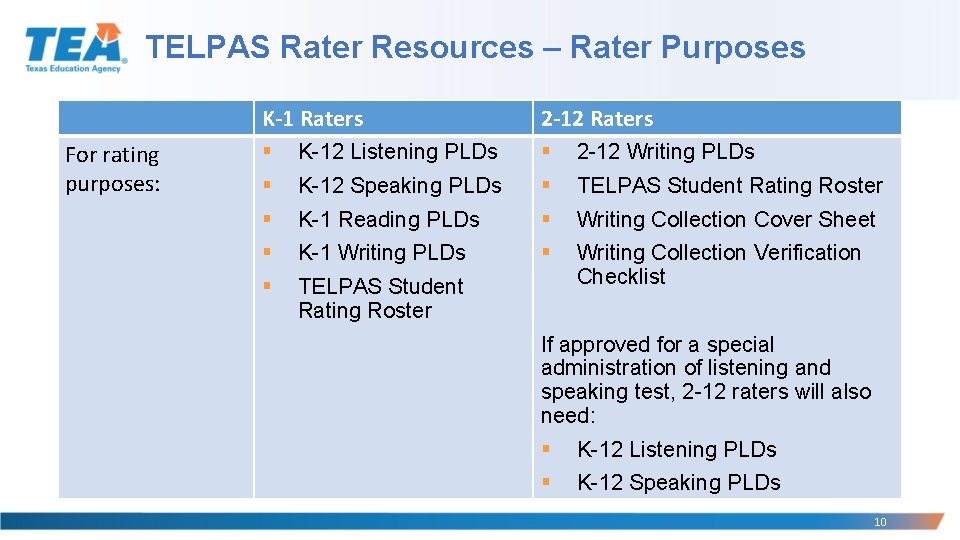
TELPAS Rater Resources – Rater Purposes For rating purposes: K-1 Raters 2 -12 Raters § K-12 Listening PLDs § 2 -12 Writing PLDs § K-12 Speaking PLDs § TELPAS Student Rating Roster § K-1 Reading PLDs § Writing Collection Cover Sheet § K-1 Writing PLDs § § TELPAS Student Rating Roster Writing Collection Verification Checklist If approved for a special administration of listening and speaking test, 2 -12 raters will also need: § K-12 Listening PLDs § K-12 Speaking PLDs 10
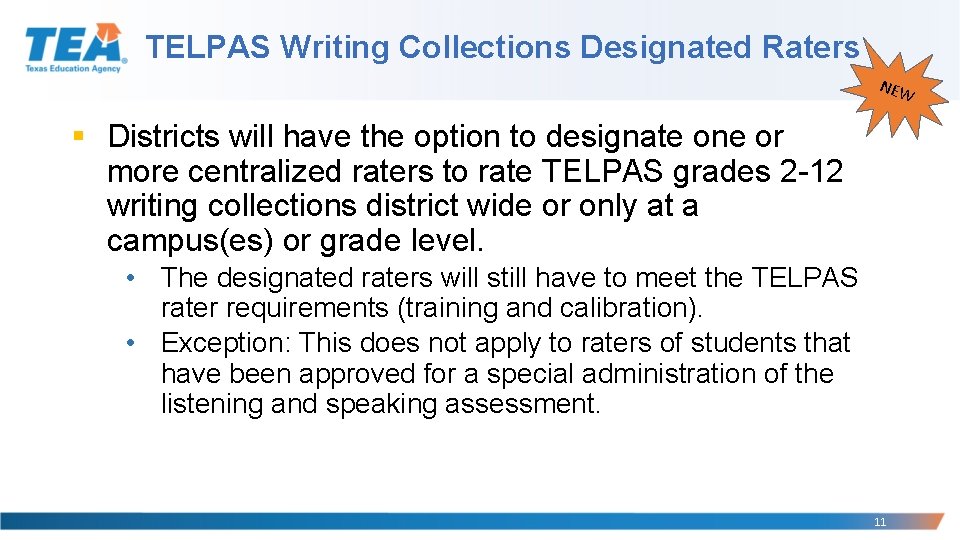
TELPAS Writing Collections Designated Raters NEW § Districts will have the option to designate one or more centralized raters to rate TELPAS grades 2 -12 writing collections district wide or only at a campus(es) or grade level. • The designated raters will still have to meet the TELPAS rater requirements (training and calibration). • Exception: This does not apply to raters of students that have been approved for a special administration of the listening and speaking assessment. 11
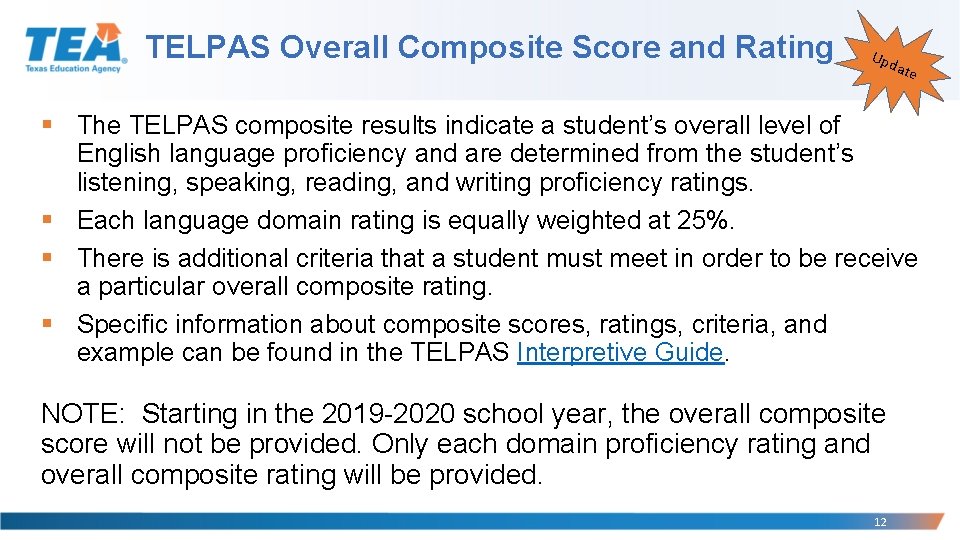
TELPAS Overall Composite Score and Rating Upd ate § The TELPAS composite results indicate a student’s overall level of English language proficiency and are determined from the student’s listening, speaking, reading, and writing proficiency ratings. § Each language domain rating is equally weighted at 25%. § There is additional criteria that a student must meet in order to be receive a particular overall composite rating. § Specific information about composite scores, ratings, criteria, and example can be found in the TELPAS Interpretive Guide. NOTE: Starting in the 2019 -2020 school year, the overall composite score will not be provided. Only each domain proficiency rating and overall composite rating will be provided. 12
TELPAS Testing: Allowable Activities Test Administrators: § TAs may read the directions in the gray-box directions. • The gray-box directions may be read, clarified, translated to student at the student’s request. Students: § Students may prepare their spoken response by planning or writing out their response using either the notepad tool in Test. Nav or using the scratch paper and pencil provided during the test administration. § Best practice – Check your answers, such as making sure an answer is selected for the reading and listening items and listen to his/her spoken response to make sure it is audible. § Listen to the recorded prompts as many times as needed. 13
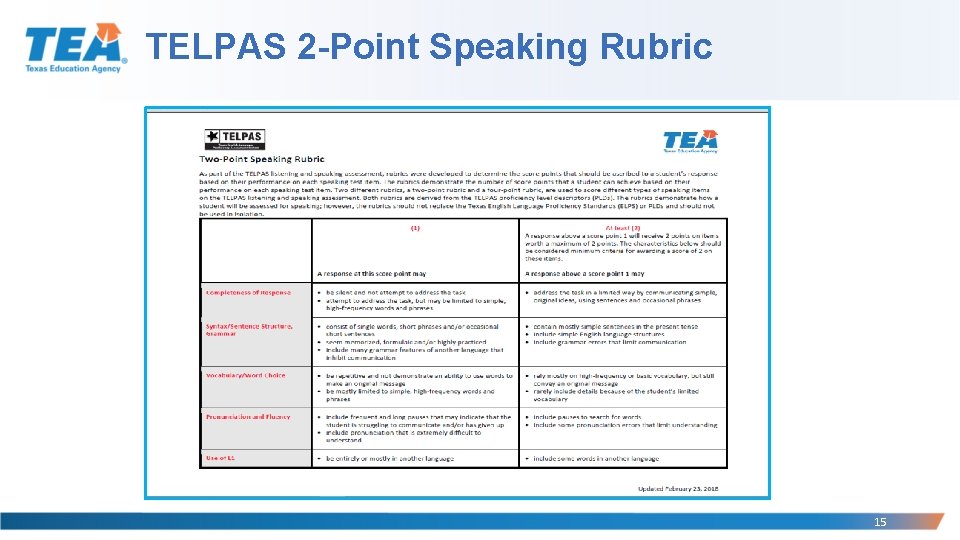
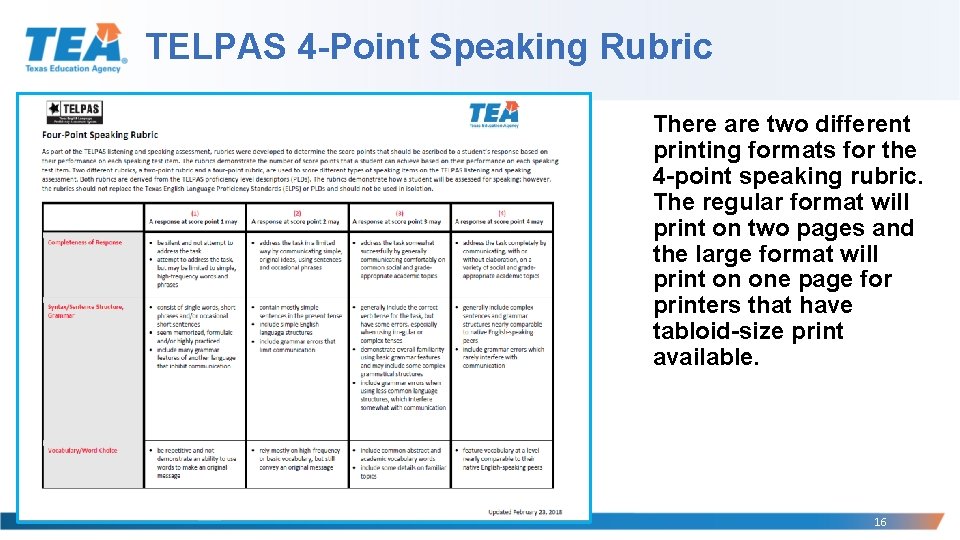
Listening & Speaking Rubrics Speaking prompts are scored according to a 2 - or 4 - point rubric depending on the item type. § Two-point item types are fairly simple, such as making a prediction based on a picture stimulus or using a simple map to provide directions. § Four-point item types are more open ended, such as using a series of pictures to explain a multi-step process, comparing and contrasting, or taking a position on an issue and defending that position. 14
TELPAS 2 -Point Speaking Rubric 15
TELPAS 4 -Point Speaking Rubric There are two different printing formats for the 4 -point speaking rubric. The regular format will print on two pages and the large format will print on one page for printers that have tabloid-size print available. 16
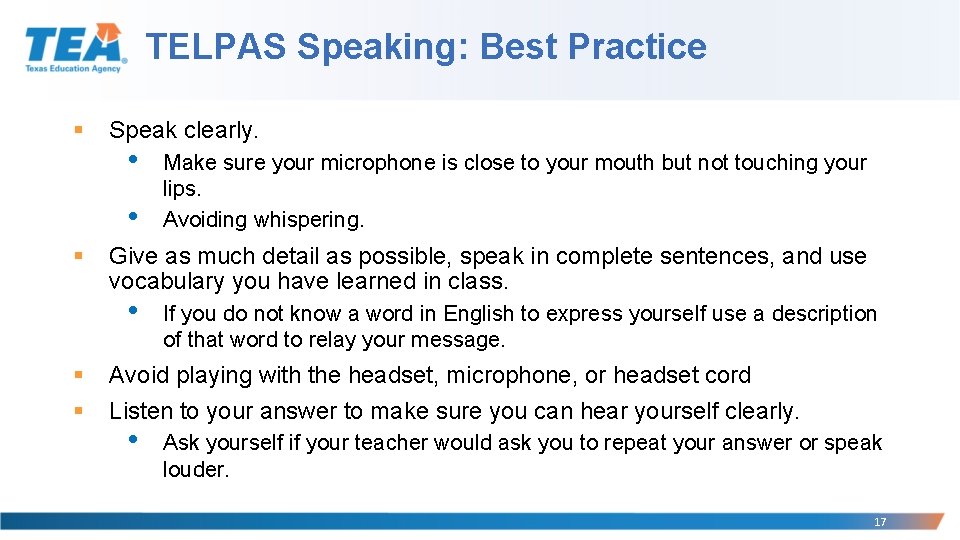
TELPAS Speaking: Best Practice § Speak clearly. • • § Give as much detail as possible, speak in complete sentences, and use vocabulary you have learned in class. • § § Make sure your microphone is close to your mouth but not touching your lips. Avoiding whispering. If you do not know a word in English to express yourself use a description of that word to relay your message. Avoid playing with the headset, microphone, or headset cord Listen to your answer to make sure you can hear yourself clearly. • Ask yourself if your teacher would ask you to repeat your answer or speak louder. 17
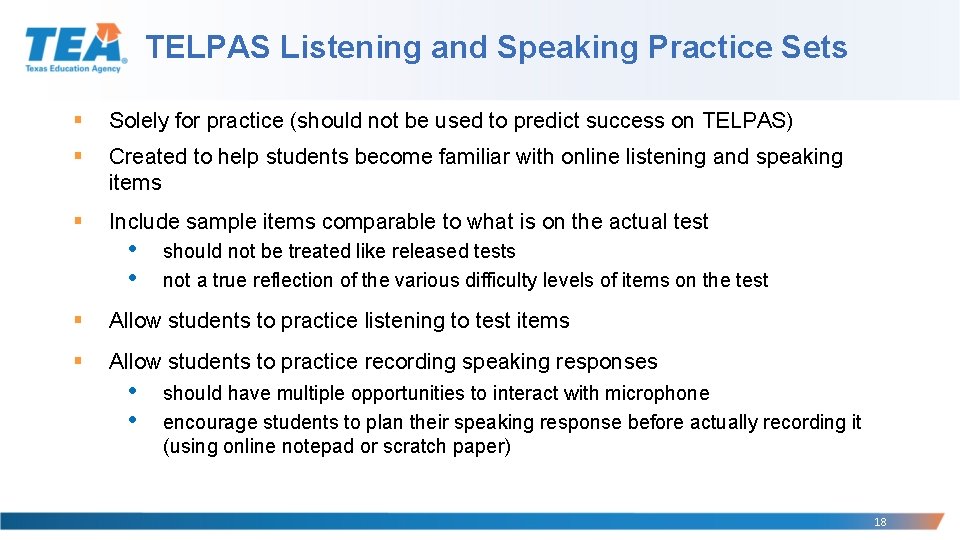
TELPAS Listening and Speaking Practice Sets § Solely for practice (should not be used to predict success on TELPAS) § Created to help students become familiar with online listening and speaking items § Include sample items comparable to what is on the actual test • • should not be treated like released tests not a true reflection of the various difficulty levels of items on the test § Allow students to practice listening to test items § Allow students to practice recording speaking responses • • should have multiple opportunities to interact with microphone encourage students to plan their speaking response before actually recording it (using online notepad or scratch paper) 18
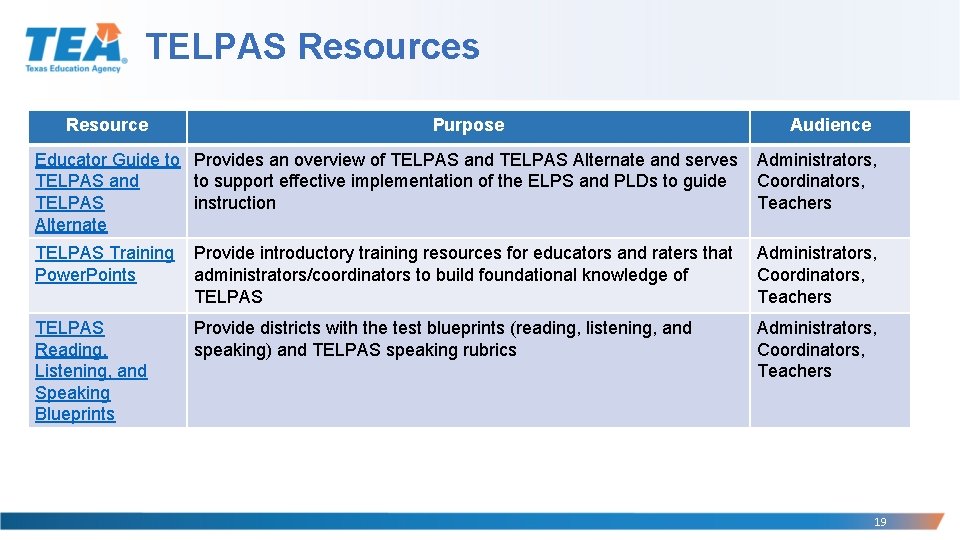
TELPAS Resources Resource Purpose Audience Educator Guide to Provides an overview of TELPAS and TELPAS Alternate and serves Administrators, TELPAS and to support effective implementation of the ELPS and PLDs to guide Coordinators, TELPAS instruction Teachers Alternate TELPAS Training Provide introductory training resources for educators and raters that Power. Points administrators/coordinators to build foundational knowledge of TELPAS Administrators, Coordinators, Teachers TELPAS Reading, Listening, and Speaking Blueprints Administrators, Coordinators, Teachers Provide districts with the test blueprints (reading, listening, and speaking) and TELPAS speaking rubrics 19
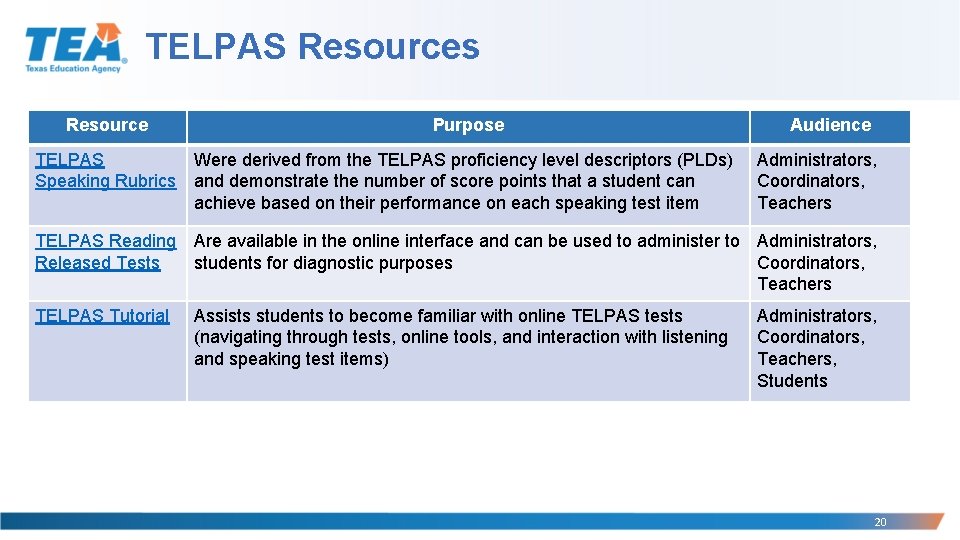
TELPAS Resources Resource Purpose TELPAS Were derived from the TELPAS proficiency level descriptors (PLDs) Speaking Rubrics and demonstrate the number of score points that a student can achieve based on their performance on each speaking test item Audience Administrators, Coordinators, Teachers TELPAS Reading Are available in the online interface and can be used to administer to Administrators, Released Tests students for diagnostic purposes Coordinators, Teachers TELPAS Tutorial Assists students to become familiar with online TELPAS tests (navigating through tests, online tools, and interaction with listening and speaking test items) Administrators, Coordinators, Teachers, Students 20
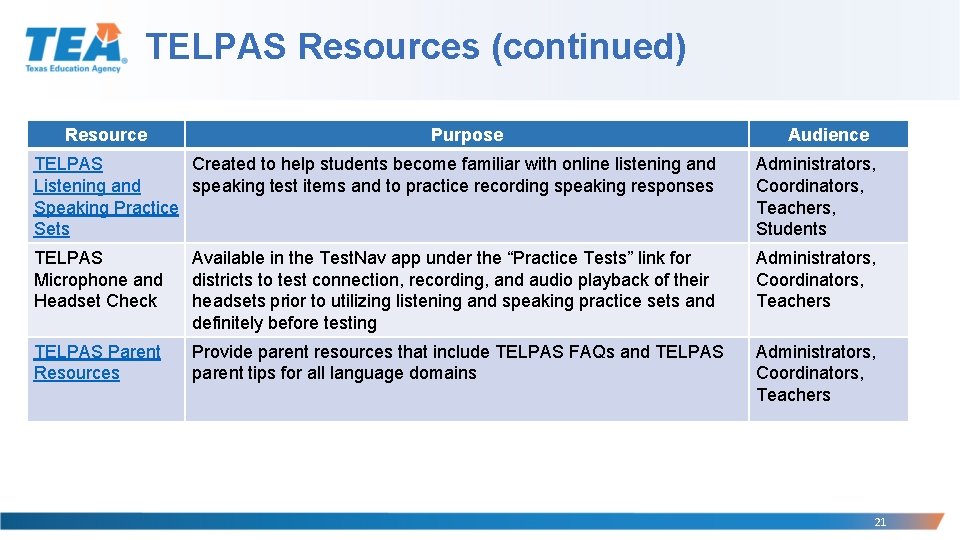
TELPAS Resources (continued) Resource Purpose Audience TELPAS Created to help students become familiar with online listening and Listening and speaking test items and to practice recording speaking responses Speaking Practice Sets Administrators, Coordinators, Teachers, Students TELPAS Microphone and Headset Check Available in the Test. Nav app under the “Practice Tests” link for districts to test connection, recording, and audio playback of their headsets prior to utilizing listening and speaking practice sets and definitely before testing Administrators, Coordinators, Teachers TELPAS Parent Resources Provide parent resources that include TELPAS FAQs and TELPAS parent tips for all language domains Administrators, Coordinators, Teachers 21
2019 TELPAS Results 22
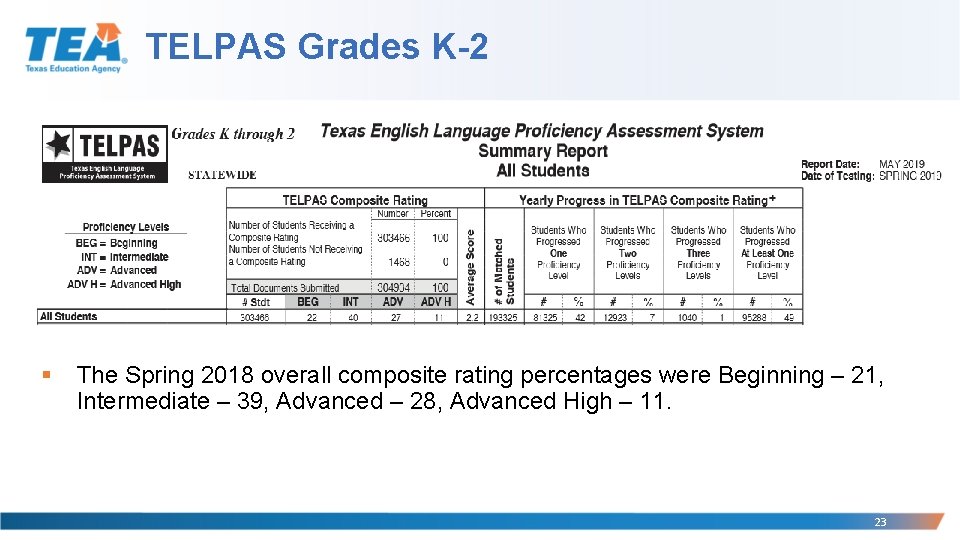
TELPAS Grades K-2 § The Spring 2018 overall composite rating percentages were Beginning – 21, Intermediate – 39, Advanced – 28, Advanced High – 11. 23
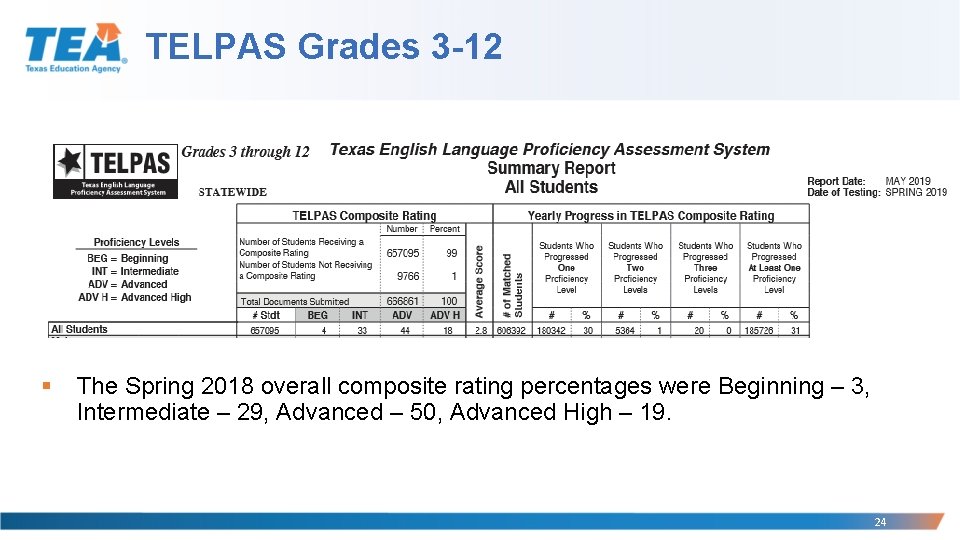
TELPAS Grades 3 -12 § The Spring 2018 overall composite rating percentages were Beginning – 3, Intermediate – 29, Advanced – 50, Advanced High – 19. 24
TELPAS Alternate 25
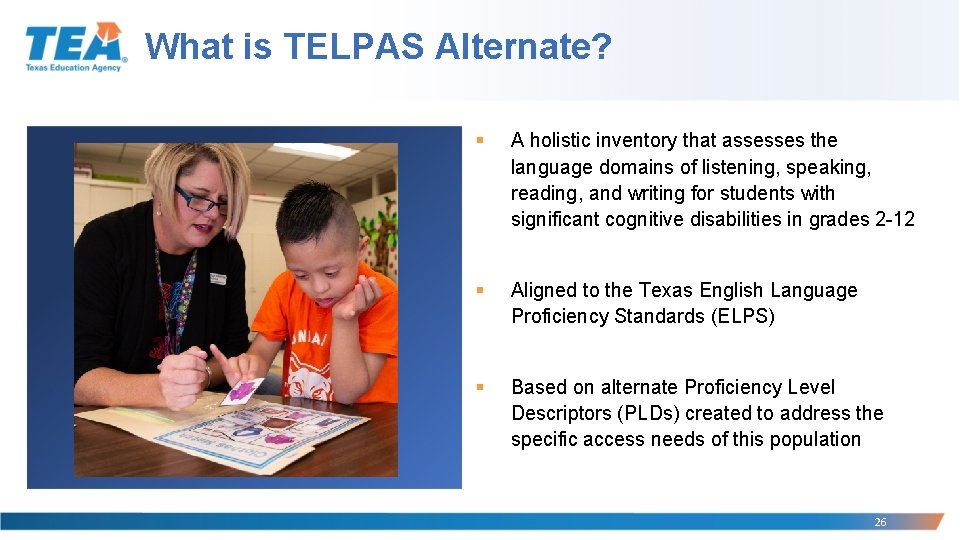
What is TELPAS Alternate? § A holistic inventory that assesses the language domains of listening, speaking, reading, and writing for students with significant cognitive disabilities in grades 2 -12 § Aligned to the Texas English Language Proficiency Standards (ELPS) § Based on alternate Proficiency Level Descriptors (PLDs) created to address the specific access needs of this population 26
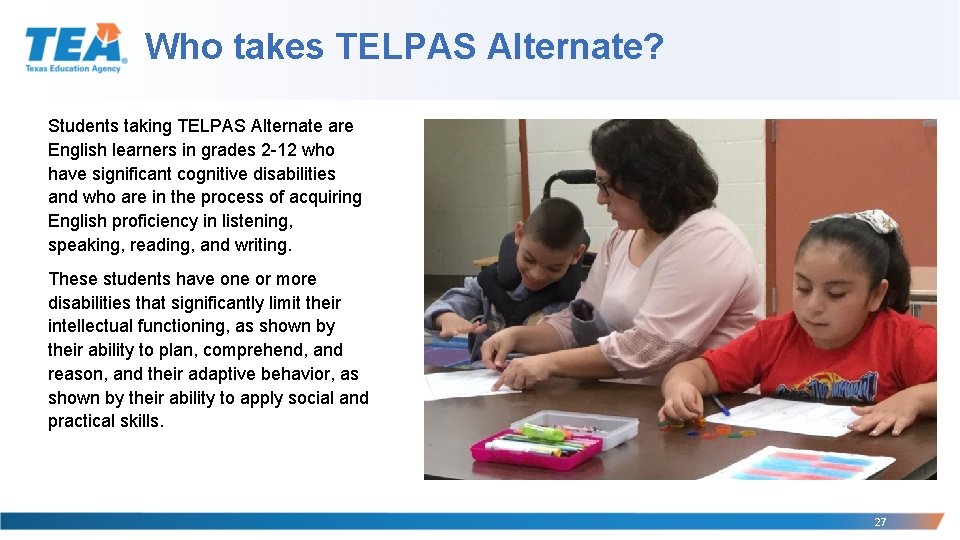
Who takes TELPAS Alternate? Students taking TELPAS Alternate are English learners in grades 2 -12 who have significant cognitive disabilities and who are in the process of acquiring English proficiency in listening, speaking, reading, and writing. These students have one or more disabilities that significantly limit their intellectual functioning, as shown by their ability to plan, comprehend, and reason, and their adaptive behavior, as shown by their ability to apply social and practical skills. 27
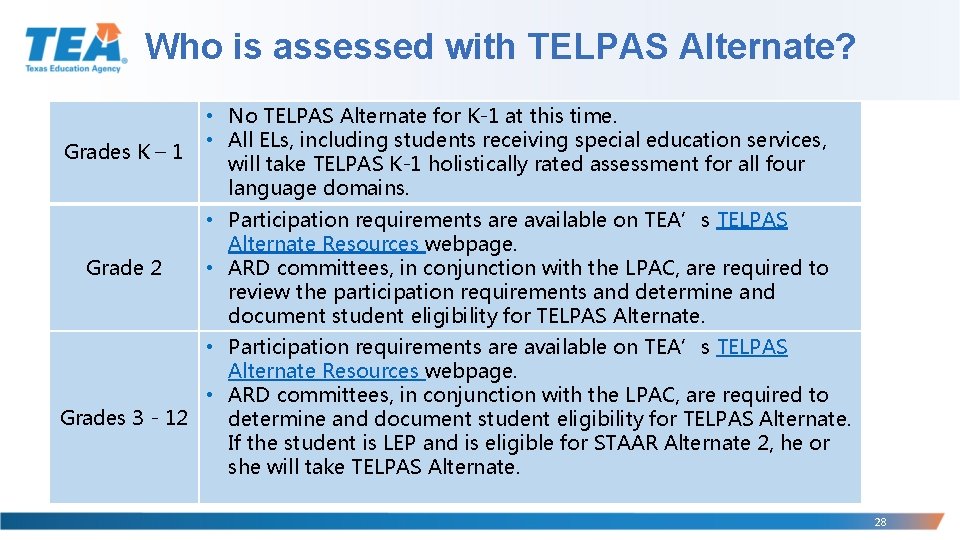
Who is assessed with TELPAS Alternate? Grades K – 1 • No TELPAS Alternate for K-1 at this time. • All ELs, including students receiving special education services, will take TELPAS K-1 holistically rated assessment for all four language domains. Grade 2 • Participation requirements are available on TEA’s TELPAS Alternate Resources webpage. • ARD committees, in conjunction with the LPAC, are required to review the participation requirements and determine and document student eligibility for TELPAS Alternate. • Participation requirements are available on TEA’s TELPAS Alternate Resources webpage. • ARD committees, in conjunction with the LPAC, are required to Grades 3 - 12 determine and document student eligibility for TELPAS Alternate. If the student is LEP and is eligible for STAAR Alternate 2, he or she will take TELPAS Alternate. 28
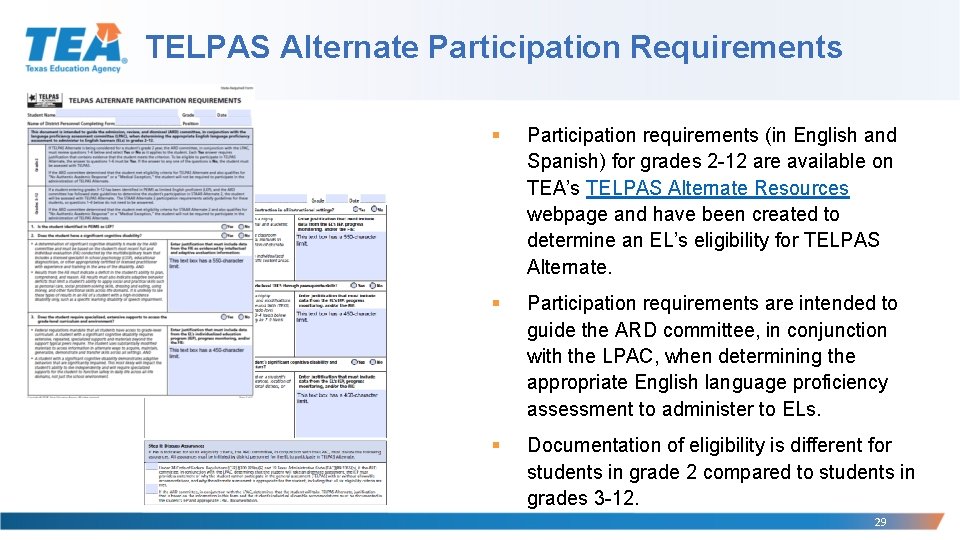
TELPAS Alternate Participation Requirements § Participation requirements (in English and Spanish) for grades 2 -12 are available on TEA’s TELPAS Alternate Resources webpage and have been created to determine an EL’s eligibility for TELPAS Alternate. § Participation requirements are intended to guide the ARD committee, in conjunction with the LPAC, when determining the appropriate English language proficiency assessment to administer to ELs. § Documentation of eligibility is different for students in grade 2 compared to students in grades 3 -12. 29
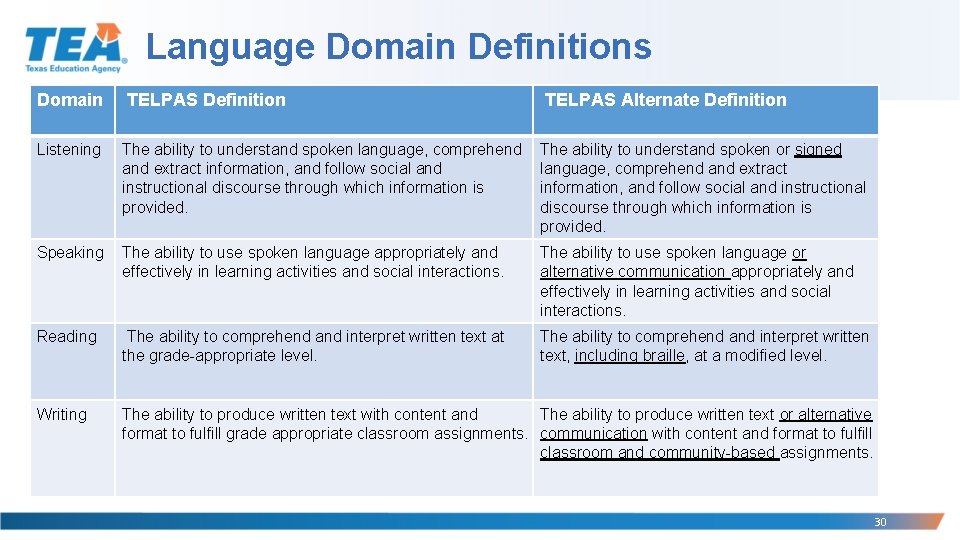
Language Domain Definitions Domain TELPAS Definition TELPAS Alternate Definition Listening The ability to understand spoken language, comprehend and extract information, and follow social and instructional discourse through which information is provided. The ability to understand spoken or signed language, comprehend and extract information, and follow social and instructional discourse through which information is provided. Speaking The ability to use spoken language appropriately and effectively in learning activities and social interactions. The ability to use spoken language or alternative communication appropriately and effectively in learning activities and social interactions. Reading The ability to comprehend and interpret written text at the grade-appropriate level. The ability to comprehend and interpret written text, including braille, at a modified level. Writing The ability to produce written text with content and The ability to produce written text or alternative format to fulfill grade appropriate classroom assignments. communication with content and format to fulfill classroom and community-based assignments. 30
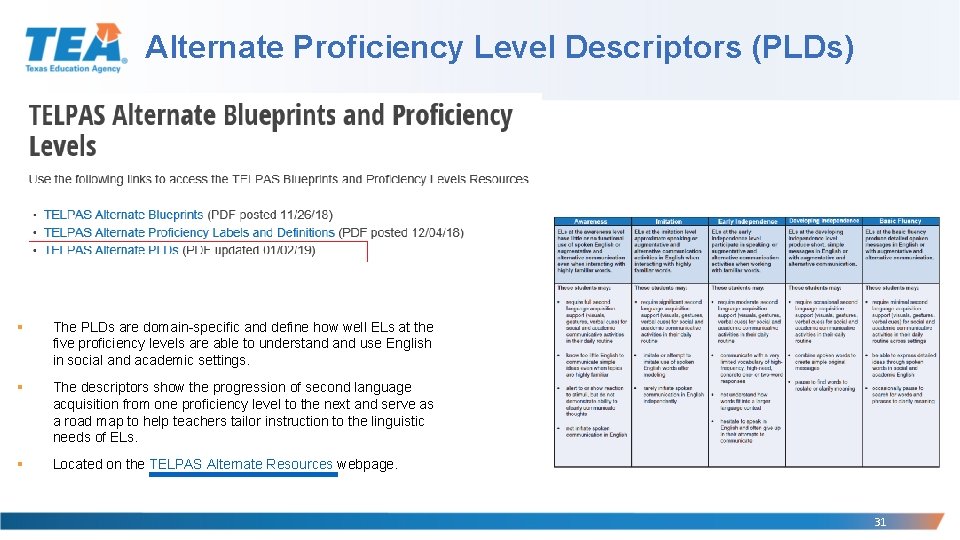
Alternate Proficiency Level Descriptors (PLDs) § The PLDs are domain-specific and define how well ELs at the five proficiency levels are able to understand use English in social and academic settings. § The descriptors show the progression of second language acquisition from one proficiency level to the next and serve as a road map to help teachers tailor instruction to the linguistic needs of ELs. § Located on the TELPAS Alternate Resources webpage. 31
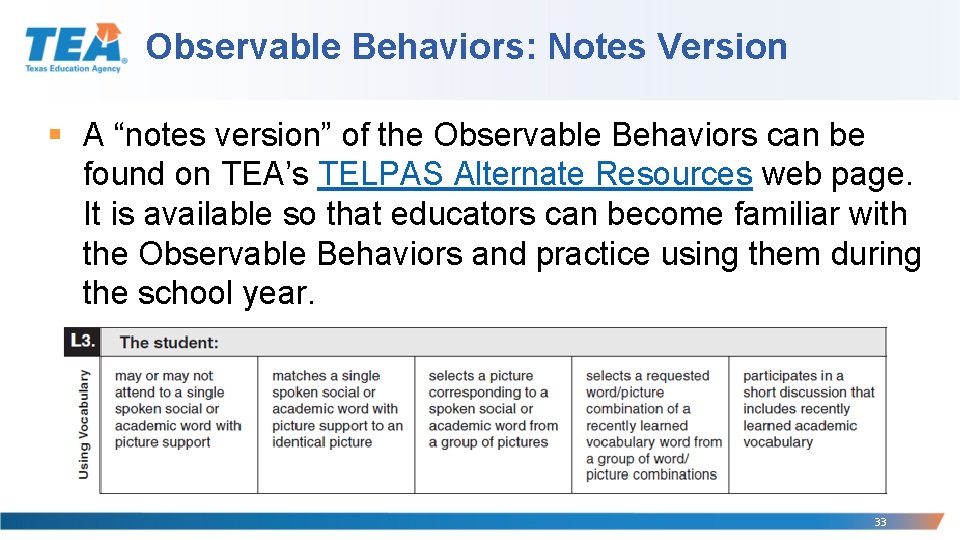
What are Observable Behaviors? § The “questions” are called observable behaviors. Each observable behavior describes characteristics that students learning English demonstrate as they gain proficiency. § Test administrators, based on their knowledge of a student’s English language skills over a period of time, will make holistic judgments across all four domains of English language proficiency (listening, speaking, reading, writing) using alternate ELPS-aligned observable behaviors. 32
Observable Behaviors: Notes Version § A “notes version” of the Observable Behaviors can be found on TEA’s TELPAS Alternate Resources web page. It is available so that educators can become familiar with the Observable Behaviors and practice using them during the school year. 33
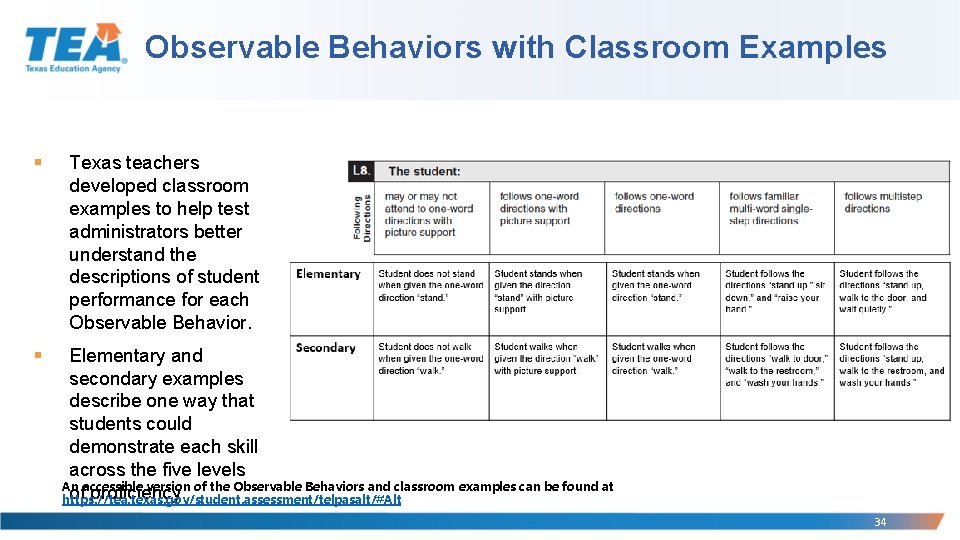
Observable Behaviors with Classroom Examples § § Texas teachers developed classroom examples to help test administrators better understand the descriptions of student performance for each Observable Behavior. Elementary and secondary examples describe one way that students could demonstrate each skill across the five levels An accessible version of the Observable Behaviors and classroom examples can be found at of proficiency. https: //tea. texas. gov/student. assessment/telpasalt/#Alt 34
Using the Classroom Examples § The purpose of each example is to illustrate how a student could demonstrate the skill at each proficiency level. § There are many other classroom activities that could be used as examples for the Observable Behaviors. § These examples are not intended to be used as test questions or performance tasks for teachers to replicate, although using them for this purpose is acceptable if needed. § Teachers are encouraged to use their own activities in the regular classroom setting when determining a student’s ability to understand use English. 35
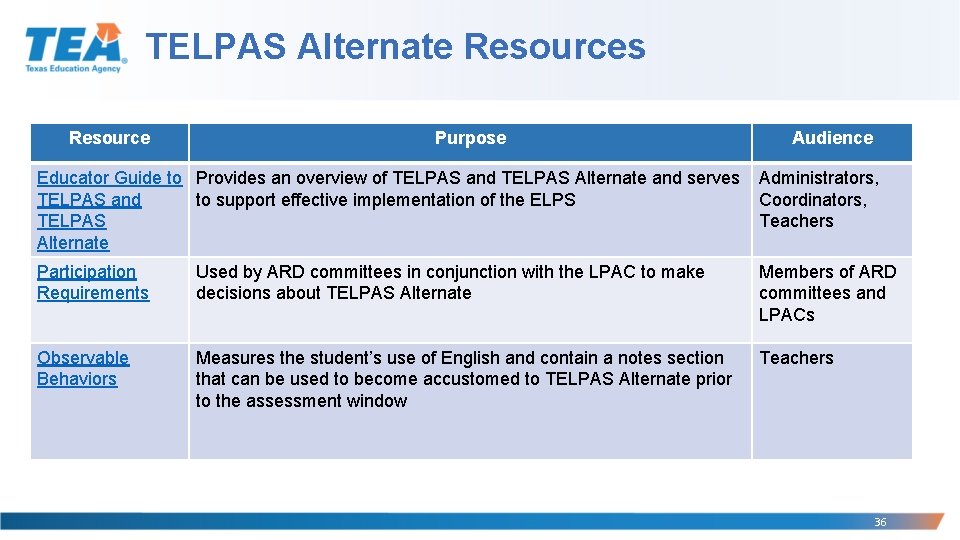
TELPAS Alternate Resources Resource Purpose Audience Educator Guide to Provides an overview of TELPAS and TELPAS Alternate and serves Administrators, TELPAS and to support effective implementation of the ELPS Coordinators, TELPAS Teachers Alternate Participation Requirements Used by ARD committees in conjunction with the LPAC to make decisions about TELPAS Alternate Members of ARD committees and LPACs Observable Behaviors Measures the student’s use of English and contain a notes section that can be used to become accustomed to TELPAS Alternate prior to the assessment window Teachers 36
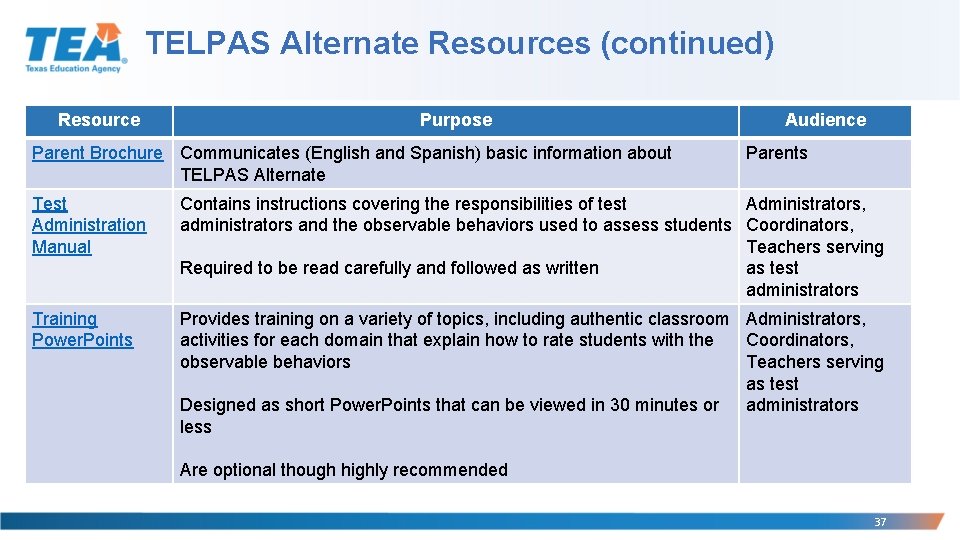
TELPAS Alternate Resources (continued) Resource Purpose Parent Brochure Communicates (English and Spanish) basic information about TELPAS Alternate Audience Parents Test Administration Manual Contains instructions covering the responsibilities of test Administrators, administrators and the observable behaviors used to assess students Coordinators, Teachers serving Required to be read carefully and followed as written as test administrators Training Power. Points Provides training on a variety of topics, including authentic classroom Administrators, activities for each domain that explain how to rate students with the Coordinators, observable behaviors Teachers serving as test Designed as short Power. Points that can be viewed in 30 minutes or administrators less Are optional though highly recommended 37
2019 TELPAS Alternate Results 38
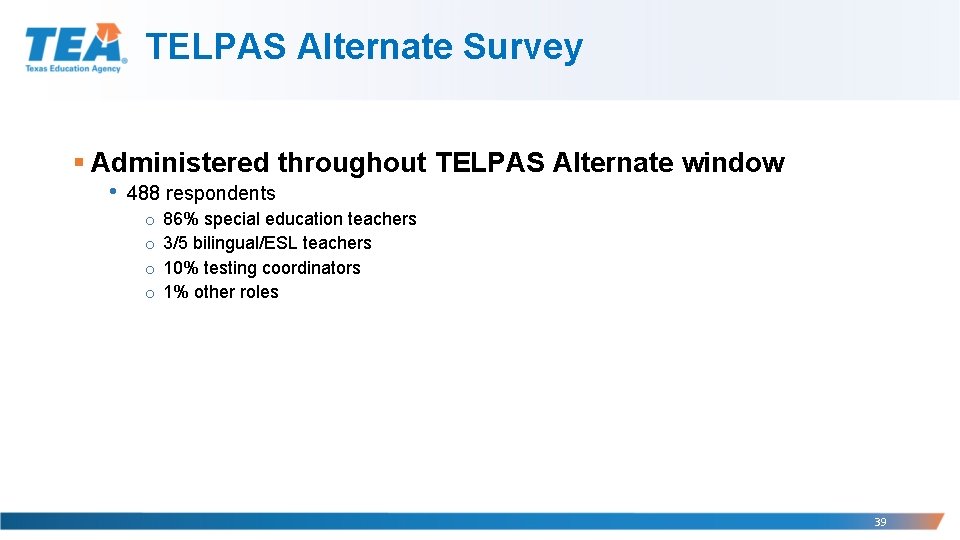
TELPAS Alternate Survey § Administered throughout TELPAS Alternate window • 488 respondents o o 86% special education teachers 3/5 bilingual/ESL teachers 10% testing coordinators 1% other roles 39
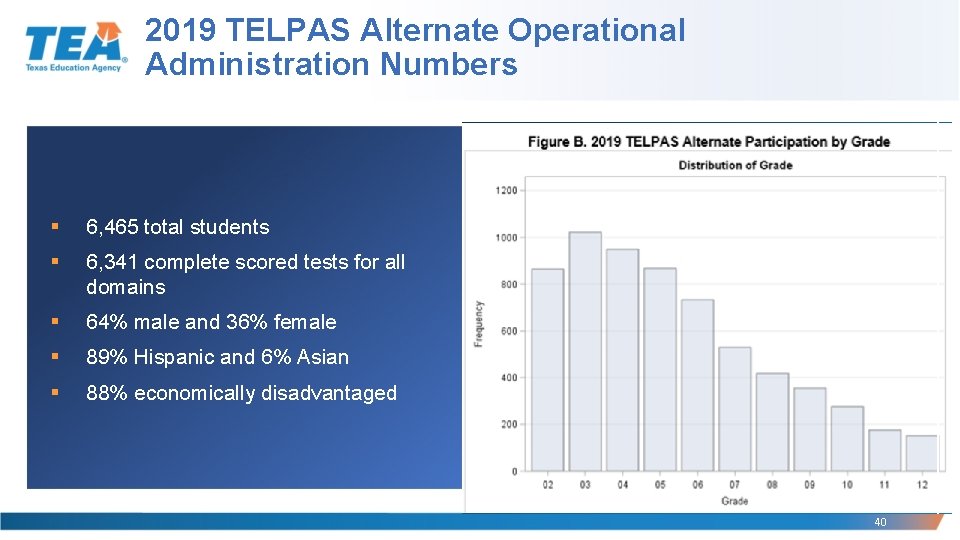
2019 TELPAS Alternate Operational Administration Numbers § 6, 465 total students § 6, 341 complete scored tests for all domains § 64% male and 36% female § 89% Hispanic and 6% Asian § 88% economically disadvantaged 40
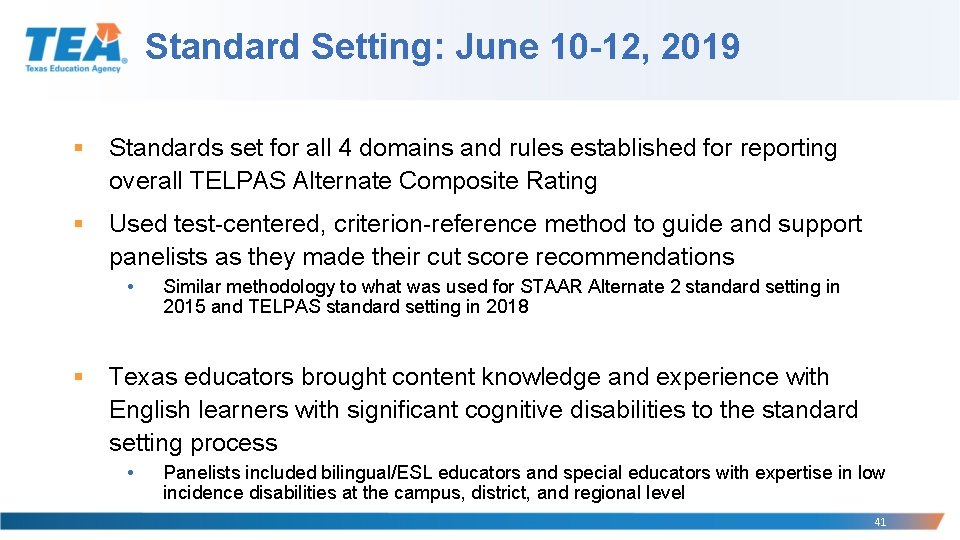
Standard Setting: June 10 -12, 2019 § Standards set for all 4 domains and rules established for reporting overall TELPAS Alternate Composite Rating § Used test-centered, criterion-reference method to guide and support panelists as they made their cut score recommendations • Similar methodology to what was used for STAAR Alternate 2 standard setting in 2015 and TELPAS standard setting in 2018 § Texas educators brought content knowledge and experience with English learners with significant cognitive disabilities to the standard setting process • Panelists included bilingual/ESL educators and special educators with expertise in low incidence disabilities at the campus, district, and regional level 41
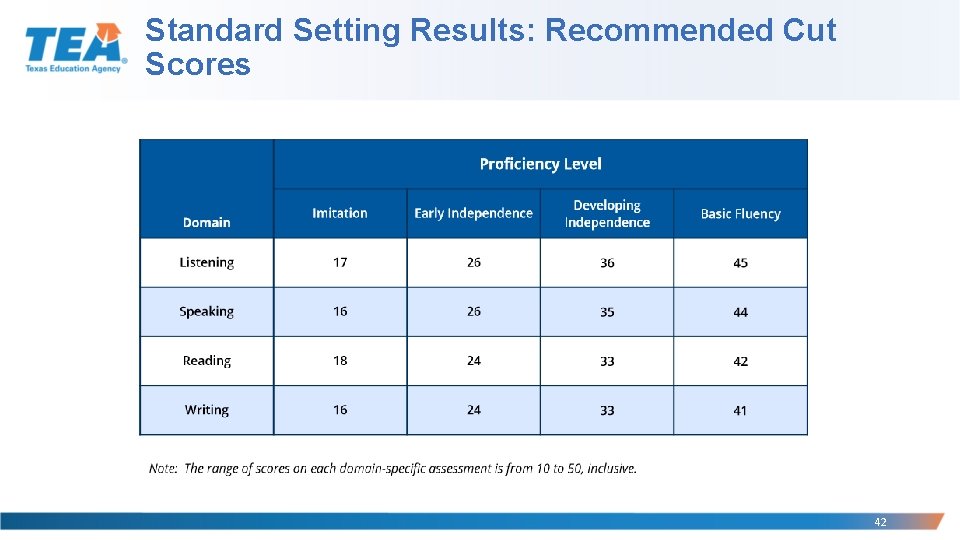
Standard Setting Results: Recommended Cut Scores 42
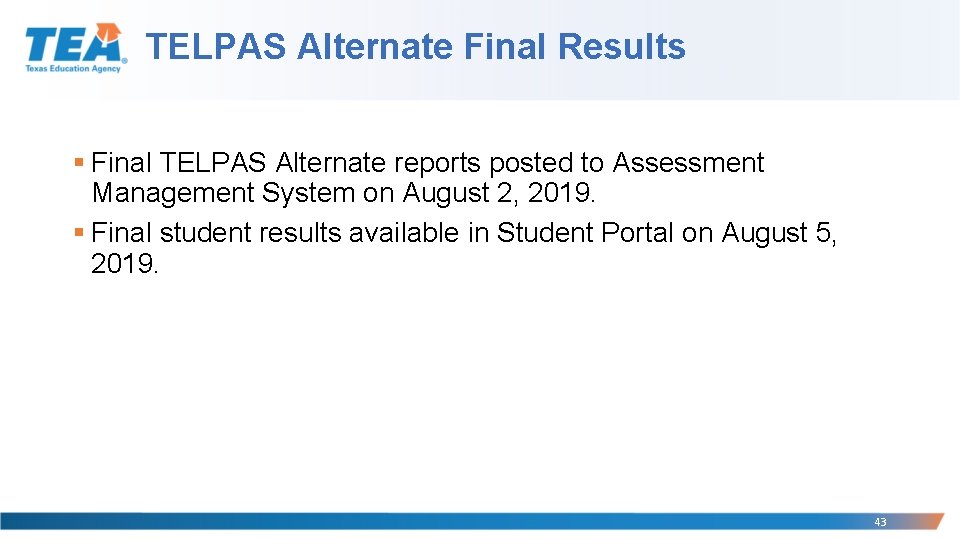
TELPAS Alternate Final Results § Final TELPAS Alternate reports posted to Assessment Management System on August 2, 2019. § Final student results available in Student Portal on August 5, 2019. 43
Disclaimer These slides have been prepared by the Student Assessment Division of the Texas Education Agency. You are encouraged to use them for local training. If any of the slides are changed for local use, please hide or remove any TEA logos, headers, or footers. (You may need to edit the Master slide. ) In addition, you must remove the photographs. Only TEA has parental permission to use these photographs for training purposes. This training is not intended to replace any materials or additional information on the TEA website. 44
For More Information TEA’s Student Assessment Division 512 -463 -9536 assessment. specialpopulations@tea. texas. gov TELPAS Resources Webpage https: //tea. texas. gov/student. assessment/ell/telpas/ TELPAS Alternate Resources Webpage https: //tea. texas. gov/student. assessment/telpasalt/ 45