
Telling Your Story Communicating Your Message Through Earned

- Slides: 43
Telling Your Story: Communicating Your Message Through Earned & Paid Media Trey Hawkins VP Political Affairs Credit Union National Assoc. (CUNA)
Developing a Message • Campaigns are about choices • Can your message persuade voters to choose you over your opponent?
Why are you running? • What about you distinguishes you from your opponent in a way that leads voters to pick you over your opponent? • Distill those differences into a clear and concise thought and you have your campaign’s message
“To Thine Own Self Be True” • Acknowledge the truth about your strengths and weaknesses as a candidate, and be ruthless. • Your opponent certainly will.
Consider everything somebody could say about you (and be honest): • Your background, both professional and personal • Your stance on issues • Any vote or position you’ve taken publicly • Your standing in the community in general • Your voter history • Have you paid your taxes, is your business license up to date, have you ever been sued?
Know your enemy, too. • His or her voting history • Business dealings • Personal finances • Donors • What kind of campaign he/she has run in the past • What groups and individuals will be helping his/her campaign
“But I want to run a positive campaign on the issues, not a negative campaign. ”
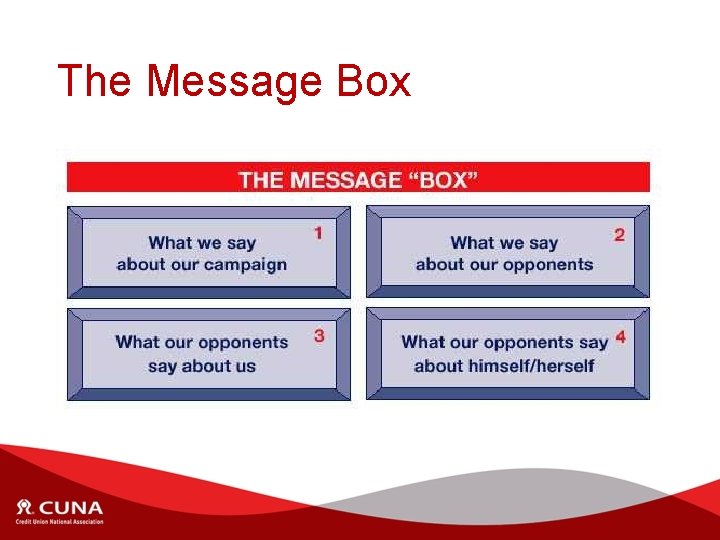
Remember, campaigns are about choices: Choices among or between candidates. By defining the differences between you and your opponent, you are helping voters to choose.
The Message Box
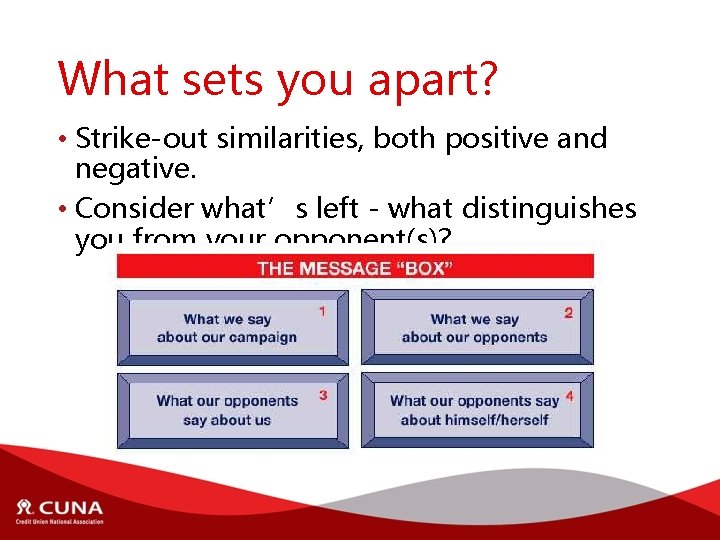
What sets you apart? • Strike-out similarities, both positive and negative. • Consider what’s left - what distinguishes you from your opponent(s)?
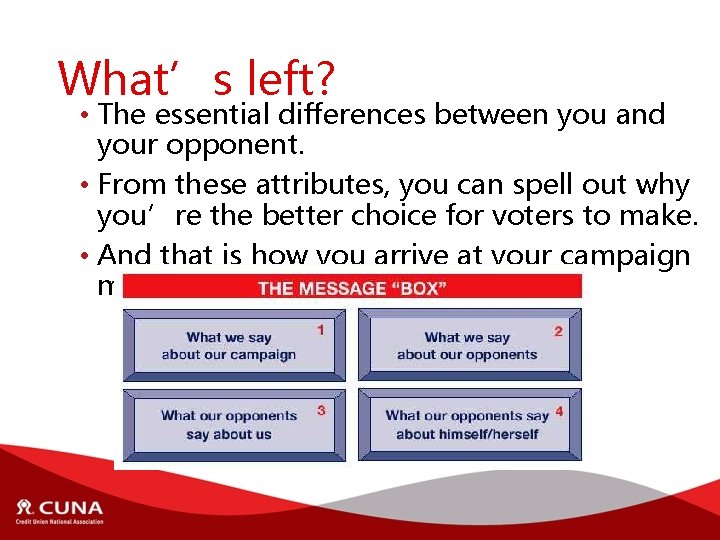
What’s left? • The essential differences between you and your opponent. • From these attributes, you can spell out why you’re the better choice for voters to make. • And that is how you arrive at your campaign message.
The campaign theme • A simple phrase, sentence or word summing up the central point of why voters choose you. • Your campaign theme should: • • Be easy to remember Interesting Consistent with what you care about Work well with the issues you will be talking about
Examples of Campaign Themes • Make America great again (Trump 2016) • Change we can believe in (Obama 2008) • Straight talk (Mc. Cain 2000) • Building a bridge to the 21 st Century (Clinton 1996) • It’s morning again in America (Reagan 1984)
Delivering your message and campaign theme • Repetition, repetition • Voters should here the same thing: • • • At their doors, on the phone and online In debates and other public forums In direct mail and broadcast advertising In the press On social media • When you’re sick of saying it, you’ve only begun to succeed in delivering your message
Delivering Your Message • Earned Media • Paid Media • Be cost effective and target your voters • Polling and research can help
What About the Press?
“Free Media” vs. “Earned Media” • Good press coverage –in print, online, on TV or radio—is never free • It costs your campaign lots of time, energy and effort to get it
Different ways to communicate with the Media: • Public Meetings/Events, speeches • Press Conferences • Press Releases • In-person interviews • Telephone interviews • Editorial board sessions • Op-Ed pieces • Letters to the Editors • Call-in Shows (radio) • Photos + captions 18
Spice up your media coverage with variety • It’ll take trying a variety of methods to deliver your message to the press. • If one isn’t working, try something else.
Rules to Live by • Limit press release/media hits to one topic, one page or a statement that is 5 minutes of less • If you don’t know the answer to a question, tell them you will be happy to get back to them later. • Give reporters simple local examples to illustrate the issue or problem—make it relevant • Don’t offer up statistics or facts you’re not sure of • Don’t overwhelm the reporter— give them small, manageable bits of information to chew on • Nothing is ever “off the record” – only say something you don’t mind seeing in print or on TV • Never lie or mislead the press 20
How to get coverage • Stick to your theme, 2 -3 major issues • Amplify and coordinate • Use theme weeks • Use national or state hooks to tie into your local race • Use milestones, holidays, etc – back to school, Labor Day, 4 th of July, Domestic Violence Awareness Month
Before getting starting Make sure the press knows who you are • Take them out to lunch or breakfast • Give them some basic background information • Answer basic questions of why you’re running, what your key issues are • Establish a rapport
Use volunteers • Op-ed’s • Letters to the Editors • Call-in shows • Debates
Don’t get discouraged • Getting coverage and building credibility with the press takes time and energy, but eventually, the quality and quantity of what you do breaks through • Quality of Coverage matters more than Quantity
Press Summary • Keep it simple, short • Make it interesting, relevant and timely • Localize the press hit • Do let reports put words in your mouth • Give reporters information in small bites • Always tell the truth and check your facts beforehand • Keep driving the message home
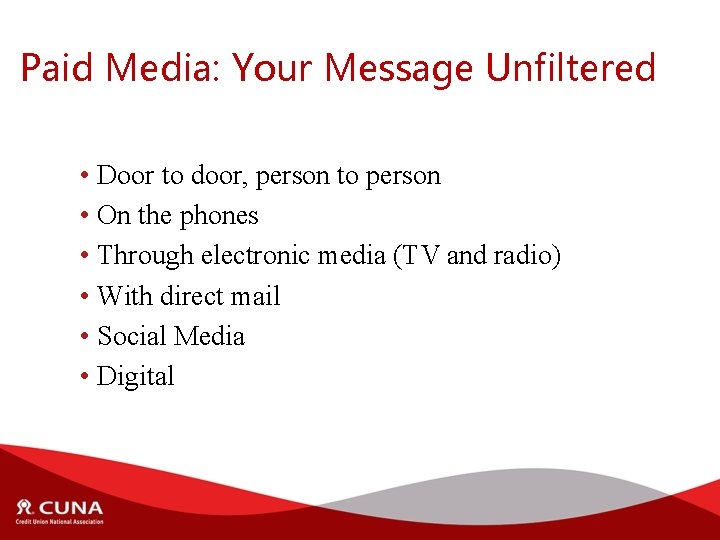
Paid Media: Your Message Unfiltered • Door to door, person to person • On the phones • Through electronic media (TV and radio) • With direct mail • Social Media • Digital
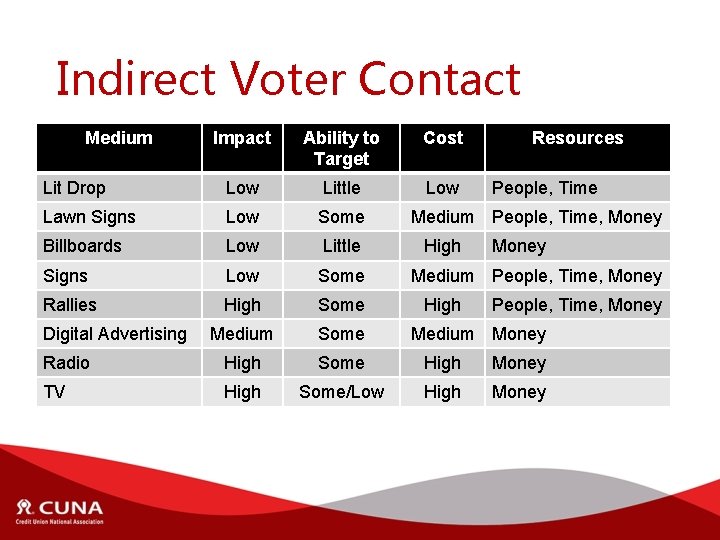
Indirect Voter Contact Medium Impact Ability to Target Cost Lit Drop Low Little Low Lawn Signs Low Some Billboards Low Little Signs Low Some Rallies High Some Medium Some Radio High Some High Money TV High Some/Low High Money Digital Advertising Resources People, Time Medium People, Time, Money High Money Medium People, Time, Money High People, Time, Money Medium Money
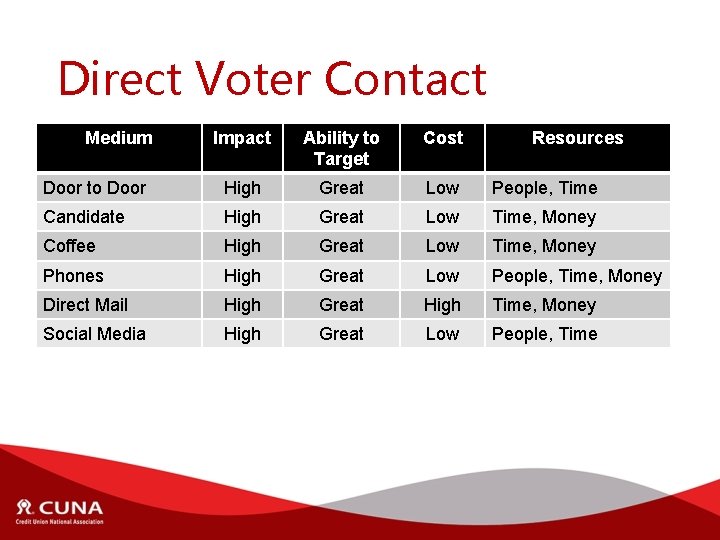
Direct Voter Contact Medium Impact Ability to Target Cost Resources Door to Door High Great Low People, Time Candidate High Great Low Time, Money Coffee High Great Low Time, Money Phones High Great Low People, Time, Money Direct Mail High Great High Time, Money Social Media High Great Low People, Time
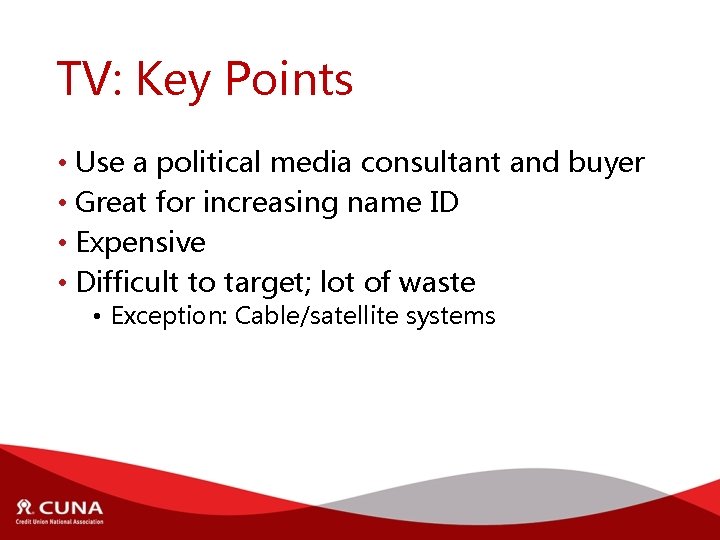
TV: Key Points • Use a political media consultant and buyer • Great for increasing name ID • Expensive • Difficult to target; lot of waste • Exception: Cable/satellite systems
Radio: Key Points • Easier to target by demographic than TV • Useful in rural areas • Use 60 second spot • Repeat campaign name as much as possible • Can be expensive – is it worth it?
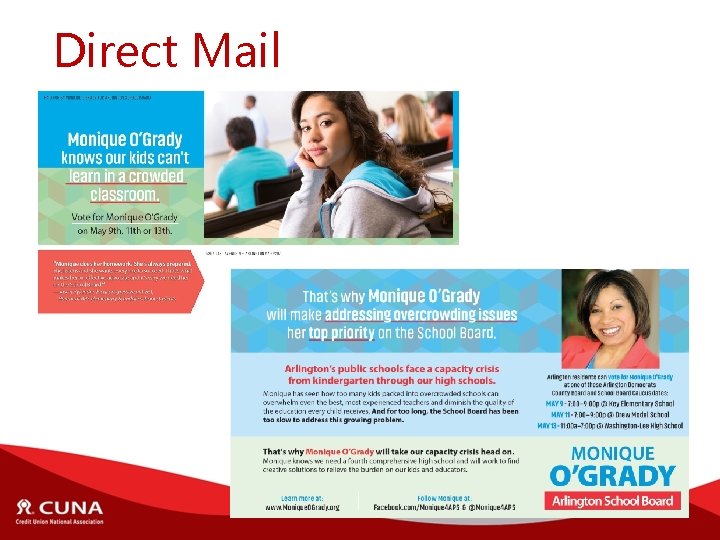
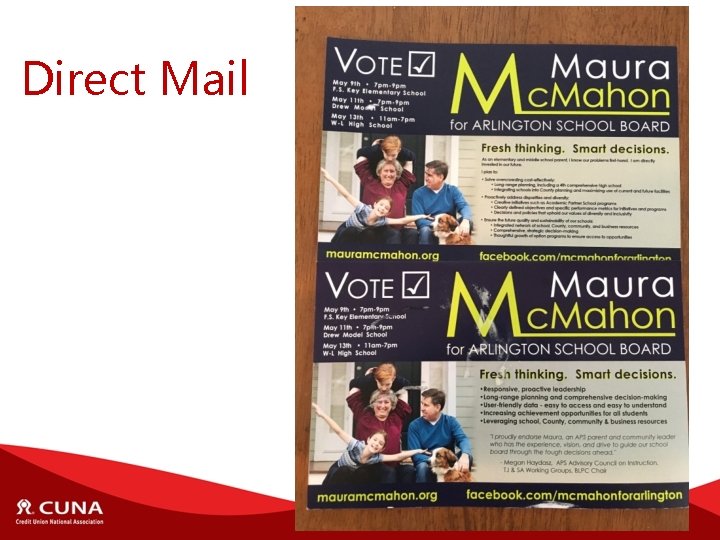
Direct Mail: Key Points • Pictures and imagery is key; avoid being too wordy • Stick to variations on your campaign theme • Target, target • Use a political mail vendor to get political bulk rate
Direct Mail
Direct Mail
Social Media: Key Points • Share news & announcements • Good for recruiting volunteers/supporters • Requires constant care & feeding • Engage, engage • Keep it fun and lighthearted • But be mindful social is a public medium • Know your medium & audience • Facebook vs. Twitter vs. Instagram, etc.
Digital: Key Points • Many different media • Facebook, Twitter, Pandora, websites • Somewhat targetable • Use brief slogan & imagery • Banner ads & 15 sec. “Ad roll” • Need a call to action / link to website • Social Media vs. Paid Digital
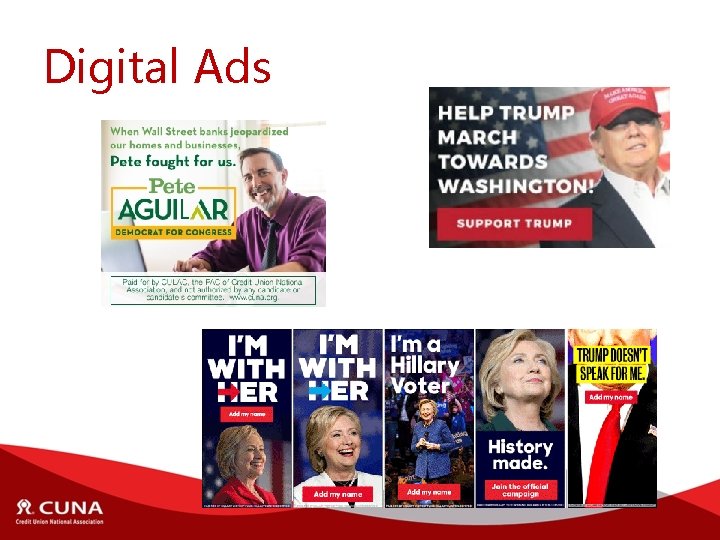
Digital Ads
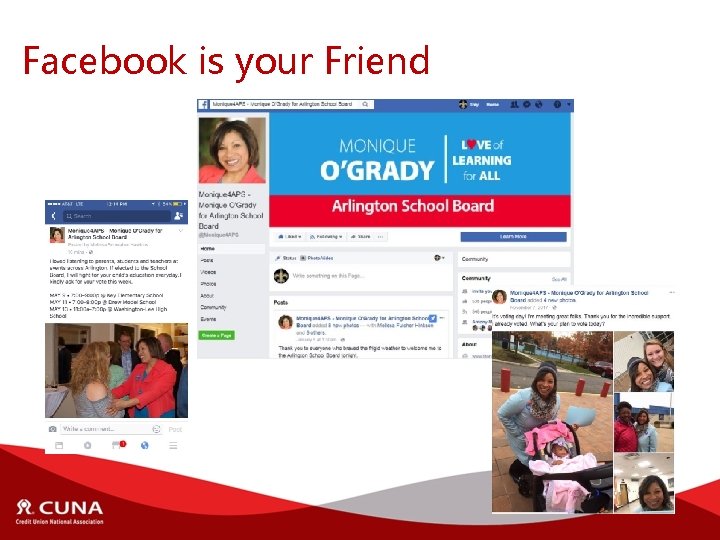
Facebook is your Friend
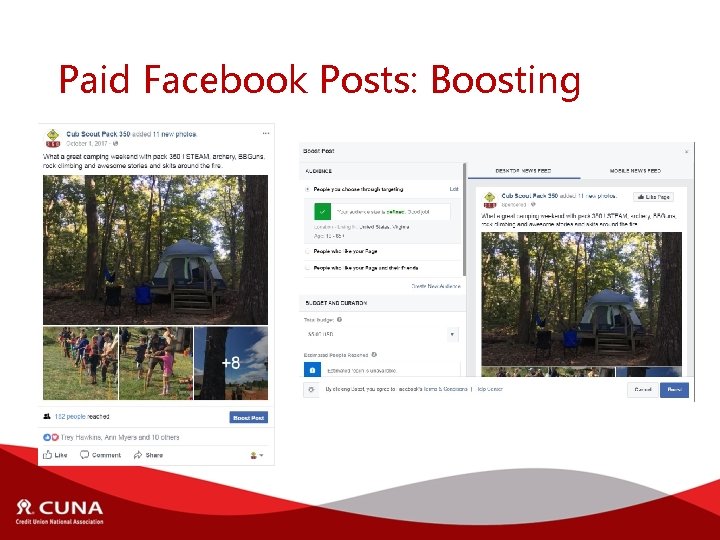
Paid Facebook Posts: Boosting
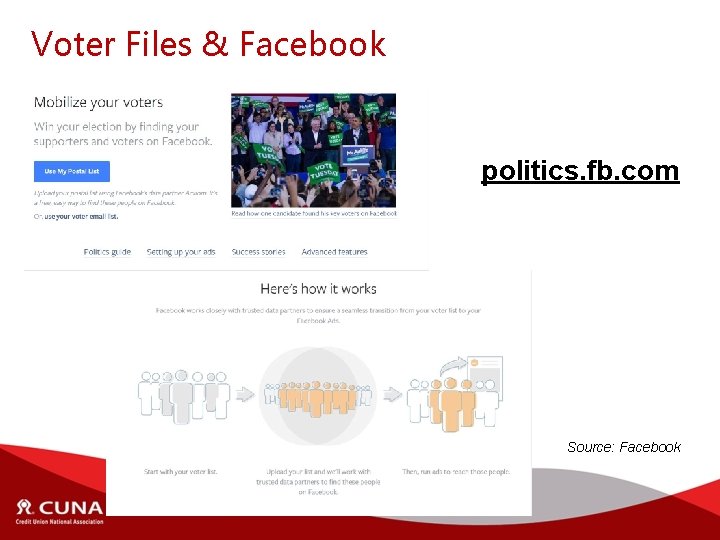
Voter Files & Facebook politics. fb. com Source: Facebook
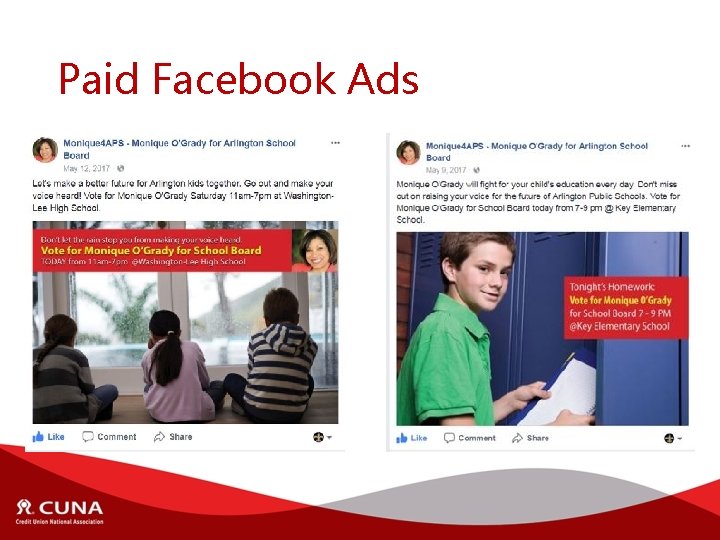
Paid Facebook Ads
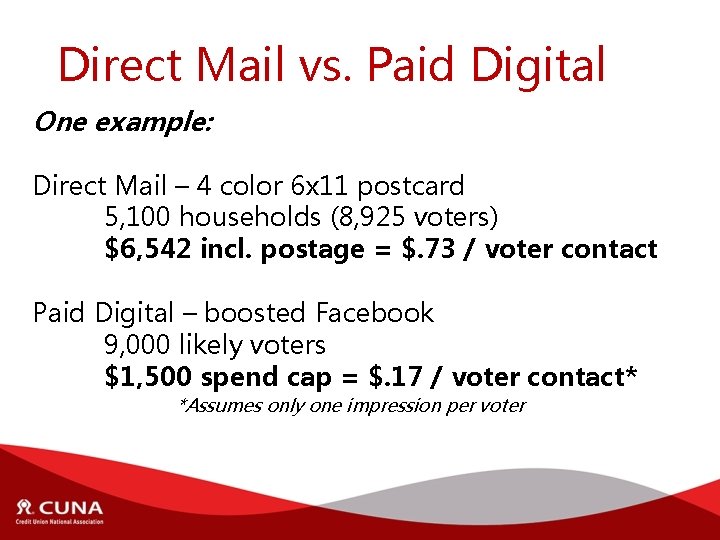
Direct Mail vs. Paid Digital One example: Direct Mail – 4 color 6 x 11 postcard 5, 100 households (8, 925 voters) $6, 542 incl. postage = $. 73 / voter contact Paid Digital – boosted Facebook 9, 000 likely voters $1, 500 spend cap = $. 17 / voter contact* *Assumes only one impression per voter
Final Thoughts Develop a clear, concise message that: 1. Offers voters a clear choice between candidates, & 2. Compels voters to choose you. Deliver your message to your targeted voters in most efficient manner. Repeat, repeat, & repeat some more.
Questions? Trey Hawkins VP Political Affairs Credit Union National Association 202 -508 -6712 thawkins@cuna. com Twitter: @Trey. Hawkins. DC