
Tell me about Igor Ansoff Sort the Statements
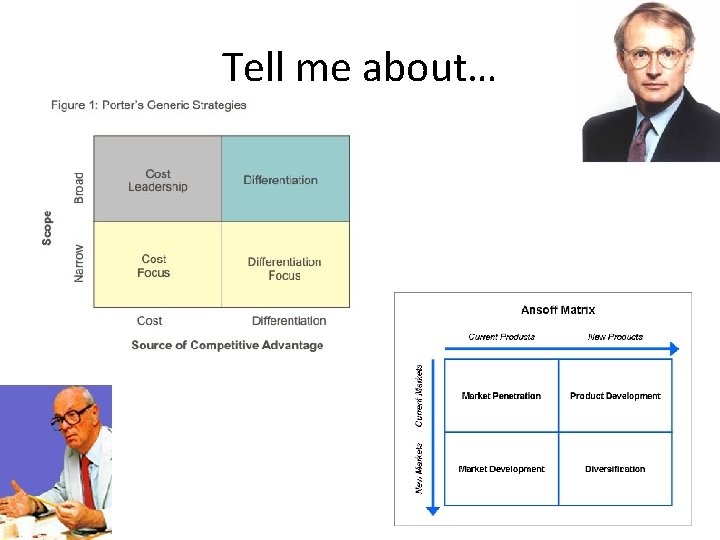
Tell me about…
Igor Ansoff – Sort the Statements - High innovation (R&D) costs - High market research costs - High advertising costs to help retain and attract new customers. Especially in competitive markets - Encourages brand loyalty - Brand not recognised in new market – expensive promotional costs - Less risk attached – business understands their product and their target market needs - Alienation of existing target market - High risk as product and market is new to business. - Need to adapt to needs / culture of new market (localisation) - Increased target market and boost to revenue - Spreads risk across the business
ILC work – well underway by Wednesday
Learning Outcomes By the end of the lesson you will. - Explain the strategies on Bowman’s Strategic Clock - Apply them to different businesses to explain their success of failure
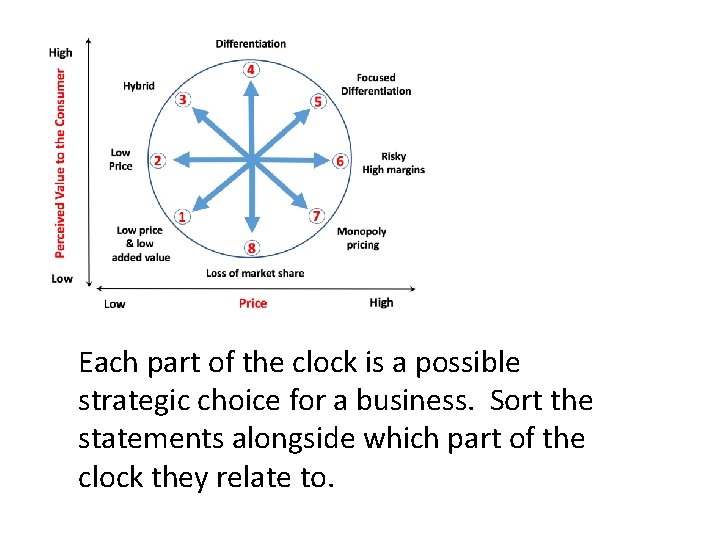
Each part of the clock is a possible strategic choice for a business. Sort the statements alongside which part of the clock they relate to.
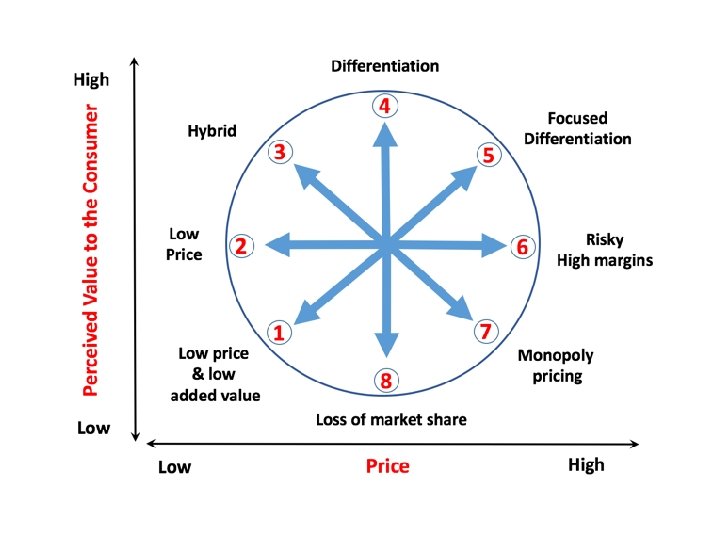
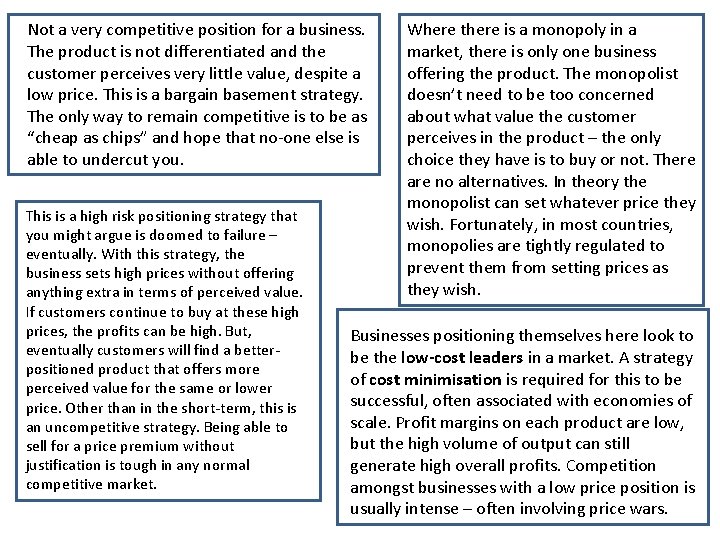
Not a very competitive position for a business. The product is not differentiated and the customer perceives very little value, despite a low price. This is a bargain basement strategy. The only way to remain competitive is to be as “cheap as chips” and hope that no-one else is able to undercut you. This is a high risk positioning strategy that you might argue is doomed to failure – eventually. With this strategy, the business sets high prices without offering anything extra in terms of perceived value. If customers continue to buy at these high prices, the profits can be high. But, eventually customers will find a betterpositioned product that offers more perceived value for the same or lower price. Other than in the short-term, this is an uncompetitive strategy. Being able to sell for a price premium without justification is tough in any normal competitive market. Where there is a monopoly in a market, there is only one business offering the product. The monopolist doesn’t need to be too concerned about what value the customer perceives in the product – the only choice they have is to buy or not. There are no alternatives. In theory the monopolist can set whatever price they wish. Fortunately, in most countries, monopolies are tightly regulated to prevent them from setting prices as they wish. Businesses positioning themselves here look to be the low-cost leaders in a market. A strategy of cost minimisation is required for this to be successful, often associated with economies of scale. Profit margins on each product are low, but the high volume of output can still generate high overall profits. Competition amongst businesses with a low price position is usually intense – often involving price wars.
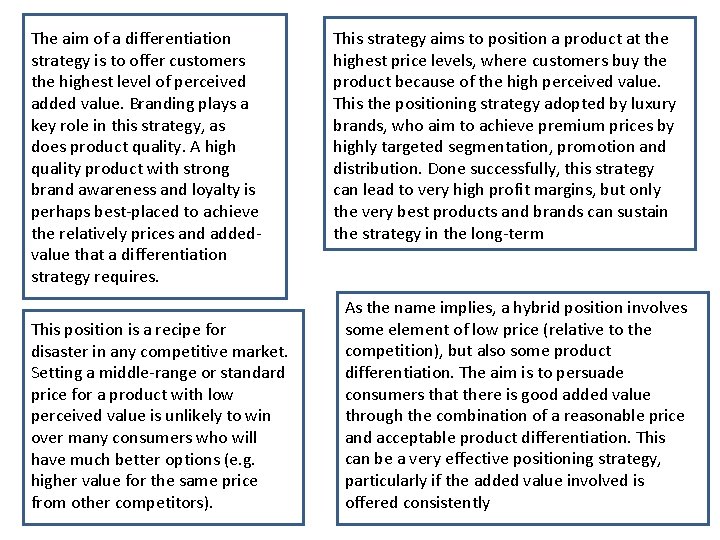
The aim of a differentiation strategy is to offer customers the highest level of perceived added value. Branding plays a key role in this strategy, as does product quality. A high quality product with strong brand awareness and loyalty is perhaps best-placed to achieve the relatively prices and addedvalue that a differentiation strategy requires. This position is a recipe for disaster in any competitive market. Setting a middle-range or standard price for a product with low perceived value is unlikely to win over many consumers who will have much better options (e. g. higher value for the same price from other competitors). This strategy aims to position a product at the highest price levels, where customers buy the product because of the high perceived value. This the positioning strategy adopted by luxury brands, who aim to achieve premium prices by highly targeted segmentation, promotion and distribution. Done successfully, this strategy can lead to very high profit margins, but only the very best products and brands can sustain the strategy in the long-term As the name implies, a hybrid position involves some element of low price (relative to the competition), but also some product differentiation. The aim is to persuade consumers that there is good added value through the combination of a reasonable price and acceptable product differentiation. This can be a very effective positioning strategy, particularly if the added value involved is offered consistently
Explain the success / failure of… JD (S) Apple (S) BHS (F) Aldi (S) Tesco (S then F) ASOS (S) Uber (S) Using Bowman’s strategic clock and research on news websites into (_______ success/failure). Find evidence in the form of figures / quotes that relate to a specific part of the clock.
ILC work – well underway by Wednesday
Essay debate… To what extent is setting low prices the best way for a retailer to gain a successful position in a competitive market? 1 – argue for low prices 2 – argue for another part of the clock 3 – argue for a different part of the clock You need to come up with clear benefits / drawbacks of your strategy choice but say why the benefits are more significant than the drawbacks.
The toughest questions in year 2? To what extent is setting low prices the best way for a retailer to gain a successful position in a competitive market? (25) How do we show our exam skills in our plan? Essay plan template to use (from T 2 U file)
Review Porter Vs Ansoff Vs Bowman
- Slides: 13