
Television and Audiences A case study Television industry

- Slides: 14
Television and Audiences A case study
Television industry basic info • TV in the US – Conglomerates: Disney, News. Corp, NBCUniversal, Viacom, Time Warner. – Networks: ABC (Disney); Fox (News Corp); NBC; CBS; CW (Time Warner) – Local stations (Project for Excellence in Journalism, 2007) • Over 90% of the local stations in the US are affiliates of one of the big four networks (ABC, FOX, NBC, CBS) • Affiliates broadcast national news and television shows that are produced by the networks.
Local stations • Networks only own and operate a handful of local stations (Project for Excellence in Journalism, 2007). – CBS (39); Fox (35); NBC (14); ABC (10). – Networks usually own and operate the stations in the top 10 markets (New York, Los Angeles, Chicago, Philadelphia, Boston, San Francisco, Dallas-Ft Worth, Washington Dc, Atlanta, Houston) (Media Management Center. org, 2004) • Local stations (Columbus – ranked 32): • WTTE-Fox & WSYX-ABC (Sinclair Media) • WCMH-NBC (Media General Inc) • WBNS-CBS (The Dispatch Broadcast Group)
Political Economy of Television • Political economy: the economic system determines the types of media that is produced in a country. • Television in US – Privately owned – Advertiser driven
The commodity audience • TV audiences are a commodity (Smythe, 2006; Meehan, 2006). Television networks sell their attention to advertisers and retailers • The commodity audience (CA): • Potential consumers, who prefer/can afford brand names. • Retailers make money even if only a fraction of the audience buys their product.
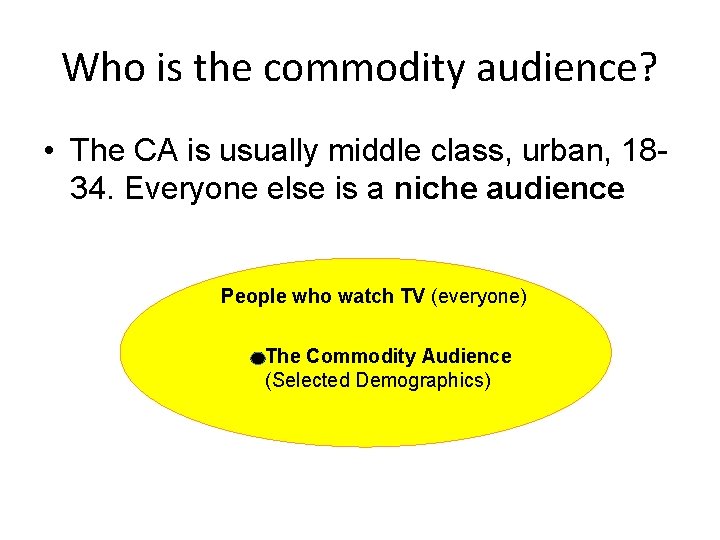
Who is the commodity audience? • The CA is usually middle class, urban, 1834. Everyone else is a niche audience People who watch TV (everyone) The Commodity Audience (Selected Demographics)
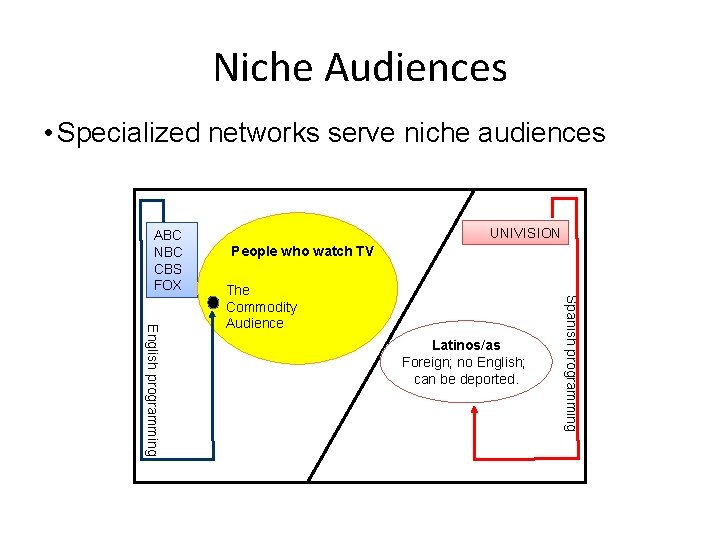
Niche Audiences • Specialized networks serve niche audiences ABC NBC CBS FOX UNIVISION People who watch TV Latinos/as Foreign; no English; can be deported. Spanish programming English programming The Commodity Audience
The ratings • The AC Nielsen Company measures the audience by defining demographics (groups by age, gender, race/ethnicity, etc. ). • Number of viewers in key demographics creates the Nielsen Ratings (NR). • TV Networks use the NR to set advertising prices, and to decide which shows to broadcast and keep on the air.
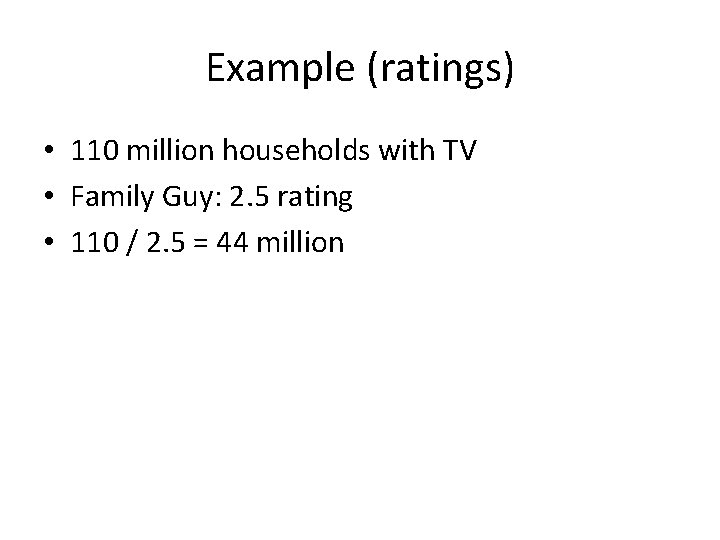
Ratings and Share • Rating: percentage of all homes equipped with televisions that are tuned to a particular station at a particular time. • Ratings include televisions that are not turned on. • Share: percentage of homes in which the television is in use and tuned to a particular station. • Ratings and shares refer to households, not individual people
Example (ratings) • 110 million households with TV • Family Guy: 2. 5 rating • 110 / 2. 5 = 44 million
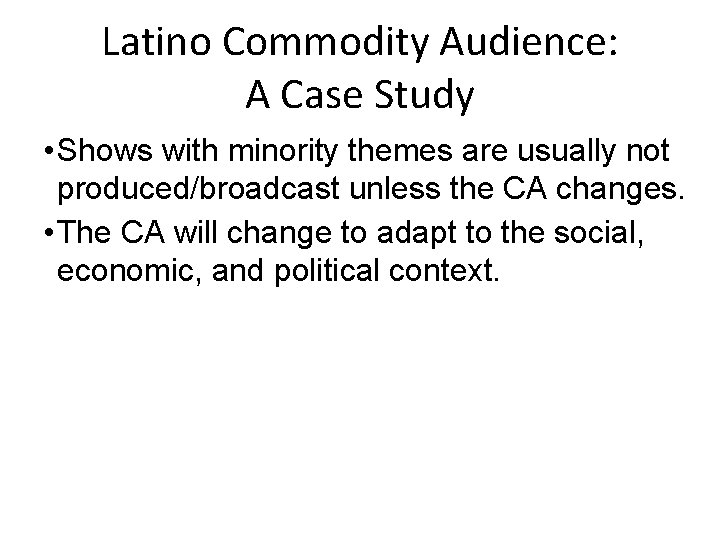
Latino Commodity Audience: A Case Study • Shows with minority themes are usually not produced/broadcast unless the CA changes. • The CA will change to adapt to the social, economic, and political context.
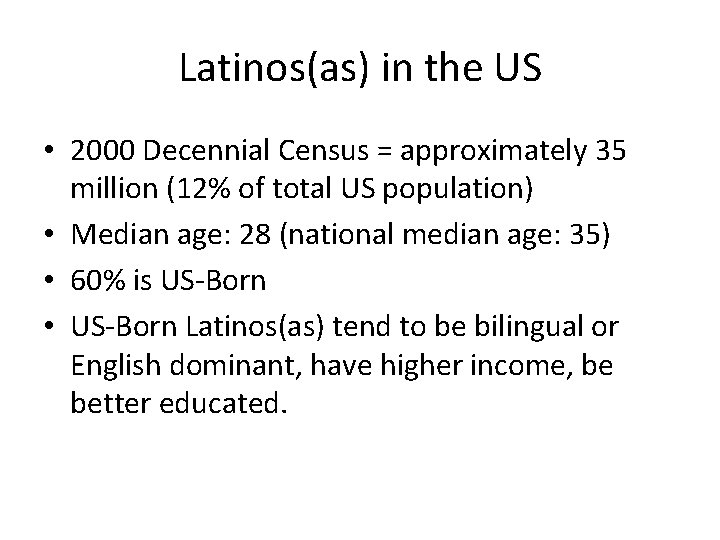
Latinos(as) in the US • 2000 Decennial Census = approximately 35 million (12% of total US population) • Median age: 28 (national median age: 35) • 60% is US-Born • US-Born Latinos(as) tend to be bilingual or English dominant, have higher income, be better educated.
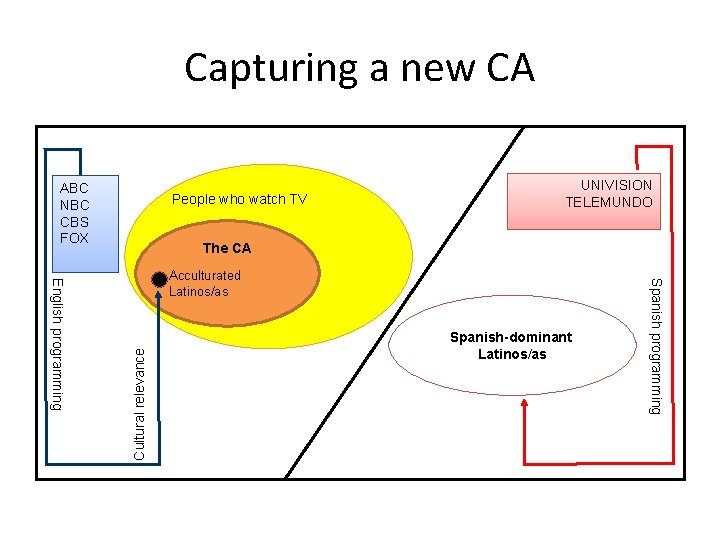
Capturing a new CA ABC NBC CBS FOX People who watch TV UNIVISION TELEMUNDO The CA Cultural relevance Spanish-dominant Latinos/as Spanish programming English programming Acculturated Latinos/as
New trends • Shows about Latinos(as) – George Lopez (2002 – 2007) – Freddie (2005 – 2006) – Cane (2006) – Ugly Betty (2006 - current) • Latino(a) Characters – Lost, Heroes, Cold Case, Without a Trace.