
Telerehabilitation Lessons learned from two examples William Durfee
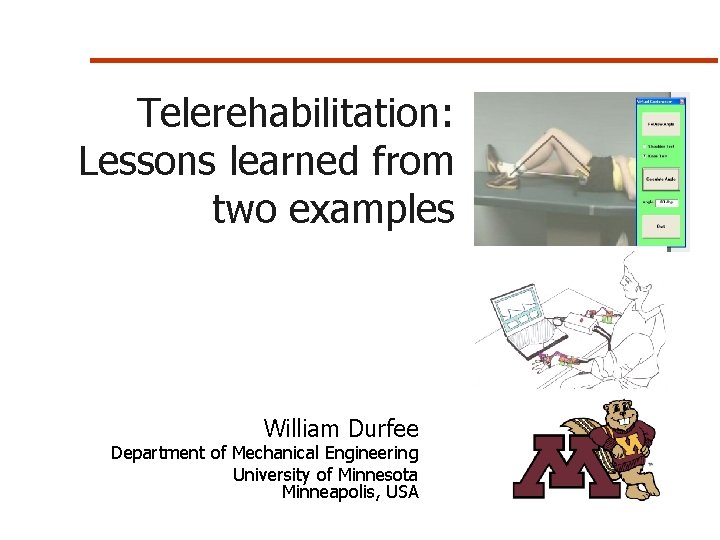
Telerehabilitation: Lessons learned from two examples William Durfee Department of Mechanical Engineering University of Minnesota Minneapolis, USA
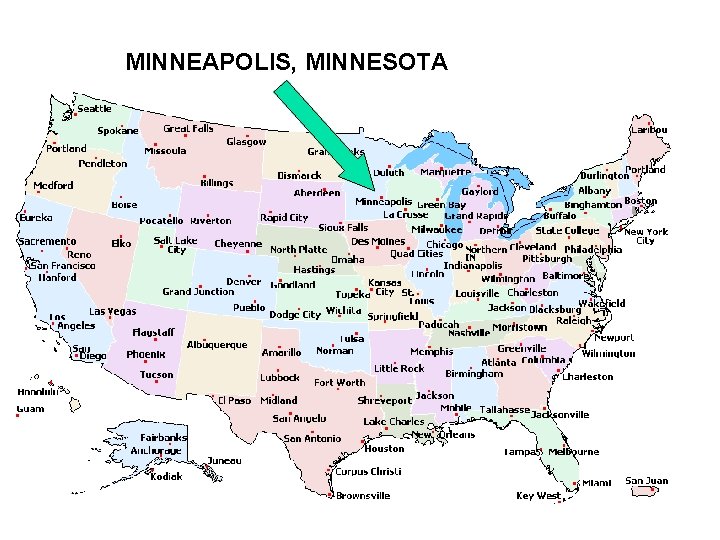
MINNEAPOLIS, MINNESOTA

MINNESOTA, Land of 10, 000 Lakes

Roadside “Art” in Minnesota

MINNEAPOLIS, City of Lakes

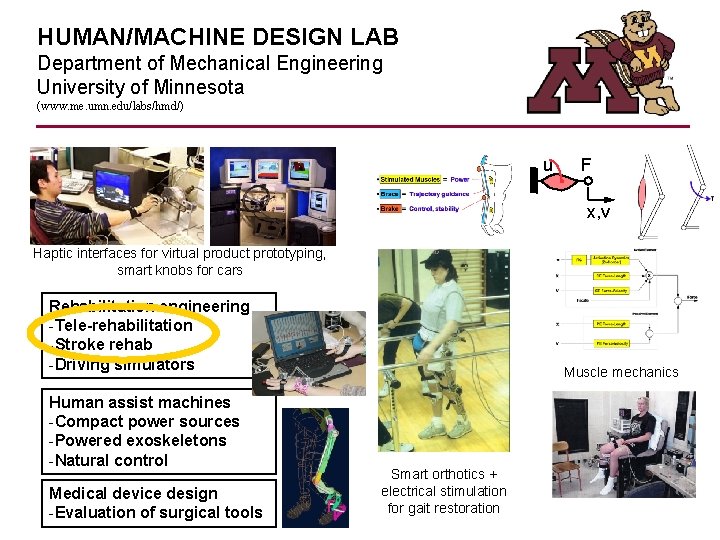
HUMAN/MACHINE DESIGN LAB Department of Mechanical Engineering University of Minnesota (www. me. umn. edu/labs/hmd/) u F x, v Haptic interfaces for virtual product prototyping, smart knobs for cars Rehabilitation engineering -Tele-rehabilitation -Stroke rehab -Driving simulators Human assist machines -Compact power sources -Powered exoskeletons -Natural control Medical device design -Evaluation of surgical tools Muscle mechanics Smart orthotics + electrical stimulation for gait restoration
OUTLINE n n Overview of telerehabilitation Example 1: Tele-assessment Example 2: Home stroke trainer Conclusions and lessons learned
Overview of Telerehabilitation
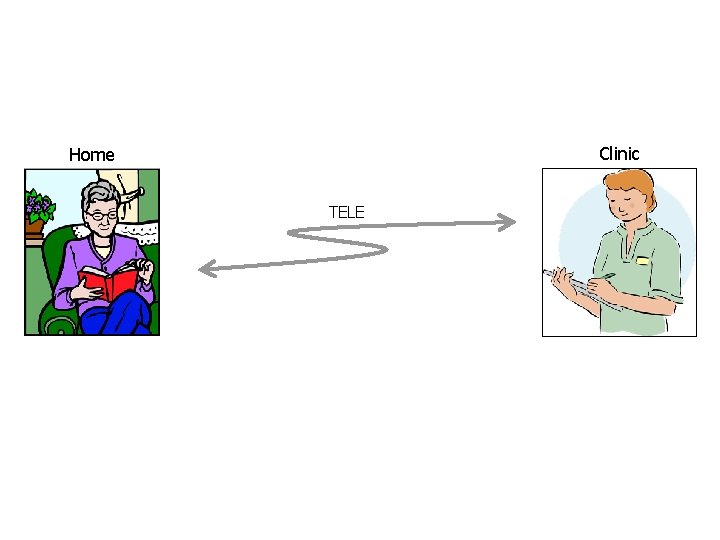
Clinic Home TELE
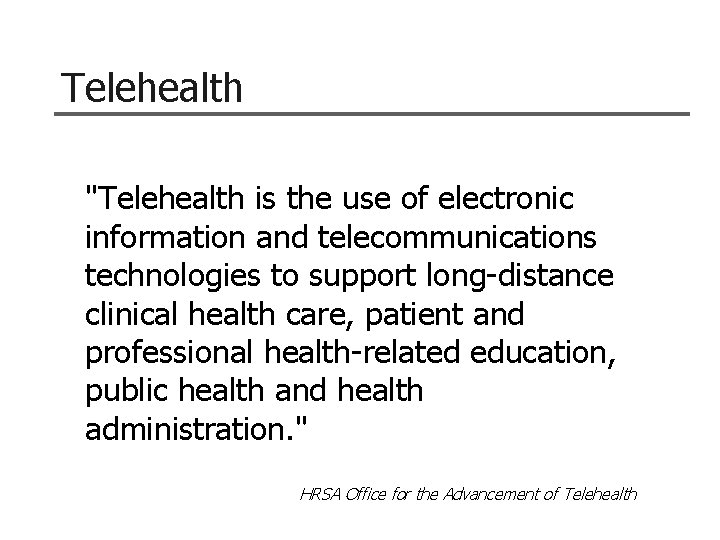
Telehealth "Telehealth is the use of electronic information and telecommunications technologies to support long-distance clinical health care, patient and professional health-related education, public health and health administration. " HRSA Office for the Advancement of Telehealth
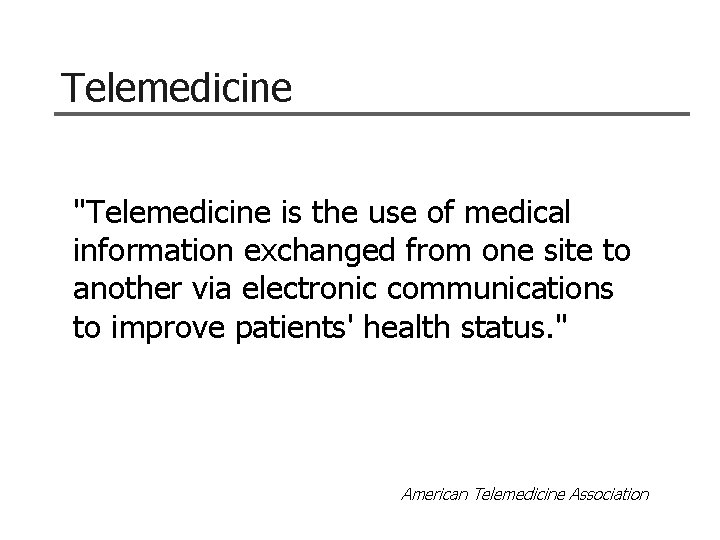
Telemedicine "Telemedicine is the use of medical information exchanged from one site to another via electronic communications to improve patients' health status. " American Telemedicine Association
Telerehabilitation "Telerehabilitation is the clinical application of consultative, preventative, diagnostic, and therapeutic services via two-way interactive telecommunication technology. " American Association of Occupational Therapists Position Paper on Telerehabilitation
Why tele? n n Clients in rural locations Clients in urban locations, but have transportation challenges n n n No car Poor public transportation Eliminates transportation time
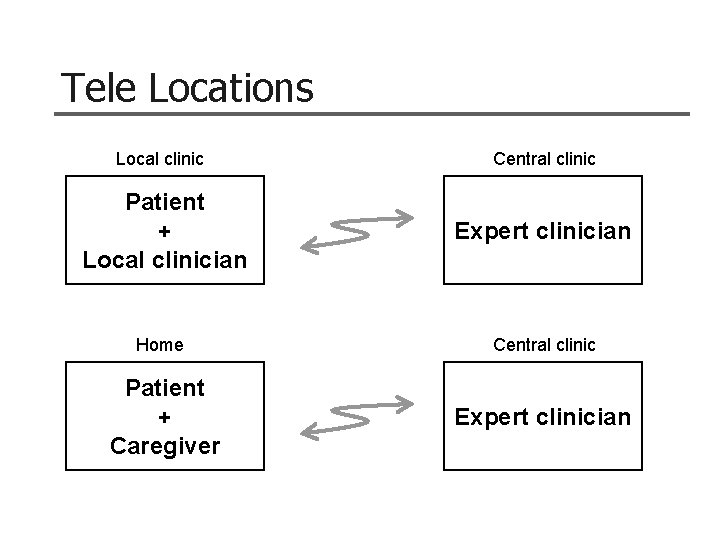
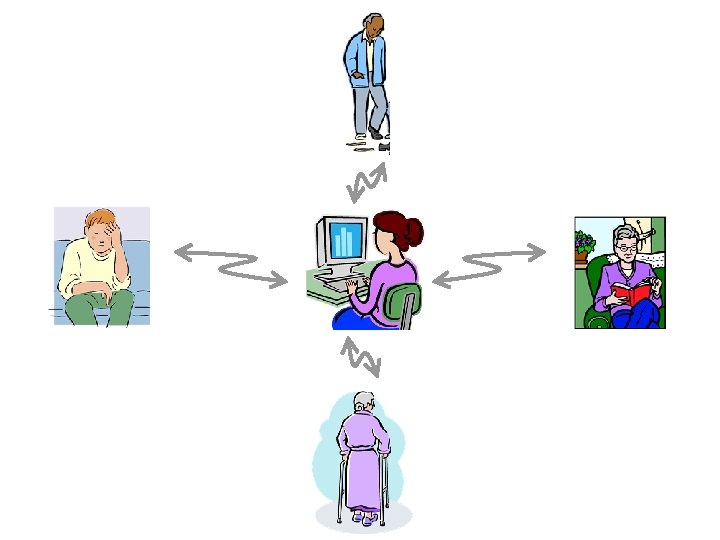
Tele Locations Local clinic Central clinic Patient + Local clinician Expert clinician Home Central clinic Patient + Caregiver Expert clinician
Telerehabilitation Applications n n n Consultation Home and activity monitoring Assessment Motor relearning (robot, biofeedback) Diagnosis and evaluation Education and training
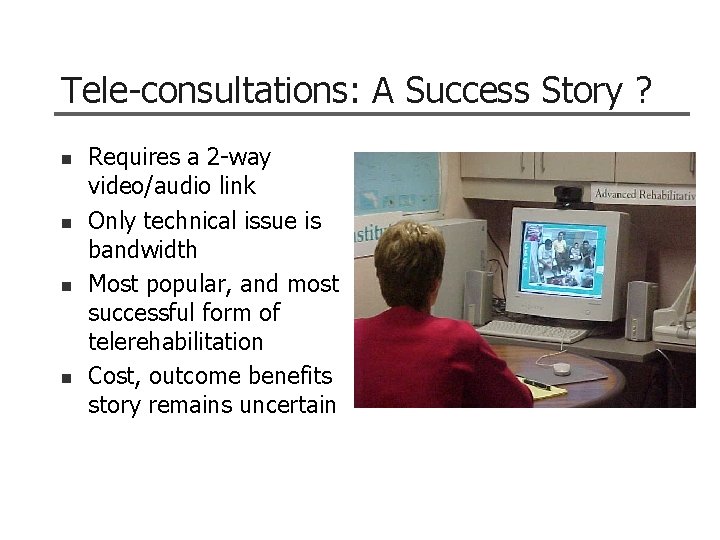
Tele-consultations: A Success Story ? n n Requires a 2 -way video/audio link Only technical issue is bandwidth Most popular, and most successful form of telerehabilitation Cost, outcome benefits story remains uncertain
Telerehabilitation Flaws? n Possibly adds cost n n n n n Technology cost Extra prep time for provider May not eliminate face visits Technology growing pains Provider training Limited communications infrastructure Patient trust & familiarity Limited applications Unproven outcome benefits
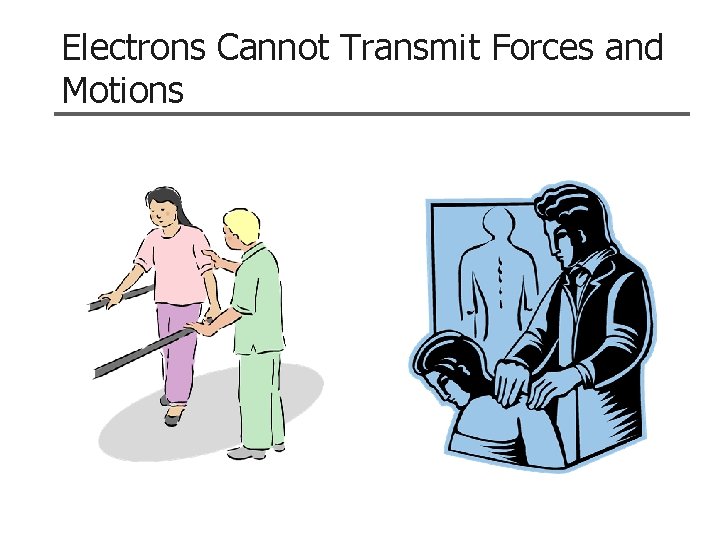
Electrons Cannot Transmit Forces and Motions
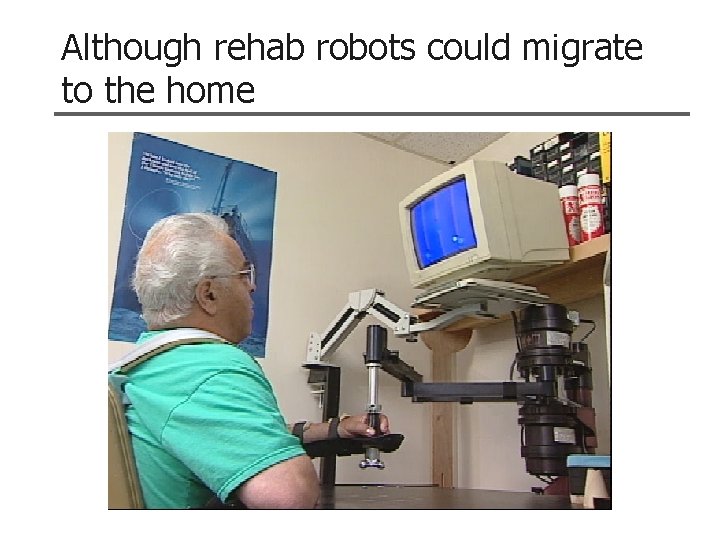
Although rehab robots could migrate to the home
Example project #1 Technical Feasibility of Teleassessment
Approach n n n Standardized assessments essential Standard assessment instruments exist, and have long history of use Match technology to assessment rather than creating a new assessment to match the technology
Hypothesis “Assessment instruments applied remotely are no different than assessment instruments applied locally” Test hypothesis by implementing assessment locally and remotely on the same person, then look for differences in the results
Selection Criteria for Selection Instruments n n n Published measurement tool Reliable and valid Used widely by physical therapists Supported by standardized instructions and scoring methods Likely to reveal strengths and weaknesses of tele approach
Assessment Instruments n Range of Motion (ROM) n n n Manual Muscle Test (MMT) Berg Balance Test n n n Shoulder abduction, shoulder rotation, knee flexion Item 1: Sit-to-Stand Item 8: Forward Reach Timed Up and Go Test (TUG)
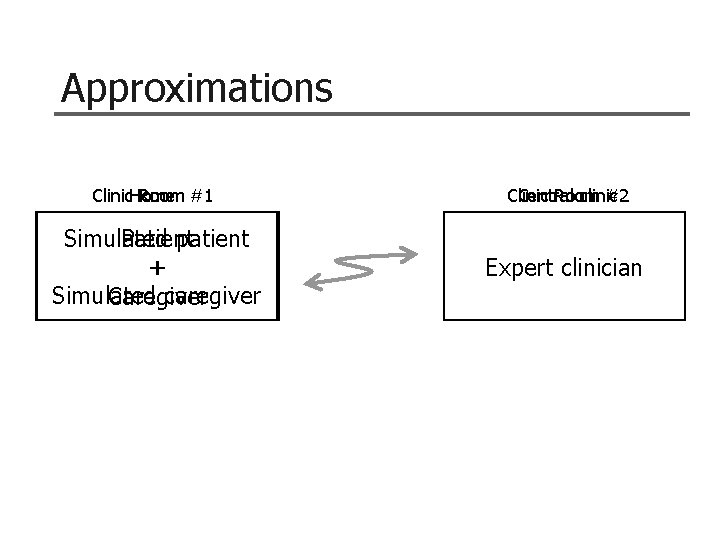
Approximations Clinic. Home Room #1 Central clinic Clinic Room #2 Simulated patient Patient + Simulated caregiver Caregiver Expert clinician
Simulated impairments n n n MMT: added weights Berg: stand on Dynadisk TUG: walk a balance beam
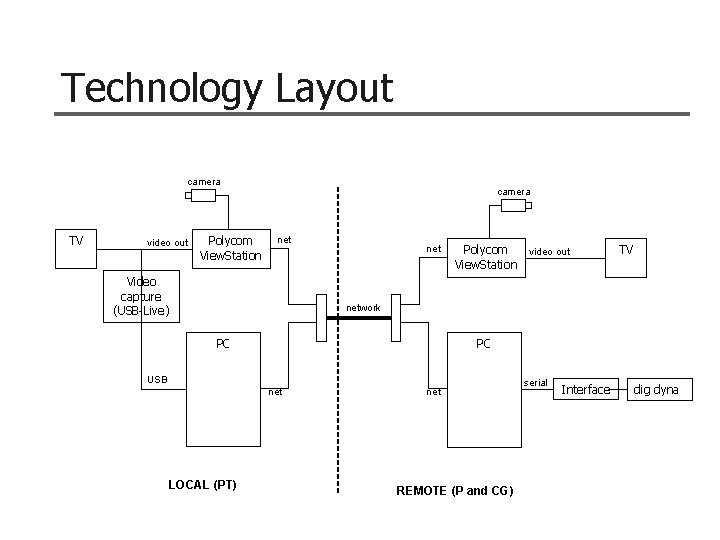
Technology Layout camera TV video out Polycom View. Station camera net Video capture (USB-Live) net Polycom video out View. Station TV network PC PC USB net LOCAL (PT) net REMOTE (P and CG) serial Interface dig dyna
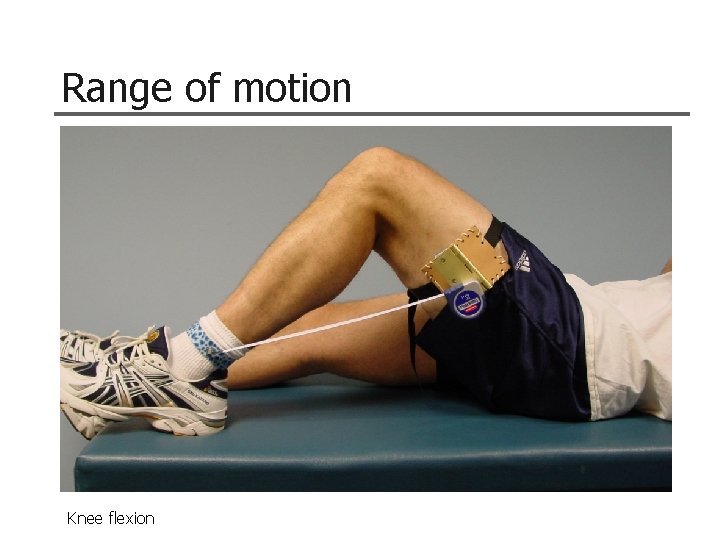
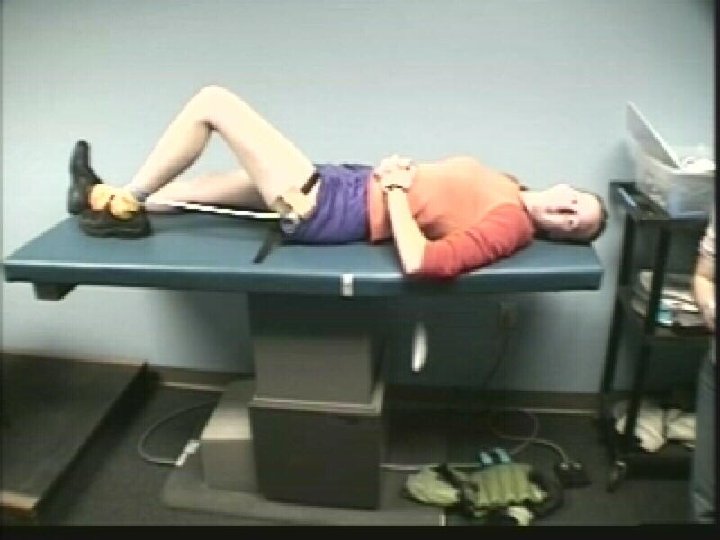
Range of motion Knee flexion
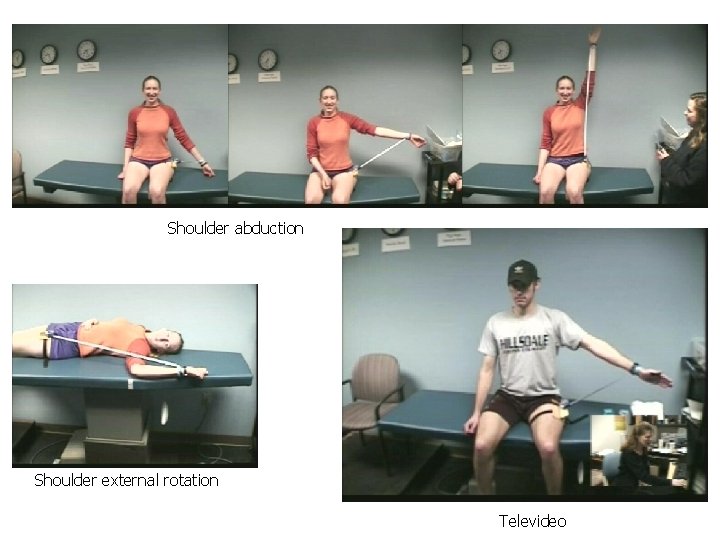
Shoulder abduction Shoulder external rotation Televideo
ROM Tele Measuring Methods 1. Caregiver places & reads goniometer 2. Caregiver places goniometer, therapist reads by zooming camera 3. Photo snapped, therapist holds goniometer up to screen 4. Photo snapped, therapist uses virtual goniometer
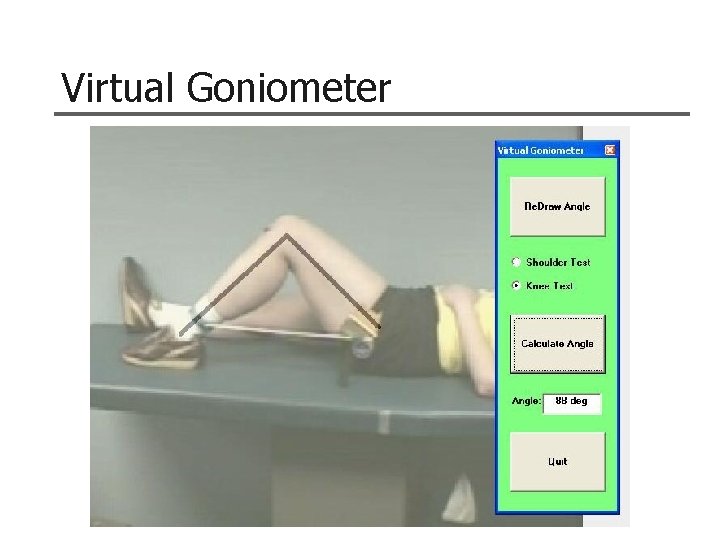
Virtual Goniometer
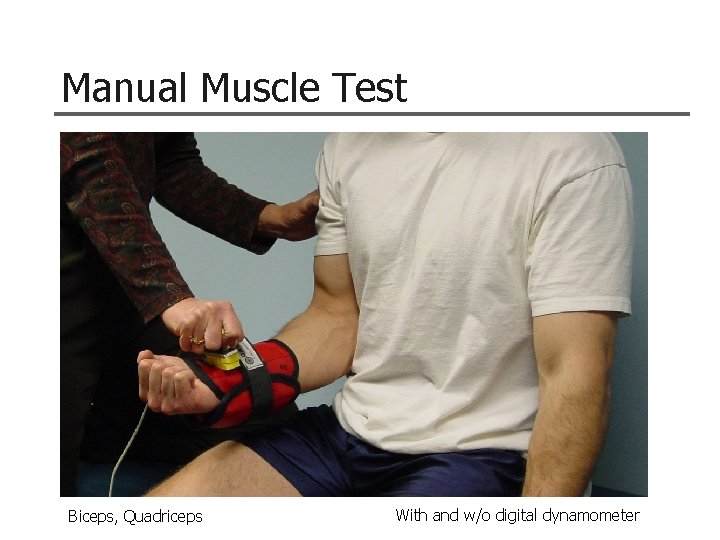
Manual Muscle Test Biceps, Quadriceps With and w/o digital dynamometer
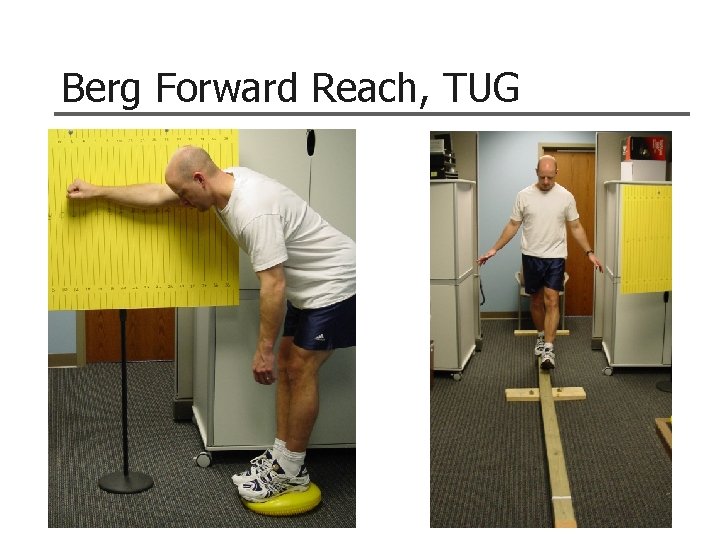
Berg Forward Reach, TUG
Experiment Design n n 10 subjects + 10 caregivers 5 assessment instruments Trained PTs Co-located and remote testing
Key result No significant difference between any of the measurement methods
Discussion n Communication bandwitdh n n ROM n n Dynamometer not needed, but still could aid Sit-Stand TUG n n Caregivers could place goniometer Snapshot + virtual goniometer Need clear camera view MMT n n High quality audio link essential, requirements for video not known No difficulties for tele-implementation Forward reach n n Need zoom camera Measurement technology would help
Limitations n n Simulated patients Simulated caregivers Performance variation No inter-rater reliability
Conclusion Some assessment methods are suitable for tele implementation with modest technology. Proof of clinical efficacy requires a home study with real patients.
Example project #2 Telerehabilitation for Training Recovery of Hand Function Following Stroke
Background n Post-stroke paralysis: dead cells + reduced excitability in surviving cells Chu et al. , Stroke v. 33, 2002 n “Learned nonuse”, compensatory use of non-impaired muscles, hinders recovery Taub, 1980 n Constraint induced movement therapy (CIMT) targets learned nonuse Taub et al. , Arch Phys Med Rehab, 1993; Liepert, Taub, Stroke, 2000 n n Question: Is it forced use or forced learning? Animal studies show repetitive movement is not enough Plautz et al. , Neurobiol Learn Mem, 2000
Strategy Provide patients with a movement task that requires learning. A task that requires concentration. A thinkbefore-move task.
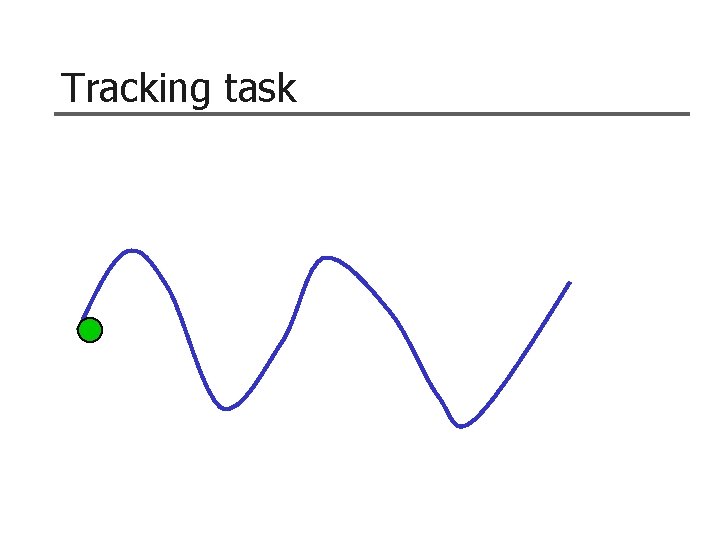
Tracking task
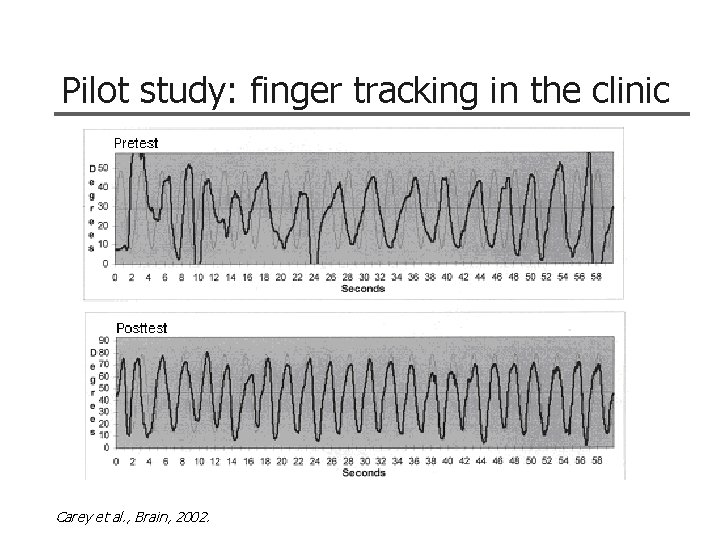
Pilot study: finger tracking in the clinic Carey et al. , Brain, 2002.
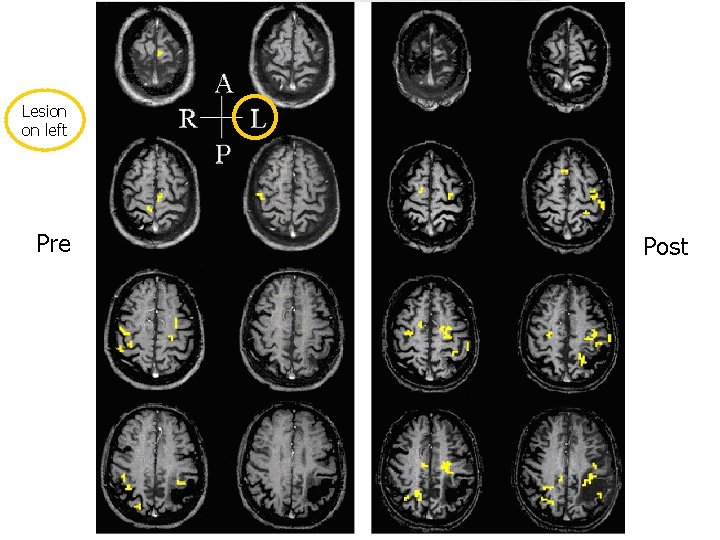
Lesion on left Pre Post
Home-based tracking n n n Eliminate need for patients to travel to clinic Patients can track on own schedule Lower cost Primary science question: can tracking training be transferred to the home? Secondary science question: compare tracking training (learning) with movement training (no learning) Primary technology question: is home based tracking training feasible?
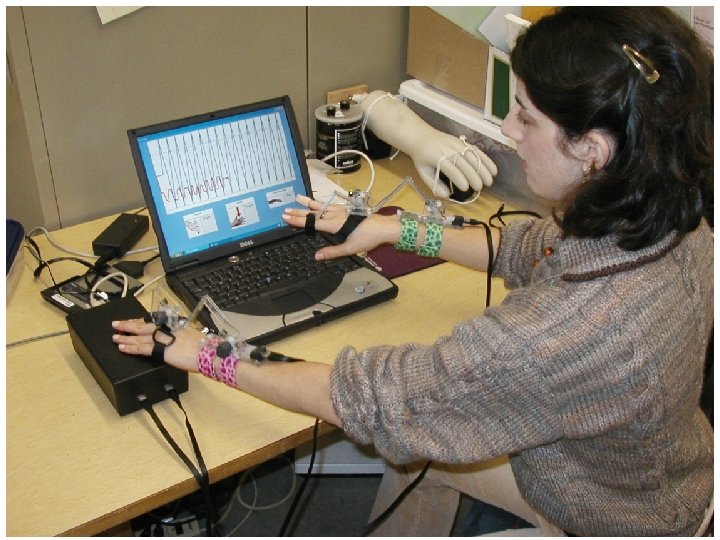
Track train system
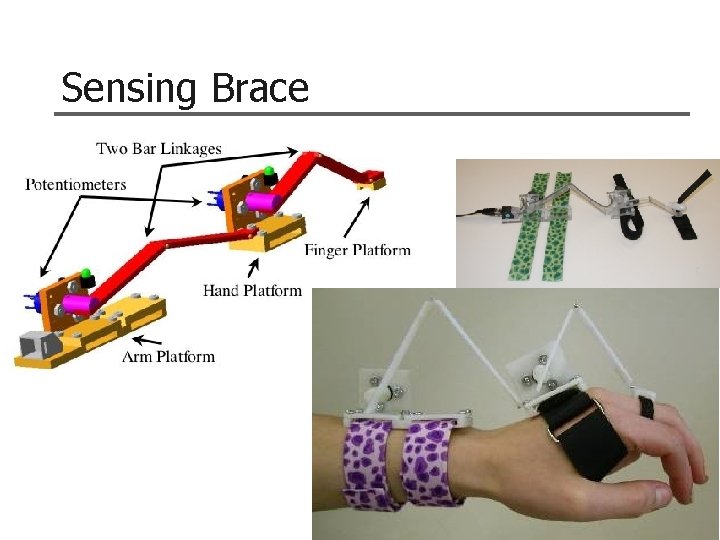
Sensing Brace
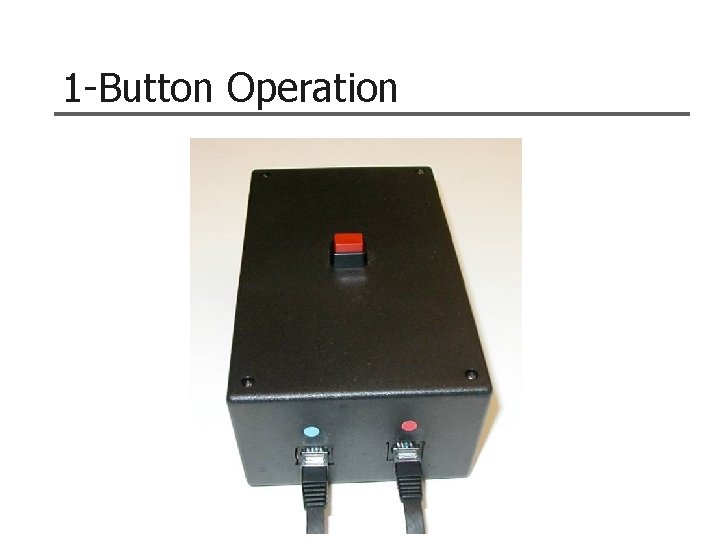
1 -Button Operation
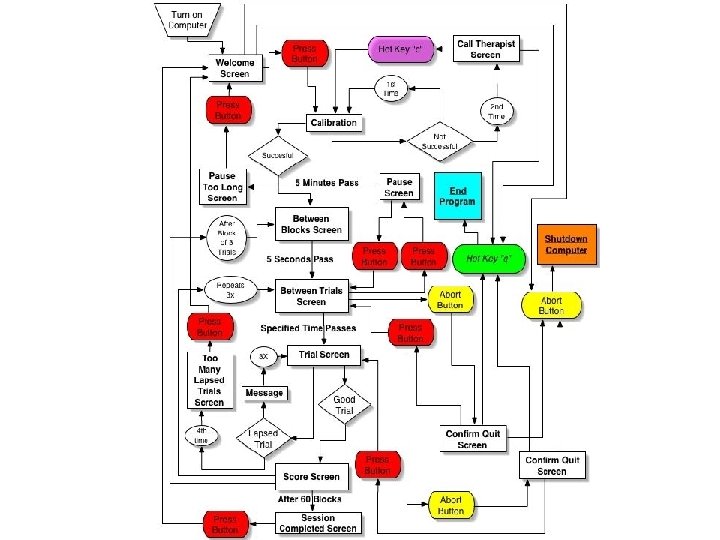
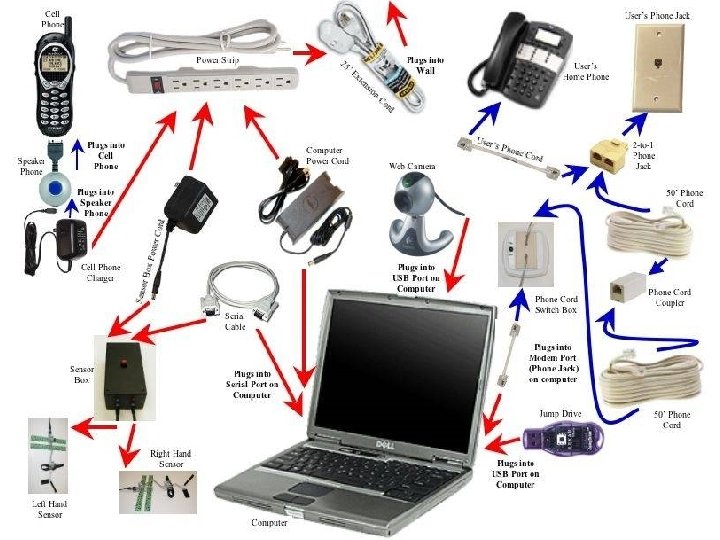
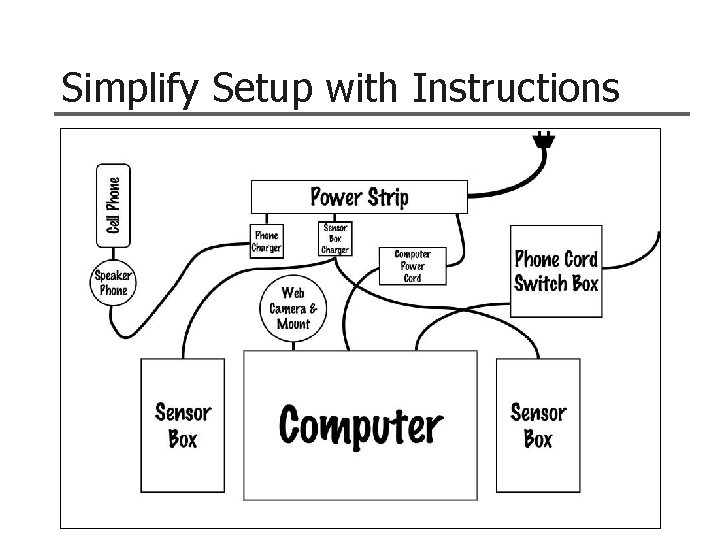
Simplify Setup with Instructions
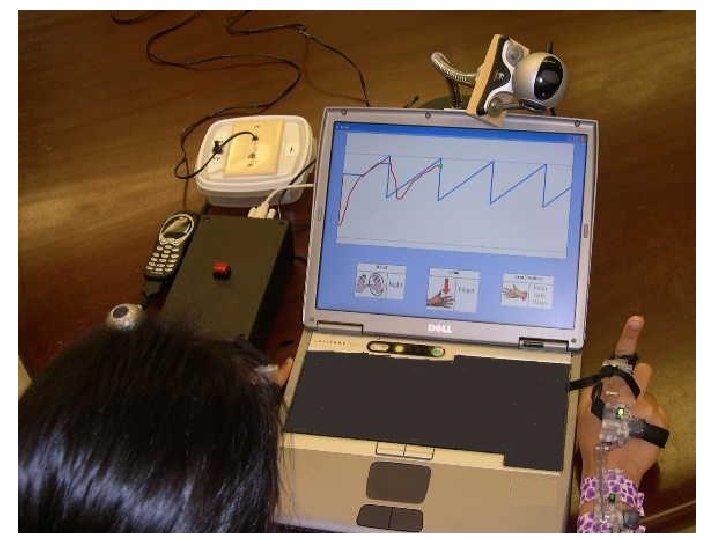
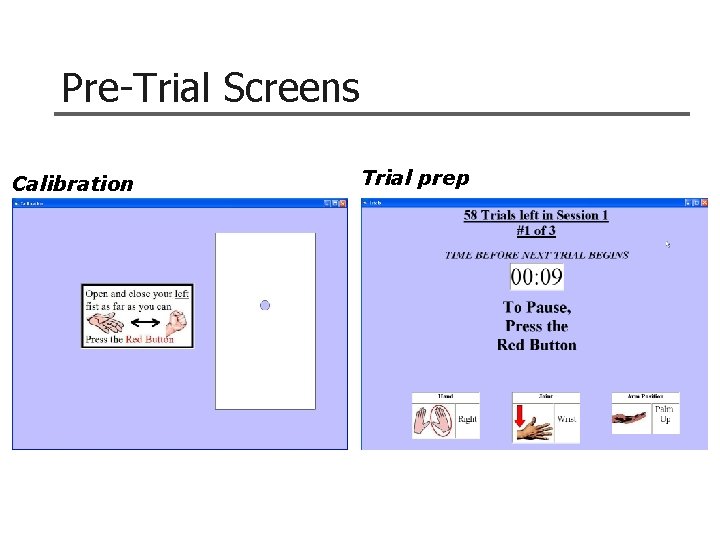
Pre-Trial Screens Calibration Trial prep
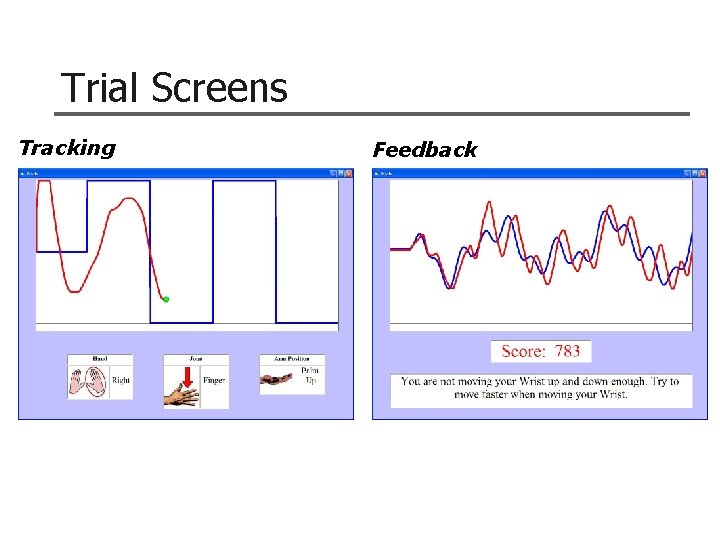
Trial Screens Tracking Feedback
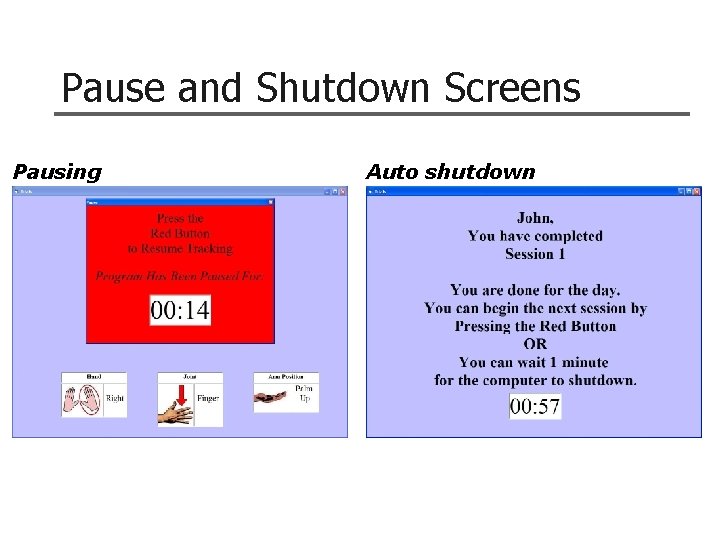
Pause and Shutdown Screens Pausing Auto shutdown
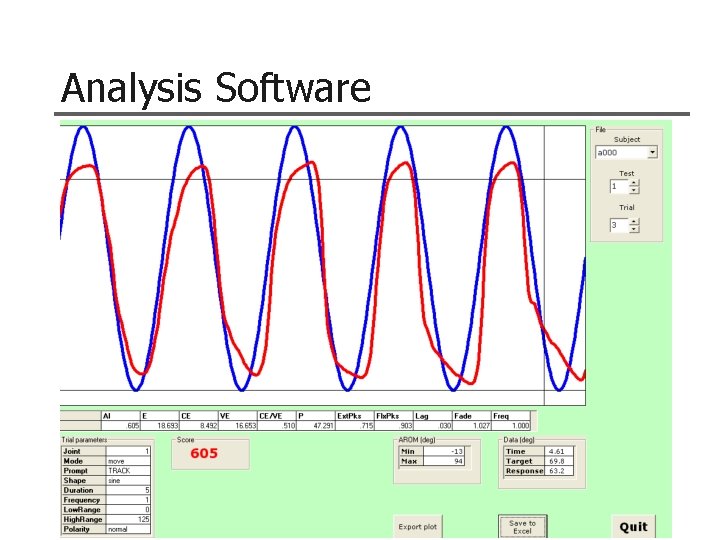
Analysis Software
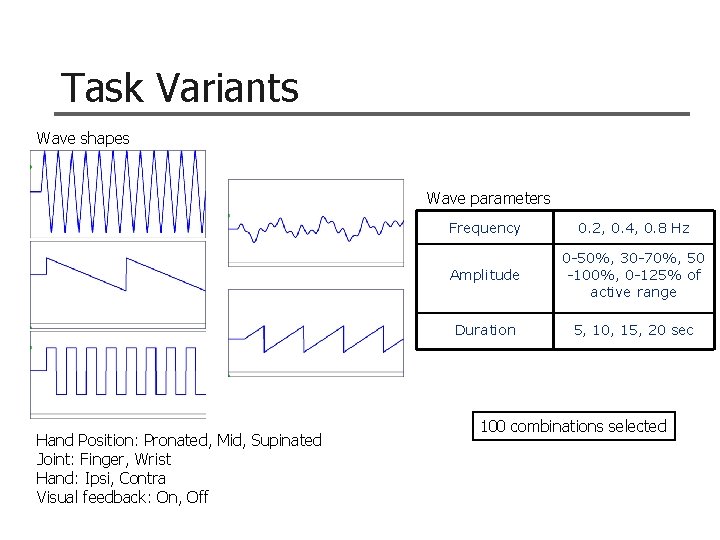
Task Variants Wave shapes Wave parameters Hand Position: Pronated, Mid, Supinated Joint: Finger, Wrist Hand: Ipsi, Contra Visual feedback: On, Off Frequency 0. 2, 0. 4, 0. 8 Hz Amplitude 0 -50%, 30 -70%, 50 -100%, 0 -125% of active range Duration 5, 10, 15, 20 sec 100 combinations selected
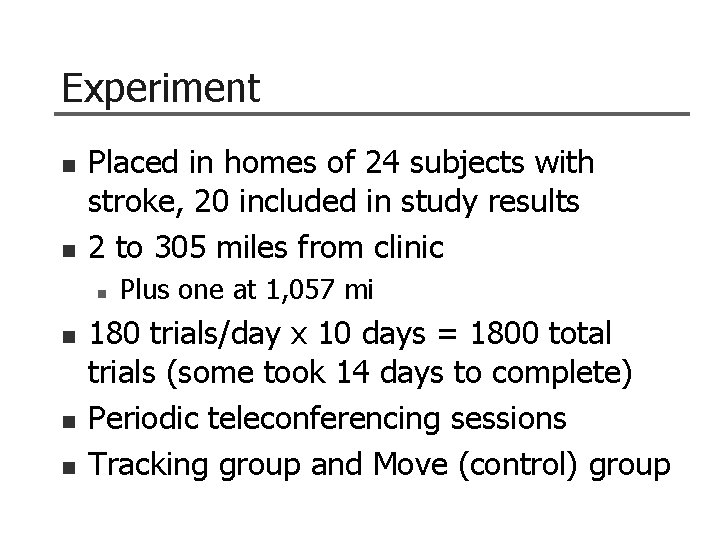
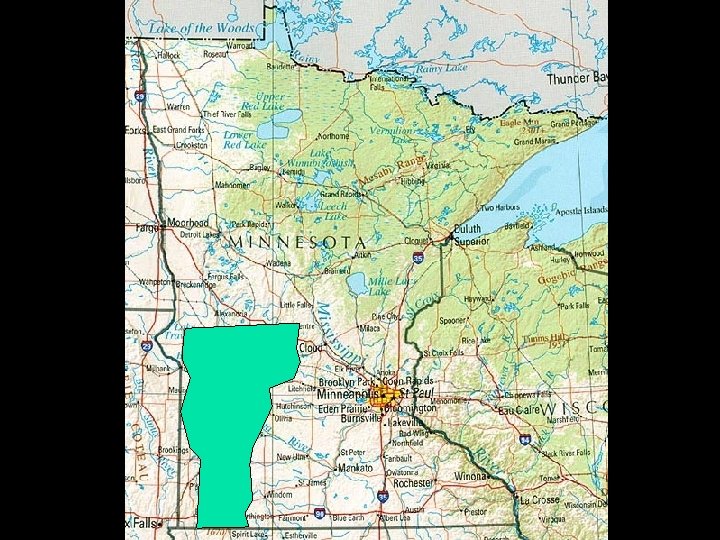
Experiment n n Placed in homes of 24 subjects with stroke, 20 included in study results 2 to 305 miles from clinic n n Plus one at 1, 057 mi 180 trials/day x 10 days = 1800 total trials (some took 14 days to complete) Periodic teleconferencing sessions Tracking group and Move (control) group
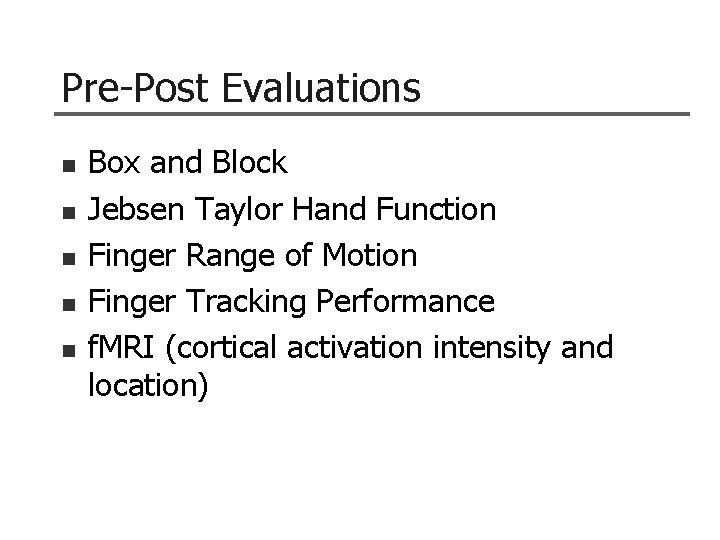
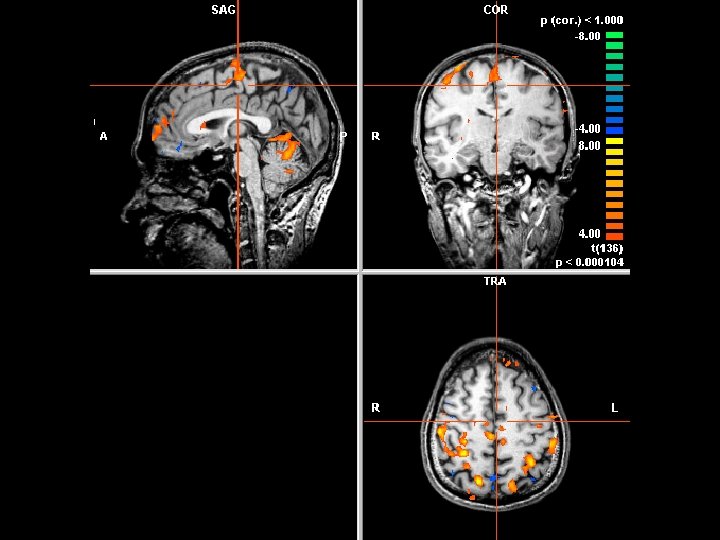
Pre-Post Evaluations n n n Box and Block Jebsen Taylor Hand Function Finger Range of Motion Finger Tracking Performance f. MRI (cortical activation intensity and location)
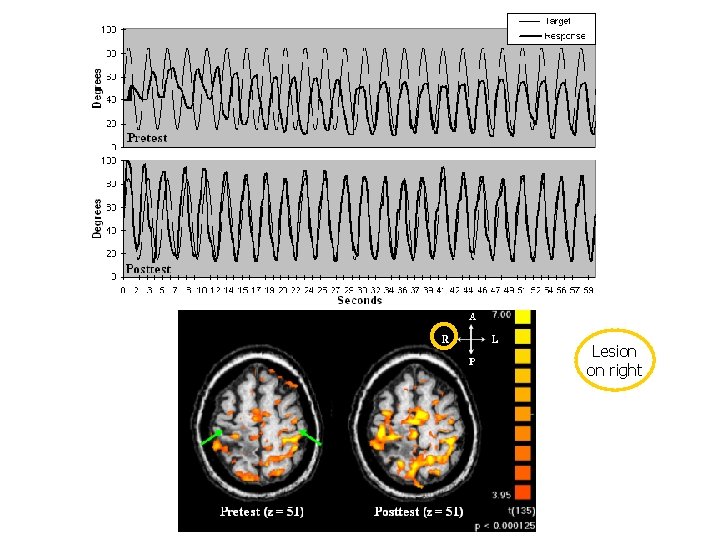
Lesion on right
Key Results n n Tracking group improved in tracking accuracy and finger ROM Both groups improved on functional tests Both groups had cortical reorganization, but Tracking group showed more shift towards lesioned side Subjects could self-install system and don/doff sensors Conclusion: Tracking training at home is feasible and effective. Need to explore why Tracking and Move groups were similar
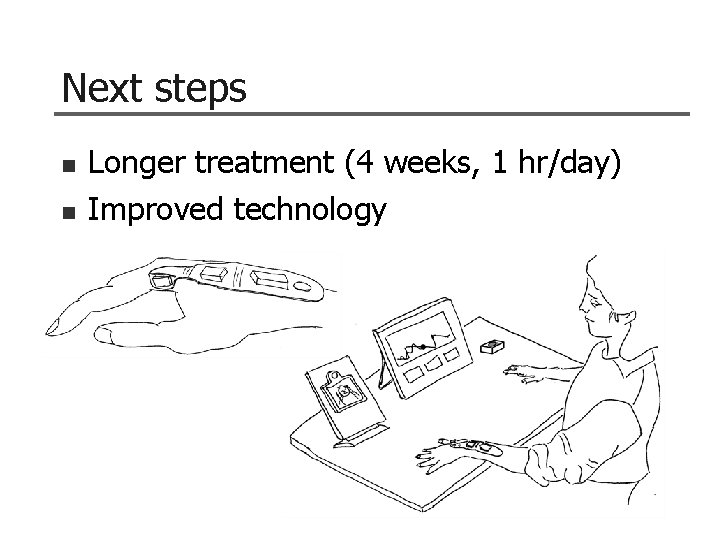
Next steps n n Longer treatment (4 weeks, 1 hr/day) Improved technology
Conclusions & Lessons Learned
Tele Technology n n High quality audio essential Video quality requirements open Clients have surprising tolerance for technology…if motivated More technology = more training
Tele Applications n n n Tele-consultation: a winner Self-administered home treatment with periodic tele-checkups: promising Interactions requiring touch: not yet, but rehab robots promising Cost and outcome benefits of telerehabilitation unknown which means research is only path to progress
Collaborators Teleassessment n n Lynda Savard Samantha Weinstein Stroke Rehab n n Project funded by the Sister Kenny Foundation, Minneapolis James Carey Samantha Weinstein Ela Bhatt Ashima Nagpal Project funded by NIDRR, H 133 G 020145

- Slides: 72