
Telehealth in SpeechLanguage pathology Dr Majid OryadiZanjani Associate

- Slides: 26
Telehealth in Speech-Language pathology Dr. Majid Oryadi-Zanjani Associate Professor Department od Speech Therapy Shiraz University of Medical Sciences
2 Improving Access to Speech Pathology Services via Telehealth is defined as: “The use of electronic information and telecommunications technologies to support long-distance clinical health care, patient and professional healthrelated education, public health and health administration” Dr. Majid Oryadi-Zanjani, SLP, Associate Professor, SUMS
3 Improving Access to Speech Pathology Services via Telehealth The term, Telehealth is often used interchangeably with other terms such as telemedicine and telerehabilitation which refer more specifically to the delivery of medical and rehabilitation services, respectively Dr. Majid Oryadi-Zanjani, SLP, Associate Professor, SUMS
4 Improving Access to Speech Pathology Services via Telehealth The term Telepractice has been adopted by the American Speech. Language-Hearing Association (ASHA) and refers to: “The application of telecommunications technology to deliver professional services at a distance by linking clinician to client, or clinician to clinician for assessment, intervention, and/or consultation” (ASHA, 2005. p. 1) Dr. Majid Oryadi-Zanjani, SLP, Associate Professor, SUMS
5 Improving Access to Speech Pathology Services via Telehealth However, the term telehealth will be used generically to denote the use of technology to deliver speech pathology services to clients in health and education domains Dr. Majid Oryadi-Zanjani, SLP, Associate Professor, SUMS
6 Improving Access to Speech Pathology Services via Telehealth Speech pathology services for people with communication and swallowing disorders primarily involve audio-visual interactions As such, these services can be readily hosted in an online or technologybased environment provided auditory and visual signals can be adequately replicated and transmitted at a distance The scope for the delivery of speech pathology services via telehealth is broad with the potential to provide valid and cost-effective services to individuals with most types of communication and swallowing disorders Dr. Majid Oryadi-Zanjani, SLP, Associate Professor, SUMS
7 Why Telehealth? The need for telehealth delivered services in speech pathology is driven by (Theodoros, 2012): The ever-increasing cost and demand for health care services and changing social and demographic factors Dr. Majid Oryadi-Zanjani, SLP, Associate Professor, SUMS
8 Why Telehealth? Population ageing will have a significant impact on the demand for speech pathology services With increasing age, people will live longer with chronic diseases and conditions that may be associated with communication and swallowing disorders e. g. , Parkinson’s disease and stroke (Morris et al. , 2010) Dr. Majid Oryadi-Zanjani, SLP, Associate Professor, SUMS
9 Why Telehealth? It is likely that older people will remain living in their own homes and communities, even though transport issues will arise as their capacity to drive decreases (Morris et al. , 2010) Speech pathology services will need to evolve in order to accommodate these societal changes Dr. Majid Oryadi-Zanjani, SLP, Associate Professor, SUMS
10 Why Telehealth? Alternative means of service delivery are also needed to meet the demand for equitable access to speech pathology services Previous studies have identified disparities in speech pathology services in rural and regional areas with residents in these areas having access to significantly fewer speech pathologists per head of population than counterparts in urban areas (Lambier & Atherton, 2003; Wilson et al. , 2002) Dr. Majid Oryadi-Zanjani, SLP, Associate Professor, SUMS
11 Why Telehealth? Similarly, for parents of children with communication and swallowing disorders, difficulties accessing speech pathology services are exacerbated by the demands of other siblings and family members, and inflexible work schedules Dr. Majid Oryadi-Zanjani, SLP, Associate Professor, SUMS
12 What are the Benefits of Telehealth? Although equitable access to healthcare services has been the primary driver of telehealth, evidence suggests that technology enabled services may actually enhance the quality of care provided (Mc. Cue, Fairman, & Pramuka, 2010; Winters & Winters, 2004) Through this method of service delivery, it is possible to optimize the timing, intensity, and sequencing of intervention leading to a greater functional outcome for the client (Winters & Winters, 2004) Dr. Majid Oryadi-Zanjani, SLP, Associate Professor, SUMS
13 What are the Benefits of Telehealth? Technology-based intervention has greater capacity to support evidence-based practice, such as intensive neurorehabilitation protocols required by people following traumatic brain injury, stroke, and Parkinson’s Disease, due to the ability to interact with a client more readily and frequently (Bach-y-Rita, 2000) Dr. Majid Oryadi-Zanjani, SLP, Associate Professor, SUMS
14 What are the Benefits of Telehealth? Examples of this can be seen in the use of: Computer-based language therapy for aphasia (Cherney, Holland, & Cole, 2008) Treatment of dysarthria in Parkinson disease via the internet (Constantinescu et al. , 2011) Dr. Majid Oryadi-Zanjani, SLP, Associate Professor, SUMS
15 What are the Benefits of Telehealth? Telehealth also enables speech pathologists to monitor communication and swallowing function in adults and children at a distance So that intervention may occur at an appropriate time, thus reducing morbidity and limitation to everyday life (Theodoros, 2012) Dr. Majid Oryadi-Zanjani, SLP, Associate Professor, SUMS
16 What are the Benefits of Telehealth? Equally important is the fact that telehealth enables speech pathology services to be delivered to the child or adult in their own environment e. g. home, local community, school, or workplace Dr. Majid Oryadi-Zanjani, SLP, Associate Professor, SUMS
17 What are the Benefits of Telehealth? Strong evidence exists to support the fact that interventions delivered in the person’s natural environment or specific context (e. g. workplace, school) are more effective than clinic-based interventions (Mc. Cue, Fairman. & Pramuka, 2010) Dr. Majid Oryadi-Zanjani, SLP, Associate Professor, SUMS
18 What are the Benefits of Telehealth? Studies have reported positive effects in the generalization of behavior, functional outcomes, and patient satisfaction and selfmanagement in various conditions including stroke (Legg & Langhorne, 2004; Von Koch, Wottrich, & Holmqvist, 1998), and severe brain injury (Ylvisaker, 2003) Dr. Majid Oryadi-Zanjani, SLP, Associate Professor, SUMS
19 What are the Benefits of Telehealth? This approach to community-based intervention is endorsed by the WHO framework (WHO, 2001) which promotes: A person’s functioning within the context of their environment Dr. Majid Oryadi-Zanjani, SLP, Associate Professor, SUMS
20 Evidence for the Use of Telehealth There is a growing body of evidence documenting the feasibility, validity, and reliability of delivering speech pathology services via telehealth This research has spanned the major communication disorders in adults and children, including neurogenic communication disorders (aphasia, dysarthria, apraxia), voice disorders, stuttering, articulation, language, and literacy disorders in children, and communicative function following laryngectomy Several studies have demonstrated the feasibility and validity of using telehealth in the management of people with swallowing disorders Dr. Majid Oryadi-Zanjani, SLP, Associate Professor, SUMS
21 Evidence for the Use of Telehealth Overall, the studies have provided strong evidence to demonstrate comparability between telehealth delivered assessment and intervention and face-to-face interaction, indicating that: These services can be validly provided across the Internet Dr. Majid Oryadi-Zanjani, SLP, Associate Professor, SUMS
22 Evidence for the Use of Telehealth Wales et al. (2017) (A Systematic Review): Both telehealth and inperson participants made significant and similar improvements when treatment effects There is limited but promising evidence to support telehealth for delivering speech language pathology intervention services to schoolage children Dr. Majid Oryadi-Zanjani, SLP, Associate Professor, SUMS
23 Evidence for the Use of Telehealth: Hong Kong Fong et al. (2021): Title: The Implementation of Telepractice in Speech Language Pathology in Hong Kong During the COVID-19 Pandemic Findings: The survey findings suggested that telepractice provision in Hong Kong was different from that of other countries where telepractice has been well established, due to the accelerated emergence by the COVID-19 pandemic Dr. Majid Oryadi-Zanjani, SLP, Associate Professor, SUMS
24 Evidence for the Use of Telehealth: Iran Tohidast et al. (2020): Title: Provision of speech-language pathology services for the treatment of speech and language disorders in children during the COVID-19 pandemic: Problems, concerns, and solutions Findings: Active therapists of the field must dedicate efforts to the proper provision of telepractice services The speech-language-hearing associations and other diseases that require SLP services should take solemn measures to train therapists so as to provide telepractice services and increase the quality of these services Dr. Majid Oryadi-Zanjani, SLP, Associate Professor, SUMS
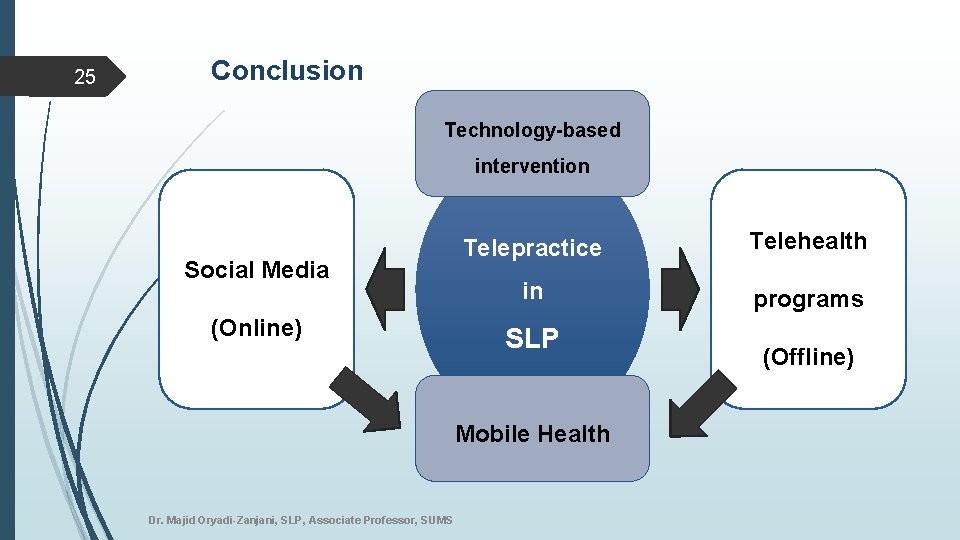
25 Conclusion Technology-based intervention Social Media (Online) Telepractice Telehealth in programs SLP Mobile Health Dr. Majid Oryadi-Zanjani, SLP, Associate Professor, SUMS (Offline)