
TELECOMMUNICATOR EMERGENCY RESPONSE TASKFORCE George Long RPL ORCEMS

- Slides: 17
TELECOMMUNICATOR EMERGENCY RESPONSE TASKFORCE George Long, RPL, ORCEMS TERT Coordinator for Oregon Member, NJTI-TERT National Committee
OVERVIEW ■ Assistance to Oregon PSAPs ■ What is TERT and how does it fit ■ Developing TERT ■ Planning Processes for PSAPs
ASSISTANCE TO OTHER PSAPs ■ Malhuer National Wildlife Refuge Stand Off ■ LODD in Seaside ■ UCC Shooting
WHAT IS TERT? ■ Telecommunicator Emergency Response Taskforce – Developed following Hurricane Katrina – A joint venture by APCO and NENA ■ When 9 -1 -1 needs 9 -1 -1 – Predetermined, deployable teams – Augment staffing in PSAPs and EOCs
HOW DOES IT WORK ■ PSAP leadership determine the need for extra staffing ■ Request is made to the State OEM for assistance via TERT ■ OEM contacts TERT State Coordinator ■ Teams are coordinated and sent to the impacted PSAP ■ Similar process for out of state requests
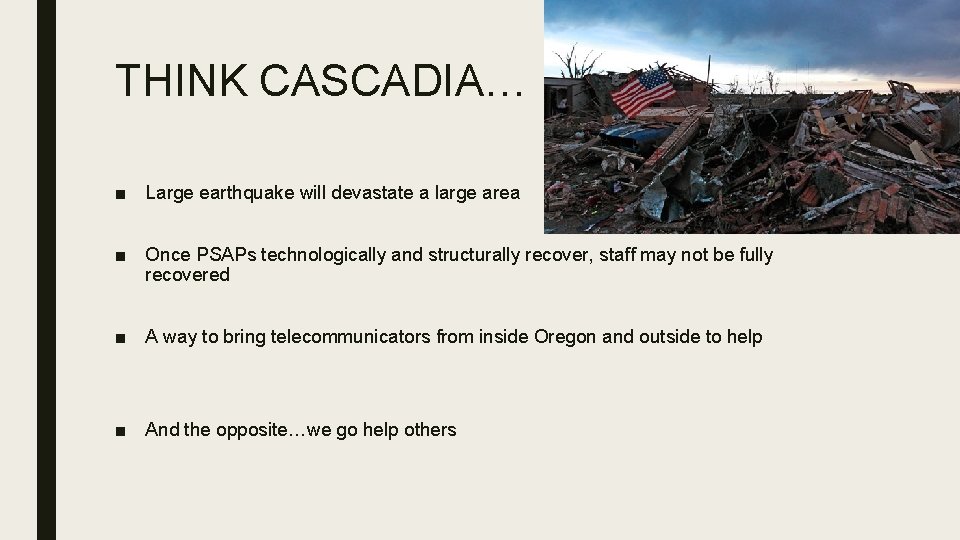
THINK CASCADIA… ■ Large earthquake will devastate a large area ■ Once PSAPs technologically and structurally recover, staff may not be fully recovered ■ A way to bring telecommunicators from inside Oregon and outside to help ■ And the opposite…we go help others
THE HIGHs AND LOWs ■ TERT is a Federally recognized, typed resource – This means during federally declared disasters, funding/reimbursements may be available to agencies to cover the cost of TERT deployments ■ TERT comes with a price tag – Outside of a Federally declared response, it may be on the requesting agency, sending agencies or the individuals to cover costs – Harney County incident is example, some people volunteered ■ TERT is not a random selection of people – Those deploying must meet certain requirements and be approved by their agency
DEVELOPING A TERT PROGRAM IN OREGON ■ Process has already started – Appointment of State Coordinator Oct 2015 – Creation of TERT Work Group Nov 2015 and ongoing work in 2016 ■ Required collection of information from National APCO and other TERT programs
CHALLENGES TO IMPLIMENTATION ■ Training – National APCO/NENA no longer guide training, it is up to the states to build their own – Training and agency approvals must be tracked at the state level – Creation of a training plan has already been started ■ Establishing MOUs and IGAs – This is the hardest part for most states trying to create a program – Currently working with members of OEM to determine what is needed and from who
SO WHAT ABOUT TRAINING? ■ FEMA Independent Study IS-144 focuses on the overall TERT concepts and philosophies – Everyone must take this – Currently the only additional requirement for anyone who has a basic certificate issued by DPSST ■ Additional recommended training for team leaders: – FEMA COML course – FEMA ICS 300/400 ■ Any additional training related to disaster operations is encouraged
WHAT ARE WE DOING ABOUT TRAINING ■ In person training is better ■ Developing a one day training course ■ This course will be a requirement in Oregon only in order to be considered deployable ■ Will try to host at DPSST to reduce costs as low as possible for agencies and individuals
WHAT CAN YOU DO? - INDIVIDUAL ■ Go online and complete the FEMA Independent Study Course IS-144 – Keep your certificate! ■ Discuss with your agency the possibility of participating with a TERT team ■ Discuss with your family the possibility of being sent on a deployment – Develop a plan for your family for when you are gone so that they are taken care of as well ■ Continue education on disasters and disaster operations to better understand your role and how operations work beyond the PSAP
WHAT CAN WE DO? - AGENCY ■ Plan, plan and then plan some more – Every agency should have a COOP plan – If TERT is part of that, then consider the following and make plans: ■ ■ ■ How will we receive TERT teams How will we train TERT teams How will we return to normal operations once TERT teams leave ■ Start keeping track of who has completed IS-144 and is interested in deploying – How will you decide who you approve? ■ Plan for how you will operate with TERT members absent
SO WHERE DO WE GO FROM HERE? ■ Educate telecommunicators about TERT ■ Encourage agencies to start planning ■ Develop an Oregon TERT SOP ■ Finalize needs with OEM ■ Submit request to NJTI-TERT to be formally recognized ■ Start collecting information from PSAPs ■ Prepare for deployment
CONCLUSION ■ We all have seen help is needed ■ We all are going to need help some day ■ Start YOUR preparation now, be it individual or agency ■ STAY CURRENT ■ Find us on Facebook: National Joint TERT Initiative, LLC ■ Visit the website (massive update coming soon) http: //www. njti-tert. org/
LET’S TALK George Long 503 -763 -1400 (w) 541 -908 -2867 (c) call or text glong@cityofsalem. net
QUESTIONS? ■ Oregon TERT Workgroup – Heidi Anderson, Hood River – Tami Atkinson, DPSST – Hank Evans, Deschutes County – Kim Foster, WCCCA – Lara Marzilli, WCCCA