
Telecommunications Infrastructure Standard for Data Centers ANSITIA942 Outline

- Slides: 27
Telecommunications Infrastructure Standard for Data Centers ——ANSI/TIA-942
Outline 1、 Purpose of TIA-942 2、 Spaces of Data Centers 3、 Data Center Cabling 4、 Infrastructure Administration 5、 Facilities Specifications & Tiers Page 2 ★
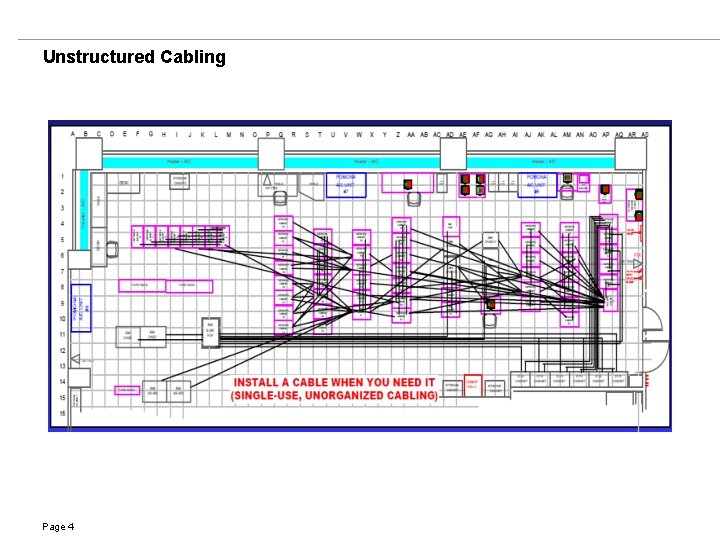
Purpose of TIA-942 l Encourage early participation of telecom designers in data center design process l Fill a void by providing standards for planning of data centers, computer rooms, server rooms, and similar spaces. l The standard encompasses much more than just telecommunications infrastructure. l Structured cabling system for data centers using standardized architecture and media l Replaces unstructured point-to-point cabling that uses different cabling for different applications l The TIA data center tier standard is: Ø A tool to communicate design requirements Ø A tool to evaluate existing data centers Page 3
Unstructured Cabling Page 4
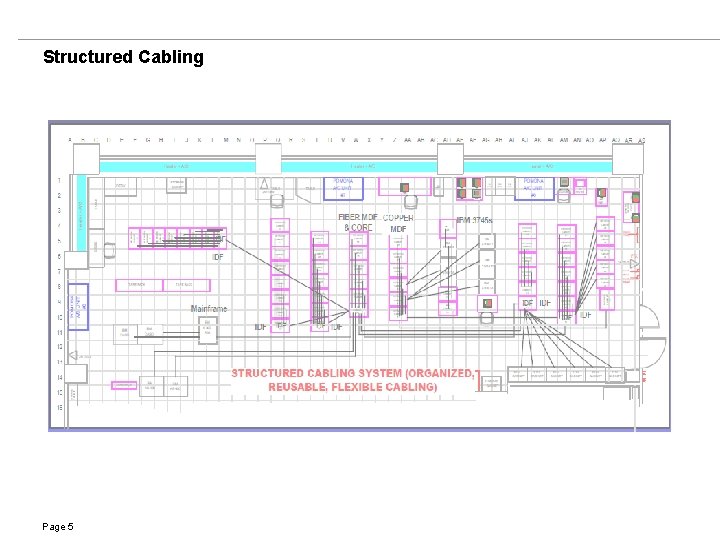
Structured Cabling Page 5
Outline 1、 Purpose of TIA-942 2、 Spaces of Data Centers 3、 Data Center Cabling 4、 Infrastructure Administration 5、 Facilities Specifications & Tiers Page 6 ★
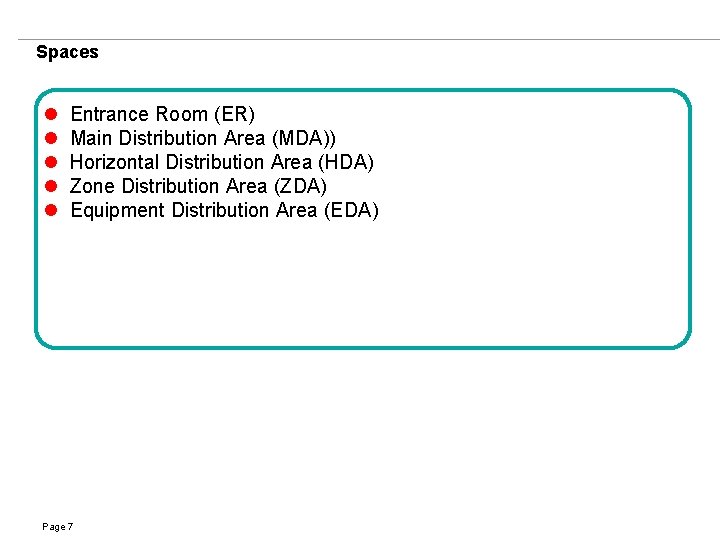
Spaces l l l Entrance Room (ER) Main Distribution Area (MDA)) Horizontal Distribution Area (HDA) Zone Distribution Area (ZDA) Equipment Distribution Area (EDA) Page 7
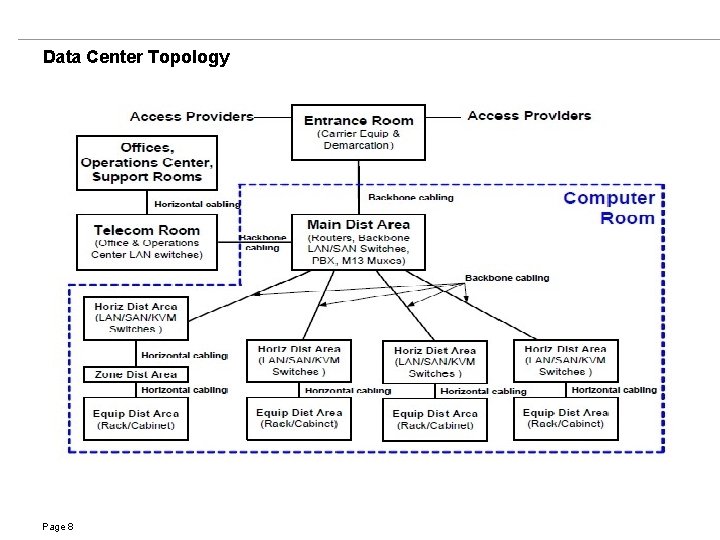
Data Center Topology Page 8
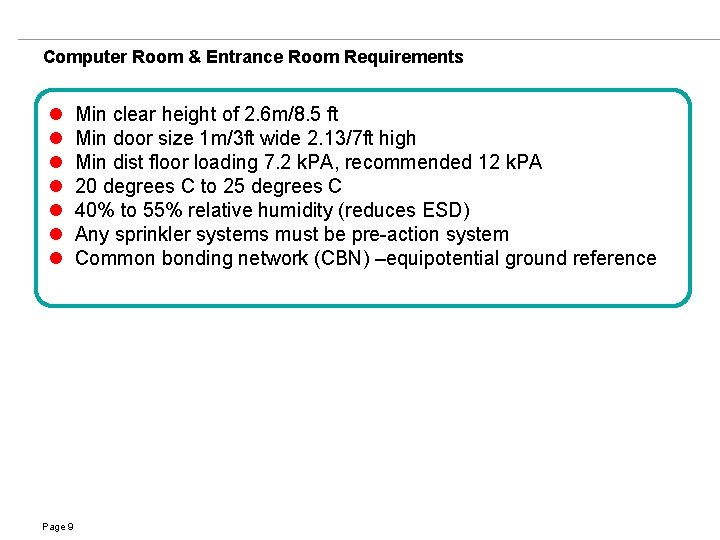
Computer Room & Entrance Room Requirements l l l l Page 9 Min clear height of 2. 6 m/8. 5 ft Min door size 1 m/3 ft wide 2. 13/7 ft high Min dist floor loading 7. 2 k. PA, recommended 12 k. PA 20 degrees C to 25 degrees C 40% to 55% relative humidity (reduces ESD) Any sprinkler systems must be pre-action system Common bonding network (CBN) –equipotential ground reference
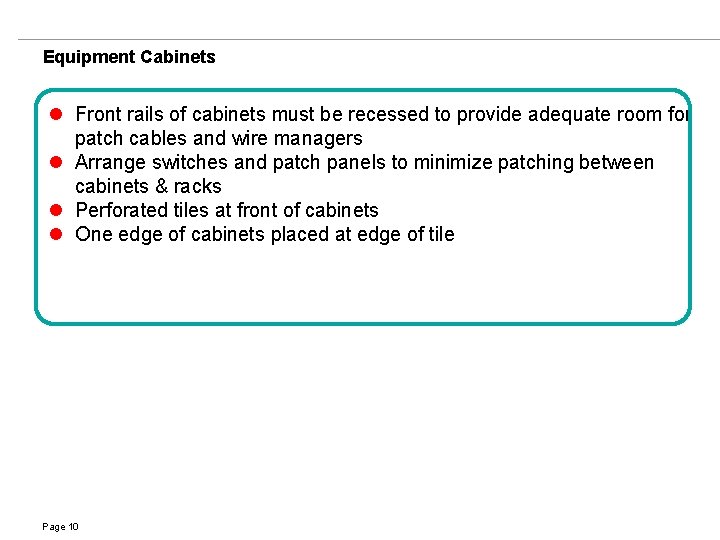
Equipment Cabinets l Front rails of cabinets must be recessed to provide adequate room for patch cables and wire managers l Arrange switches and patch panels to minimize patching between cabinets & racks l Perforated tiles at front of cabinets l One edge of cabinets placed at edge of tile Page 10
Outline 1、 Purpose of TIA-942 2、 Spaces of Data Centers 3、 Data Center Cabling 4、 Infrastructure Administration 5、 Facilities Specifications & Tiers Page 11 ★
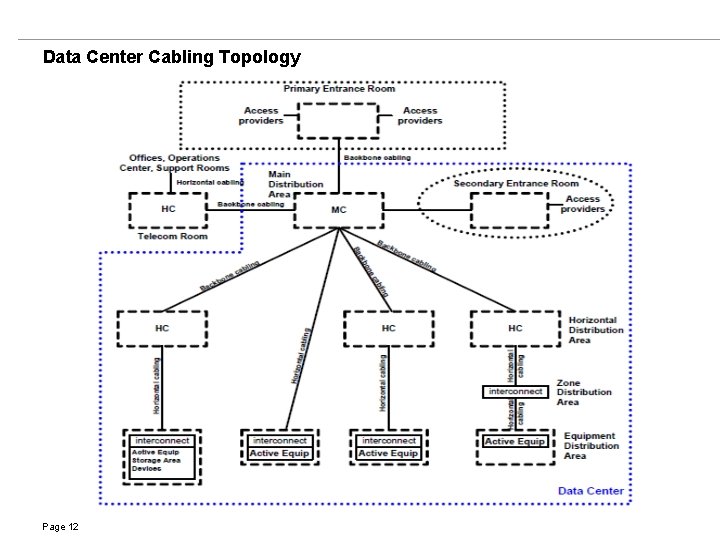
Data Center Cabling Topology Page 12
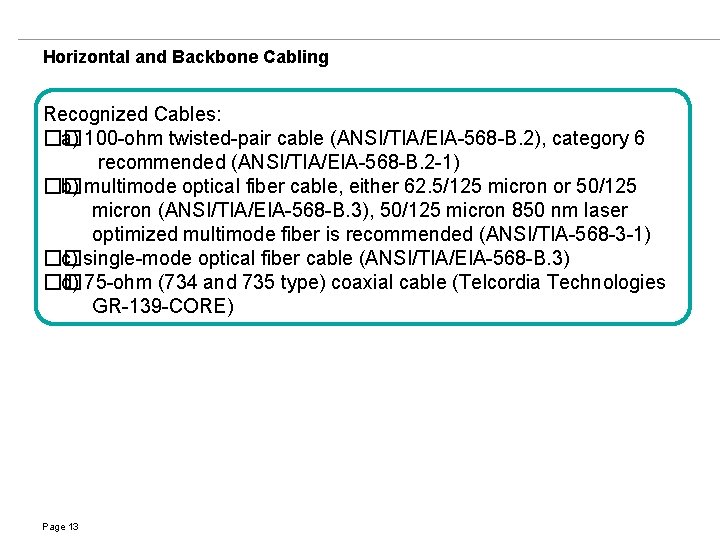
Horizontal and Backbone Cabling Recognized Cables: �� a) 100 -ohm twisted-pair cable (ANSI/TIA/EIA-568 -B. 2), category 6 recommended (ANSI/TIA/EIA-568 -B. 2 -1) �� b) multimode optical fiber cable, either 62. 5/125 micron or 50/125 micron (ANSI/TIA/EIA-568 -B. 3), 50/125 micron 850 nm laser optimized multimode fiber is recommended (ANSI/TIA-568 -3 -1) �� c) single-mode optical fiber cable (ANSI/TIA/EIA-568 -B. 3) �� d) 75 -ohm (734 and 735 type) coaxial cable (Telcordia Technologies GR-139 -CORE) Page 13
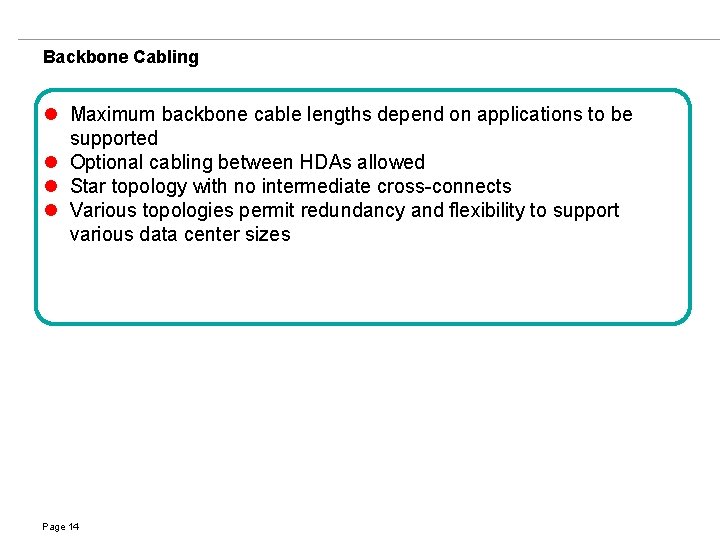
Backbone Cabling l Maximum backbone cable lengths depend on applications to be supported l Optional cabling between HDAs allowed l Star topology with no intermediate cross-connects l Various topologies permit redundancy and flexibility to support various data center sizes Page 14
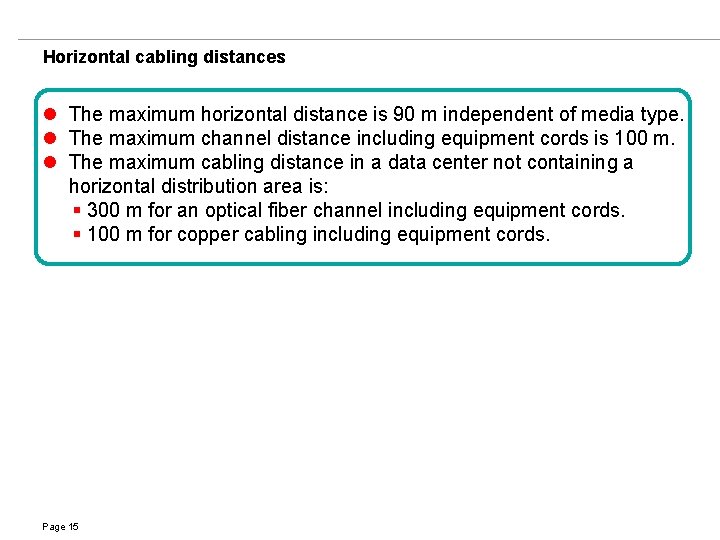
Horizontal cabling distances l The maximum horizontal distance is 90 m independent of media type. l The maximum channel distance including equipment cords is 100 m. l The maximum cabling distance in a data center not containing a horizontal distribution area is: § 300 m for an optical fiber channel including equipment cords. § 100 m for copper cabling including equipment cords. Page 15
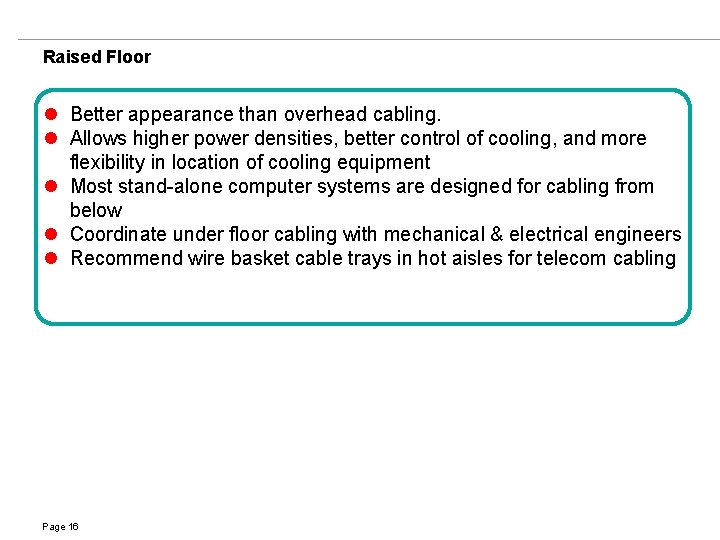
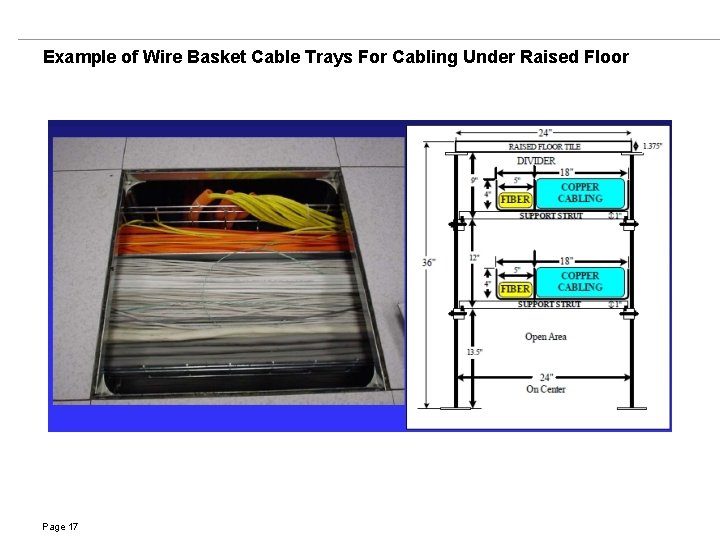
Raised Floor l Better appearance than overhead cabling. l Allows higher power densities, better control of cooling, and more flexibility in location of cooling equipment l Most stand-alone computer systems are designed for cabling from below l Coordinate under floor cabling with mechanical & electrical engineers l Recommend wire basket cable trays in hot aisles for telecom cabling Page 16
Example of Wire Basket Cable Trays For Cabling Under Raised Floor Page 17
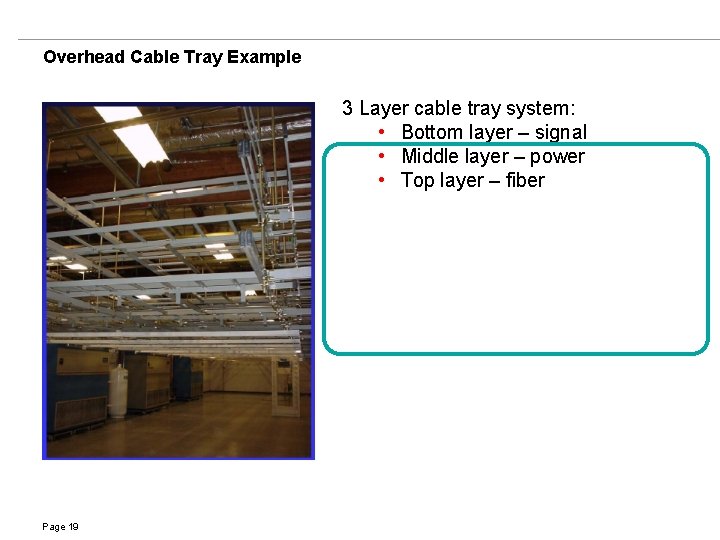
Overhead Cable Trays l Less expensive than raised floor systems l Cable trays can be attached to the top of racks and cabinets (if they are uniform in height) l Cable trays suspended from the ceiling provides more flexibility for supporting cabinets/racks of various heights and for adding and removing cabinets/racks l Coordinate location with lighting, ducts, overhead conduits, overhead power distribution l Cable trays can be installed with several layers Page 18
Overhead Cable Tray Example 3 Layer cable tray system: • Bottom layer – signal • Middle layer – power • Top layer – fiber Page 19
Outline 1、 Purpose of TIA-942 2、 Spaces of Data Centers 3、 Data Center Cabling 4、 Infrastructure Administration 5、 Facilities Specifications & Tiers Page 20 ★
Infrastructure Administration l Informative annex with TIA-606 -A standards compliant labeling scheme for all components. l Labeling scheme extended for use in data centers l Cabinets and racks labeled by location using tile grid or row/position identifiers l All cabinets, racks, patch panels, cables, and patch cords should be labeled Page 21
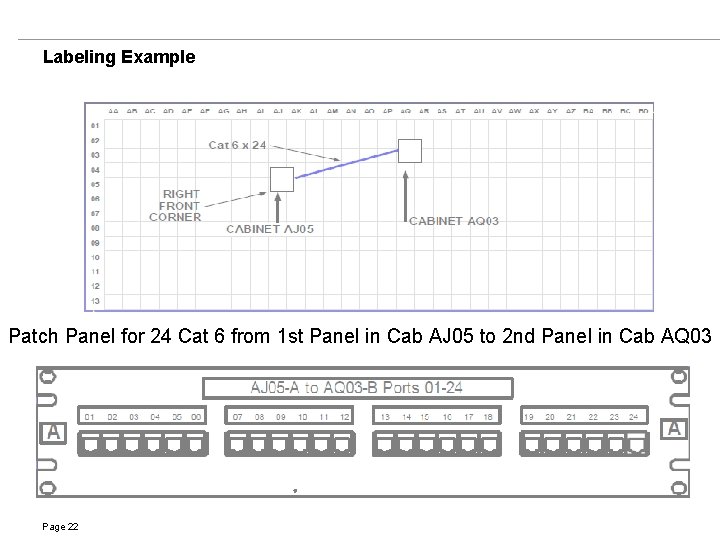
Labeling Example Patch Panel for 24 Cat 6 from 1 st Panel in Cab AJ 05 to 2 nd Panel in Cab AQ 03 Page 22
Outline 1、 Purpose of TIA-942 2、 Spaces of Data Centers 3、 Data Center Cabling 4、 Infrastructure Administration 5、 Facilities Specifications & Tiers Page 23 ★
Facilities Specifications l Annex includes detailed architectural, security, electrical, mechanical, and telecommunications recommendations for each Tier l Recommended specifications by tier are a uniform way to rate aspects of a data center design and are a starting point for initiating design requirements with qualified architects and engineers Page 24
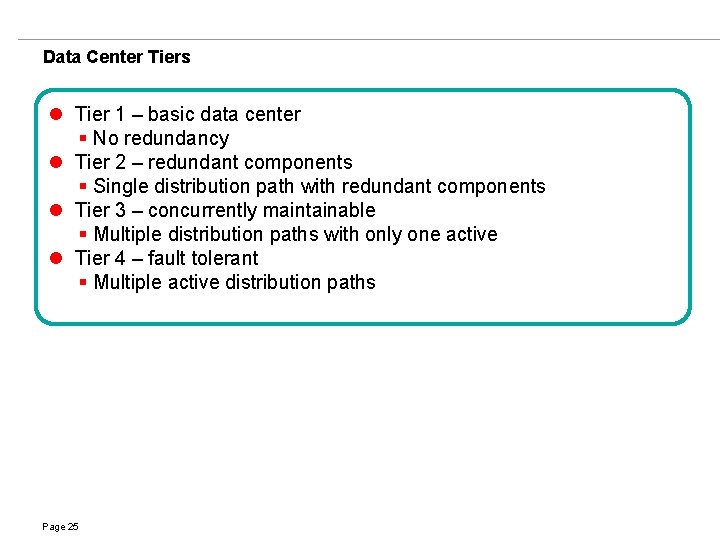
Data Center Tiers l Tier 1 – basic data center § No redundancy l Tier 2 – redundant components § Single distribution path with redundant components l Tier 3 – concurrently maintainable § Multiple distribution paths with only one active l Tier 4 – fault tolerant § Multiple active distribution paths Page 25
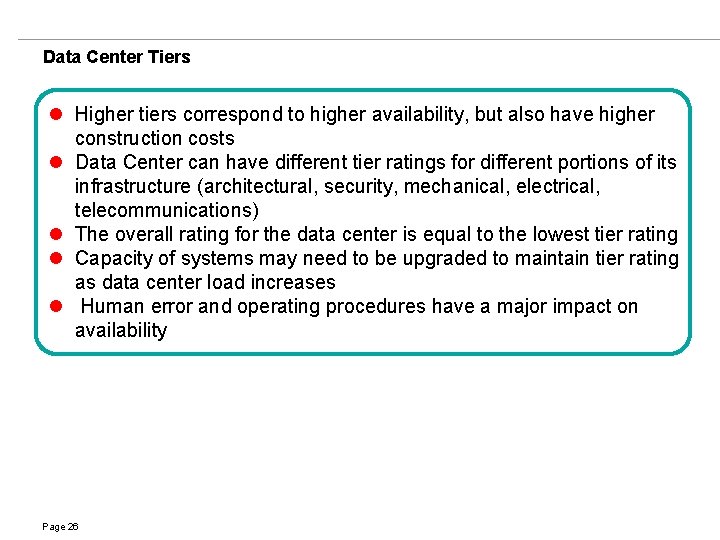
Data Center Tiers l Higher tiers correspond to higher availability, but also have higher construction costs l Data Center can have different tier ratings for different portions of its infrastructure (architectural, security, mechanical, electrical, telecommunications) l The overall rating for the data center is equal to the lowest tier rating l Capacity of systems may need to be upgraded to maintain tier rating as data center load increases l Human error and operating procedures have a major impact on availability Page 26
Thanks! Page 27