
Telecare in the UK home general directions and






- Slides: 20
Telecare in the UK home: general directions and commercial aspects for service delivery Paul Garner, BT 22/10/04
Telecare definition The use of Information and Communication Technology (ICT) to support independent living for older, frail and disabled people
The changing population 8 million over 65 s 12 million over 65 s 40% of NHS expenditure and 50% of social services expenditure is spent on people aged
The Cost of Care Type of care No of recipients Amount purchased in 2001 -02 Average cost per client per year Total cost Nursing care 85, 960 3, 580, 186 £ 19, 136 £ 1, 317 million weeks Residential care 163, 300 11, 557, 035 weeks £ 15, 836 £ 2, 861 million Community based care 925, 000 150, 000 hours £ 1, 956 £ 1, 810 million Assessment & management 1, 088, 300 N/A £ 457 £ 498 million Total 1, 088, 300 N/A £ 5, 960 £ 6, 487 million Over £ 7. 5 B by 2026, without inflation!
Ratio Persons Aged 16 -64 to 65+ 4. 5 Support Ratio 50 1 UK Long Term Healthcare Cost 2 4. 0 45 40 35 3. 5 30 3. 0 25 20 2. 5 15 2. 0 1995 2005 2015 2025 2035 2045 UK Long Term Healthcare Cost (£B) Less carers available 10 2055 Year 1. Office for National Statistics, 2002. 2. Royal Commission Report into Long Term Care, 1999.
Residential Care
Political Drivers • National Service Framework for Older People: “by 2006, an extra 100, 000 people should be looked after at home” • Patient centric care – single assessment process • Bed-blocking – over 65 s cost the NHS 1. 3 million bed-days each year • £ 80 M for Telecare pump priming in English LAs from 2006 (plus extra £ 1 bn for social services)
1 st Generation Telecare Solutions There are now 1. 5 million alarm support systems in the UK which use simple technology to provide support to vulnerable people. . . … but systems using new technology could provide much better support.
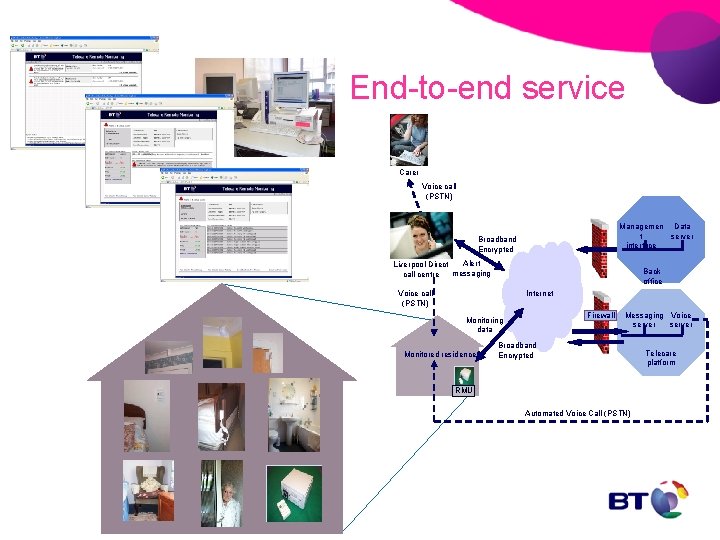
2 nd Generation: Telecare Pilot An automated intelligent supportive home care system using an array of environmental sensors and a broadband gateway Works with the occupant to help maintain their independence and safety.
End-to-end service Carer Voice call (PSTN) Managemen Data server t interface Broadband Encrypted Monitored residence Alert Liverpool Direct messaging call centre Back office Internet Voice call (PSTN) Firewall Monitoring data Monitored residence Messaging Voice server Broadband Encrypted RMU Automated Voice Call (PSTN) Telecare platform
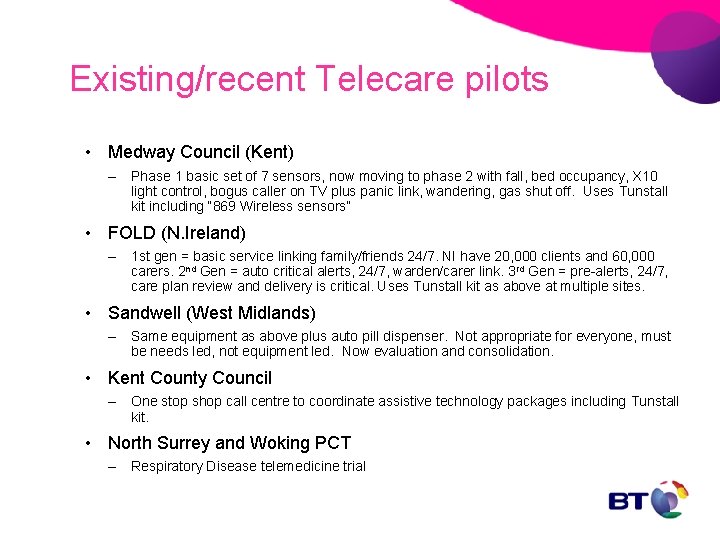
Existing/recent Telecare pilots • Medway Council (Kent) – Phase 1 basic set of 7 sensors, now moving to phase 2 with fall, bed occupancy, X 10 light control, bogus caller on TV plus panic link, wandering, gas shut off. Uses Tunstall kit including “ 869 Wireless sensors” • FOLD (N. Ireland) – 1 st gen = basic service linking family/friends 24/7. NI have 20, 000 clients and 60, 000 carers. 2 nd Gen = auto critical alerts, 24/7, warden/carer link. 3 rd Gen = pre-alerts, 24/7, care plan review and delivery is critical. Uses Tunstall kit as above at multiple sites. • Sandwell (West Midlands) – Same equipment as above plus auto pill dispenser. Not appropriate for everyone, must be needs led, not equipment led. Now evaluation and consolidation. • Kent County Council – One stop shop call centre to coordinate assistive technology packages including Tunstall kit. • North Surrey and Woking PCT – Respiratory Disease telemedicine trial
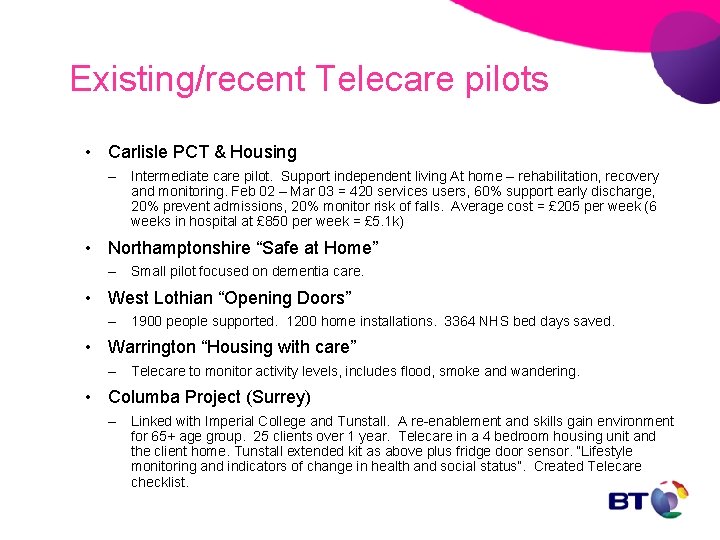
Existing/recent Telecare pilots • Carlisle PCT & Housing – Intermediate care pilot. Support independent living At home – rehabilitation, recovery and monitoring. Feb 02 – Mar 03 = 420 services users, 60% support early discharge, 20% prevent admissions, 20% monitor risk of falls. Average cost = £ 205 per week (6 weeks in hospital at £ 850 per week = £ 5. 1 k) • Northamptonshire “Safe at Home” – Small pilot focused on dementia care. • West Lothian “Opening Doors” – 1900 people supported. 1200 home installations. 3364 NHS bed days saved. • Warrington “Housing with care” – Telecare to monitor activity levels, includes flood, smoke and wandering. • Columba Project (Surrey) – Linked with Imperial College and Tunstall. A re-enablement and skills gain environment for 65+ age group. 25 clients over 1 year. Telecare in a 4 bedroom housing unit and the client home. Tunstall extended kit as above plus fridge door sensor. “Lifestyle monitoring and indicators of change in health and social status”. Created Telecare checklist.
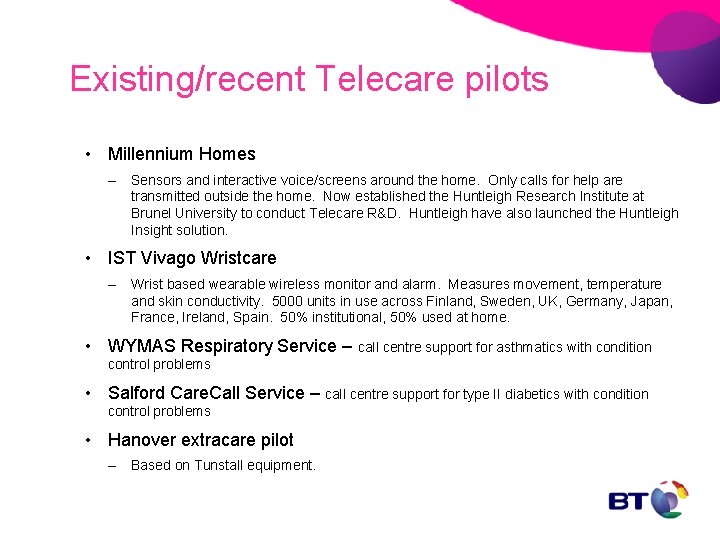
Existing/recent Telecare pilots • Millennium Homes – Sensors and interactive voice/screens around the home. Only calls for help are transmitted outside the home. Now established the Huntleigh Research Institute at Brunel University to conduct Telecare R&D. Huntleigh have also launched the Huntleigh Insight solution. • IST Vivago Wristcare – Wrist based wearable wireless monitor and alarm. Measures movement, temperature and skin conductivity. 5000 units in use across Finland, Sweden, UK, Germany, Japan, France, Ireland, Spain. 50% institutional, 50% used at home. • WYMAS Respiratory Service – call centre support for asthmatics with condition control problems • Salford Care. Call Service – call centre support for type II diabetics with condition control problems • Hanover extracare pilot – Based on Tunstall equipment.
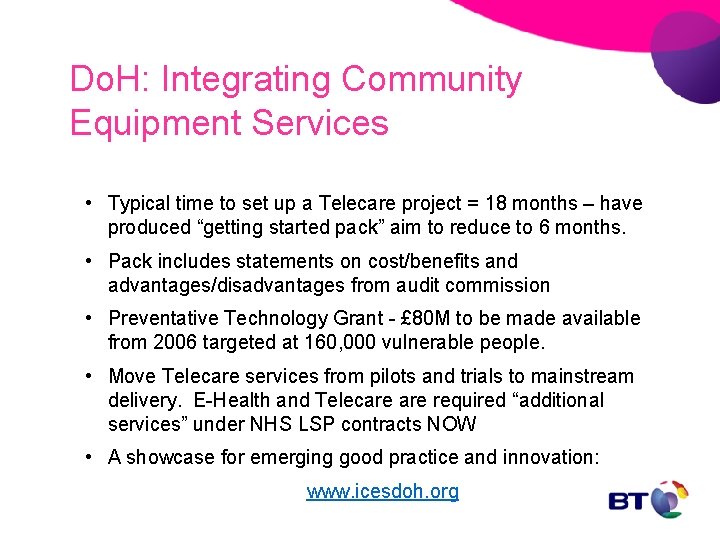
Do. H: Integrating Community Equipment Services • Typical time to set up a Telecare project = 18 months – have produced “getting started pack” aim to reduce to 6 months. • Pack includes statements on cost/benefits and advantages/disadvantages from audit commission • Preventative Technology Grant - £ 80 M to be made available from 2006 targeted at 160, 000 vulnerable people. • Move Telecare services from pilots and trials to mainstream delivery. E-Health and Telecare required “additional services” under NHS LSP contracts NOW • A showcase for emerging good practice and innovation: www. icesdoh. org
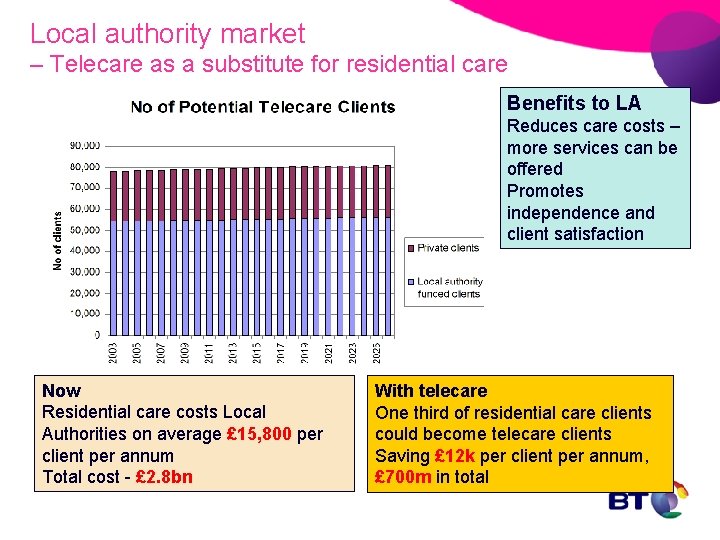
Local authority market – Telecare as a substitute for residential care Benefits to LA Reduces care costs – more services can be offered Promotes independence and client satisfaction Now Residential care costs Local Authorities on average £ 15, 800 per client per annum Total cost - £ 2. 8 bn With telecare One third of residential care clients could become telecare clients Saving £ 12 k per client per annum, £ 700 m in total
Consumer market • Reassurance market – typically adult children concerned about elderly parents • 20% of UK population aged over 60 in 2001, rising to 30% in 2026 • There is an opportunity to offer a consumer version of Telecare building on the home security and home entertainment markets • 3. 1 million single pensioner households • 1. 4 million single pensioners have no panic alarm and ABC 1 children Consumer monitoring market alone worth > £ 150 m per annum
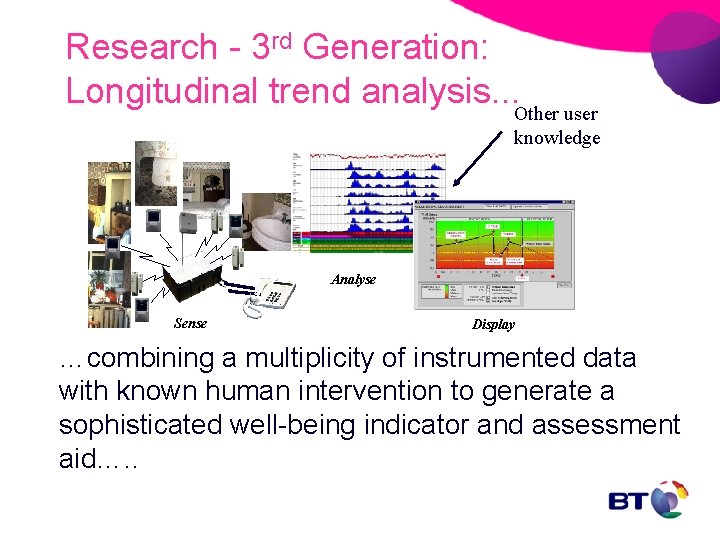
Research - 3 rd Generation: Longitudinal trend analysis. . . Other user knowledge Analyse Sense Display …combining a multiplicity of instrumented data with known human intervention to generate a sophisticated well-being indicator and assessment aid…. .
Centre for Care in Community Led by BT this Centre, by focusing on Telecare, aims to design and prove a system for continuous monitoring of client health and social well-being in the home.
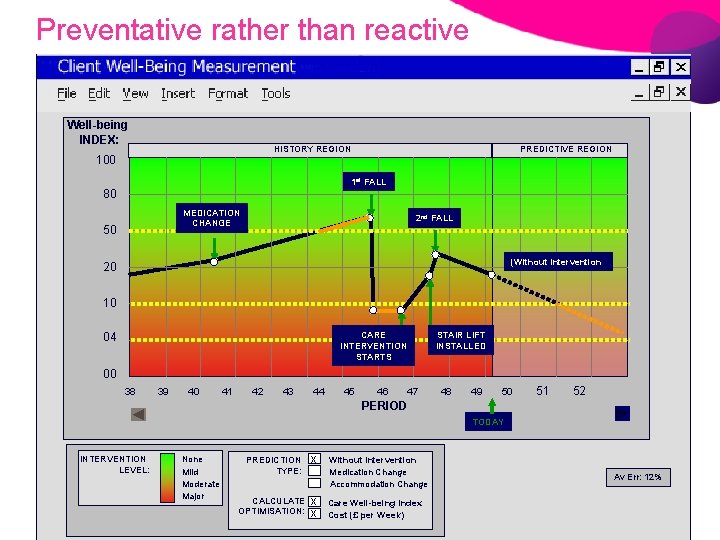
Preventative rather than reactive Well-being INDEX: HISTORY REGION 100 PREDICTIVE REGION 1 st FALL 80 MEDICATION CHANGE 50 2 nd FALL (Without Intervention) 20 10 STAIR LIFT INSTALLED CARE INTERVENTION STARTS 04 00 38 39 40 41 42 43 44 45 46 47 48 49 50 51 52 PERIOD TODAY INTERVENTION LEVEL: None Mild Moderate Major PREDICTION X TYPE: CALCULATE X OPTIMISATION: X Without Intervention Medication Change Accommodation Change Care Well-being Index Cost (£ per Week) Av Err: 12%
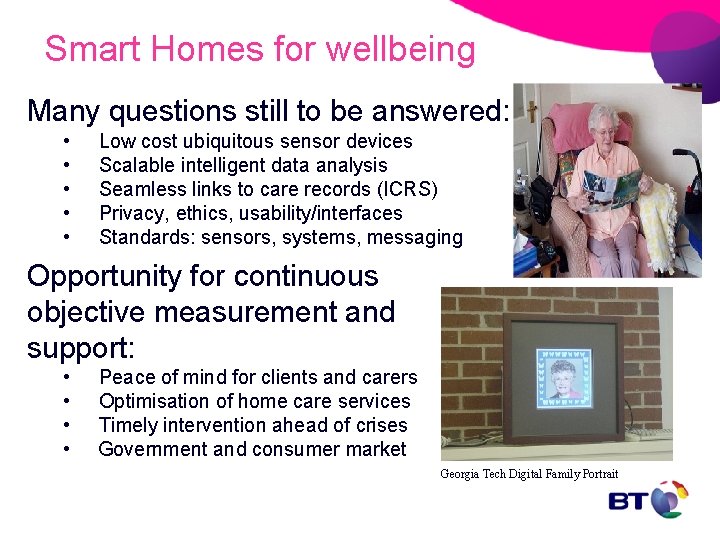
Smart Homes for wellbeing Many questions still to be answered: • • • Low cost ubiquitous sensor devices Scalable intelligent data analysis Seamless links to care records (ICRS) Privacy, ethics, usability/interfaces Standards: sensors, systems, messaging Opportunity for continuous objective measurement and support: • • Peace of mind for clients and carers Optimisation of home care services Timely intervention ahead of crises Government and consumer market Georgia Tech Digital Family Portrait