
TEKS for Teachers StandardsBased Education in Texas Welcome
TEKS for Teachers Standards-Based Education in Texas
Welcome to the Region 10 Education Service Center online professional development session, TEKS for Teachers.
Training Goals l l l The objective of this training is to provide you with foundational information relating to standards-based education in Texas Following the presentation of the material, you will take an online quiz. Upon satisfactory completion, you will print a certificate of completion for the training and give it to your administrator.
Three Sections This online staff development is divided into three sections: • Section 1: Standards-based Education and the TEKS • Section 2: Accountability Connections • Section 3: Special Circumstances
What’s it all about? Section 1: Standards-based Education and the TEKS
Section 1 Objectives After completing this section you will be able to: l Identify the basic principles of standards-based education l Differentiate between content and performance objectives l Identify and define the parts of the TEKS document l Explain the meaning and implications of alignment as it relates to the TEKS
Introduction l Standards-based education has been a driving principle of educational change for more than a decade. l Central to the concept are high-stakes testing, accountability and high expectations for all students to achieve established standards.
Introduction The pervasiveness of standards has been further reinforced by the No Child Left Behind (NCLB) Act of 2001, which requires states to establish standards for student learning and to measure student progress using assessments aligned with those standards.
Do you agree? With which of the following premises would you agree? l Teachers should clearly know what content and skills they are responsible for teaching. l Students and their parents should know what content students are responsible for learning. l Assessments should align with content taught. l There should be accountability of teachers and schools for student achievement.
Three Principles l Most educators would agree with all the statements presented. l Together, the premises help to define three foundational principles of standards-based instruction: • Standards • Assessment • Accountability
Standards-Based Education l As we consider the meaning and implications of standards-based education, we must first consider a fundamental question… What is a standard?
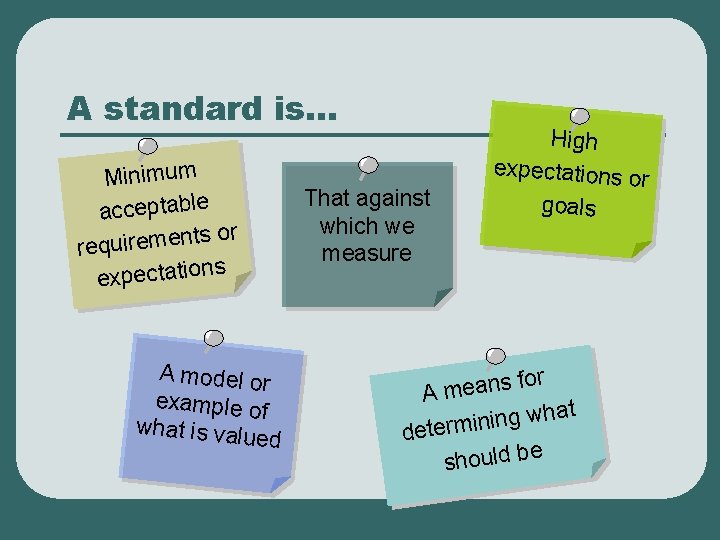
A standard is… Minimum acceptable r o s t n e m e r i requ s expectation A model or example of what is valu ed That against which we measure High expectations or goals for s n a e m A hat w g n i determ e should b
In other words… l Standards are what we work toward. l They are what “should be” and therefore help us to define high expectations, and l Allow educators to work toward commonly agreed upon goals.
These multiple definitions of the word “standard” provide a foundation for our definition of standards-based education.
Standards-Based Education Is a process for planning, delivering, monitoring and improving academic programs in which clearly defined academic content standards provide the basis for content in instruction and assessment.
Standards-Based Education Generally l Includes agreed upon, high levels of expectation or performance l Focuses on the ends, not on the means l Involves some form of accountability l Aims for a high and deep level of student understanding
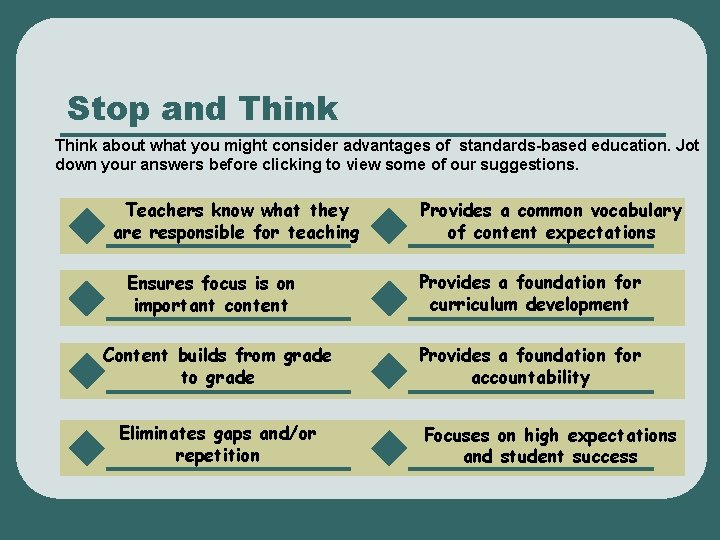
Stop and Think about what you might consider advantages of standards-based education. Jot down your answers before clicking to view some of our suggestions. Teachers know what they are responsible for teaching Provides a common vocabulary of content expectations ___________ Ensures focus is on important content Provides a foundation for curriculum development ___________ Content builds from grade to grade Provides a foundation for accountability ___________ Eliminates gaps and/or repetition Focuses on high expectations and student success ___________
Standards in Texas… The Texas Essential Knowledge and Skills, or TEKS, comprise the state-mandated curriculum that establishes what every student, from elementary school through high school, should know and be able to do.
In Texas… The TEKS provide a clear picture of how students develop academically from grade to grade in order to perform successfully in educational and real-world settings.
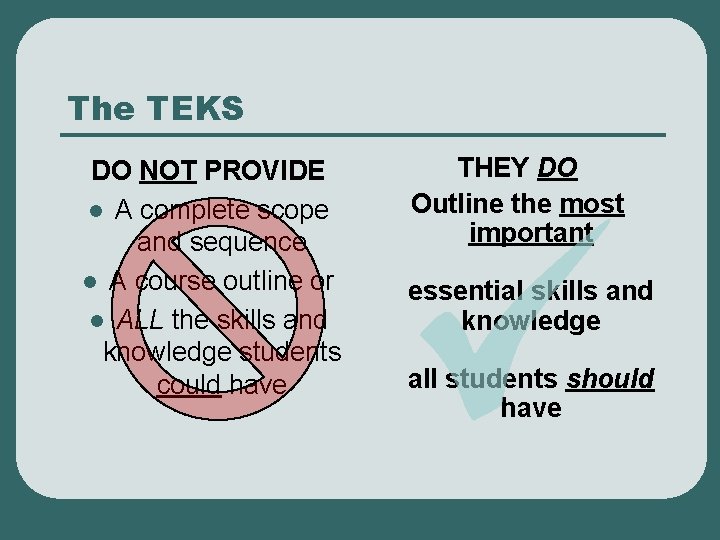
The TEKS DO NOT PROVIDE l A complete scope and sequence l A course outline or l ALL the skills and knowledge students could have THEY DO Outline the most important essential skills and knowledge all students should have
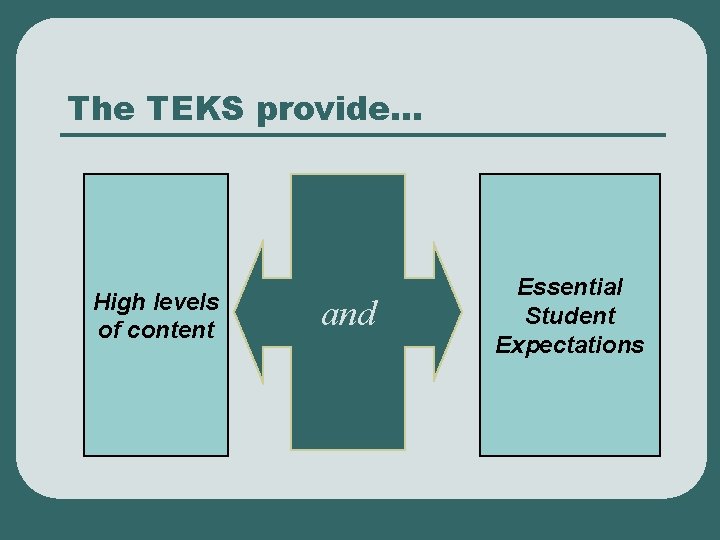
The TEKS provide… High levels of content and Essential Student Expectations
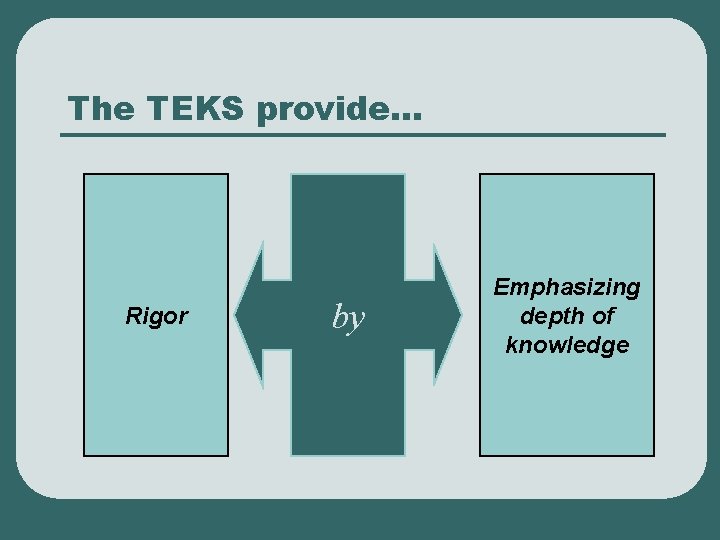
The TEKS provide… Rigor by Emphasizing depth of knowledge
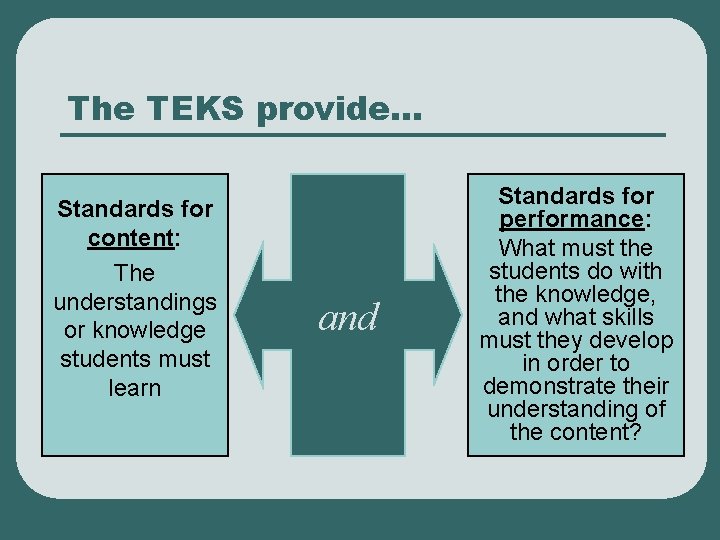
The TEKS provide… Standards for content: The understandings or knowledge students must learn and Standards for performance: What must the students do with the knowledge, and what skills must they develop in order to demonstrate their understanding of the content?

TEKS Format Now, let’s look more closely at the TEKS documents and the way they are formatted.
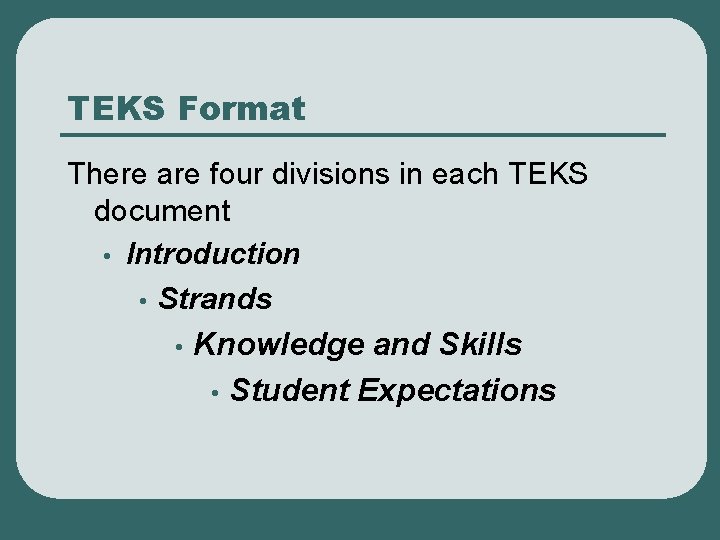
TEKS Format There are four divisions in each TEKS document • Introduction • Strands • Knowledge and Skills • Student Expectations
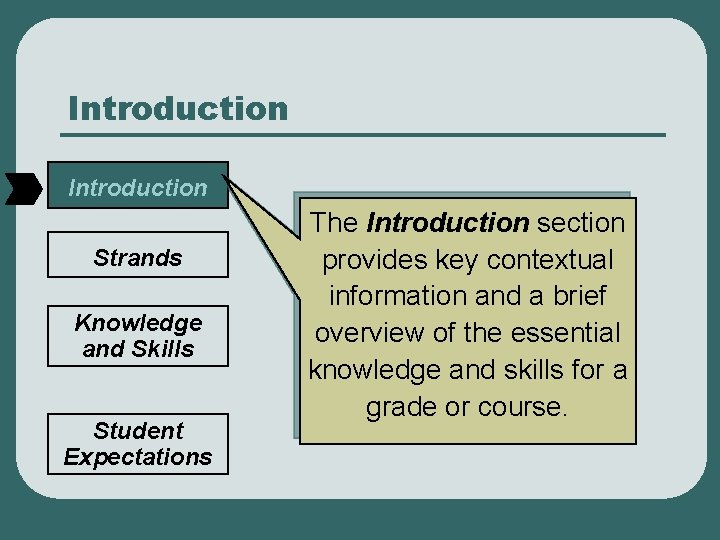
Introduction Strands Knowledge and Skills Student Expectations The Introduction section provides key contextual information and a brief overview of the essential knowledge and skills for a grade or course.
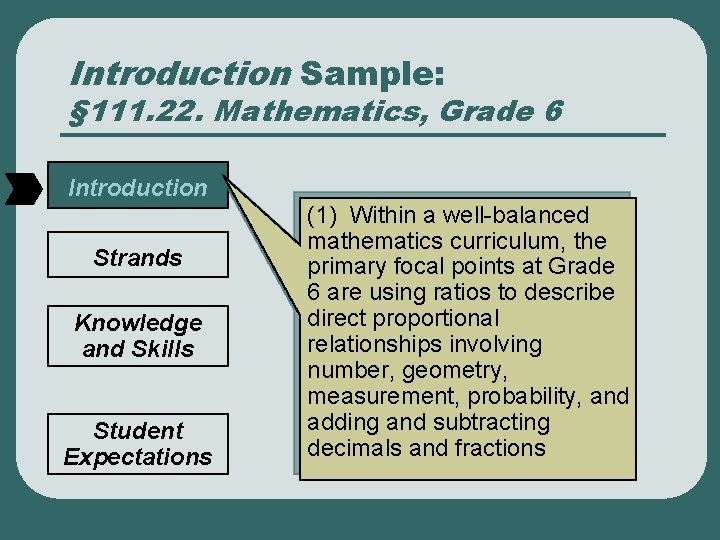
Introduction Sample: § 111. 22. Mathematics, Grade 6 Introduction Strands Knowledge and Skills Student Expectations (1) Within a well-balanced mathematics curriculum, the primary focal points at Grade 6 are using ratios to describe direct proportional relationships involving number, geometry, measurement, probability, and adding and subtracting decimals and fractions
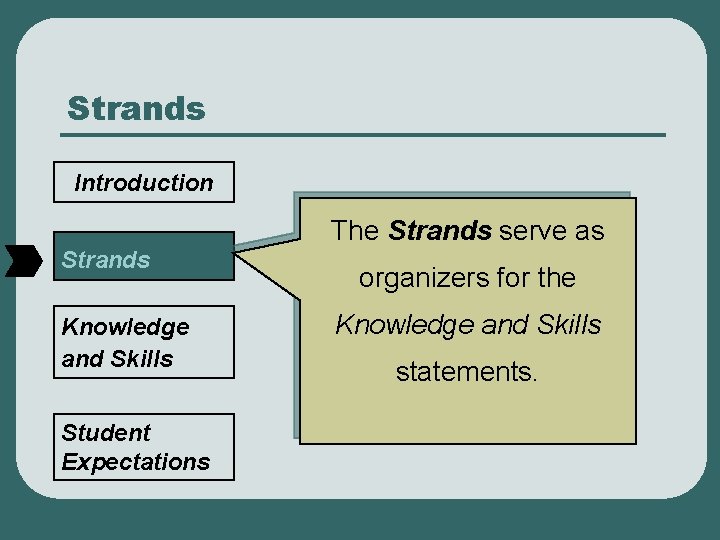
Strands Introduction The Strands serve as c Strands Knowledge and Skills Student Expectations organizers for the Knowledge and Skills statements.
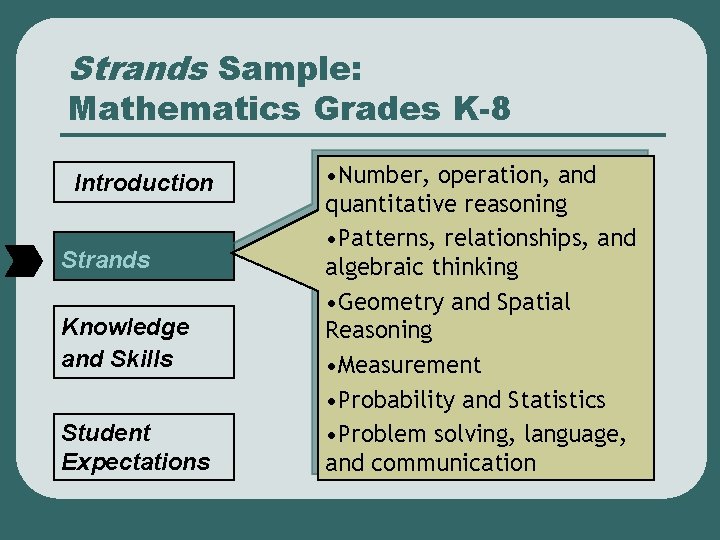
Strands Sample: Mathematics Grades K-8 Introduction c Strands Knowledge and Skills Student Expectations • Number, operation, and quantitative reasoning • Patterns, relationships, and algebraic thinking • Geometry and Spatial Reasoning • Measurement • Probability and Statistics • Problem solving, language, and communication
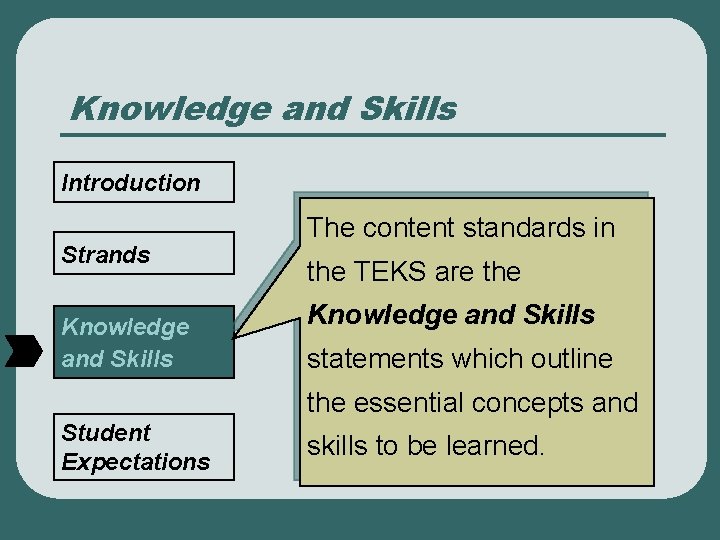
Knowledge and Skills Introduction Strands c Knowledge and Skills The content standards in the TEKS are the Knowledge and Skills statements which outline the essential concepts and Student Expectations skills to be learned.
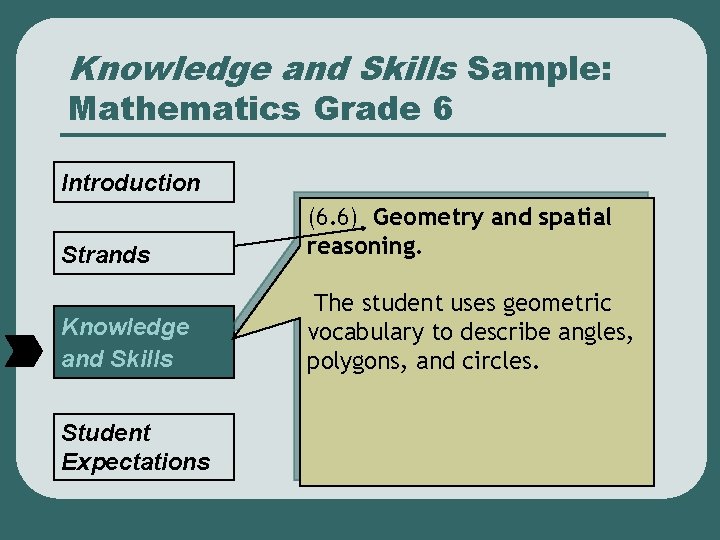
Knowledge and Skills Sample: Mathematics Grade 6 Introduction c Strands (6. 6) Geometry and spatial reasoning. Knowledge and Skills The student uses geometric vocabulary to describe angles, polygons, and circles. Student Expectations
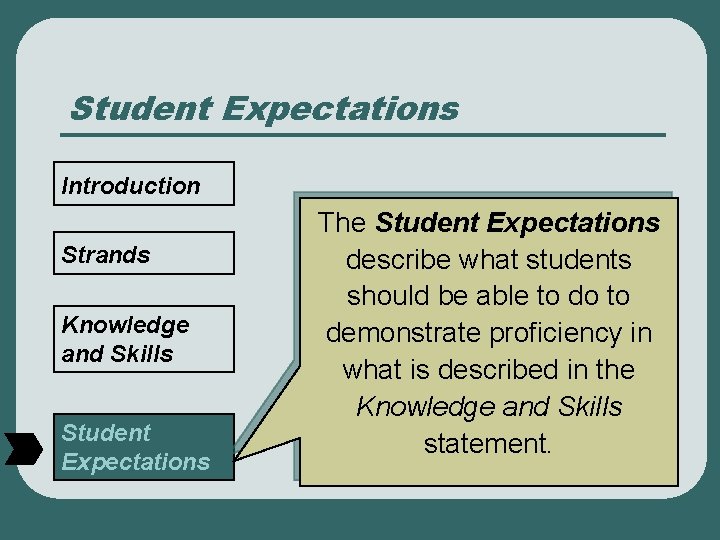
Student Expectations Introduction Strands Knowledge and Skills c Student Expectations The Student Expectations describe what students should be able to do to demonstrate proficiency in what is described in the Knowledge and Skills statement.
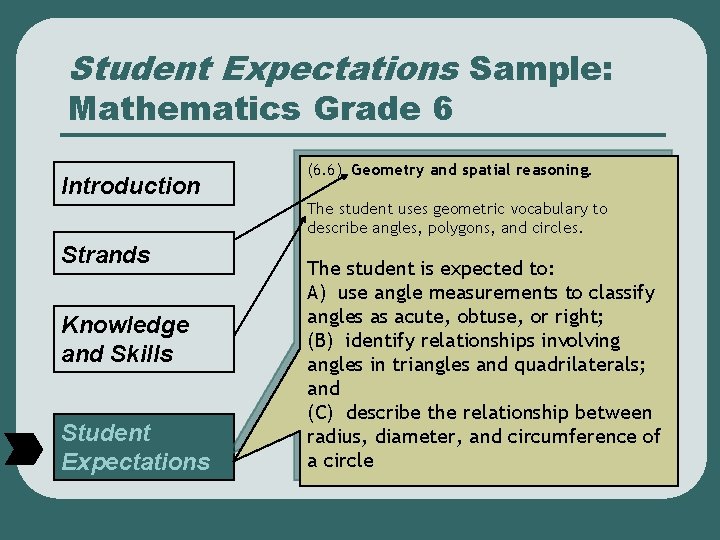
Student Expectations Sample: Mathematics Grade 6 Introduction Strands Knowledge and Skills c Student Expectations (6. 6) Geometry and spatial reasoning. The student uses geometric vocabulary to describe angles, polygons, and circles. The student is expected to: A) use angle measurements to classify angles as acute, obtuse, or right; (B) identify relationships involving angles in triangles and quadrilaterals; and (C) describe the relationship between radius, diameter, and circumference of a circle
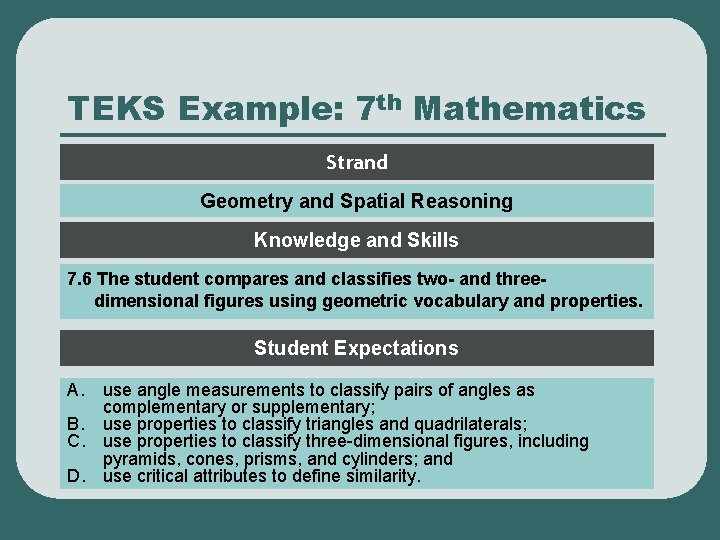
TEKS Example: 7 th Mathematics Strand Geometry and Spatial Reasoning Knowledge and Skills 7. 6 The student compares and classifies two- and threedimensional figures using geometric vocabulary and properties. Student Expectations A. use angle measurements to classify pairs of angles as complementary or supplementary; B. use properties to classify triangles and quadrilaterals; C. use properties to classify three-dimensional figures, including pyramids, cones, prisms, and cylinders; and D. use critical attributes to define similarity.
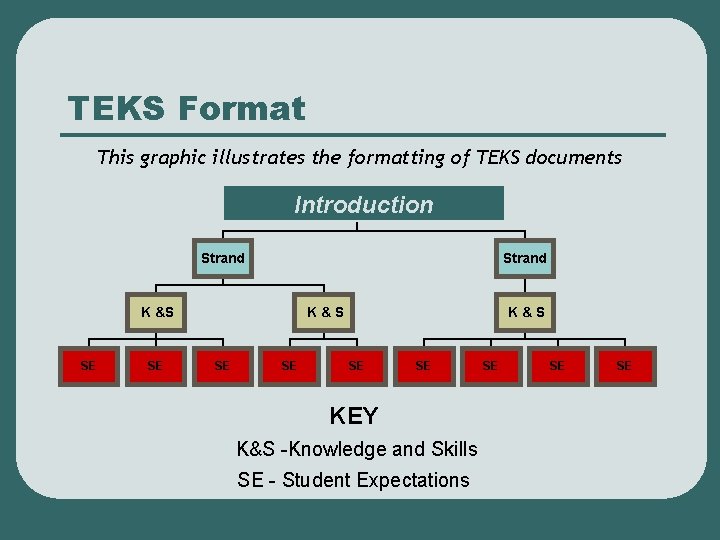
TEKS Format This graphic illustrates the formatting of TEKS documents Introduction Strand K &S SE SE K&S SE SE KEY K&S -Knowledge and Skills SE - Student Expectations SE SE SE
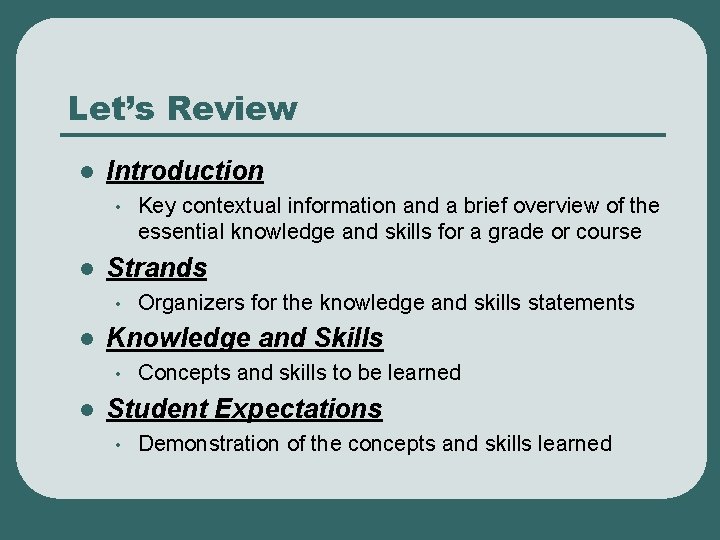
Let’s Review l Introduction • l Strands • l Organizers for the knowledge and skills statements Knowledge and Skills • l Key contextual information and a brief overview of the essential knowledge and skills for a grade or course Concepts and skills to be learned Student Expectations • Demonstration of the concepts and skills learned
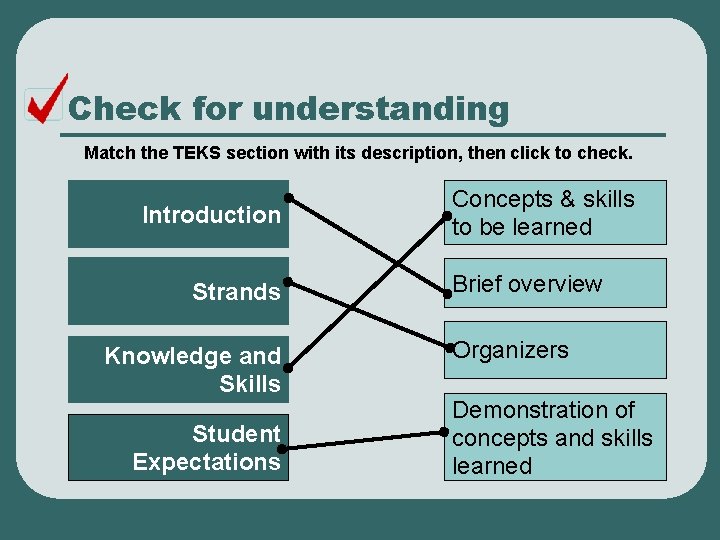
Check for understanding Match the TEKS section with its description, then click to check. Introduction Strands Knowledge and Skills Student Expectations Concepts & skills to be learned Brief overview Organizers Demonstration of concepts and skills learned
Vertical Alignment The TEKS are vertically aligned so that the content (Knowledge and Skills) and performance (Student Expectations) objectives build in rigor and complexity from grade to grade. Insert pictures of students at different grade levels
Alignment means every teacher l Understands what is expected of students l Understands these expectations within the context of the K-12 program l Accepts responsibility for these expectations for all students
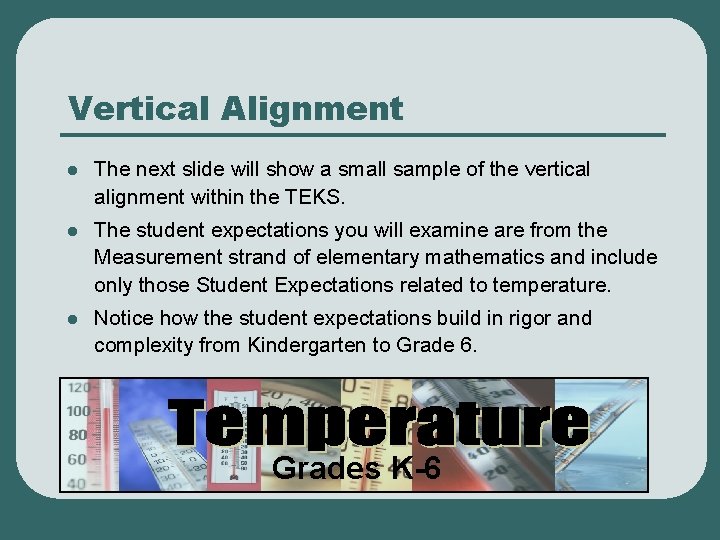
Vertical Alignment l The next slide will show a small sample of the vertical alignment within the TEKS. l The student expectations you will examine are from the Measurement strand of elementary mathematics and include only those Student Expectations related to temperature. l Notice how the student expectations build in rigor and complexity from Kindergarten to Grade 6. Grades K-6
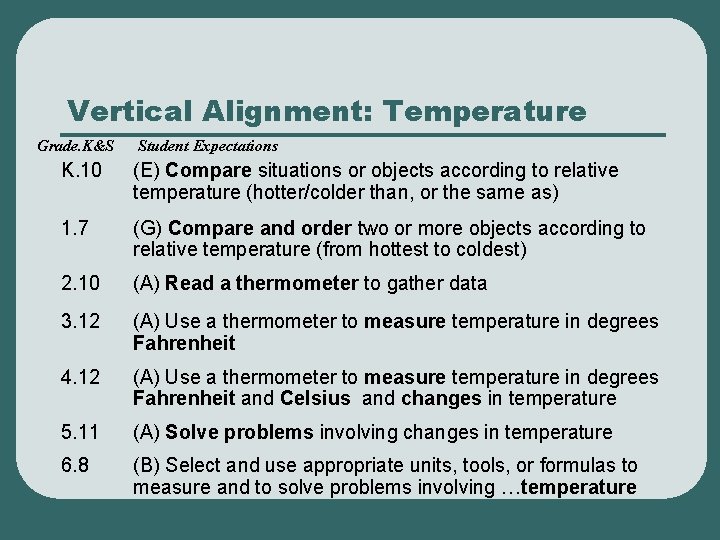
Vertical Alignment: Temperature Grade. K&S K. 10 1. 7 Student Expectations (E) Compare situations or objects according to relative temperature (hotter/colder than, or the same as) (G) Compare and order two or more objects according to relative temperature (from hottest to coldest) 2. 10 (A) Read a thermometer to gather data 3. 12 (A) Use a thermometer to measure temperature in degrees Fahrenheit 4. 12 (A) Use a thermometer to measure temperature in degrees Fahrenheit and Celsius and changes in temperature 5. 11 (A) Solve problems involving changes in temperature 6. 8 (B) Select and use appropriate units, tools, or formulas to measure and to solve problems involving …temperature
The standards outlined in the are non-negotiable
In other words… The Knowledge and Skills and Student Expectations must serve as the basis for instructional planning so that all teachers first consider what they want the students to know and be able to do as a result of their instruction. What do I want my students to know and be able to do after this lesson?
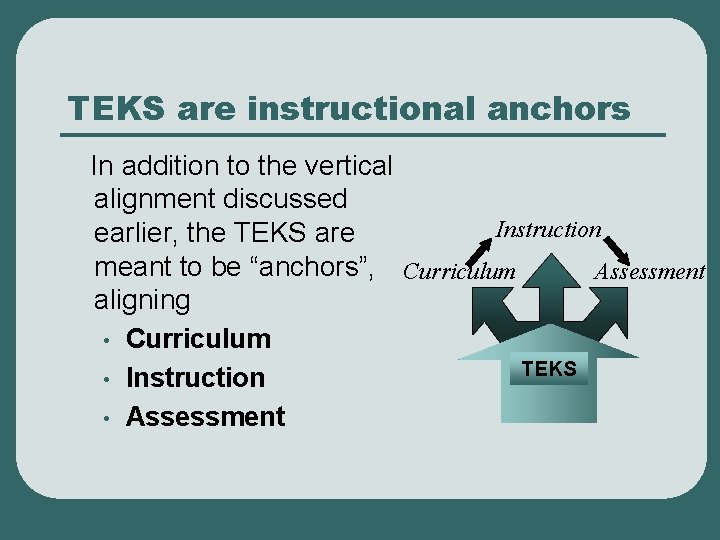
TEKS are instructional anchors In addition to the vertical alignment discussed Instruction earlier, the TEKS are meant to be “anchors”, Curriculum Assessment aligning • Curriculum TEKS • Instruction • Assessment
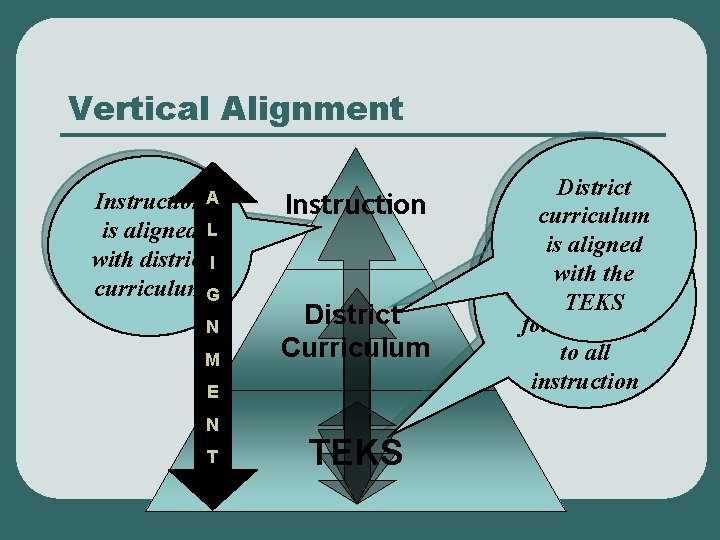
Vertical Alignment Instruction A is aligned L with district I curriculum. G N M Instruction District Curriculum E N T TEKS District curriculum Theis. TEKS are aligned vertically with the aligned and TEKS foundational to all instruction
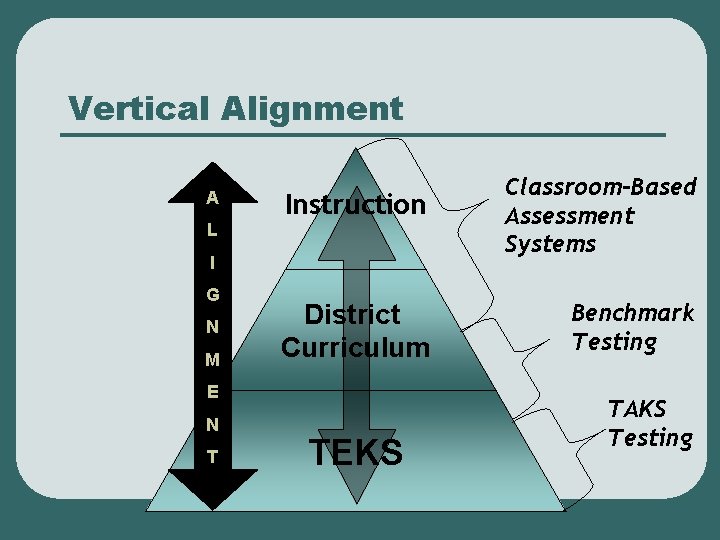
Vertical Alignment A L Instruction Classroom-Based Assessment Systems District Curriculum Benchmark Testing I G N M E N T TEKS TAKS Testing
OYO (On Your On) Click on the link below to access the TEKS document(s) for your subject/grade level. Focus Questions: l Can you identify the parts of the document? l Select one Knowledge and Skills statement and study the Student Expectations that are associated with it at your grade level, the one below and one above. Is the vertical alignment apparent? http: //www. tea. state. tx. us/teks/index. html
OYO (On Your On) Click on the link below to access the TEA website “Frequently Asked Questions” about the TEKS. Focus Question: l Scroll down to Question 7 and read the clarification provided on the use of the terms “including” and “such as” in the TEKS. http: //www. tea. state. tx. us/teksfaq/teksqa. html
Let’s Review 1. Why should you be familiar with the TEKS at grade levels other than the one(s) you teach? 2. What is the meaning of standards-based education? 3. Describe the principle of vertical alignment as it relates to the TEKS documents. 4. Describe the relationship between the TEKS and daily classroom instruction and assessment.
Remember… The more familiar you are with the formal curriculum expectations, the more comfortable and creative you can be in planning effective teaching-learning cycles. Could insert picture of teacher planning.
End of Section 1 This concludes Section 1 of TEKS for Teachers online staff development.
- Slides: 51