
Teepa Snow Positive Approach LLC to be reused
© Teepa Snow, Positive Approach, LLC – to be reused only with permission.
Visual Data • The most powerful sensory input. People with dementia pay more attention to what they see than what they hear.
Make a Note • • No touching until you’ve done a visual/ verbal Don’t do “to” someone…do “with” someone Dementia robs skill before robbing strength Use “hand under hand” to support
Auditory Data • What do we often do wrong? Care partners like to talk. The person with dementia is focused on how we look visually and they are not processing the content.
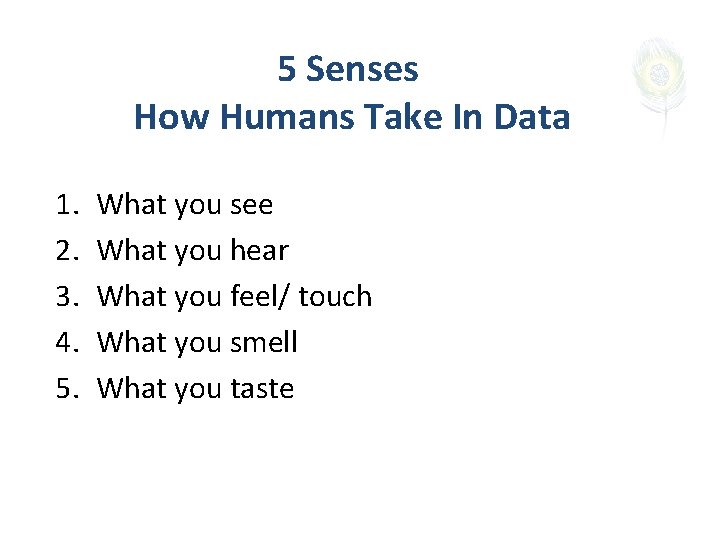
5 Senses How Humans Take In Data 1. 2. 3. 4. 5. What you see What you hear What you feel/ touch What you smell What you taste
NORMAL Aging NOT Normal Aging © Teepa Snow, Positive Approach, LLC – to be reused only with permission.
REALIZE … It Takes TWO to Tango … or two to tangle… © Teepa Snow, Positive Approach, LLC – to be reused only with permission.
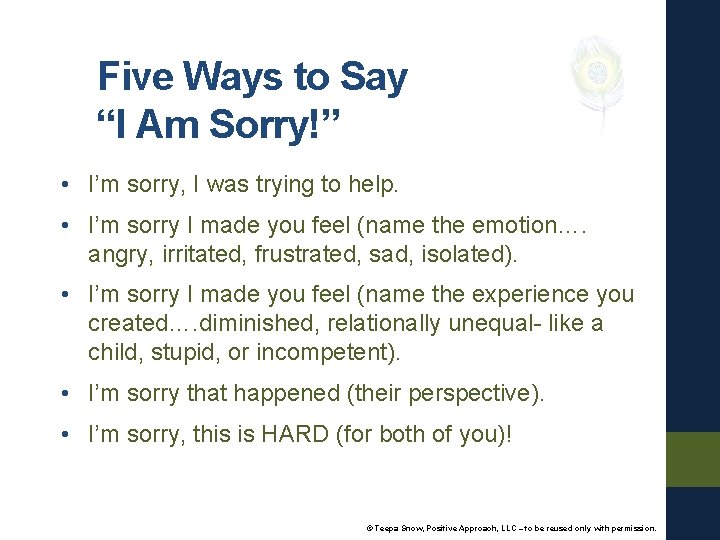
Five Ways to Say “I Am Sorry!” • I’m sorry, I was trying to help. • I’m sorry I made you feel (name the emotion…. angry, irritated, frustrated, sad, isolated). • I’m sorry I made you feel (name the experience you created…. diminished, relationally unequal- like a child, stupid, or incompetent). • I’m sorry that happened (their perspective). • I’m sorry, this is HARD (for both of you)! © Teepa Snow, Positive Approach, LLC – to be reused only with permission.
Dementia: What is It? It is BOTH • a chemical change in the brain AND • a structural change in the brain This means… • It may come and go. • “Sometimes they can and sometimes they can’t. ” © Teepa Snow, Positive Approach, LLC – to be reused only with permission.
Dementia: What Changes • Structural changes –permanent • Cells are shrinking and dying • Chemical changes - variable üCells are producing and sending less chemicals üCan ‘shine’ when least expected – chemical rush © Teepa Snow, Positive Approach, LLC – to be reused only with permission.
DEMENTIA does not = Alzheimer’s does not = “Memory Problems” © Teepa Snow, Positive Approach, LLC – to be reused only with permission.
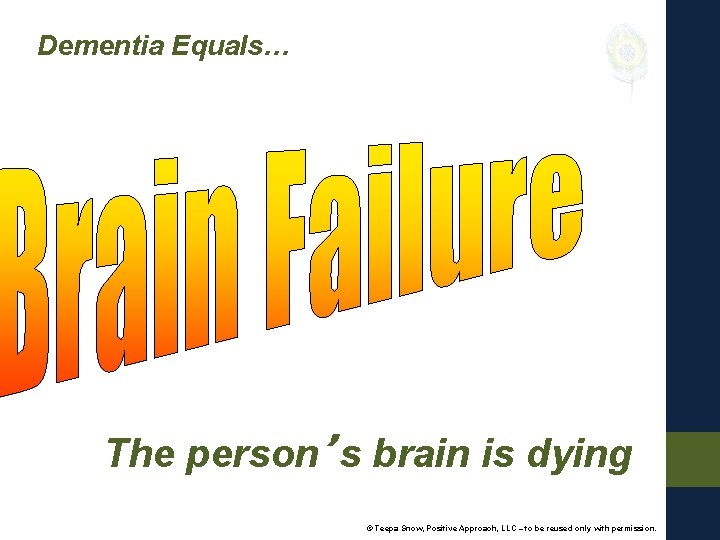
Dementia Equals… The person’s brain is dying © Teepa Snow, Positive Approach, LLC – to be reused only with permission.
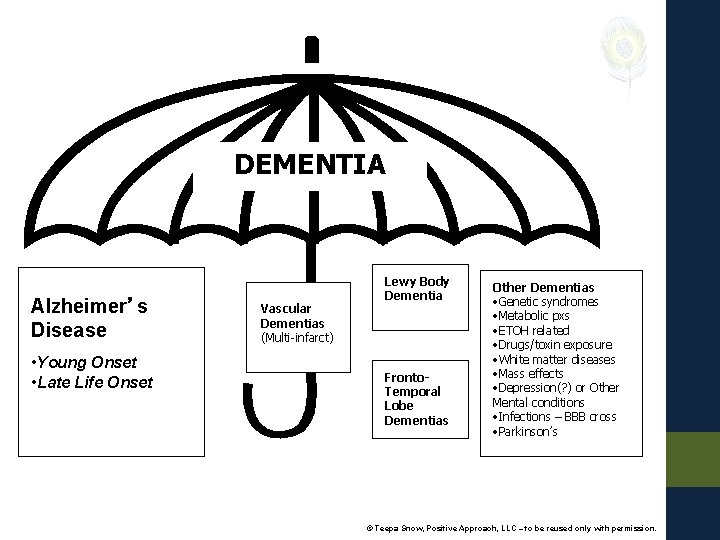
DEMENTIA Alzheimer’s Disease • Young Onset • Late Life Onset Vascular Dementias (Multi-infarct) Lewy Body Dementia Fronto. Temporal Lobe Dementias Other Dementias • Genetic syndromes • Metabolic pxs • ETOH related • Drugs/toxin exposure • White matter diseases • Mass effects • Depression(? ) or Other Mental conditions • Infections – BBB cross • Parkinson’s © Teepa Snow, Positive Approach, LLC – to be reused only with permission.
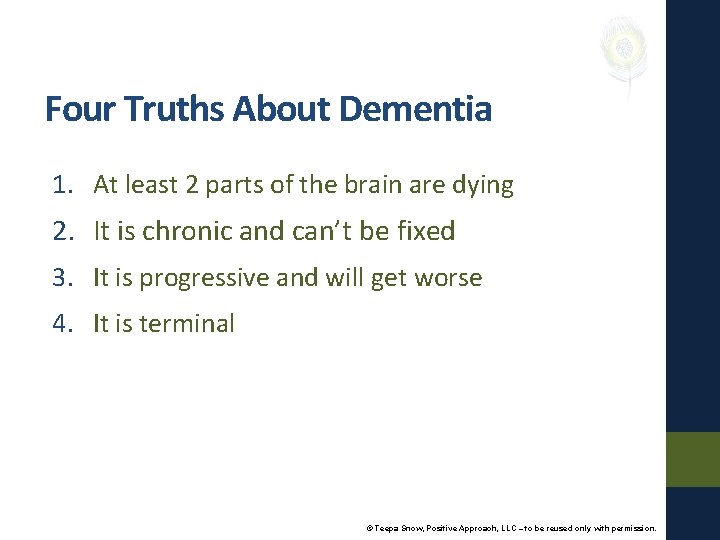
Four Truths About Dementia 1. At least 2 parts of the brain are dying 2. It is chronic and can’t be fixed 3. It is progressive and will get worse 4. It is terminal © Teepa Snow, Positive Approach, LLC – to be reused only with permission.
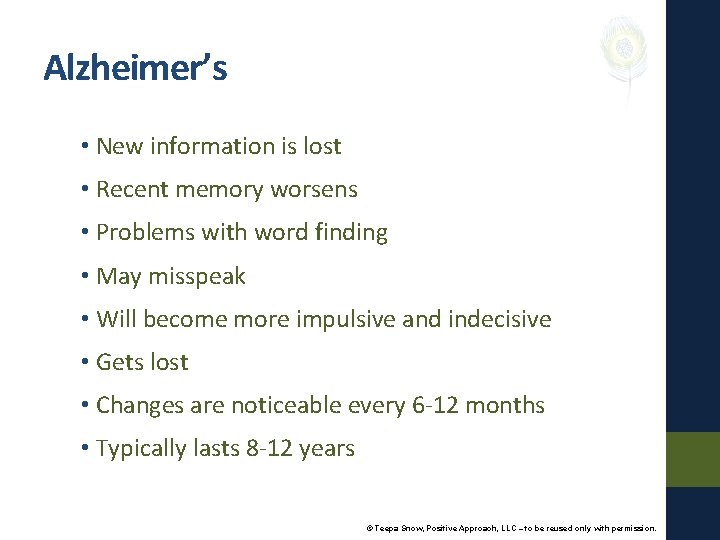
Alzheimer’s • New information is lost • Recent memory worsens • Problems with word finding • May misspeak • Will become more impulsive and indecisive • Gets lost • Changes are noticeable every 6 -12 months • Typically lasts 8 -12 years © Teepa Snow, Positive Approach, LLC – to be reused only with permission.
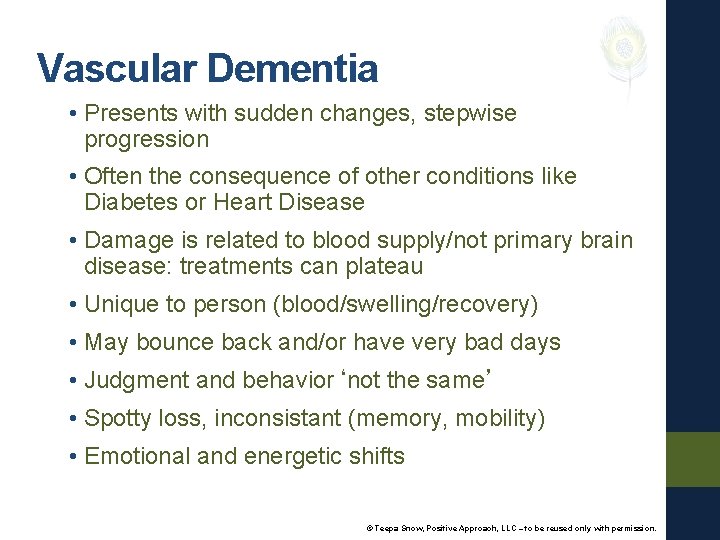
Vascular Dementia • Presents with sudden changes, stepwise progression • Often the consequence of other conditions like Diabetes or Heart Disease • Damage is related to blood supply/not primary brain disease: treatments can plateau • Unique to person (blood/swelling/recovery) • May bounce back and/or have very bad days • Judgment and behavior‘not the same’ • Spotty loss, inconsistant (memory, mobility) • Emotional and energetic shifts © Teepa Snow, Positive Approach, LLC – to be reused only with permission.
Lewy Body Dementia • Movement problems, will fall hard and often • Visual Hallucinations including animals, children, people • Fine motor problems typically in hands and with swallowing • Episodes of rigidity and/or syncope • May have history of nightmares or insomnia • Usually includes delusional thinking • Fluctuations in ability, abilities really come and go • Drug responses can be extreme and strange • Can become toxic, unable to move, or die • May have OPPOSITE and atypical reaction © Teepa Snow, Positive Approach, LLC – to be reused only with permission.
Fronto-Temporal Dementias • Many types, typically younger onset • “Frontal” includes loss of impulse and behavior control (typically this dementia doesn’t present with memory issues) • Will say unexpected, rude, mean, or odd things to others • Has no ability to filter thought processes • Dis-inhibited in behavior around food, drink, sex, emotions, or actions • May include OCD (obsessive compulsive disorder type behaviors) • Hyporality • “Temporal” includes loss of language (speech and/or comprehension) • Unable to word find, vague descriptions • Comprehension limited, unable to understand, sound fluent – nonsense words © Teepa Snow, Positive Approach, LLC – to be reused only with permission.
Temporal Lobe Non-Fluent Aphasia • Can’t NAME items • Hesitant speech • Receptive inability • Not speaking • Other skills intact – early • Worsening of speech production over time • 25% never develop global dementia • Echolalia • Mis-speaking • Word salad © Teepa Snow, Positive Approach, LLC – to be reused only with permission.
Temporal Lobe Fluent Aphasia • Has smooth delivery • More nonsense words • Word salad • May think they make sense • Expect rhythm back • Fixates on a few phrases • Chit-chats if enjoying company • Volume control varies – limited awareness of others’ needs • There are frequently 1 -2 ‘value words’ mixed in to speech • Picks up on ‘value words’ they hear – they then connect and want to talk more © Teepa Snow, Positive Approach, LLC – to be reused only with permission.
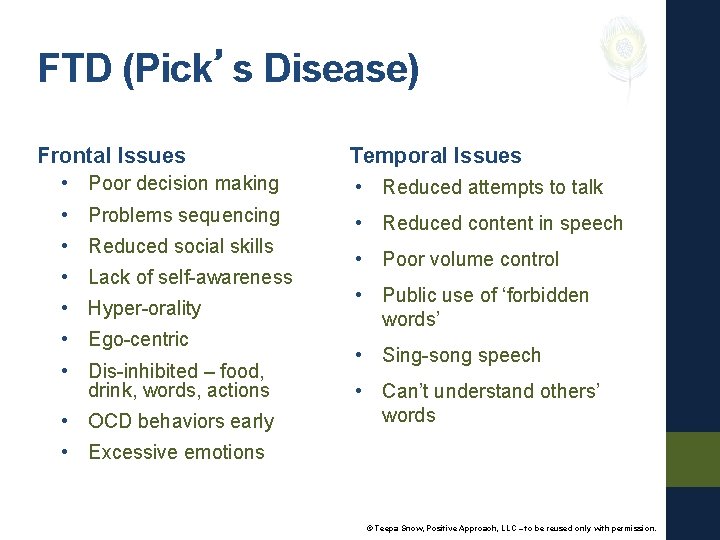
FTD (Pick’s Disease) Frontal Issues Temporal Issues • Poor decision making • Reduced attempts to talk • Problems sequencing • Reduced content in speech • Reduced social skills • Lack of self-awareness • Hyper-orality • Ego-centric • Dis-inhibited – food, drink, words, actions • OCD behaviors early • Poor volume control • Public use of ‘forbidden words’ • Sing-song speech • Can’t understand others’ words • Excessive emotions © Teepa Snow, Positive Approach, LLC – to be reused only with permission.
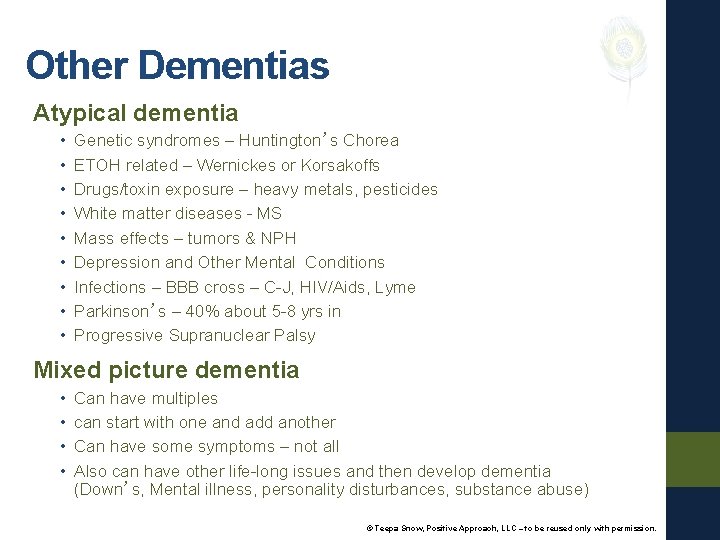
Other Dementias Atypical dementia • • • Genetic syndromes – Huntington’s Chorea ETOH related – Wernickes or Korsakoffs Drugs/toxin exposure – heavy metals, pesticides White matter diseases - MS Mass effects – tumors & NPH Depression and Other Mental Conditions Infections – BBB cross – C-J, HIV/Aids, Lyme Parkinson’s – 40% about 5 -8 yrs in Progressive Supranuclear Palsy Mixed picture dementia • • Can have multiples can start with one and add another Can have some symptoms – not all Also can have other life-long issues and then develop dementia (Down’s, Mental illness, personality disturbances, substance abuse) © Teepa Snow, Positive Approach, LLC – to be reused only with permission.
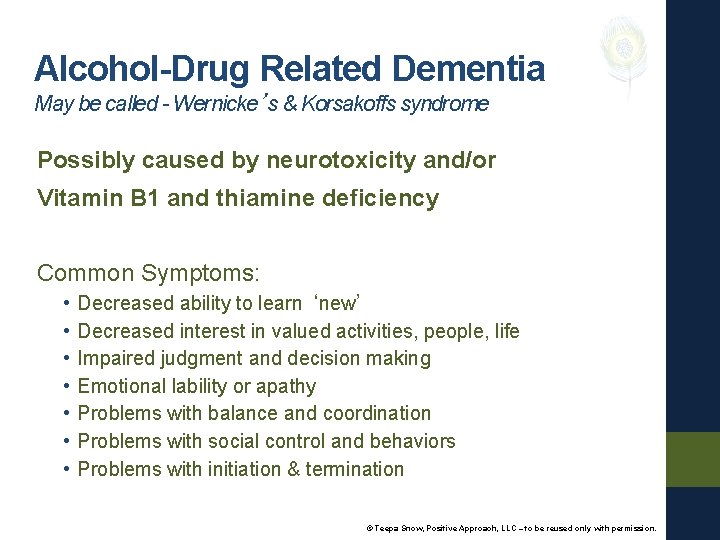
Alcohol-Drug Related Dementia May be called - Wernicke’s & Korsakoffs syndrome Possibly caused by neurotoxicity and/or Vitamin B 1 and thiamine deficiency Common Symptoms: • • Decreased ability to learn ‘new’ Decreased interest in valued activities, people, life Impaired judgment and decision making Emotional lability or apathy Problems with balance and coordination Problems with social control and behaviors Problems with initiation & termination © Teepa Snow, Positive Approach, LLC – to be reused only with permission.
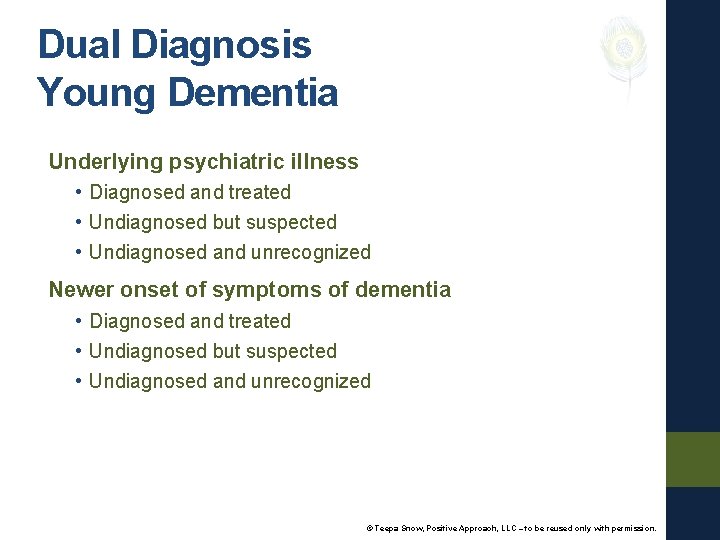
Dual Diagnosis Young Dementia Underlying psychiatric illness • Diagnosed and treated • Undiagnosed but suspected • Undiagnosed and unrecognized Newer onset of symptoms of dementia • Diagnosed and treated • Undiagnosed but suspected • Undiagnosed and unrecognized © Teepa Snow, Positive Approach, LLC – to be reused only with permission.
Chronic Traumatic Encephalopathy Caused by repeated head injuries or concussions – doesn’t happen to all Symptoms: • • Frontal lobe issues Temporal lobe issues Sometimes rapid progression into ‘Alzheimer’ patterns Sometimes rapid progression into FTD pattterns © Teepa Snow, Positive Approach, LLC – to be reused only with permission.
Downs Syndrome • Probably affects the vast majority of people with Downs • Due to premature aging, onset is earlier • 45 -65 – numbers increase dramatically • Some people will experience very rapid onset (1 -3 years) • Most progression lasts 3 -10 years • Frequently have other medical problems © Teepa Snow, Positive Approach, LLC – to be reused only with permission.
Downs and Unique Changes • Attention losses are first - not memory • Self-care skills are damaged early • Seizures may be noted – ‘staring’ • Memory pxs are not the 1 st noticed • Reduced speech attempts – more slurring or repetitive words • Increased stereotypical behaviors • Sensory needs & tolerances change • Behaviors change – ‘plans’ don’t help © Teepa Snow, Positive Approach, LLC – to be reused only with permission.
Additional Dementias • 80 + forms, types, causes…. • Some progress very rapidly • Some are genetic some are not • Some are unique, some follow more traditional patterns © Teepa Snow, Positive Approach, LLC – to be reused only with permission.
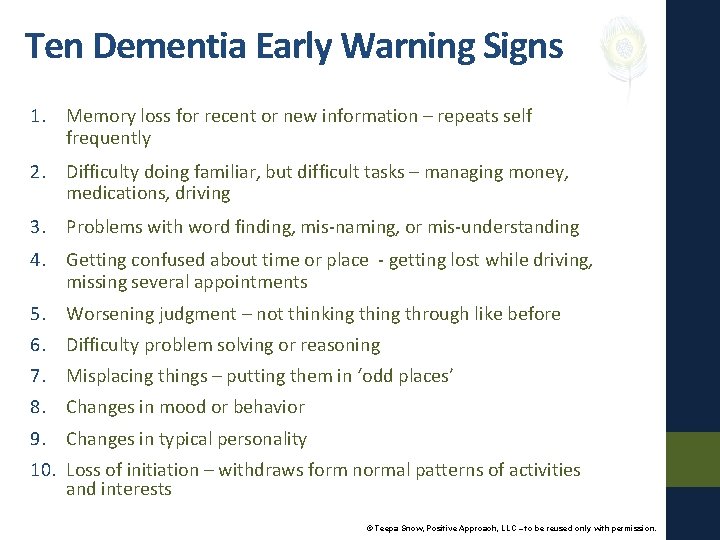
Ten Dementia Early Warning Signs 1. Memory loss for recent or new information – repeats self frequently 2. Difficulty doing familiar, but difficult tasks – managing money, medications, driving 3. Problems with word finding, mis-naming, or mis-understanding 4. Getting confused about time or place - getting lost while driving, missing several appointments 5. Worsening judgment – not thinking through like before 6. Difficulty problem solving or reasoning 7. Misplacing things – putting them in ‘odd places’ 8. Changes in mood or behavior 9. Changes in typical personality 10. Loss of initiation – withdraws form normal patterns of activities and interests © Teepa Snow, Positive Approach, LLC – to be reused only with permission.
Mild Cognitive Impairment • MCI is the beginning of a not-normal condition üMemory üLanguage üBehavior üMotor skills • Not life altering, BUT definitely different… © Teepa Snow, Positive Approach, LLC – to be reused only with permission.
Is MCI always Dementia? • Could be a form of DEMENTIA • Symptom of another health condition • Medication side-effect • Hearing loss or vision loss • Depression • Delirium • Pain-related © Teepa Snow, Positive Approach, LLC – to be reused only with permission.
Screening Options OLD: Mini Mental NEW: • AD-8 Interview • SLUMS – 7 minute screen • Animal fluency – 1 minute # of animals • Clock Drawing – 2 step • Full Neuropsychological testing panel © Teepa Snow, Positive Approach, LLC – to be reused only with permission.
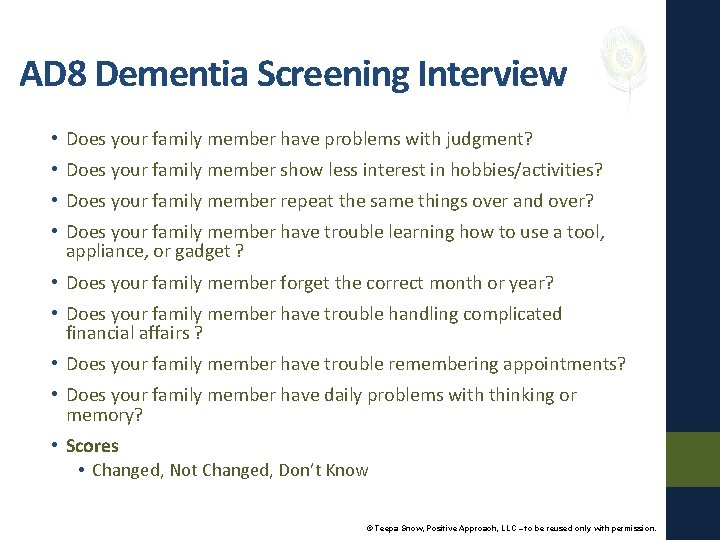
AD 8 Dementia Screening Interview • Does your family member have problems with judgment? • Does your family member show less interest in hobbies/activities? • Does your family member repeat the same things over and over? • Does your family member have trouble learning how to use a tool, appliance, or gadget ? • Does your family member forget the correct month or year? • Does your family member have trouble handling complicated financial affairs ? • Does your family member have trouble remembering appointments? • Does your family member have daily problems with thinking or memory? • Scores • Changed, Not Changed, Don’t Know © Teepa Snow, Positive Approach, LLC – to be reused only with permission.
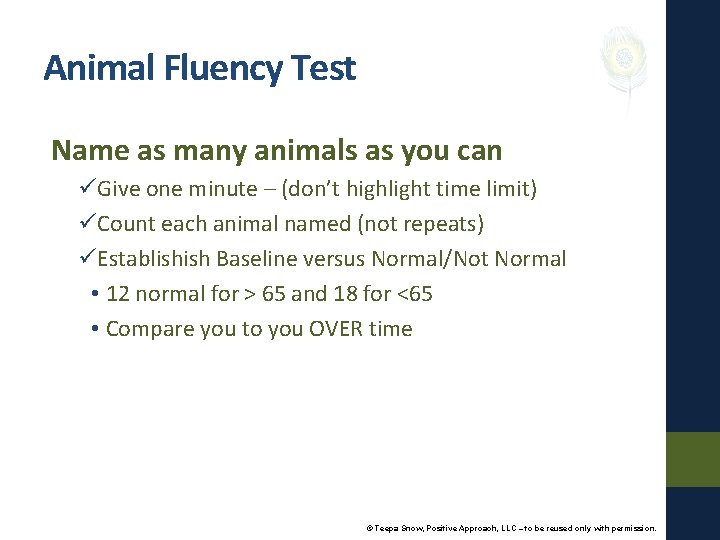
Animal Fluency Test Name as many animals as you can üGive one minute – (don’t highlight time limit) üCount each animal named (not repeats) üEstablishish Baseline versus Normal/Not Normal • 12 normal for > 65 and 18 for <65 • Compare you to you OVER time © Teepa Snow, Positive Approach, LLC – to be reused only with permission.
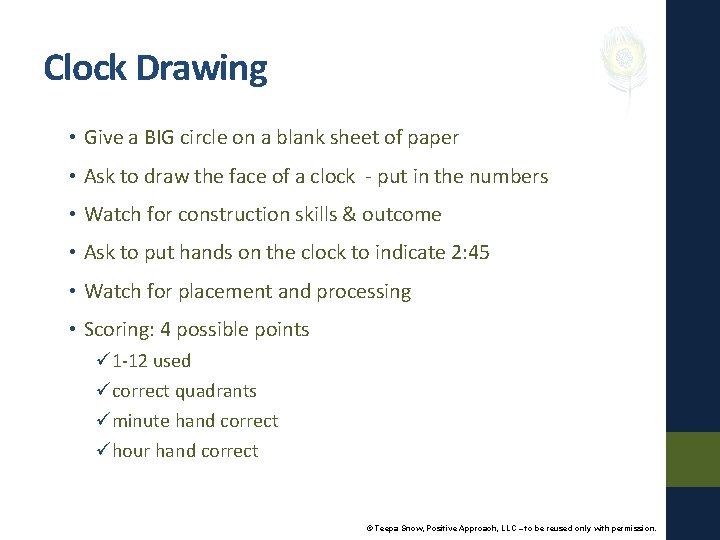
Clock Drawing • Give a BIG circle on a blank sheet of paper • Ask to draw the face of a clock - put in the numbers • Watch for construction skills & outcome • Ask to put hands on the clock to indicate 2: 45 • Watch for placement and processing • Scoring: 4 possible points ü 1 -12 used ücorrect quadrants üminute hand correct ühour hand correct © Teepa Snow, Positive Approach, LLC – to be reused only with permission.
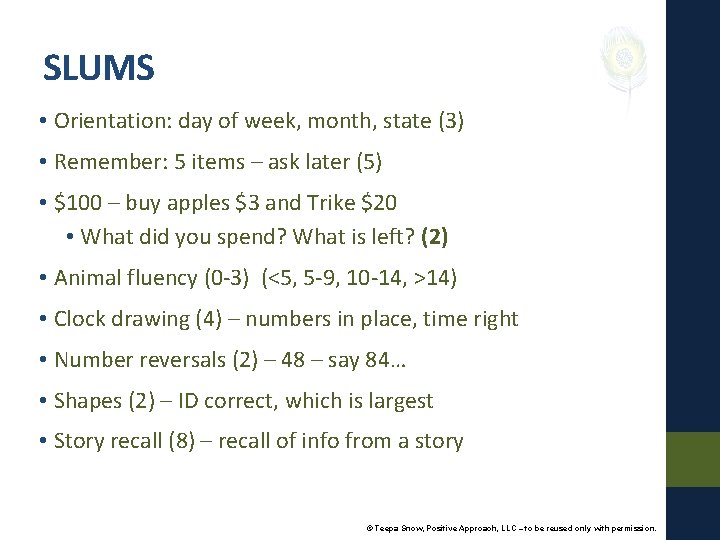
SLUMS • Orientation: day of week, month, state (3) • Remember: 5 items – ask later (5) • $100 – buy apples $3 and Trike $20 • What did you spend? What is left? (2) • Animal fluency (0 -3) (<5, 5 -9, 10 -14, >14) • Clock drawing (4) – numbers in place, time right • Number reversals (2) – 48 – say 84… • Shapes (2) – ID correct, which is largest • Story recall (8) – recall of info from a story © Teepa Snow, Positive Approach, LLC – to be reused only with permission.
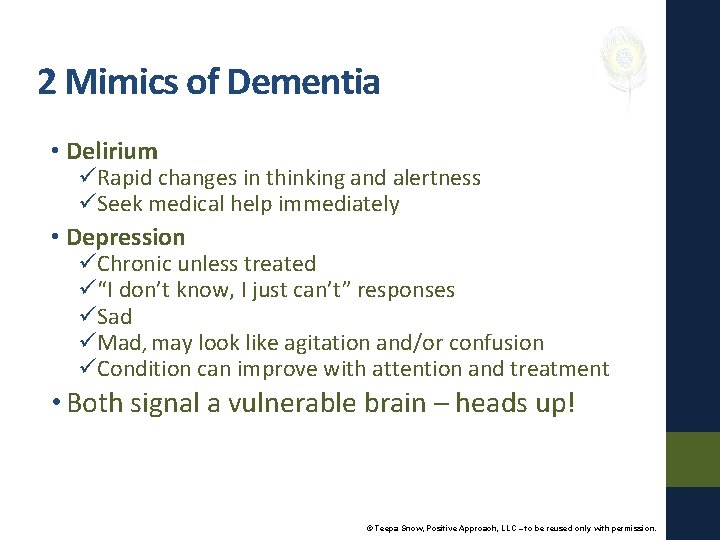
2 Mimics of Dementia • Delirium üRapid changes in thinking and alertness üSeek medical help immediately • Depression üChronic unless treated ü“I don’t know, I just can’t” responses üSad üMad, may look like agitation and/or confusion üCondition can improve with attention and treatment • Both signal a vulnerable brain – heads up! © Teepa Snow, Positive Approach, LLC – to be reused only with permission.
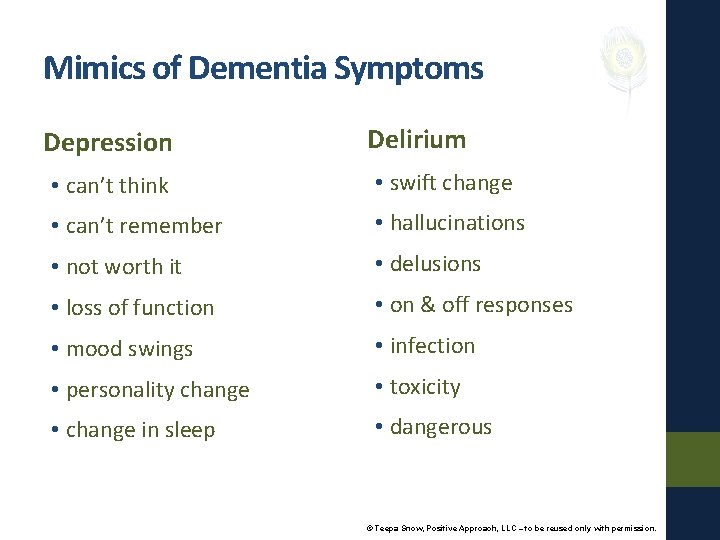
Mimics of Dementia Symptoms Depression Delirium • can’t think • swift change • can’t remember • hallucinations • not worth it • delusions • loss of function • on & off responses • mood swings • infection • personality change • toxicity • change in sleep • dangerous © Teepa Snow, Positive Approach, LLC – to be reused only with permission.
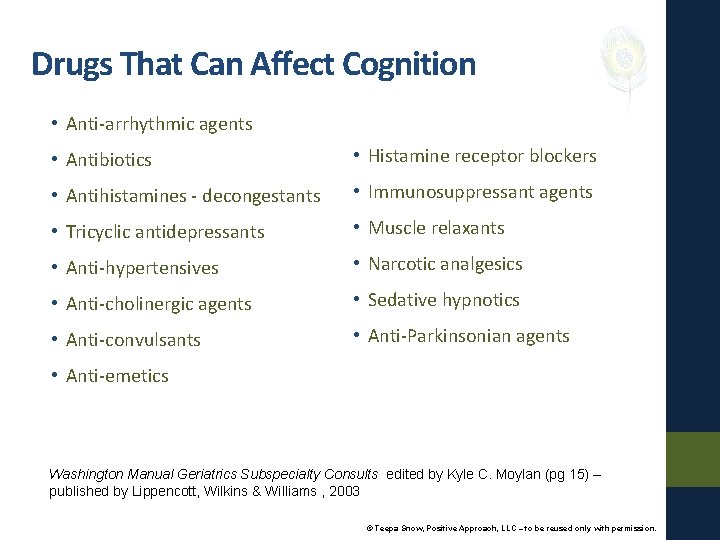
Drugs That Can Affect Cognition • Anti-arrhythmic agents • Antibiotics • Histamine receptor blockers • Antihistamines - decongestants • Immunosuppressant agents • Tricyclic antidepressants • Muscle relaxants • Anti-hypertensives • Narcotic analgesics • Anti-cholinergic agents • Sedative hypnotics • Anti-convulsants • Anti-Parkinsonian agents • Anti-emetics Washington Manual Geriatrics Subspecialty Consults edited by Kyle C. Moylan (pg 15) – published by Lippencott, Wilkins & Williams , 2003 © Teepa Snow, Positive Approach, LLC – to be reused only with permission.
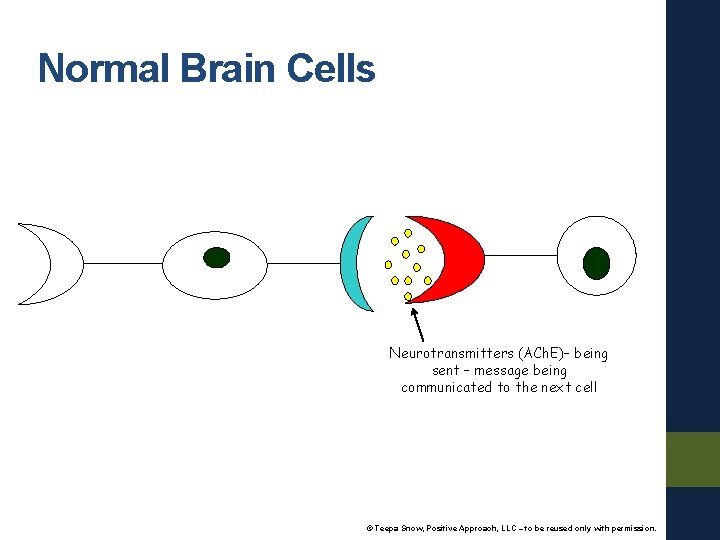
Normal Brain Cells Neurotransmitters (ACh. E)– being sent – message being communicated to the next cell © Teepa Snow, Positive Approach, LLC – to be reused only with permission.
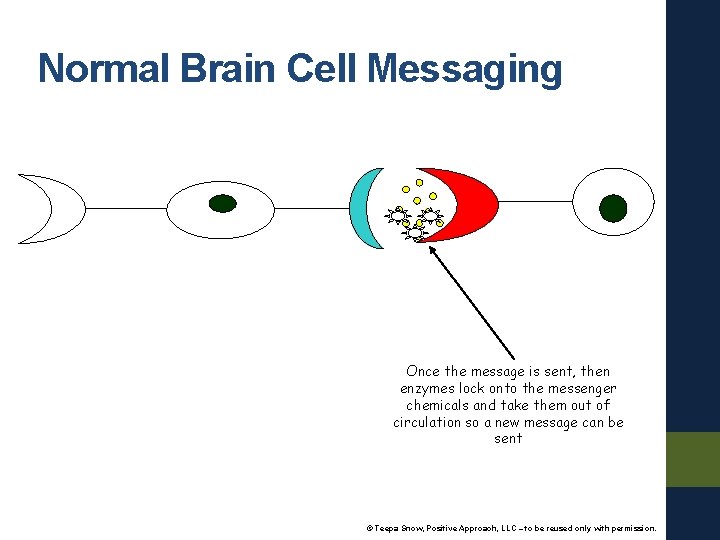
Normal Brain Cell Messaging Once the message is sent, then enzymes lock onto the messenger chemicals and take them out of circulation so a new message can be sent © Teepa Snow, Positive Approach, LLC – to be reused only with permission.
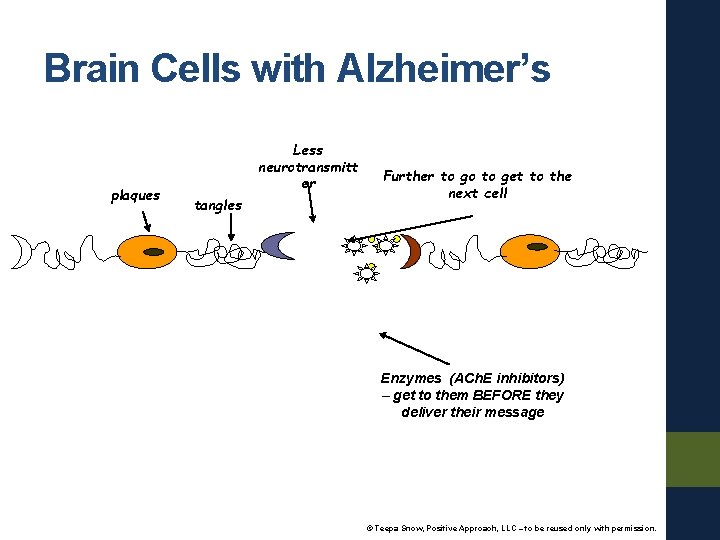
Brain Cells with Alzheimer’s plaques Less neurotransmitt er tangles Further to go to get to the next cell Enzymes (ACh. E inhibitors) – get to them BEFORE they deliver their message © Teepa Snow, Positive Approach, LLC – to be reused only with permission.
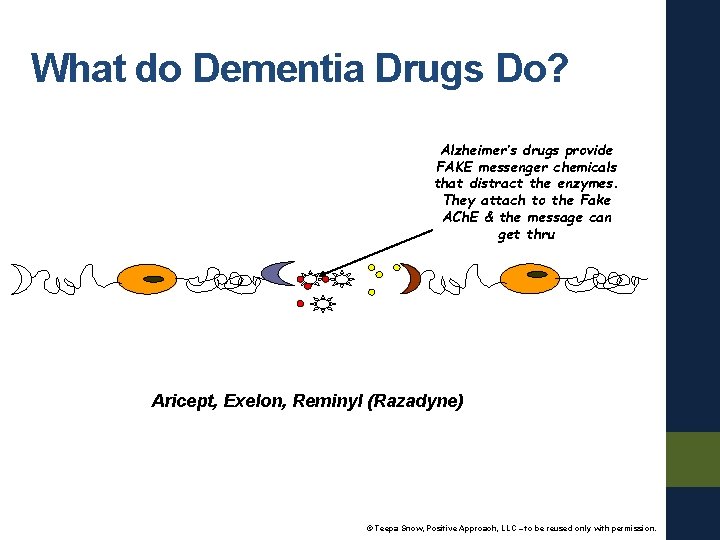
What do Dementia Drugs Do? Alzheimer’s drugs provide FAKE messenger chemicals that distract the enzymes. They attach to the Fake ACh. E & the message can get thru Aricept, Exelon, Reminyl (Razadyne) © Teepa Snow, Positive Approach, LLC – to be reused only with permission.
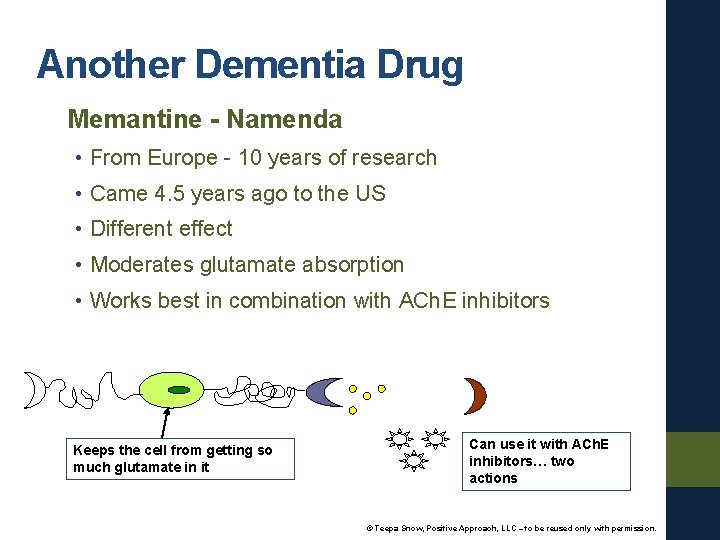
Another Dementia Drug Memantine - Namenda • From Europe - 10 years of research • Came 4. 5 years ago to the US • Different effect • Moderates glutamate absorption • Works best in combination with ACh. E inhibitors Keeps the cell from getting so much glutamate in it Can use it with ACh. E inhibitors… two actions © Teepa Snow, Positive Approach, LLC – to be reused only with permission.
If You Notice Changes… You Should ü Get an assessment ü Go see the doctor © Teepa Snow, Positive Approach, LLC – to be reused only with permission.
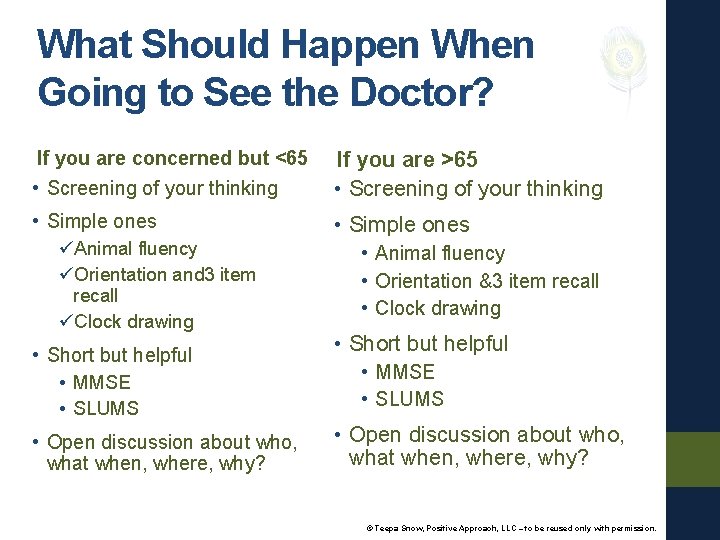
What Should Happen When Going to See the Doctor? If you are concerned but <65 • Screening of your thinking If you are >65 • Screening of your thinking • Simple ones üAnimal fluency üOrientation and 3 item • Simple ones recall üClock drawing • Short but helpful • MMSE • SLUMS • Open discussion about who, what when, where, why? • Animal fluency • Orientation &3 item recall • Clock drawing • Short but helpful • MMSE • SLUMS • Open discussion about who, what when, where, why? © Teepa Snow, Positive Approach, LLC – to be reused only with permission.
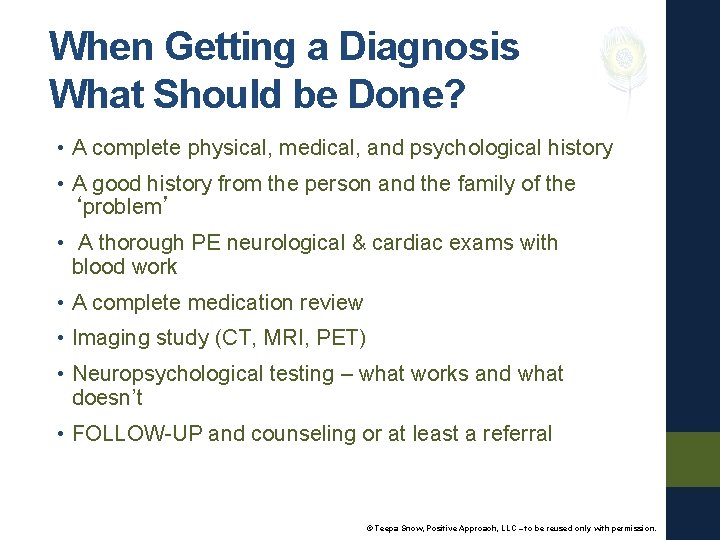
When Getting a Diagnosis What Should be Done? • A complete physical, medical, and psychological history • A good history from the person and the family of the ‘problem’ • A thorough PE neurological & cardiac exams with blood work • A complete medication review • Imaging study (CT, MRI, PET) • Neuropsychological testing – what works and what doesn’t • FOLLOW-UP and counseling or at least a referral © Teepa Snow, Positive Approach, LLC – to be reused only with permission.
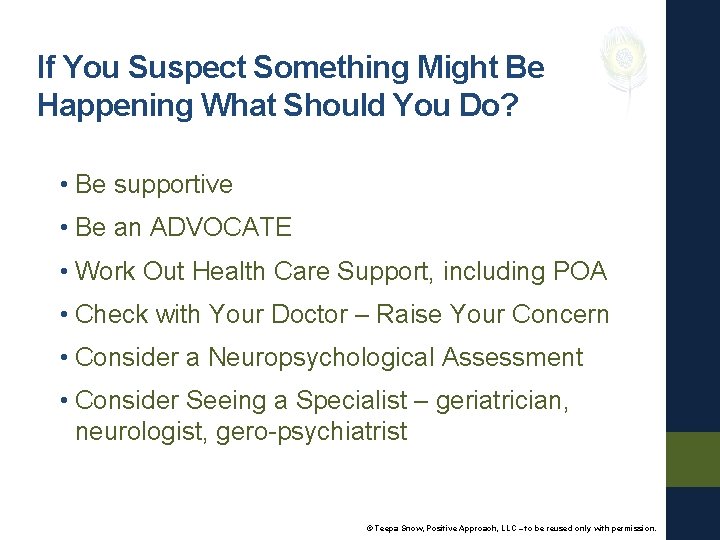
If You Suspect Something Might Be Happening What Should You Do? • Be supportive • Be an ADVOCATE • Work Out Health Care Support, including POA • Check with Your Doctor – Raise Your Concern • Consider a Neuropsychological Assessment • Consider Seeing a Specialist – geriatrician, neurologist, gero-psychiatrist © Teepa Snow, Positive Approach, LLC – to be reused only with permission.
When Should You Consider Getting a Second Opinion? • When what we talked about didn’t happen • When you feel un-listened to about concerns • When you are not offered options that seem reasonable • When you think or feel that the MD is not skilled enough to do a good job of managing this • When it is an atypical dementia © Teepa Snow, Positive Approach, LLC – to be reused only with permission.
Helpful Intervention / Programming • Physical activity • Mental activity • Social activity • Spiritual involvement • Well-being and self-worth • Minimize ‘risky’, challenging, or ‘dangerous behaviors • Reduce anxiety or distress © Teepa Snow, Positive Approach, LLC – to be reused only with permission.
Dementia… • It changes everything over time • It is NOT something a person can control • It is NOT the same for every person • It is NOT a mental illness • It is real • It is very hard at times © Teepa Snow, Positive Approach, LLC – to be reused only with permission.
Four Truths About Dementia 1. At least 2 parts of the brain are dying • One related to memory and one other 2. It is chronic and can’t be fixed 3. It is progressive and will get worse 4. It is terminal and it will kill, eventually © Teepa Snow, Positive Approach, LLC – to be reused only with permission.
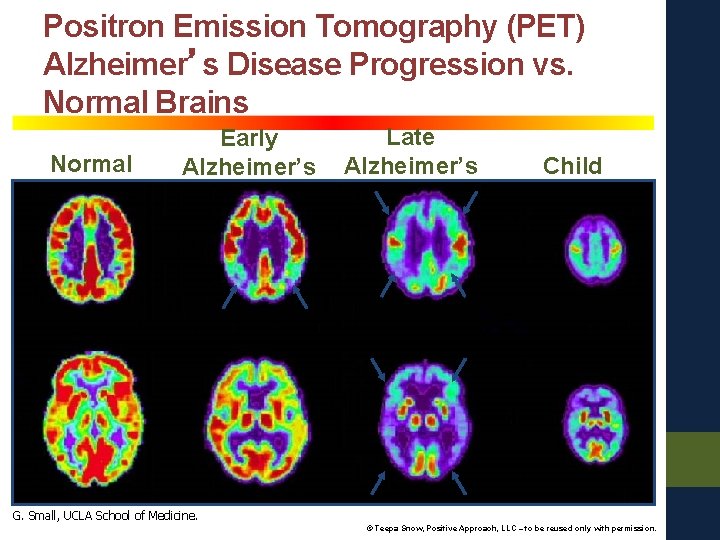
Positron Emission Tomography (PET) Alzheimer’s Disease Progression vs. Normal Brains Normal Early Alzheimer’s Late Alzheimer’s Child G. Small, UCLA School of Medicine. © Teepa Snow, Positive Approach, LLC – to be reused only with permission.
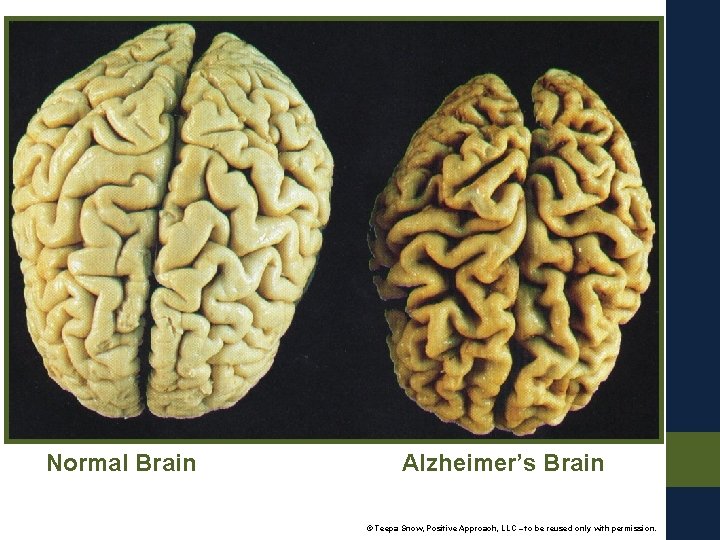
Normal Brain Alzheimer’s Brain Alzheimers Brain © Teepa Snow, Positive Approach, LLC – to be reused only with permission.
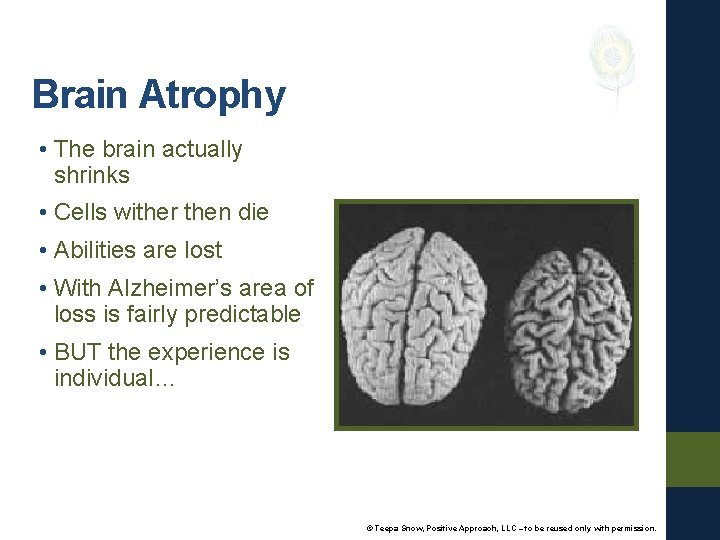
Brain Atrophy • The brain actually shrinks • Cells wither then die • Abilities are lost • With Alzheimer’s area of loss is fairly predictable • BUT the experience is individual… © Teepa Snow, Positive Approach, LLC – to be reused only with permission.
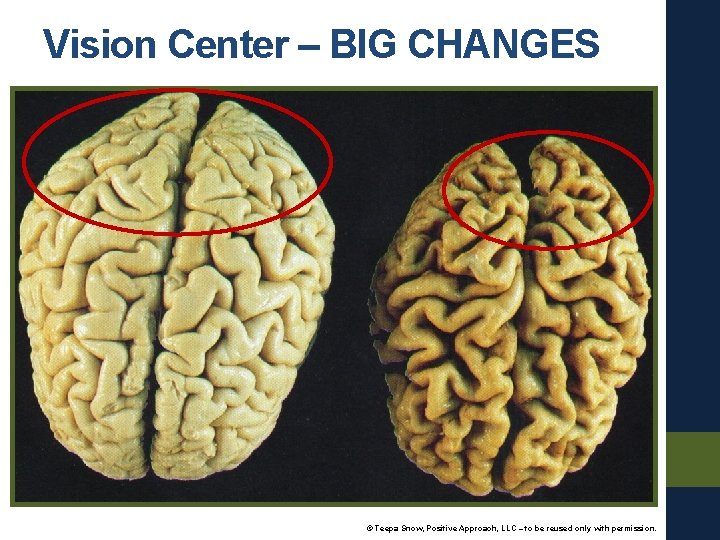
Vision Center – BIG CHANGES © Teepa Snow, Positive Approach, LLC – to be reused only with permission.
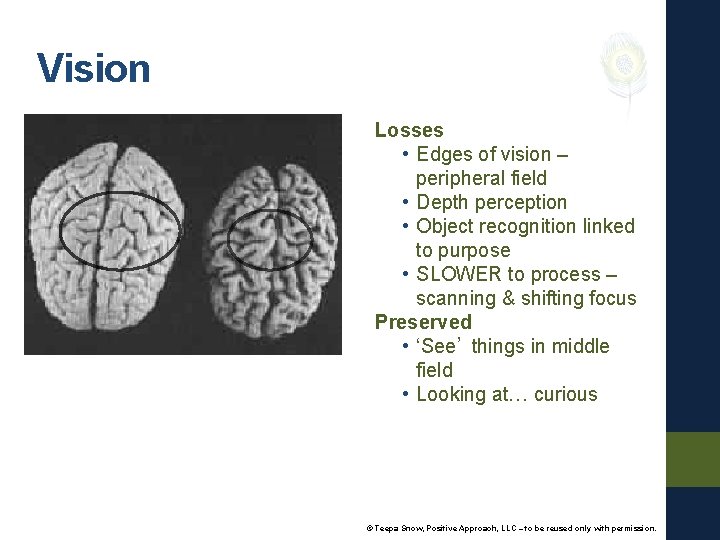
Vision Losses • Edges of vision – peripheral field • Depth perception • Object recognition linked to purpose • SLOWER to process – scanning & shifting focus Preserved • ‘See’ things in middle field • Looking at… curious © Teepa Snow, Positive Approach, LLC – to be reused only with permission.
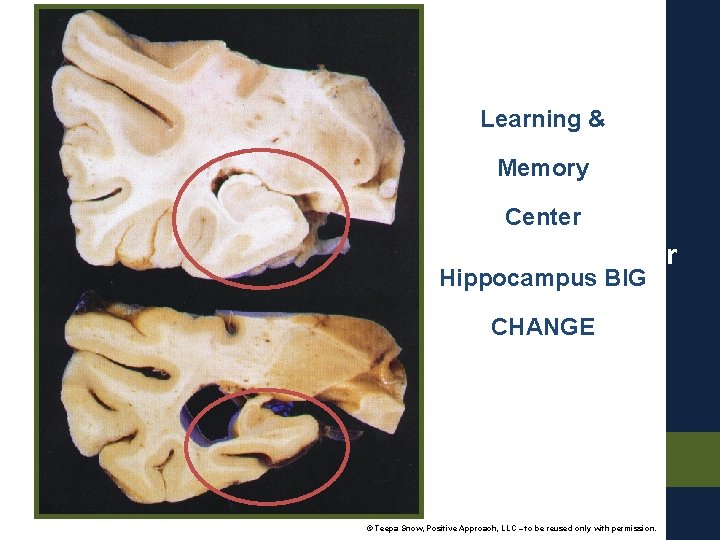
Learning & Memory Center Hippocampus BIG Hippocampus CHANGE BIG CHANGE © Teepa Snow, Positive Approach, LLC – to be reused only with permission.
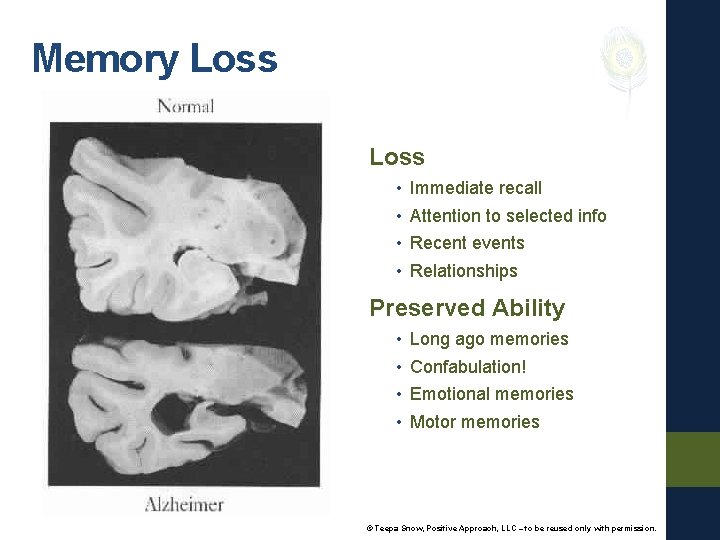
Memory Loss • • Immediate recall Attention to selected info Recent events Relationships Preserved Ability • • Long ago memories Confabulation! Emotional memories Motor memories © Teepa Snow, Positive Approach, LLC – to be reused only with permission.
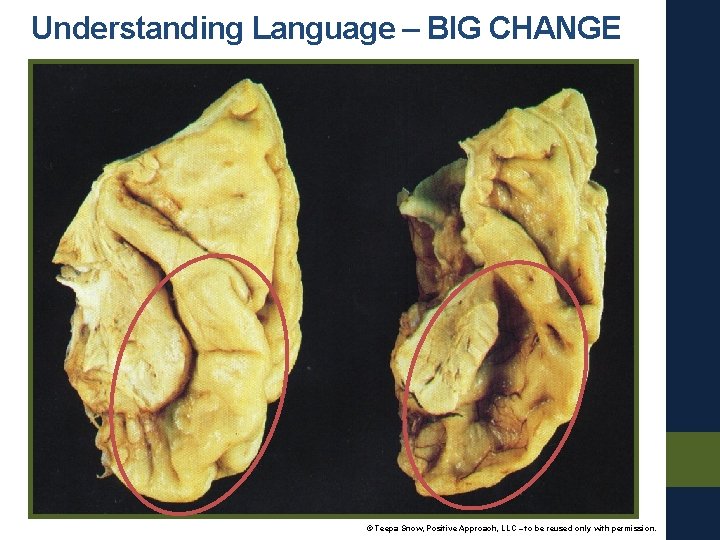
Understanding Language – BIG CHANGE © Teepa Snow, Positive Approach, LLC – to be reused only with permission.
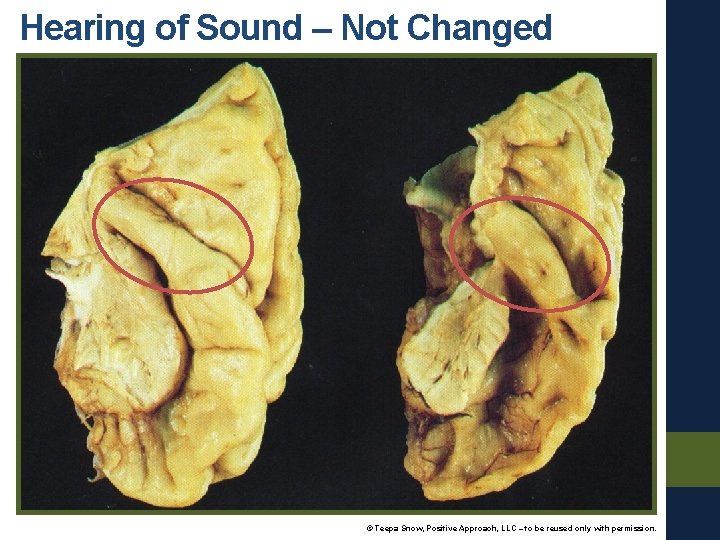
Hearing of Sound – Not Changed © Teepa Snow, Positive Approach, LLC – to be reused only with permission.
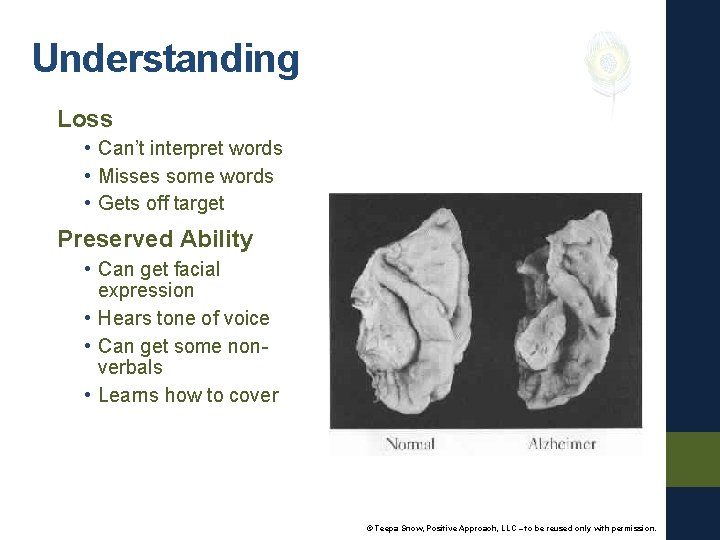
Understanding Loss • Can’t interpret words • Misses some words • Gets off target Preserved Ability • Can get facial expression • Hears tone of voice • Can get some nonverbals • Learns how to cover © Teepa Snow, Positive Approach, LLC – to be reused only with permission.
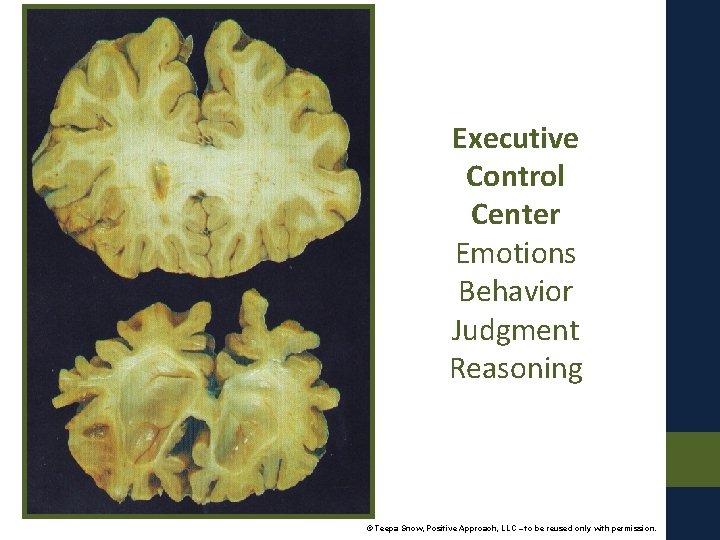
Executive Control Center Emotions Behavior Judgment Reasoning © Teepa Snow, Positive Approach, LLC – to be reused only with permission.
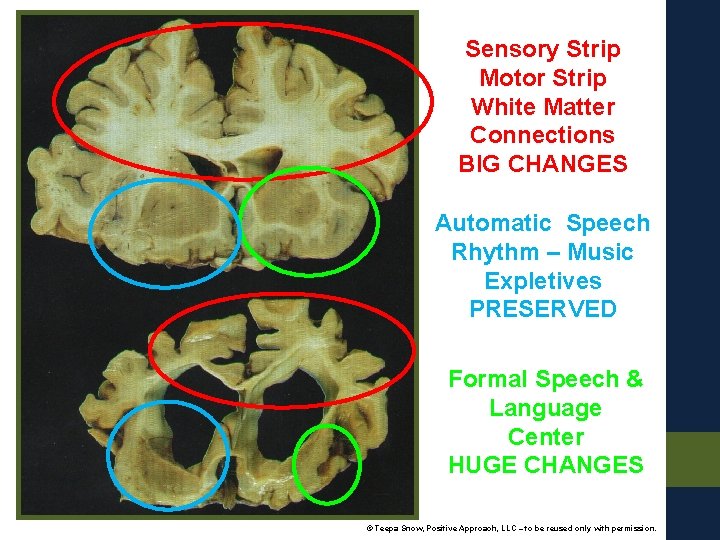
Sensory Strip Motor Strip White Matter Connections BIG CHANGES Automatic Speech Rhythm – Music Expletives PRESERVED Formal Speech & Language Center HUGE CHANGES © Teepa Snow, Positive Approach, LLC – to be reused only with permission.
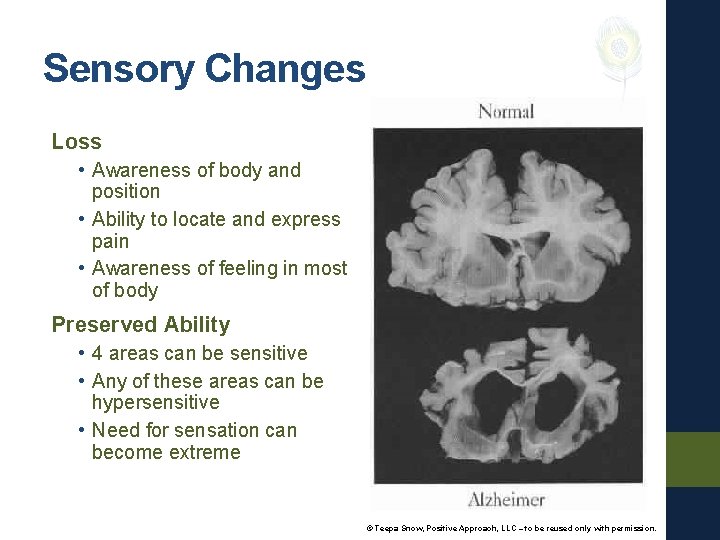
Sensory Changes Loss • Awareness of body and position • Ability to locate and express pain • Awareness of feeling in most of body Preserved Ability • 4 areas can be sensitive • Any of these areas can be hypersensitive • Need for sensation can become extreme © Teepa Snow, Positive Approach, LLC – to be reused only with permission.
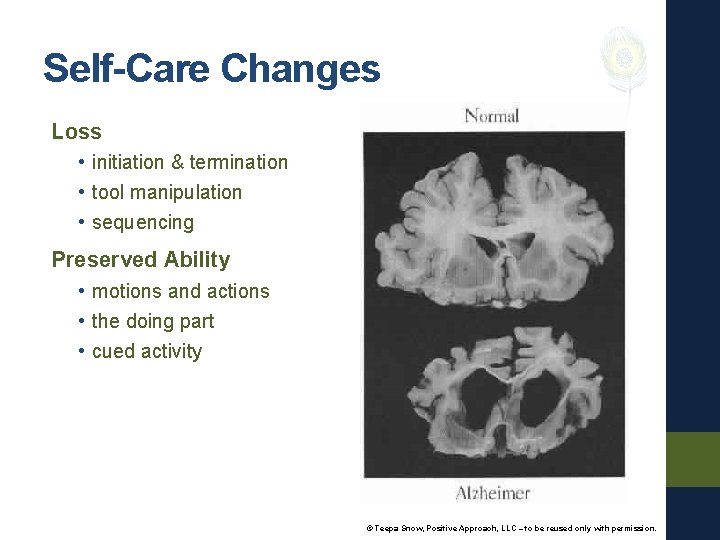
Self-Care Changes Loss • initiation & termination • tool manipulation • sequencing Preserved Ability • motions and actions • the doing part • cued activity © Teepa Snow, Positive Approach, LLC – to be reused only with permission.
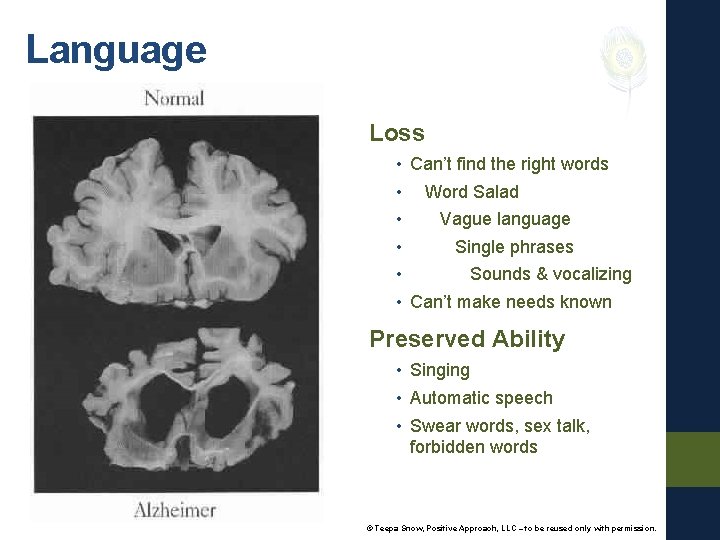
Language Loss • Can’t find the right words • Word Salad • Vague language • Single phrases • Sounds & vocalizing • Can’t make needs known Preserved Ability • Singing • Automatic speech • Swear words, sex talk, forbidden words © Teepa Snow, Positive Approach, LLC – to be reused only with permission.
Dementia Can Be Treated • With knowledge • With skill building • With commitment • With flexibility • With practice • With support • With compassion © Teepa Snow, Positive Approach, LLC – to be reused only with permission.
The Basics for Success • Be a Detective NOT a Judge • Look, Listen, Offer, Think… • Use Your Approach as a Screening Tool • Always use this sequence for CUES üVisual - Show üVerbal - Tell üPhysical – Touch • Match your help to remaining abilities © Teepa Snow, Positive Approach, LLC – to be reused only with permission.
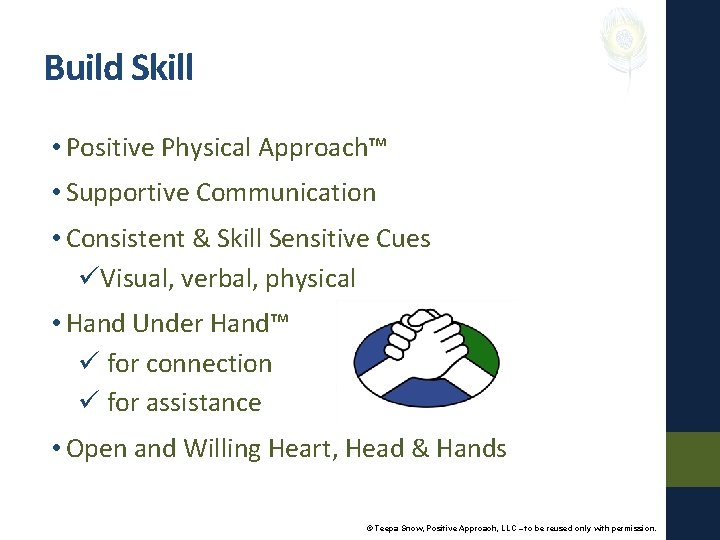
Build Skill • Positive Physical Approach™ • Supportive Communication • Consistent & Skill Sensitive Cues üVisual, verbal, physical • Hand Under Hand™ ü for connection ü for assistance • Open and Willing Heart, Head & Hands © Teepa Snow, Positive Approach, LLC – to be reused only with permission.
Approach Matters Use a consistent Positive Physical Approach™ • Pause at edge of public space • Gesture and greet by name • Offer your hand make eye contact • Approach slowly within visual range • Shake hands and maintain Hand-Under-Hand™ • Move to the side • Get to eye level & respect intimate space • Wait for acknowledgement © Teepa Snow, Positive Approach, LLC – to be reused only with permission.
Supportive Communication Make a connection • Offer your name – “I’m (NAME)… and you are…” • Offer a shared background – “I’m from (place) …and you’re from…” • Offer a positive personal comment – “You look great in that …. ” or “I love that color on you…” © Teepa Snow, Positive Approach, LLC – to be reused only with permission.
Emotional Communication Validate emotions • EARLY –“It’s really (label emotion) to have this happen” or “I’m sorry this is happening to you” • MIDWAY – Repeat/reflect their words (with emotion) üLISTEN for added information, ideas, thoughts üEXPLORE the new information by ‘watching and listening’ (wonder what they are trying to communicate) • LATE – Check out their ‘whole’ body – üObserve face, posture, movement, gestures, touching, looking üLook for NEED under the words or actions © Teepa Snow, Positive Approach, LLC – to be reused only with permission.
First Connect Then Do • 1 st – Visually • 2 nd – Verbally • 3 rd – Physically • 4 th – Emotionally • 5 th – Spiritually - Individually © Teepa Snow, Positive Approach, LLC – to be reused only with permission.
When Doing • Do ‘With’ • Give SIMPLE and Short Pieces of Information • Offer concrete CHOICES • Ask for HELP • Ask the person to TRY • Break the TASK DOWN to single steps at a time © Teepa Snow, Positive Approach, LLC – to be reused only with permission.
Keep it SIMPLE • USE VISUAL combined VERBAL (gesture/point) ü“It’s about time for… “ ü“Let’s go this way…” ü“Here are your socks…” • DON’T ask questions you DON’T want to hear the answer to… • Acknowledge the response/reaction to your information… • LIMIT your words – SIMPLE is better always • Wait, Pause, Slow Down © Teepa Snow, Positive Approach, LLC – to be reused only with permission.
When Words Don’t Work Well Hand-under-Hand™ • Uses established nerve pathways • Allows the person to feel in control • Connects you to the person • Allows you to DO with not to • Gives you advance notice of ‘possible problems’ • Connects eye-hand skills • Use the dominant side of the person © Teepa Snow, Positive Approach, LLC – to be reused only with permission.
Use Hand-Under-Hand™ • Connecting – comforting and directing gaze • Guiding and helping with movement • Getting eye contact and attention • Providing help with fine motor • Offering a sense of control, even when you are doing almost everything © Teepa Snow, Positive Approach, LLC – to be reused only with permission.
For ALL Communication If what you are trying is NOT working… • STOP • Back off • THINK IT THROUGH… • Then, re-approach • And try something slightly different © Teepa Snow, Positive Approach, LLC – to be reused only with permission.
Care Partners Need To… • Take care of yourself • Understand the symptoms and progression • Build skill in support and caregiving • Build skill in communication and interactions • Understand ‘the condition’ of brain change • Identify and utilize local resources • Set limits for yourself © Teepa Snow, Positive Approach, LLC – to be reused only with permission.
Latest Thinking About Risk Reduction • Mental activity • Statins (when needed) • Aerobic activity • NSAIDS (when needed) • Enough vitamins E & C • Keeping Iron levels in limit • Heart Smart Diet • Omega 3 fatty acids • Keeping homocysteine‘right’ Vitamin B’s • Lower weight • Staying socially active • Not smoking • Getting depression treated • Avoiding head injuries • Controlling diabetes • Getting enough sleep • Controlling hypertension • De-stressing © Teepa Snow, Positive Approach, LLC – to be reused only with permission.
About Dementia • It changes everything over time • It is NOT something the person can control • It is NOT always the same for every person • It is NOT a mental illness • It is real • It is hard at times © Teepa Snow, Positive Approach, LLC – to be reused only with permission.
Dementia Challenges • • • No F Po. A or HC Po. A – • • Making 911 calls Going to MD problems ‘Losing’ Important Things Getting Lost – time, place, situation Unsafe task performance Repeated calls & contacts Refusing help & care ‘Bad mouthing’ you to others Making up stories - confabulation Undoing what is done Swearing/cursing, sex talk, racial slur, ugly words Mixing day & night Sleep problems – too much or too little Not following care/rx plans - denying No initiation – can’t get started Perseveration – can’t stop repeating Not talking any more • • Paranoid/delusional thinking Shadowing - following Eloping or Wandering Seeing things & people not there hallucinations • Getting ‘into’ things • Threatening caregivers • Undressing in public – not changing when needed • Problems w/intimacy & sexuality • Being rude - intruding • Feeling ‘sick’ – not doing ‘anything’ • Use of drugs or alcohol to ‘cope’ • Striking out at others • Falls & injuries • Dehydration & malnourishment • Contractures & immobility • Infections & pneumonias • Issues w/ eating or drinking © Teepa Snow, Positive Approach, LLC – to be reused only with permission.
Gem Dementia Abilities Based on Allen Cognitive Levels • A Cognitive Disability Theory – OT based • Creates a common language and approach to providing: üEnvironmental support üCaregiver support and cueing strategies üExpectations for retained ability and lost skill üPromotes graded task modification • Each Gem state requires a special ‘setting’ and ‘just right’ care üVisual, verbal, touch communication cues • Each can shine • Encourages in the moment assessment of ability and need üAccounts for chemistry as well as structure change © Teepa Snow, Positive Approach, LLC – to be reused only with permission.
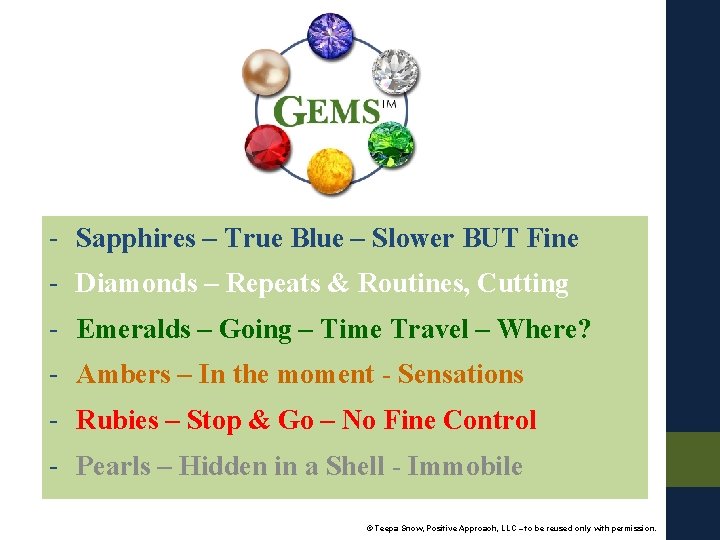
- Sapphires – True Blue – Slower BUT Fine - Diamonds – Repeats & Routines, Cutting - Emeralds – Going – Time Travel – Where? - Ambers – In the moment - Sensations - Rubies – Stop & Go – No Fine Control - Pearls – Hidden in a Shell - Immobile © Teepa Snow, Positive Approach, LLC – to be reused only with permission.
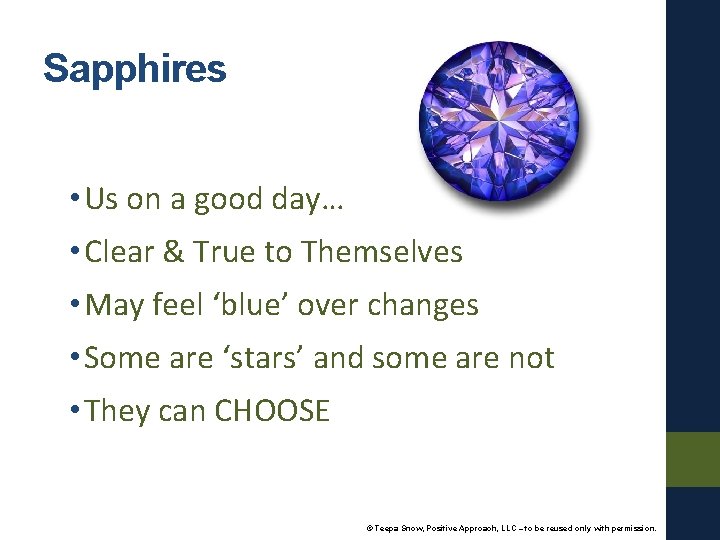
Sapphires • Us on a good day… • Clear & True to Themselves • May feel ‘blue’ over changes • Some are ‘stars’ and some are not • They can CHOOSE © Teepa Snow, Positive Approach, LLC – to be reused only with permission.
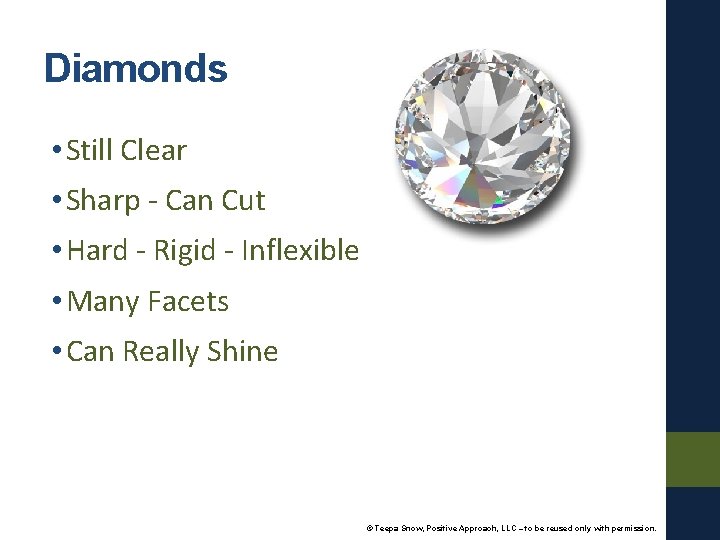
Diamonds • Still Clear • Sharp - Can Cut • Hard - Rigid - Inflexible • Many Facets • Can Really Shine © Teepa Snow, Positive Approach, LLC – to be reused only with permission.
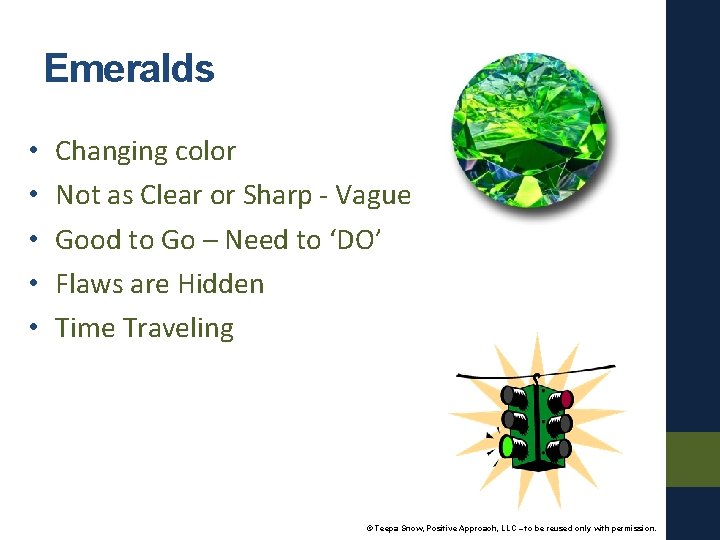
Emeralds • • • Changing color Not as Clear or Sharp - Vague Good to Go – Need to ‘DO’ Flaws are Hidden Time Traveling © Teepa Snow, Positive Approach, LLC – to be reused only with permission.
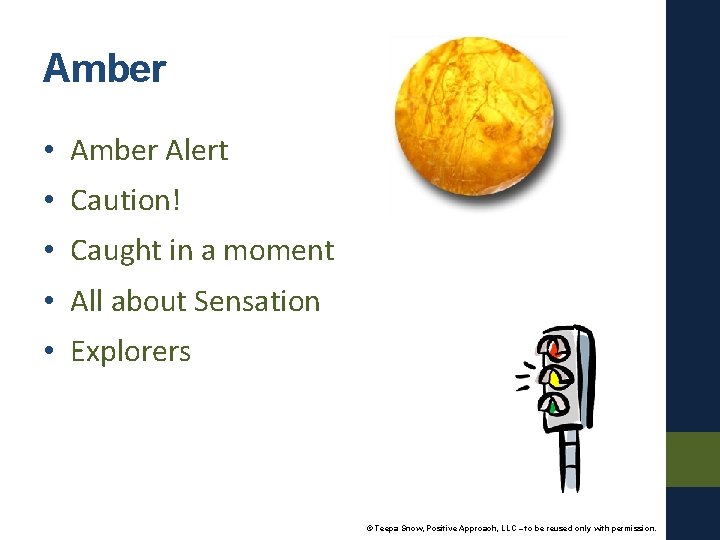
Amber • Amber Alert • Caution! • Caught in a moment • All about Sensation • Explorers © Teepa Snow, Positive Approach, LLC – to be reused only with permission.
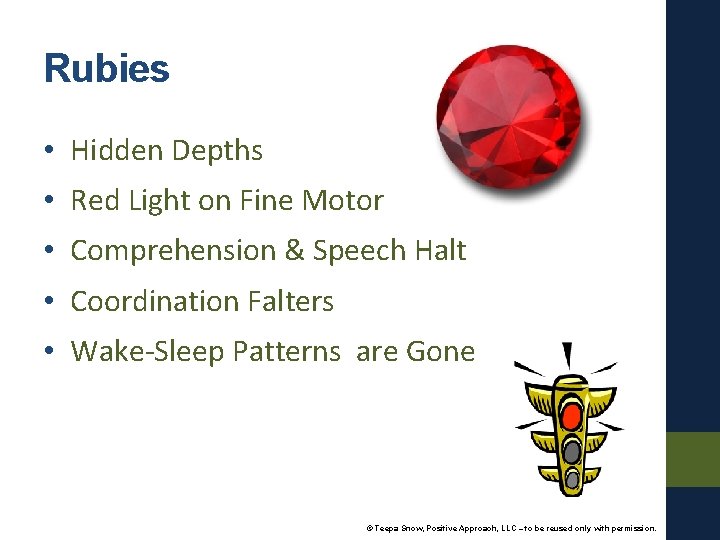
Rubies • Hidden Depths • Red Light on Fine Motor • Comprehension & Speech Halt • Coordination Falters • Wake-Sleep Patterns are Gone © Teepa Snow, Positive Approach, LLC – to be reused only with permission.
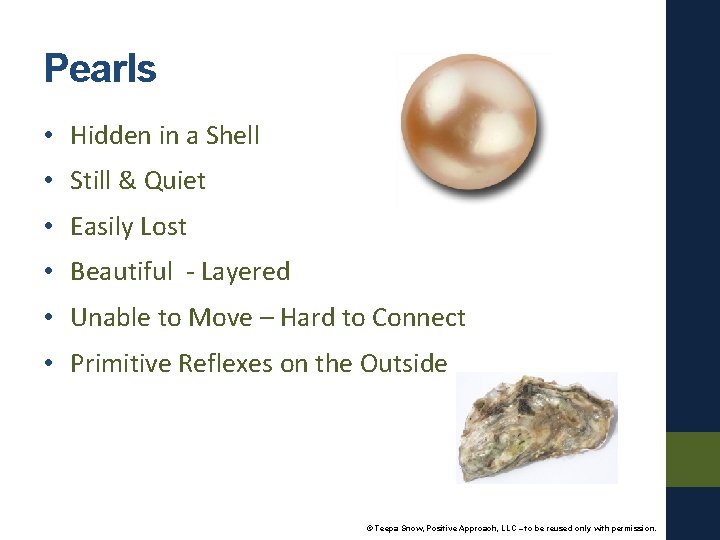
Pearls • Hidden in a Shell • Still & Quiet • Easily Lost • Beautiful - Layered • Unable to Move – Hard to Connect • Primitive Reflexes on the Outside © Teepa Snow, Positive Approach, LLC – to be reused only with permission.
Sapphire Characteristics • Can connect the dots – make contracts • May have other health issues that affect behaviors • Recognize life experiences, achievements and values in interactions • Can follow written information and hold onto it • Will still need us to work with them • Can typically CHOOSE their behaviors © Teepa Snow, Positive Approach, LLC – to be reused only with permission.
Diamond Characteristics • Uses routines and old habits to function • Can complete personal care in ‘familiar place’ • Follow simple prompted schedules - mostly • May misplace things and can’t find them • Will resent ‘takeover’ or being bossed by others • Notices other individuals misbehavior or mistakes • Very territorial • Varies in lack of self-awareness © Teepa Snow, Positive Approach, LLC – to be reused only with permission.
Diamond Interests • Enjoy what they feel competent at • Like who they like • Activities that make them feel valued • Things that feel comfortable but stimulate them • The familiar but intriguing or intersting • Logical and consistent matching personal values and beliefs • Authority, or who is in charge © Teepa Snow, Positive Approach, LLC – to be reused only with permission.
Diamond Care Challenges Individual Activities of Daily Living: • Money management • Transportation • - Driving • Cooking • Home maintenance and safety • Caring for someone else • Pet maintenance • Med administration Unfamiliar settings or situations: • Hospital stay • Housing transition • Change in family • Change in support system • Doctor visits • New diagnoses • Traveling or vacations © Teepa Snow, Positive Approach, LLC – to be reused only with permission.
Visual Cues to Help Diamonds • Personalized room • Way finding signs • Highlighted schedules • Familiar and inviting environments • Familiar set-ups for tasks or activities • Personal approach with a smile • Place cards at table settings • Wear name tags on right side © Teepa Snow, Positive Approach, LLC – to be reused only with permission.
Verbal Cues to Help Diamonds • • Knock before entering Be respectful, Use Sir and Ma’am Ask permission to do things in their space Offer positive comments/feedback Issue invitations don’t give orders Ask for help or input Frame‘RULES’as for everyone at large Acknowledge skill, ask for their support or understanding, “a favor” © Teepa Snow, Positive Approach, LLC – to be reused only with permission.
Tactile Cues to Help Emeralds • Hand shake greetings • Return of friendly affection • Responsive hugs • Hand-Under-Hand™ comfort • Back rubs – with permission • Hand or foot massages, ‘pampering’ © Teepa Snow, Positive Approach, LLC – to be reused only with permission.
What Else Helps Diamonds • Apologies “I’m SORRY!” or “I was trying to help. ” • Friendly NOT bossy, leader to leader • “Let’s try…”, for now, temporary solutions • Share responsibility and do not take over, partner • Use as many‘old habits’ as possible • Give up being‘RIGHT’ • Go with the FLOW • Let it go • Give other ‘job’ when taking one away • Feeling purposeful © Teepa Snow, Positive Approach, LLC – to be reused only with permission.
When Diamonds Forget Expect repeated questions or requests • Don’t share so early, especially emotional content • Make sure you are connected when you respond • Repeat their words back to them in the form of a question • Answer their questions • THEN - Use new words with enthusiasm and energy - Go to a new place - Add a new activity (possibly related) © Teepa Snow, Positive Approach, LLC – to be reused only with permission.
Diamonds Need to Share • Listen as if it’s new • Use “Tell me about it” üTo accept the story üTo reduce risk of ‘paranoia-like’ thinking • Store them for the future üWrite them down üShare them with others üYou will possibly need them for supportive communication later • Learn several – prompt for ‘switch up’ © Teepa Snow, Positive Approach, LLC – to be reused only with permission.
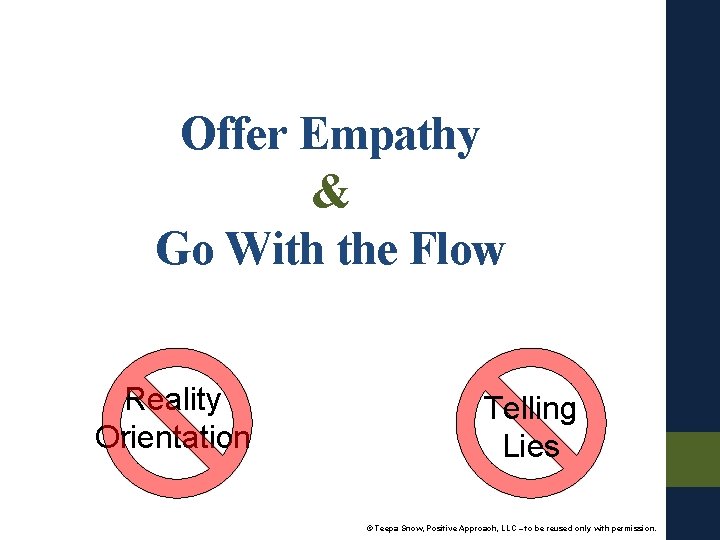
Offer Empathy & Go With the Flow Reality Orientation Telling Lies © Teepa Snow, Positive Approach, LLC – to be reused only with permission.
Changing Diamond Care Habits • Quit saying “Don’t you remember…” • Recognize and accept changes or differences • Do not force changes in relationship roles or responsibilities • Resist taking over completely • Take responsibility for saying “NO” • Try to accept things at face value • Stop arguing © Teepa Snow, Positive Approach, LLC – to be reused only with permission.
Emerald Characteristics • Two Kinds of Engagement: • Doers • Supervisors • Will respond to what is seen, will miss what is not • Must be in Control • Not able to do tasks right • Repeats a task over and over • OR will not participate at all © Teepa Snow, Positive Approach, LLC – to be reused only with permission.
Emerald Interests • Doing familiar tasks • Doing visible tasks • Historic tasks and people and places • Engaging with or helping others • Finding important people or things • Having a ‘job’ or ‘purpose’ • Being an ‘adult’ • Getting finished & doing something else © Teepa Snow, Positive Approach, LLC – to be reused only with permission.
Challenges of Emerald Care • Doesn’t do self care routinely – thinks they do • Unaware of making mistakes in sequence • May repeat care routines over and over • Will resist or refuse help when needed • Gets lost, losing way finding ability • Limited awareness of ‘personal needs’ – • Hunger, thirst, voiding, bathing, grooming… • Avoids, has other‘stuff’ to do… © Teepa Snow, Positive Approach, LLC – to be reused only with permission.
More Emerald Issues • Afternoon or Evening – “Got to go home” • Daytime – “Got to go to work” • Looking for people/places from the past • Losing important things – thinking others stole/took them • Doing private things in public places • Having emotional meltdowns • Treating strangers like friends and visa versa © Teepa Snow, Positive Approach, LLC – to be reused only with permission.
Visual Cues to Help Emeralds The environment • Overall look (friendly, fun, familiar, forgiving) • Surfaces to work on or do things on • Places to sit (paired chairs) • Set up Props (objects that ‘say’ what to do) • Highlighted areas (light, color contrast, clutter reduction, organized) • Hidden – what is NOT to be done, what is already done, what ‘triggers’ distress © Teepa Snow, Positive Approach, LLC – to be reused only with permission.
Visual Cues (continued) You Can Use • Facial expression - Friendly - Concerned • Gestures - Invite with gestures and your face - Indicate next item to use, or options • Offer items - Offer an item in correct orientation - Present two to pick from © Teepa Snow, Positive Approach, LLC – to be reused only with permission.
Verbal Cues to Help Emeralds • Tone of Voice üFriendly üInterested üConcerned • Reduce and Focused words üUse preferred name for getting attention üMatch words with gestures or offering • Listen and use their words to keep connection © Teepa Snow, Positive Approach, LLC – to be reused only with permission.
Verbal Cues (continued) When Emeralds become distressed • Use PPA – Invite them to come to you, if possible • Listen - Get emotionally connected to where they are • Give empathic understanding feedback • Listen for key words • Go with their FLOW – don’t push for the change THEN use redirection, NOT distraction © Teepa Snow, Positive Approach, LLC – to be reused only with permission.
Physical Cues to Help Emeralds • Limit Physical Cues when helping • Match with a visual / verbal cue combo • Offer objects, don’t put hands on Emeralds • Share the task • Give them something to do while you do your part • Model ‘it’ with/to someone else first, then approach the Emerald © Teepa Snow, Positive Approach, LLC – to be reused only with permission.
Physical Cues (continued) When Emeralds become distressed • Match your touch to their preferences • Hand-under-Hand FIRST • Back rub – if interested • Hug – show first • Increase space and distance, if cued • BACK OFF, if it is not working © Teepa Snow, Positive Approach, LLC – to be reused only with permission.
How to Help Emeralds • Learn about “SO WHAT!”… Best to let go • Provide ‘subtle’ supervision for care • Provide visual guidance and prompting to do • Gestures, objects, set-up, samples, show, model • Hide visual cues to ‘stop’/prevent • Put away, move out of range, leave • Use the environment to cue – SHOW them • Use ‘normal’, humor, friendliness, support © Teepa Snow, Positive Approach, LLC – to be reused only with permission.
Connecting With Emeralds • Identify common interests • Say something nice about the person or their place • Share something personal about yourself and encourage the person to share back • Follow the Emerald’s lead – listen actively • Use some of their words to keep the flow of conversation going • Remember its the FIRST TIME for them – expect repetition • Use the phrase “Tell me about that …” © Teepa Snow, Positive Approach, LLC – to be reused only with permission.
Emerald Do’s Go with the FLOW Use SUPPORTIVE communication techniques • Use objects and the environment • Give examples • Use gestures and pointing • Acknowledge & accept emotions • Use empathy & Validation • Use familiar phrases or known interests • Respect ‘values’ and ‘beliefs’ – avoid the negative © Teepa Snow, Positive Approach, LLC – to be reused only with permission.
EMERALD Do Not’s Try to CONTROL the FLOW • Give up reality orientation and BIG lies • Do not correct errors • Offer info if asked, monitoring the emotional state Try to STOP the FLOW • Don’t reject topics • Don’t try to distract UNTIL you are well connected • Keep VISUAL cues positive © Teepa Snow, Positive Approach, LLC – to be reused only with permission.
Changing Emerald Care Habits • Notice but never ‘point out’ errors • Ask “Can you help” instead of tell “You need to…” • It might be ‘too much’ talking, showing, touching • Offer don’t ‘take over’ • Do with NOT to Emeralds • Resist ‘fussing’ with their body • Do not use reality orientation or lie to Emeralds • Use ‘distraction’and creative problem solving © Teepa Snow, Positive Approach, LLC – to be reused only with permission.
Amber Characteristics • Private and quiet OR public and noisy • All about sensory tolerance and needs • Focus on fingers and mouth • Like Touching - Tasting – Handling – Exploring • Will DO what they like and AVOID what they don’t • Appear over-stimulated or under-stimulated • No safety awareness • Ego-centric, may invade others space © Teepa Snow, Positive Approach, LLC – to be reused only with permission.
Amber Interests • Things to mess with (may be people) • Places to explore • Things to take, eat, handle, move… • Visually interesting things • People who look or sound interesting • Or places that are quiet and private • Textures, shapes, movement, colors, numbers, stacking, folding, sorting… © Teepa Snow, Positive Approach, LLC – to be reused only with permission.
Challenges of Amber Care • Will get into and/or take things • No understanding of personal space, may • bothers • Unable to make their needs known • May not understand why/what caregivers are doing • Don’t like sensation of being helped/touched/handled • Resist showers or bathing • Behavioral repetition of sounds/words/actions © Teepa Snow, Positive Approach, LLC – to be reused only with permission.
Visual Cues to Help Ambers • Automatic social greeting and signals • Well lighted work surfaces with strong props • Demonstrations – work along side Ambers • Model the actions desired • Do the action one time, then offer the prop • Show one step at a time, break it down • Show a NEW item (substitution), then cover the old one up © Teepa Snow, Positive Approach, LLC – to be reused only with permission.
Verbal Cues to Help Ambers • Call out Amber’s name • Use simple nouns, verbs, or noun + verb ü“Cookie? ” ü“Sit down” ü“Lets go” • Use gestures whenever possible with words • Give simple positive feedback • Listen for their words, repeat the words back and wait for more…(they might fill in a blank) © Teepa Snow, Positive Approach, LLC – to be reused only with permission.
Physical Cues to Help Ambers • Show the motion or action desired • Touch the body part of interest • Position the prop for use – light touch • Model/show the action yourself • Use Hand Under Hand™ guidance • Offer the prop once started – encourage Amber use of the item © Teepa Snow, Positive Approach, LLC – to be reused only with permission.
How to Help Ambers • Provide step-by-step guidance • Communicate what you want with demonstration • Use Hand Under Hand™ assistance then after a few repetitions transfer (expect utensil use may be difficult) • Offer something to handle, manipulate, touch, gather • Limit talking, noise, touch, other activities • SUBSTITUTE don’t SUBTRACT © Teepa Snow, Positive Approach, LLC – to be reused only with permission.
Connecting with Ambers Make Emotional Connections • Use props or objects • Consider PARALLEL engagement Be alongside them at first, interested or looking at‘object’not person… ‘share it’ with an Amber • Talk less, wait longer, take turns • When you don’t understand, ‘cover don’t confront’, enjoy the exchange • Use social ‘chit chat’ to start interactions • Keep it short – Emphasize the VISUAL © Teepa Snow, Positive Approach, LLC – to be reused only with permission.
Changing Amber Care Habits • Show more, talk less • Do not keep ‘pushing’ • Doing with NOT to • Adjust and make safer environment to explore • Respect intimate space • Careful of over or under stimulating • Do not be loud and forceful © Teepa Snow, Positive Approach, LLC – to be reused only with permission.
Ruby Characteristics • No skill -‘strength’in movement • (walking, rolling, rocking) • Hand action – not fingers • Tend toward movement unless ‘asleep’ • Will follow gross demonstration and big gesture directing action • Limited visual awareness • Major sensory change • Major movement skill change • Fine motor skill loss – mouth & hands © Teepa Snow, Positive Approach, LLC – to be reused only with permission.
Ruby Interests • Walking a routine path • Going forward • Watching others – checking them out • Being close or having space • Things to pick up, hold, carry, push, wipe, rub, grip, squeeze, pinch, slap • Things to chew on, suck on, grind • Rhythmic movements and actions © Teepa Snow, Positive Approach, LLC – to be reused only with permission.
Challenges of Ruby Care • Safe mobility – fatigue, wandering, and falls • Intake – amount and safety while trying • Hydration – interest, amount, safety • Rest time and place – night time waking • Shadowing others – invading places • Not staying – not settling for meals • Reactions to hands on care – sensation • Identifying and meeting needs © Teepa Snow, Positive Approach, LLC – to be reused only with permission.
Challenges of Ruby Care (continued) • Muscle contracture • Well being of skin – bruises, tears, rashes • Pressure or friction • Infections – UTI, yeast, URI, pneumonias • Swallowing • Circulation © Teepa Snow, Positive Approach, LLC – to be reused only with permission.
Visual Cues to Help Rubies • Demonstrate what you want Ruby to do • Show big movements to be copied • Move slowly and with rhythm • Present cues in central visual field about 12 -18 inches away • Hold things still for Ruby, allow exploration • Offer your hand • Smile while offering support © Teepa Snow, Positive Approach, LLC – to be reused only with permission.
Verbal Cues to Help Rubies • Call name to get attention at 6’away • Use ‘song’ to connect • Speak 1 to 3 words only at a time • Combine verbal direction with gestures or demo • Give one‘action’ cue at a time • Match tone of voice/inflection to intent • Give positive‘strokes’with attempts © Teepa Snow, Positive Approach, LLC – to be reused only with permission.
Physical Cues to Help Rubies • Hand Under Hand™ • Touch body part first, then move or use • Place hand/foot then gesture next step • Offer comfort touch before task attempt • Sensation of back rubs can be helpful: üFlat and slow – to calm üFinger tips and quick circles – to awaken © Teepa Snow, Positive Approach, LLC – to be reused only with permission.
How to Help Rubies - SLOW yourself DOWN - Use Hand Under Hand™ - Move with Ruby first – then guide them - Watch for patterns of ‘need’ - Use music and rhythm to start or stop movement - Touch with care - Combine cuing and ‘doing SLOW’ © Teepa Snow, Positive Approach, LLC – to be reused only with permission.
Changing Ruby Care Habits • Careful of startling or touching too quickly • Pay attention when ‘leaning in’ – invading Ruby intimate space • Notice volume, talk softer • No‘baby-talking, deep and firm tone • Not talking at all is ok • Demonstrate what is wanted • Patience when trying to understand or uncover a need © Teepa Snow, Positive Approach, LLC – to be reused only with permission.
Pearl Characteristics • The end of the journey is near • Multiple systems are failing • Connection between the physical and sensory world is weak • Providers are often the bridge – the connection to the world • Many Pearls need permission to go – • They are still our moms, dads, spouses, friends • They will go in their own time IF we don’t try to change • what is © Teepa Snow, Positive Approach, LLC – to be reused only with permission.
Pearl Characteristics • Immobile – can’t get started • Bed or chair bound – frequently fall to side or forward • Have more time asleep or unaware • Have many ‘primitive’ reflexes present -Startles easily • May cry out or mumble ‘constantly’ • Have increased vocalization with distress • Difficult to calm • Knows familiar from unfamiliar • Touch and voice make a difference in behaviors © Teepa Snow, Positive Approach, LLC – to be reused only with permission.
Pearl Interests • Internal cues • Pleasant and familiar sounds and voices • Warmth and comfort • Soft textures • Pleasant smells • ‘Good’ tastes • Smooth and slow movement • ‘Just right’ touch and feel © Teepa Snow, Positive Approach, LLC – to be reused only with permission.
Primitive Reflexes to Consider • Startle reflex üSudden movement causes total body motion • Grasp reflex üTouches palm üGrips hard üCan’t release • Sucking reflex üSucks on anything near mouth • Rooting reflex üTurns toward any facial touch and tries to eat © Teepa Snow, Positive Approach, LLC – to be reused only with permission.
More Reflexes • Bite reflex üAny touch in mouth causes bite down • Tongue thrust üAnything in mouth causes tongue to push forward and out • Withdrawal / rebound üPull away from stretch • Gag reflex üAny touch to tongue causes gag © Teepa Snow, Positive Approach, LLC – to be reused only with permission.
Pearl Positioning Consider: • Constant muscle activity causes ‘contractures’ shortening / can’t relax • Stronger muscles cause typical ‘fetal’ positioning • Pulling against contractures is painful • Shortened muscles cause some areas to: üBecome ‘raw’ or ‘irritated’from lack of air üRub or press against other body parts üGet too much pressure – no ability to move off © Teepa Snow, Positive Approach, LLC – to be reused only with permission.
Challenges of Pearl Care • Little interaction ability • May ‘cry out’ – can’t make needs known • Skin and hygiene issues • Weight loss • Reflexes make care tasks difficult • Repeated infections • Not eating or drinking • Not able to sit up safely © Teepa Snow, Positive Approach, LLC – to be reused only with permission.
Visual Cues to Help Pearls • Get into supportive position • Place your face in the central field of vision • Make sure light comes from behind the person – onto your face • Bring up lights slowly for transition time • Move slowly so they can track and follow you • Show items to be used in central vision field © Teepa Snow, Positive Approach, LLC – to be reused only with permission.
Verbal Cues to Help Pearls • Keep your tone deep & calm • Add rhythm to your voice • Tell Pearls what you are doing and what is happening while you give care • Reflect emotions you think you see • Offer positive comments and familiar short phrases as you offer care • Quiet down, if signaled to do so © Teepa Snow, Positive Approach, LLC – to be reused only with permission.
Touch Cues for Pearls • Use firm, but gentle palm pressure at joints to make contact • Try to always maintain contact with one hand while working with the other • Once physically connected, stay connected • Use flats of fingers and palms for care, pressure is good • Always utilize Hand Under Hand™ when doing something ‘intense’ © Teepa Snow, Positive Approach, LLC – to be reused only with permission.
How to Help a Pearl • Hand Under Hand™ help & care – might use hand on forearm, if hand/arm movement is poor • Check for reflexes – modify help and approach to match needs • GO SLOW • Use calm, rhythmic movements and voice • Come in from back of extremities to clean • Stabilize Pearl with one hand, work with other © Teepa Snow, Positive Approach, LLC – to be reused only with permission.
How to Help a Pearl (continued) • Gather all supplies for a task before getting started • Increase warmth of the room for bathing • Use warm towels and light weight blankets • GO SLOW • Use circular, rotational movements to relax joints for care • Provide for the skin – it is fragile and dry © Teepa Snow, Positive Approach, LLC – to be reused only with permission.
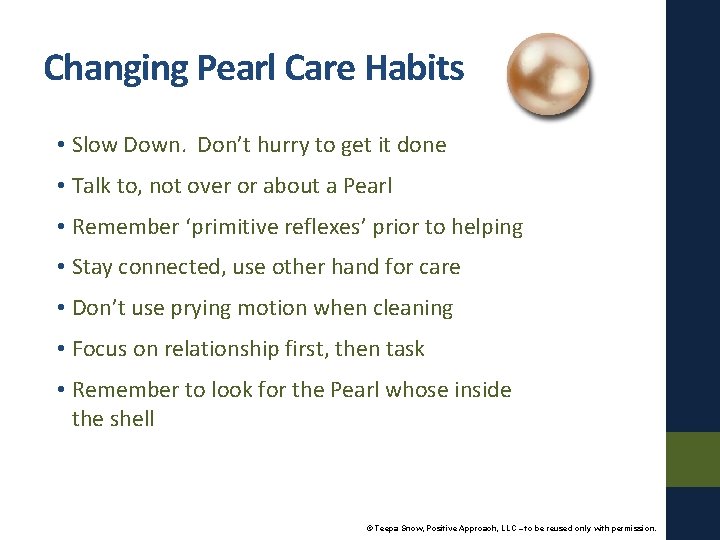
Changing Pearl Care Habits • Slow Down. Don’t hurry to get it done • Talk to, not over or about a Pearl • Remember ‘primitive reflexes’ prior to helping • Stay connected, use other hand for care • Don’t use prying motion when cleaning • Focus on relationship first, then task • Remember to look for the Pearl whose inside the shell © Teepa Snow, Positive Approach, LLC – to be reused only with permission.
People Living with Dementia Need Care Partners To Wonder About What They Want, Need, or Think Watch and Observe • What they show you- how they look • What they say – how they sound • What they do – physical reactions © Teepa Snow, Positive Approach, LLC – to be reused only with permission.
- Slides: 150