
Tectonic Plates Boundaries Personal Dictionaries Whenever you see

Tectonic Plates – Boundaries
Personal Dictionaries • Whenever you see a word that looks like this, write down the definition on your dictionary paper • Your weekly homework is to go back into your dictionaries and add an example, a diagram, or a sentence that shows the meaning of the word. • You should leave some space below each word to fill in later. • These will be one of your resources to use during activities and is useful to study. • For example: Tectonic Plate: a massive, irregularly shaped piece of the Earth’s crust. Tectonic Plates move very slowly but are large enough to cause major events when they interact.
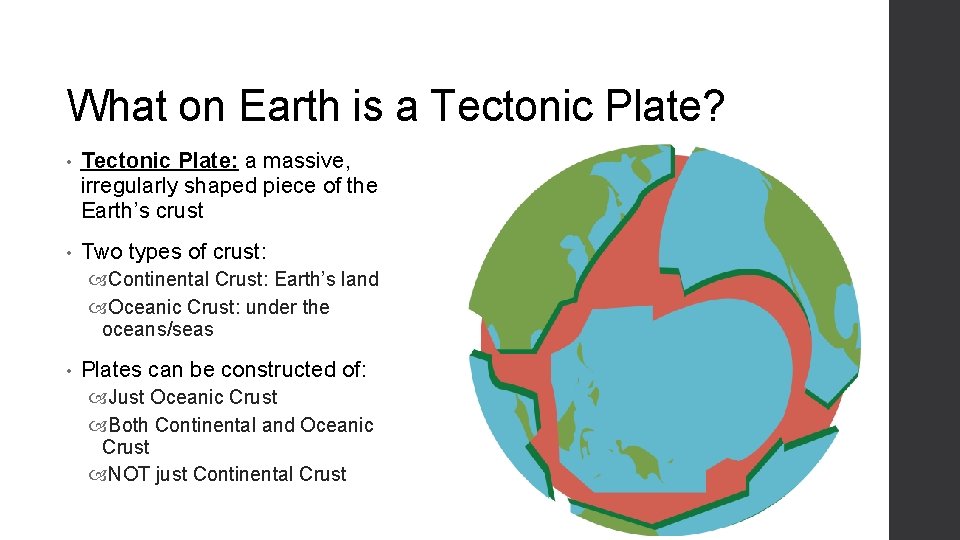
What on Earth is a Tectonic Plate? • Tectonic Plate: a massive, irregularly shaped piece of the Earth’s crust • Two types of crust: Continental Crust: Earth’s land Oceanic Crust: under the oceans/seas • Plates can be constructed of: Just Oceanic Crust Both Continental and Oceanic Crust NOT just Continental Crust
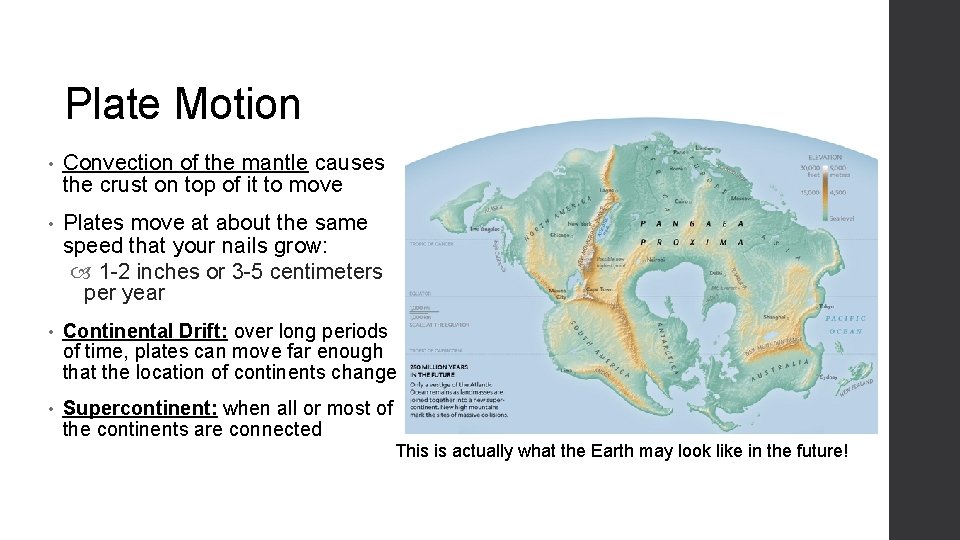
Plate Motion • Convection of the mantle causes the crust on top of it to move • Plates move at about the same speed that your nails grow: 1 -2 inches or 3 -5 centimeters per year • Continental Drift: over long periods of time, plates can move far enough that the location of continents change • Supercontinent: when all or most of the continents are connected This is actually what the Earth may look like in the future!
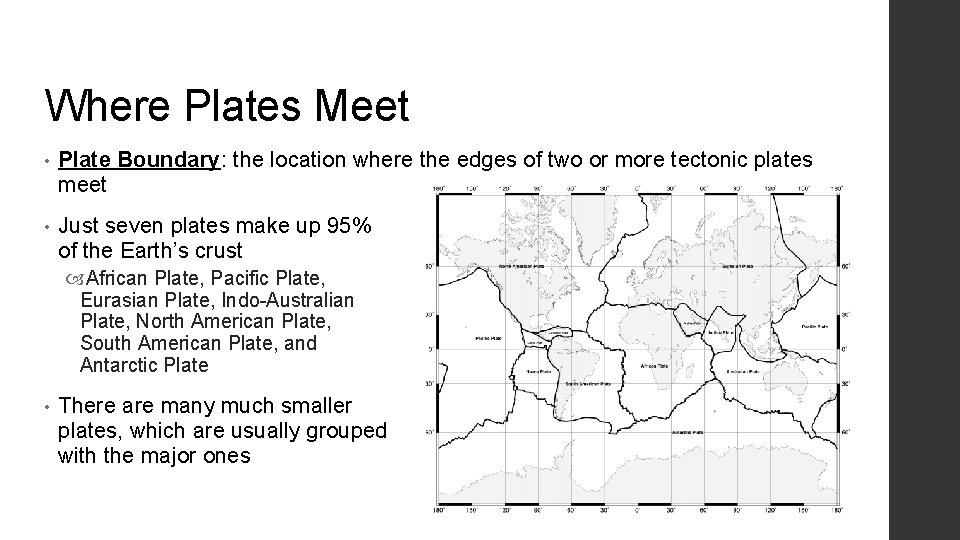
Where Plates Meet • Plate Boundary: the location where the edges of two or more tectonic plates meet • Just seven plates make up 95% of the Earth’s crust African Plate, Pacific Plate, Eurasian Plate, Indo-Australian Plate, North American Plate, South American Plate, and Antarctic Plate • There are many much smaller plates, which are usually grouped with the major ones

Three Types of Boundaries • There are three main types of boundaries • Boundary types are named after how plates interact at that boundary • Different boundary types are responsible for different geological features
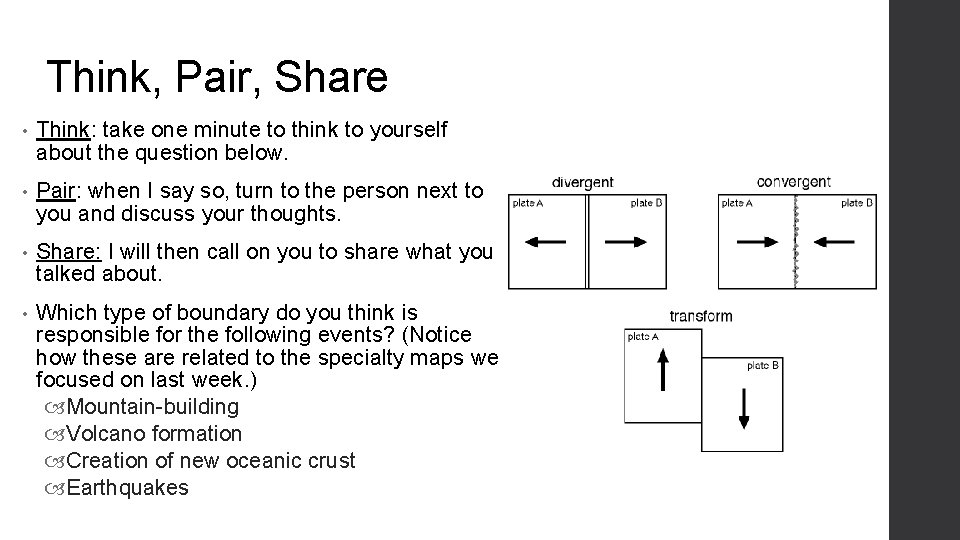
Think, Pair, Share • Think: take one minute to think to yourself about the question below. • Pair: when I say so, turn to the person next to you and discuss your thoughts. • Share: I will then call on you to share what you talked about. • Which type of boundary do you think is responsible for the following events? (Notice how these are related to the specialty maps we focused on last week. ) Mountain-building Volcano formation Creation of new oceanic crust Earthquakes
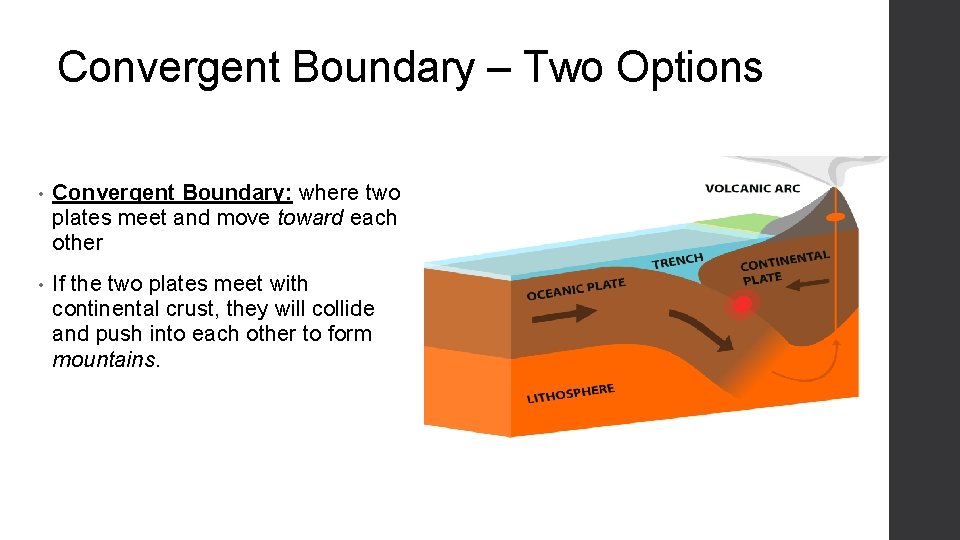
Convergent Boundary – Two Options • Convergent Boundary: where two plates meet and move toward each other • If the two plates meet with continental crust, they will collide and push into each other to form mountains.
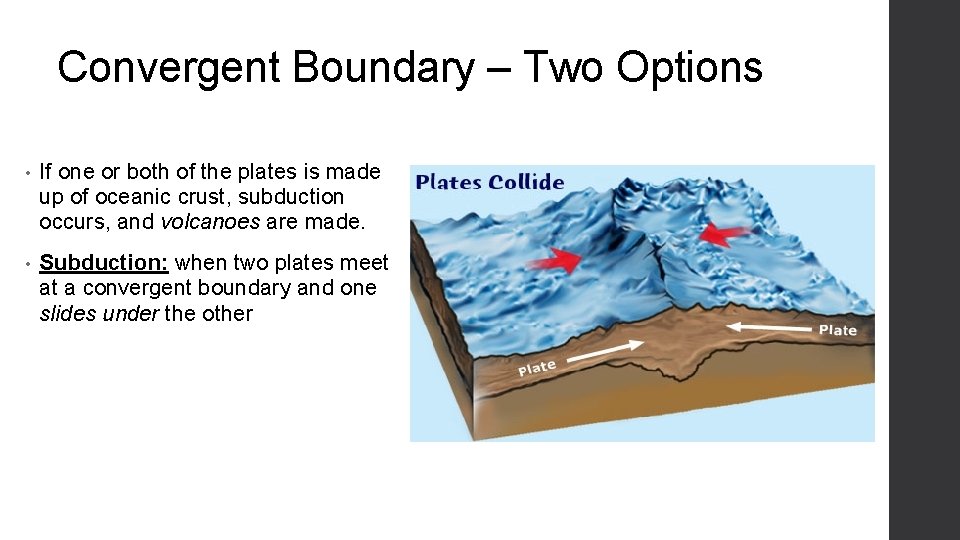
Convergent Boundary – Two Options • If one or both of the plates is made up of oceanic crust, subduction occurs, and volcanoes are made. • Subduction: when two plates meet at a convergent boundary and one slides under the other
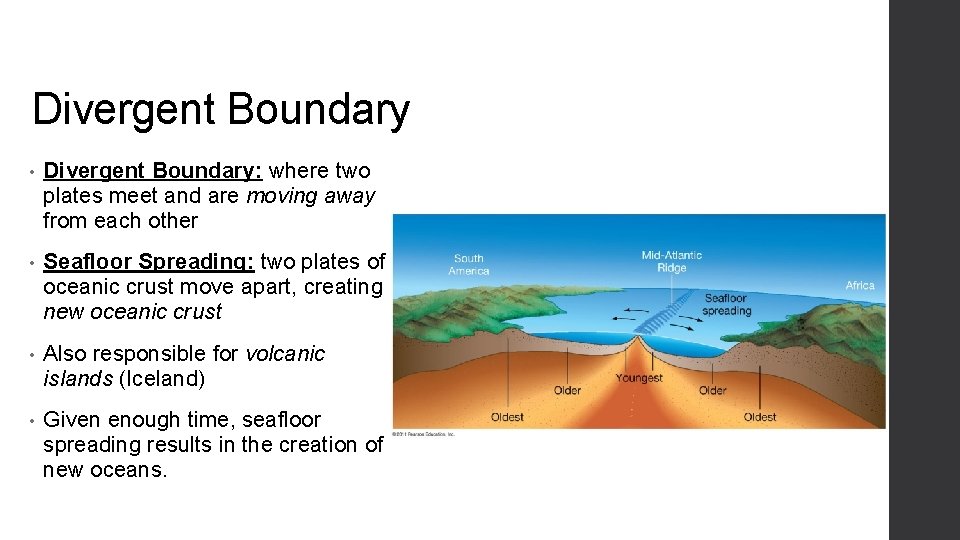
Divergent Boundary • Divergent Boundary: where two plates meet and are moving away from each other • Seafloor Spreading: two plates of oceanic crust move apart, creating new oceanic crust • Also responsible for volcanic islands (Iceland) • Given enough time, seafloor spreading results in the creation of new oceans.
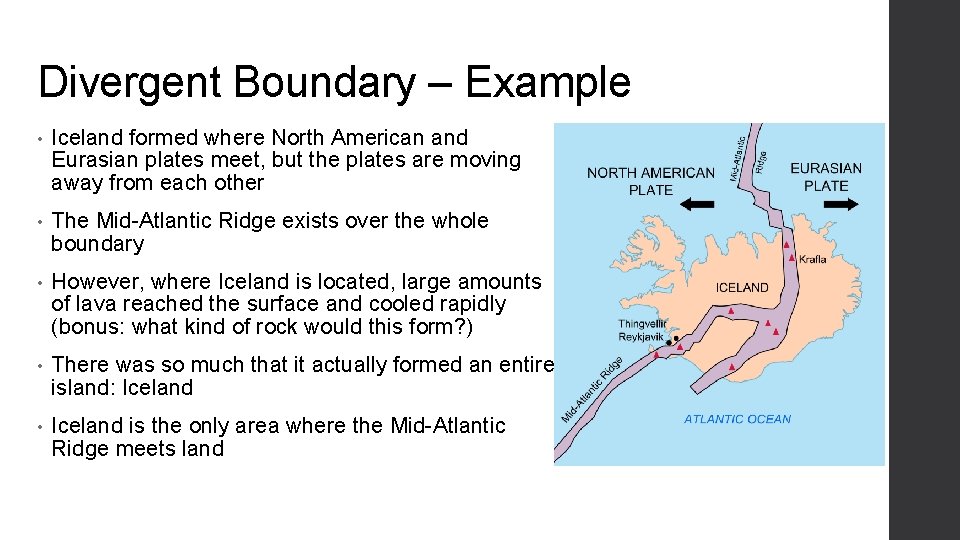
Divergent Boundary – Example • Iceland formed where North American and Eurasian plates meet, but the plates are moving away from each other • The Mid-Atlantic Ridge exists over the whole boundary • However, where Iceland is located, large amounts of lava reached the surface and cooled rapidly (bonus: what kind of rock would this form? ) • There was so much that it actually formed an entire island: Iceland • Iceland is the only area where the Mid-Atlantic Ridge meets land
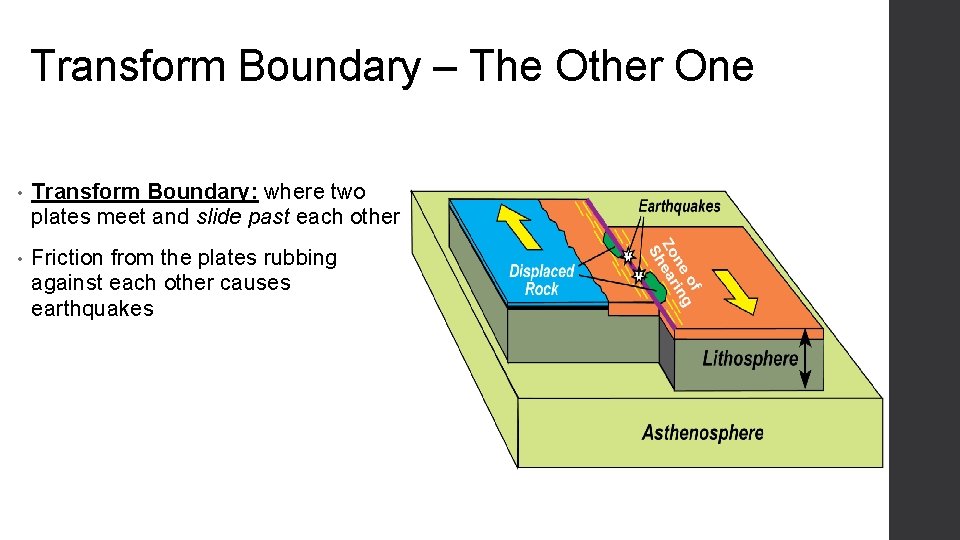
Transform Boundary – The Other One • Transform Boundary: where two plates meet and slide past each other • Friction from the plates rubbing against each other causes earthquakes
Vocabulary Review • Tectonic Plate: a massive, irregularly shaped piece of the Earth’s crust • Continental Drift: over long periods of time, plates can move far enough that the location of continents change • Supercontinent: when all or most of the continents are connected • Plate Boundary: the location where the edges of two or more tectonic plates meet • Convergent Boundary: where two plates meet and move toward each other • Subduction: when two plates meet at a convergent boundary and one slides under the other • Divergent Boundary: where two plates meet and are moving away from each other • Seafloor Spreading: two plates of oceanic crust move apart, creating new oceanic crust • Transform Boundary: where two plates meet and slide past each other
- Slides: 13