
Tecto MT Software framework for developing MT systems
- Slides: 36
Tecto. MT Software framework for developing MT systems (and other NLP applications) Zdeněk Žabokrtský ÚFAL MFF UK 1
Outline Part I – Introduction What is Tecto. MT Motivation Part II - Tecto. MT System Architecture Data structures Processing units: blocks, scenarios, applications Part III – Applications implemented in Tecto. MT 2
What is Tecto. MT is … a highly modular extendable NLP software system composed of numerous (mostly previously existing) NLP tools integrated into a uniform infrastructure aimed at (not limited to) developing MT system Tecto. MT is not … a specific method of MT (even if some approaches can profit from its existence more than others) an end-user application (even if releasing of singlepurpose stand-alone applications is possible and technically supported) 3
Motivation for creating Tecto. MT First, technical reasons: Want to make use of more than two NLP tools in your experiment? Be ready for endless data conversions, need for other people's source code tweaking, incompatibility of source code and model versions… Unified software infrastructure might help us. Second, our long-term MT plan: We believe that tectogrammar (deep syntax) as implemented in Prague Dependency Treebank might help to (1) reduce data sparseness, and (2) find and employ structural similarities revealed by tectogrammar even between typologically different languages. 4
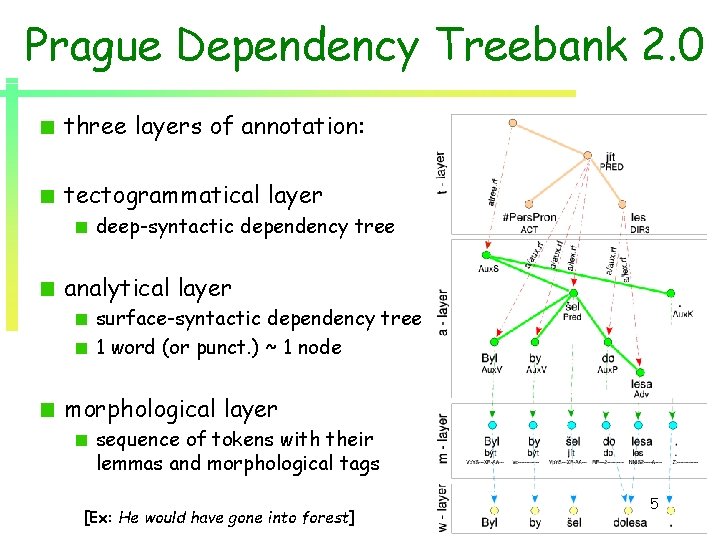
Prague Dependency Treebank 2. 0 three layers of annotation: tectogrammatical layer deep-syntactic dependency tree analytical layer surface-syntactic dependency tree 1 word (or punct. ) ~ 1 node morphological layer sequence of tokens with their lemmas and morphological tags [Ex: He would have gone into forest] 5
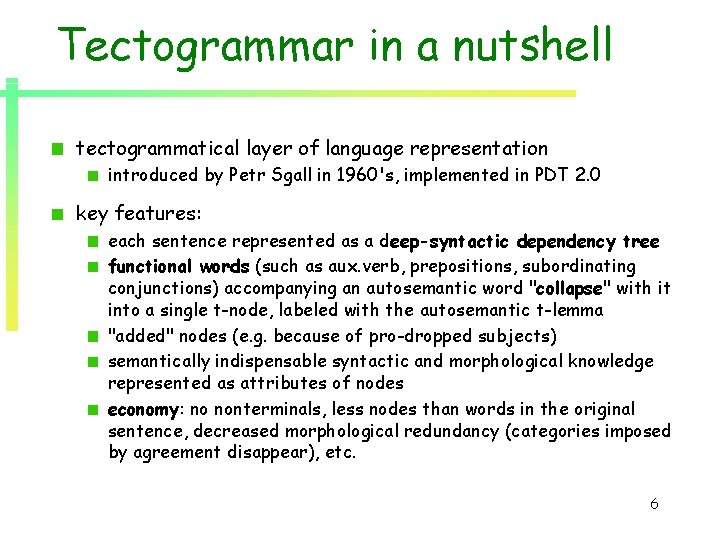
Tectogrammar in a nutshell tectogrammatical layer of language representation introduced by Petr Sgall in 1960's, implemented in PDT 2. 0 key features: each sentence represented as a deep-syntactic dependency tree functional words (such as aux. verb, prepositions, subordinating conjunctions) accompanying an autosemantic word "collapse" with it into a single t-node, labeled with the autosemantic t-lemma "added" nodes (e. g. because of pro-dropped subjects) semantically indispensable syntactic and morphological knowledge represented as attributes of nodes economy: no nonterminals, less nodes than words in the original sentence, decreased morphological redundancy (categories imposed by agreement disappear), etc. 6
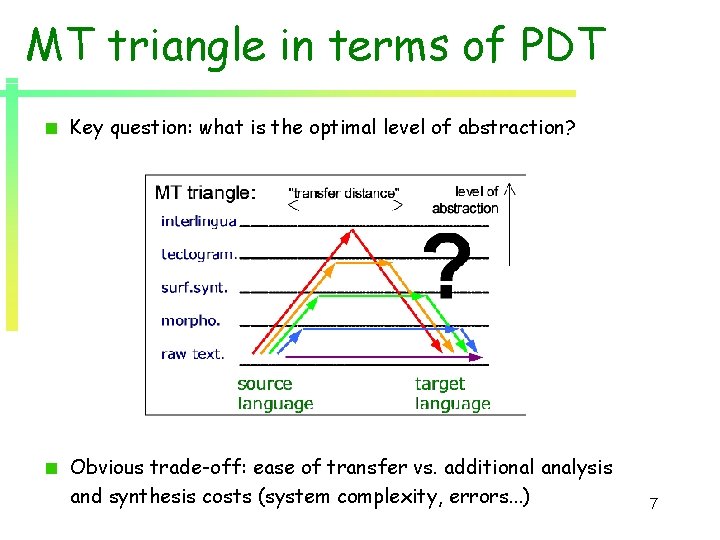
MT triangle in terms of PDT Key question: what is the optimal level of abstraction? Obvious trade-off: ease of transfer vs. additional analysis and synthesis costs (system complexity, errors. . . ) 7
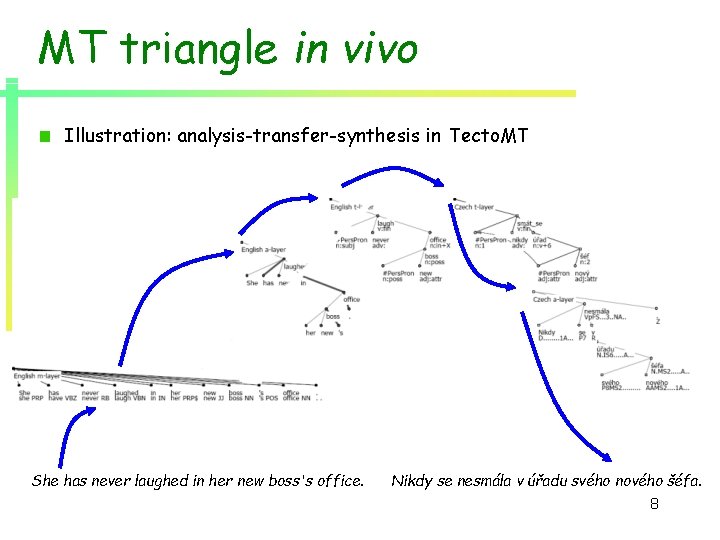
MT triangle in vivo Illustration: analysis-transfer-synthesis in Tecto. MT She has never laughed in her new boss's office. Nikdy se nesmála v úřadu svého nového šéfa. 8
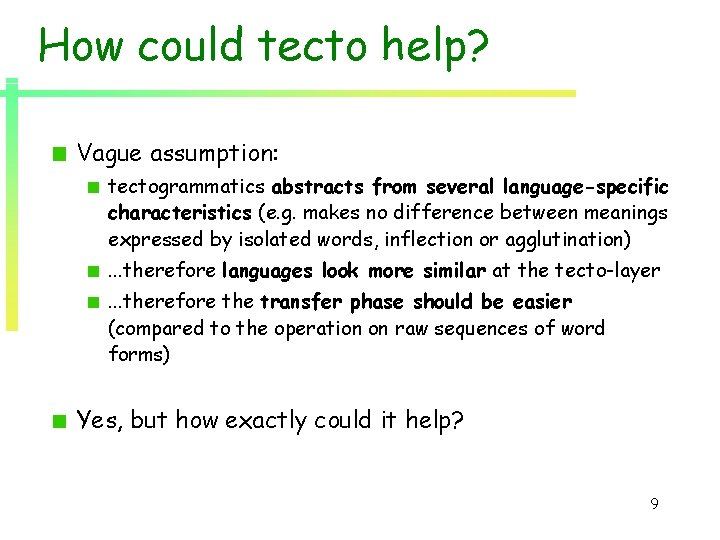
How could tecto help? Vague assumption: tectogrammatics abstracts from several language-specific characteristics (e. g. makes no difference between meanings expressed by isolated words, inflection or agglutination). . . therefore languages look more similar at the tecto-layer. . . therefore the transfer phase should be easier (compared to the operation on raw sequences of word forms) Yes, but how exactly could it help? 9
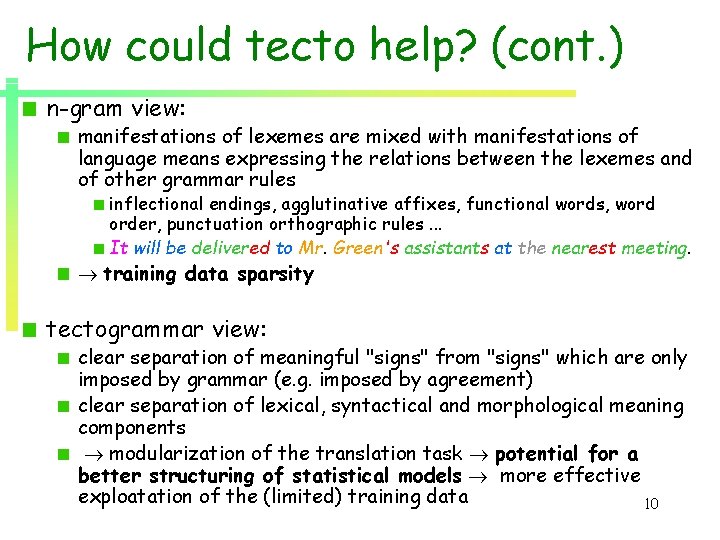
How could tecto help? (cont. ) n-gram view: manifestations of lexemes are mixed with manifestations of language means expressing the relations between the lexemes and of other grammar rules inflectional endings, agglutinative affixes, functional words, word order, punctuation orthographic rules. . . It will be delivered to Mr. Green's assistants at the nearest meeting. training data sparsity tectogrammar view: clear separation of meaningful "signs" from "signs" which are only imposed by grammar (e. g. imposed by agreement) clear separation of lexical, syntactical and morphological meaning components modularization of the translation task potential for a better structuring of statistical models more effective exploatation of the (limited) training data 10
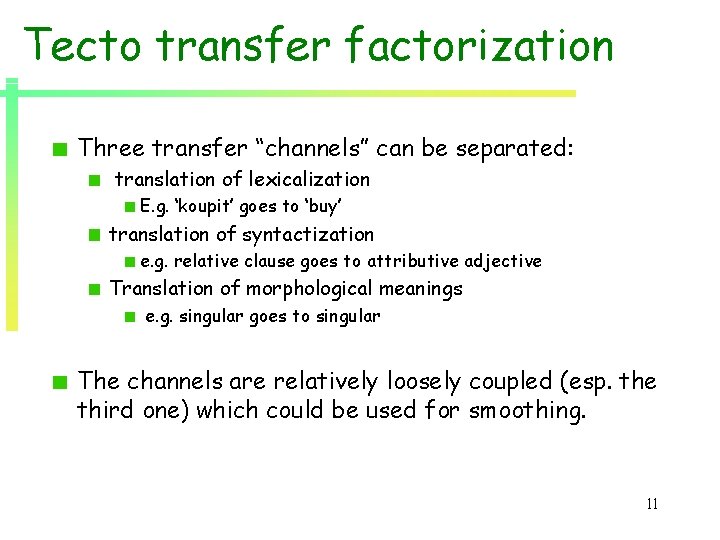
Tecto transfer factorization Three transfer “channels” can be separated: translation of lexicalization E. g. ‘koupit’ goes to ‘buy’ translation of syntactization e. g. relative clause goes to attributive adjective Translation of morphological meanings e. g. singular goes to singular The channels are relatively loosely coupled (esp. the third one) which could be used for smoothing. 11
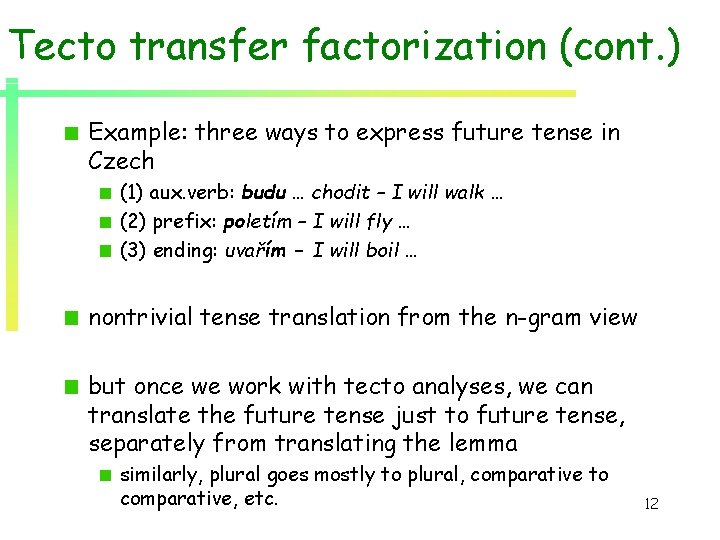
Tecto transfer factorization (cont. ) Example: three ways to express future tense in Czech (1) aux. verb: budu … chodit – I will walk … (2) prefix: poletím – I will fly … (3) ending: uvařím – I will boil … nontrivial tense translation from the n-gram view but once we work with tecto analyses, we can translate the future tense just to future tense, separately from translating the lemma similarly, plural goes mostly to plural, comparative to comparative, etc. 12
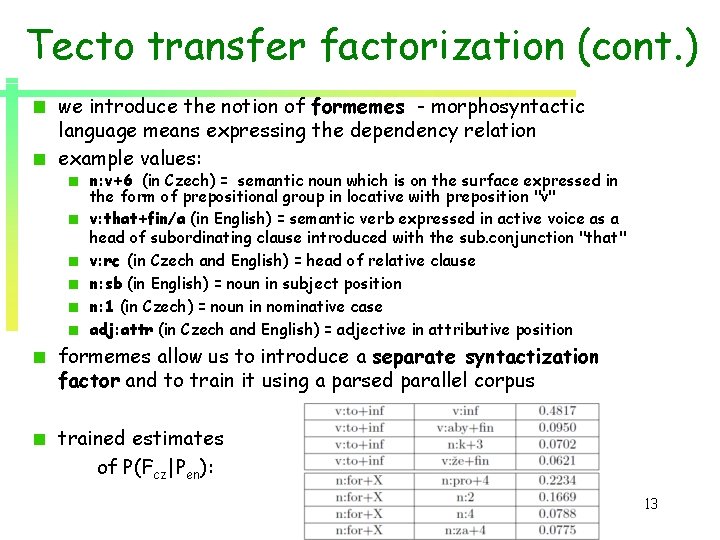
Tecto transfer factorization (cont. ) we introduce the notion of formemes - morphosyntactic language means expressing the dependency relation example values: n: v+6 (in Czech) = semantic noun which is on the surface expressed in the form of prepositional group in locative with preposition "v" v: that+fin/a (in English) = semantic verb expressed in active voice as a head of subordinating clause introduced with the sub. conjunction "that" v: rc (in Czech and English) = head of relative clause n: sb (in English) = noun in subject position n: 1 (in Czech) = noun in nominative case adj: attr (in Czech and English) = adjective in attributive position formemes allow us to introduce a separate syntactization factor and to train it using a parsed parallel corpus trained estimates of P(Fcz|Pen): 13
Using tree context Hypothesis: translation choices are conditioned rather by governing/dependent words than by linear predecessors/followers syntactic dependency and linear adjacency often coincide, but long distance dependencies occur too long distance dependencies are notoriously difficult to handle by n-gram models 14
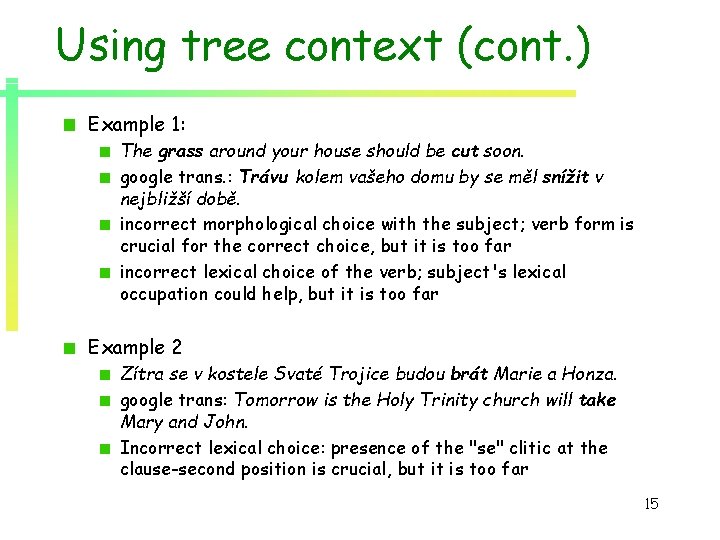
Using tree context (cont. ) Example 1: The grass around your house should be cut soon. google trans. : Trávu kolem vašeho domu by se měl snížit v nejbližší době. incorrect morphological choice with the subject; verb form is crucial for the correct choice, but it is too far incorrect lexical choice of the verb; subject's lexical occupation could help, but it is too far Example 2 Zítra se v kostele Svaté Trojice budou brát Marie a Honza. google trans: Tomorrow is the Holy Trinity church will take Mary and John. Incorrect lexical choice: presence of the "se" clitic at the clause-second position is crucial, but it is too far 15
How could tecto help - summary Tectogrammar offers a natural transfer factorization into three relatively independent channels Tectogrammar offers local tree context (instead of only local linear context) 16
Hybrid MT with Tecto. MT other option: to combine translation based on tecto-transfer with a conventional phrase-based translation system X Tecto. MT can provide X with additional hypotheses Tecto. MT can be used for decomposing input sentences into smaller, relatively independently translatable chunks (e. g. finite clauses or even individual constituents) Tecto. MT can steel the lexical choices from X’s output and resynthetize the sentence (or its parts) according to grammar rules, e. g. in order to correct agreement New features for reranking X’s output hypotheses can be extracted from their syntactic analyses by Tecto. MT (e. g. by penalizing presence of abnormal tree configurations) 17
Hybrid MT with Tecto. MT (cont. ) Tecto. MT can be used for making the source and target languages more similar even from the n-gram view: Adding artificial tokens (e. g. inserting _det_ when translating to a language with determiners) Joining tokens (e. g. of John -> of_John, when translating into a language using genitive ending instead of a functional word) Regular grammar-based word order changes: e. g. shifting ago in front of the noun group (as it was a preposition) when translating from English to German 18
Part II: Tecto. MT System Architecture 19
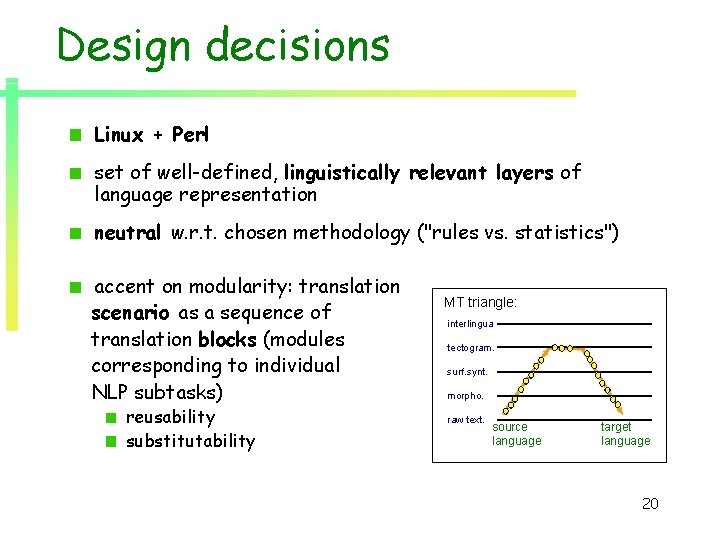
Design decisions Linux + Perl set of well-defined, linguistically relevant layers of language representation neutral w. r. t. chosen methodology ("rules vs. statistics") accent on modularity: translation scenario as a sequence of translation blocks (modules corresponding to individual NLP subtasks) reusability substitutability MT triangle: interlingua tectogram. surf. synt. morpho. raw text. source language target language 20
Design decisions (cont. ) reuse of Prague Dependency Treebank technology (tools, XML -based format) in-house object-oriented architecture as the backbone all tools communicate via standardized OO Perl interface avoiding the former practice of tools communicating via files in specialized formats easy incorporation of external tools previously existing parsers, taggers, lemmatizers etc. just provide them with a Perl "wrapper" with the prescribed interface 21
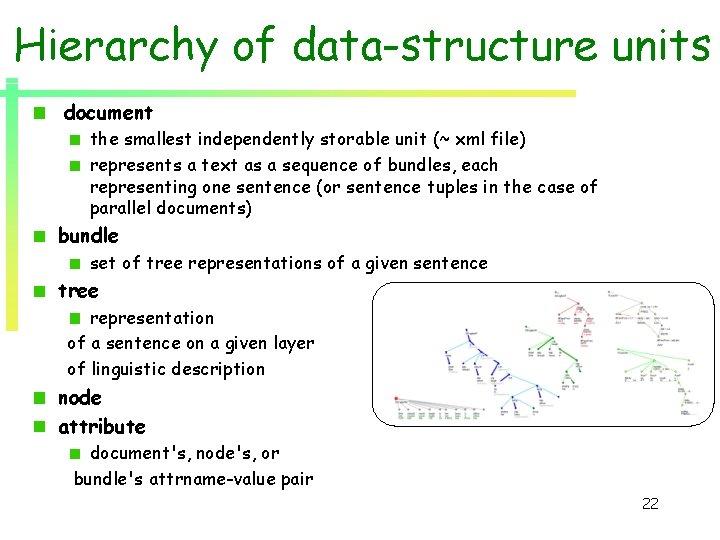
Hierarchy of data-structure units document the smallest independently storable unit (~ xml file) represents a text as a sequence of bundles, each representing one sentence (or sentence tuples in the case of parallel documents) bundle set of tree representations of a given sentence tree representation of a sentence on a given layer of linguistic description node attribute document's, node's, or bundle's attrname-value pair 22
Layers of sentence description in each bundle, there can be at most one tree for each "layer" set of possible layers = {S, T} x {English, Czech, . . . } x {M, P, A, T, N} S - source, T-target M - morphological analysis P - phrase-structure tree A - analytical tree T - tectogrammatical tree N - instances of named entities Example: SEnglish. A - tectogrammatical analysis of an English sentence on the source-language side 23
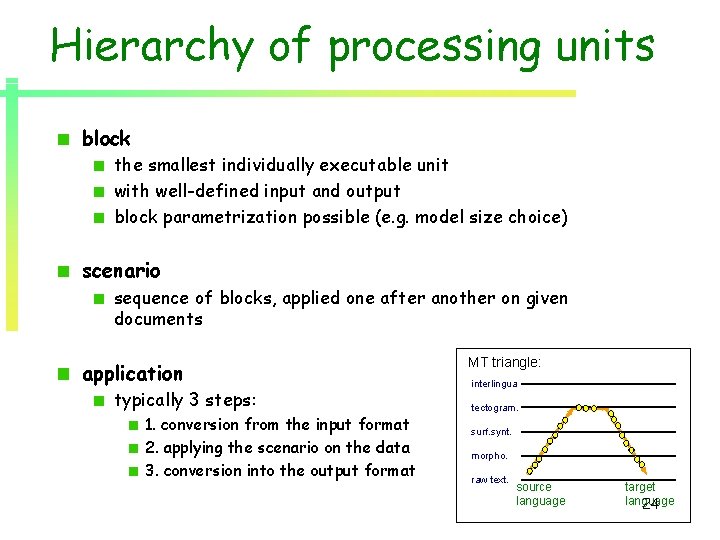
Hierarchy of processing units block the smallest individually executable unit with well-defined input and output block parametrization possible (e. g. model size choice) scenario sequence of blocks, applied one after another on given documents application typically 3 steps: 1. conversion from the input format 2. applying the scenario on the data 3. conversion into the output format MT triangle: interlingua tectogram. surf. synt. morpho. raw text. source language target language 24
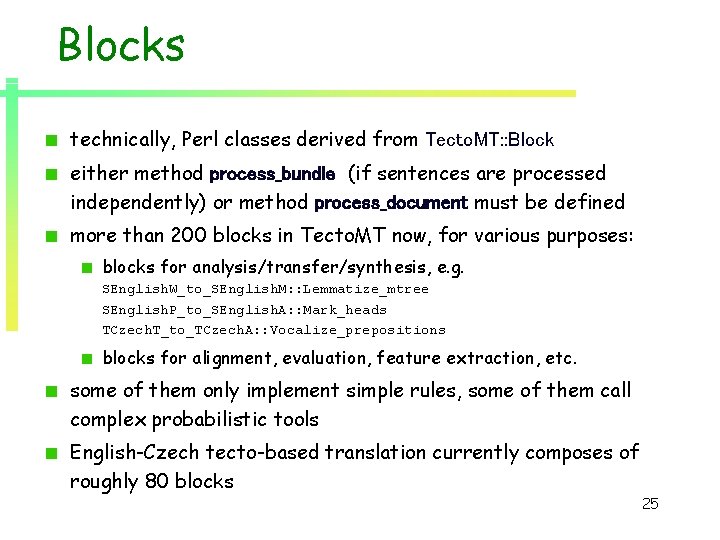
Blocks technically, Perl classes derived from Tecto. MT: : Block either method process_bundle (if sentences are processed independently) or method process_document must be defined more than 200 blocks in Tecto. MT now, for various purposes: blocks for analysis/transfer/synthesis, e. g. SEnglish. W_to_SEnglish. M: : Lemmatize_mtree SEnglish. P_to_SEnglish. A: : Mark_heads TCzech. T_to_TCzech. A: : Vocalize_prepositions blocks for alignment, evaluation, feature extraction, etc. some of them only implement simple rules, some of them call complex probabilistic tools English-Czech tecto-based translation currently composes of roughly 80 blocks 25
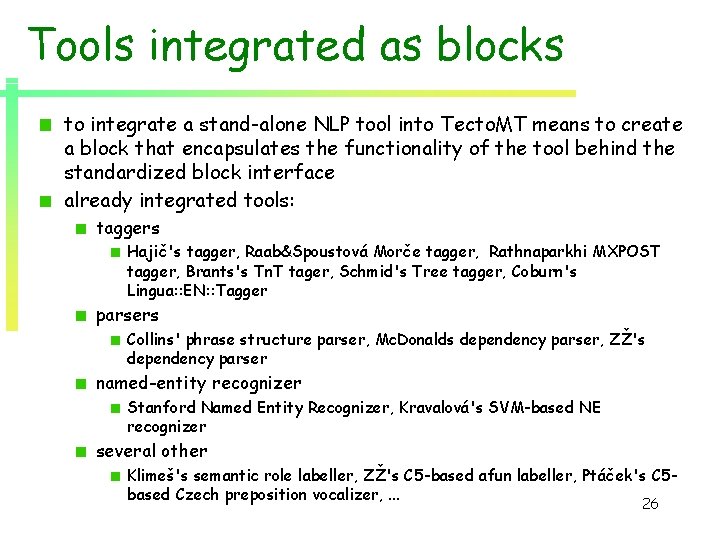
Tools integrated as blocks to integrate a stand-alone NLP tool into Tecto. MT means to create a block that encapsulates the functionality of the tool behind the standardized block interface already integrated tools: taggers Hajič's tagger, Raab&Spoustová Morče tagger, Rathnaparkhi MXPOST tagger, Brants's Tn. T tager, Schmid's Tree tagger, Coburn's Lingua: : EN: : Tagger parsers Collins' phrase structure parser, Mc. Donalds dependency parser, ZŽ's dependency parser named-entity recognizer Stanford Named Entity Recognizer, Kravalová's SVM-based NE recognizer several other Klimeš's semantic role labeller, ZŽ's C 5 -based afun labeller, Ptáček's C 5 based Czech preposition vocalizer, . . . 26
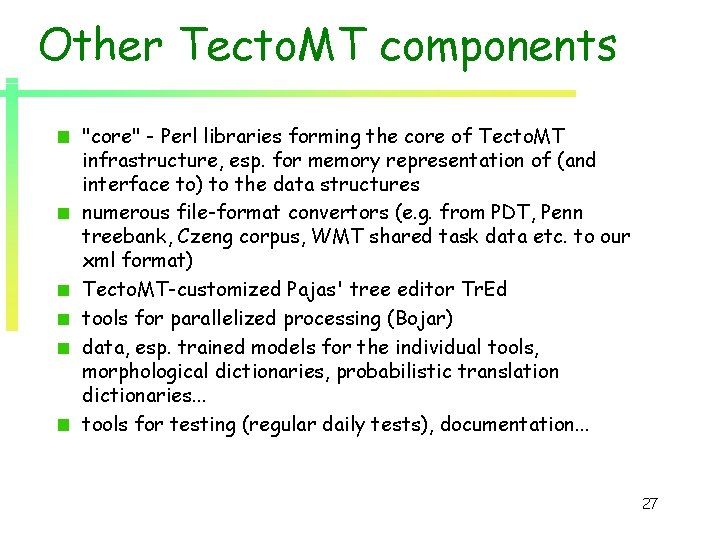
Other Tecto. MT components "core" - Perl libraries forming the core of Tecto. MT infrastructure, esp. for memory representation of (and interface to) to the data structures numerous file-format convertors (e. g. from PDT, Penn treebank, Czeng corpus, WMT shared task data etc. to our xml format) Tecto. MT-customized Pajas' tree editor Tr. Ed tools for parallelized processing (Bojar) data, esp. trained models for the individual tools, morphological dictionaries, probabilistic translation dictionaries. . . tools for testing (regular daily tests), documentation. . . 27
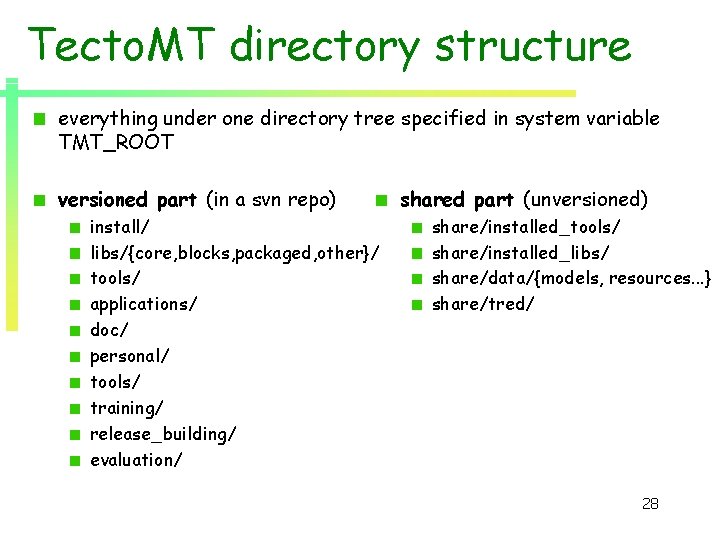
Tecto. MT directory structure everything under one directory tree specified in system variable TMT_ROOT versioned part (in a svn repo) install/ libs/{core, blocks, packaged, other}/ tools/ applications/ doc/ personal/ tools/ training/ release_building/ evaluation/ shared part (unversioned) share/installed_tools/ share/installed_libs/ share/data/{models, resources. . . } share/tred/ 28
Part III: Applications implemented in Tecto. MT 29
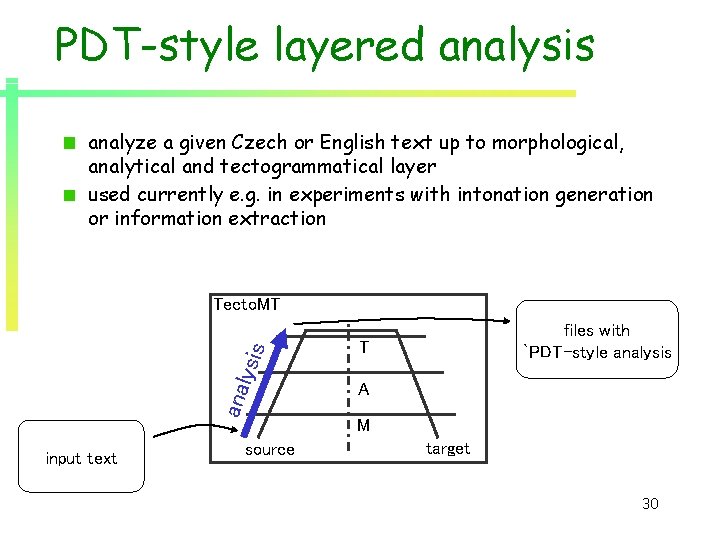
PDT-style layered analysis analyze a given Czech or English text up to morphological, analytical and tectogrammatical layer used currently e. g. in experiments with intonation generation or information extraction ana ly sis Tecto. MT input text source files with `PDT-style analysis T A M target 30
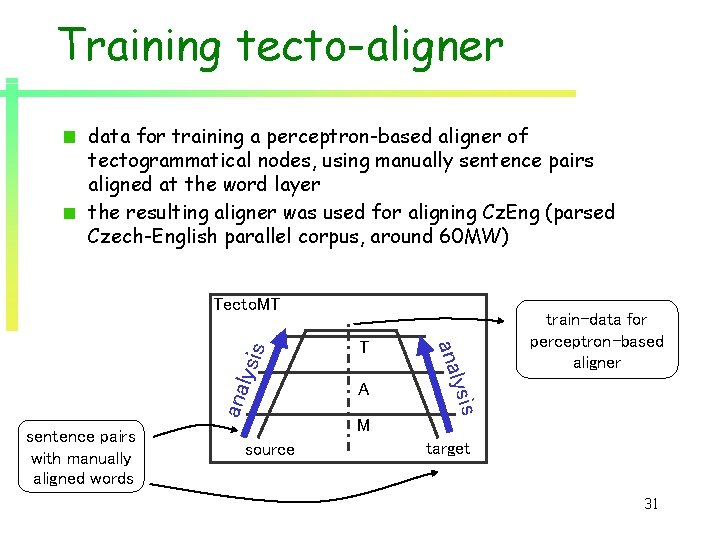
Training tecto-aligner data for training a perceptron-based aligner of tectogrammatical nodes, using manually sentence pairs aligned at the word layer the resulting aligner was used for aligning Cz. Eng (parsed Czech-English parallel corpus, around 60 MW) ana ly source A M train-data for perceptron-based aligner ysis sentence pairs with manually aligned words T anal sis Tecto. MT target 31
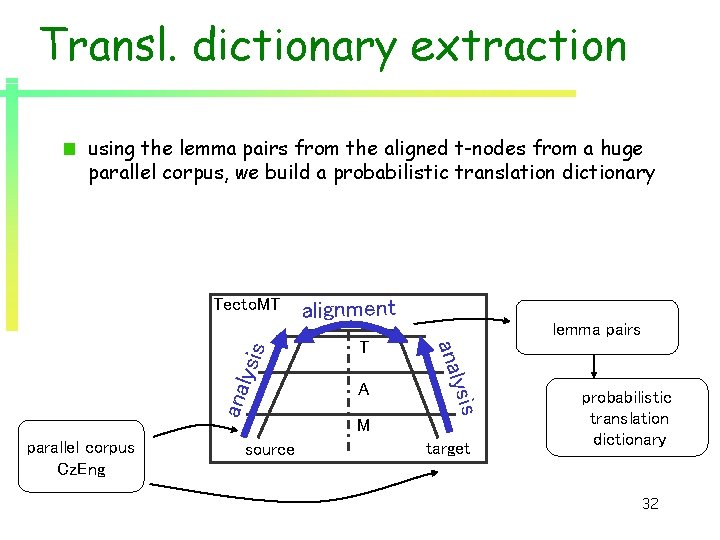
Transl. dictionary extraction using the lemma pairs from the aligned t-nodes from a huge parallel corpus, we build a probabilistic translation dictionary ana ly source T A M lemma pairs ysis parallel corpus Cz. Eng alignment anal sis Tecto. MT target probabilistic translation dictionary 32
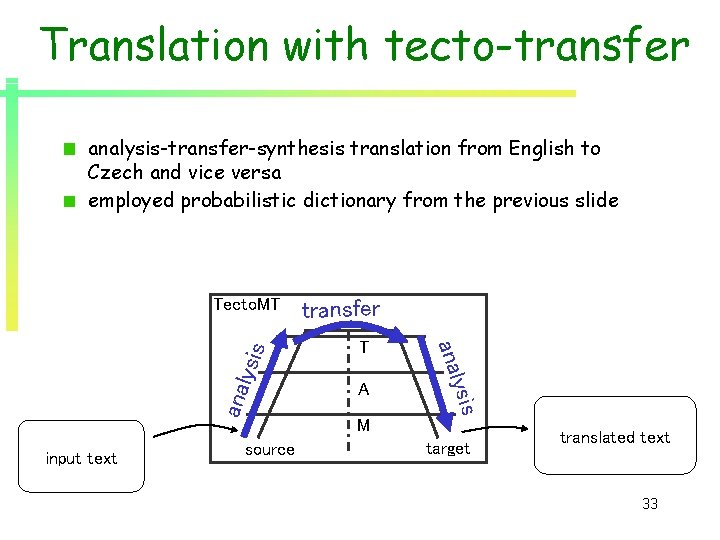
Translation with tecto-transfer analysis-transfer-synthesis translation from English to Czech and vice versa employed probabilistic dictionary from the previous slide ana ly T A M ysis input text source transfer anal sis Tecto. MT target translated text 33
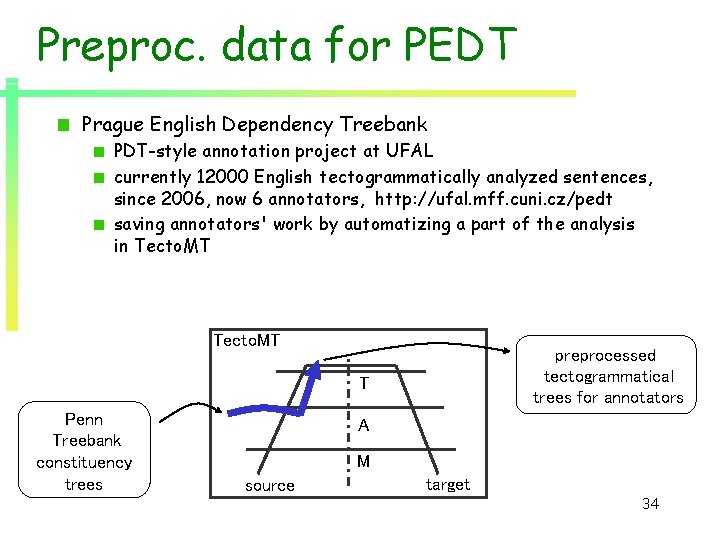
Preproc. data for PEDT Prague English Dependency Treebank PDT-style annotation project at UFAL currently 12000 English tectogrammatically analyzed sentences, since 2006, now 6 annotators, http: //ufal. mff. cuni. cz/pedt saving annotators' work by automatizing a part of the analysis in Tecto. MT preprocessed tectogrammatical trees for annotators T Penn Treebank constituency trees A M source target 34
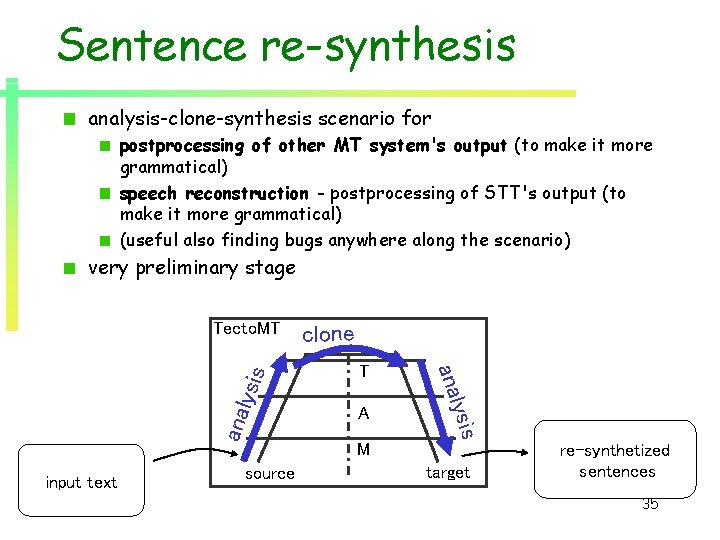
Sentence re-synthesis analysis-clone-synthesis scenario for postprocessing of other MT system's output (to make it more grammatical) speech reconstruction - postprocessing of STT's output (to make it more grammatical) (useful also finding bugs anywhere along the scenario) very preliminary stage ana ly source T A M ysis input text clone anal sis Tecto. MT target re-synthetized sentences 35
Final remarks Our implementation of tectogrammar-based MT is still premature and does not reach state-of-theart quality (WMT Shared Task 2009) However, having the Tecto. MT infrastructure and sharing its components already saves our work in several research directions. 36