
Technology Trends and Manufacturing Considerations for Leading Edge

- Slides: 27
Technology Trends and Manufacturing Considerations for Leading Edge 3 D Packaging Lithography Oct 16, 2014 Robert Hsieh, Warren Flack, Manish Ranjan Ultratech, Inc Robert Hsieh/Slide
Outline • Introduction • Reconstituted wafers • Overlay, field size, and mapping • Substrate handing • Interposer enabling technologies • Lithography for Through Silicon Via • Large Area Interposers • Microbump Process • Conclusions Robert Hsieh/Slide 2
Introduction • To meet increasing levels of functionality and integration advanced packaging will need to support increased interconnect count and density • Smaller CD • Larger device area • 3 D structures • Approaches for incorporation of advanced structures • Reconstituted wafer (Fan-Out) • Silicon interposers with through silicon via Robert Hsieh/Slide 3 technology
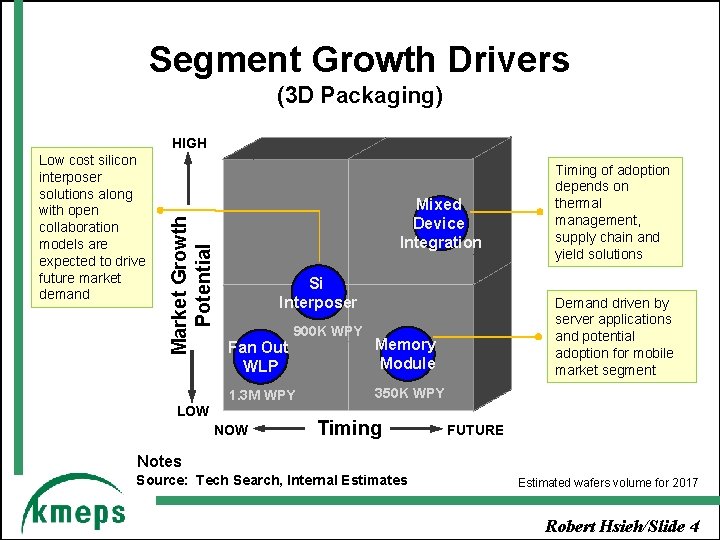
Segment Growth Drivers (3 D Packaging) Low cost silicon interposer solutions along with open collaboration models are expected to drive future market demand Market Growth Potential HIGH Mixed Device Integration Si Interposer Fan Out WLP 900 K WPY 1. 3 M WPY LOW NOW Timing of adoption depends on thermal management, supply chain and yield solutions Demand driven by server applications and potential adoption for mobile market segment Memory Module 350 K WPY Timing FUTURE Notes Source: Tech Search, Internal Estimates Estimated wafers volume for 2017 Robert Hsieh/Slide 4
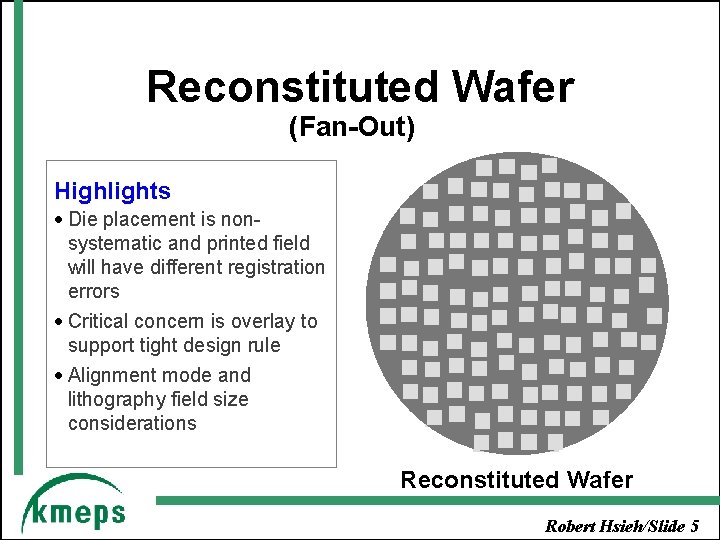
Reconstituted Wafer (Fan-Out) Highlights · Die placement is nonsystematic and printed field will have different registration errors · Critical concern is overlay to support tight design rule · Alignment mode and lithography field size considerations Reconstituted Wafer Robert Hsieh/Slide 5
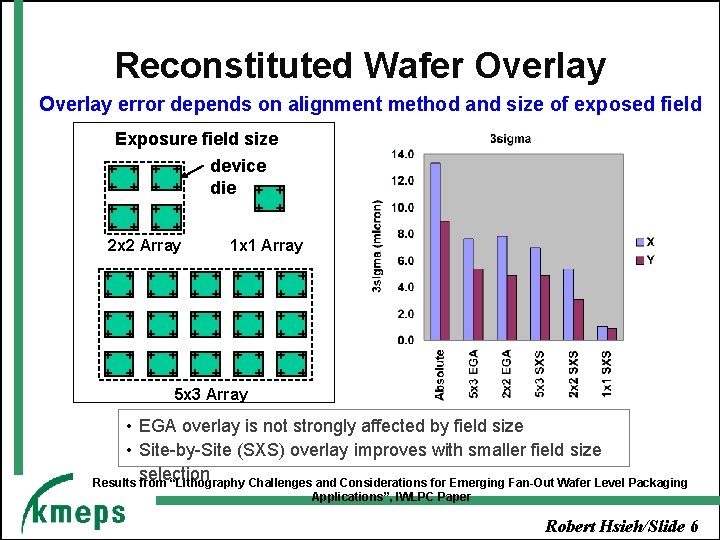
Reconstituted Wafer Overlay error depends on alignment method and size of exposed field Exposure field size device die 2 x 2 Array 1 x 1 Array 5 x 3 Array • EGA overlay is not strongly affected by field size • Site-by-Site (SXS) overlay improves with smaller field size selection Results from “Lithography Challenges and Considerations for Emerging Fan-Out Wafer Level Packaging Applications”, IWLPC Paper Robert Hsieh/Slide 6
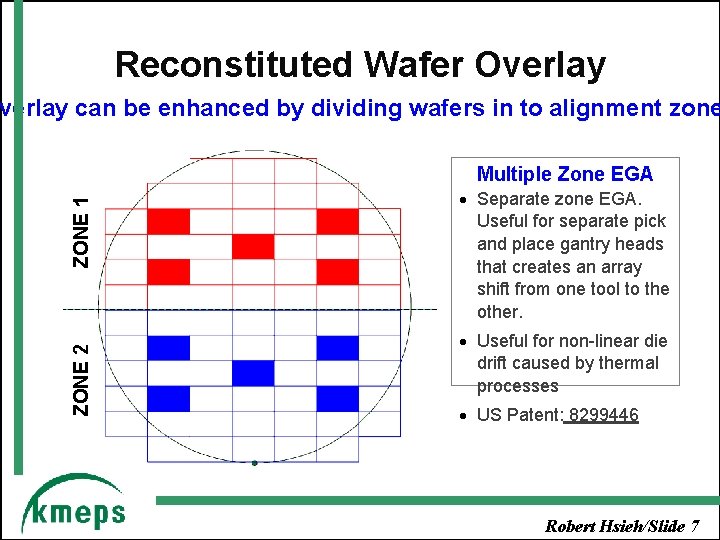
Reconstituted Wafer Overlay can be enhanced by dividing wafers in to alignment zone ZONE 2 ZONE 1 Multiple Zone EGA · Separate zone EGA. Useful for separate pick and place gantry heads that creates an array shift from one tool to the other. · Useful for non-linear die drift caused by thermal processes · US Patent: 8299446 Robert Hsieh/Slide 7
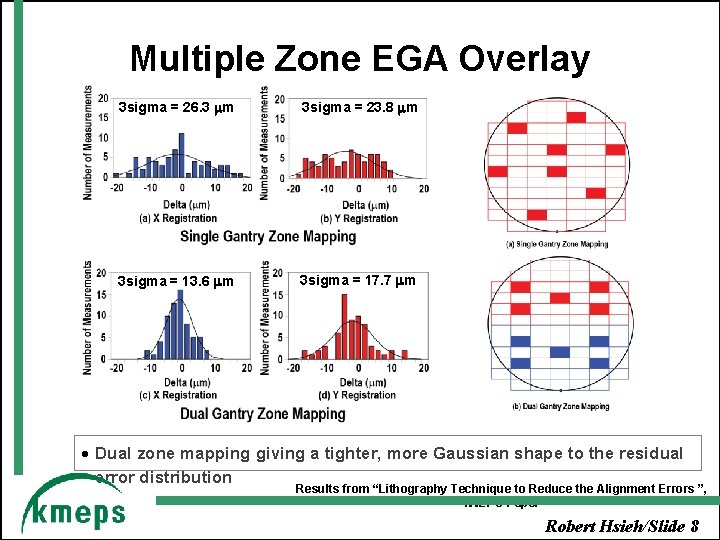
Multiple Zone EGA Overlay 3 sigma = 26. 3 m 3 sigma = 23. 8 m 3 sigma = 13. 6 m 3 sigma = 17. 7 m · Dual zone mapping giving a tighter, more Gaussian shape to the residual error distribution Results from “Lithography Technique to Reduce the Alignment Errors ”, IWLPC Paper Robert Hsieh/Slide 8
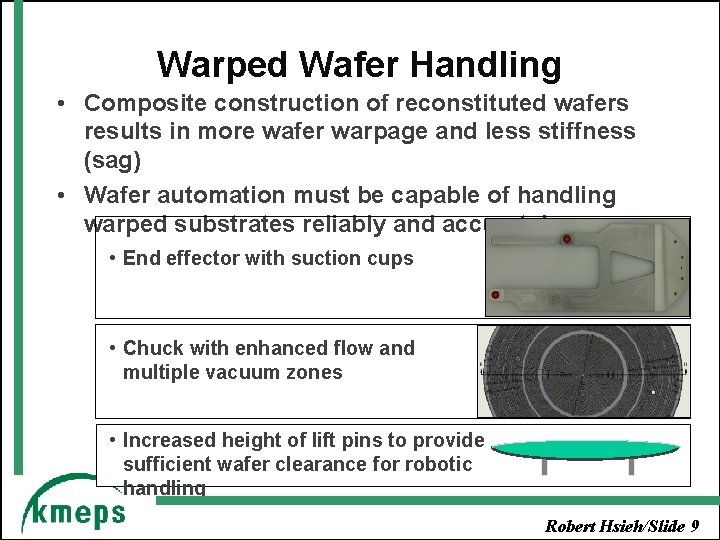
Warped Wafer Handling • Composite construction of reconstituted wafers results in more wafer warpage and less stiffness (sag) • Wafer automation must be capable of handling warped substrates reliably and accurately • End effector with suction cups • Chuck with enhanced flow and multiple vacuum zones • Increased height of lift pins to provide sufficient wafer clearance for robotic handling Robert Hsieh/Slide 9
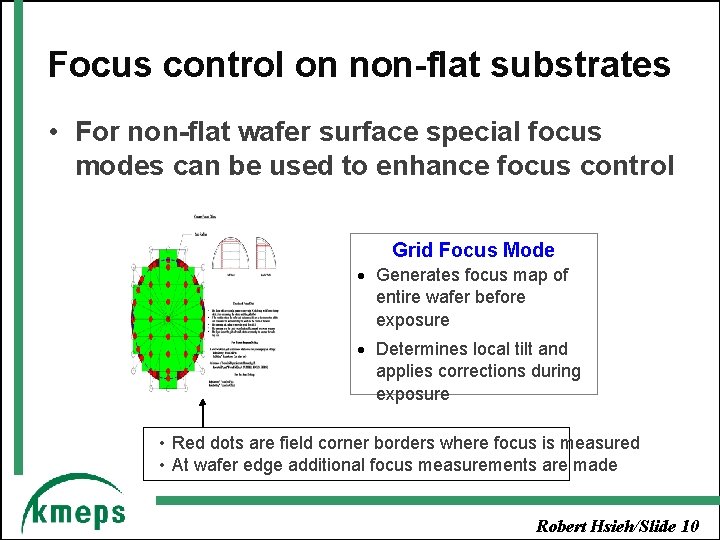
Focus control on non-flat substrates • For non-flat wafer surface special focus modes can be used to enhance focus control Grid Focus Mode · Generates focus map of entire wafer before exposure · Determines local tilt and applies corrections during exposure • Red dots are field corner borders where focus is measured • At wafer edge additional focus measurements are made Robert Hsieh/Slide 10
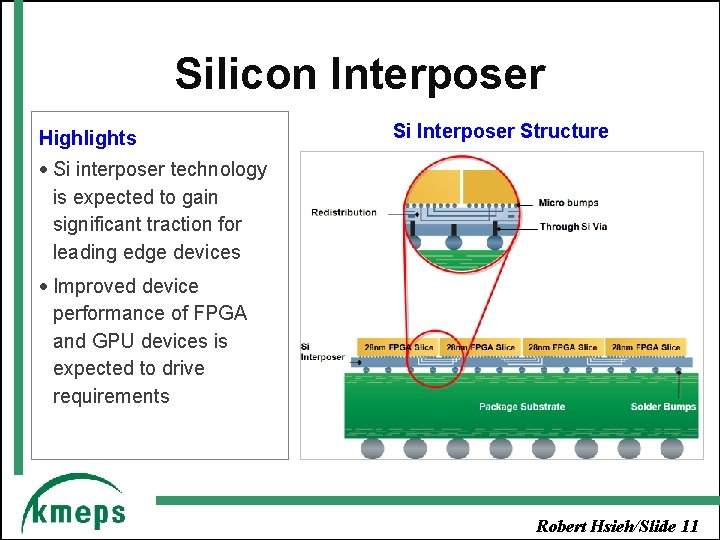
Silicon Interposer Highlights Si Interposer Structure · Si interposer technology is expected to gain significant traction for leading edge devices · Improved device performance of FPGA and GPU devices is expected to drive requirements Robert Hsieh/Slide 11
Si Interposer Enabling Technologies • Implementing silicon interposer requires development of new process technologies • Embedded target alignment for Through Silicon Via • IR Alignment system • Metrology • Large area devices • Field stitching • Microbump • Attach dies to the interposer Robert Hsieh/Slide 12
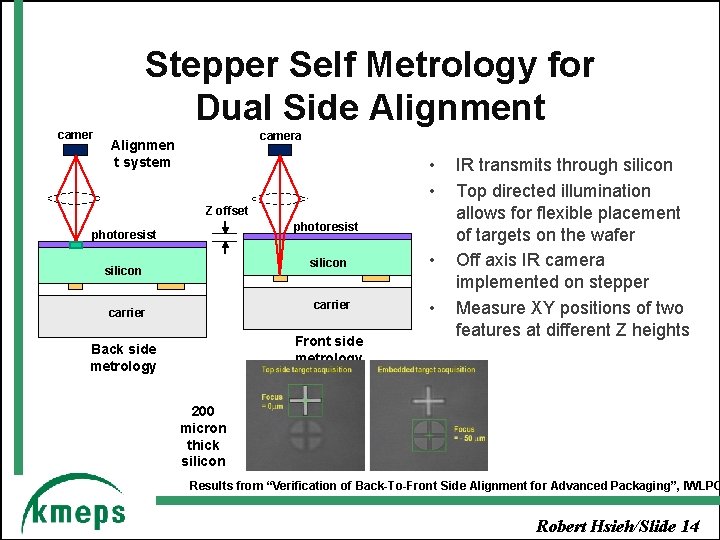
Embedded target alignment • For Via Last process to form Through Silicon Vias the device layers and alignment targets are viewed through silicon • Process requires thinning the silicon with uniform thickness and polished surface for best image contrast Robert Hsieh/Slide 13
Stepper Self Metrology for Dual Side Alignment camer a camera Alignmen t system • • Z offset photoresist silicon carrier silicon • carrier • Front side metrology Back side metrology IR transmits through silicon Top directed illumination allows for flexible placement of targets on the wafer Off axis IR camera implemented on stepper Measure XY positions of two features at different Z heights 200 micron thick silicon Results from “Verification of Back-To-Front Side Alignment for Advanced Packaging”, IWLPC Robert Hsieh/Slide 14
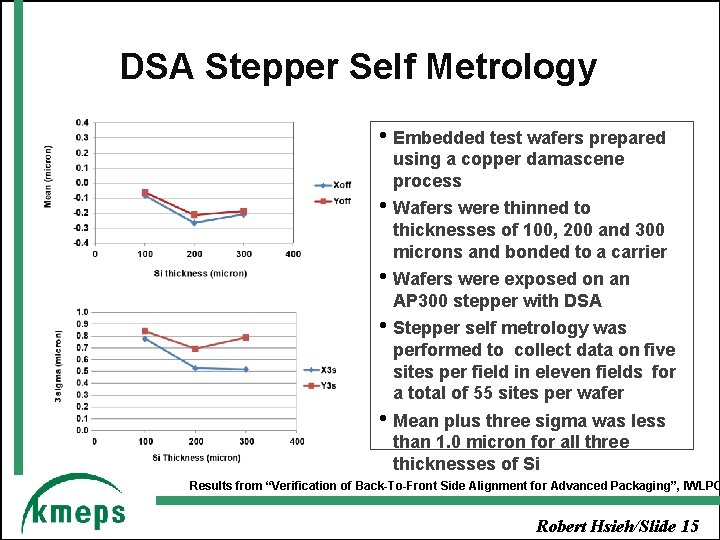
DSA Stepper Self Metrology • Embedded test wafers prepared using a copper damascene process • Wafers were thinned to thicknesses of 100, 200 and 300 microns and bonded to a carrier • Wafers were exposed on an AP 300 stepper with DSA • Stepper self metrology was performed to collect data on five sites per field in eleven fields for a total of 55 sites per wafer • Mean plus three sigma was less than 1. 0 micron for all three thicknesses of Si Results from “Verification of Back-To-Front Side Alignment for Advanced Packaging”, IWLPC Robert Hsieh/Slide 15
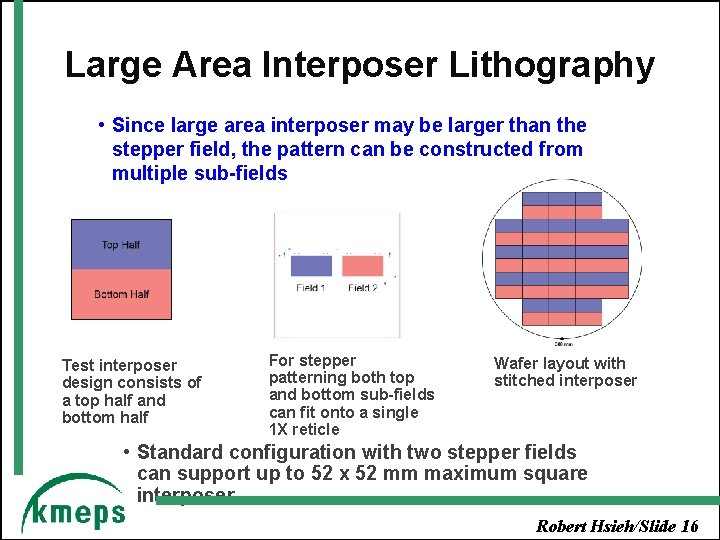
Large Area Interposer Lithography • Since large area interposer may be larger than the stepper field, the pattern can be constructed from multiple sub-fields Test interposer design consists of a top half and bottom half For stepper patterning both top and bottom sub-fields can fit onto a single 1 X reticle Wafer layout with stitched interposer • Standard configuration with two stepper fields can support up to 52 x 52 mm maximum square interposer Robert Hsieh/Slide 16
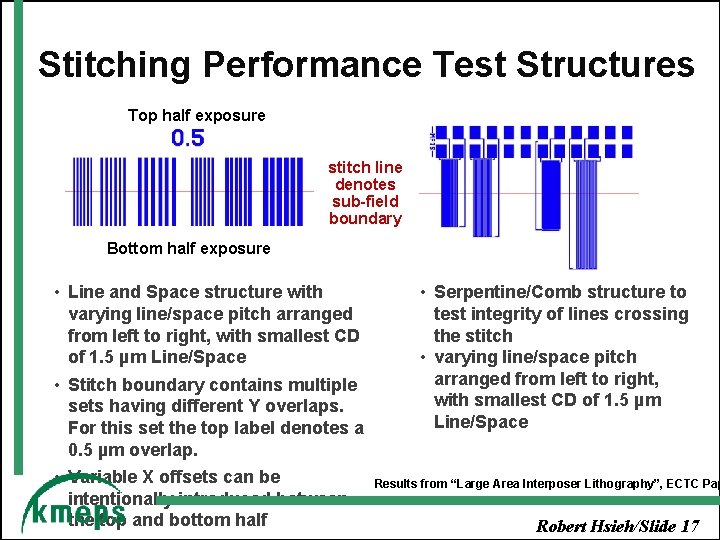
Stitching Performance Test Structures Top half exposure stitch line denotes sub-field boundary Bottom half exposure • Line and Space structure with varying line/space pitch arranged from left to right, with smallest CD of 1. 5 µm Line/Space • Stitch boundary contains multiple sets having different Y overlaps. For this set the top label denotes a 0. 5 µm overlap. • Variable X offsets can be intentionally introduced between the top and bottom half • Serpentine/Comb structure to test integrity of lines crossing the stitch • varying line/space pitch arranged from left to right, with smallest CD of 1. 5 µm Line/Space Results from “Large Area Interposer Lithography”, ECTC Pap Robert Hsieh/Slide 17
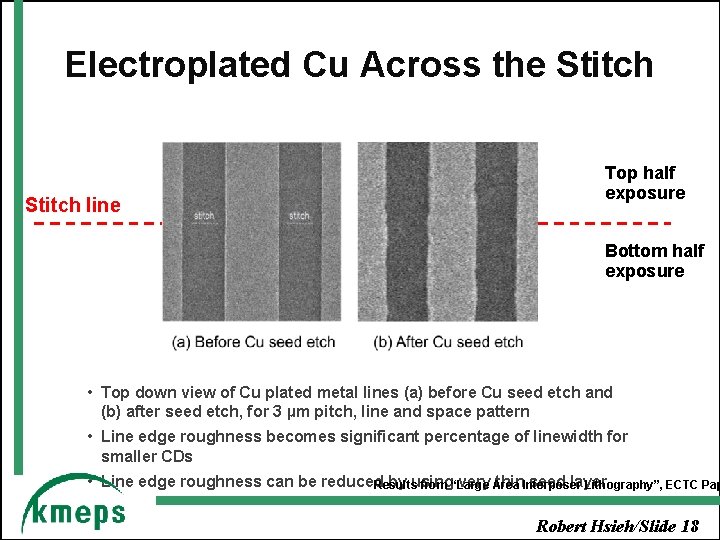
Electroplated Cu Across the Stitch line Top half exposure Bottom half exposure • Top down view of Cu plated metal lines (a) before Cu seed etch and (b) after seed etch, for 3 µm pitch, line and space pattern • Line edge roughness becomes significant percentage of linewidth for smaller CDs • Line edge roughness can be reduced by using very Area thin. Interposer seed layer Results from “Large Lithography”, ECTC Pap Robert Hsieh/Slide 18
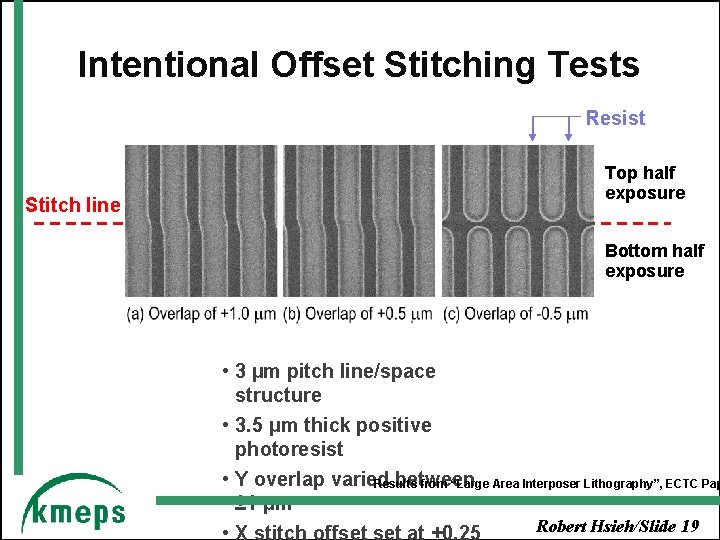
Intentional Offset Stitching Tests Resist Stitch line Top half exposure Bottom half exposure • 3 µm pitch line/space structure • 3. 5 μm thick positive photoresist • Y overlap varied between Results from “Large Area Interposer Lithography”, ECTC Pap ± 1 μm Robert Hsieh/Slide 19
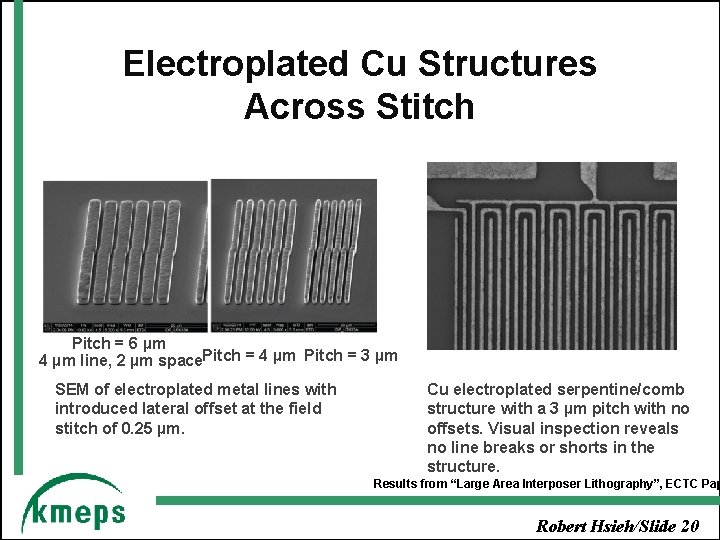
Electroplated Cu Structures Across Stitch Pitch = 6 µm 4 µm line, 2 µm space. Pitch = 4 µm Pitch = 3 µm SEM of electroplated metal lines with introduced lateral offset at the field stitch of 0. 25 µm. Cu electroplated serpentine/comb structure with a 3 µm pitch with no offsets. Visual inspection reveals no line breaks or shorts in the structure. Results from “Large Area Interposer Lithography”, ECTC Pap Robert Hsieh/Slide 20
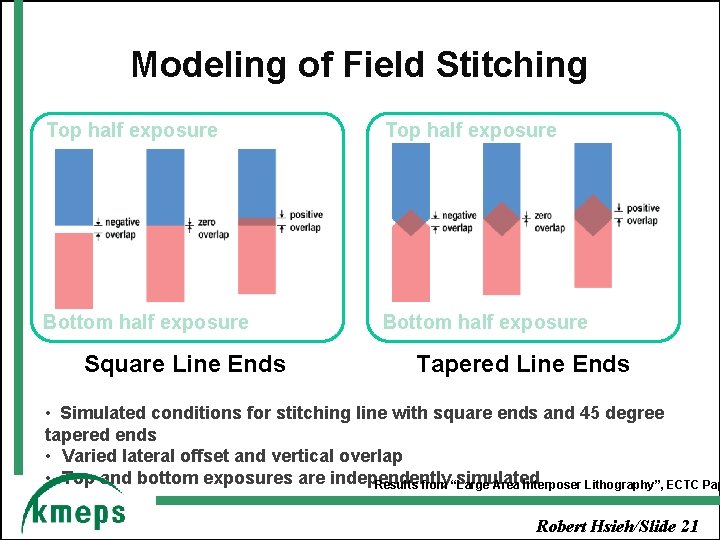
Modeling of Field Stitching Top half exposure Bottom half exposure Square Line Ends Tapered Line Ends • Simulated conditions for stitching line with square ends and 45 degree tapered ends • Varied lateral offset and vertical overlap • Top and bottom exposures are independently simulated Results from “Large Area Interposer Lithography”, ECTC Pap Robert Hsieh/Slide 21
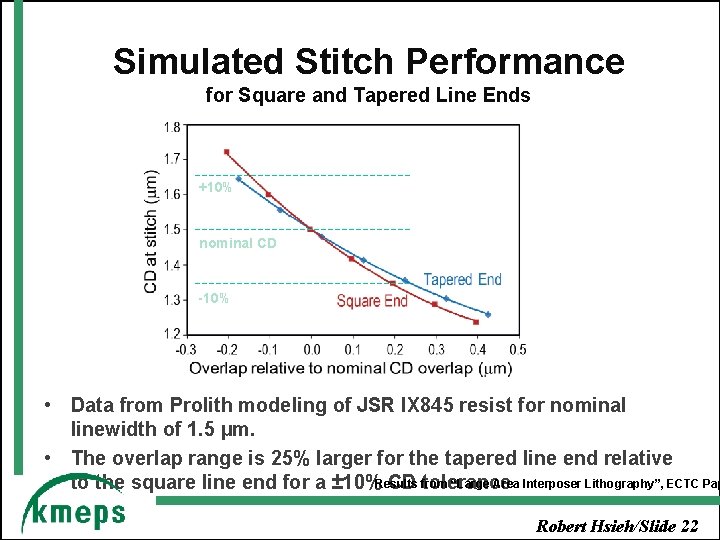
Simulated Stitch Performance for Square and Tapered Line Ends +10% nominal CD -10% • Data from Prolith modeling of JSR IX 845 resist for nominal linewidth of 1. 5 µm. • The overlap range is 25% larger for the tapered line end relative “Large Area Interposer Lithography”, ECTC Pap to the square line end for a ± 10%Results CD from tolerance Robert Hsieh/Slide 22
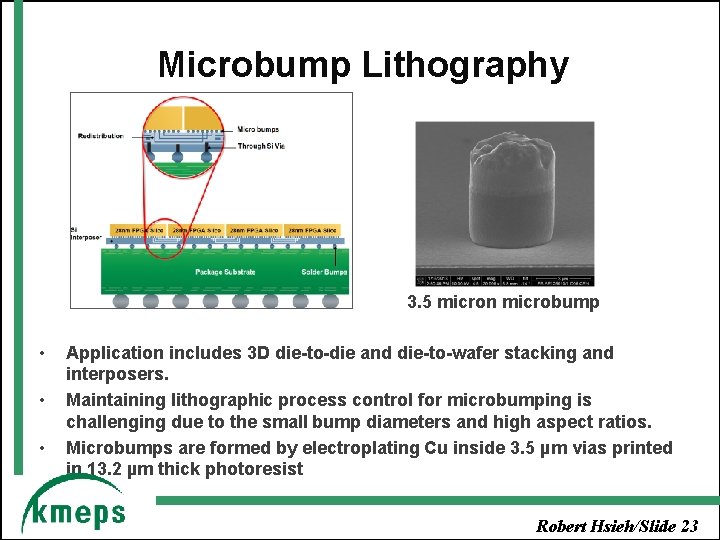
Microbump Lithography 3. 5 micron microbump • • • Application includes 3 D die-to-die and die-to-wafer stacking and interposers. Maintaining lithographic process control for microbumping is challenging due to the small bump diameters and high aspect ratios. Microbumps are formed by electroplating Cu inside 3. 5 µm vias printed in 13. 2 µm thick photoresist Robert Hsieh/Slide 23
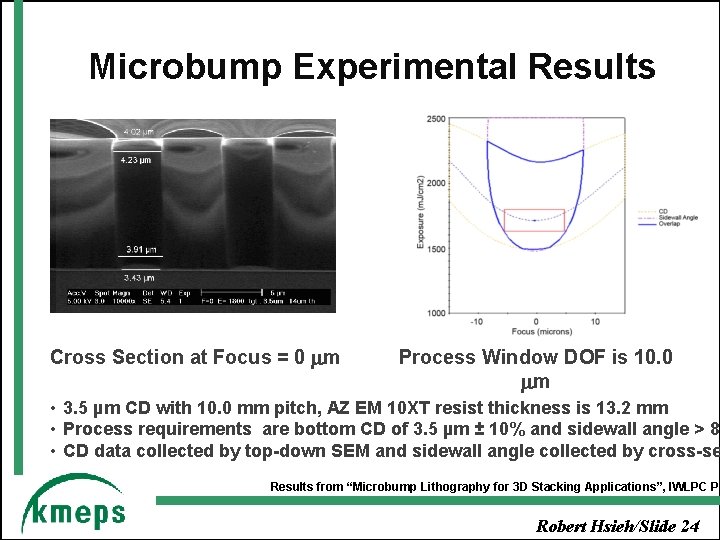
Microbump Experimental Results Cross Section at Focus = 0 m Process Window DOF is 10. 0 m • 3. 5 µm CD with 10. 0 mm pitch, AZ EM 10 XT resist thickness is 13. 2 mm • Process requirements are bottom CD of 3. 5 µm ± 10% and sidewall angle > 87 • CD data collected by top-down SEM and sidewall angle collected by cross-se Results from “Microbump Lithography for 3 D Stacking Applications”, IWLPC Pa Robert Hsieh/Slide 24
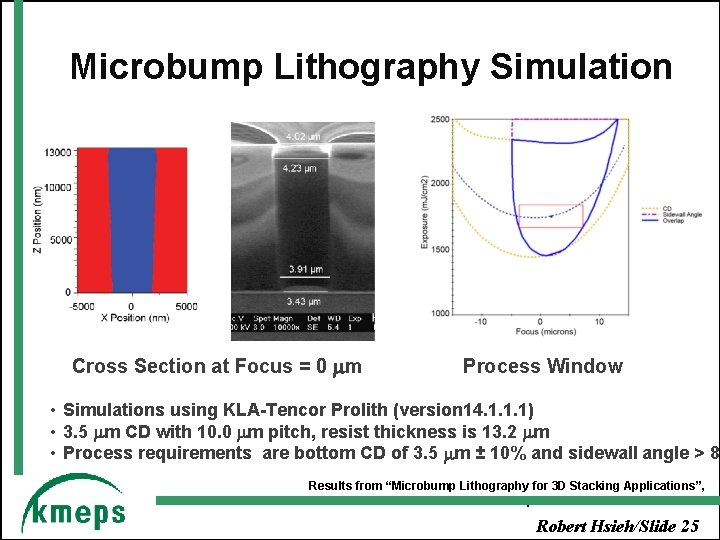
Microbump Lithography Simulation Cross Section at Focus = 0 m Process Window • Simulations using KLA-Tencor Prolith (version 14. 1. 1. 1) • 3. 5 m CD with 10. 0 m pitch, resist thickness is 13. 2 m • Process requirements are bottom CD of 3. 5 m ± 10% and sidewall angle > 87 Results from “Microbump Lithography for 3 D Stacking Applications”, IWLPC Paper Robert Hsieh/Slide 25
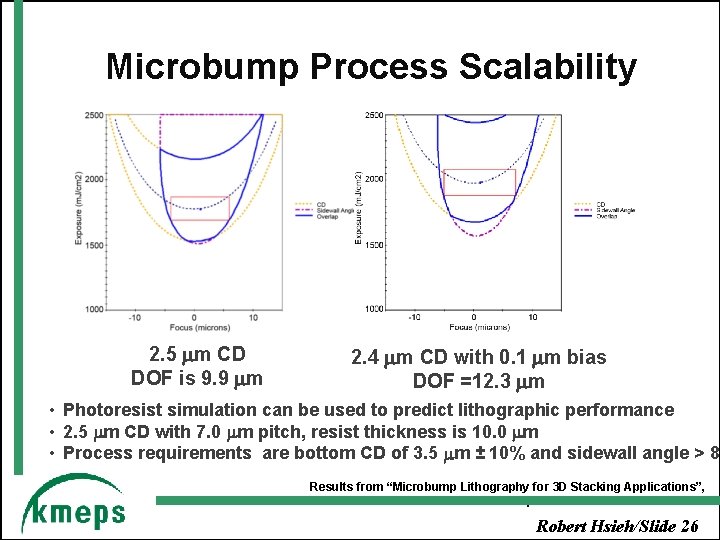
Microbump Process Scalability 2. 5 m CD DOF is 9. 9 m 2. 4 m CD with 0. 1 m bias DOF =12. 3 m • Photoresist simulation can be used to predict lithographic performance • 2. 5 m CD with 7. 0 m pitch, resist thickness is 10. 0 m • Process requirements are bottom CD of 3. 5 m ± 10% and sidewall angle > 87 Results from “Microbump Lithography for 3 D Stacking Applications”, IWLPC Paper Robert Hsieh/Slide 26
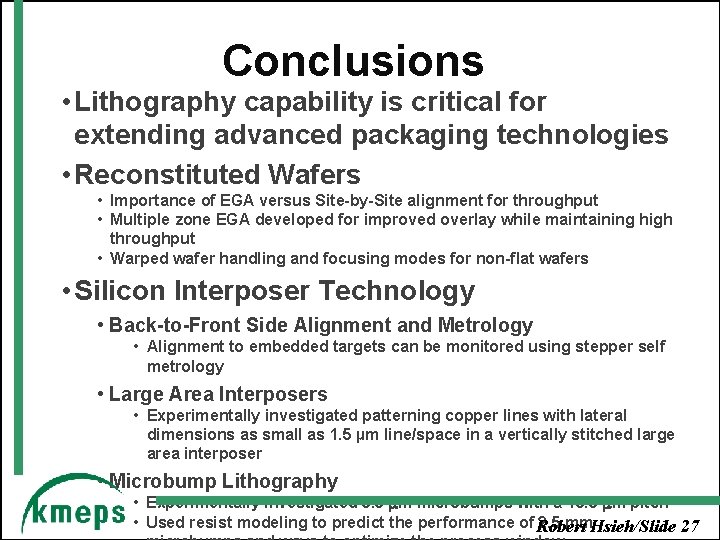
Conclusions • Lithography capability is critical for extending advanced packaging technologies • Reconstituted Wafers • Importance of EGA versus Site-by-Site alignment for throughput • Multiple zone EGA developed for improved overlay while maintaining high throughput • Warped wafer handling and focusing modes for non-flat wafers • Silicon Interposer Technology • Back-to-Front Side Alignment and Metrology • Alignment to embedded targets can be monitored using stepper self metrology • Large Area Interposers • Experimentally investigated patterning copper lines with lateral dimensions as small as 1. 5 µm line/space in a vertically stitched large area interposer • Microbump Lithography • Experimentally investigated 3. 5 m microbumps with a 10. 0 m pitch • Used resist modeling to predict the performance of Robert 2. 5 mm. Hsieh/Slide 27