
Technology Standards Publishing a RFC in the IETF
Technology Standards Publishing a RFC in the IETF CSCI E 45 a: The Cyber World – part A 1 Copyright © Scott Bradner & Ben Gaucherin 2015
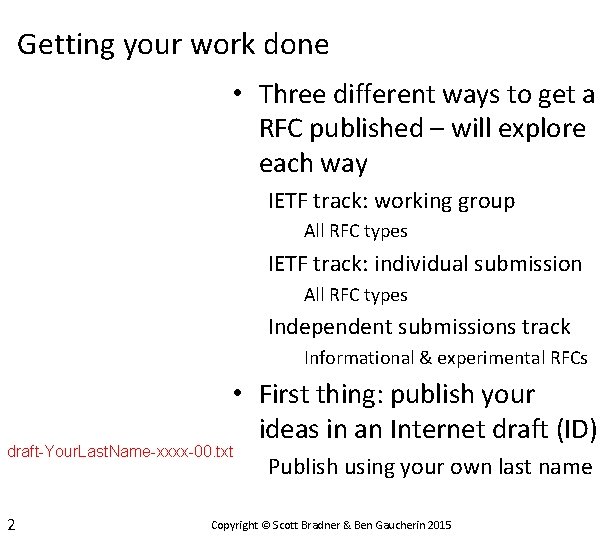
Getting your work done • Three different ways to get a RFC published – will explore each way IETF track: working group All RFC types IETF track: individual submission All RFC types Independent submissions track Informational & experimental RFCs • First thing: publish your ideas in an Internet draft (ID) draft-Your. Last. Name-xxxx-00. txt 2 Publish using your own last name Copyright © Scott Bradner & Ben Gaucherin 2015
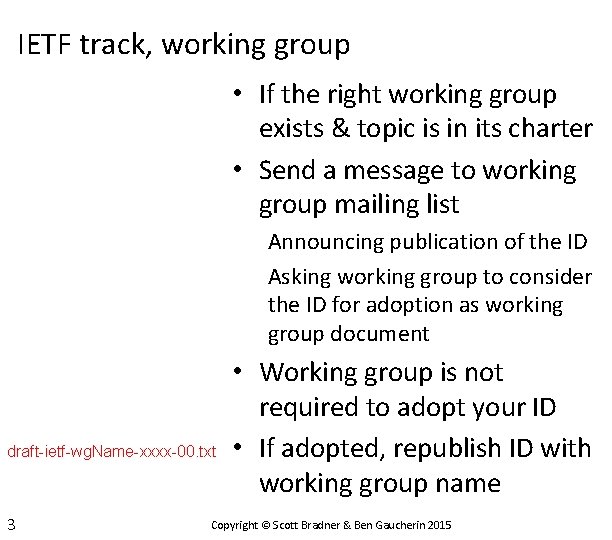
IETF track, working group • If the right working group exists & topic is in its charter • Send a message to working group mailing list Announcing publication of the ID Asking working group to consider the ID for adoption as working group document draft-ietf-wg. Name-xxxx-00. txt 3 • Working group is not required to adopt your ID • If adopted, republish ID with working group name Copyright © Scott Bradner & Ben Gaucherin 2015
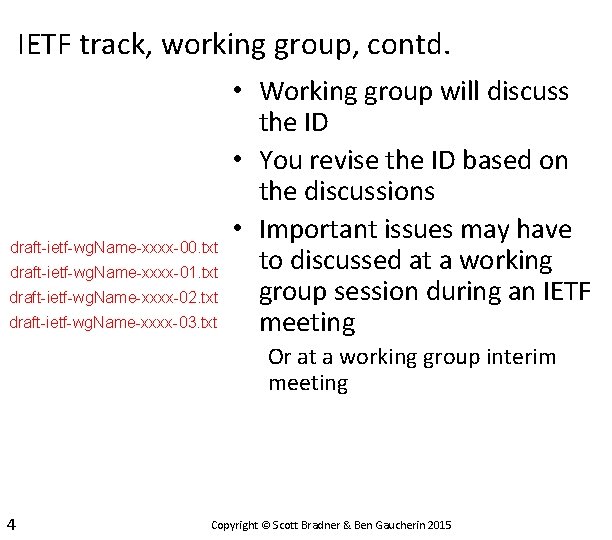
IETF track, working group, contd. draft-ietf-wg. Name-xxxx-00. txt draft-ietf-wg. Name-xxxx-01. txt draft-ietf-wg. Name-xxxx-02. txt draft-ietf-wg. Name-xxxx-03. txt • Working group will discuss the ID • You revise the ID based on the discussions • Important issues may have to discussed at a working group session during an IETF meeting Or at a working group interim meeting 4 Copyright © Scott Bradner & Ben Gaucherin 2015
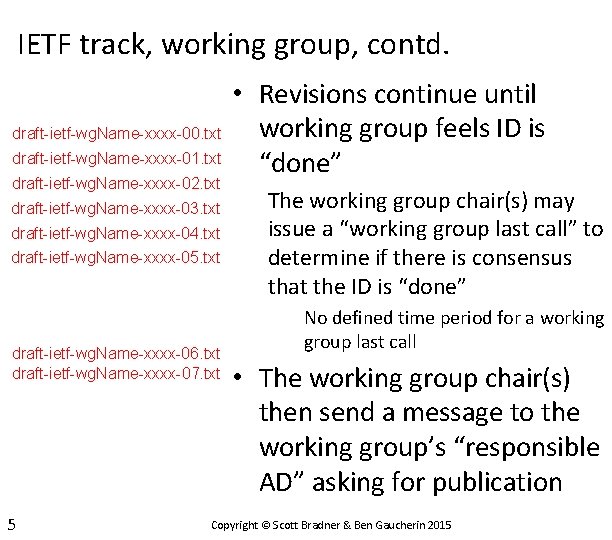
IETF track, working group, contd. draft-ietf-wg. Name-xxxx-00. txt draft-ietf-wg. Name-xxxx-01. txt draft-ietf-wg. Name-xxxx-02. txt draft-ietf-wg. Name-xxxx-03. txt draft-ietf-wg. Name-xxxx-04. txt draft-ietf-wg. Name-xxxx-05. txt draft-ietf-wg. Name-xxxx-06. txt draft-ietf-wg. Name-xxxx-07. txt 5 • Revisions continue until working group feels ID is “done” The working group chair(s) may issue a “working group last call” to determine if there is consensus that the ID is “done” No defined time period for a working group last call • The working group chair(s) then send a message to the working group’s “responsible AD” asking for publication Copyright © Scott Bradner & Ben Gaucherin 2015

IETF track, working group, contd. • The responsible AD reviews the ID to determine if the AD feels it is ready draft-ietf-wg. Name-xxxx-08. txt AD will return it to the working group, with comments, if not • If the AD feels the ID is ready, the AD forwards the request to the IESG • IESG will issue a IETF-wide “last call” for comments Two-week last call period 6 Copyright © Scott Bradner & Ben Gaucherin 2015
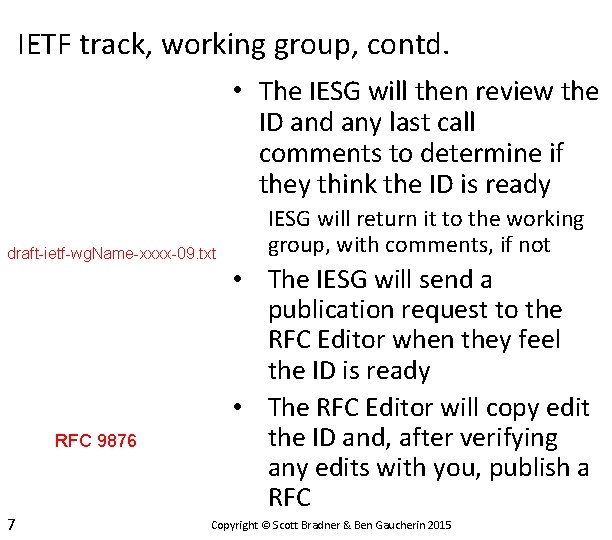
IETF track, working group, contd. • The IESG will then review the ID and any last call comments to determine if they think the ID is ready draft-ietf-wg. Name-xxxx-09. txt RFC 9876 7 IESG will return it to the working group, with comments, if not • The IESG will send a publication request to the RFC Editor when they feel the ID is ready • The RFC Editor will copy edit the ID and, after verifying any edits with you, publish a RFC Copyright © Scott Bradner & Ben Gaucherin 2015
IETF track, working group, not in charter • Working group exists but topic is not in the charter • Work with the working group chair(s) to see if they would support revising the charter The char(s) do not have to agree to add the topic to the charter If the chair(s) agree, they will work with the AD to see if the IESG agrees (they do not have to) If not, then this path is closed • You proceed as above if the IESG updates the charter 8 Copyright © Scott Bradner & Ben Gaucherin 2015
IETF track, no existing working group • If the right working group does not exist Talk to an appropriate area director about holding a BOF AD might tell you “no” or to first set up a mailing list, or use an existing mailing list, and hold a discussion If a BOF is held & it demonstrates interest, work with the AD to try to form a working group • Note that, generally, an ID author is not selected as a working group chair To avoid conflicts of interest in managing discussions 9 Copyright © Scott Bradner & Ben Gaucherin 2015
IETF track, individual submission • Set up a mailing list to discuss your ID • Iterate your ID based on the discussion • When you think it is ready talk to a AD working in the area about submitting your ID for publication • The AD may agree to review the ID – but is not required to 10 Copyright © Scott Bradner & Ben Gaucherin 2015
IETF track, individual submission, contd. • If the AD agrees to review the AD & agrees to support it after reviewing it, the process proceeds like the normal working group process Except that the last call period is four-weeks (instead of two) 11 Copyright © Scott Bradner & Ben Gaucherin 2015
Image credits All drawings and photos by Scott Bradner unless noted Slide# credit 12 Copyright © Scott Bradner & Ben Gaucherin 2015
- Slides: 12