
Technology Roadmap LowCarbon Technology for the Indian Cement
Technology Roadmap: Low-Carbon Technology for the Indian Cement Industry Mr. L Rajasekar Ultra. Tech Cement Ltd. © OECD/IEA 2013
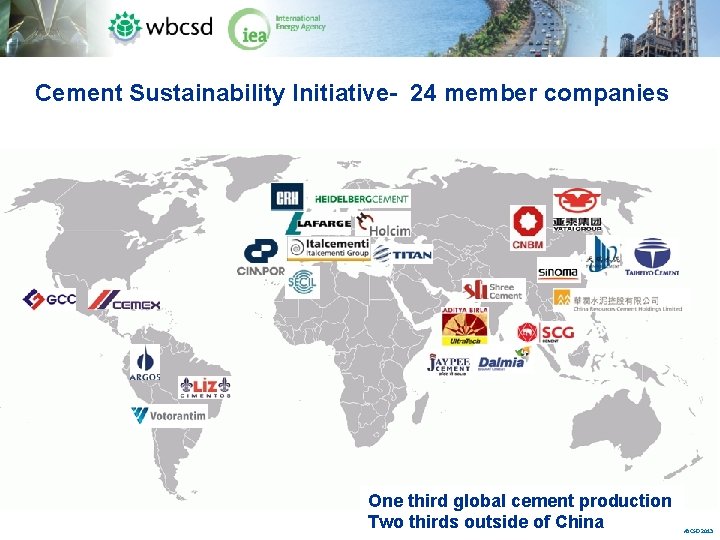
Cement Sustainability Initiative- 24 member companies One third global cement production Two thirds outside of China © OECD/IEA and WBCSD 2013
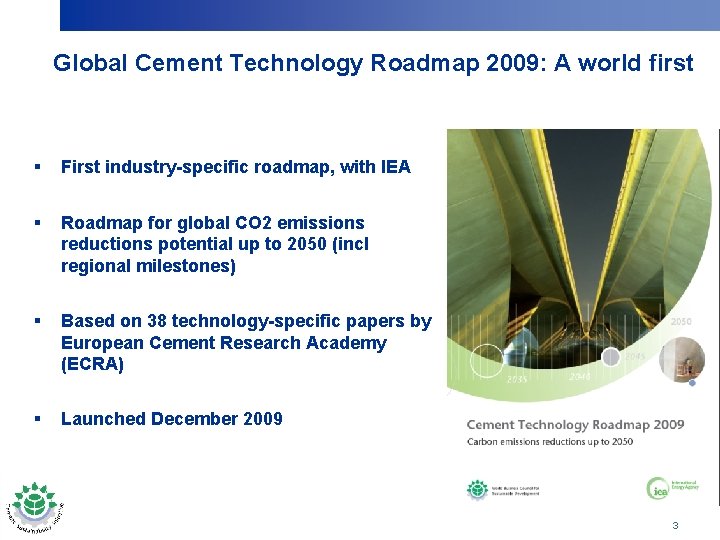
Global Cement Technology Roadmap 2009: A world first § First industry-specific roadmap, with IEA § Roadmap for global CO 2 emissions reductions potential up to 2050 (incl regional milestones) § Based on 38 technology-specific papers by European Cement Research Academy (ECRA) § Launched December 2009 3
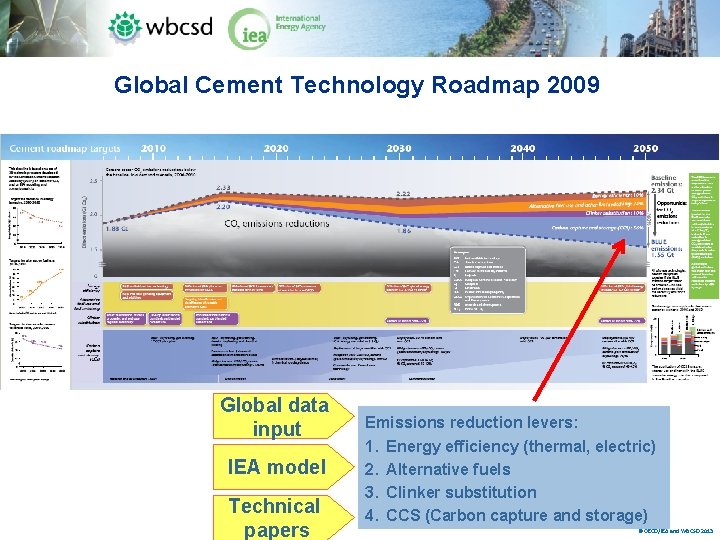
Global Cement Technology Roadmap 2009 Global data input IEA model Technical papers Emissions reduction levers: 1. Energy efficiency (thermal, electric) 2. Alternative fuels 3. Clinker substitution 4. CCS (Carbon capture and storage) © OECD/IEA and WBCSD 2013
CSI in India >60% of national production © OECD/IEA and WBCSD 2013
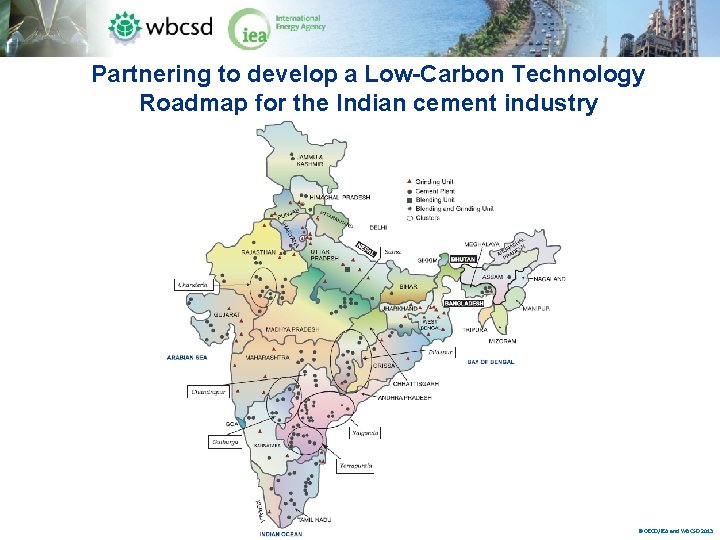
Partnering to develop a Low-Carbon Technology Roadmap for the Indian cement industry © OECD/IEA and WBCSD 2013
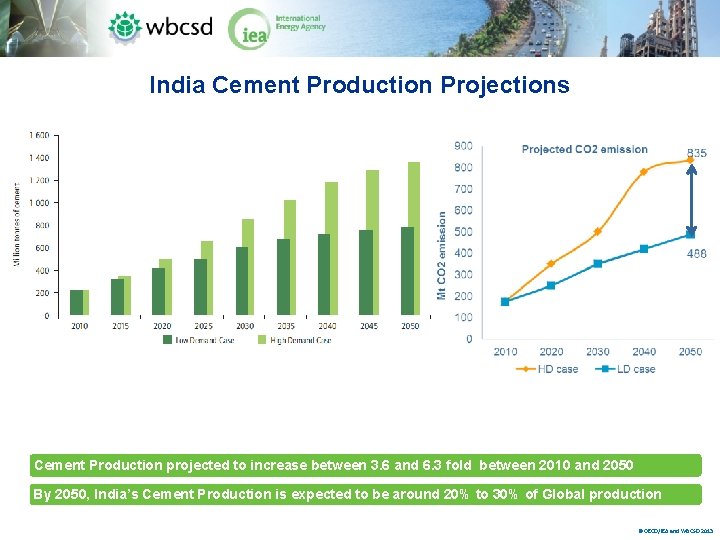
India Cement Production Projections Cement Production projected to increase between 3. 6 and 6. 3 fold between 2010 and 2050 By 2050, India’s Cement Production is expected to be around 20% to 30% of Global production © OECD/IEA and WBCSD 2013
Low Carbon Technology Roadmap For The Indian Cement Industry Ø Merits in evolving India Specific Roadmap ü Input data to Model – Data of Indian Cement Industry ü Assumptions/ options/ alternative relate to Indian Cement Industry ü Roadmap addresses issues relevant to Indian Cement Industry ü Identifying Indian cement industry-specific technology options ü Based on current level of specific energy consumption & technology absorption ü Focus on identifying Gap /Barriers and specific policy interventions Roadmap Partners – WBSCD & IEA ; Supported & Part funded by IFC © OECD/IEA and WBCSD 2013
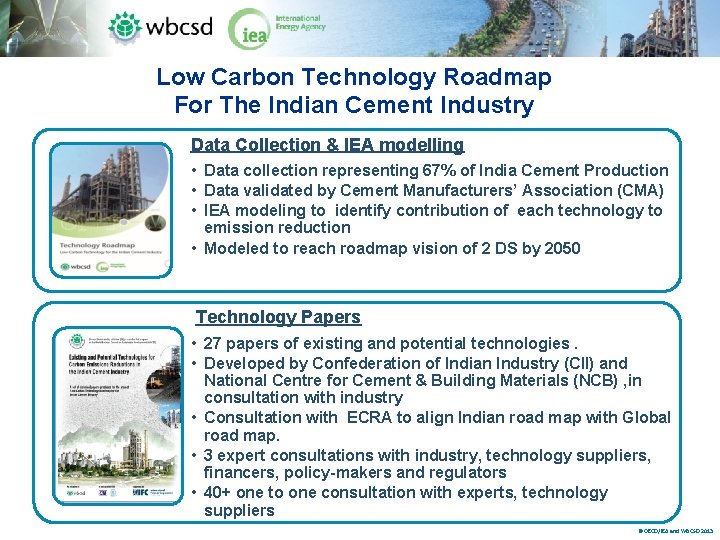
Low Carbon Technology Roadmap For The Indian Cement Industry Data Collection & IEA modelling • Data collection representing 67% of India Cement Production • Data validated by Cement Manufacturers’ Association (CMA) • IEA modeling to identify contribution of each technology to emission reduction • Modeled to reach roadmap vision of 2 DS by 2050 Technology Papers • 27 papers of existing and potential technologies. • Developed by Confederation of Indian Industry (CII) and National Centre for Cement & Building Materials (NCB) , in consultation with industry • Consultation with ECRA to align Indian road map with Global road map. • 3 expert consultations with industry, technology suppliers, financers, policy-makers and regulators • 40+ one to one consultation with experts, technology suppliers © OECD/IEA and WBCSD 2013
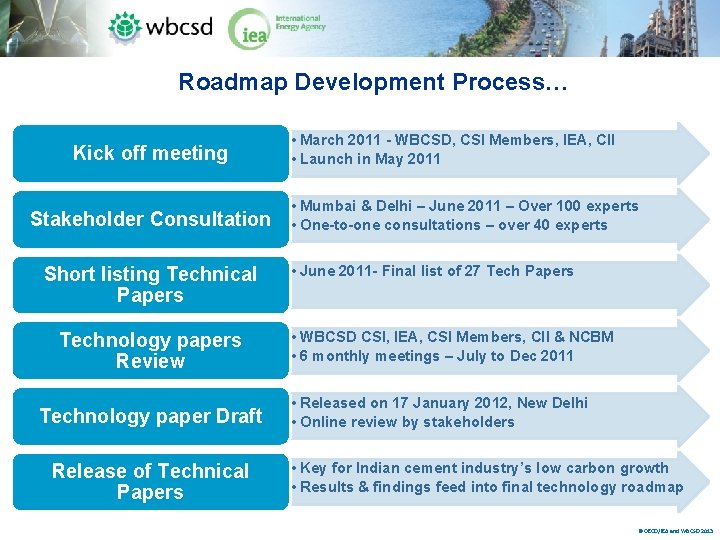
Roadmap Development Process… Kick off meeting Stakeholder Consultation Short listing Technical Papers Technology papers Review Technology paper Draft Release of Technical Papers • March 2011 - WBCSD, CSI Members, IEA, CII • Launch in May 2011 • Mumbai & Delhi – June 2011 – Over 100 experts • One-to-one consultations – over 40 experts • June 2011 - Final list of 27 Tech Papers • WBCSD CSI, IEA, CSI Members, CII & NCBM • 6 monthly meetings – July to Dec 2011 • Released on 17 January 2012, New Delhi • Online review by stakeholders • Key for Indian cement industry’s low carbon growth • Results & findings feed into final technology roadmap © OECD/IEA and WBCSD 2013
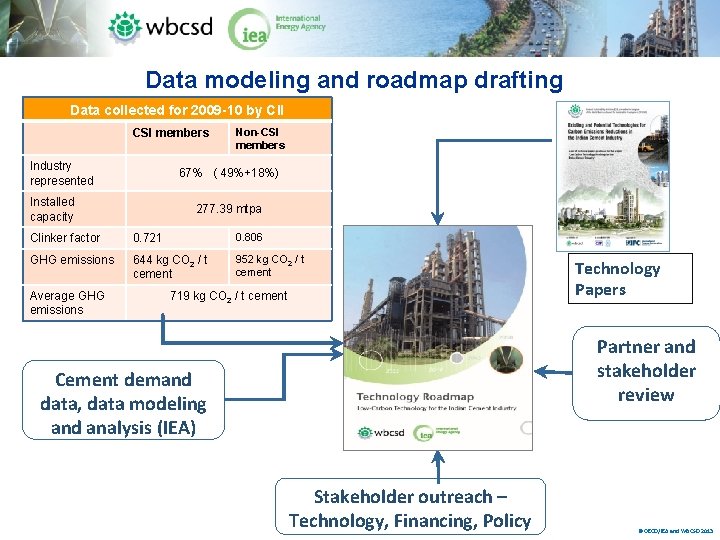
Data modeling and roadmap drafting Data collected for 2009 -10 by CII CSI members Industry represented Non-CSI members 67% ( 49%+18%) Installed capacity 277. 39 mtpa Clinker factor 0. 721 0. 806 GHG emissions 644 kg CO 2 / t cement 952 kg CO 2 / t cement Average GHG emissions 719 kg CO 2 / t cement Technology Papers Partner and stakeholder review Cement demand data, data modeling and analysis (IEA) Stakeholder outreach – Technology, Financing, Policy © OECD/IEA and WBCSD 2013
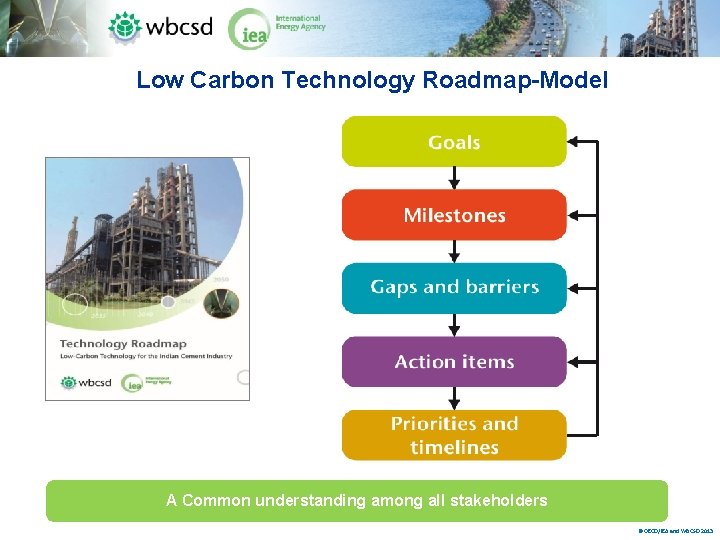
Low Carbon Technology Roadmap-Model A Common understanding among all stakeholders © OECD/IEA and WBCSD 2013
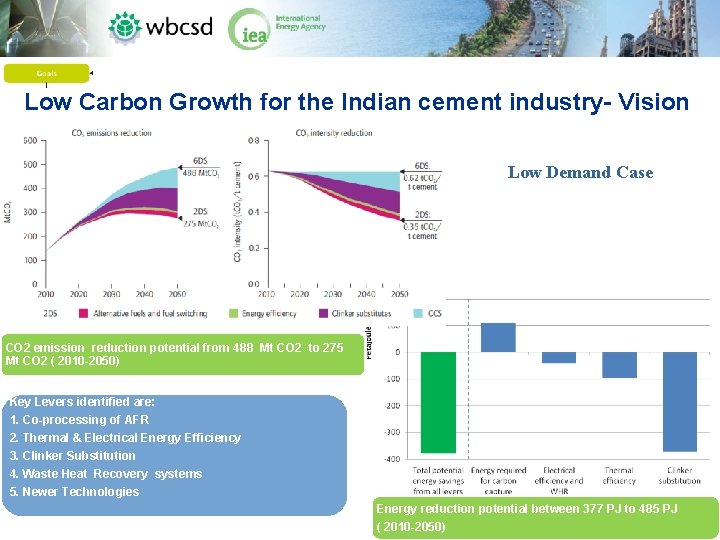
Low Carbon Growth for the Indian cement industry- Vision Low Demand Case CO 2 emission reduction potential from 488 Mt CO 2 to 275 Mt CO 2 ( 2010 -2050) Key Levers identified are: 1. Co-processing of AFR 2. Thermal & Electrical Energy Efficiency 3. Clinker Substitution 4. Waste Heat Recovery systems 5. Newer Technologies Energy reduction potential between 377 PJ to 485 PJ ( 2010 -2050) © OECD/IEA and WBCSD 2013
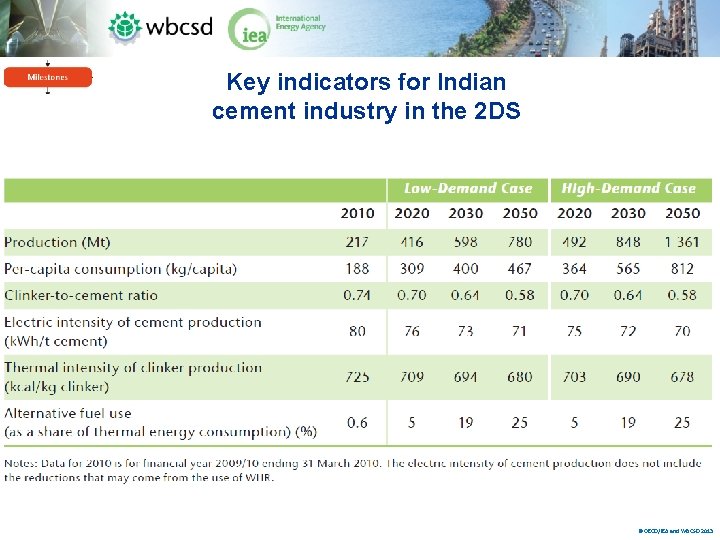
Key indicators for Indian cement industry in the 2 DS © OECD/IEA and WBCSD 2013
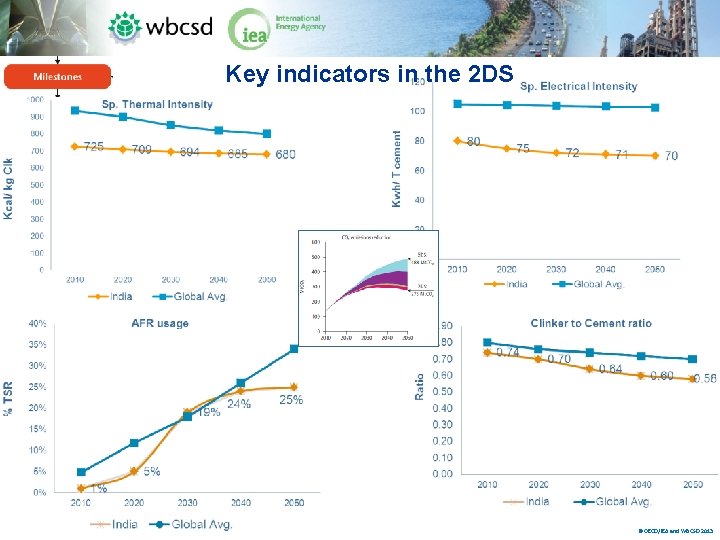
Key indicators in the 2 DS © OECD/IEA and WBCSD 2013
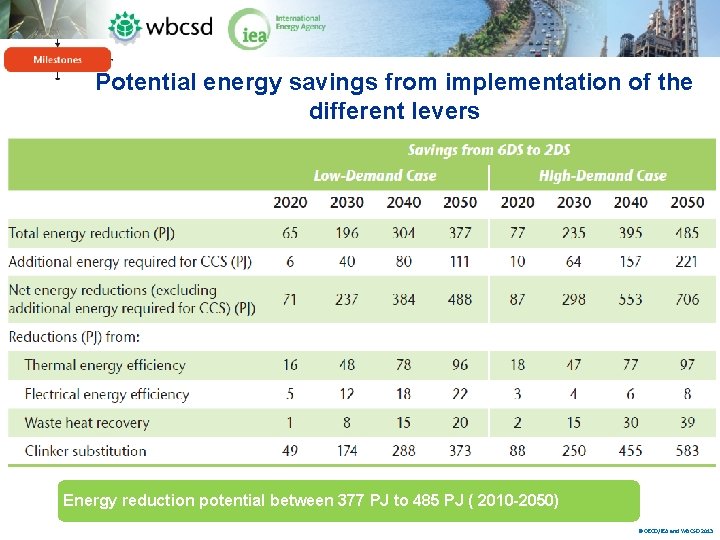
Potential energy savings from implementation of the different levers Energy reduction potential between 377 PJ to 485 PJ ( 2010 -2050) © OECD/IEA and WBCSD 2013
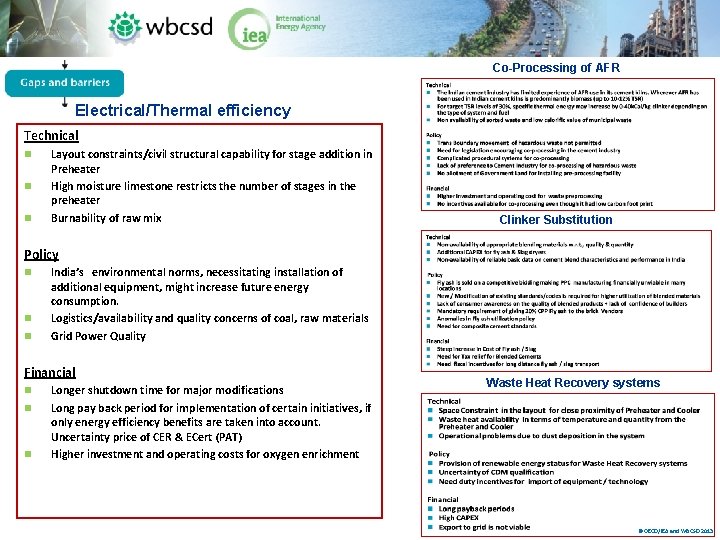
Co-Processing of AFR Electrical/Thermal efficiency Technical n n n Layout constraints/civil structural capability for stage addition in Preheater High moisture limestone restricts the number of stages in the preheater Burnability of raw mix Clinker Substitution Policy n n n India’s environmental norms, necessitating installation of additional equipment, might increase future energy consumption. Logistics/availability and quality concerns of coal, raw materials Grid Power Quality Financial n n n Longer shutdown time for major modifications Long pay back period for implementation of certain initiatives, if only energy efficiency benefits are taken into account. Uncertainty price of CER & ECert (PAT) Higher investment and operating costs for oxygen enrichment Waste Heat Recovery systems © OECD/IEA and WBCSD 2013
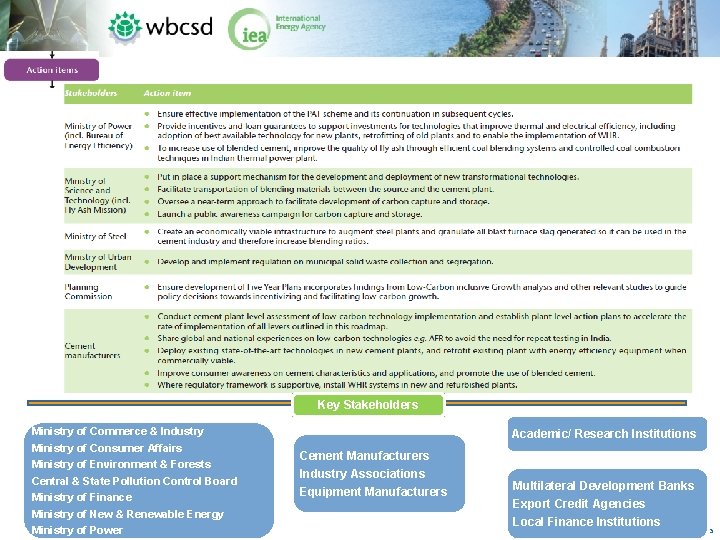
Key Stakeholders Ministry of Commerce & Industry Ministry of Consumer Affairs Ministry of Environment & Forests Central & State Pollution Control Board Ministry of Finance Ministry of New & Renewable Energy Ministry of Power Academic/ Research Institutions Cement Manufacturers Industry Associations Equipment Manufacturers Multilateral Development Banks Export Credit Agencies Local Finance Institutions © OECD/IEA and WBCSD 2013
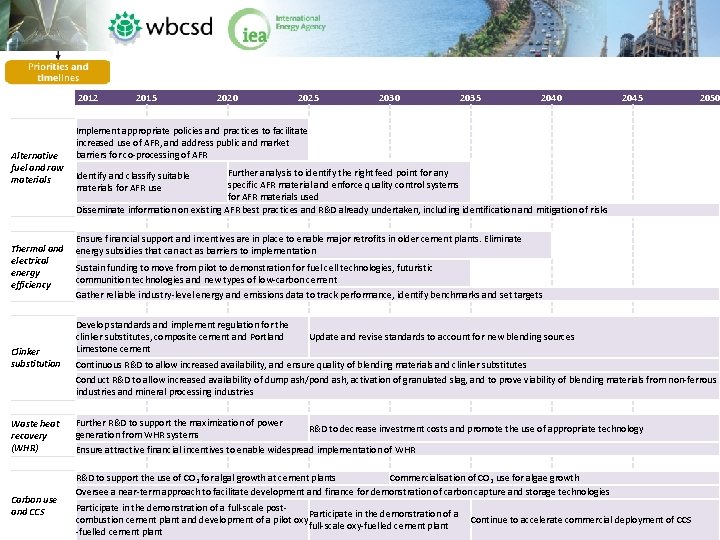
2012 2015 Alternative fuel and raw materials Thermal and electrical energy efficiency 2020 2025 Implement appropriate policies and practices to facilitate increased use of AFR, and address public and market barriers for co-processing of AFR 2030 2035 2040 2045 2050 Further analysis to identify the right feed point for any specific AFR material and enforce quality control systems for AFR materials used Disseminate information on existing AFR best practices and R&D already undertaken, including identification and mitigation of risks Identify and classify suitable materials for AFR use Ensure financial support and incentives are in place to enable major retrofits in older cement plants. Eliminate energy subsidies that can act as barriers to implementation Gather reliable industry-level energy and emissions data to track performance, identify benchmarks and set targets Develop standards and implement regulation for the clinker substitutes, composite cement and Portland Limestone cement Sustain funding to move from pilot to demonstration for fuel cell technologies, futuristic communition technologies and new types of low-carbon cement Clinker substitution Update and revise standards to account for new blending sources Continuous R&D to allow increased availability, and ensure quality of blending materials and clinker substitutes Conduct R&D to allow increased availability of dump ash/pond ash, activation of granulated slag, and to prove viability of blending materials from non-ferrous industries and mineral processing industries Waste heat recovery (WHR) Carbon use and CCS Further R&D to support the maximization of power generation from WHR systems R&D to decrease investment costs and promote the use of appropriate technology Ensure attractive financial incentives to enable widespread implementation of WHR R&D to support the use of CO 2 for algal growth at cement plants Commercialisation of CO 2 use for algae growth Oversee a near-term approach to facilitate development and finance for demonstration of carbon capture and storage technologies Participate in the demonstration of a full-scale post. Participate in the demonstration of a combustion cement plant and development of a pilot oxy Continue to accelerate commercial deployment of CCS full-scale oxy-fuelled cement plant © OECD/IEA and WBCSD 2013 -fuelled cement plant
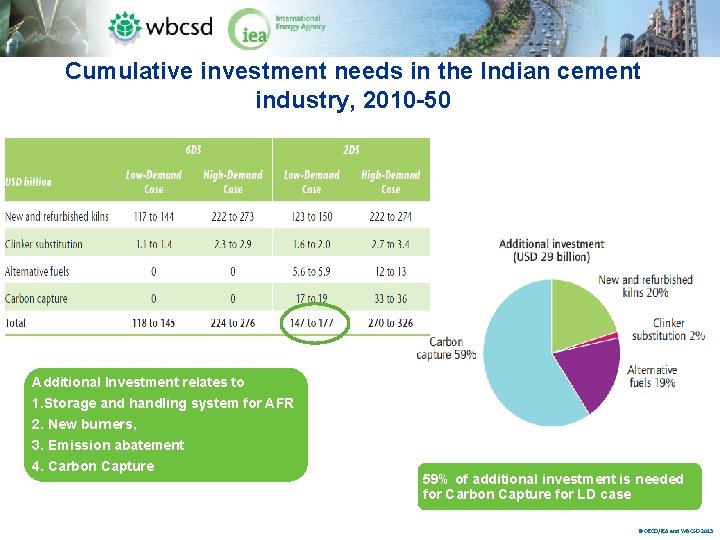
Cumulative investment needs in the Indian cement industry, 2010 -50 Additional Investment relates to 1. Storage and handling system for AFR 2. New burners, 3. Emission abatement 4. Carbon Capture 59% of additional investment is needed for Carbon Capture for LD case © OECD/IEA and WBCSD 2013
Key findings n Industry achieved CO 2 emission levels of 719 kg in 2010 from 1120 Kg in n n 1996 In absence of appropriate technological/ policy measures, CO 2 emissions are projected to reach 488 Mt CO 2 (LD) and 835 Mt CO 2 (HD). Technologies, policy framework and investment needs outlined in roadmap could limit the CO 2 emission to 275 Mt CO 2 (LD) and 468 Mt CO 2 (HD) Achieving Milestones would enhance energy security by saving 377 PJ to 485 PJ energy by 2050 Additional investment needed to reach target emission envisioned in the roadmap is between USD 29 and USD 50 billion Social acceptance, Political will, Policy development and Financial support is key to ensure widespread deployment and implementation © OECD/IEA and WBCSD 2013
Roadmap Process-Learning n A workshop (1 -2 days) for core roadmap team to understand IEA model structure, model inputs, and sensitivity of inputs. l This will help in necessary checks, precautions during data collection/inputs to model/Technology paper development n Active participation of National Industry Association to be ensured early in the process. l This will help in moderating inputs/outcomes with wider perspective and outlook l Accommodating non-CSI members, views, data n Global roadmap & Technology papers to be used as a guidance documents l This helps in getting necessary inputs, verify accuracy and useful comparison n Identify National/International domain experts at early stage for their views/comments on draft Technical papers. l This will expedite the activities of Technology paper development © OECD/IEA and WBCSD 2013
Roadmap Process- Learning n Frequent exchanges with Global CSI/ECRA, for their views on draft documents and Inputs in areas where Country does not have domain expertise n Periodic review of Roadmap outputs by committee of CEOs for any mid course corrections n Rigorous/Persistent stakeholders dialogue with key organizations/ people jointly or individually for their Inputs on way forward to meet the objectives; participation of core team members in one-to-one dialogue with key persons is recommended. n Active involvement of Local/National policy makers and financial Institutions to be ensured at an early stage of Roadmap preparation. l This will enhance acceptability/credibility of roadmap and better buying in and overcoming barriers in Implementation and Financial constraints © OECD/IEA and WBCSD 2013
Way Forward… Ø Three Pilot plants identified for feasibility assessment of implementing technical papers Ø Evaluate anticipated benefits, overall GHG emission reduction opportunities. Ø Develop an action plan for pilot plant based on GHG emission reduction opportunity and investment 26 © OECD/IEA and WBCSD 2013
For further details please contact CSI: Roland Hunziker: hunziker@wbcsd. org or IEA: Nathalie Trudeau: nathalie. trudeau@iea. org © OECD/IEA and WBCSD 2013
- Slides: 25