
Technology Readiness Level Calculator NDIA Systems Engineering Conference


- Slides: 28
Technology Readiness Level Calculator NDIA Systems Engineering Conference October 20, 2003 William L. Nolte, P. E. , CQE Sensors Directorate Air Force Research Laboratory Brian C. Kennedy Consulting, Inc. Ann Arbor, MI Roger J. Dziegiel, Jr. Information Directorate Air Force Research Laboratory
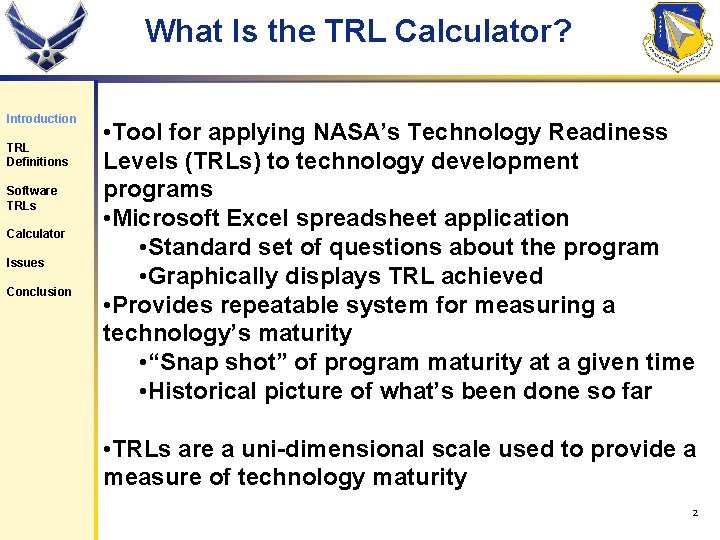
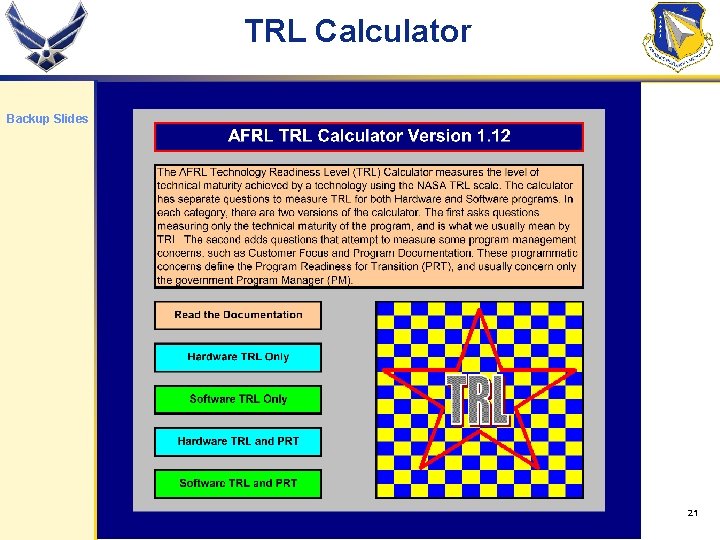
What Is the TRL Calculator? Introduction TRL Definitions Software TRLs Calculator Issues Conclusion • Tool for applying NASA’s Technology Readiness Levels (TRLs) to technology development programs • Microsoft Excel spreadsheet application • Standard set of questions about the program • Graphically displays TRL achieved • Provides repeatable system for measuring a technology’s maturity • “Snap shot” of program maturity at a given time • Historical picture of what’s been done so far • TRLs are a uni-dimensional scale used to provide a measure of technology maturity 2
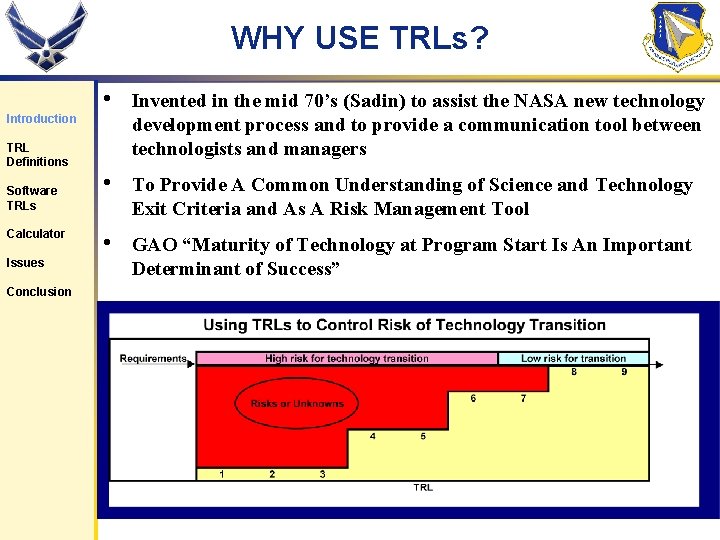
WHY USE TRLs? Introduction TRL Definitions Software TRLs Calculator Issues • Invented in the mid 70’s (Sadin) to assist the NASA new technology development process and to provide a communication tool between technologists and managers • To Provide A Common Understanding of Science and Technology Exit Criteria and As A Risk Management Tool • GAO “Maturity of Technology at Program Start Is An Important Determinant of Success” Conclusion 3
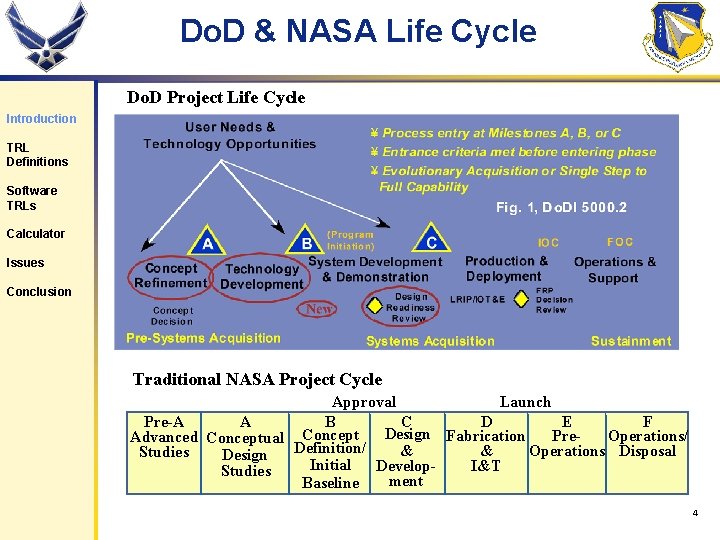
Do. D & NASA Life Cycle Do. D Project Life Cycle Introduction TRL Definitions Software TRLs Calculator Issues Conclusion Traditional NASA Project Cycle Approval Launch Pre-A A B C D E F Design Fabrication Pre. Operations/ Advanced Conceptual Concept Definition/ & & Operations Disposal Studies Design Initial Develop. I&T Studies ment Baseline 4
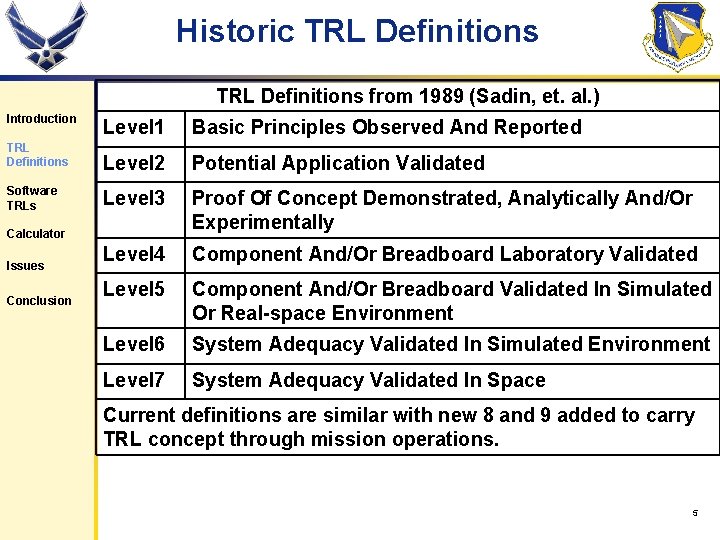
Historic TRL Definitions from 1989 (Sadin, et. al. ) Introduction Level 1 Basic Principles Observed And Reported TRL Definitions Level 2 Potential Application Validated Software TRLs Level 3 Proof Of Concept Demonstrated, Analytically And/Or Experimentally Level 4 Component And/Or Breadboard Laboratory Validated Level 5 Component And/Or Breadboard Validated In Simulated Or Real-space Environment Level 6 System Adequacy Validated In Simulated Environment Level 7 System Adequacy Validated In Space Calculator Issues Conclusion Current definitions are similar with new 8 and 9 added to carry TRL concept through mission operations. 5
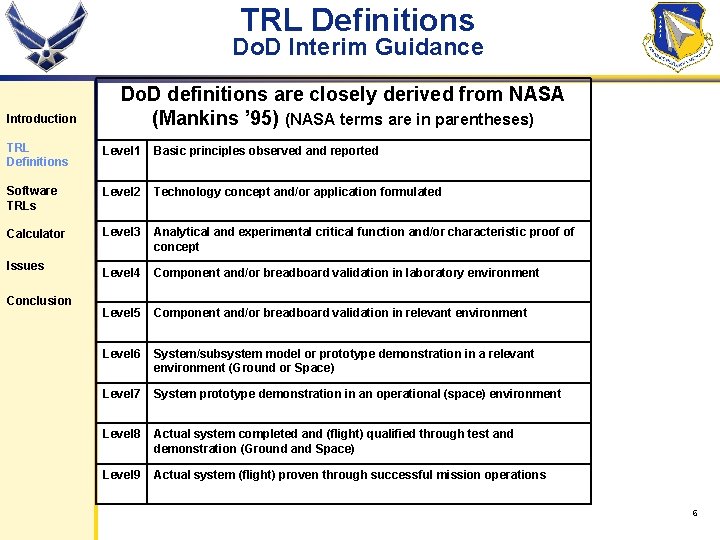
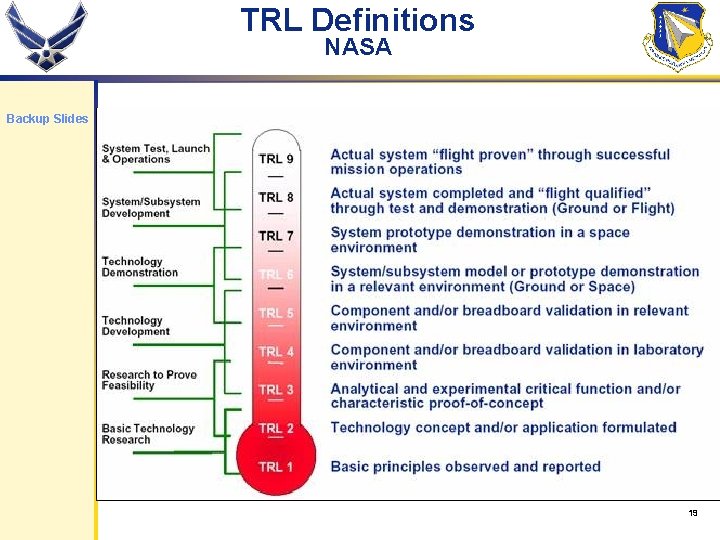
TRL Definitions Do. D Interim Guidance Introduction Do. D definitions are closely derived from NASA (Mankins ’ 95) (NASA terms are in parentheses) TRL Definitions Level 1 Basic principles observed and reported Software TRLs Level 2 Technology concept and/or application formulated Calculator Level 3 Analytical and experimental critical function and/or characteristic proof of concept Level 4 Component and/or breadboard validation in laboratory environment Level 5 Component and/or breadboard validation in relevant environment Level 6 System/subsystem model or prototype demonstration in a relevant environment (Ground or Space) Level 7 System prototype demonstration in an operational (space) environment Level 8 Actual system completed and (flight) qualified through test and demonstration (Ground and Space) Level 9 Actual system (flight) proven through successful mission operations Issues Conclusion 6
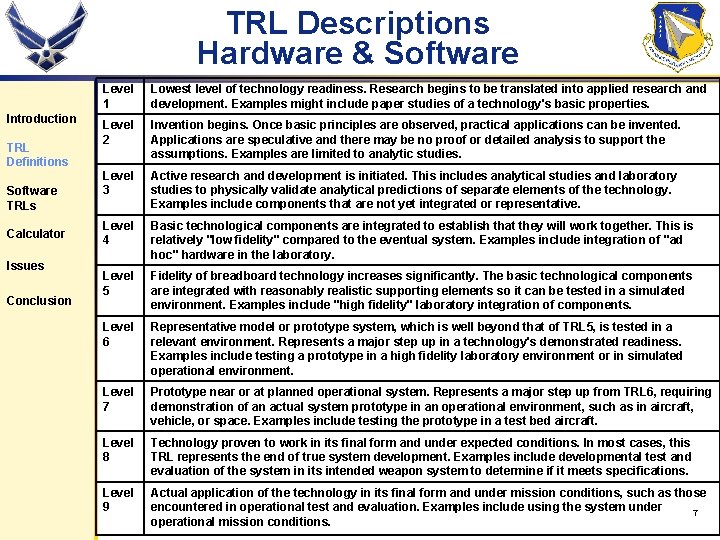
TRL Descriptions Hardware & Software Introduction TRL Definitions Software TRLs Calculator Issues Conclusion Level 1 Lowest level of technology readiness. Research begins to be translated into applied research and development. Examples might include paper studies of a technology's basic properties. Level 2 Invention begins. Once basic principles are observed, practical applications can be invented. Applications are speculative and there may be no proof or detailed analysis to support the assumptions. Examples are limited to analytic studies. Level 3 Active research and development is initiated. This includes analytical studies and laboratory studies to physically validate analytical predictions of separate elements of the technology. Examples include components that are not yet integrated or representative. Level 4 Basic technological components are integrated to establish that they will work together. This is relatively "low fidelity" compared to the eventual system. Examples include integration of "ad hoc" hardware in the laboratory. Level 5 Fidelity of breadboard technology increases significantly. The basic technological components are integrated with reasonably realistic supporting elements so it can be tested in a simulated environment. Examples include "high fidelity" laboratory integration of components. Level 6 Representative model or prototype system, which is well beyond that of TRL 5, is tested in a relevant environment. Represents a major step up in a technology's demonstrated readiness. Examples include testing a prototype in a high fidelity laboratory environment or in simulated operational environment. Level 7 Prototype near or at planned operational system. Represents a major step up from TRL 6, requiring demonstration of an actual system prototype in an operational environment, such as in aircraft, vehicle, or space. Examples include testing the prototype in a test bed aircraft. Level 8 Technology proven to work in its final form and under expected conditions. In most cases, this TRL represents the end of true system development. Examples include developmental test and evaluation of the system in its intended weapon system to determine if it meets specifications. Level 9 Actual application of the technology in its final form and under mission conditions, such as those encountered in operational test and evaluation. Examples include using the system under 7 operational mission conditions.
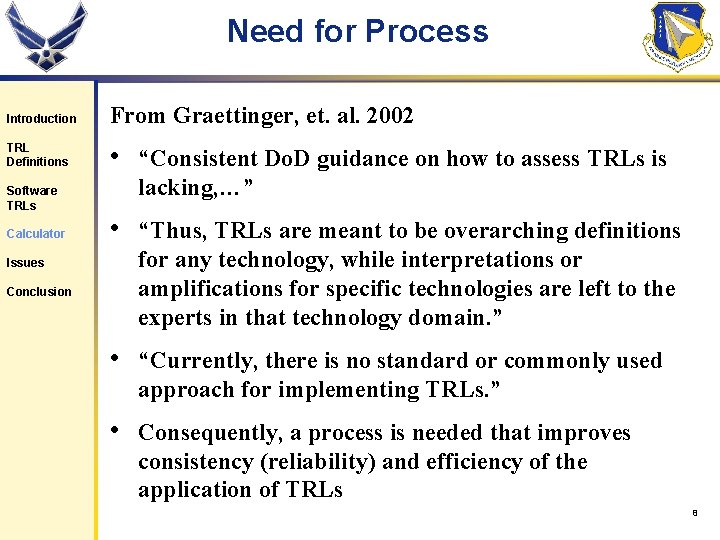
Need for Process Introduction From Graettinger, et. al. 2002 TRL Definitions • “Consistent Do. D guidance on how to assess TRLs is lacking, …” • “Thus, TRLs are meant to be overarching definitions for any technology, while interpretations or amplifications for specific technologies are left to the experts in that technology domain. ” • “Currently, there is no standard or commonly used approach for implementing TRLs. ” • Consequently, a process is needed that improves consistency (reliability) and efficiency of the application of TRLs Software TRLs Calculator Issues Conclusion 8
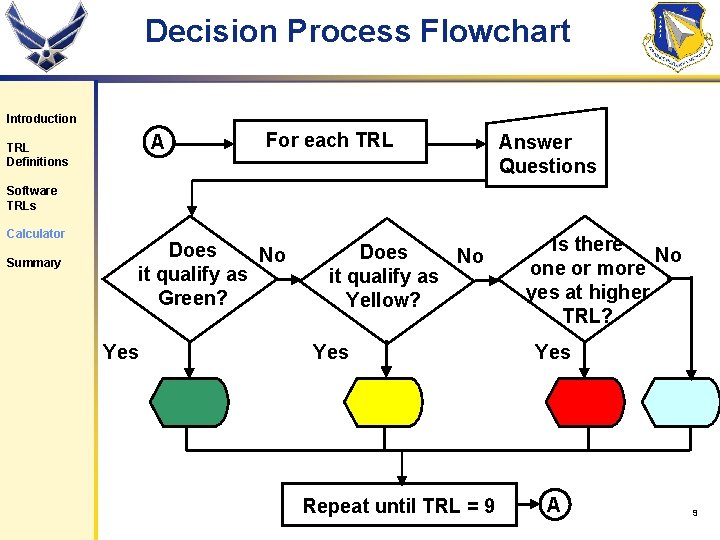
Decision Process Flowchart Introduction A TRL Definitions For each TRL Answer Questions Software TRLs Calculator Summary Does No it qualify as Green? Yes Does No it qualify as Yellow? Yes Repeat until TRL = 9 Is there No one or more yes at higher TRL? Yes A 9
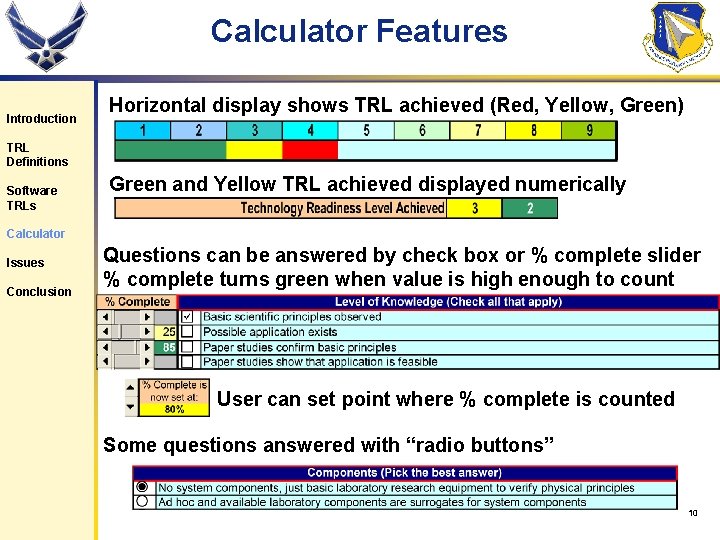
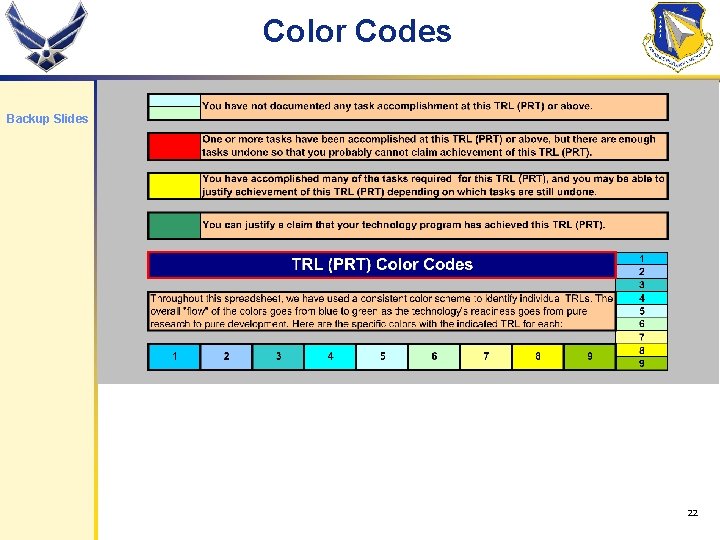
Calculator Features Introduction Horizontal display shows TRL achieved (Red, Yellow, Green) TRL Definitions Software TRLs Green and Yellow TRL achieved displayed numerically Calculator Issues Conclusion Questions can be answered by check box or % complete slider % complete turns green when value is high enough to count User can set point where % complete is counted Some questions answered with “radio buttons” 10
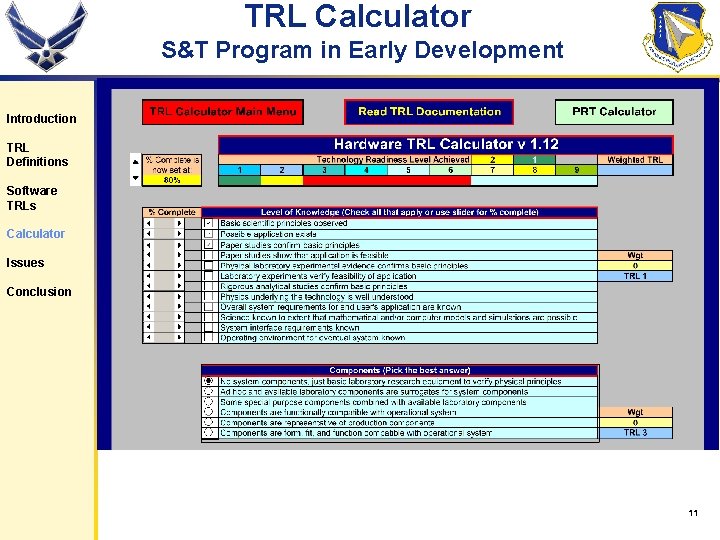
TRL Calculator S&T Program in Early Development Introduction TRL Definitions Software TRLs Calculator Issues Conclusion 11
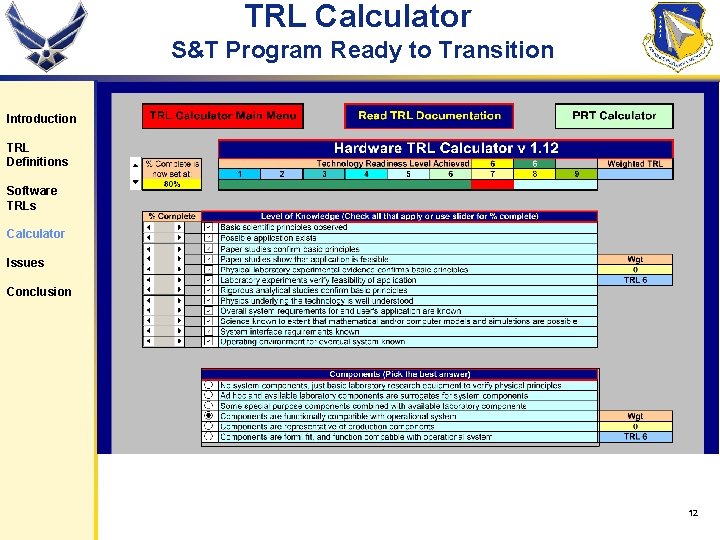
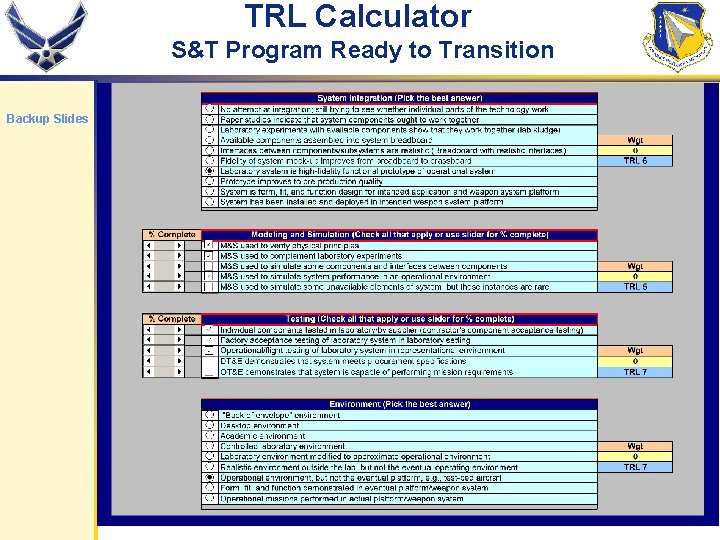
TRL Calculator S&T Program Ready to Transition Introduction TRL Definitions Software TRLs Calculator Issues Conclusion 12
Issues Introduction TRL Definitions Software TRLs • • Technology Maturity vs. Programmatics – • Calculator • • Practice Based Technology Maturity Emphasis on Community of Users If Goal Is Transition, Process Requires Both Technology Developer and Technology Receiver – • Measuring Technology Maturity Is a Multi-Dimensional Problem Producibility – Manufacturing Readiness Levels – • Pure Program Issues Measured Separately TRL Is One Dimension of Technology Maturity – Issues Conclusion Separate Versions for Hardware and Software Readiness to Receive Is a Separate Measure Statistical Validity of Calculator Not Yet Demonstrated 13
Scaling From Psychometrics Introduction TRL Definitions Software TRLs • The field of Psychometrics from Psychology provides a scientific method for creating and applying “scales” • “Scaling is the branch of measurement that involves the construction of an instrument that associates qualitative constructs with quantitative metric units. Scaling evolved out of efforts in psychology and education to measure "unmeasurable" constructs like authoritarianism and self esteem. In many ways, scaling remains one of the most arcane and misunderstood aspects of social research measurement. And, it attempts to do one of the most difficult of research tasks -- measure abstract concepts. ” Trochim • Professor Trochim, Cornell University “The science of Psychometrics will improve our TRL process” • Professor Gonzalez, U. Mich “It would be ideal to redefine categories. The other approach is a decision aid, a piece of software that asks questions and hones in on the category. ” Calculator Issues Conclusion 14
What is Scaling? Introduction TRL Definitions • “Scaling is the assignment of objects to numbers according to a rule. ” S. S. Stevens • Scaling starts with a “focus” followed by a large (>100 preferred) set of statements related to the focus. (see http: //trochim. human. cornell. edu for examples) • • Statements are then rated by participants (or judges) • A tool is then created that allows users to respond to questions and an algorithm is used to calculate the result on the scale • The TRL Calculator represents an ad hoc version of the Psychometric scaling process Software TRLs Calculator Issues Conclusion Results are analyzed and a scale is created. There are three techniques used Thurstone or Equal-Appearing Interval Scaling, Likert or "Summative" Scaling, and Guttman or "Cumulative" Scaling. 15
Conclusion Introduction TRL Definitions Software TRLs Calculator Issues Conclusion • AFRL Developed a TRL Calculator for Hardware and Software • Calculator Simplifies the Process of Applying TRLs to Research and Development Programs • Next Steps – Develop Final Set of Software Descriptions – Add Questions for Manufacturing Readiness – Add Questions for Practice Based Technologies – Formal Validation of TRL Calculator Using Psychometrics or Similar Statistical Technique 16
Discussion / Questions Introduction TRL Definitions Software TRLs Calculator Issues Conclusion 17
Backup Slides 18
TRL Definitions NASA Backup Slides 19
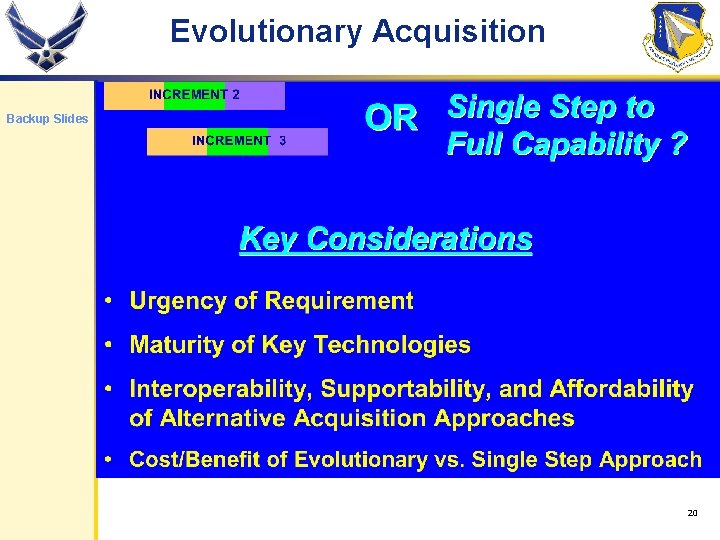
Evolutionary Acquisition Backup Slides 20
TRL Calculator Backup Slides 21
Color Codes Backup Slides 22
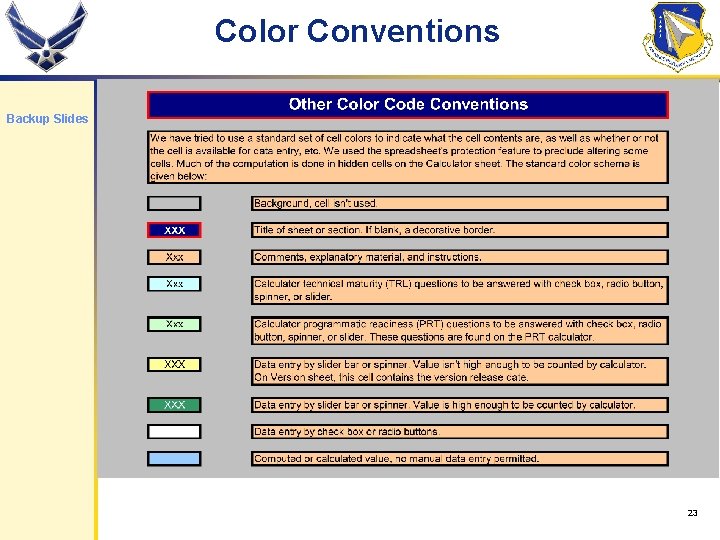
Color Conventions Backup Slides 23
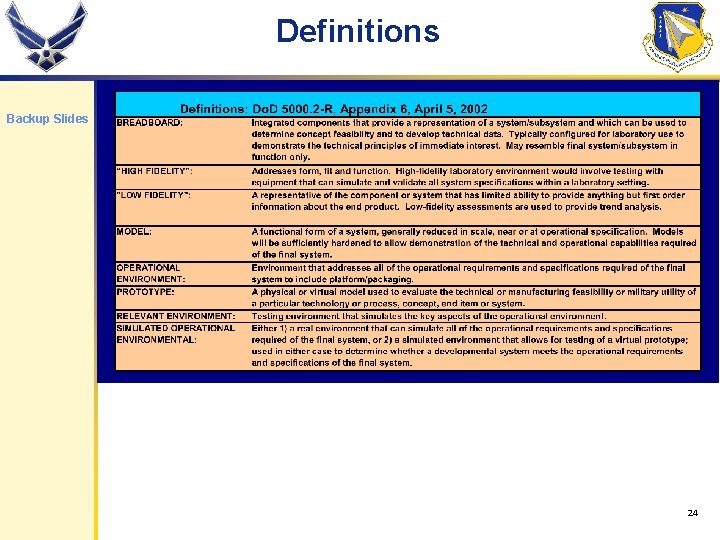
Definitions Backup Slides 24
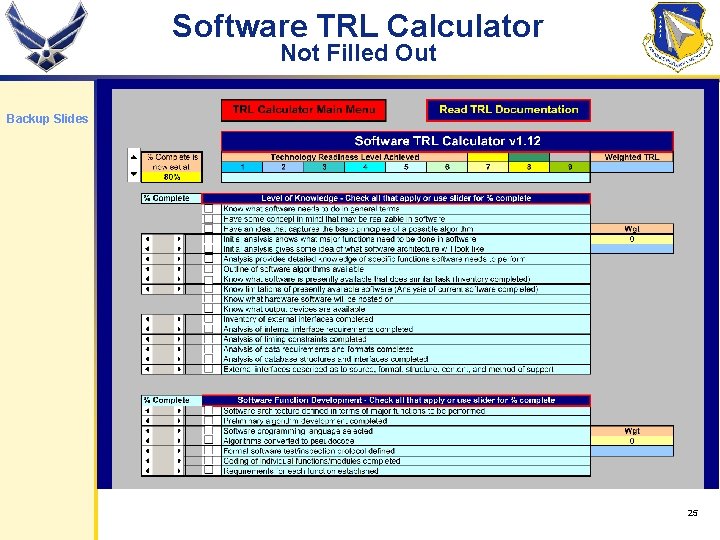
Software TRL Calculator Not Filled Out Backup Slides 25
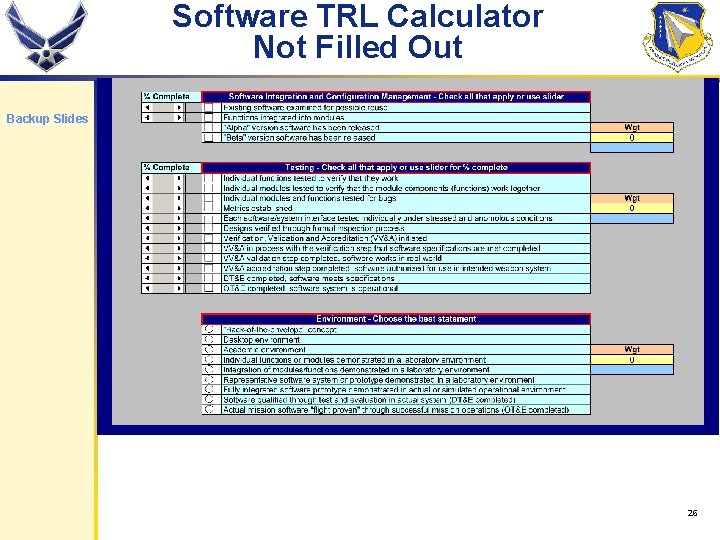
Software TRL Calculator Not Filled Out Backup Slides 26
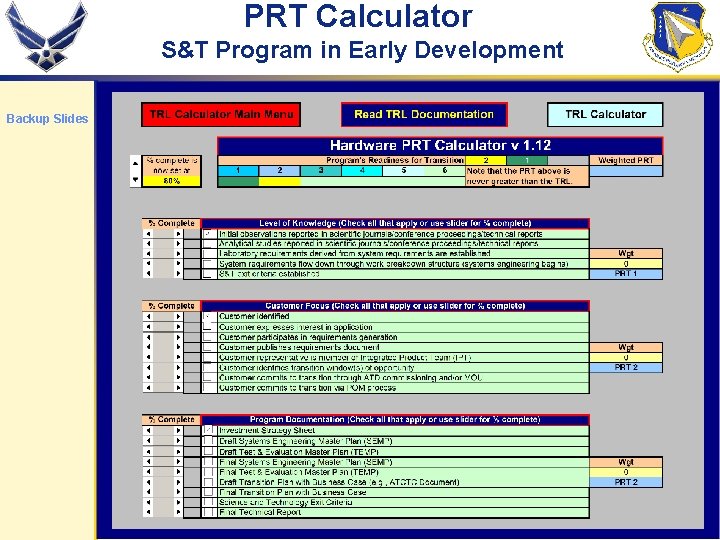
PRT Calculator S&T Program in Early Development Backup Slides 27
TRL Calculator S&T Program Ready to Transition Backup Slides 28