
Technology Protection System TPS Science and Issues Mel

- Slides: 53
Technology Protection System (TPS) Science and Issues Mel Oliver
The Need for TPS FTo protect the environment from the escape of transgenes to non-crop species FTo protect US technology FStimulate the investment by US companies in plant biotechnology
Why USDA-ARS? FTransfer of new technology to the private sector and industry is a responsibility of all Federal research agencies : - Following Laws. FFederal Technology Transfer Act of 1986 FStevenson-Wydler Act of 1980 FBahl-Dole Act of 1980 FCRADA -Cooperative Research and Development Agreement ensuring access
Benefits of Protection Systems FProtection of the environment from gene escapes into other plant species FProtection of technology provider’s investment against free use of technology FIncentive to companies to develop technologies - new products and new choices for the producer.
Genetic Protection Systems VGURT - Varietal Gene Use restriction Technology TGURT - Traite Gene Use Restriction Technology
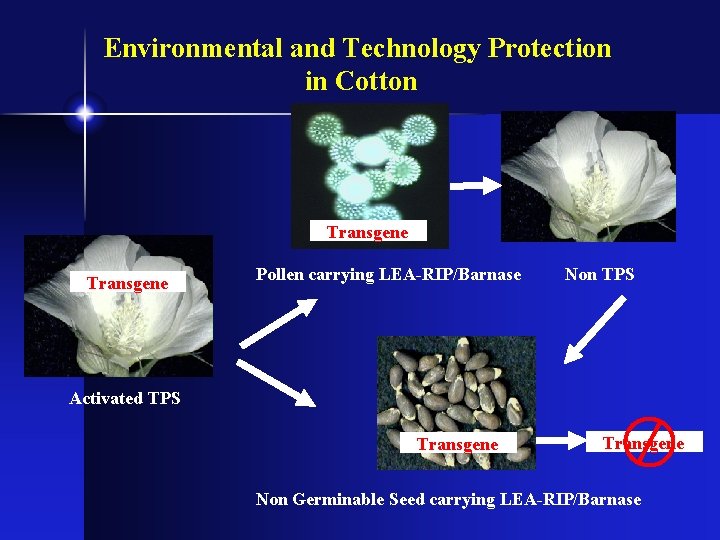
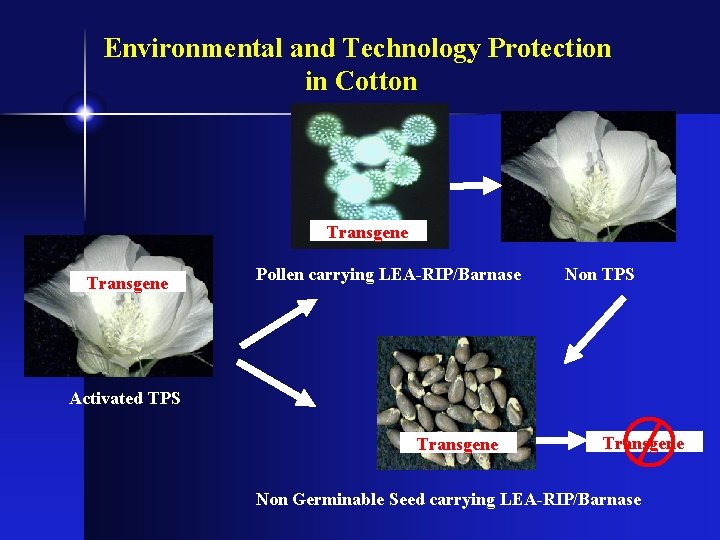
Environmental and Technology Protection in Cotton Transgene Pollen carrying LEA-RIP/Barnase Non TPS Activated TPS Transgene Non Germinable Seed carrying LEA-RIP/Barnase
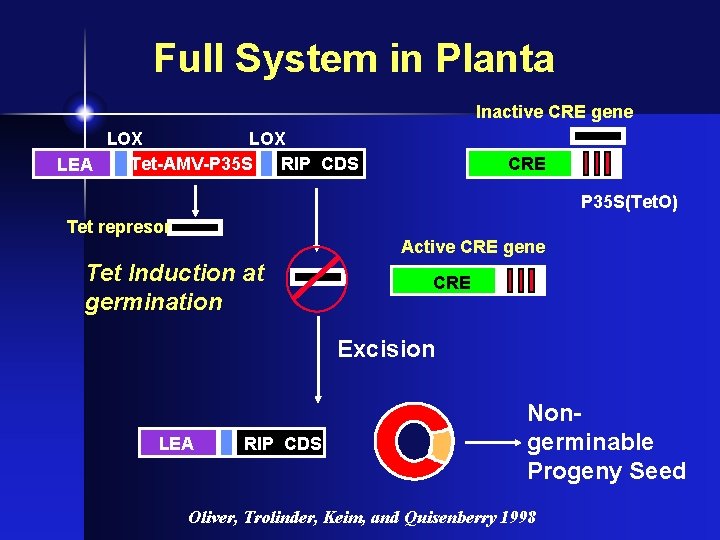
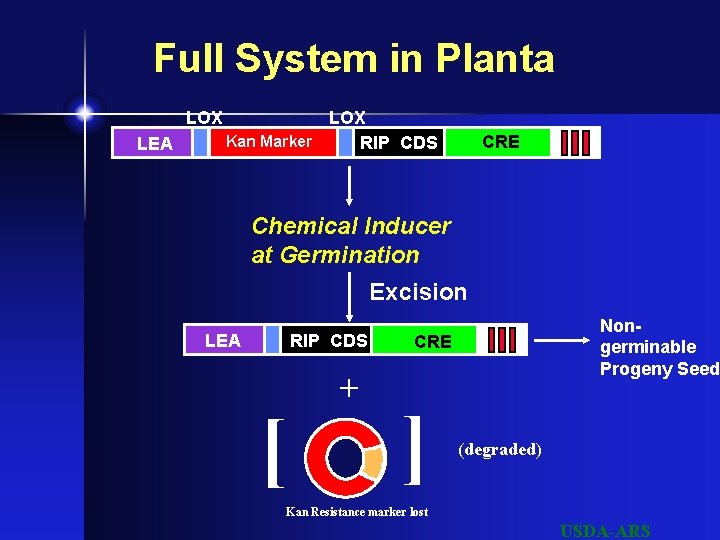
Full System in Planta Inactive CRE gene LOX Tet-AMV-P 35 S RIP CDS LEA CRE P 35 S(Tet. O) Tet represor Active CRE gene Tet Induction at germination CRE Excision LEA RIP CDS Nongerminable Progeny Seed Oliver, Trolinder, Keim, and Quisenberry 1998
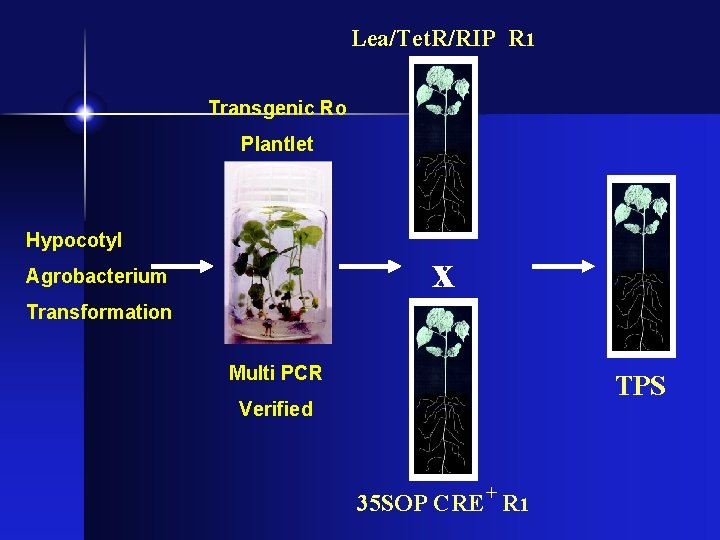
Lea/Tet. R/RIP R 1 Transgenic Ro Plantlet Hypocotyl x Agrobacterium Transformation Multi PCR TPS Verified + 35 SOP CRE R 1
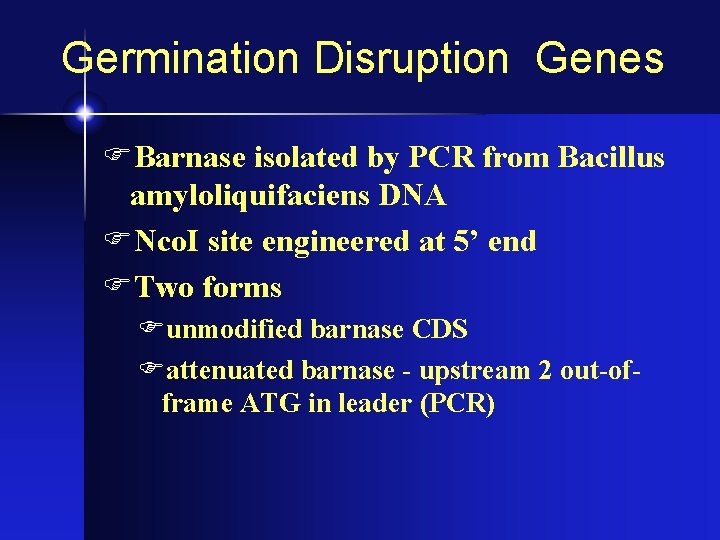
Germination Disruption Genes FBarnase isolated by PCR from Bacillus amyloliquifaciens DNA FNco. I site engineered at 5’ end FTwo forms Funmodified barnase CDS Fattenuated barnase - upstream 2 out-offrame ATG in leader (PCR)
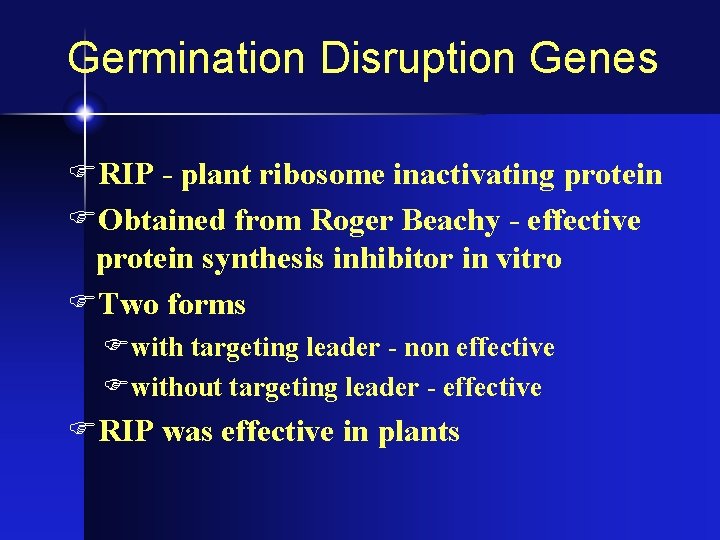
Germination Disruption Genes FRIP - plant ribosome inactivating protein FObtained from Roger Beachy - effective protein synthesis inhibitor in vitro FTwo forms Fwith targeting leader - non effective Fwithout targeting leader - effective FRIP was effective in plants
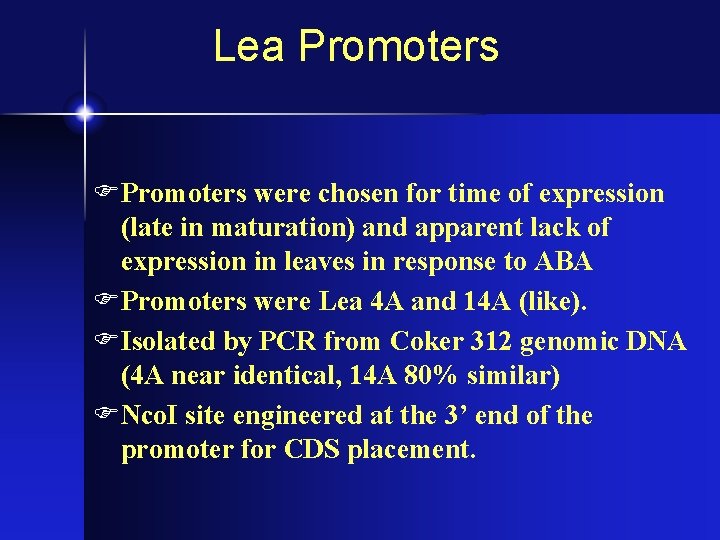
Lea Promoters FPromoters were chosen for time of expression (late in maturation) and apparent lack of expression in leaves in response to ABA FPromoters were Lea 4 A and 14 A (like). FIsolated by PCR from Coker 312 genomic DNA (4 A near identical, 14 A 80% similar) FNco. I site engineered at the 3’ end of the promoter for CDS placement.
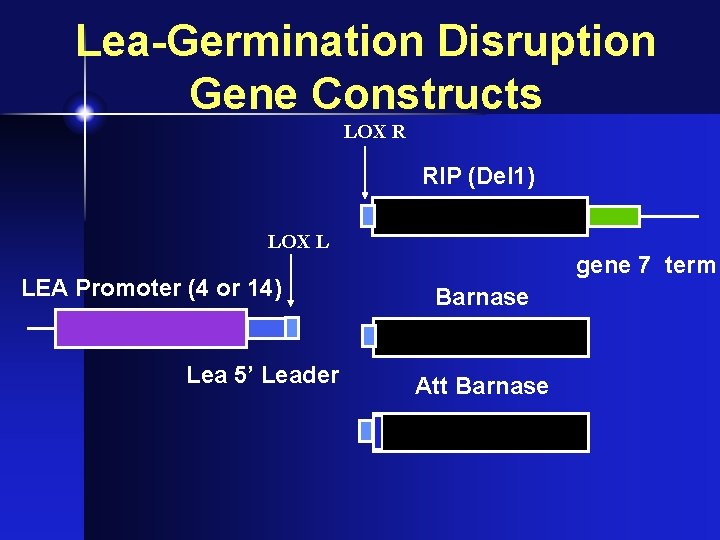
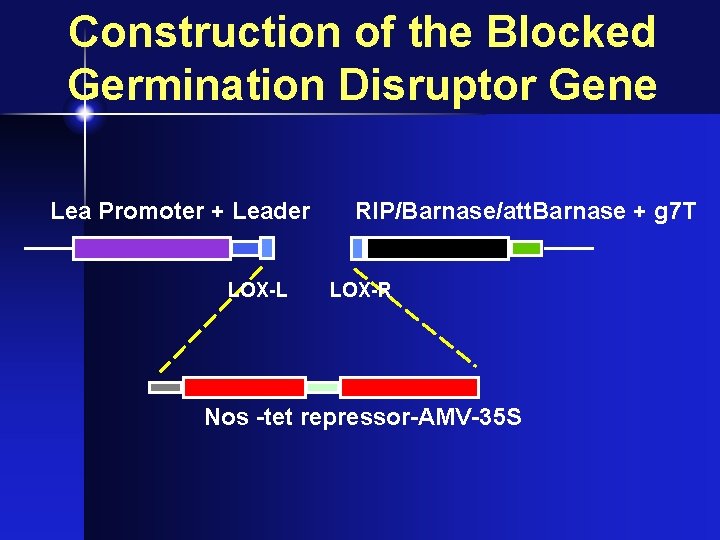
Lea-Germination Disruption Gene Constructs LOX R RIP (Del 1) LOX L LEA Promoter (4 or 14) Lea 5’ Leader gene 7 term Barnase Att Barnase
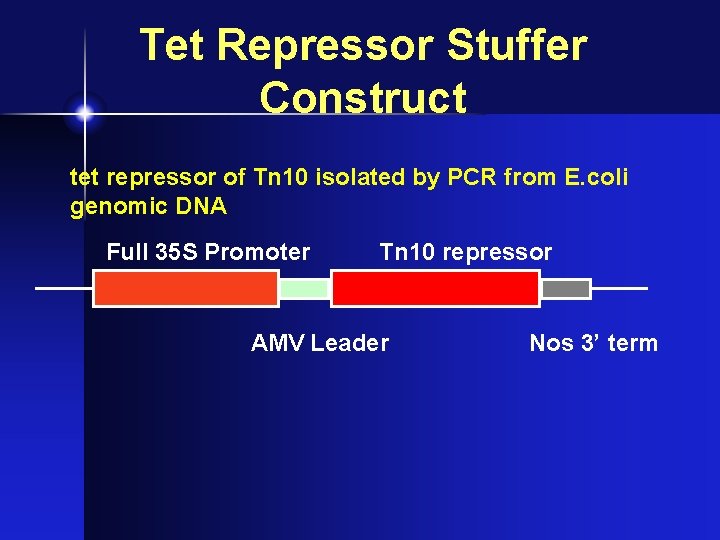
Tet Repressor Stuffer Construct tet repressor of Tn 10 isolated by PCR from E. coli genomic DNA Full 35 S Promoter Tn 10 repressor AMV Leader Nos 3’ term
LOX Sites FConstructed from oligonucleotides FCloned and sequenced to confirm FOriented to negate the insertion of an ATG codon upstream of RIP or Barnase CDS
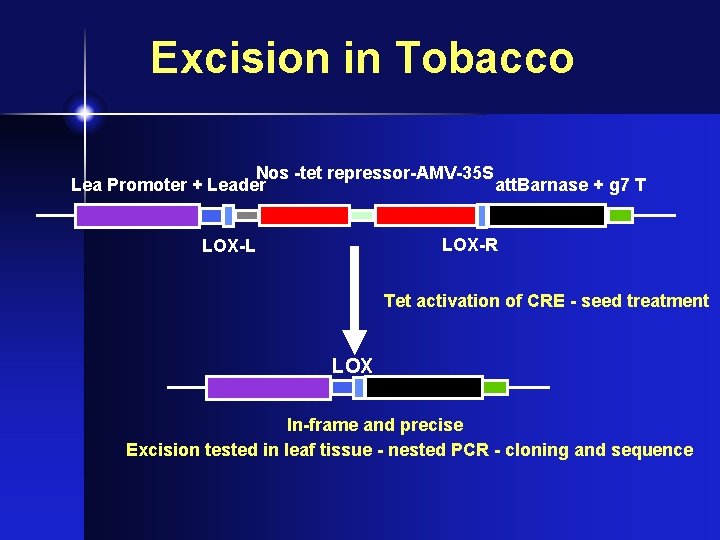
Construction of the Blocked Germination Disruptor Gene Lea Promoter + Leader LOX-L RIP/Barnase/att. Barnase + g 7 T LOX-R Nos -tet repressor-AMV-35 S
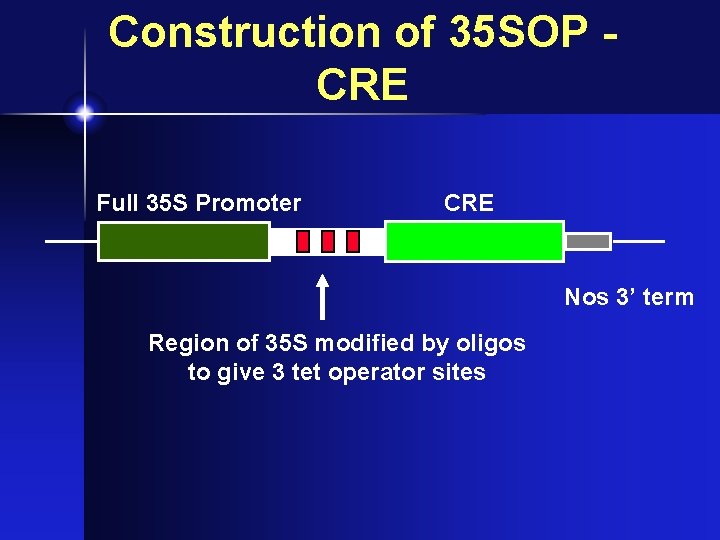
Construction of 35 SOP CRE Full 35 S Promoter CRE Nos 3’ term Region of 35 S modified by oligos to give 3 tet operator sites
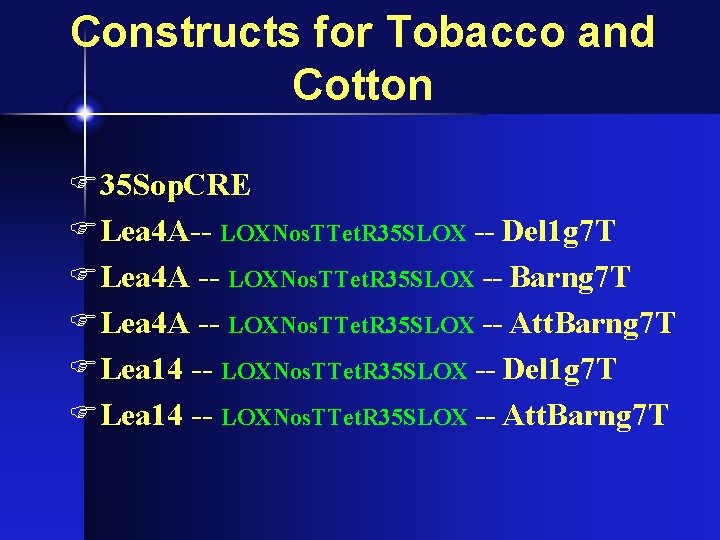
Constructs for Tobacco and Cotton F 35 Sop. CRE FLea 4 A-- LOXNos. TTet. R 35 SLOX -- Del 1 g 7 T FLea 4 A -- LOXNos. TTet. R 35 SLOX -- Barng 7 T FLea 4 A -- LOXNos. TTet. R 35 SLOX -- Att. Barng 7 T FLea 14 -- LOXNos. TTet. R 35 SLOX -- Del 1 g 7 T FLea 14 -- LOXNos. TTet. R 35 SLOX -- Att. Barng 7 T
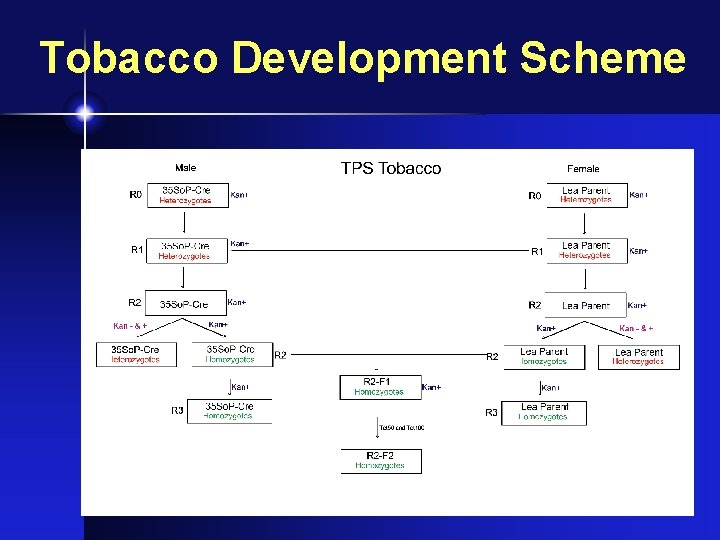
Tobacco Development Scheme
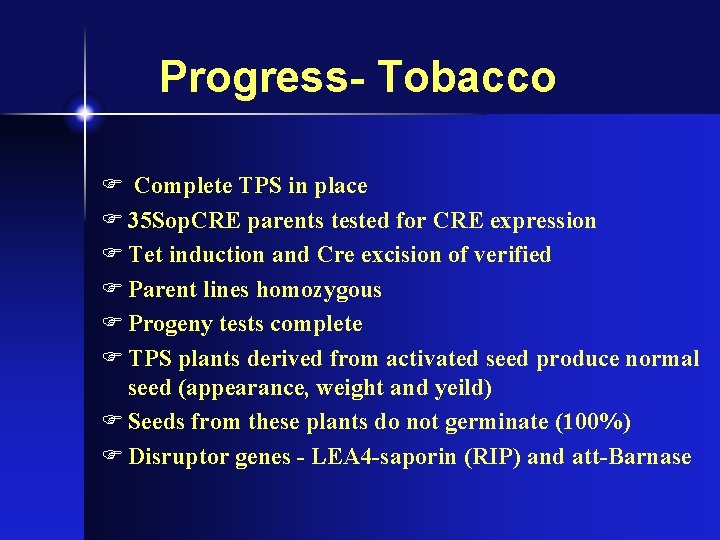
Progress- Tobacco F Complete TPS in place F 35 Sop. CRE parents tested for CRE expression F Tet induction and Cre excision of verified F Parent lines homozygous F Progeny tests complete F TPS plants derived from activated seed produce normal seed (appearance, weight and yeild) F Seeds from these plants do not germinate (100%) F Disruptor genes - LEA 4 -saporin (RIP) and att-Barnase
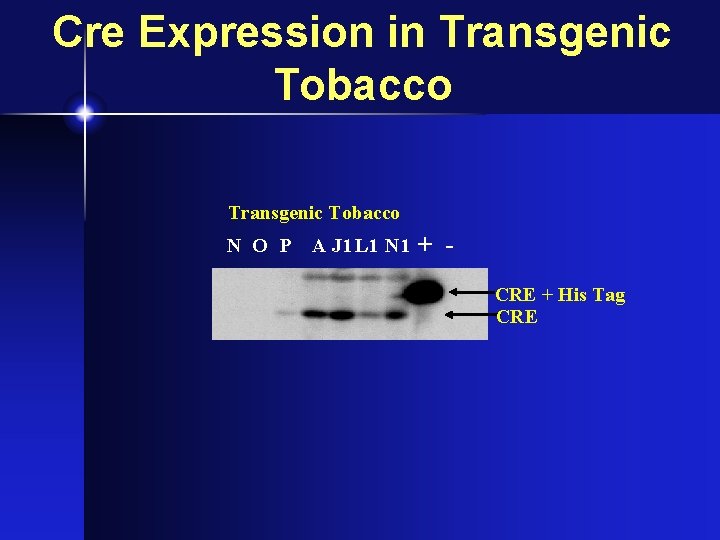
Cre Expression in Transgenic Tobacco N O P A J 1 L 1 N 1 + CRE + His Tag CRE
Excision in Tobacco Nos -tet repressor-AMV-35 S Lea Promoter + Leader att. Barnase + g 7 T LOX-R LOX-L Tet activation of CRE - seed treatment LOX In-frame and precise Excision tested in leaf tissue - nested PCR - cloning and sequence
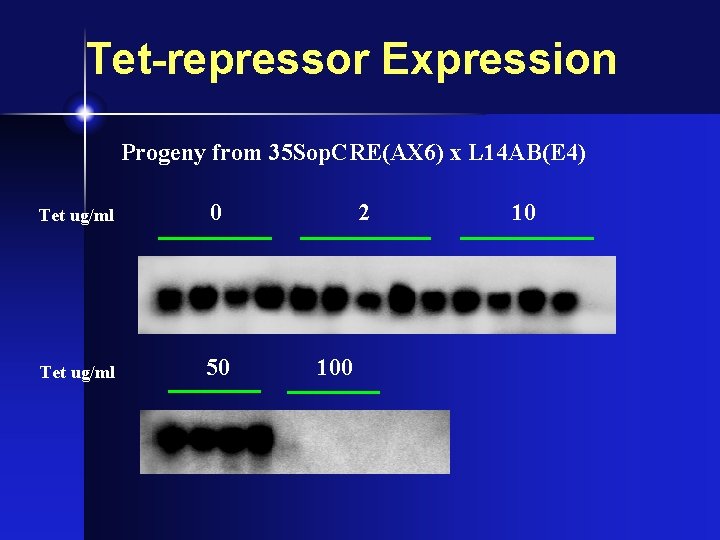
Tet-repressor Expression Progeny from 35 Sop. CRE(AX 6) x L 14 AB(E 4) Tet ug/ml 0 Tet ug/ml 50 2 100 10
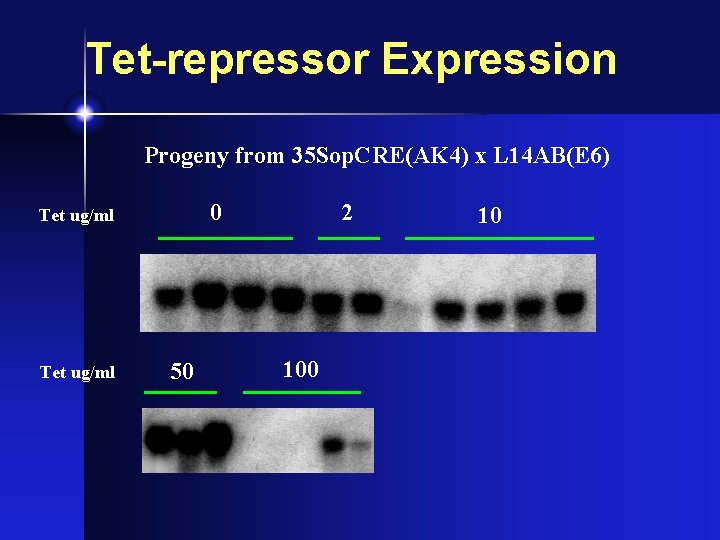
Tet-repressor Expression Progeny from 35 Sop. CRE(AK 4) x L 14 AB(E 6) 0 Tet ug/ml 50 2 100 10
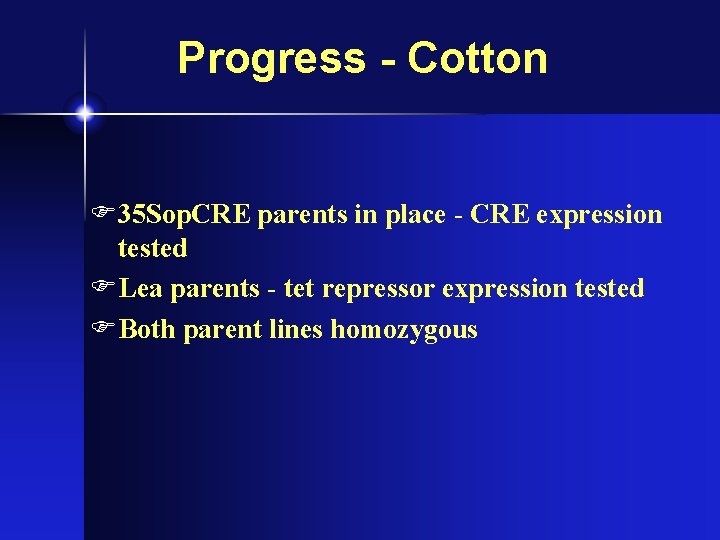
Progress - Cotton F 35 Sop. CRE parents in place - CRE expression tested FLea parents - tet repressor expression tested FBoth parent lines homozygous
Full System in Planta LOX LEA LOX Kan Marker RIP CDS CRE Chemical Inducer at Germination Excision LEA RIP CDS [ + Nongerminable Progeny Seed CRE ] (degraded) Kan Resistance marker lost USDA-ARS
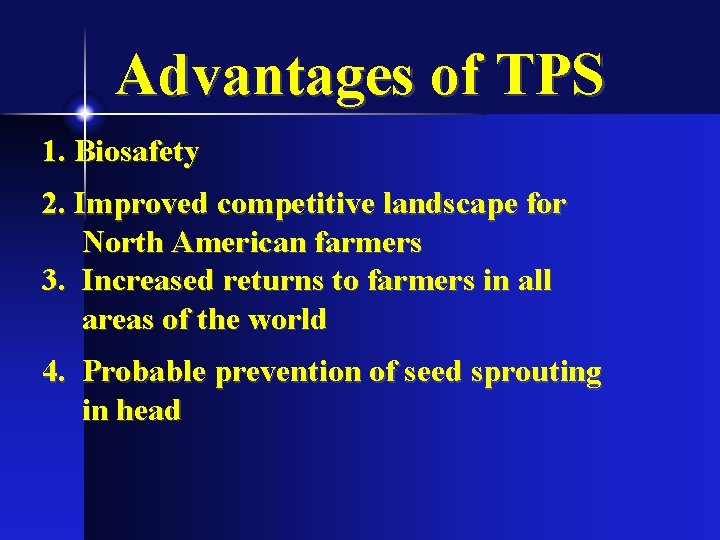
Advantages of TPS 1. Biosafety 2. Improved competitive landscape for North American farmers 3. Increased returns to farmers in all areas of the world 4. Probable prevention of seed sprouting in head
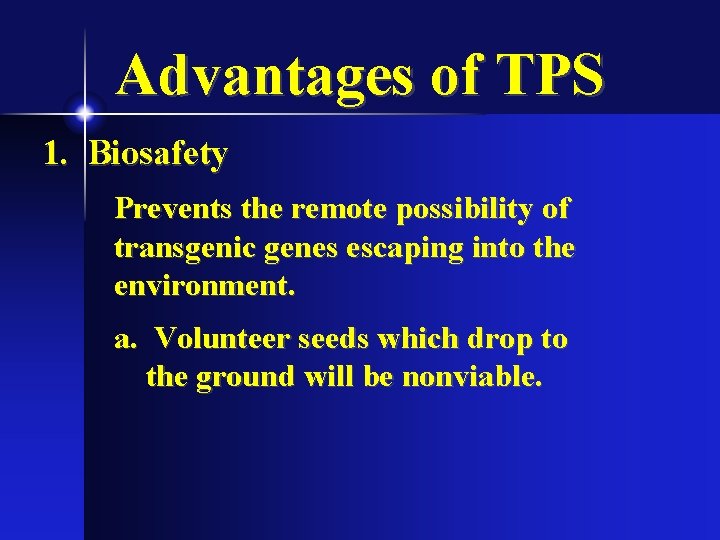
Advantages of TPS 1. Biosafety Prevents the remote possibility of transgenic genes escaping into the environment. a. Volunteer seeds which drop to the ground will be nonviable.
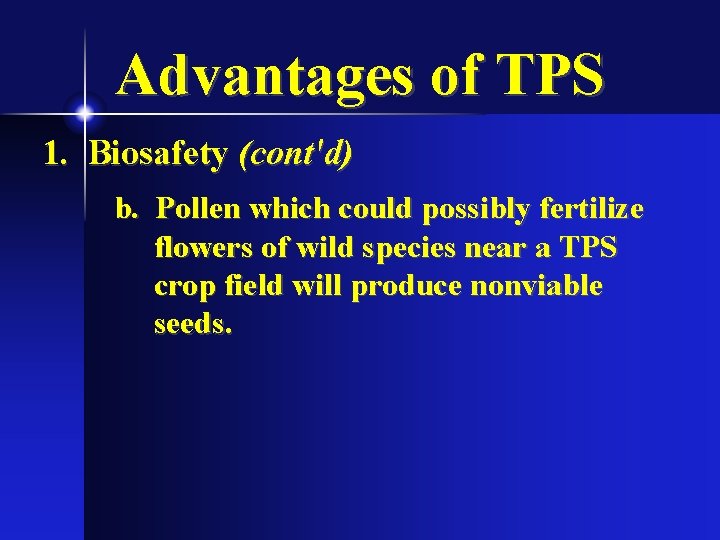
Advantages of TPS 1. Biosafety (cont'd) b. Pollen which could possibly fertilize flowers of wild species near a TPS crop field will produce nonviable seeds.
Environmental and Technology Protection in Cotton Transgene Pollen carrying LEA-RIP/Barnase Non TPS Activated TPS Transgene Non Germinable Seed carrying LEA-RIP/Barnase
Advantages of TPS 2. Improved competitive landscape for North American farmers. TPS will provide a more level playing field for North American farmers as farmers in other countries will also have to pay for improved varieties and transgenic traits.
Advantages of TPS 2. Improved competitive landscape for North American farmers. a. Varieties have been pirated out of North America. b. Transgenic traits have been pirated out of North America.
Advantages of TPS 3. Increased returns to farmers Because of the possibility of a return on investment in breeding research, many more improved varieties should be available. a. In crops which have not been given optimum breeding attention; - wheat - soybeans - rice
Advantages of TPS 3. Increased returns to farmers (cont'd) b. In countries in which breeding research has not been at a level proportionate to their agricultural importance. c. Transgenic traits may be more available to farmers in crops and countries in which they have not been.
Farmers will not pay directly for TPS.
TPS will be broadly available to both large and small seed firms in the U. S. and in other countries. Therefore, TPS itself will not confer a competitive advantage.
The competitive advantage for seed firms will only be gained through increased breeding of superior varieties. This is a distinct advantage of the farmers.
Farmers will buy seed carrying TPS only if they receive a return on their investment, such as; a. Improved yields b. Improved quality traits c. More and better pest resistance
Farmers will continue to have seed of non-TPS varieties available to them.
Advantages of TPS 4. Probable prevention of seed sprouting in the head prior to harvest
Genetic Diversity There should be no correlation between TPS and reduced genetic diversity.
Global Perceptions of the TPS
The Reaction of North American Farmers to the TPS Technology
Misconceptions Concerning the Technology Protection System (TPS)
MISCONCEPTION: Seed sterility can spread and wipe out populations and species. FACTS: • Sterile seeds do not produce plants and those nonexistent plants cannot produce pollen to spread the sterility trait. • The sterility trait lasts only one generation and by definition, does not propagate itself.
MISCONCEPTION: Home gardeners will not be able to save seed because of TPS. FACTS: • Garden vegetable and flower varieties are not targets for TPS because of the small markets and acreage and the difficulty and costs related to converting, through biotechnology, many different species and varieties to TPS.
MISCONCEPTION: Gardeners will be prevented from providing viable seeds of heirloom vegetable varieties to others. FACTS: • Because of the effort and cost, seed companies will not incorporate TPS into old heirloom varieties. Seed companies are more interested in protecting new varieties carrying technically advanced traits.
MISCONCEPTION: Farmers will not be able to save seed of non. TPS crops in field adjacent to TPS crops. FACTS: • The large targeted crops of soybean, wheat and rice are highly self pollinated. Therefore, the farmers' crop will already be pollinated by its own pollen before being pollinated by sterile pollen from TPS plants.
MISCONCEPTION: Farmers will have to use TPS varieties. FACTS: • Farmers will continue to have the choice of planting TPS varieties or non-TPS varieties. They will make their choice based on whether they get a payback on their investment in the seed cost each year.
MISCONCEPTION: TPS will put the farmers at a disadvantage. FACTS: • It should make more and better varieties available to farmers, in particular varieties carrying new technologies e. g. , transgenic traits. • New genetics would be available in crops and geographic areas which, at this time, are receiving insufficient attention.
MISCONCEPTION: Farmers are against TPS. FACTS: • Much interest and support for TPS has been shown by American farmers, both by individuals and by farmer organizations such as the Sunflower Association, the National Cotton Council and the National Grain Sorghum Producers.
MISCONCEPTION: TPS would be dangerous for the environment. FACTS: • TPS is environmentally friendly • TPS could be an important tool in preventing the escape of transgenic traits to wild species through pollen.
Skepticism for "New" Genetics “We have recently advanced our knowledge of genetics to a point where we can manipulate life in a way never intended by nature -- We must proceed with the utmost caution in the application of this new found knowledge. ”
1906 Critique of Luther Burbank's Studies on Hybrid Plants