
Technology Plan for the Coherent Subsystem of a
Technology Plan for the Coherent Subsystem of a Space-Based Hybrid Doppler Wind Lidar M. Kavaya, F. Amzajerdian, U. Singh J. Yu, D. Emmitt 16 July 2002 Working Group on Space. Based Lidar Winds 10/19/2021 1
The Hybrid DWL Approach • Direct detection component will be optimized to provide wind observations in the cloud free mid and upper troposphere (potentially lower stratosphere also) • Coherent detection component will be optimized for the lower troposphere and cloudy regions • The cost and time (and risk) of technology development is reduced 10/19/2021 2
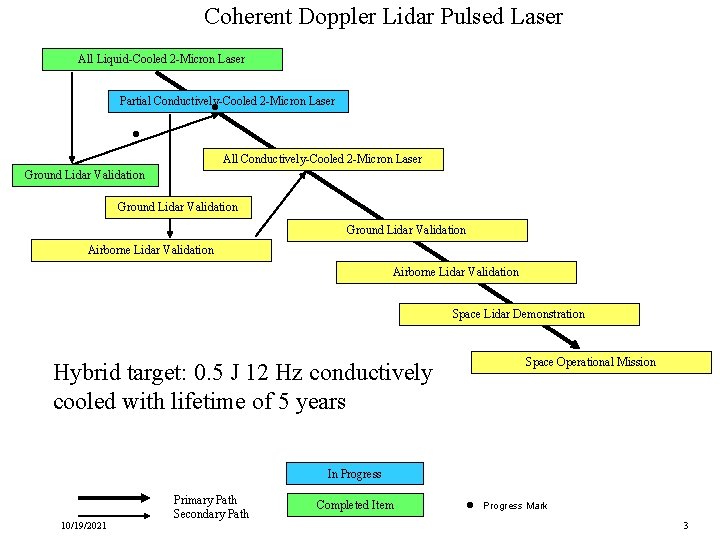
Coherent Doppler Lidar Pulsed Laser All Liquid-Cooled 2 -Micron Laser Partial Conductively-Cooled 2 -Micron Laser l l All Conductively-Cooled 2 -Micron Laser Ground Lidar Validation Airborne Lidar Validation Space Lidar Demonstration Space Operational Mission Hybrid target: 0. 5 J 12 Hz conductively cooled with lifetime of 5 years In Progress 10/19/2021 Primary Path Secondary Path Completed Item l Progress Mark 3
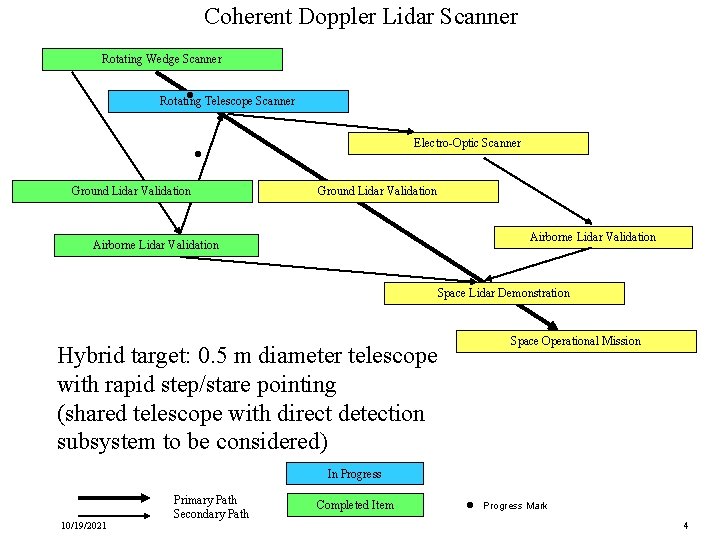
Coherent Doppler Lidar Scanner Rotating Wedge Scanner l Rotating Telescope Scanner Electro-Optic Scanner l Ground Lidar Validation Airborne Lidar Validation Space Lidar Demonstration Space Operational Mission Hybrid target: 0. 5 m diameter telescope with rapid step/stare pointing (shared telescope with direct detection subsystem to be considered) In Progress 10/19/2021 Primary Path Secondary Path Completed Item l Progress Mark 4
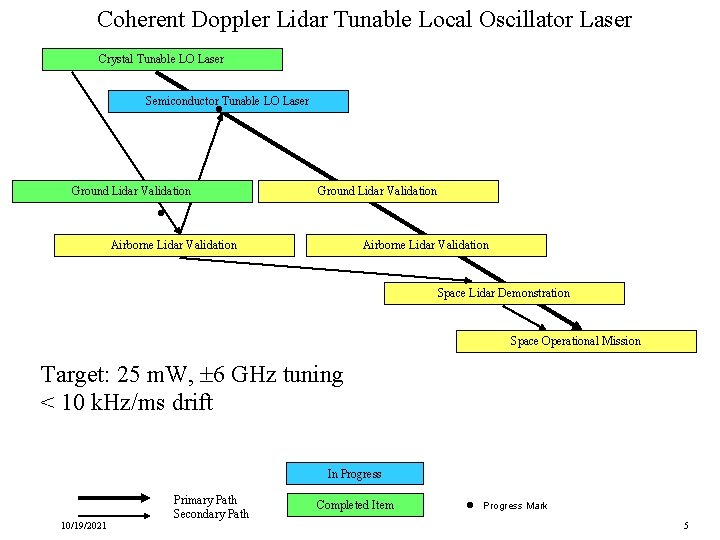
Coherent Doppler Lidar Tunable Local Oscillator Laser Crystal Tunable LO Laser Semiconductor Tunable LO Laser l Ground Lidar Validation l Airborne Lidar Validation Space Lidar Demonstration Space Operational Mission Target: 25 m. W, ± 6 GHz tuning < 10 k. Hz/ms drift In Progress 10/19/2021 Primary Path Secondary Path Completed Item l Progress Mark 5
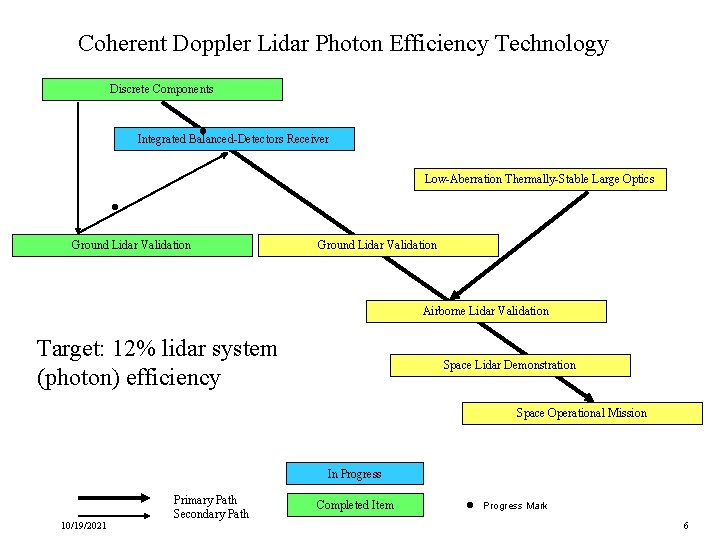
Coherent Doppler Lidar Photon Efficiency Technology Discrete Components l Integrated Balanced-Detectors Receiver Low-Aberration Thermally-Stable Large Optics l Ground Lidar Validation Airborne Lidar Validation Target: 12% lidar system (photon) efficiency Space Lidar Demonstration Space Operational Mission In Progress 10/19/2021 Primary Path Secondary Path Completed Item l Progress Mark 6

Coherent Doppler Lidar Autoalignment Technology Alignment Controller & Mirror Actuator l Alignment Algorithm l l Detector Array Wavefront Sensor And Corrector Ground Lidar Validation Airborne Lidar Validation Hybrid target: < 150 mrad alignment (where beam is 1 cm diameter) Space Lidar Demonstration Space Operational Mission In Progress 10/19/2021 Primary Path Secondary Path Completed Item l Progress Mark 7
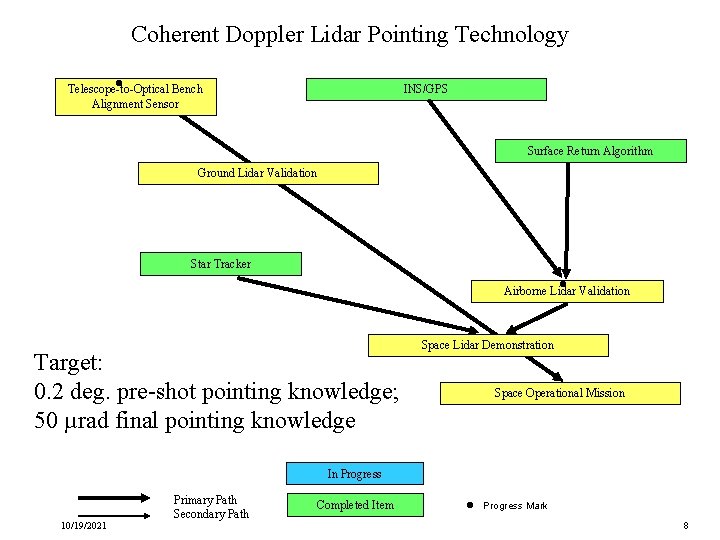
Coherent Doppler Lidar Pointing Technology l INS/GPS Telescope-to-Optical Bench Alignment Sensor Surface Return Algorithm Ground Lidar Validation Star Tracker l Airborne Lidar Validation Target: 0. 2 deg. pre-shot pointing knowledge; 50 µrad final pointing knowledge Space Lidar Demonstration Space Operational Mission In Progress 10/19/2021 Primary Path Secondary Path Completed Item l Progress Mark 8
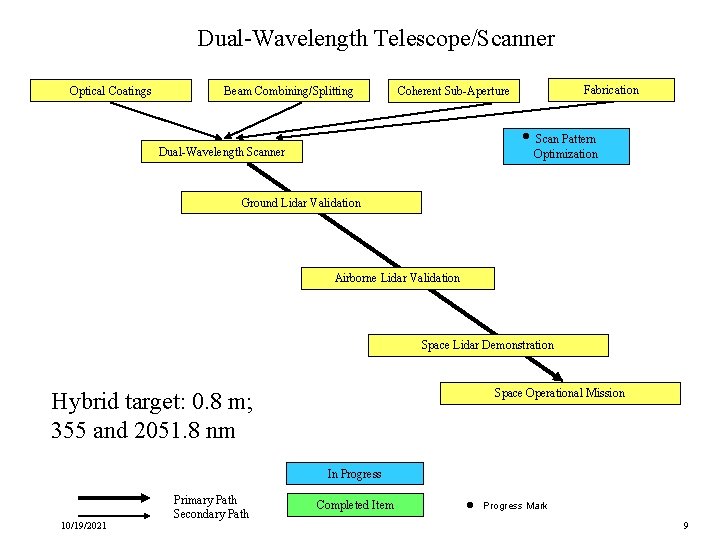
Dual-Wavelength Telescope/Scanner Optical Coatings Beam Combining/Splitting Fabrication Coherent Sub-Aperture l Dual-Wavelength Scanner Scan Pattern Optimization Ground Lidar Validation Airborne Lidar Validation Space Lidar Demonstration Space Operational Mission Hybrid target: 0. 8 m; 355 and 2051. 8 nm In Progress 10/19/2021 Primary Path Secondary Path Completed Item l Progress Mark 9
Conclusions • The hybrid Doppler wind lidar may be the optimum solution to the difficult global wind measurement opportunity • The technology roadmap to a hybrid DWL is consistent and almost identical to the former “go it alone” technology paths • There is much studying to do regarding shared technology, shared scan patterns, and shared spacecraft 10/19/2021 10

BACK UP SLIDES 10/19/2021 11

Progress Mark Explanations • Pulsed Laser – – – • Scanner – – – • – CTI measured discrete component system efficiency (1999 CLRC, p. 247) • (LSECTI = LSELARC * 0. 46 * 0. 955 = LSELARC * 0. 44 = LSELARC/2. 28) La. RC developing integrated receiver, begun FY 02 (ALTP/ECTP/LRRP) Autoalignment – – – • JPL crystal LO validated on ground by CTI (SPARCLE PDR, 12/98) JPL semiconductor laser under development (ATIP) Photon Efficiency – • Rotating wedge validated on aircraft by MSFC (MACAWS) Rotating telescope concept examined by GSFC ISAL/IMDC teams La. RC developing low-mass telescope, begun FY 02 (ALTP/ECTP/LRRP) LO Laser – – • La. RC all-liquid laser validated on the ground already; 700 m. J CTI all-liquid laser, different material, validated in aircraft La. RC partial CC laser close to completion CTI SBIR produced 5 -element detector array U. Colorado developed detector array theory and algorithm Mirror and controller are COTS; not procured yet Pointing – – – 10/19/2021 GSFC IMDC team designed telescope sensor (2/02) SPARCLE procured INS/GPS (SIGI) SWA developed surface return algorithm TODWL tested surface return algorithm on aircraft (LAHDSSA) GSFC IMDC team stated that current star trackers are adequate (2/02) 12
- Slides: 12