
Technology Organisational Change Guy Harley Bachelor of Law
Technology & Organisational Change Guy Harley § Bachelor of Law (University of Adelaide – 1978) § Barrister and Solicitor in Adelaide for 18 years § Master of Business (e. Business) (University of SA 2001) § Contact Information • (02) 4570 1116 • guy@harley. net. au
Technology & Organisational Change Dates for 2 nd Semester § § Classes start 14 July Tutorials start – 21 July Classes finish – 29 September Exams – 9 to 16 October
Technology & Organisational Change Course Assessment § Exam 70% § Internal assessment 30% § Essay plan 18 th August 2004 - 5% § Essay 8 th September 2004 - 25% § To pass subject, students must § 40% or more in exam, and § 50% or more overall
Technology & Organisational Change Course Assessment (cont. ) § Penalty for late submission of assessments is 5% per day off maximum possible mark § Extension are only granted for serious medical or personal events. § Requests for an extension must be made in advance and must be accompanied with medical or other evidence. § Students who miss assessments because of illness must provide a medical certificate within 72 hours. § Students must complete an assessment cover sheet (lecturer must sign it).
Technology & Organisational Change Plagiarism § Copying the work of someone else and passing it off as your own § Failing to acknowledge the source of information you have used § Plagiarism is STEALING § You will receive a mark of zero for a substantially plagiarised assignment § If you plagiarise more than twice you may have your enrolment cancelled
Technology & Organisational Change Text Book § Hanson & Dowling, 2003, “Strategic Management Competitiveness & Globalisation: A Pacific Rim Focus”, Thomas Nelson, Australia
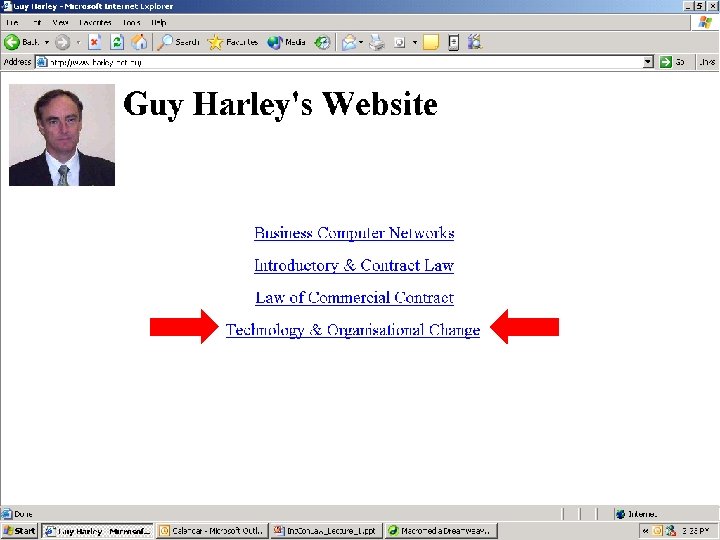
Technology & Organisational Change Resources § www. harley. net. au § § § Lecture slides Tutorial exercises Notices Course outline including assessment Links Writing guides
Technology & Organisational Change

Technology & Organisational Change
Technology & Organisational Change Resources (cont. ) § La Trobe IT web site § http: //ironbark. bendigo. latrobe. edu. au/courses /subjects/Subjects. html § A. C. N. Website § http: //resource. auscampus. net § Libraries § La. Trobe Online § UTS
Technology & Organisational Change Academic Support § Thursdays 12. 00 pm – help with planning assignments, study skills, reading & writing § Essay writing for exams Mon 29 March & 5 April, 4. 30 pm – 6. 30 pm § Answering multiple choice questions Mon 3 May 4. 30 pm – 6. 30 pm § Answering short answer questions Mon 17 May 4. 30 pm – 6. 30 pm
Technology & Organisational Change What is required of you? § Spend the same amount of time in private study as you do in class § Read textbook and notes every week § Attend lectures and TAKE NOTES § Prepare for tutorials in advance § Be prepared to ask and answer questions § Complete all assessments on time § Participate fully in all group activities
Technology & Organisational Change Do you want to pass this subject? § In an Australian university learning is YOUR responsibility. It is up to you to be selfdisciplined and keep up to date § Begin reading your textbook TODAY § Attend free classes on essay writing § Ask your lecturer to explain if you don’t understand something. § Give priority to your study over part time work
Technology & Organisational Change Strategic Management & Competitiveness Hanson & Dowling Chapter 1

Technology & Organisational Change § Strategic Competitiveness Where a firm formulates and implements a value creating strategy § Sustainable Competitive Advantage A value creating strategy that other firms cannot easily duplicate § Strategic Management Process The set of commitments, decisions and actions required for a firm to achieve strategic competitiveness

Technology & Organisational Change External Environment Internal Environment Strategic Intent Strategic Mission Strategy Implementation Strategy Formulation Strategic Competitiveness Feedback Loop Above Average Returns
Technology & Organisational Change Strategy - A Continual Challenge § 30% of companies in Australia’s top 100 drop off every 10 years. § Andrew Grove - Intel’s former CEO § Only paranoid companies survive § Anticipate the unexpected
Technology & Organisational Change 21 st Century Competitive Landscape § § Convergence The Global Economy Globalisation Technology
Technology & Organisational Change Convergence § Industries § Technologies The Global Economy § Goods, services, people, skills & ideas move freely across geographical borders § Europe has replaced USA as world’s largest single market § Countries pursue a national competitive advantage
Technology & Organisational Change Globalisation § The spread of economic innovations, together with political & cultural adjustments, around the world § Encourages international integration § Global corporations § Global standards § Emerging economies § Challenges § Managing diversified operations § New skill sets foreign environments § Maintaining concentration on domestic market
Technology & Organisational Change Technology § Increasing rate of Change & Diffusion § Shorter product life cycles § Promotes first mover advantage § Reduces protection from patents § Information Age § Speed & Reach of dissemination § Networking § e. Business
Technology & Organisational Change Technology (cont. ) § Knowledge Management § § Capture Transform Distribute Exploit
Technology & Organisational Change Strategic Agility § Ability to respond quickly to changes in the environment § Requires organisational learning
Technology & Organisational Change Strategic Models § Industrial Organisation Model § Emphasises influence of external environment § Resource Based Model § Emphasises firm’s internal resources § Research § 20% of profitability comes from industry § 36% from firm’s characteristics & actions § Use both together
Technology & Organisational Change Industrial Organisation Model § Challenges firms to § find most attractive industry in which to compete § then develop internal skills
Technology & Organisational Change Industrial Organisation Model (cont. ) § 4 underlying assumptions § External environment imposes pressures & constraints that determine strategy § Firms in an industry have similar resources & strategies § Resources used to implement strategies are mobile across firms § Organisational decision makers are rational
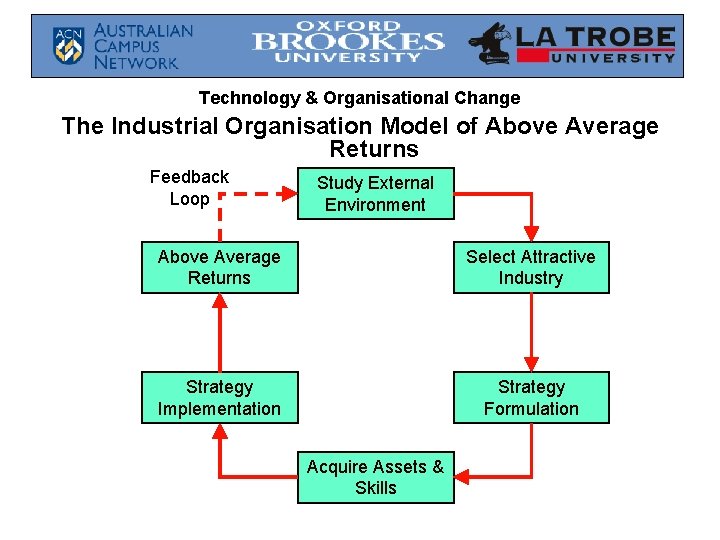
Technology & Organisational Change The Industrial Organisation Model of Above Average Returns Feedback Loop Study External Environment Above Average Returns Select Attractive Industry Strategy Implementation Strategy Formulation Acquire Assets & Skills
Technology & Organisational Change Industrial Organisation Model (cont. ) § Promotes strategies of: § Cost-leadership § Differentiation § Focus-differentiation § Uses 5 forces model to analyse external environment
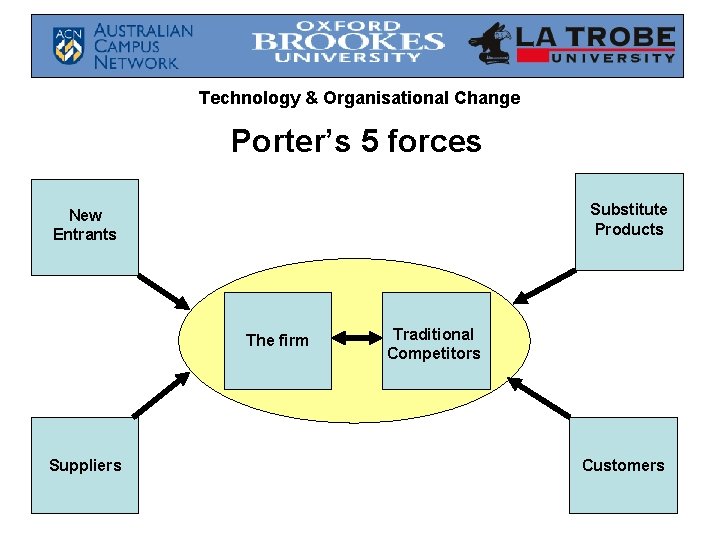
Technology & Organisational Change Porter’s 5 forces Substitute Products New Entrants The firm Suppliers Traditional Competitors Customers
Technology & Organisational Change Resource Based Model § Assumes § Each organisation is a collection of unique resources and capabilities § Differences in firm’s performance are driven by differences in firm’s resources and capabilities § Over time firms develop different resources and capabilities § Not all firms in an industry possess the same resources and capabilities § Resources may not be highly mobile across a firm
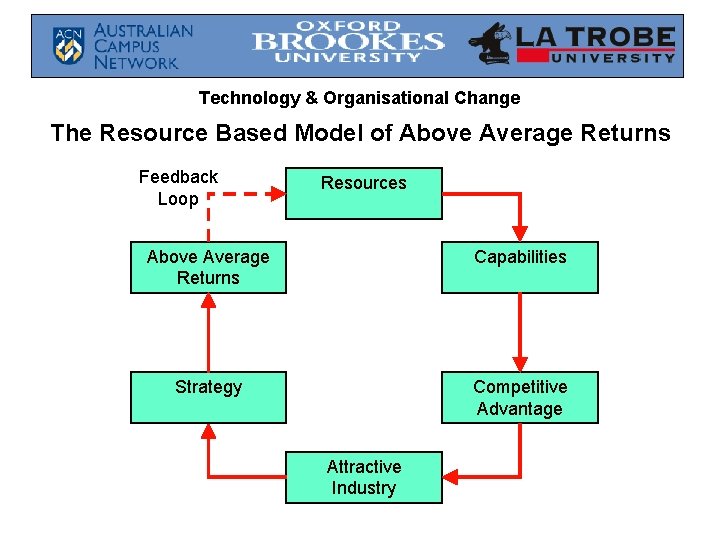
Technology & Organisational Change The Resource Based Model of Above Average Returns Feedback Loop Resources Above Average Returns Capabilities Strategy Competitive Advantage Attractive Industry
Technology & Organisational Change Resources § 3 types § Physical § Human § Organisational Capability § The capacity for a set of resources to integratively perform a task
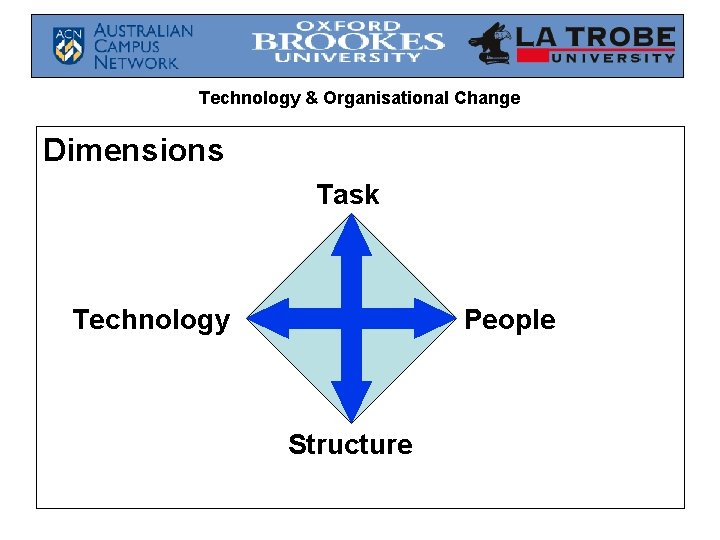
Technology & Organisational Change Dimensions Task Technology People Structure
Technology & Organisational Change Competitive Advantage § Occurs when resources and capabilities are: § § Valuable, Rare, Costly to imitate, and Non-substitutable § They are valuable when they take advantage of opportunities or neutralise threats § When all 4 criteria are met they become core competencies
Technology & Organisational Change Strategic Intent § The leveraging of a firm’s internal resources, capabilities and core competencies to accomplish the firm’s goals in a competitive environment § Exists only when all levels of the firm are committed to a specific and significant performance criterion § A firm must also identify its competitors strategic intent
Technology & Organisational Change Strategic Mission § A statement of a firm’s unique purpose and scope of operations in product and market terms § Flows from Strategic Intent § It is externally focused
Technology & Organisational Change Stakeholders § Individuals and groups that § Affect or are affected by the strategic outcomes achieved, and § Have enforceable claims on a firm’s performance § Firm’s depend on stakeholders § Stakeholders can influence a firm’s operations
Technology & Organisational Change Classification of Stakeholders § Capital Market Stakeholders § Shareholders § Suppliers of capital (e. g. banks) § Product Market Stakeholders § § Customers Suppliers Host communities Unions § Organisational Stakeholders § Employees § Managers
Technology & Organisational Change Managing Stakeholders § Firm must manage and prioritise competing stakeholder demands § Society’s standards influence the weightings allocated amongst the 3 stakeholder groups § Different cultures have different weightings § A Transnational firm must have a global mindset
Technology & Organisational Change Strategy Success Factors § § § § Hard work Thorough analysis Brutally honest Common sense Speed & Flexibility Acceptance of change & innovation A desire for the firm and its people to accomplish more Encourage others to think and enquire what firm is doing and why
Technology & Organisational Change Strategy Pitfalls § Changes in strategic assumptions § Strategic mission may become a strategic blinder § Operational routines create strategic inertia § Established relationships prevent change § Shared beliefs become dogmas that prevent a change in organisational culture
Technology & Organisational Change Organisational Culture § Definition: § The complex set of ideologies, symbols and core values § Shared throughout the firm § That influences the way it conducts business § Includes organisational ethics
- Slides: 42