
Technology Economics and the Importance of Software Process



- Slides: 48
Technology Economics and the Importance of Software Process Dr. Howard Rubin Professor Emeritus Hunter College of CUNY MIT CISR Research Associate Gartner Senior Advisor Howard_rubin@compuserve. com +1 914 420 8568 1
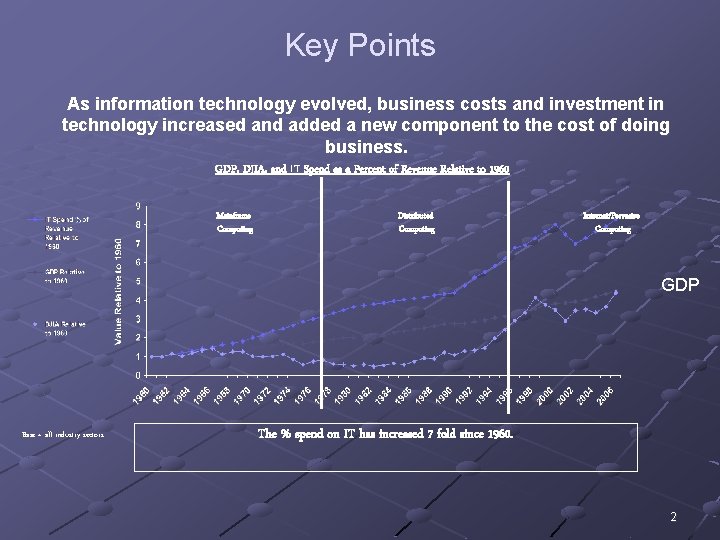
Key Points As information technology evolved, business costs and investment in technology increased and added a new component to the cost of doing business. GDP, DJIA, and IT Spend as a Percent of Revenue Relative to 1960 Mainframe Computing Distributed Computing Internet/Pervasive Computing GDP Base = all industry sectors The % spend on IT has increased 7 fold since 1960. 2
Key Points…. We are entering an era in which technology economics in business can be understood Companies that can master technology economics will likely have extreme competitive advantage in the short term Technology economics provides a powerful backdrop to understand the importance of software process 3
And More…. About 40%+ of every Tech $ is spent on Application Development and Maintenance activities The ability to focus Tech $ on Application Development and Maintenance is being “squeezed” by data center build out demands in most sectors Strategically it is more critical than ever in the applications are to produce and support “more for less” – software process is a critical enabler 4
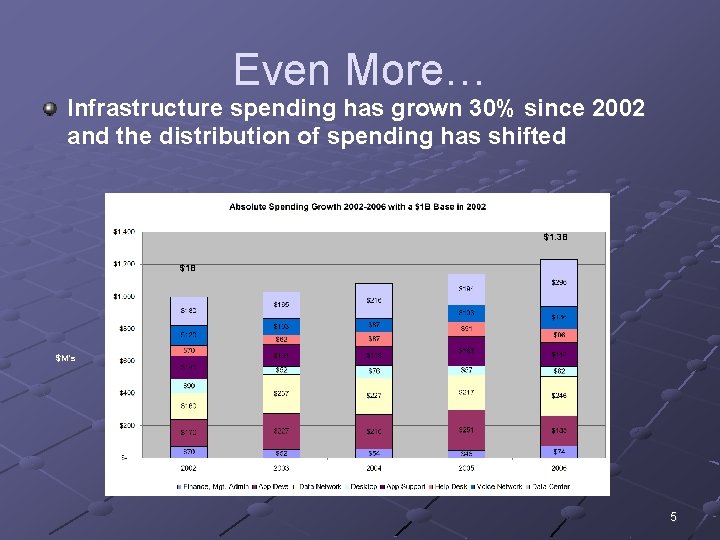
Even More… Infrastructure spending has grown 30% since 2002 and the distribution of spending has shifted $1. 3 B $1 B $M’s 5
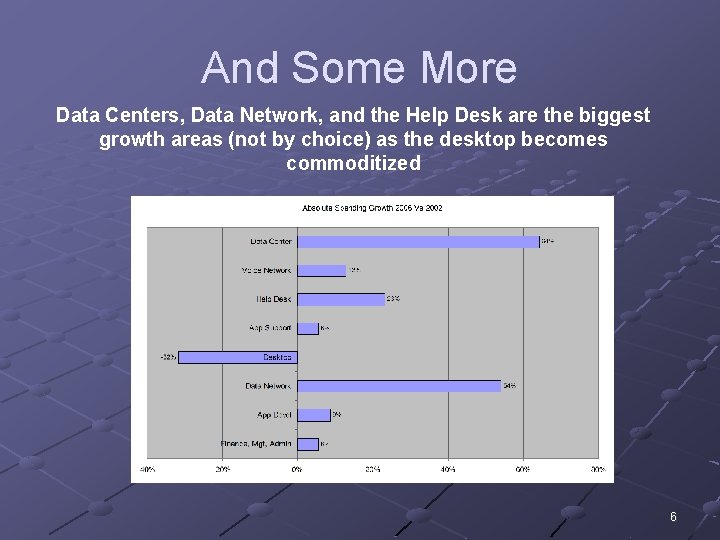
And Some More Data Centers, Data Network, and the Help Desk are the biggest growth areas (not by choice) as the desktop becomes commoditized 6
My Background Milestones in Technology Economics Economic Patterns and Observations Technology Optimization & Software Process 7
Academic Business Consulting Environmental Political 8
9
11% of US GDP (of $13. 2 T) $120 B of IT Spending 10
“Economics” 1. The branch of social science that deals with the production and distribution and consumption of goods and services and their management 2. The study of choice and decision-making in a world with limited resources 11
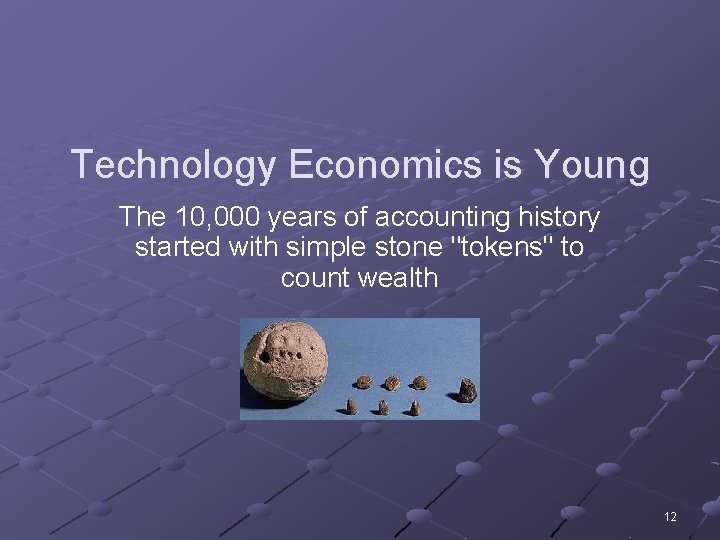
Technology Economics is Young The 10, 000 years of accounting history started with simple stone "tokens" to count wealth 12
In Search of the “IT CFO” IT CFO: 711 Hits CFO: 24, 500, 000 Hits 13
Technology Economics Milestones 1976 – Equitable Life Software Estimation (Jim Johnson, John Gosden) 1979 – IBM Function Points (Alan Albrecht) 1981 – Software Engineering Economics (Barry Boehm) 1985 – Nolan Norton Application Portfolio Management 1987 – SEI CMM (Watts Humphrey) 1990 – The Business Value of Computers (Paul Strassmann) 1999 – Merrill Lynch (John Mc. Kinley/Marvin Balliet – “IT CFO”) 1999 – Verizon IT Portfolio and Infrastructure Market Basket (Joe Castellano, Gerry Higgins) 2003 – Altria Self Benchmarking Rate Card (Jim Noble) 2004/2005 – JPMorgan Infrastructure Cost Optimization and Rate Model (Charles Costa, Mike Sztejnberg) 2005 – Lehman Brothers Market Basket Model (Jon Beyman & John Ambrose) 2006 – Credit Suisse Economic Target Setting (David Reilly, Mark Rufeh, Tom Sanzone, Mia Peterson, Phil Cushmaro) 2006/2007 – Citigroup Technology and Operations Optimization (Marv Adams, Jeff Nachowitz, Mike Roberts, Eric Joosten) 14
Technology Economics: Financial Services as an Example 15
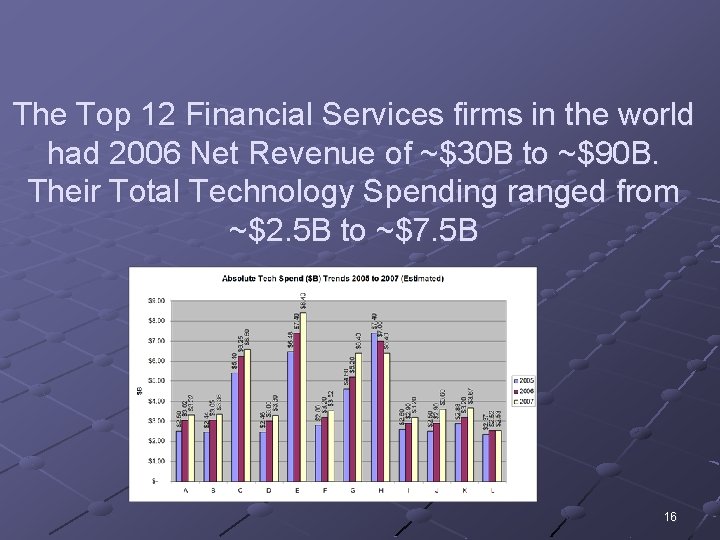
The Top 12 Financial Services firms in the world had 2006 Net Revenue of ~$30 B to ~$90 B. Their Total Technology Spending ranged from ~$2. 5 B to ~$7. 5 B 16
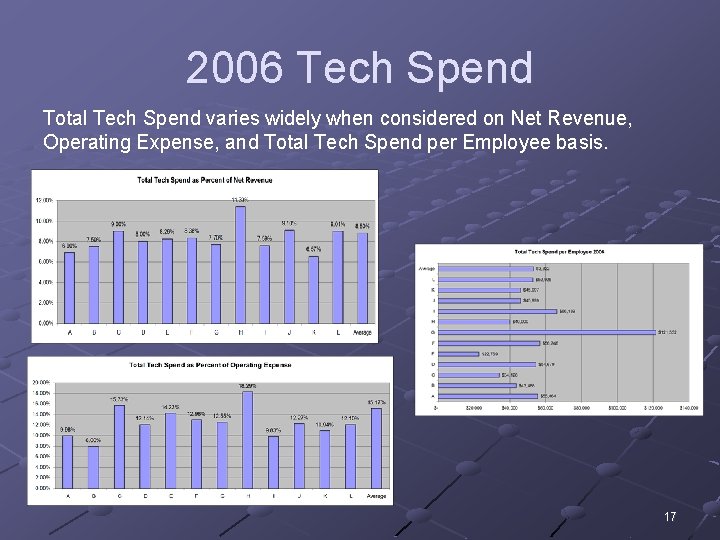
2006 Tech Spend Total Tech Spend varies widely when considered on Net Revenue, Operating Expense, and Total Tech Spend per Employee basis. 17
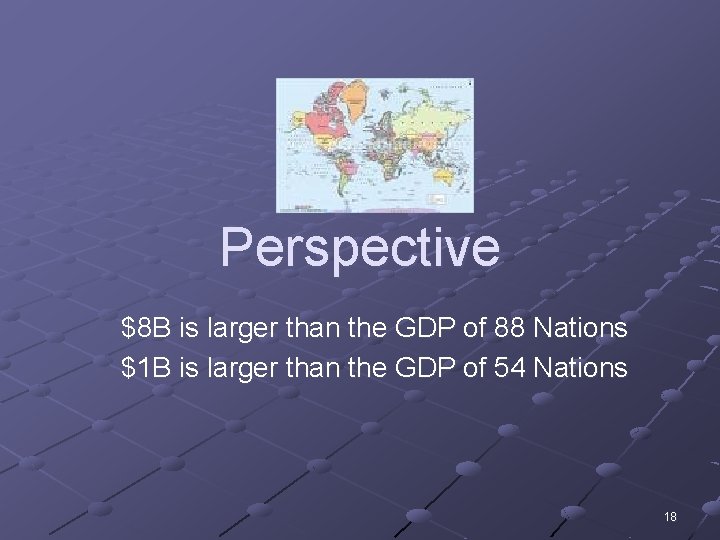
Perspective $8 B is larger than the GDP of 88 Nations $1 B is larger than the GDP of 54 Nations 18
Patterns, Empiricism, & Technology Economics 1. application of observation and experiment: the application of observation and experiment, and not theory, in determining something 2. philosophy philosophical belief regarding sense-derived knowledge: the philosophical belief that all knowledge is derived from the experience of the senses 3. medicine based solely on experience: medicine that is based on practical experience, and not on theory or scientific proof 19
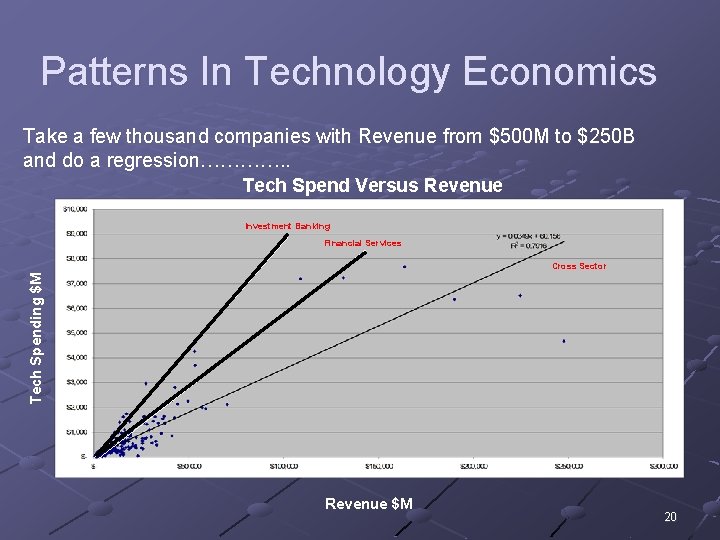
Patterns In Technology Economics Take a few thousand companies with Revenue from $500 M to $250 B and do a regression…………. . Tech Spend Versus Revenue Investment Banking Financial Services Tech Spending $M Cross Sector Revenue $M 20
Patterns and Business Performance Financial Services Institutions 21
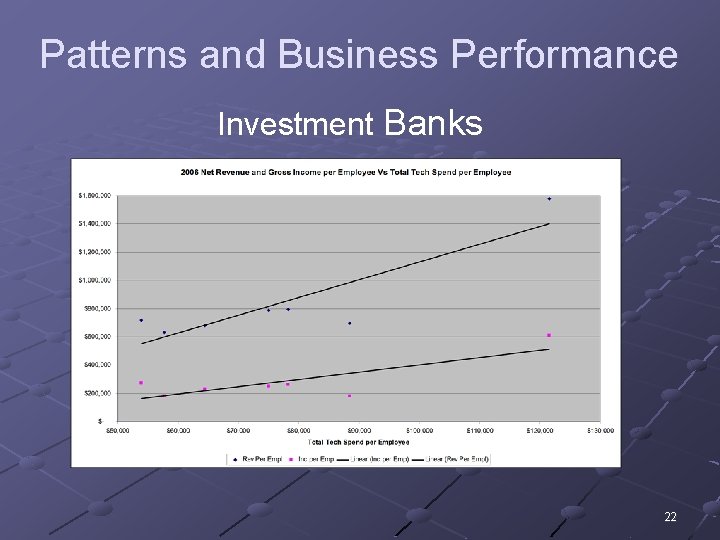
Patterns and Business Performance Investment Banks 22
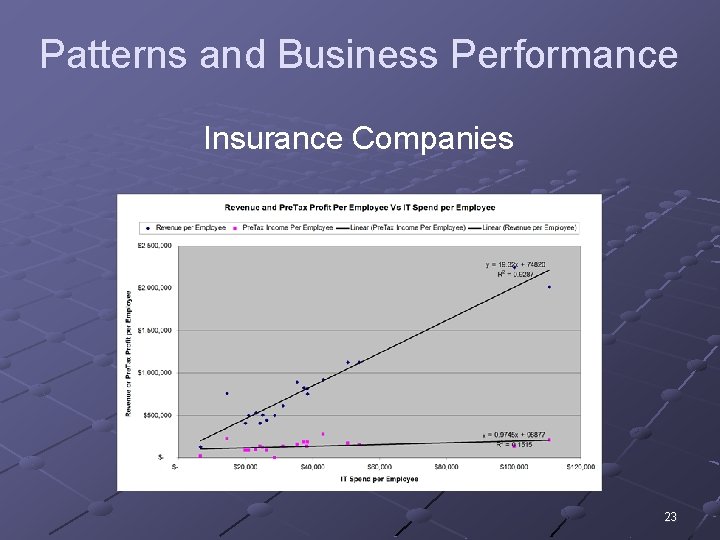
Patterns and Business Performance Insurance Companies 23
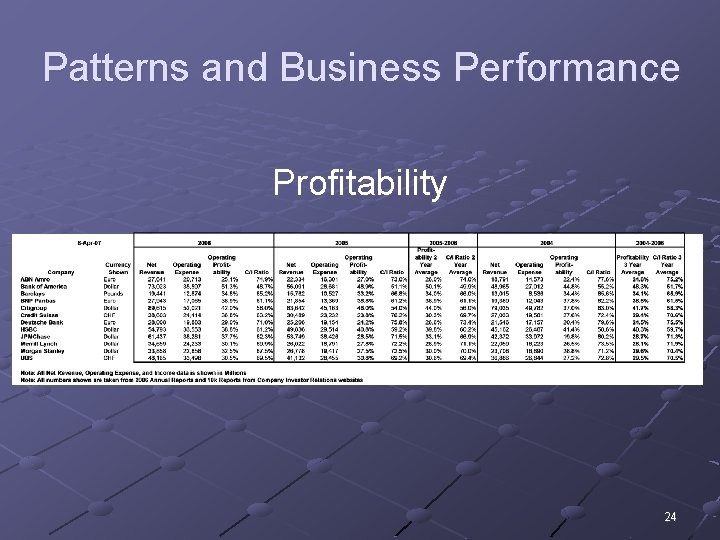
Patterns and Business Performance Profitability 24
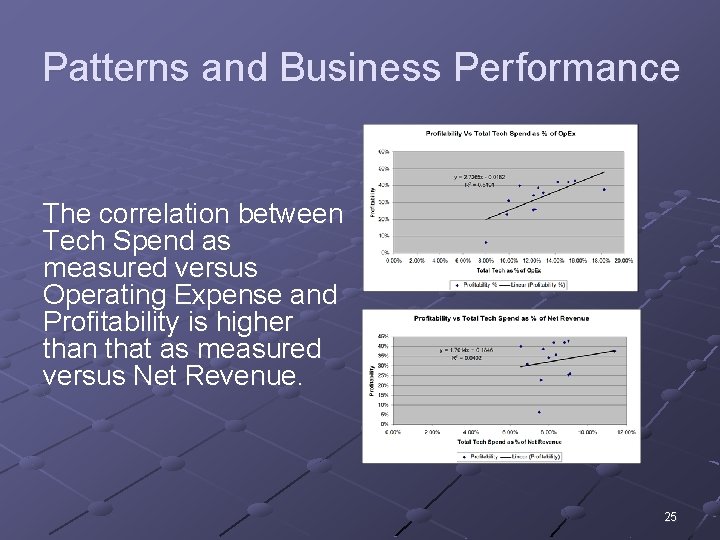
Patterns and Business Performance The correlation between Tech Spend as measured versus Operating Expense and Profitability is higher than that as measured versus Net Revenue. 25
Putting the Patterns to “Work” 26
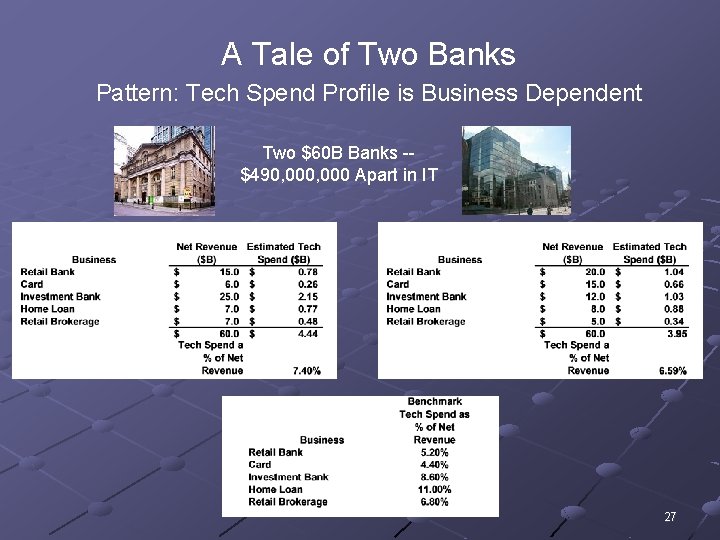
A Tale of Two Banks Pattern: Tech Spend Profile is Business Dependent Two $60 B Banks -$490, 000 Apart in IT 27
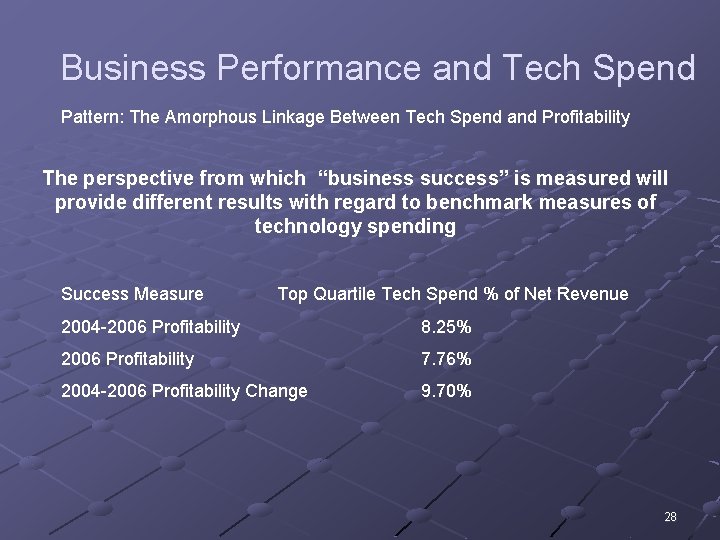
Business Performance and Tech Spend Pattern: The Amorphous Linkage Between Tech Spend and Profitability The perspective from which “business success” is measured will provide different results with regard to benchmark measures of technology spending Success Measure Top Quartile Tech Spend % of Net Revenue 2004 -2006 Profitability 8. 25% 2006 Profitability 7. 76% 2004 -2006 Profitability Change 9. 70% 28
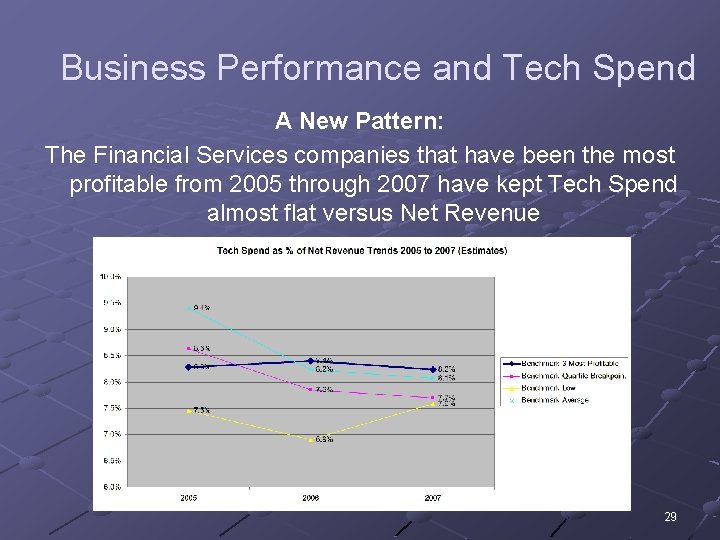
Business Performance and Tech Spend A New Pattern: The Financial Services companies that have been the most profitable from 2005 through 2007 have kept Tech Spend almost flat versus Net Revenue 29
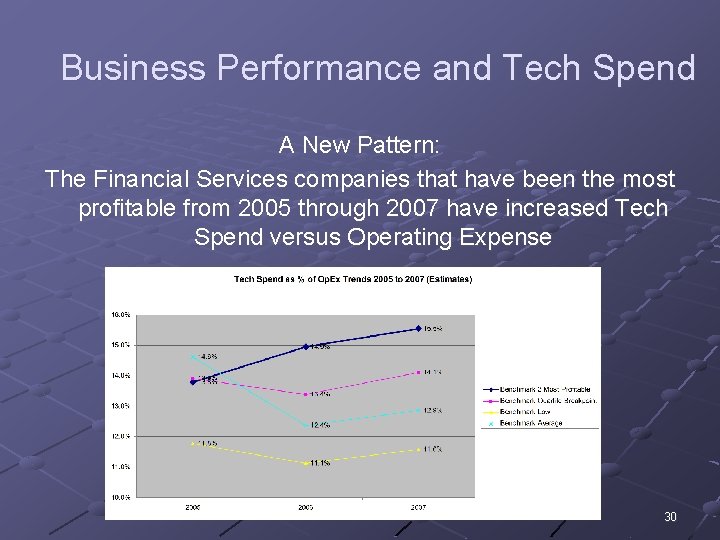
Business Performance and Tech Spend A New Pattern: The Financial Services companies that have been the most profitable from 2005 through 2007 have increased Tech Spend versus Operating Expense 30
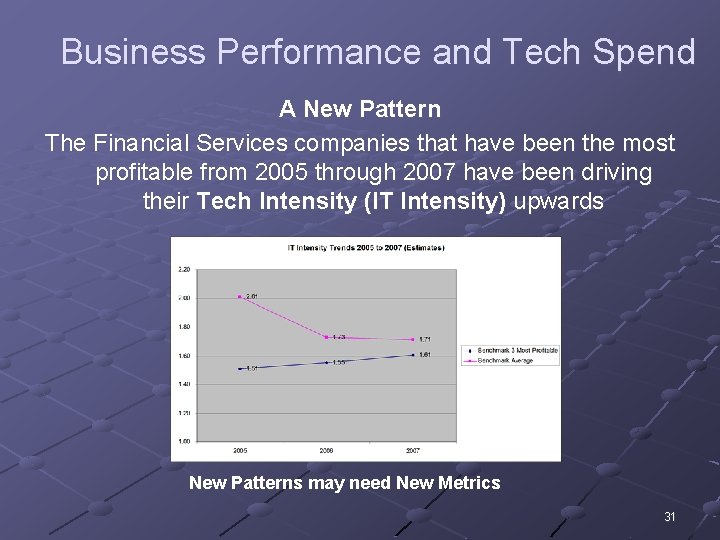
Business Performance and Tech Spend A New Pattern The Financial Services companies that have been the most profitable from 2005 through 2007 have been driving their Tech Intensity (IT Intensity) upwards New Patterns may need New Metrics 31
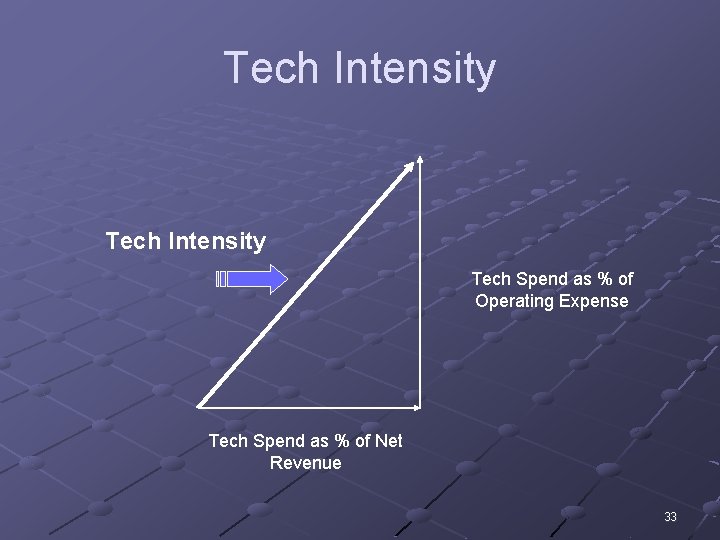
Technology Intensity? ? A new experimental measure that considers Tech Spend in the context Net Revenue and Operating Expense simultaneously 32
Tech Intensity Tech Spend as % of Operating Expense Tech Spend as % of Net Revenue 33
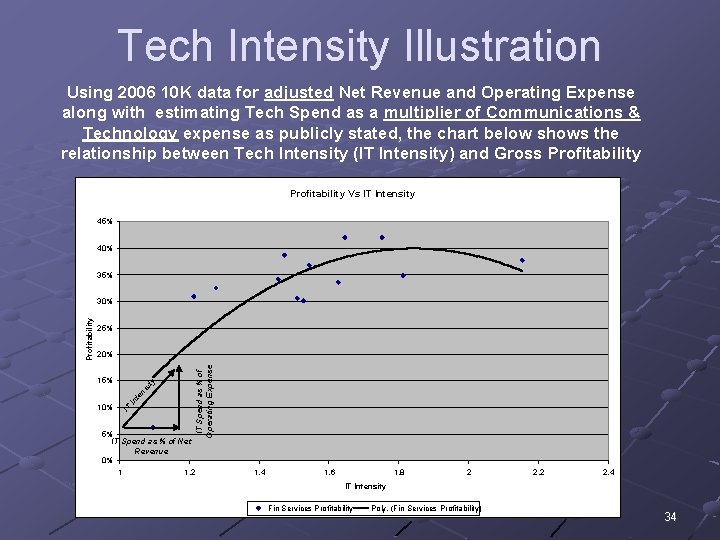
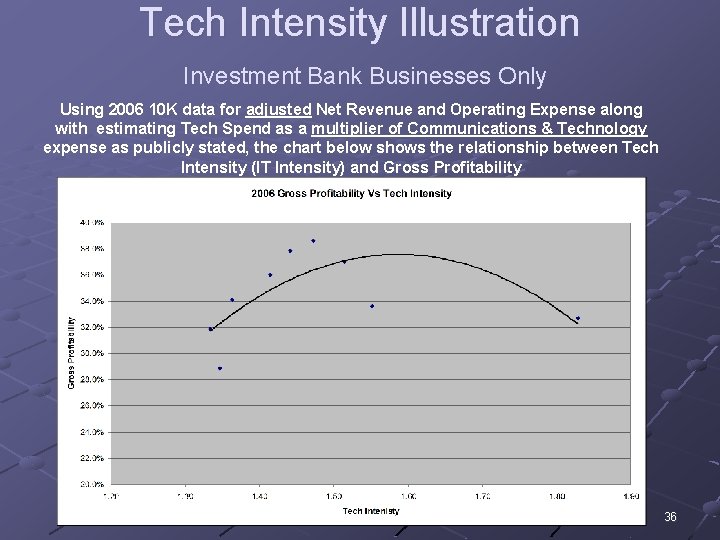
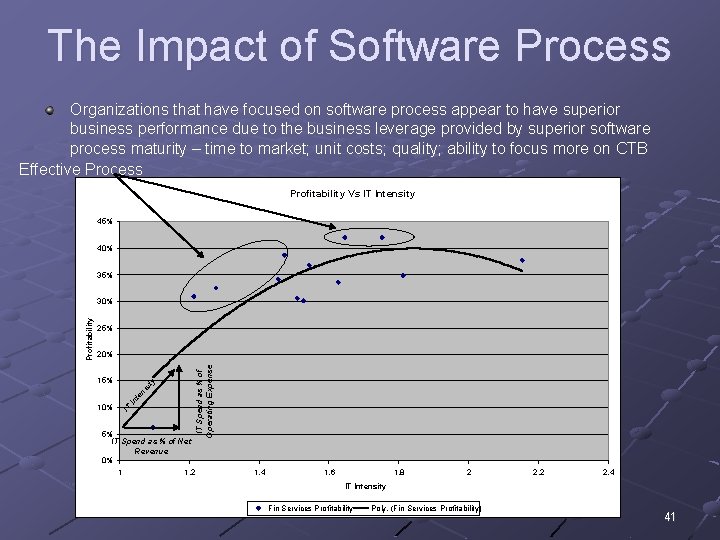
Tech Intensity Illustration Using 2006 10 K data for adjusted Net Revenue and Operating Expense along with estimating Tech Spend as a multiplier of Communications & Technology expense as publicly stated, the chart below shows the relationship between Tech Intensity (IT Intensity) and Gross Profitability Vs IT Intensity 45% 40% 35% te ns 20% IT 10% In te ns 15% AXA IT Spend as % of Net Revenue 5% IT Spend as % of Net Revenue 0% 1 IT Spend as % of Operating Expense ity 25% ity IT I n Profitability 30% 1. 2 IT Intensity developed by Dr. Howard Rubin, Patent Pending 1. 4 1. 6 1. 8 2 2. 4 IT Intensity Fin Services Profitability Poly. (Fin Services Profitability) 34
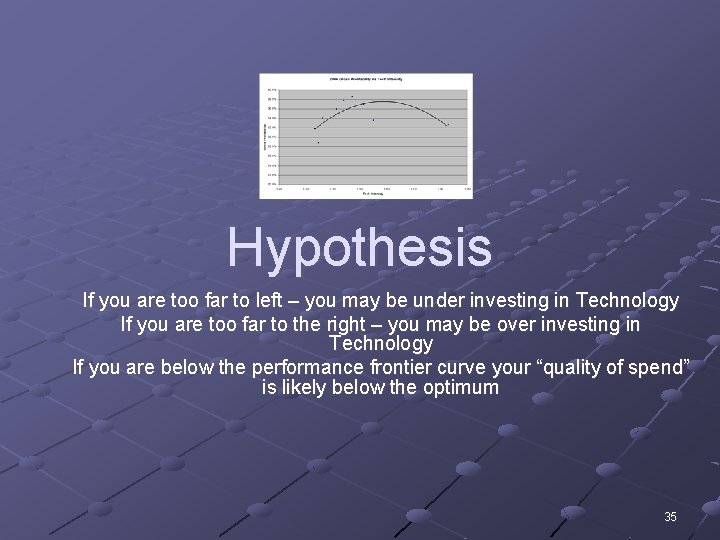
Hypothesis If you are too far to left – you may be under investing in Technology If you are too far to the right – you may be over investing in Technology If you are below the performance frontier curve your “quality of spend” is likely below the optimum 35
Tech Intensity Illustration Investment Bank Businesses Only Using 2006 10 K data for adjusted Net Revenue and Operating Expense along with estimating Tech Spend as a multiplier of Communications & Technology expense as publicly stated, the chart below shows the relationship between Tech Intensity (IT Intensity) and Gross Profitability IT Intensity developed by Dr. Howard Rubin, Patent Pending 36
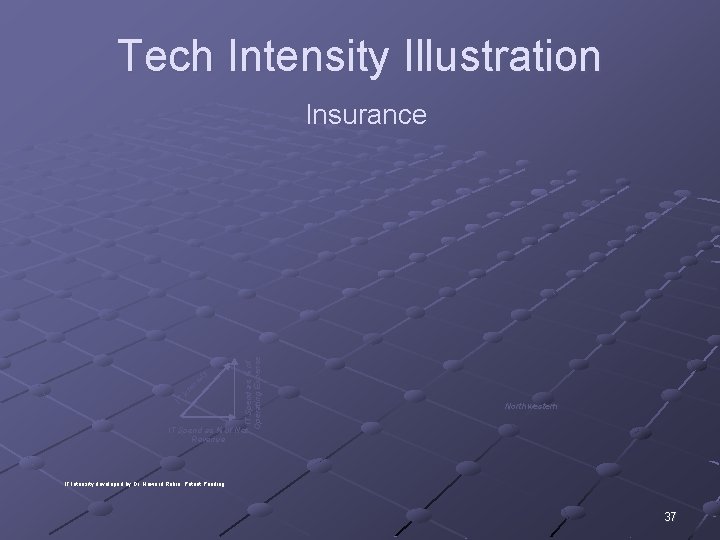
Tech Intensity Illustration IT Spend as % of Operating Expense IT In te ns ity Insurance Northwestern IT Spend as % of Net Revenue IT Intensity developed by Dr. Howard Rubin, Patent Pending 37
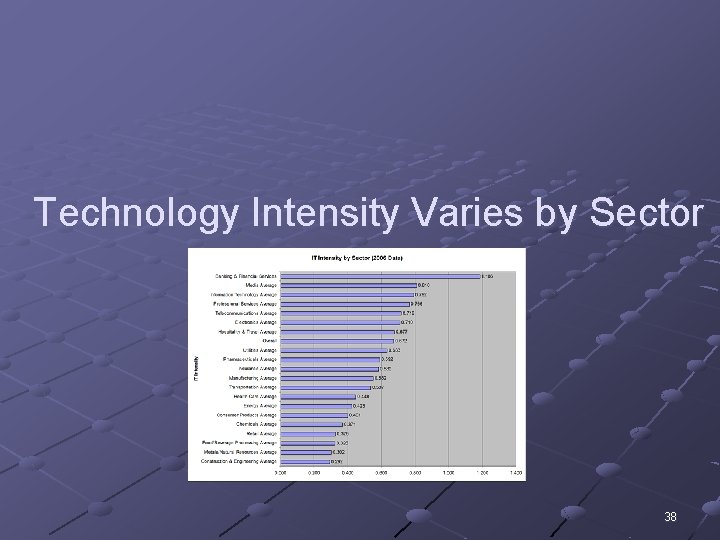
Technology Intensity Varies by Sector 38
Technology Intensity and Software Process 39
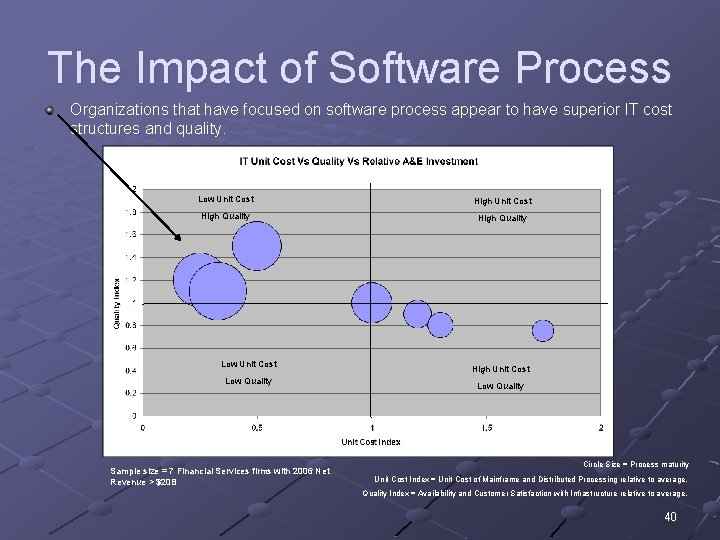
The Impact of Software Process Organizations that have focused on software process appear to have superior IT cost structures and quality. Low Unit Cost High Quality Low Unit Cost Low Quality Sample size = 7 Financial Services firms with 2006 Net Revenue > $20 B High Unit Cost Low Quality Circle Size = Process maturity Unit Cost Index = Unit Cost of Mainframe and Distributed Processing relative to average. Quality Index = Availability and Customer Satisfaction with Infrastructure relative to average. 40
The Impact of Software Process Organizations that have focused on software process appear to have superior business performance due to the business leverage provided by superior software process maturity – time to market; unit costs; quality; ability to focus more on CTB Effective Process Profitability Vs IT Intensity 45% 40% 35% te ns 20% IT 10% In te ns 15% AXA IT Spend as % of Net Revenue 5% IT Spend as % of Net Revenue 0% 1 IT Spend as % of Operating Expense ity 25% ity IT I n Profitability 30% 1. 2 IT Intensity developed by Dr. Howard Rubin, Patent Pending 1. 4 1. 6 1. 8 2 2. 4 IT Intensity Fin Services Profitability Poly. (Fin Services Profitability) 41
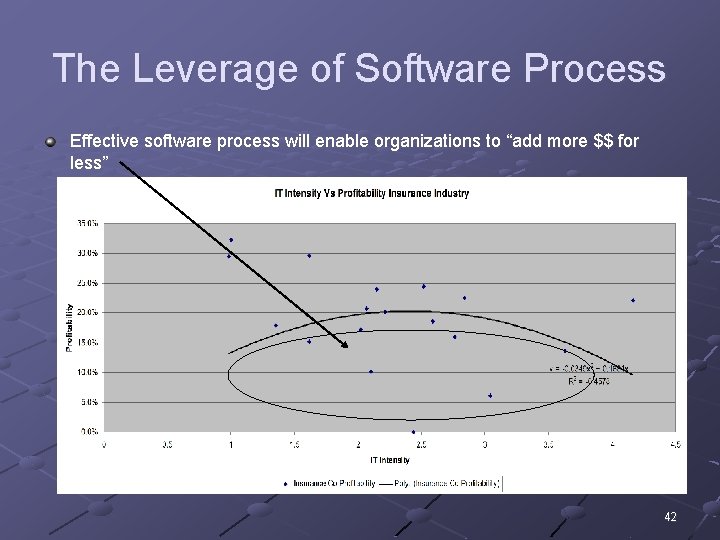
The Leverage of Software Process Effective software process will enable organizations to “add more $$ for less” 42
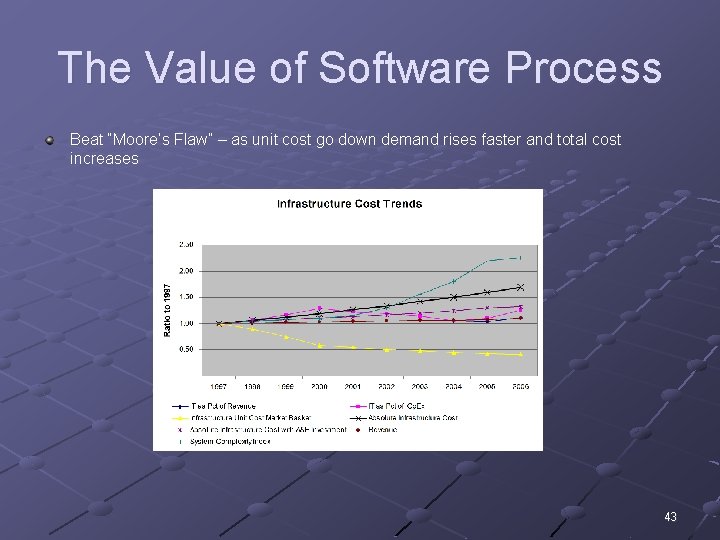
The Value of Software Process Beat “Moore’s Flaw” – as unit cost go down demand rises faster and total cost increases 43
Technology Economic Optimization and Software Process 44
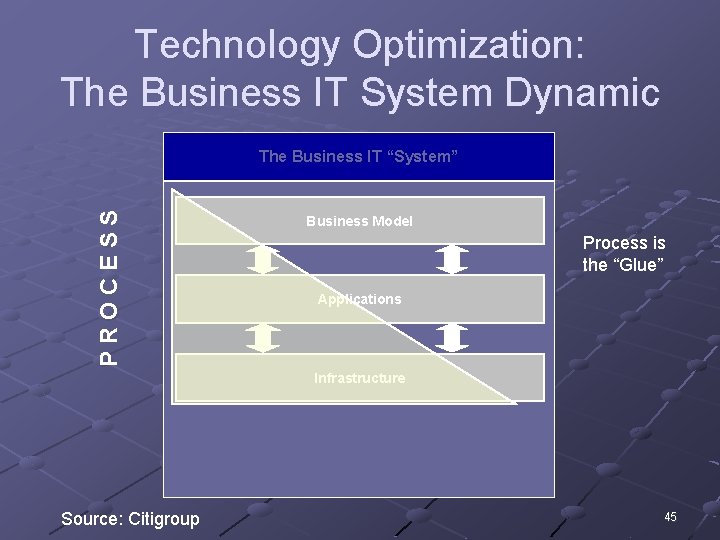
Technology Optimization: The Business IT System Dynamic PROCESS The Business IT “System” Business Model Process is the “Glue” Applications Infrastructure Source: Citigroup 45
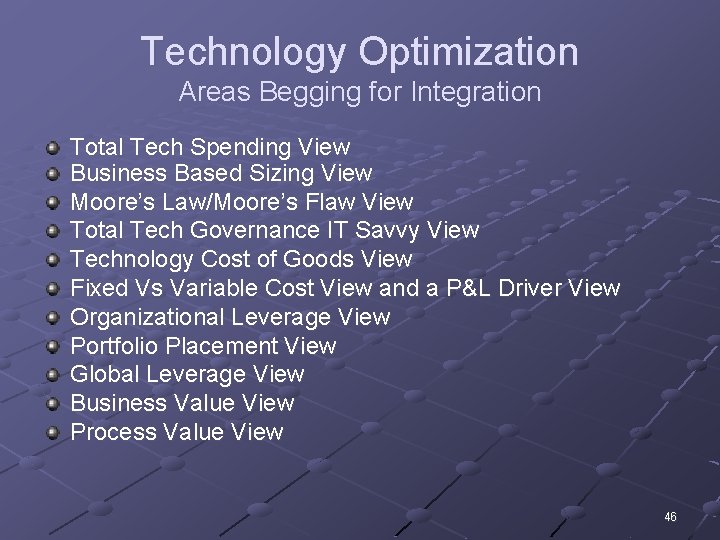
Technology Optimization Areas Begging for Integration Total Tech Spending View Business Based Sizing View Moore’s Law/Moore’s Flaw View Total Tech Governance IT Savvy View Technology Cost of Goods View Fixed Vs Variable Cost View and a P&L Driver View Organizational Leverage View Portfolio Placement View Global Leverage View Business Value View Process Value View 46
It is not the strongest of the species that survives, nor the most intelligent, but the one that is most responsive to change — Charles Darwin The only sustainable competitive advantage is to be able to learn faster than your competitors. — Peter Senge The companies that can understand manage their technology economics to continually and currently optimize business performance and create business value will have extreme competitive advantage in the near future. Those that have effective software processes will have the best positioning. — Howard Rubin 47
Thank you 48