
Technology and Theories of Economic Development Neoclassical Approach
- Slides: 13
Technology and Theories of Economic Development: Neo-classical Approach Technical Change and the Aggregate Production Function by R. Solow, 1957 The Review of Economics and Statistics, V. 39, N. 3 1
Aim n To describe an elementary way of segregating variations in output per labor due to technical change from those due to changes in the availability of capital per labor 2
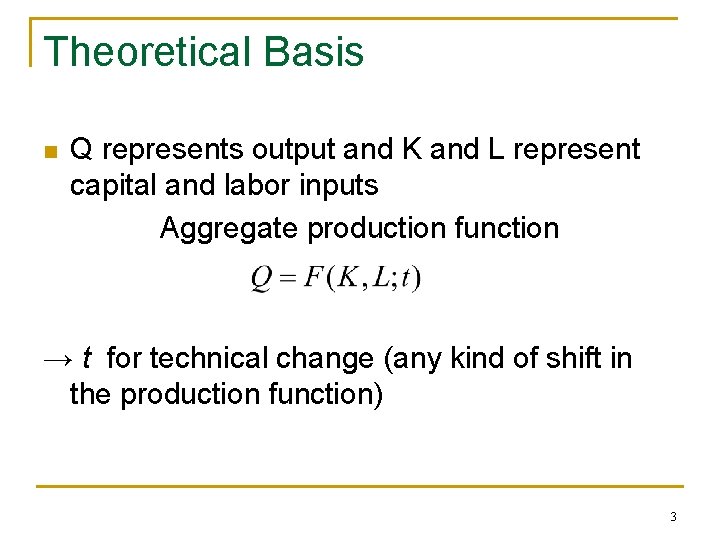
Theoretical Basis n Q represents output and K and L represent capital and labor inputs Aggregate production function → t for technical change (any kind of shift in the production function) 3
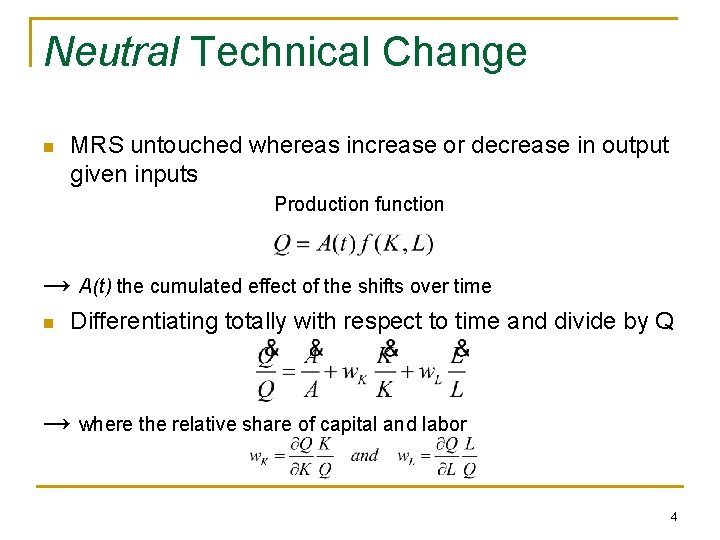
Neutral Technical Change n MRS untouched whereas increase or decrease in output given inputs Production function → A(t) the cumulated effect of the shifts over time n Differentiating totally with respect to time and divide by Q → where the relative share of capital and labor 4
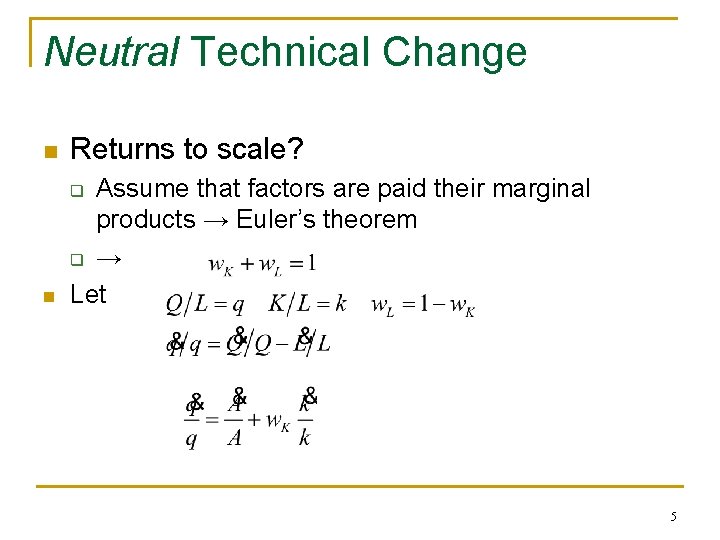
Neutral Technical Change n Returns to scale? n Assume that factors are paid their marginal products → Euler’s theorem q → Let q 5
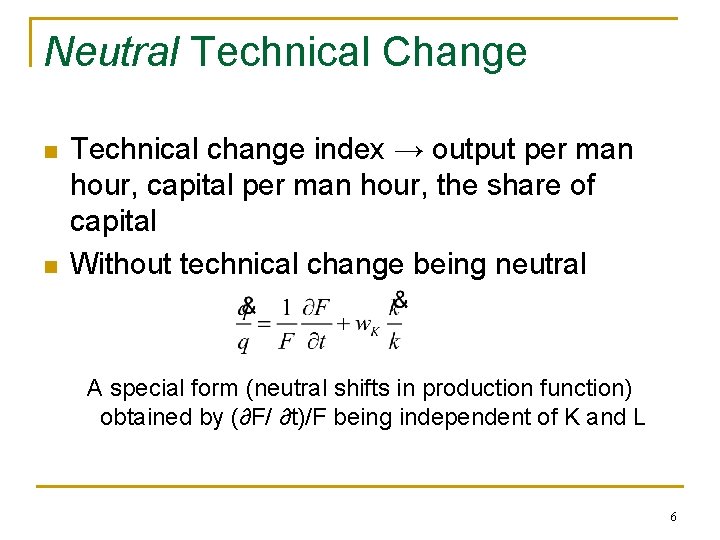
Neutral Technical Change n n Technical change index → output per man hour, capital per man hour, the share of capital Without technical change being neutral A special form (neutral shifts in production function) obtained by (∂F/ ∂t)/F being independent of K and L 6
Application to the US (1909 -1949) n Isolate shifts of the aggregate production function from movements along it (technical change) by using output per unit of labor, capital per unit of labor, the share of capital q Measure of aggregate output → real net national product n if use GNP → share of capital including depreciation q q Measure of capital → the annual flow of capital services n Hard to compute the stock of capital (capital in use) q q Time series of real private non-farm GNP per man hour Capital including land, mineral deposits with government, agricultural and consumer durables eliminated and corrected by depreciation Share of capital (factors share) 7
Application to the US (1909 -1949) n Method: replace the time derivatives by year-to-year changes and calculate ∆q/q-wk ∆k/k → estimate of ∆F/F or ∆A/A depending on relative shifts being neutral or not q n Use A(1909)=1 and A(t+1)=A(t)(1+ ∆A(t)/A(t)) A(t) series trend upward q q Solow calls the curve ∆A/A instead of ∆F/F because a scatter of ∆F/F against K/L indicated no relationship Formal conclusion: over the period 1909 -49, shifts in the aggregate production function turned out to be neutral n Neutral meaning the shifts were pure scale changes, leaving MRS unchanged at given capital/labor ratios (∆A/A uncorrelated with K/L) 8
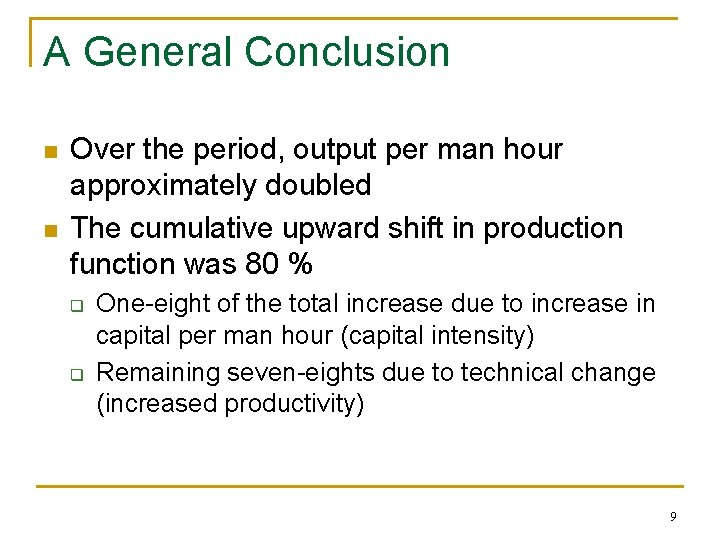
A General Conclusion n n Over the period, output per man hour approximately doubled The cumulative upward shift in production function was 80 % q q One-eight of the total increase due to increase in capital per man hour (capital intensity) Remaining seven-eights due to technical change (increased productivity) 9
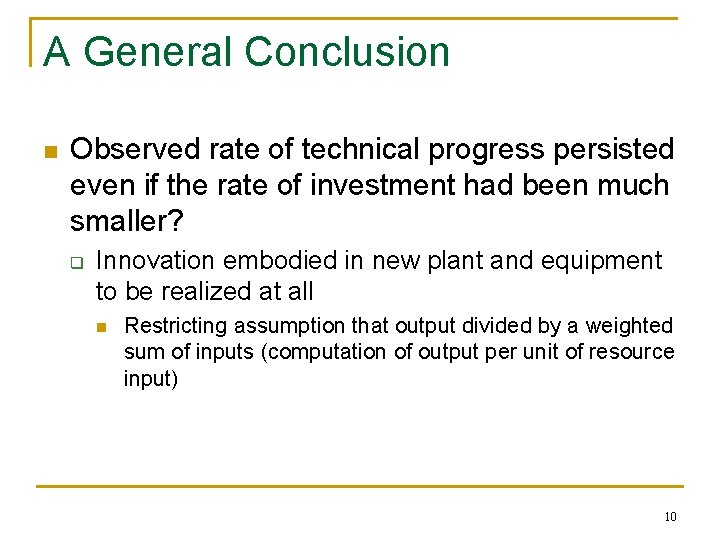
A General Conclusion n Observed rate of technical progress persisted even if the rate of investment had been much smaller? q Innovation embodied in new plant and equipment to be realized at all n Restricting assumption that output divided by a weighted sum of inputs (computation of output per unit of resource input) 10
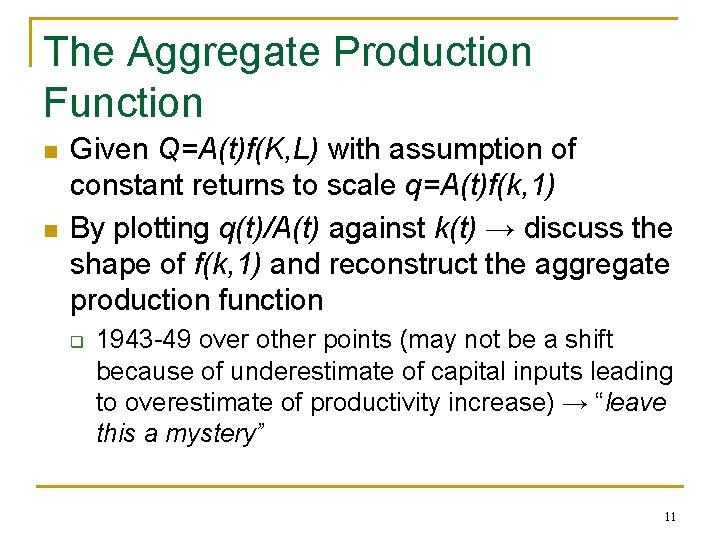
The Aggregate Production Function n n Given Q=A(t)f(K, L) with assumption of constant returns to scale q=A(t)f(k, 1) By plotting q(t)/A(t) against k(t) → discuss the shape of f(k, 1) and reconstruct the aggregate production function q 1943 -49 over other points (may not be a shift because of underestimate of capital inputs leading to overestimate of productivity increase) → “leave this a mystery” 11
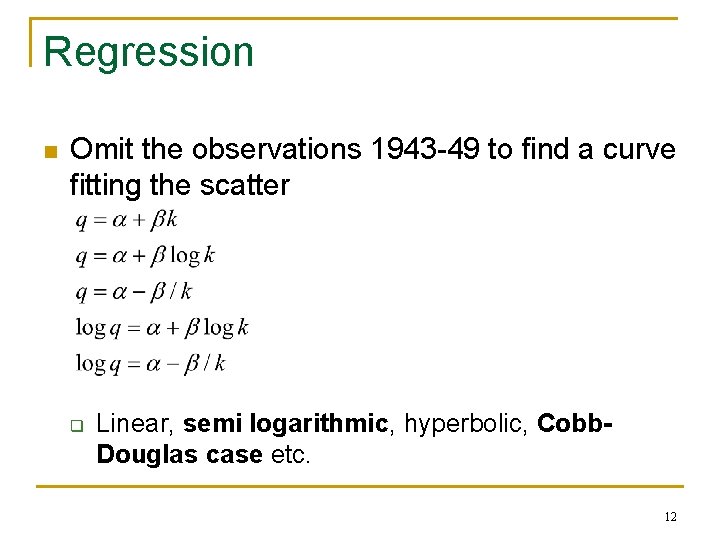
Regression n Omit the observations 1943 -49 to find a curve fitting the scatter q Linear, semi logarithmic, hyperbolic, Cobb. Douglas case etc. 12
Summary n Suggested a simple way of segregating shifts of the aggregate production function form movements along it q q Assume that factors are paid their marginal products Conclusion: over period 1909 -49 technical change was neutral on average 13