
TECHNOLOGY AND APPLICATIONS PHOTO BY R STANLEY WILLIAMS
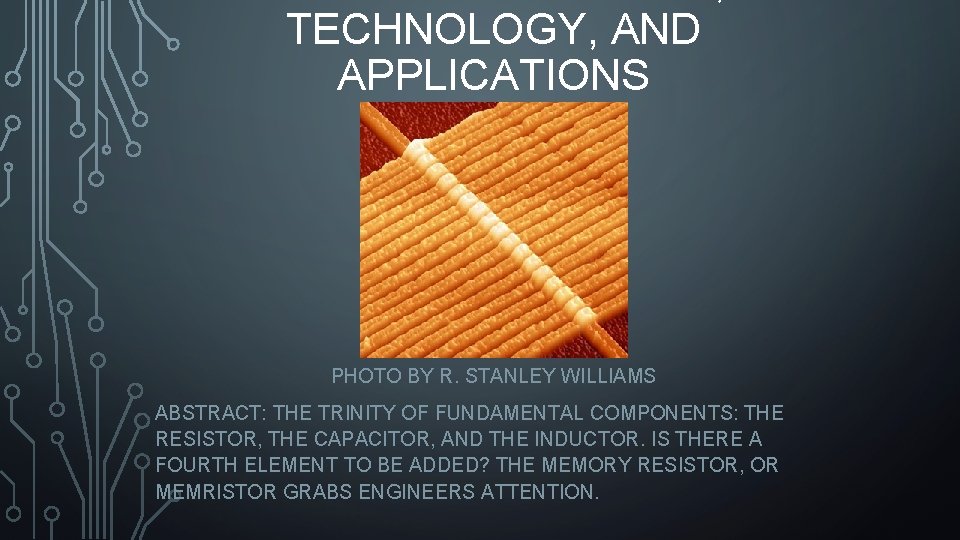
TECHNOLOGY, AND APPLICATIONS PHOTO BY R. STANLEY WILLIAMS ABSTRACT: THE TRINITY OF FUNDAMENTAL COMPONENTS: THE RESISTOR, THE CAPACITOR, AND THE INDUCTOR. IS THERE A FOURTH ELEMENT TO BE ADDED? THE MEMORY RESISTOR, OR MEMRISTOR GRABS ENGINEERS ATTENTION.
INTRODUCTION/OUTLINE • The history and theory of memristors. • The rediscovery • What is a memristor? How does it work? • Two different ways they are made. • Current research being done. • Conclusion and future applications
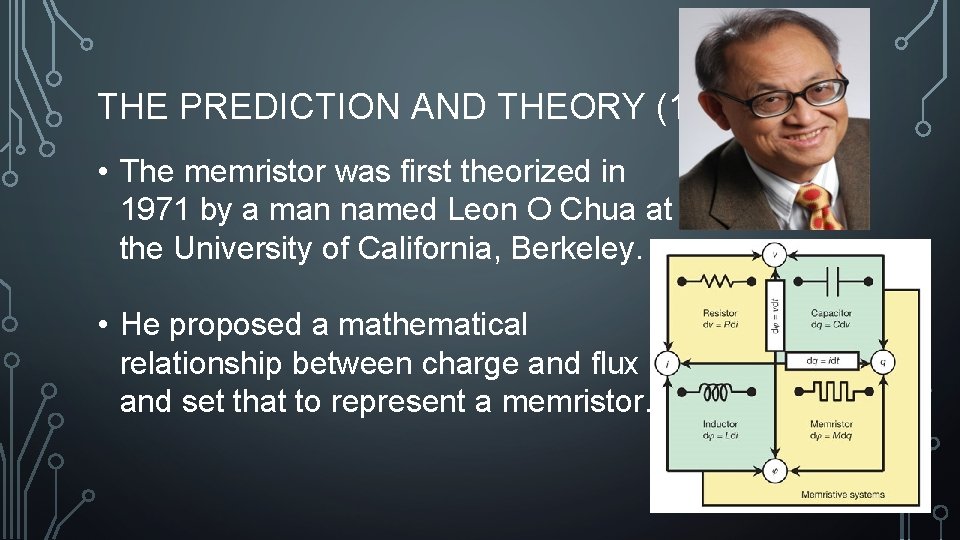
THE PREDICTION AND THEORY (1971) • The memristor was first theorized in 1971 by a man named Leon O Chua at the University of California, Berkeley. • He proposed a mathematical relationship between charge and flux and set that to represent a memristor.
R. STANLEY WILLIAMS • In 2008, HP senior Stanley Williams and his team discovered that there molecular device they were researching was acting fairly like Chua’s description of the memristor. • Noticed a similar relationship between magnetic flux and charge that a resistor gives between voltage and current.

THE MEMORY RESISTOR • A two-terminal element • Just like its name, the memristor carries memory of its past. • When the voltage is turned off, the memristor remembers how much voltage was applied before it was turned off and the duration. • This effect cannot be duplicated by any circuit combination of the three fundamental components. • Making the memristor the fourth fundamental circuit element. • It can provide dynamical-negative resistance.
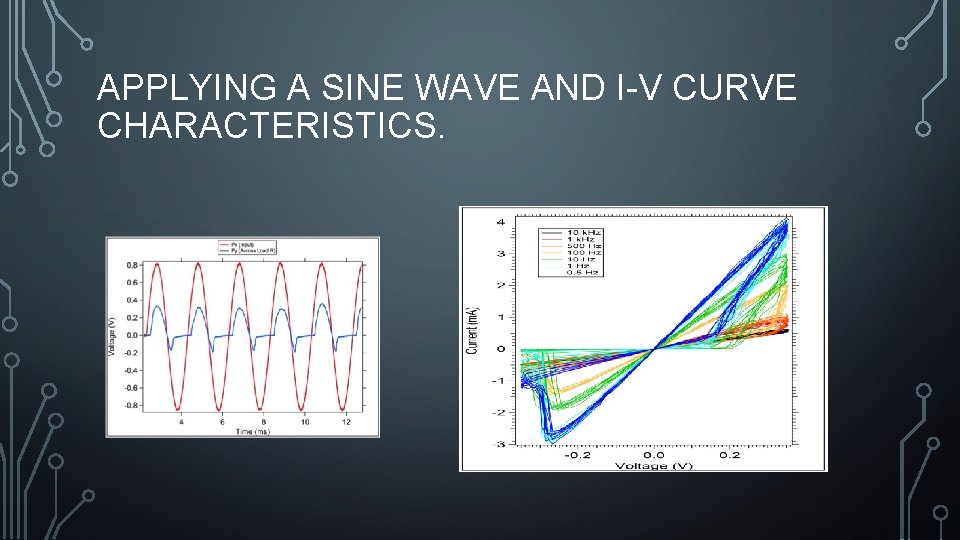
APPLYING A SINE WAVE AND I-V CURVE CHARACTERISTICS.

SOME FACTS ABOUT MEMRISTORS • Achievable through different physical mechanisms • Phase change, electrostatic, redox • Many applications enabled by orthogonal properties • • Optimizers, high endurance + incremental Learners, incremental + low decay Memory, fast switching + low decay Oscillators, high endurance
HOW CURRENT MEMRISTORS ARE MADE • In 2008, Stanley Williams found an ideal memristror in titanium dioxide • • • Like silicon titanium dioxide is a semiconductor. At its pure state titanium oxide is highly resistive. It can then be doped with other elements to make it very conductive. • Knowm’s memristor devices use Tin (Sn) or Chromium (Cr) or Tungsten (W) in the chalcogenide layer. • Can be fabricated at <500 degrees C using industry-standard unit-process steps.
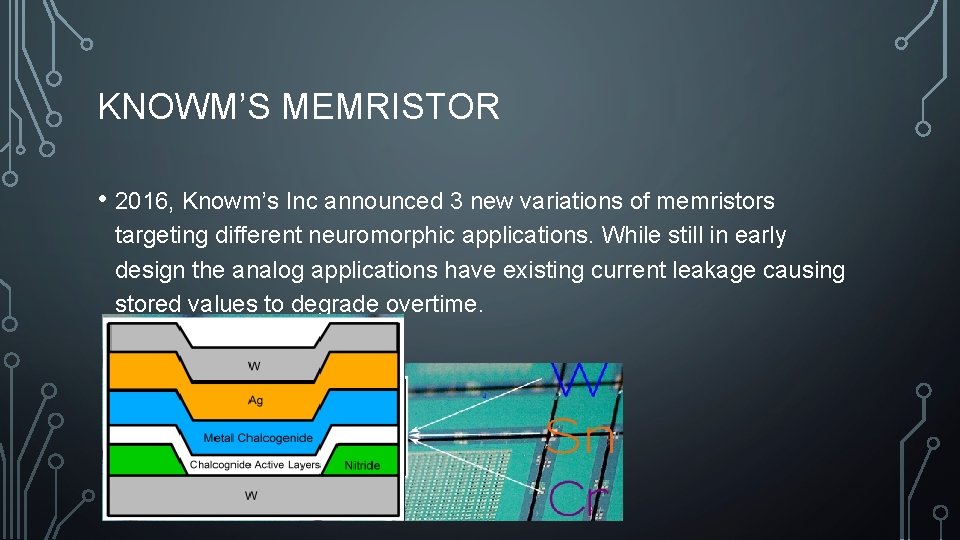
KNOWM’S MEMRISTOR • 2016, Knowm’s Inc announced 3 new variations of memristors targeting different neuromorphic applications. While still in early design the analog applications have existing current leakage causing stored values to degrade overtime.
KNOWM’S MEMRISTOR (CONT. ) • The first to develop and make it commercially available for research purposes. • 3 types, they all have same basic material structure but differ in the dopant layer. • • • Ge. Se. W (the ‘W’ device) Ge. Sn (the ‘Sn’ device) Ge. Se. Cr (the ’Cr’ device)
CONCLUSION, AND FUTURE APPLICATIONS • There is current research being done on the memory resistors in order to perfect the memristor so that it can be applied to future electronics. • You can now purchase and do personal research on ways you can applicate memristors. FUTUTRE APPLICATIONS • Denser nonvolatile memories, oscillators • New universal logic gates • Brain like computers • Post-Moores’s-Law IC’s • Analog Design, and computing • Artificial Intellagence
REFERENCES • Korczynski, Ed, Dr. "Memristor. " Semiconductor Manufacturing & Design Community. N. p. , 22 Jan. 2016. Web. 13 Apr. 2017. • Revolvy, LLC. ""Memristor" on Revolvy. com. " All Revolvy Quizzes. N. p. , n. d. Web. 18 Apr. 2017. <https: //www. revolvy. com/topic/Memristor>. • Adee, Sally. "The Mysterious Memristor. " IEEE Spectrum: Technology, Engineering, and Science News. IEEE Spectrum, 01 May 2008. Web. 18 Apr. 2017. http: //spectrum. ieee. org/semiconductors/design/the-mysteriousmemristor • "Memristors. " Knowm. org. N. p. , n. d. Web. 18 Apr. 2017. <http: //knowm. org/memristors/>. • "The Story of My Memristor – Kris Campbell. " Knowm. org. N. p. , n. d. Web. 18 Apr. 2017. <http: //knowm. org/the-story-of-my-memristor-kris-campbell/>.
5 KEY TOPICS 1. What is a Memristor? How does it work? 2. Memristors have a relationship through magnetic charge and flux. 3. Orthogonal properties and applications. 4. The doping elements of current Memristors. 5. I-V characteristics when a sine wave is applied.
- Slides: 13