
Technology and 21 st Century Skills Assessment Employee
- Slides: 1
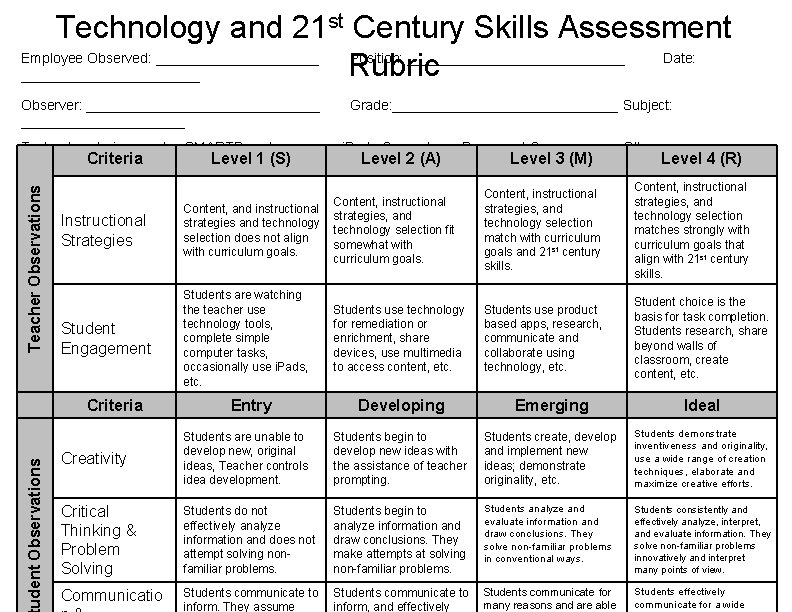
Technology and 21 st Century Skills Assessment Employee Observed: ___________ Position: ______________ Date: Rubric ____________ Observer: _______________ Technology being used: Criteria Teacher Observations (circle one or more) Level 1 (S) i. Pads Computers Document Camera Level 2 (A) Level 3 (M) Instructional Strategies Content, and instructional strategies and technology selection does not align with curriculum goals. Content, instructional strategies, and technology selection fit somewhat with curriculum goals. Content, instructional strategies, and technology selection match with curriculum goals and 21 st century skills. Student Engagement Students are watching the teacher use technology tools, complete simple computer tasks, occasionally use i. Pads, etc. Students use technology for remediation or enrichment, share devices, use multimedia to access content, etc. Students use product based apps, research, communicate and collaborate using technology, etc. Criteria udent Observations SMARTBoard Grade: _______________ Subject: Entry Other: _____ Level 4 (R) Content, instructional strategies, and technology selection matches strongly with curriculum goals that align with 21 st century skills. Student choice is the basis for task completion. Students research, share beyond walls of classroom, create content, etc. Developing Emerging Ideal Creativity Students are unable to develop new, original ideas, Teacher controls idea development. Students begin to develop new ideas with the assistance of teacher prompting. Students create, develop and implement new ideas; demonstrate originality, etc. Students demonstrate inventiveness and originality, use a wide range of creation techniques, elaborate and maximize creative efforts. Critical Thinking & Problem Solving Students do not effectively analyze information and does not attempt solving nonfamiliar problems. Students begin to analyze information and draw conclusions. They make attempts at solving non-familiar problems. Students analyze and evaluate information and draw conclusions. They solve non-familiar problems in conventional ways. Students consistently and effectively analyze, interpret, and evaluate information. They solve non-familiar problems innovatively and interpret many points of view. Communicatio Students communicate to inform. They assume Students communicate to inform, and effectively Students communicate for many reasons and are able Students effectively communicate for a wide