
Technologies that Advance our Understanding of Space SCIENCE


- Slides: 43
Technologies that Advance our Understanding of Space SCIENCE 9 UNIT E
1. 2 Discovery Through Technology
The astronomers Tools Humans have invented many tools throughout history to study the sky Sundials chart the passage of time with the sun Astrolabes are used to chart star position Why would we want these?
The Telescope The telescope first allowed man to see the planets closest to the Earth It showed space was much larger than it was imagined Today we have super-powerful optical and radio telescopes on Earth, satellites orbiting Earth and space-based telescopes which continue to expand our understanding http: //www. youtube. com/watch? v=t 5 ce. KXK 6 Kd k http: //devour. com/video/flying-over-earth/
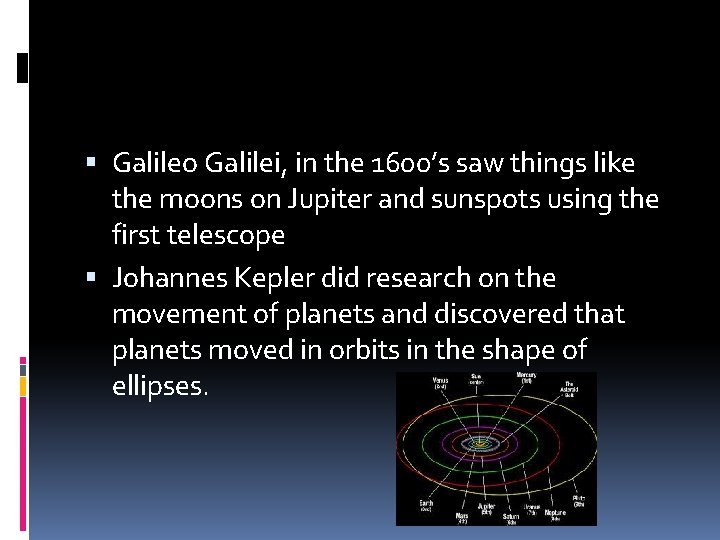
Galileo Galilei, in the 1600’s saw things like the moons on Jupiter and sunspots using the first telescope Johannes Kepler did research on the movement of planets and discovered that planets moved in orbits in the shape of ellipses.
The Immensity of Density and Time in Space Finding an appropriate measurement is important in describing distances What unit would you use to measure the length of the school? The distance around Lac la Biche?
2 New Units Of Measurement 1) Astronomical Unit (AU)- used to measure distance within our solar system It is the distance from the center of the Earth to the center of the sun 1 AU= 149 599 000 km
2) Light-years- a light year is usually used to measure the distance of things outside of our solar system like stars, nebulas and galaxies It is the distance light travels in one year Light travels at 300 000 km/s A string 1 light year (ly) long would wrap around Earth’s equator 236 million times 1 ly= 9. 5 trillion km www. youtube. com/watch? v=j 2 u. Wp 8 Wp. Gw. Y
https: //www. youtube. com/watch? v=Op 3 AYa Jc 0 Xw Distances in Space https: //www. youtube. com/watch? v=_Lsj-Hz. NS 4
Think about it! Since it takes light a long time to reach us from the stars, we are seeing light that left the star along time ago The further we look into space the further into the past we look Why is this?
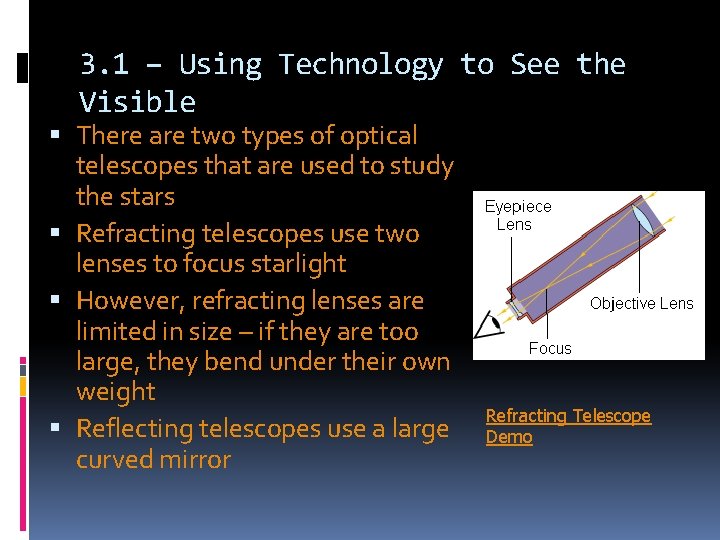
3. 1 – Using Technology to See the Visible There are two types of optical telescopes that are used to study the stars Refracting telescopes use two lenses to focus starlight However, refracting lenses are limited in size – if they are too large, they bend under their own weight Reflecting telescopes use a large curved mirror Refracting Telescope Demo
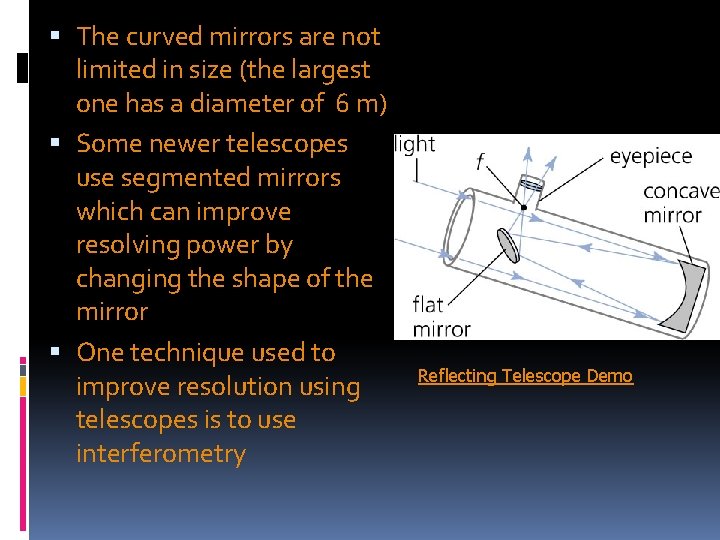
The curved mirrors are not limited in size (the largest one has a diameter of 6 m) Some newer telescopes use segmented mirrors which can improve resolving power by changing the shape of the mirror One technique used to improve resolution using telescopes is to use interferometry Reflecting Telescope Demo
In interferometry, two telescopes are linked and their images are combined, forming one image Ground-based telescopes are limited, however, by the clarity of the atmosphere Space-based telescopes, like the Hubble Space Telescope, do not have the disadvantage of atmospheric interference
The Hubble Telescope http: //hubblesite. org/the_telescope/ The Hubble Space Telescope’s launch was in 1990 Every 97 minutes, Hubble completes a spin around Earth, moving at the speed of about 8 km per second— fast enough to travel across the Canada in about 11 minutes. As it travels, Hubble's mirror captures light and directs it into its several science instruments to create images of earth
3. 2 – Using Technology to see Beyond the Visible Stars not only produce visible light, but they also produce other radiation Radio telescopes are used to study stars These telescopes have an advantage over optical telescopes – they can operate day or night, regardless of weather However, they must be placed far away from any sources of radio waves
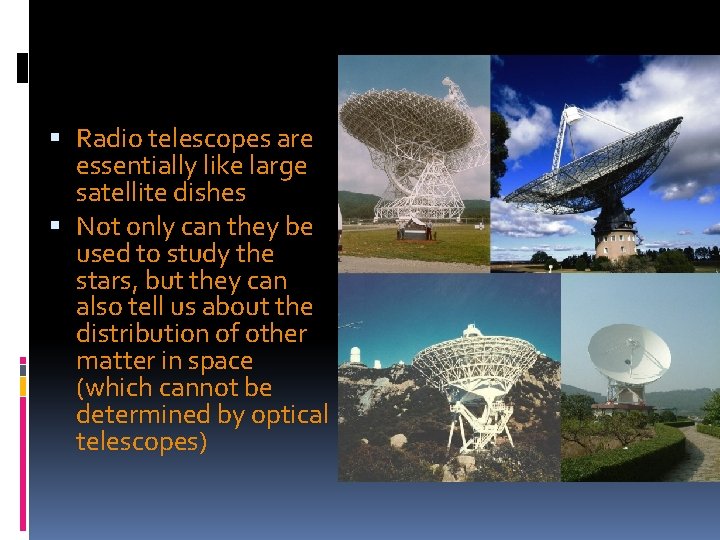
Radio telescopes are essentially like large satellite dishes Not only can they be used to study the stars, but they can also tell us about the distribution of other matter in space (which cannot be determined by optical telescopes)
Just like optical telescopes, radio telescopes can also use interferometry For instance, the VLA (Very Large Array) in New Mexico uses 27 large radio telescopes arranged in a Y-shape As a result, the resolving capacity of the VLA would be the same as a single telescope with a dish 27 km in diameter
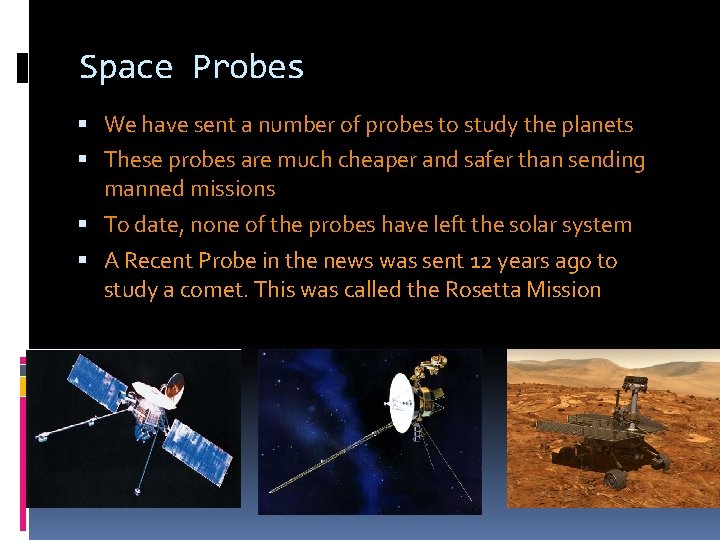
Space Probes We have sent a number of probes to study the planets These probes are much cheaper and safer than sending manned missions To date, none of the probes have left the solar system A Recent Probe in the news was sent 12 years ago to study a comet. This was called the Rosetta Mission
3. 3 – Using Technology to Interpret Space We cannot tell how far a star is away just by staring at it through a telescope We can determine distance through a method known as triangulation: triangulation is the process of determining the location of a point by measuring angles to it from known points at either end of a fixed baseline.
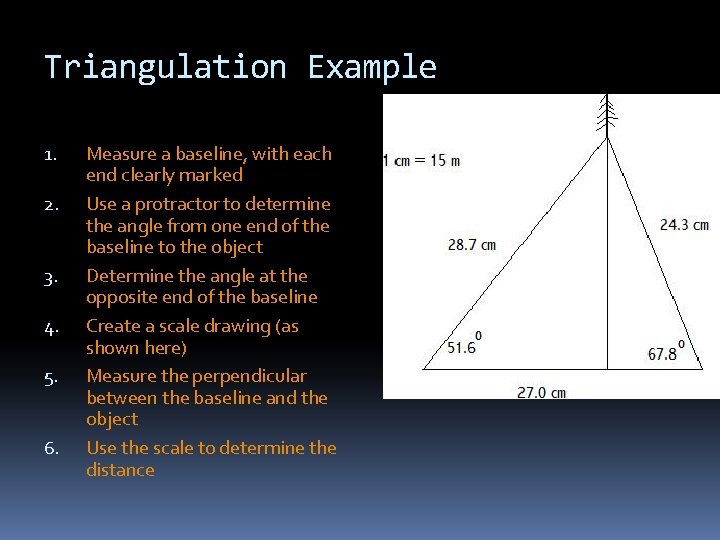
Triangulation Example 1. 2. 3. 4. 5. 6. Measure a baseline, with each end clearly marked Use a protractor to determine the angle from one end of the baseline to the object Determine the angle at the opposite end of the baseline Create a scale drawing (as shown here) Measure the perpendicular between the baseline and the object Use the scale to determine the distance
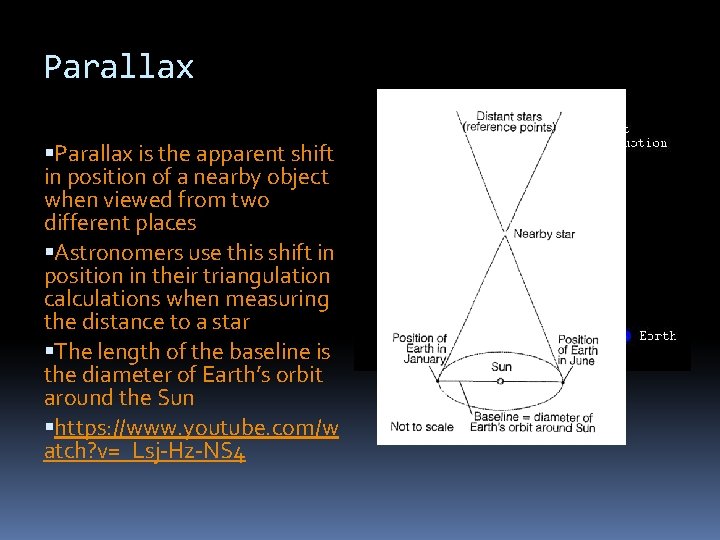
Parallax is the apparent shift in position of a nearby object when viewed from two different places Astronomers use this shift in position in their triangulation calculations when measuring the distance to a star The length of the baseline is the diameter of Earth’s orbit around the Sun https: //www. youtube. com/w atch? v=_Lsj-Hz-NS 4
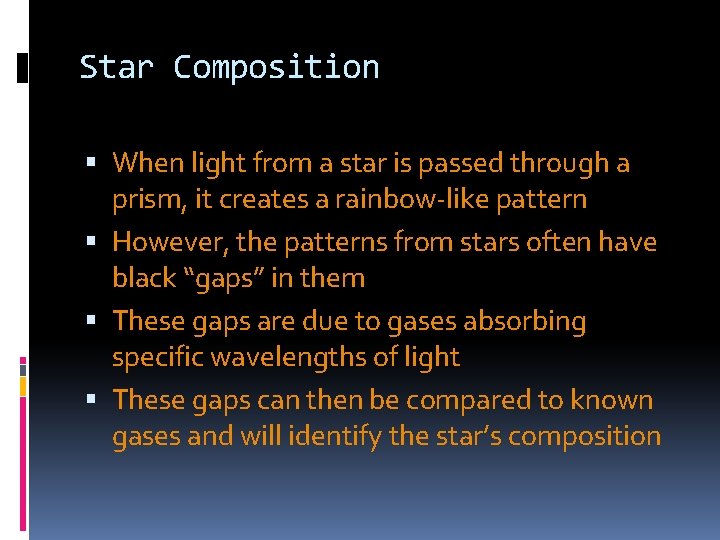
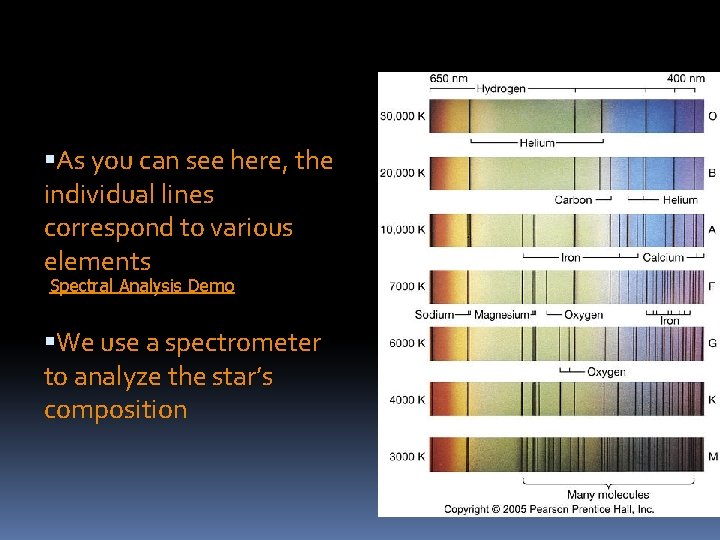
Star Composition When light from a star is passed through a prism, it creates a rainbow-like pattern However, the patterns from stars often have black “gaps” in them These gaps are due to gases absorbing specific wavelengths of light These gaps can then be compared to known gases and will identify the star’s composition
As you can see here, the individual lines correspond to various elements Spectral Analysis Demo We use a spectrometer to analyze the star’s composition
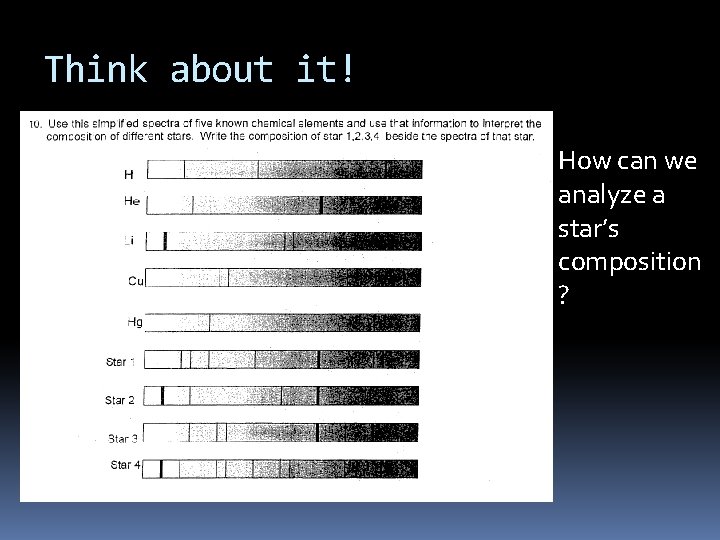
Think about it! How can we analyze a star’s composition ?
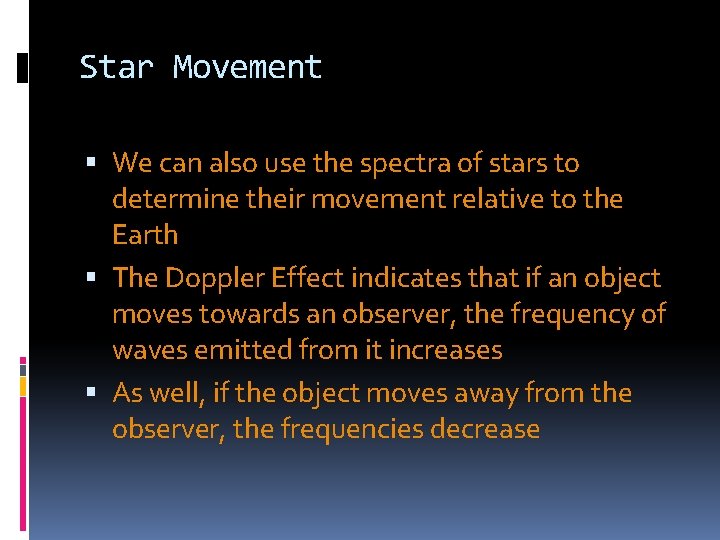
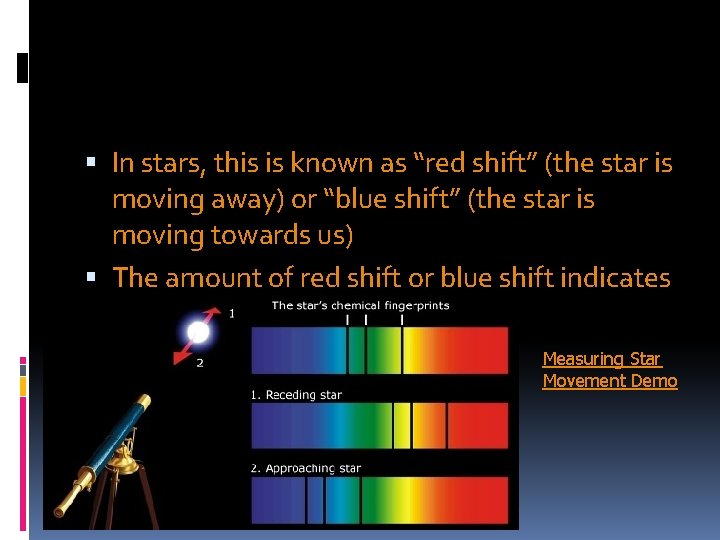
Star Movement We can also use the spectra of stars to determine their movement relative to the Earth The Doppler Effect indicates that if an object moves towards an observer, the frequency of waves emitted from it increases As well, if the object moves away from the observer, the frequencies decrease
In stars, this is known as “red shift” (the star is moving away) or “blue shift” (the star is moving towards us) The amount of red shift or blue shift indicates the speed of the star Measuring Star Movement Demo
2. 3 – Using Space Technology to Meet Human Needs on Earth We can use space technologies here on Earth One of the main ways that we use this technology is through Satellites
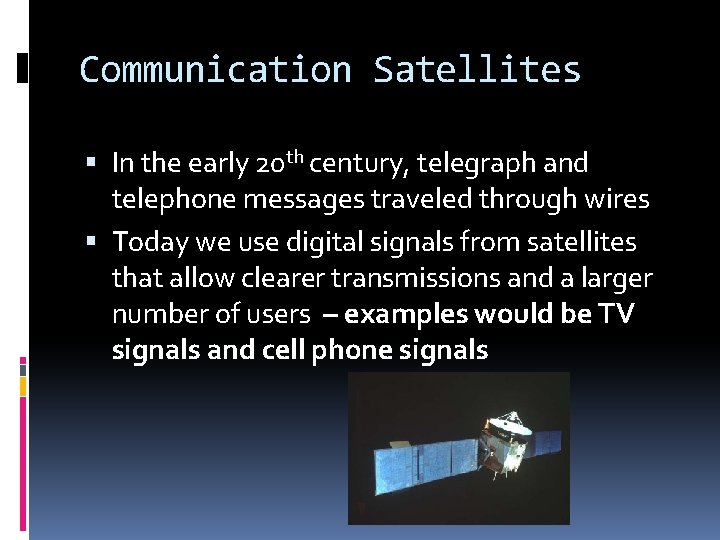
Communication Satellites In the early 20 th century, telegraph and telephone messages traveled through wires Today we use digital signals from satellites that allow clearer transmissions and a larger number of users – examples would be TV signals and cell phone signals
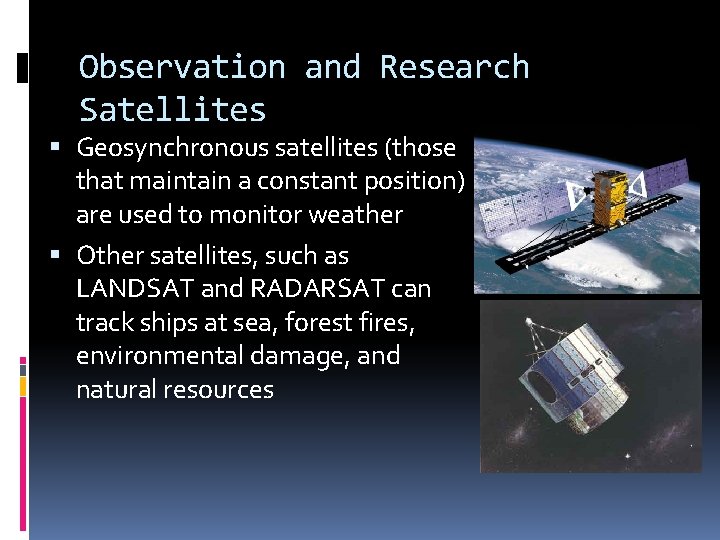
Observation and Research Satellites Geosynchronous satellites (those that maintain a constant position) are used to monitor weather Other satellites, such as LANDSAT and RADARSAT can track ships at sea, forest fires, environmental damage, and natural resources
Remote Sensing The main purpose of satellites in low Earth orbit (200 to 1000 km altitude) is to make observations about the Earth This provides information about the condition of the environment, natural resources, and the effects of urbanization
The Global Positioning System There are 24 GPS satellites that orbit the Earth At any one point, there at least three of these satellites that are above a given location at any moment They produce radio signals that are picked up by receivers
These radio signals contain time information The time information from each satellite is compared with the internal clock on the receiver, and the time difference between the signals indicates the distance from the satellite When three signals overlap, they will provide the user with their position
The GPS was originally developed for the US military In 2000, non-military users could finally receive a full-quality signal (prior to this, civilians could only receive a less accurate signal)
Practice Your Skills Complete the Skills Practice with GPS Use
Space Age Materials and Systems Many different materials and systems originally designed for space have been put to use on Earth Almost all sectors of business have been advanced through the use of these materials and technologies:
Computer Technology Computers have been used to analyze the structure of spacecraft, the monitoring of onboard systems, and the training of astronauts On Earth we use the same technologies in offices, to analyze buildings and bridges, and to develop virtual reality software
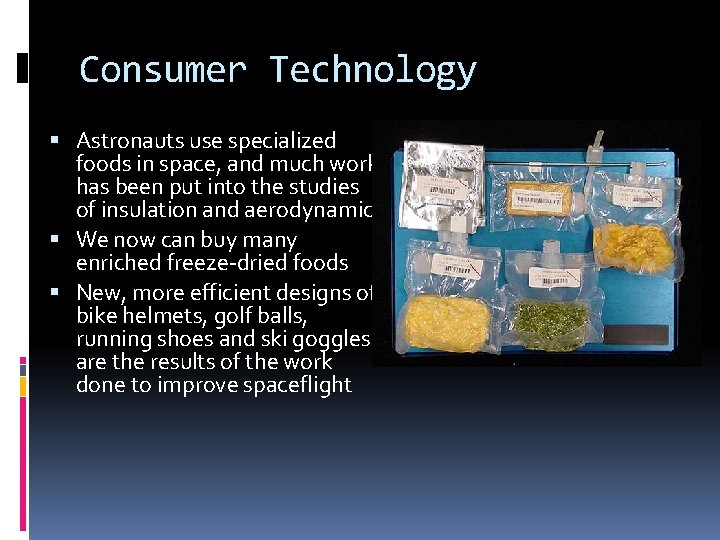
Consumer Technology Astronauts use specialized foods in space, and much work has been put into the studies of insulation and aerodynamics We now can buy many enriched freeze-dried foods New, more efficient designs of bike helmets, golf balls, running shoes and ski goggles are the results of the work done to improve spaceflight
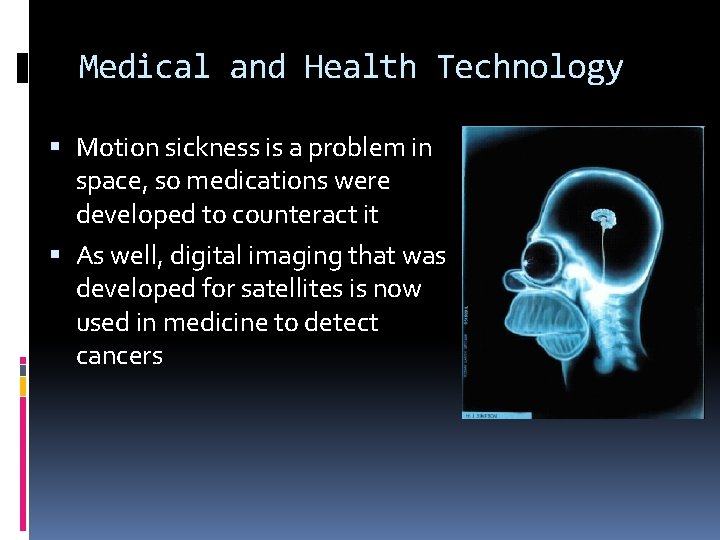
Medical and Health Technology Motion sickness is a problem in space, so medications were developed to counteract it As well, digital imaging that was developed for satellites is now used in medicine to detect cancers
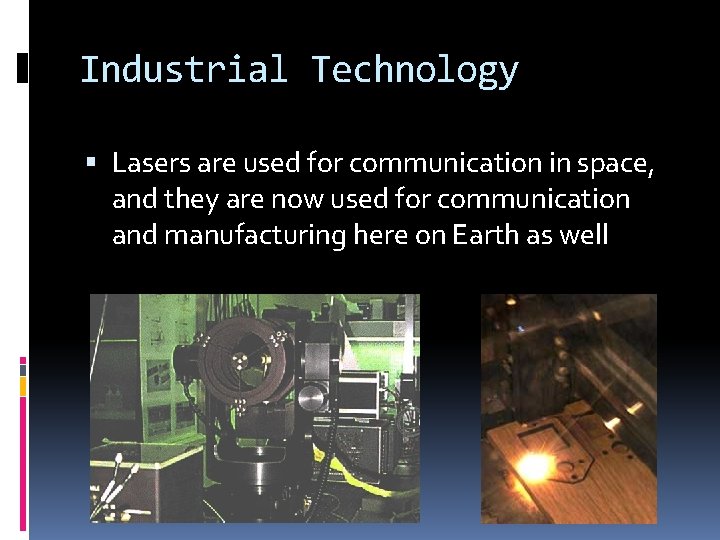
Industrial Technology Lasers are used for communication in space, and they are now used for communication and manufacturing here on Earth as well
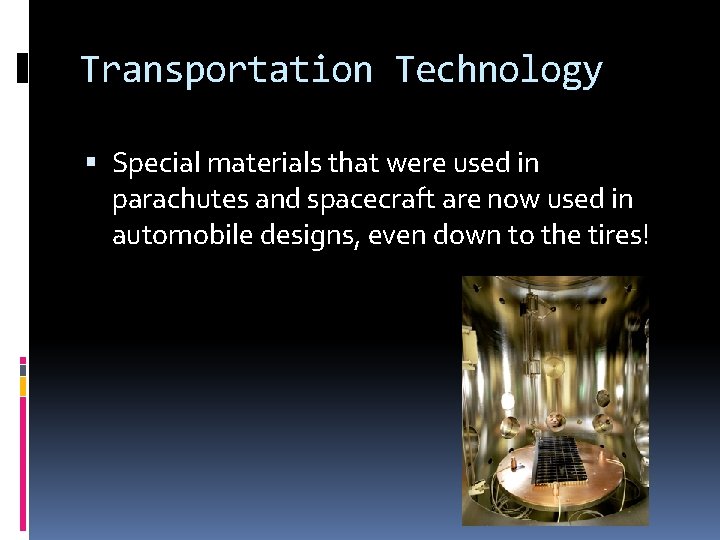
Transportation Technology Special materials that were used in parachutes and spacecraft are now used in automobile designs, even down to the tires!
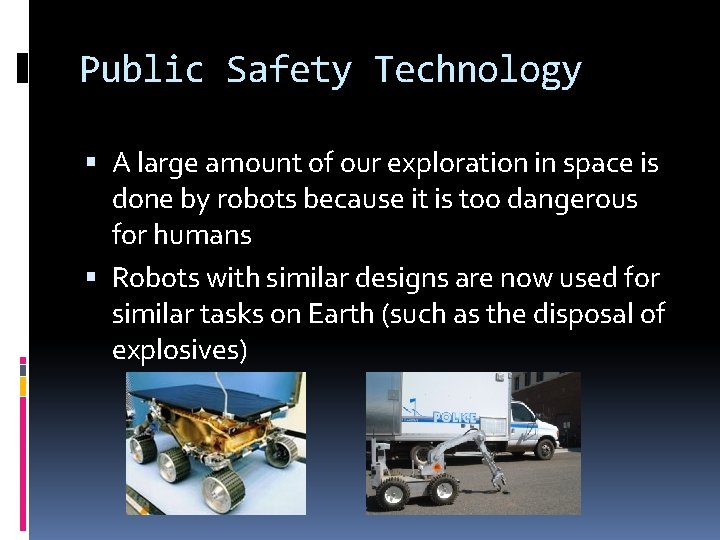
Public Safety Technology A large amount of our exploration in space is done by robots because it is too dangerous for humans Robots with similar designs are now used for similar tasks on Earth (such as the disposal of explosives)
As well, space debris can fall to Earth In 1978, a Soviet satellite crashed into the Great Slave Lake area in NWT During re-entry, the disintegrating satellite showered radioactive debris from its power plant over a 124 000 km 2 area The clean-up carried out by the Canadian and US military cost about $15 million
End of Section Assignment: Section Review p. 455 #1– 9