
Technologies driving systemic innovation Creative destruction of boundaries
Technologies driving systemic innovation. Creative destruction of boundaries Shaping your Future in Knowledge Society, Amsterdam Jan 2005 bror. salmelin@cec. eu. int European Commission, New Working Environments
Starting point: The Lisbon agenda l Lisbon council …. “To become the most competitive and dynamic knowledge-based economy in the world, capable of sustainable economic growth with more and better jobs and greater social cohesion. ” l Knowledge & Skills determines the success of individuals and companies in the global economy l Organisations inhibit or catalyse value creation in knowledge economy, add no value themselves! l Harnessing the creativity and innovation of 450 M Europeans for the knowledge economy ---- the target BEYOND CONSUMERS, WORKERS OR DEPENDENTS: A EUROPE OF CREATORS 2
Globality: challenges and opportunities Challenges… l Productivity gap? l Relocation of low quality standardized jobs and, high skilled work to countries outside the EU l Job losses l Inclusion (regional, rural, skills) Opportunities… l Strengthening the European Research Area – the IST is a priority l Investing in human capital – expand the base of qualified ICT practitioners in strategic areas, emerging technologies, skills of ICT users of innovative systems… 3
Value Creation in Knowledge Economy l intangible economy – extended products including embedded services, covering entire life cycles l knowledge based economy – digital content and services l networking – simultaneous, complex and multidisciplinary 4
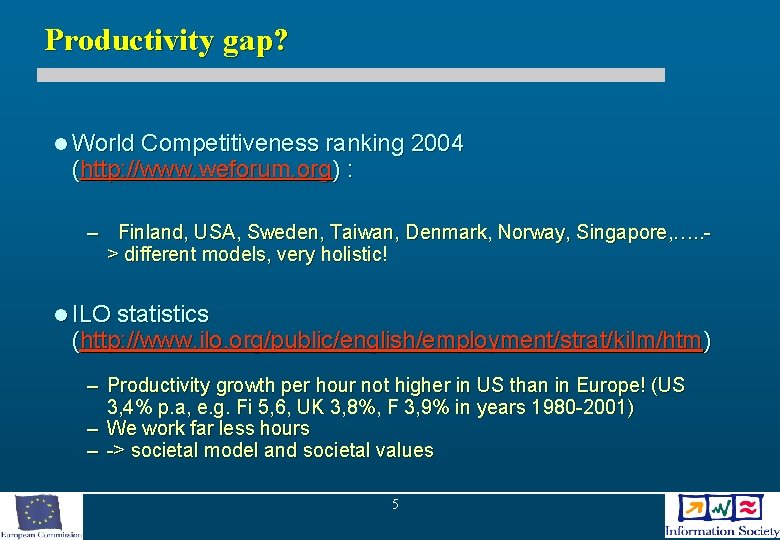
Productivity gap? l World Competitiveness ranking 2004 (http: //www. weforum. org) : – Finland, USA, Sweden, Taiwan, Denmark, Norway, Singapore, …. . > different models, very holistic! l ILO statistics (http: //www. ilo. org/public/english/employment/strat/kilm/htm) – Productivity growth per hour not higher in US than in Europe! (US 3, 4% p. a, e. g. Fi 5, 6, UK 3, 8%, F 3, 9% in years 1980 -2001) – We work far less hours – -> societal model and societal values 5
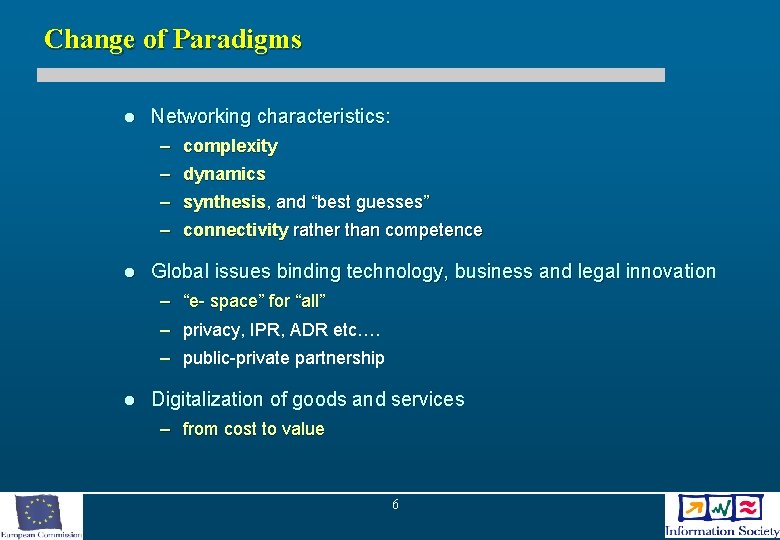
Change of Paradigms l Networking characteristics: – complexity – dynamics – synthesis, and “best guesses” – connectivity rather than competence l Global issues binding technology, business and legal innovation – – “e- space” for “all” privacy, IPR, ADR etc…. – public-private partnership l Digitalization of goods and services – from cost to value 6
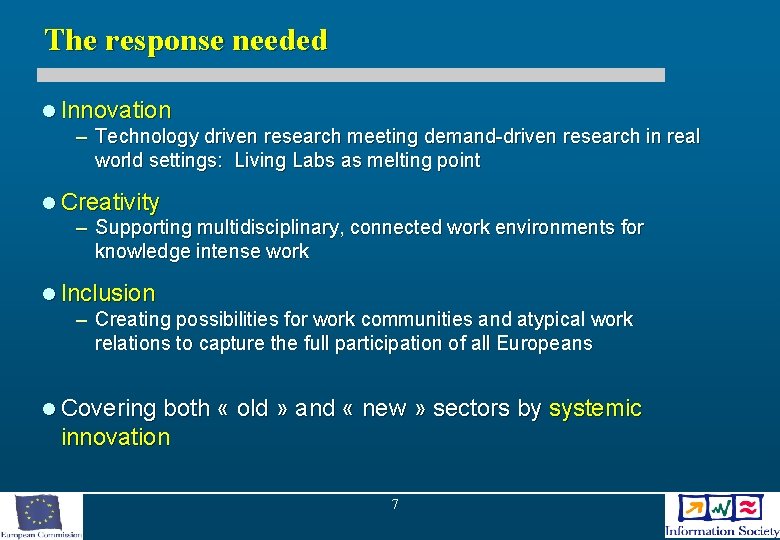
The response needed l Innovation – Technology driven research meeting demand-driven research in real world settings: Living Labs as melting point l Creativity – Supporting multidisciplinary, connected work environments for knowledge intense work l Inclusion – Creating possibilities for work communities and atypical work relations to capture the full participation of all Europeans l Covering both « old » and « new » sectors by systemic innovation 7

ICT for collaboration fostering competitiveness ICT for collaborative HUMAN BRAINS working environments COLLABORATION -seamless interaction CREATIVITY -new ideas EFFECTIVENESS EFFICIENCY -do tasks anywhere, -allocations of resources INNOVATION anytime, with anyone -participation to work -new products and services PRODUCTIVITY AND GROWTH COMPETITIVENESS 8
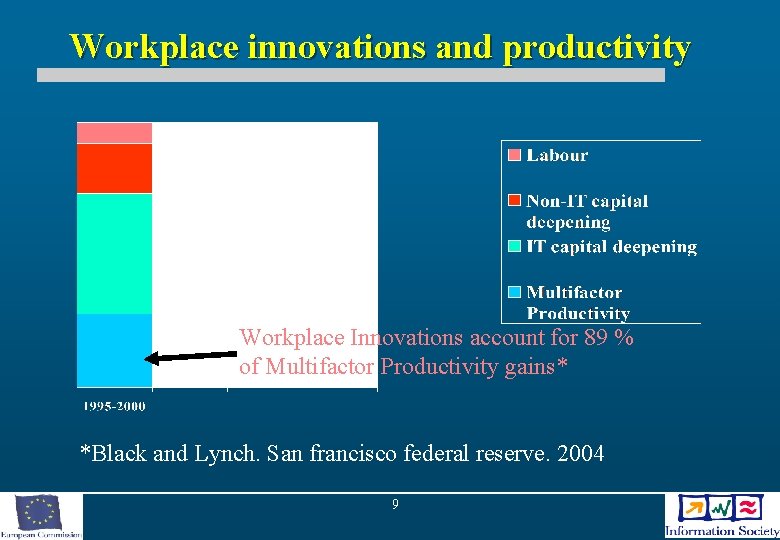
Workplace innovations and productivity Workplace Innovations account for 89 % of Multifactor Productivity gains* *Black and Lynch. San francisco federal reserve. 2004 9

Diversity – strength of Europe ! Value of innovation high Breakthrough average insignificant Low High Alignment of team members’ disciplines @ Lee Fleming, Perfecting gross-pollination. Harvard Business review September 2004. 10 low

Full Impact Needs Systemic Innovation Component innovation Systemic innovation 12
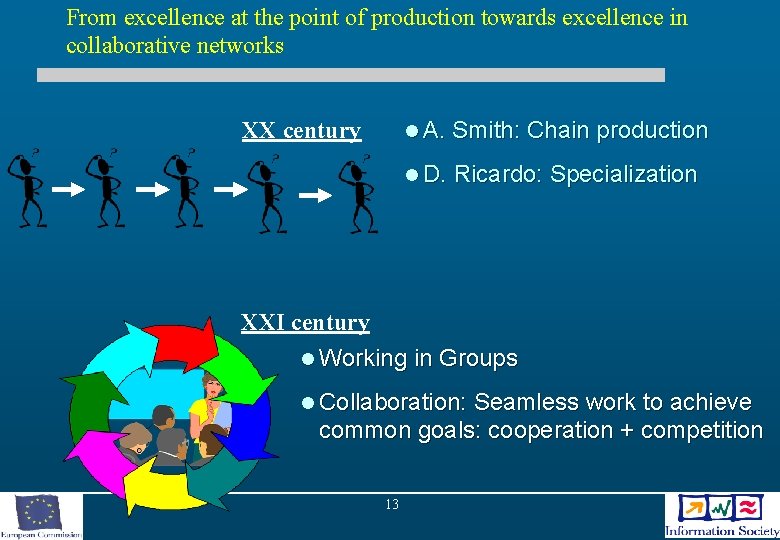
From excellence at the point of production towards excellence in collaborative networks XX century l A. Smith: Chain production l D. Ricardo: Specialization XXI century l Working in Groups l Collaboration: Seamless work to achieve common goals: cooperation + competition 13
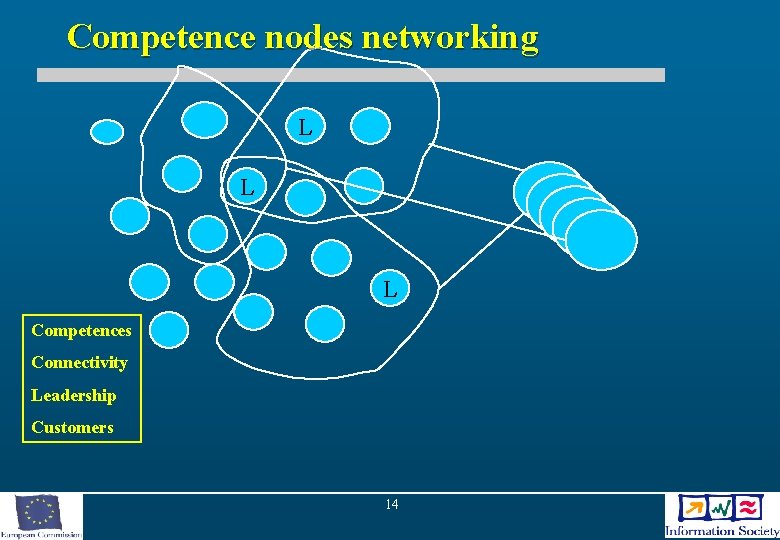
Competence nodes networking L L L Competences Connectivity Leadership Customers 14
Thesis l In knowledge economy the trends suggest us to move from organisation- to human centric perspective: – We all have multiple simultaneous roles: • • • private - public work – private often multiple and changing in context with no clear boundaries – Organisations vs. Communities – Organisations catalyse or inhibit value creation – Incentives for the individuals to value creation 15
Trend visible in the press, or is it actually? l “Collaborative solutions will be the next billion-dollar category”. Business. Week (2003) l “Almost everything is group-oriented. Everything has to do with the inefficiencies that exist with people working together” Bill Gates (Oct. 2003) l “Collaboration with colleagues, partners and customers will allow to find optimal, innovative solutions”. Japan’s Future office Scenario (April 2004) l “Global collaboration, customer feedback and personal knowledge management are transforming the workplace today”. IWPC (2004) 16
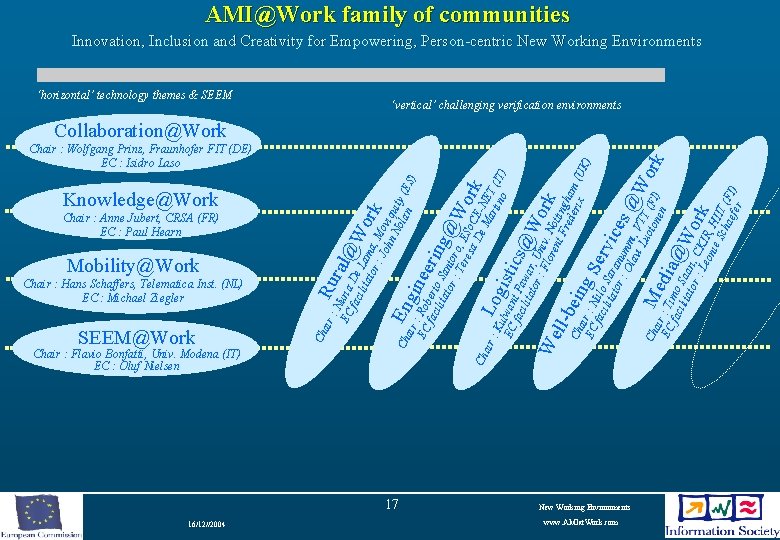
AMI@Work family of communities Innovation, Inclusion and Creativity for Empowering, Person-centric New Working Environments ‘horizontal’ technology themes & SEEM ‘vertical’ challenging verification environments 16/12//2004 New Working Environments www. AMIat. Work. com @W ork Me dia @W es vic bei ng Ser cs@ gis ti Lo ng eer i gin Wo rk rk @W o 17 We ll- SEEM@Work Chair : Flavio Bonfatti, Univ. Modena (IT) EC : Oluf Nielsen En Chair : Hans Schaffers, Telematica Inst. (NL) EC : Michael Ziegler ral Mobility@Work Ru Chair : Anne Jubert, CRSA (FR) EC : Paul Hearn ir : N EC uria fac De ilit La ato ma r: , M Joh ovi n N qui ola ty (E Ch n air S) EC : Rob fac ert ilit o S ato ant r : oro Ter , E esa So. C De E-N Ch Ma ET air rtin (IT : K u o ) EC lwan fac t Pa ilit wa ato r, U r: Flo niv. N ren ott t F ing red ha eri m ( Ch UK x air ) EC : N fac iilo ilit Sa ato ran r : um Ola mi vi L , VT uo T (F Ch ton I) air en : EC Ti m fac o ilit Saa ato ri, r : CK Leo IR nie , HI Sch IT ( aef FI) er Knowledge@Work Ch a Chair : Wolfgang Prinz, Fraunhofer FIT (DE) EC : Isidro Laso ork Collaboration@Work
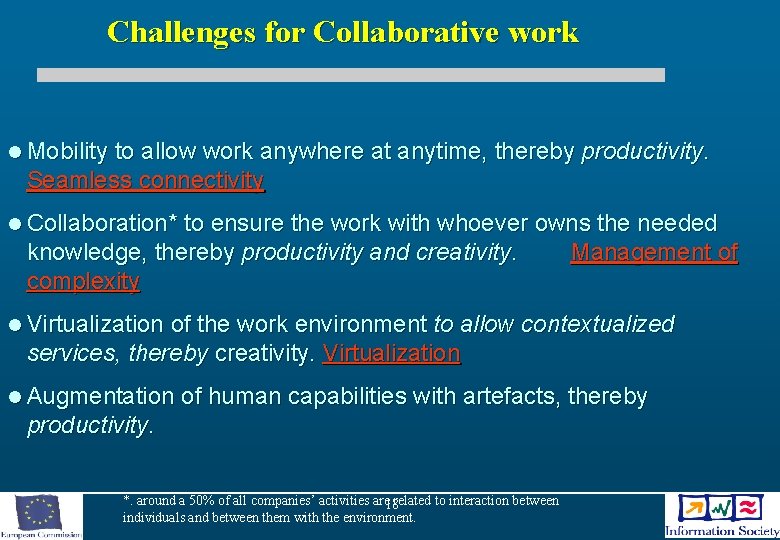
Challenges for Collaborative work l Mobility to allow work anywhere at anytime, thereby productivity. Seamless connectivity l Collaboration* to ensure the work with whoever owns the needed knowledge, thereby productivity and creativity. Management of complexity l Virtualization of the work environment to allow contextualized services, thereby creativity. Virtualization l Augmentation of human capabilities with artefacts, thereby productivity. *. around a 50% of all companies’ activities are 18 related to interaction between individuals and between them with the environment.
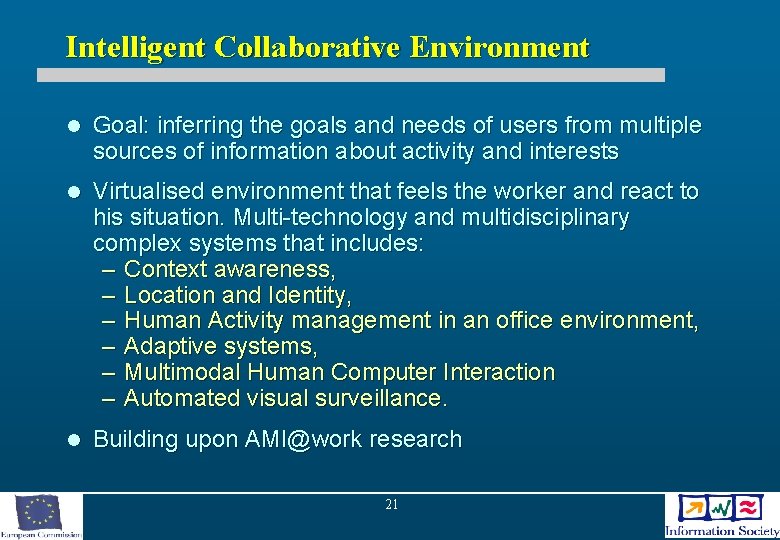
Intelligent Collaborative Environment l Goal: inferring the goals and needs of users from multiple sources of information about activity and interests l Virtualised environment that feels the worker and react to his situation. Multi-technology and multidisciplinary complex systems that includes: – Context awareness, – Location and Identity, – Human Activity management in an office environment, – Adaptive systems, – Multimodal Human Computer Interaction – Automated visual surveillance. l Building upon AMI@work research 21
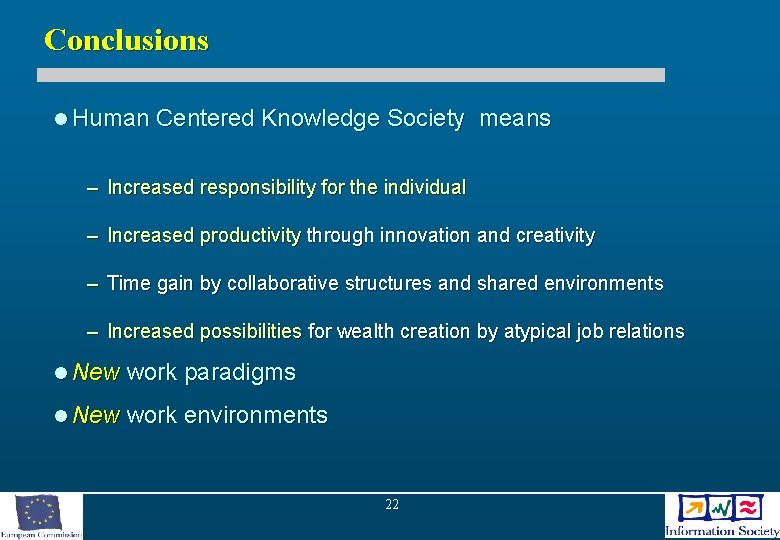
Conclusions l Human Centered Knowledge Society means – Increased responsibility for the individual – Increased productivity through innovation and creativity – Time gain by collaborative structures and shared environments – Increased possibilities for wealth creation by atypical job relations l New work paradigms l New work environments 22
Matrix: the machines were only half right…. l Ford saw us as units of production l Friedman see us as units of consumption l The matrix saw us as units of power We are creators…no longer creatures 23
Contact websites l http: //europa. eu. int/eeurope l http: //www. cordis. lu/ist l http: //www. amiatwork. com l and e-mail: bror. salmelin@cec. eu. int 24
- Slides: 21