
Technological World Movements Forces Types of Movements Types

- Slides: 49
Technological World Movements & Forces
Types of Movements
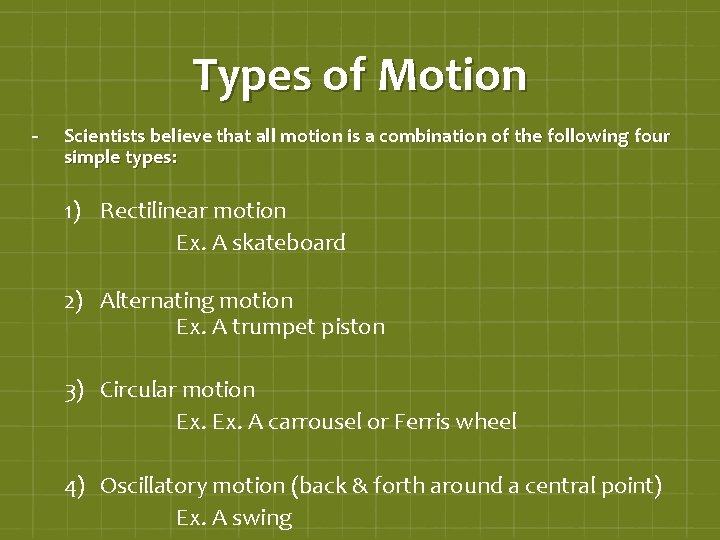
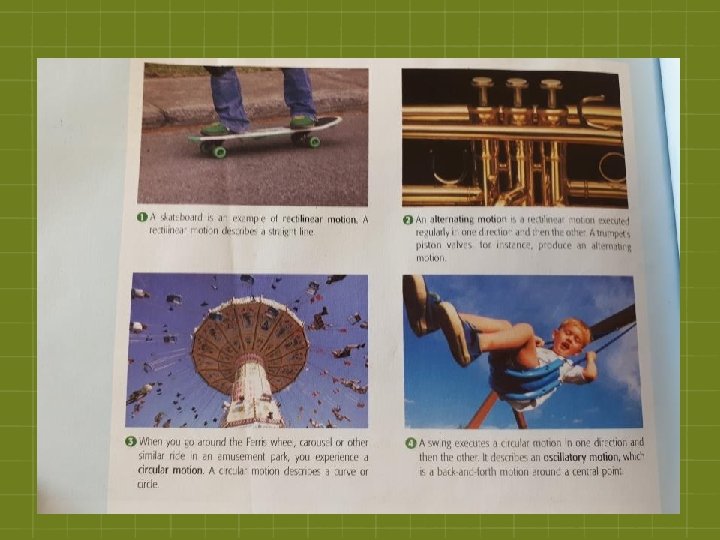
Types of Motion - Scientists believe that all motion is a combination of the following four simple types: 1) Rectilinear motion Ex. A skateboard 2) Alternating motion Ex. A trumpet piston 3) Circular motion Ex. A carrousel or Ferris wheel 4) Oscillatory motion (back & forth around a central point) Ex. A swing
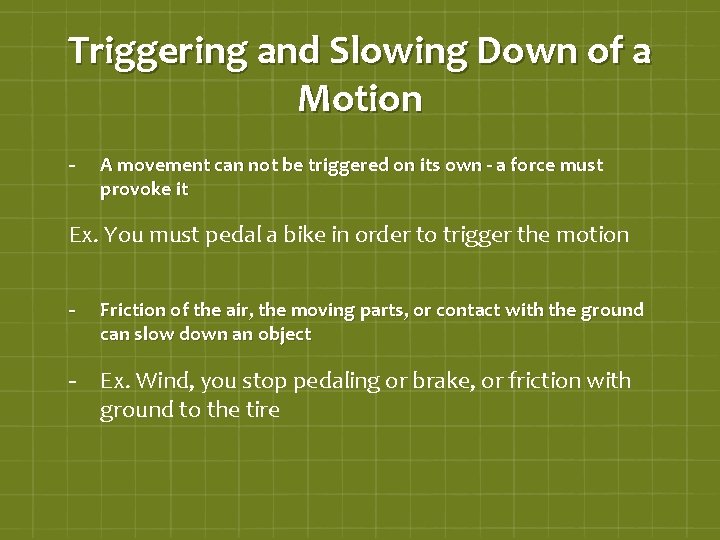
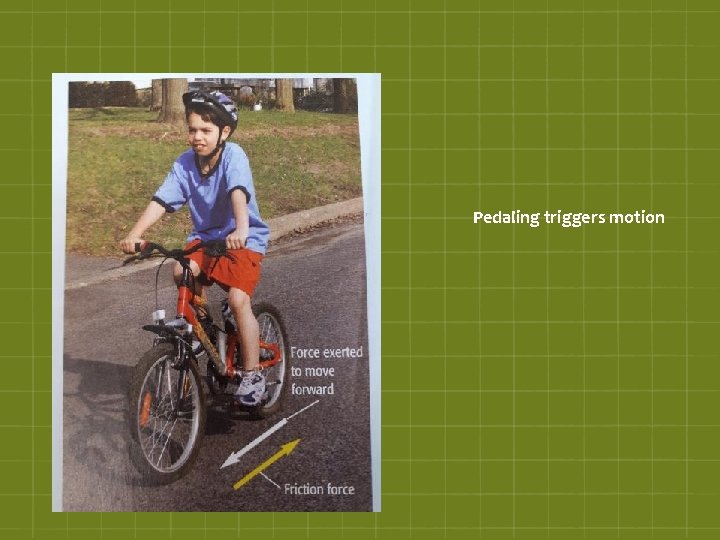
Triggering and Slowing Down of a Motion - A movement can not be triggered on its own - a force must provoke it Ex. You must pedal a bike in order to trigger the motion - Friction of the air, the moving parts, or contact with the ground can slow down an object - Ex. Wind, you stop pedaling or brake, or friction with ground to the tire
Pedaling triggers motion
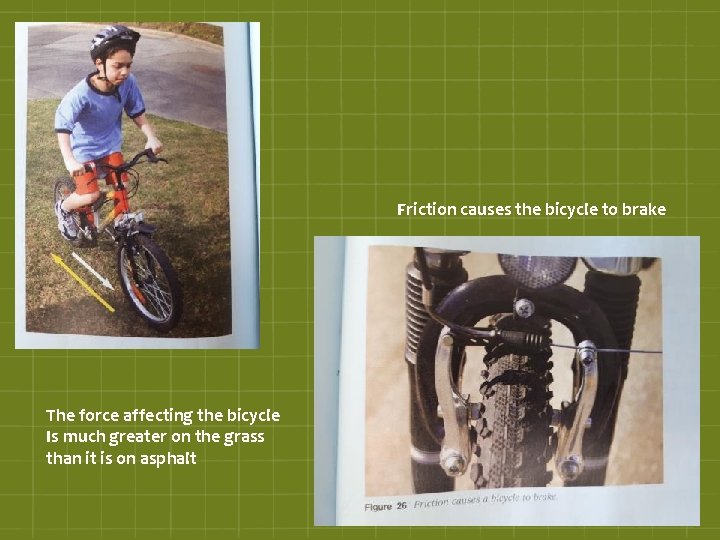
Triggering and Slowing Down of a Motion - The type of ground is an important factor in the movement of an object § Ex. It's much harder to pedal on surfaces like grass or sand than on asphalt Ø The friction force is greater on the grass and the sand, so you have to apply a greater force to fight the friction
Friction causes the bicycle to brake The force affecting the bicycle Is much greater on the grass than it is on asphalt
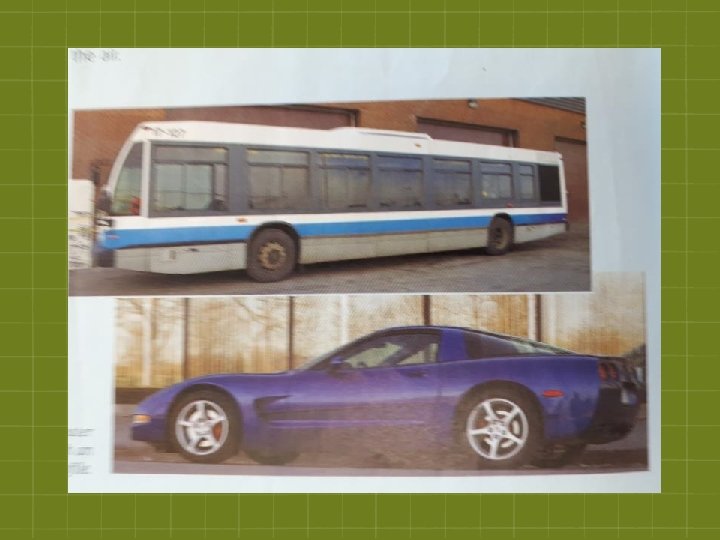
Triggering and Slowing Down of a Motion - The shape of an object is also an important factor in the movement of an object Ø The more an object has a square shape, the more the resistance of the air causes friction § Ex. Air resistance is greater for a bus than a car with an aerodynamic profile Aerodynamic Profile: A form that offers the least possible resistance to air
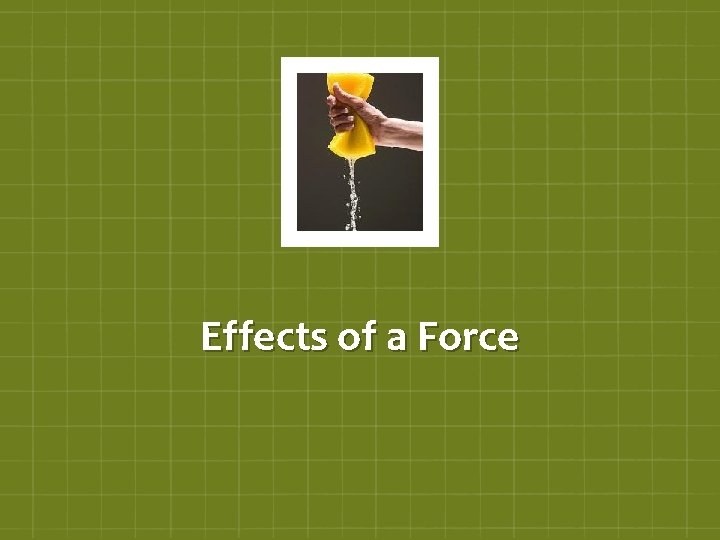
Effects of a Force
Types of Forces - When you exert a force on an object, you can: § put it in motion or change its motion § deform or break it - The most common types of forces are: § § § Bending (flexion) force The tension force The compression force The torsion force Shearing force
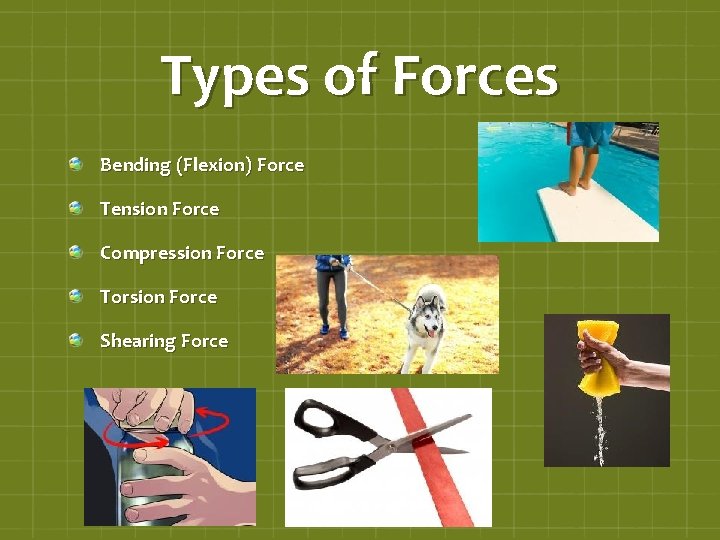
Types of Forces Bending (Flexion) Force Tension Force Compression Force Torsion Force Shearing Force
Simple Machines
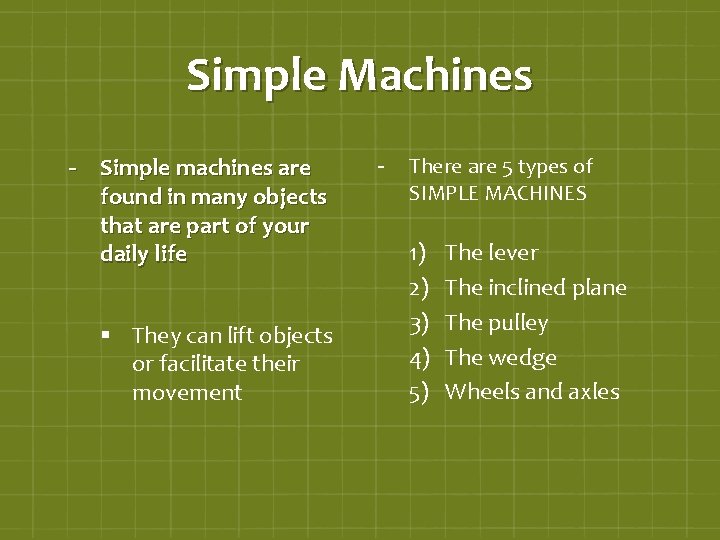
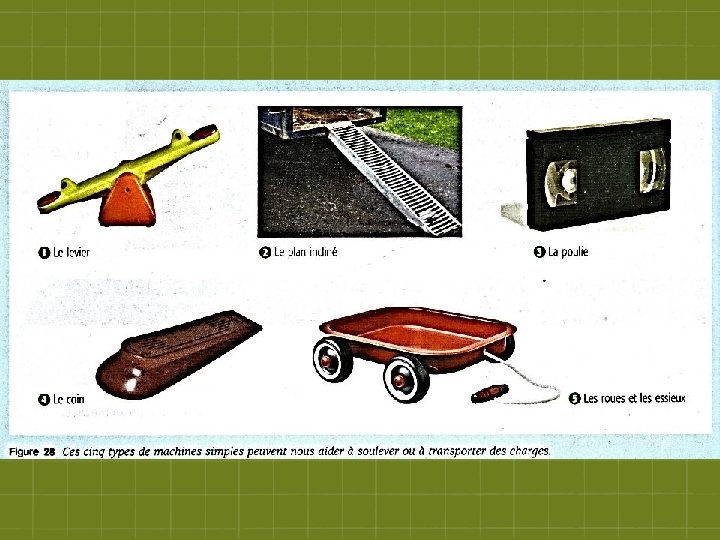
Simple Machines - Simple machines are found in many objects that are part of your daily life § They can lift objects or facilitate their movement - There are 5 types of SIMPLE MACHINES 1) 2) 3) 4) 5) The lever The inclined plane The pulley The wedge Wheels and axles
Simple Machines - Simple machines have 3 primary functions: § They transmit forces § They change the direction of a force § They change the intensity (size) of a force
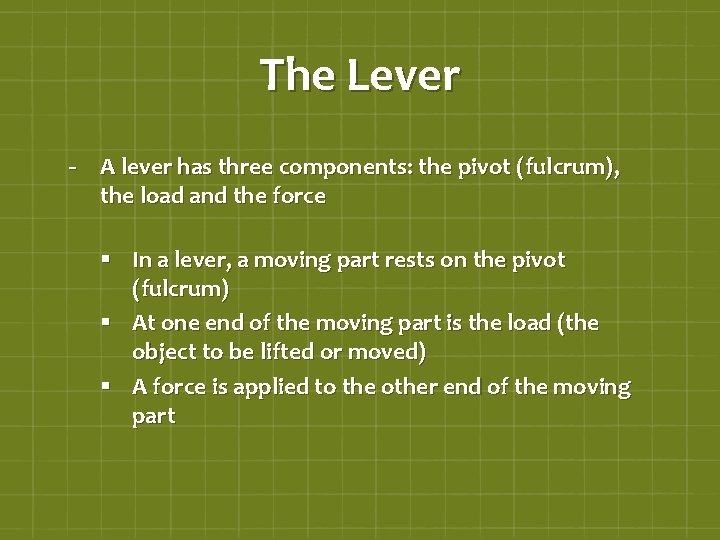
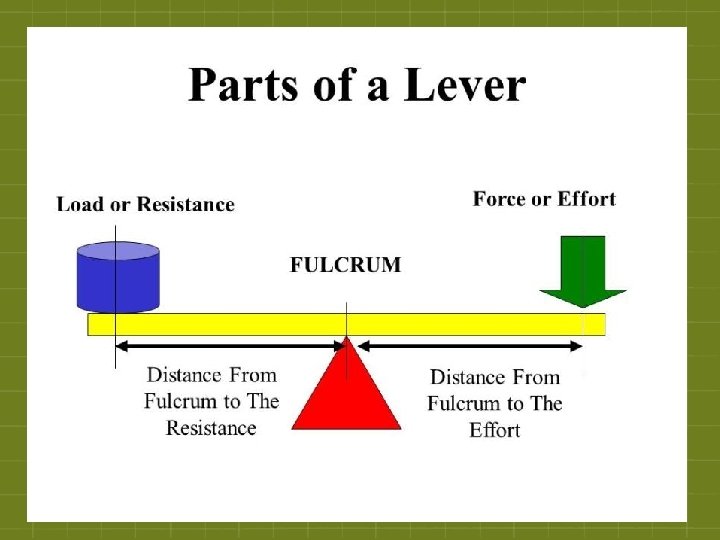
The Lever - A lever has three components: the pivot (fulcrum), the load and the force § In a lever, a moving part rests on the pivot (fulcrum) § At one end of the moving part is the load (the object to be lifted or moved) § A force is applied to the other end of the moving part
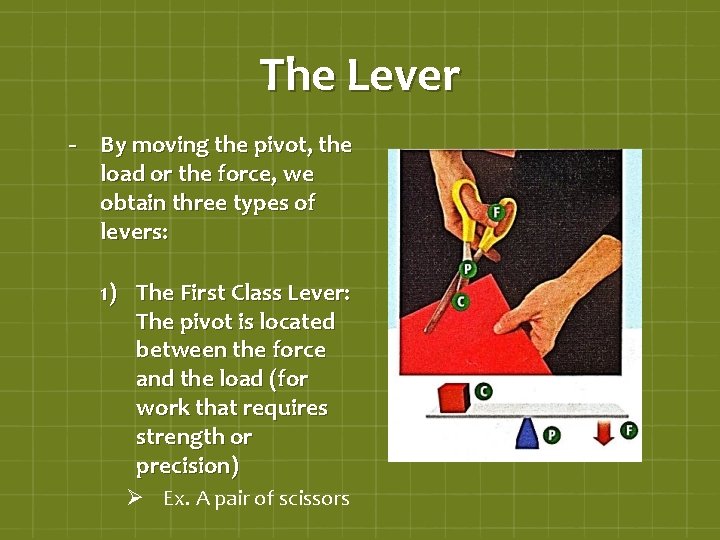
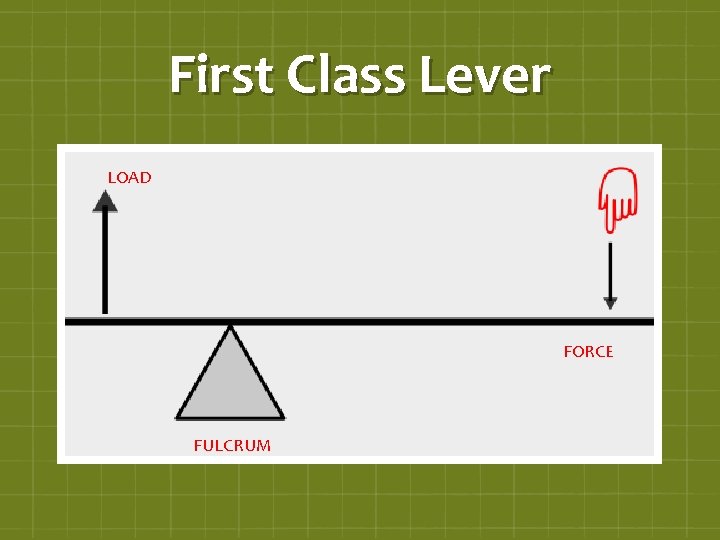
The Lever - By moving the pivot, the load or the force, we obtain three types of levers: 1) The First Class Lever: The pivot is located between the force and the load (for work that requires strength or precision) Ø Ex. A pair of scissors
First Class Lever LOAD FORCE FULCRUM
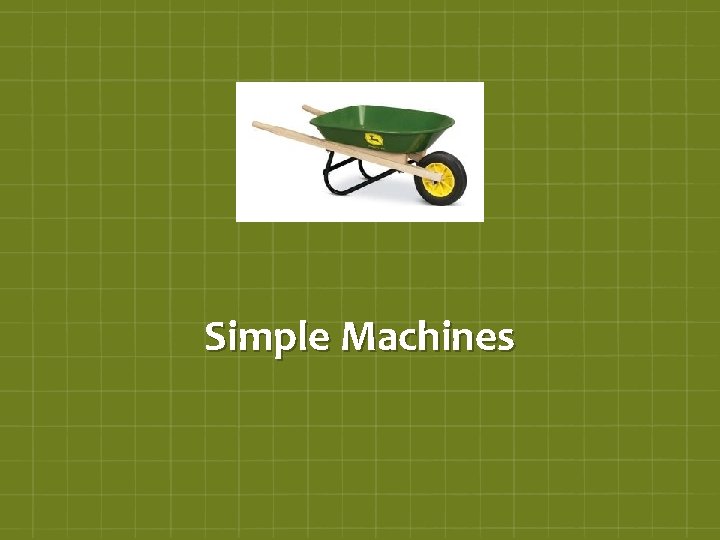
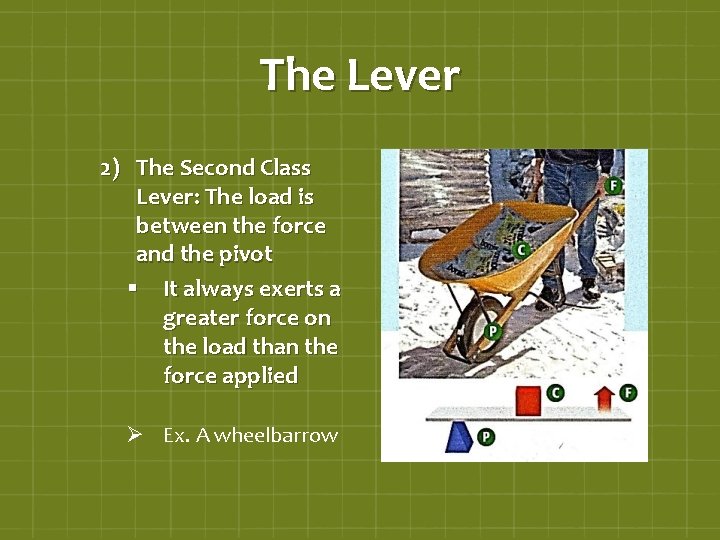
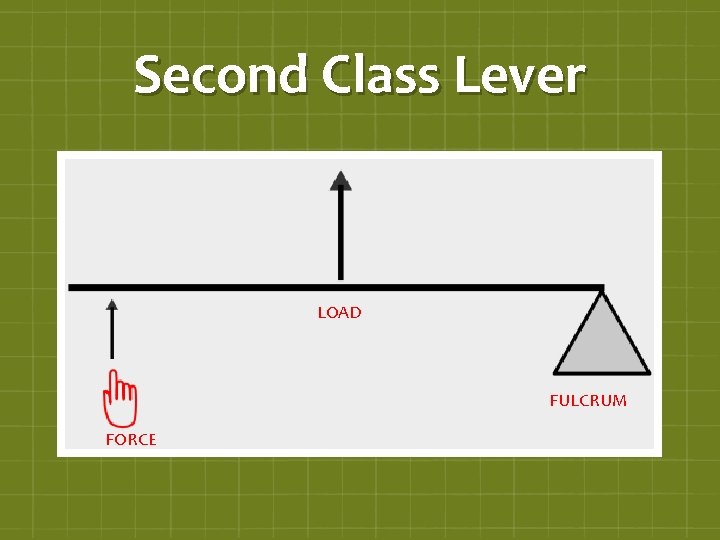
The Lever 2) The Second Class Lever: The load is between the force and the pivot § It always exerts a greater force on the load than the force applied Ø Ex. A wheelbarrow
Second Class Lever LOAD FULCRUM FORCE
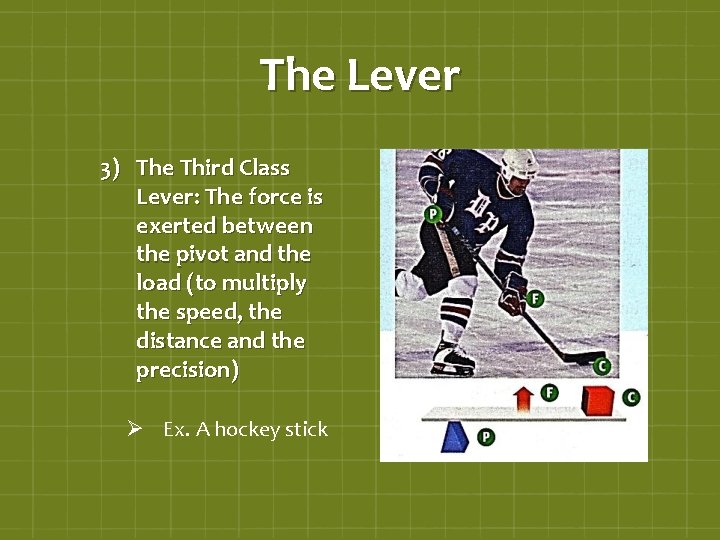
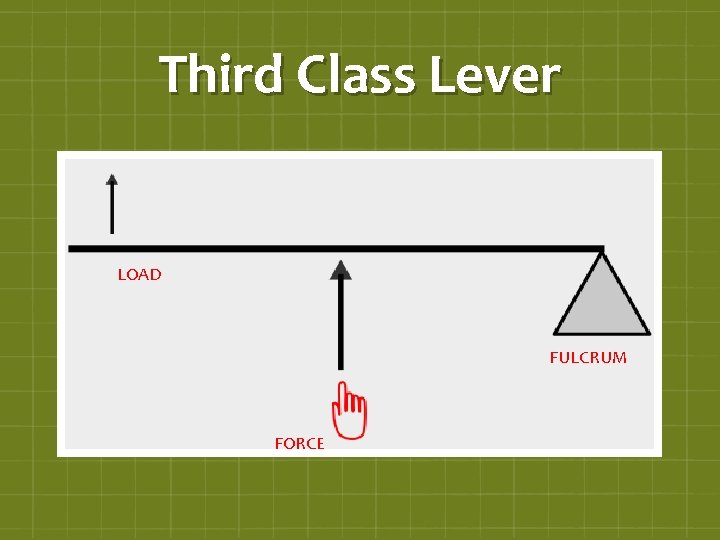
The Lever 3) The Third Class Lever: The force is exerted between the pivot and the load (to multiply the speed, the distance and the precision) Ø Ex. A hockey stick
Third Class Lever LOAD FULCRUM FORCE
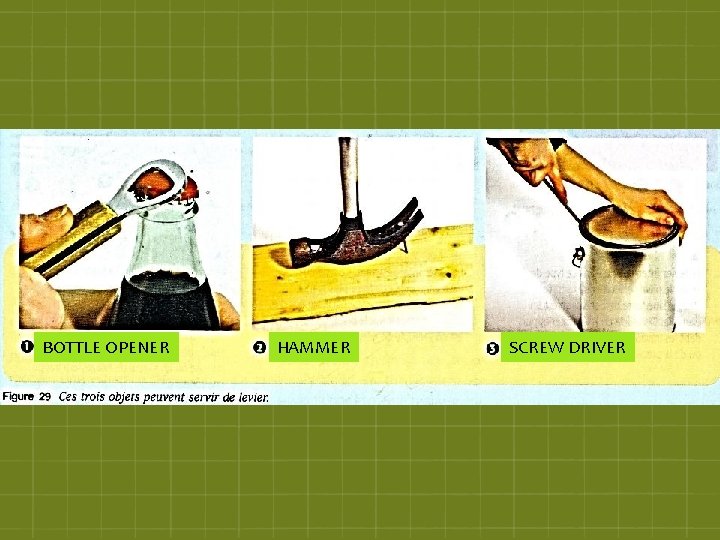
BOTTLE OPENER HAMMER SCREW DRIVER
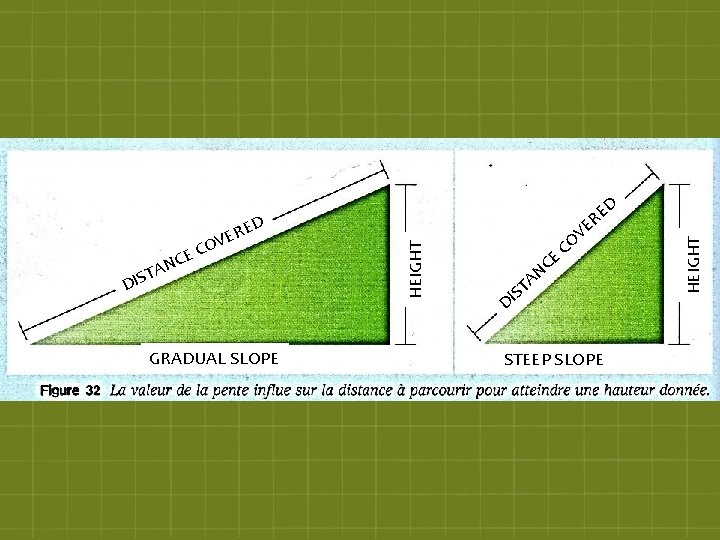
The Inclined Plane - An inclined plane has a slope § Slope reduces the amount of force required to lift a load or object Ø Instead of lifting an object, it is pushed - When the slope is gradual, it is easier to climb, but the distance to travel is longer - When the slope is steep, it is more difficult to climb, but the distance to travel is shorter
EC DIS C TAN GRADUAL SLOPE HEIGHT D ERE V O E C N CO A T IS D STEEP SLOPE HEIGHT ED R VE
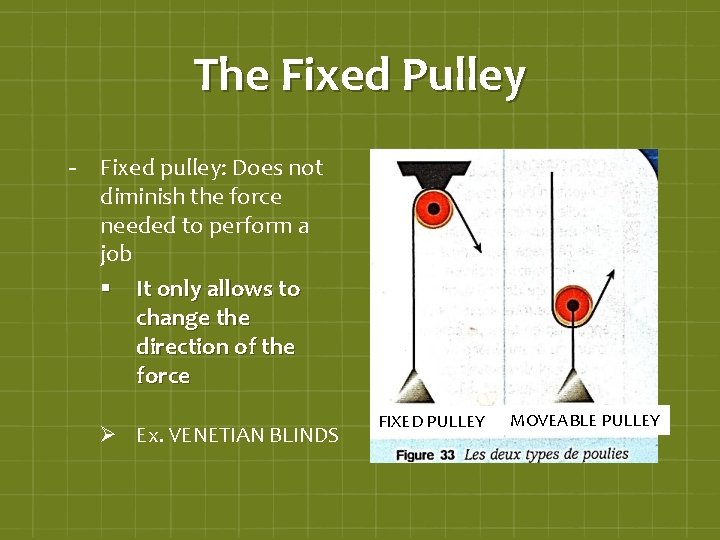
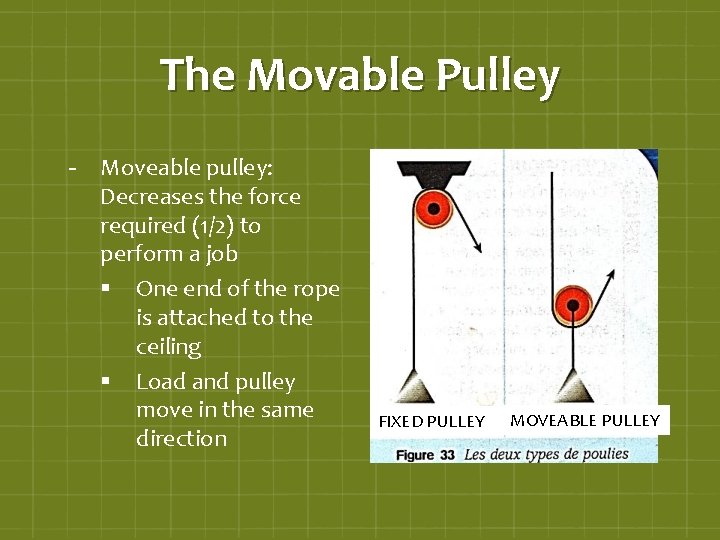
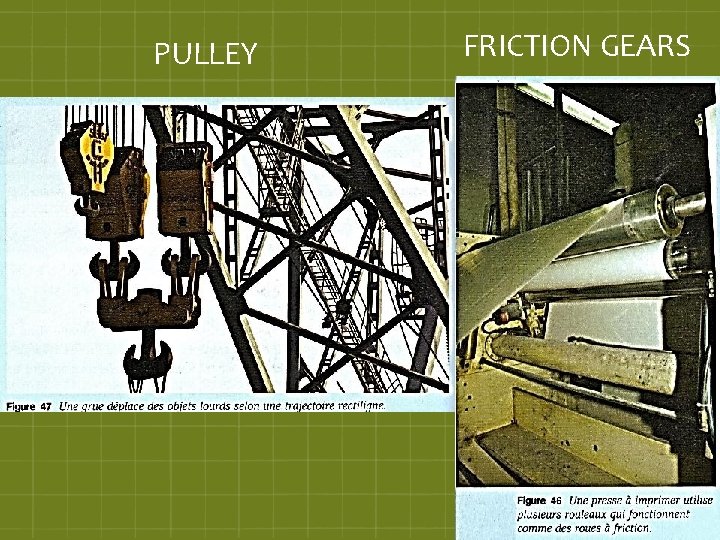
The Pulley - A pulley is composed of a wheel with a rope or chain - The rope or chain fits into the groove of the wheel Ø The pulley helps us lift loads - There are 2 types of pulleys: 1) FIXED 2) MOVEABLE
The Fixed Pulley - Fixed pulley: Does not diminish the force needed to perform a job § It only allows to change the direction of the force Ø Ex. VENETIAN BLINDS FIXED PULLEY MOVEABLE PULLEY
The Movable Pulley - Moveable pulley: Decreases the force required (1/2) to perform a job § One end of the rope is attached to the ceiling § Load and pulley move in the same direction FIXED PULLEY MOVEABLE PULLEY
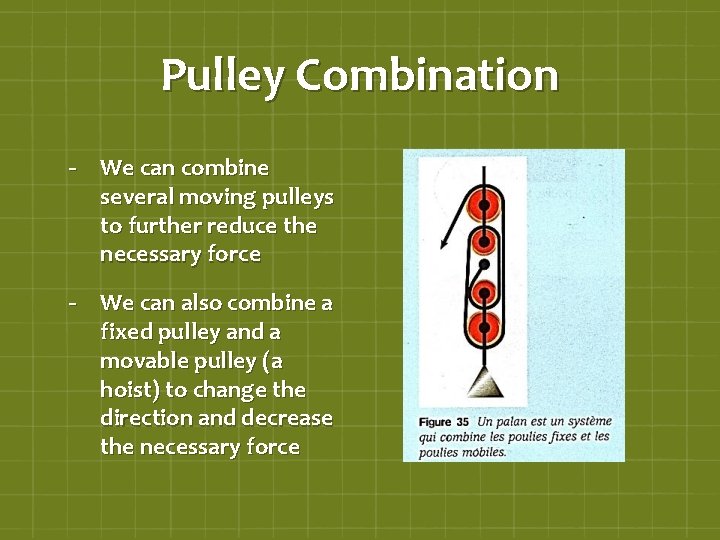
Pulley Combination - We can combine several moving pulleys to further reduce the necessary force - We can also combine a fixed pulley and a movable pulley (a hoist) to change the direction and decrease the necessary force
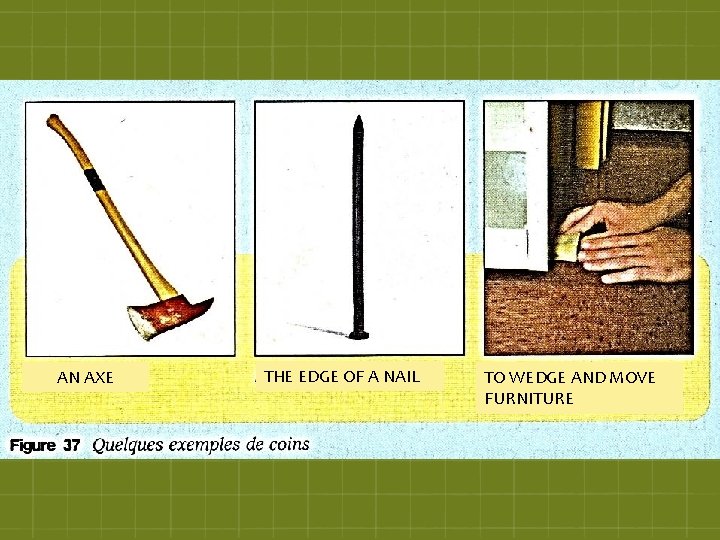
The Wedge - The Wedge is a triangular prism § It is used to exert a force on an object Ø The wedge helps us to separate pieces Ex. An axe OR the end of a nail Ø The wedge helps us lift objects Ex. A corner to lift a piece of furniture
AN AXE THE EDGE OF A NAIL TO WEDGE AND MOVE FURNITURE
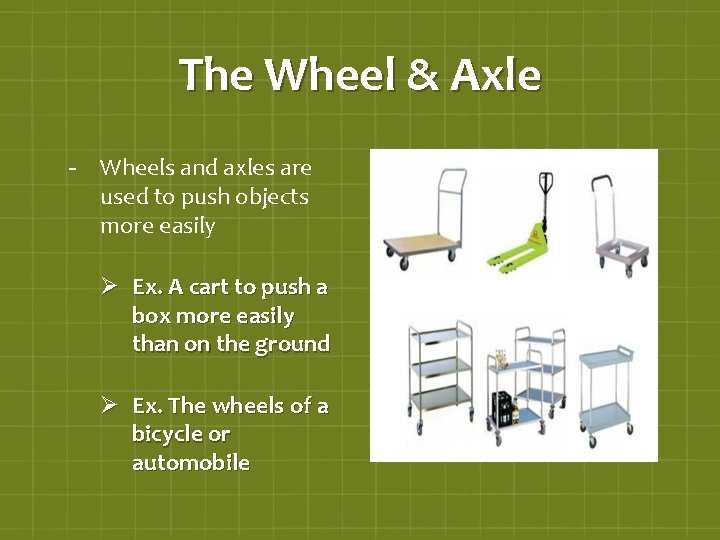
The Wheel & Axle - Wheels and axles are used to push objects more easily Ø Ex. A cart to push a box more easily than on the ground Ø Ex. The wheels of a bicycle or automobile
The Transmission of Motion
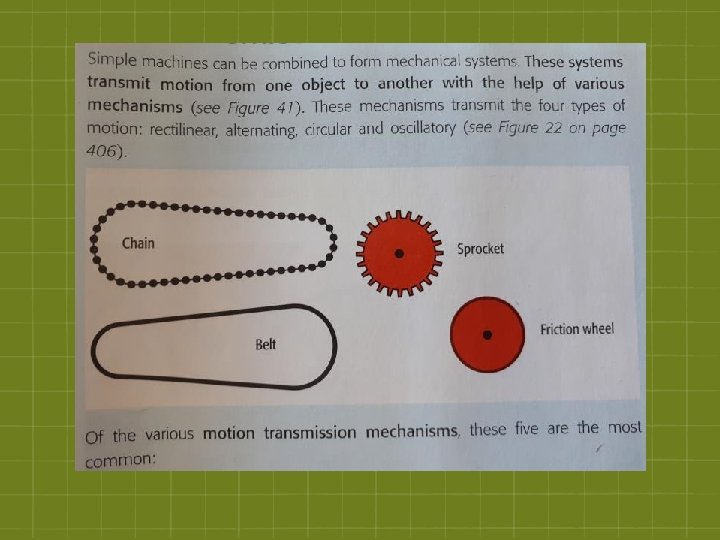
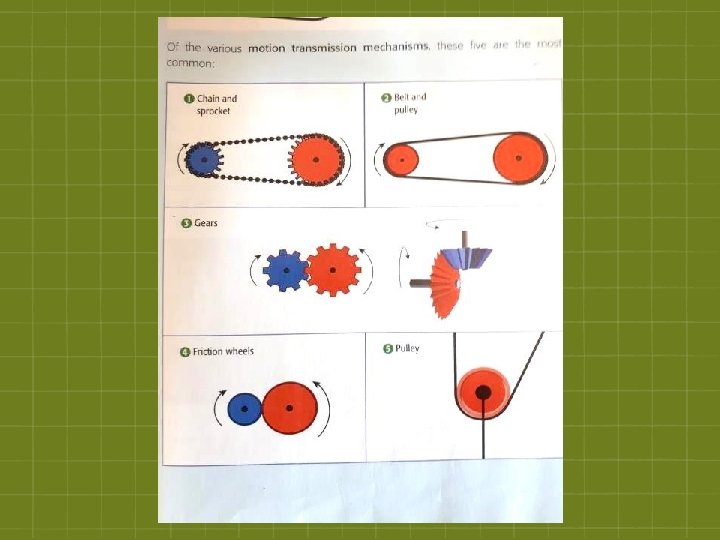
The Transmission of Motion - Simple machines can be combined to form mechanical systems § These systems are used to transmit a movement from one object to another, through different mechanisms Ø The mechanisms transmit the four types of movement: 1) Rectilinear 2) Alternative 3) Circular 4) Oscillatory
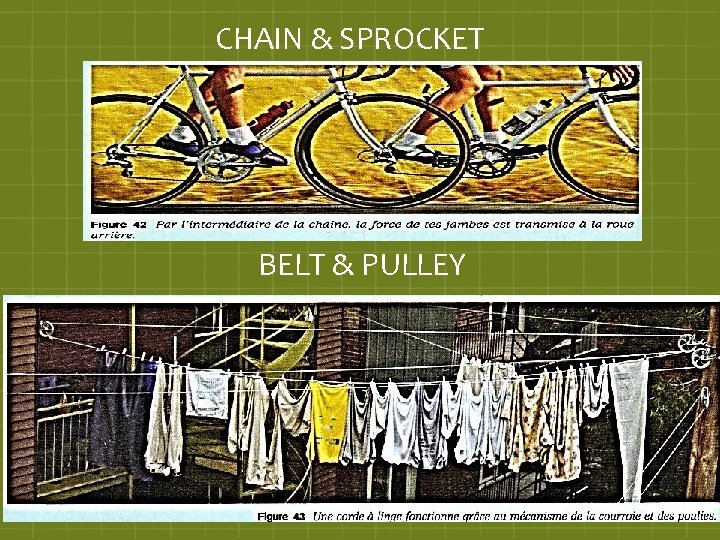
CHAIN & SPROCKET BELT & PULLEY
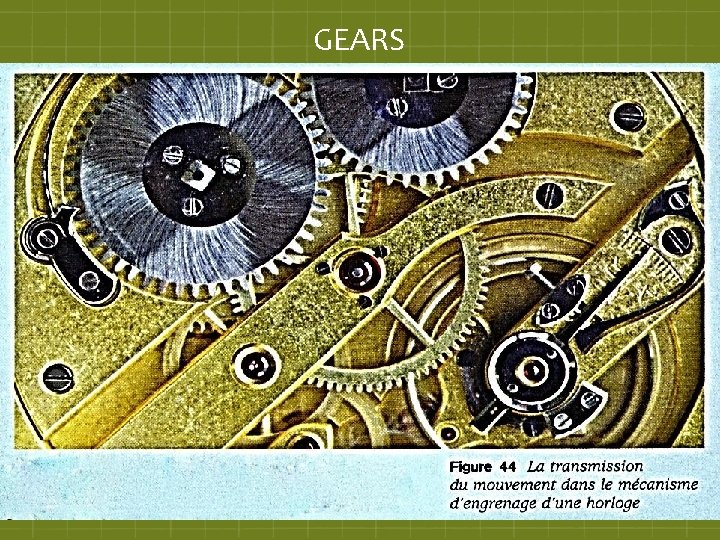
GEARS
PULLEY FRICTION GEARS
The Transformation of Motion
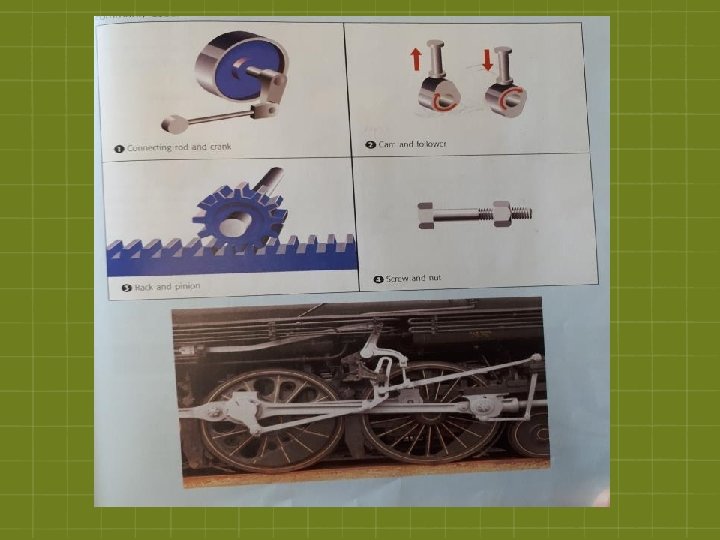
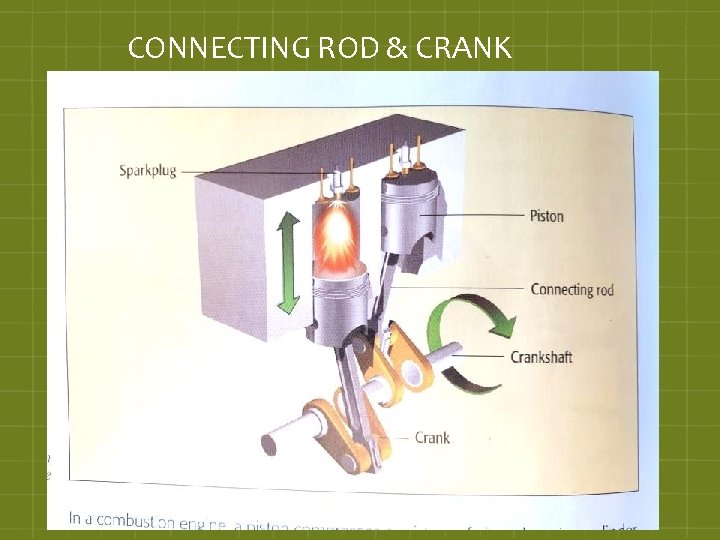
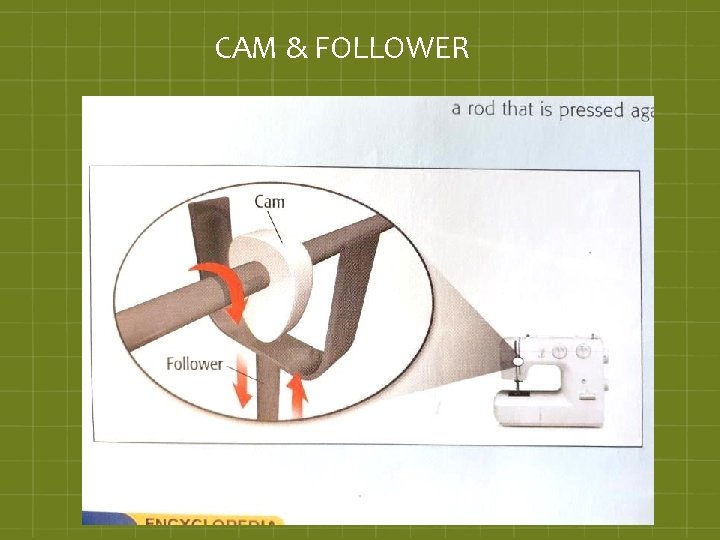
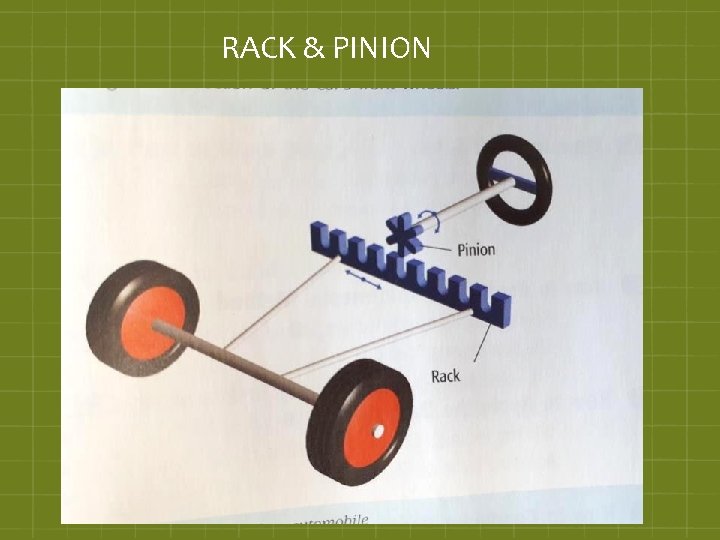
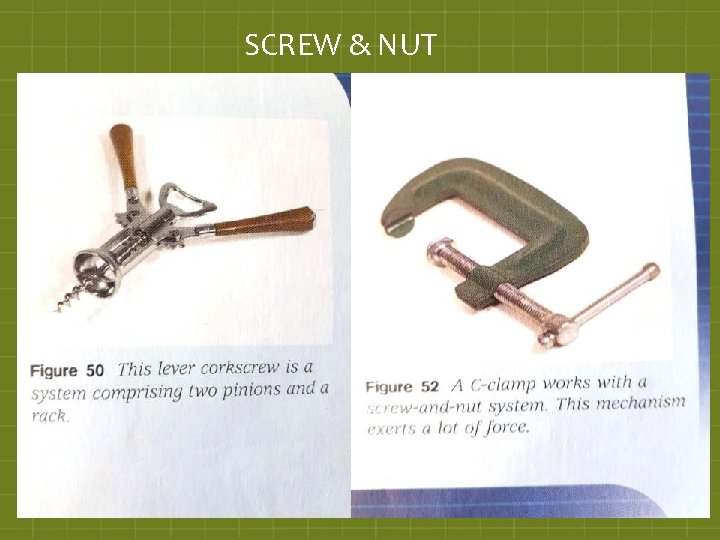
The Transformation of Motion - Some mechanisms move from one type of movement to another (transform a movement) - EX. Translational to Rotational OR Rotational to Translational
CONNECTING ROD & CRANK
CAM & FOLLOWER
RACK & PINION
SCREW & NUT