
Technological Infrastructure for Subsea Observatories Neville Hazell Alcatel
Technological Infrastructure for Subsea Observatories Neville Hazell Alcatel Submarine Networks Antoine Lecroart Alcatel-Lucent All Rights Reserved © Alcatel-Lucent 2006, #####
Cable Science Observatories Solutions Technology Pedigree Dry-Wet from Dry-Dry Architecture Optical Design IP and PTP Powering Ocean Engineering Conclusion Q&A All Rights Reserved © Alcatel-Lucent 2006, #####
Technology Pedigree All Rights Reserved © Alcatel-Lucent 2006, #####
Technology Pedigree All Rights Reserved © Alcatel-Lucent 2006, #####
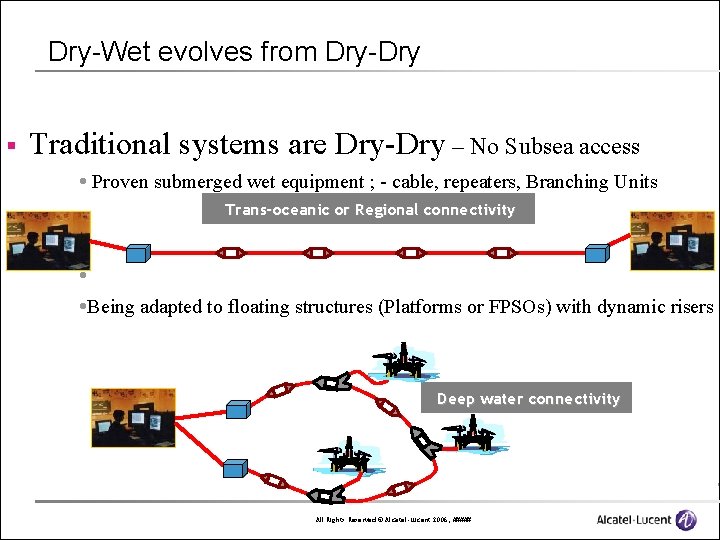
Dry-Wet evolves from Dry-Dry § Traditional systems are Dry-Dry – No Subsea access Proven submerged wet equipment ; - cable, repeaters, Branching Units Trans-oceanic or Regional connectivity Being adapted to floating structures (Platforms or FPSOs) with dynamic risers Deep water connectivity All Rights Reserved © Alcatel-Lucent 2006, #####

Dry-Wet evolves from Dry-Dry § Very different to go Dry-Wet § Flexibility – subsea access required § Plug & Play – standardised ports § Power needs to be treated differently § Power required locally on the sea bottom § Variable loads Sub sea connectivity All Rights Reserved © Alcatel-Lucent 2006, #####
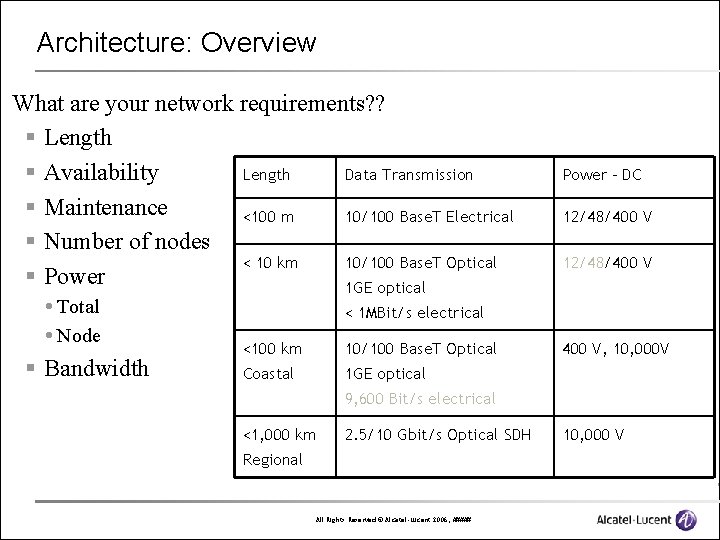
Architecture: Overview What are your network requirements? ? § Length § Availability Length Data Transmission § Maintenance <100 m 10/100 Base. T Electrical § Number of nodes < 10 km 10/100 Base. T Optical § Power 1 GE optical Total Node § Bandwidth Power - DC 12/48/400 V < 1 MBit/s electrical <100 km 10/100 Base. T Optical Coastal 1 GE optical 400 V, 10, 000 V 9, 600 Bit/s electrical <1, 000 km 2. 5/10 Gbit/s Optical SDH Regional All Rights Reserved © Alcatel-Lucent 2006, ##### 10, 000 V
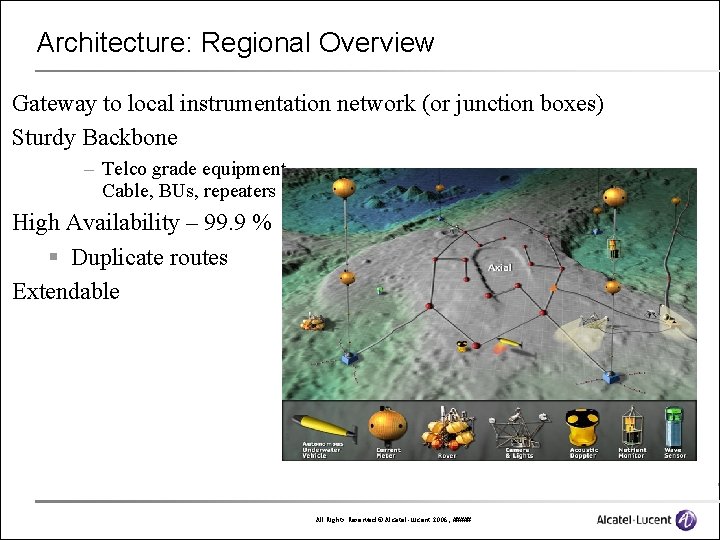
Architecture: Regional Overview Gateway to local instrumentation network (or junction boxes) Sturdy Backbone – Telco grade equipment Cable, BUs, repeaters High Availability – 99. 9 % § Duplicate routes Extendable All Rights Reserved © Alcatel-Lucent 2006, #####
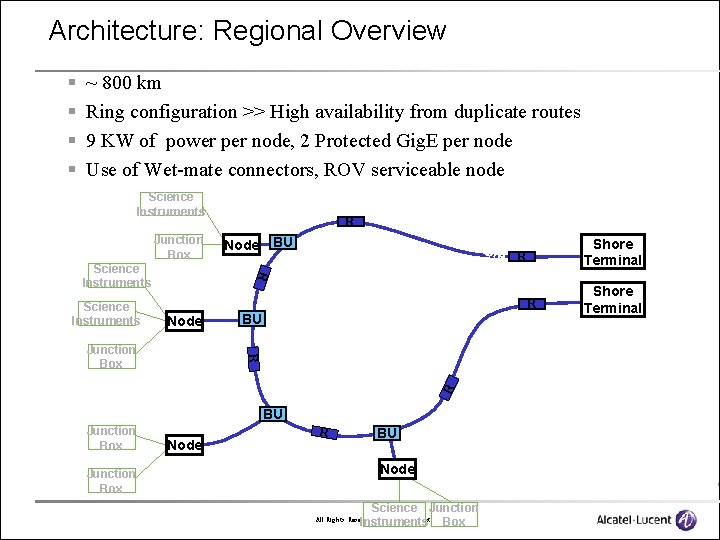
Architecture: Regional Overview § § ~ 800 km Ring configuration >> High availability from duplicate routes 9 KW of power per node, 2 Protected Gig. E per node Use of Wet-mate connectors, ROV serviceable node Science Instruments Junction Box Repeaters R ne c able R BU Node R R Junction Box Shore Terminal R R Science Instruments kbo Node BU Science Instruments Bac Node Sp ur BU le cab R BU Branching Units Node Science Junction Instruments Box All Rights Reserved © Alcatel-Lucent 2006, ##### Shore Terminal
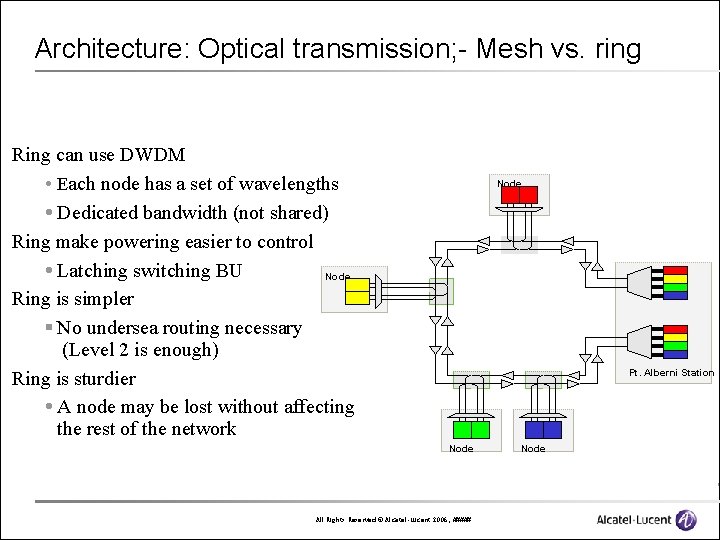
Architecture: Optical transmission; - Mesh vs. ring Ring can use DWDM Each node has a set of wavelengths Dedicated bandwidth (not shared) Ring make powering easier to control Latching switching BU Node Ring is simpler § No undersea routing necessary (Level 2 is enough) Ring is sturdier A node may be lost without affecting the rest of the network Node Pt. Alberni Station Node All Rights Reserved © Alcatel-Lucent 2006, ##### Node
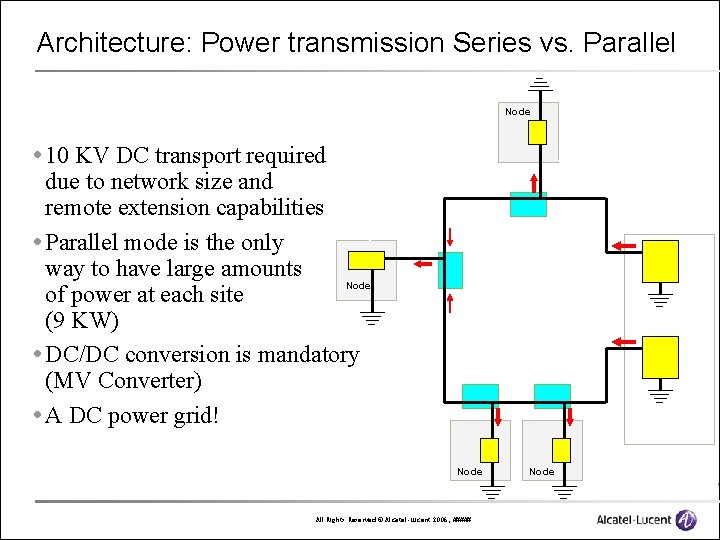
Architecture: Power transmission Series vs. Parallel ble ipm en t Ca Sp ur C ab Po le we r Fe Ba ed E ck qu bo ne hin nc Bra r nv ert e Co MV 10 KV DC transport required due to network size and remote extension capabilities Parallel mode is the only way to have large amounts Node of power at each site (9 KW) DC/DC conversion is mandatory (MV Converter) A DC power grid! g. U nit Node Pt. Alberni Shore Station Node All Rights Reserved © Alcatel-Lucent 2006, ##### Node

Line Design Subsea node uses a small form factor node WDM transponder § Based on Alcatel-Lucent 1696 MS Compact Shelf with two transponders(facing East and West) Transponder boards – Maps 2 Gig. E into an STM-16/OC-48 – FEC – High Performance Optics § Ring is designed for future extension Up to 1800 km Up to 10 nodes Some nodes could be further upgraded to 10 Gbit/s All Rights Reserved © Alcatel-Lucent 2006, #####
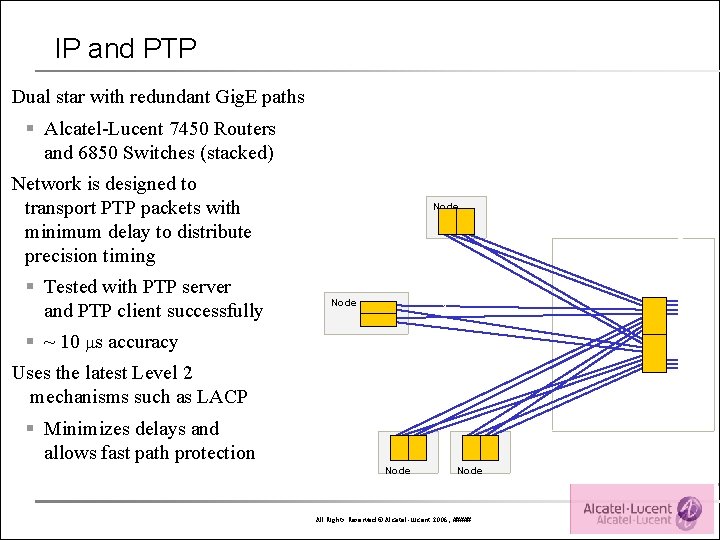
IP and PTP Dual star with redundant Gig. E paths § Alcatel-Lucent 7450 Routers and 6850 Switches (stacked) Network is designed to transport PTP packets with minimum delay to distribute precision timing es es itch Sw Sw Da ta § Tested with PTP server and PTP client successfully Node Gigabit Ethernet Node § ~ 10 s accuracy Uses the latest Level 2 mechanisms such as LACP Pt. Alberni Shore Station § Minimizes delays and allows fast path protection Node All Rights Reserved © Alcatel-Lucent 2006, #####
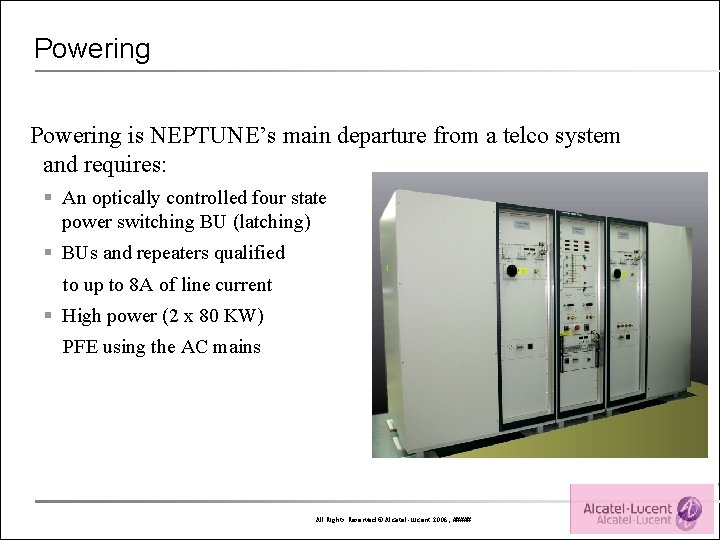
Powering is NEPTUNE’s main departure from a telco system and requires: § An optically controlled four state power switching BU (latching) § BUs and repeaters qualified to up to 8 A of line current § High power (2 x 80 KW) PFE using the AC mains All Rights Reserved © Alcatel-Lucent 2006, #####
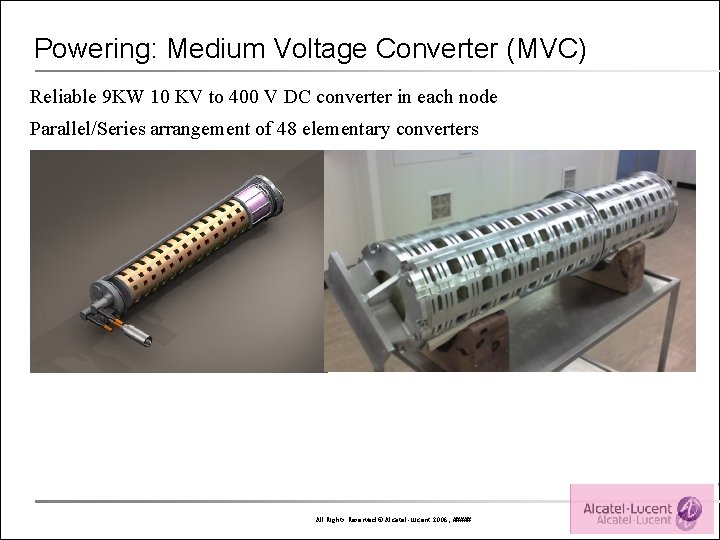
Powering: Medium Voltage Converter (MVC) Reliable 9 KW 10 KV to 400 V DC converter in each node Parallel/Series arrangement of 48 elementary converters All Rights Reserved © Alcatel-Lucent 2006, #####
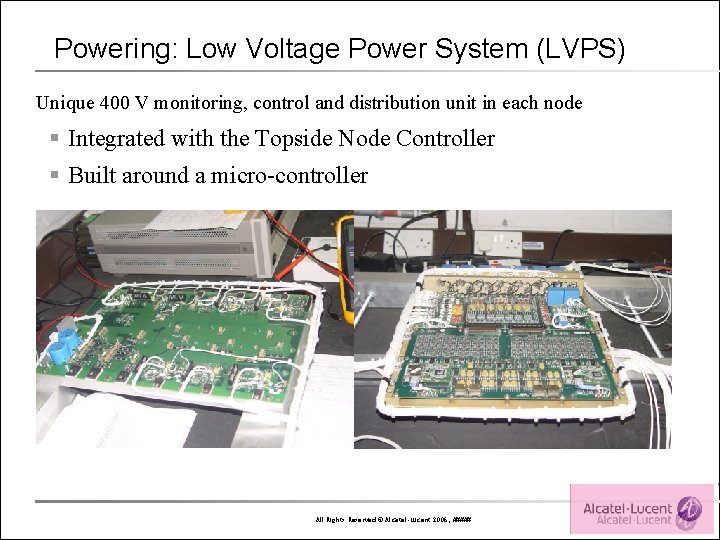
Powering: Low Voltage Power System (LVPS) Unique 400 V monitoring, control and distribution unit in each node § Integrated with the Topside Node Controller § Built around a micro-controller All Rights Reserved © Alcatel-Lucent 2006, #####
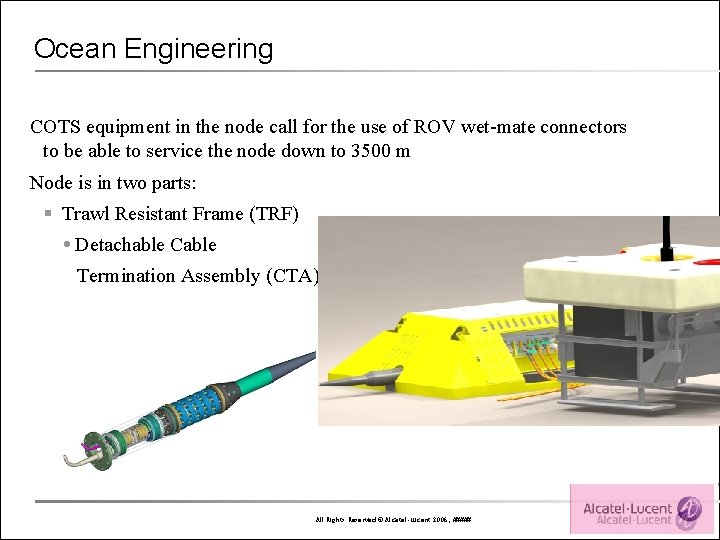
Ocean Engineering COTS equipment in the node call for the use of ROV wet-mate connectors to be able to service the node down to 3500 m Node is in two parts: § Trawl Resistant Frame (TRF) Detachable Cable Termination Assembly (CTA) All Rights Reserved © Alcatel-Lucent 2006, #####
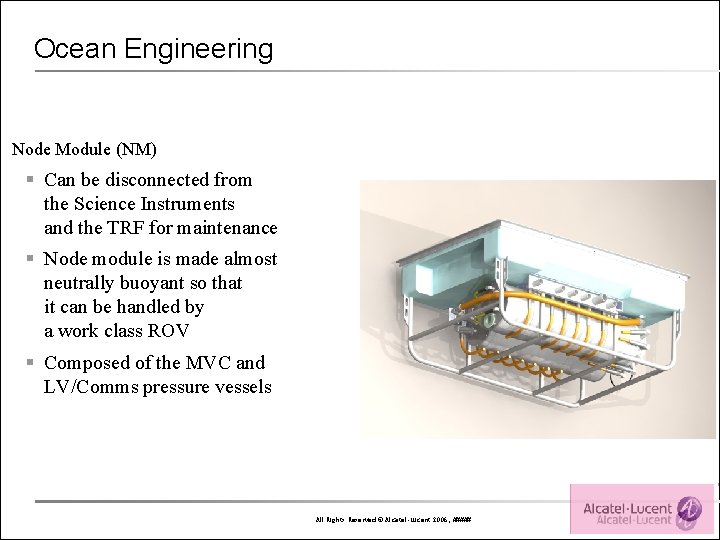
Ocean Engineering Node Module (NM) § Can be disconnected from the Science Instruments and the TRF for maintenance § Node module is made almost neutrally buoyant so that it can be handled by a work class ROV § Composed of the MVC and LV/Comms pressure vessels All Rights Reserved © Alcatel-Lucent 2006, #####
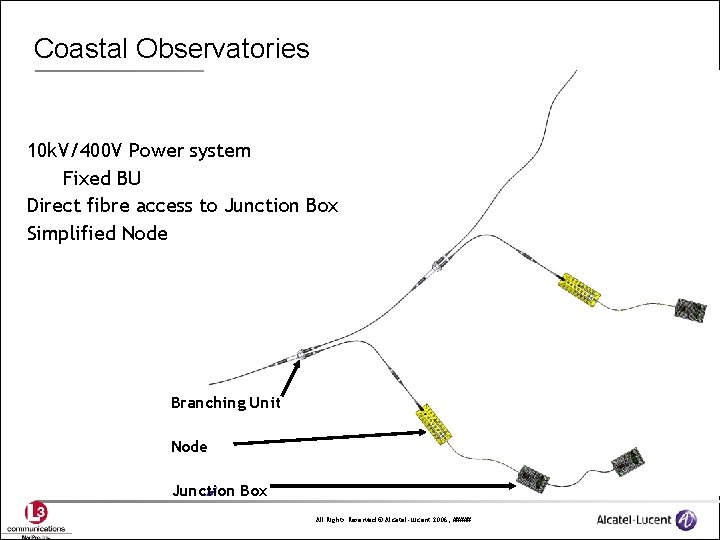
Coastal Observatories 10 k. V/400 V Power system Fixed BU Direct fibre access to Junction Box Simplified Node Branching Unit Node Junction Box All Rights Reserved © Alcatel-Lucent 2006, #####
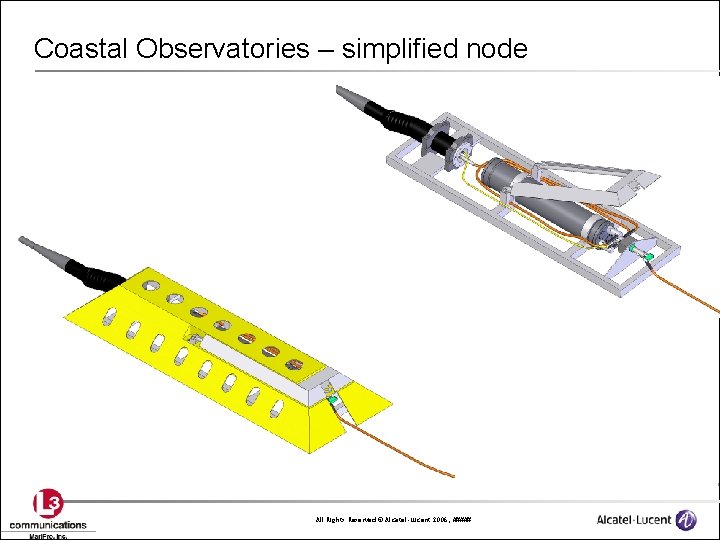
Coastal Observatories – simplified node All Rights Reserved © Alcatel-Lucent 2006, #####
Conclusion Alcatel-Lucent with its subcontractors (L-3 Mari. Pro, Texcel, ODI, Heinzinger, Westermo, Omnitron) is developing the first large scale Regional Dry-Wet network The Technology may be readily adapted for Coastal Observatories The University of Washington and the University of Victoria were the first to see the potential of this concept for oceanography and interest is also high in Asia and Europe All Rights Reserved © Alcatel-Lucent 2006, #####
- Slides: 21