
Techniques for Interrogation Chapter 12 Smart Talk Contemporary
- Slides: 40
Techniques for Interrogation Chapter 12 Smart Talk: Contemporary Interviewing and Interrogation By Denise Kindschi Gosselin 12 -1 © 2007 Pearson Education, Inc.
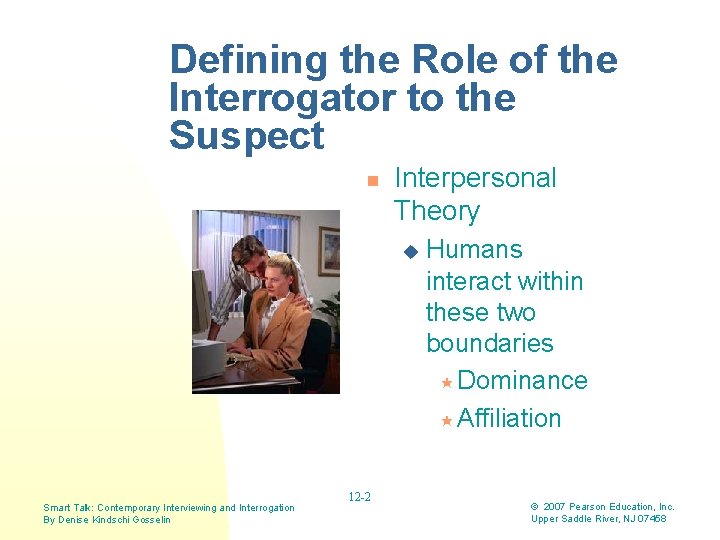
Defining the Role of the Interrogator to the Suspect n Interpersonal Theory u Smart Talk: Contemporary Interviewing and Interrogation By Denise Kindschi Gosselin 12 -2 Humans interact within these two boundaries « Dominance « Affiliation © 2007 Pearson Education, Inc. Upper Saddle River, NJ 07458
Complementary Principle n Two major assumptions Interpersonal behaviors invite reciprocal behaviors u Over time these lead to a repetitive pattern of relating u n The interrogator should establish a status role or connect through a rapport relationship Smart Talk: Contemporary Interviewing and Interrogation By Denise Kindschi Gosselin 12 -3 © 2007 Pearson Education, Inc. Upper Saddle River, NJ 07458
Interrogator Relationship n n The interrogator should determine if the approach to the interrogation is best made by establishing a status role or connecting through a rapport relationship The overriding consideration is that once the interrogator has taken on a hostile role with the suspect it is impossible to go back and later develop rapport Smart Talk: Contemporary Interviewing and Interrogation By Denise Kindschi Gosselin 12 -4 © 2007 Pearson Education, Inc. Upper Saddle River, NJ 07458
Dominant Relationship Pairing n A person’s recognition of the status of another brings the opposite complementary response in a dominant relationship Smart Talk: Contemporary Interviewing and Interrogation By Denise Kindschi Gosselin 12 -5 © 2007 Pearson Education, Inc. Upper Saddle River, NJ 07458
Expectations: a Dominant Relationship Pairing The suspect will be submissive when the interrogator is dominant u The suspect will be cooperative when the interrogator acts distrustful u The suspect will be friendly in response to the hostile interrogator u Smart Talk: Contemporary Interviewing and Interrogation By Denise Kindschi Gosselin 12 -6 © 2007 Pearson Education, Inc. Upper Saddle River, NJ 07458
Affiliation Relationship Pairing n When a connection develops through rapport the affiliation between the suspect and the interrogator elicits the corresponding complementary response Smart Talk: Contemporary Interviewing and Interrogation By Denise Kindschi Gosselin 12 -7 © 2007 Pearson Education, Inc. Upper Saddle River, NJ 07458
Expectations: an Affiliation Relationship Pairing The suspect will respond friendly when the interrogator is friendly u The suspect will respond cooperatively when the interrogator is cooperative u Smart Talk: Contemporary Interviewing and Interrogation By Denise Kindschi Gosselin 12 -8 © 2007 Pearson Education, Inc. Upper Saddle River, NJ 07458
Purpose of the Interrogation n n The primary purpose is to obtain a statement from the suspect that acknowledges or indicates the guilt of that person A secondary purpose is to document the lies when the truth is not forthcoming Smart Talk: Contemporary Interviewing and Interrogation By Denise Kindschi Gosselin 12 -9 © 2007 Pearson Education, Inc. Upper Saddle River, NJ 07458
Confession vs. Admission n Both are known as inculpatory statements u n I. e. , statements that put the blame on someone They are treated the same under constitutional analysis Smart Talk: Contemporary Interviewing and Interrogation By Denise Kindschi Gosselin 12 -10 © 2007 Pearson Education, Inc. Upper Saddle River, NJ 07458
Confession n Is a statement made by a defendant disclosing his guilt of the crime with which he is charged and excluding the possibility of a reasonable inference to the contrary Smart Talk: Contemporary Interviewing and Interrogation By Denise Kindschi Gosselin 12 -11 © 2007 Pearson Education, Inc. Upper Saddle River, NJ 07458
What Does a Confession Contain? n n It is admitting to his or her role in having committed a crime It is not limited to words but may be inferred through the demeanor, conduct, and acts of the person charged with a crime u I. e. , a person acts out HOW he killed the girl Smart Talk: Contemporary Interviewing and Interrogation By Denise Kindschi Gosselin 12 -12 © 2007 Pearson Education, Inc. Upper Saddle River, NJ 07458
Admission n Is a statement of guilty conduct, containing only facts from which guilt may be inferred u May be any information regarding the suspect and his or her role or relationship to the crime, the victim, or the place of the offense Smart Talk: Contemporary Interviewing and Interrogation By Denise Kindschi Gosselin 12 -13 © 2007 Pearson Education, Inc. Upper Saddle River, NJ 07458
What Does an Admission Contain? A suspect may admit to pulling down the pants of a 2 -year-old girl but denies that any criminal act took place, such as an indecent touching of her genitals u The suspect has denied criminal conduct but admitted to having the opportunity and relationship with the child u Smart Talk: Contemporary Interviewing and Interrogation By Denise Kindschi Gosselin 12 -14 © 2007 Pearson Education, Inc. Upper Saddle River, NJ 07458
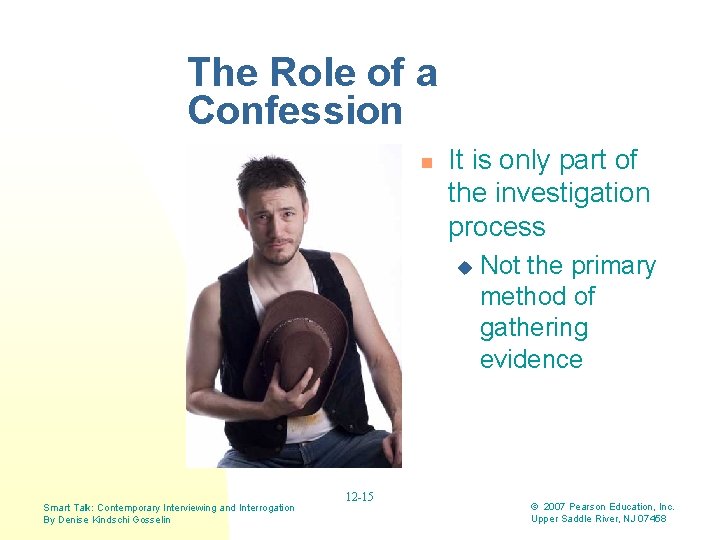
The Role of a Confession n It is only part of the investigation process u Smart Talk: Contemporary Interviewing and Interrogation By Denise Kindschi Gosselin 12 -15 Not the primary method of gathering evidence © 2007 Pearson Education, Inc. Upper Saddle River, NJ 07458
Over-reliance on a Confession is Bad! n n n May warp the investigation if collecting evidence is made secondary May cause the case to be dropped if the confession is found inadmissible and no other evidence of guilt exists A common view is that a confession alone is not enough to prove a person guilty Smart Talk: Contemporary Interviewing and Interrogation By Denise Kindschi Gosselin 12 -16 © 2007 Pearson Education, Inc. Upper Saddle River, NJ 07458
Slam-Dunk Approach to Interrogation n When the interrogator forcefully claims that the suspect is guilty and does not allow him to deny Smart Talk: Contemporary Interviewing and Interrogation By Denise Kindschi Gosselin 12 -17 © 2007 Pearson Education, Inc. Upper Saddle River, NJ 07458
Slam-Dunk Approach to Interrogation n Initial hardness may cause some offenders to be fearful of making statements and others will not talk at all u Do NOT use if the suspect is cooperative, mentally ill, or excessively emotional Smart Talk: Contemporary Interviewing and Interrogation By Denise Kindschi Gosselin 12 -18 © 2007 Pearson Education, Inc. Upper Saddle River, NJ 07458
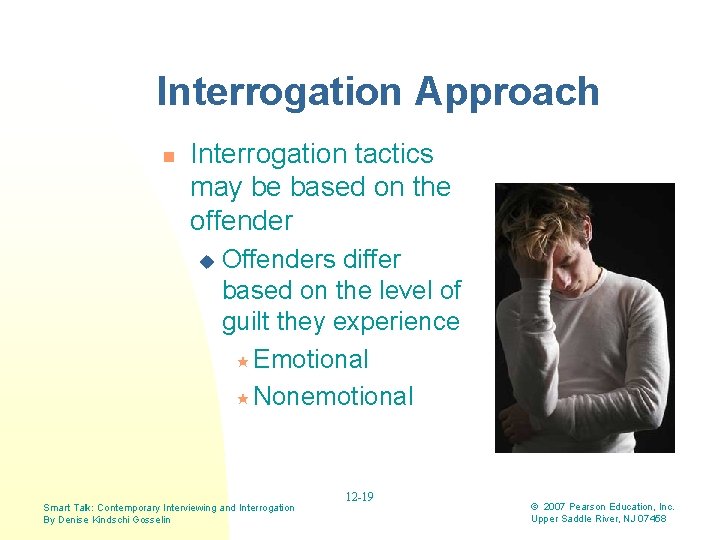
Interrogation Approach n Interrogation tactics may be based on the offender u Offenders differ based on the level of guilt they experience « Emotional « Nonemotional Smart Talk: Contemporary Interviewing and Interrogation By Denise Kindschi Gosselin 12 -19 © 2007 Pearson Education, Inc. Upper Saddle River, NJ 07458
Interrogation Approach n Interrogation tactics may be based on an assessment of the suspect u Determine offender strengths and weaknesses « Guilt, remorse, or entitlement may be exploited Smart Talk: Contemporary Interviewing and Interrogation By Denise Kindschi Gosselin 12 -20 © 2007 Pearson Education, Inc. Upper Saddle River, NJ 07458
Non-Custodial Interrogation Situations n Occurs when the suspect is not in police custody or under arrest u The suspect must be fully aware that he or she is free to leave at any time « The awareness may be based on the location of the interrogation « The attitude of the interrogator « Follow through by not arresting the suspect Smart Talk: Contemporary Interviewing and Interrogation By Denise Kindschi Gosselin 12 -21 © 2007 Pearson Education, Inc. Upper Saddle River, NJ 07458
Non-Custodial Interrogation Requirements n Miranda warnings are not required u n Must be given if the situation changes Not an available option if the suspect has been arraigned in court on the crimes under investigation or the individual asks to speak with an attorney Smart Talk: Contemporary Interviewing and Interrogation By Denise Kindschi Gosselin 12 -22 © 2007 Pearson Education, Inc. Upper Saddle River, NJ 07458
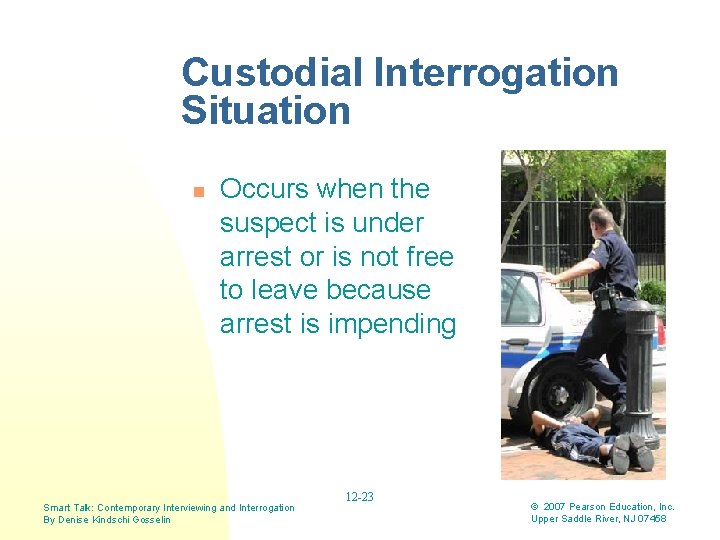
Custodial Interrogation Situation n Occurs when the suspect is under arrest or is not free to leave because arrest is impending Smart Talk: Contemporary Interviewing and Interrogation By Denise Kindschi Gosselin 12 -23 © 2007 Pearson Education, Inc. Upper Saddle River, NJ 07458
Miranda in a Custodial Interrogation Situation n The offender must be given his rights per Miranda The suspect must understand these rights and make a knowing waiver of these rights for an interrogation to take place u The suspect must make a voluntary waiver of these rights for an interrogation to take place u Smart Talk: Contemporary Interviewing and Interrogation By Denise Kindschi Gosselin 12 -24 © 2007 Pearson Education, Inc. Upper Saddle River, NJ 07458
Interrogation Phase I — Preparation n Phase I is about the interrogator establishing control over the interrogation Smart Talk: Contemporary Interviewing and Interrogation By Denise Kindschi Gosselin 12 -25 © 2007 Pearson Education, Inc. Upper Saddle River, NJ 07458
Interrogation Phase I — Preparation Step One: Determine who will interrogate u Step Two: Understand the law u Step Three: Know the case u Step Four: Establish the timing u Step Five: Determine the location u Smart Talk: Contemporary Interviewing and Interrogation By Denise Kindschi Gosselin 12 -26 © 2007 Pearson Education, Inc. Upper Saddle River, NJ 07458
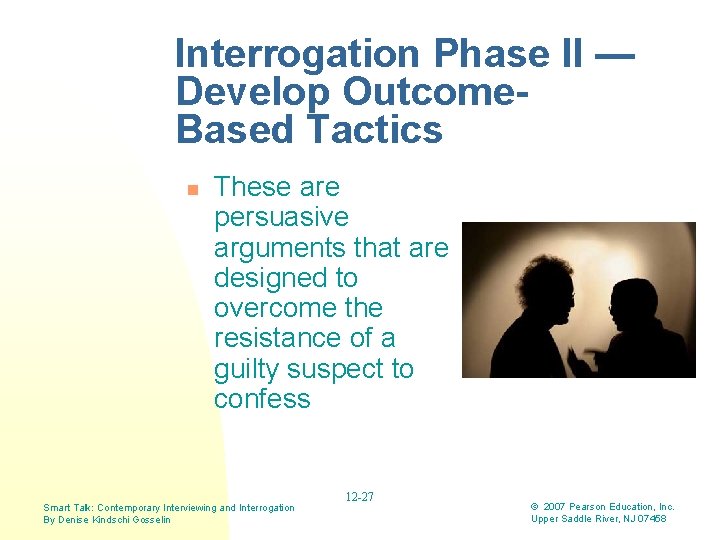
Interrogation Phase II — Develop Outcome. Based Tactics n These are persuasive arguments that are designed to overcome the resistance of a guilty suspect to confess Smart Talk: Contemporary Interviewing and Interrogation By Denise Kindschi Gosselin 12 -27 © 2007 Pearson Education, Inc. Upper Saddle River, NJ 07458
Tactic #1: An Appeal to the Suspect’s Selfinterest n n This is the most frequent tactic used in interrogation Encourage the suspect to “get it off his chest” or to “take this opportunity for his side to be heard” Smart Talk: Contemporary Interviewing and Interrogation By Denise Kindschi Gosselin 12 -28 n Possible fear to overcome: retaliation u u Empathize with the dilemma that the suspect faces Their best option is to cooperate with the police © 2007 Pearson Education, Inc. Upper Saddle River, NJ 07458
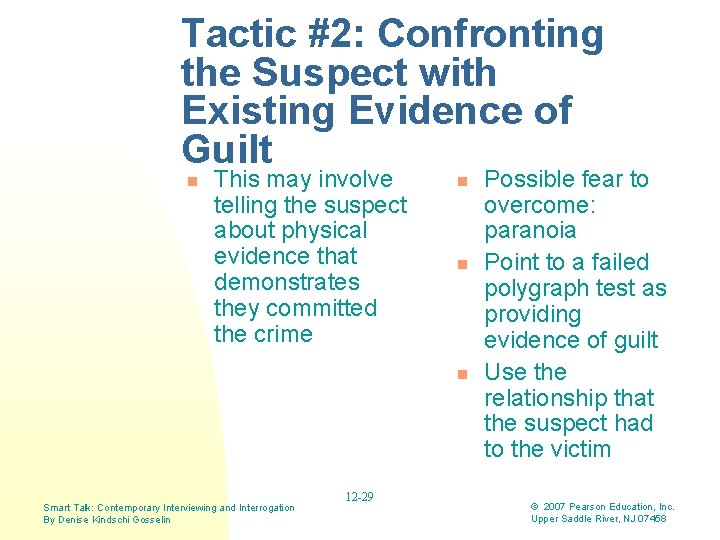
Tactic #2: Confronting the Suspect with Existing Evidence of Guilt n This may involve telling the suspect about physical evidence that demonstrates they committed the crime n n n Smart Talk: Contemporary Interviewing and Interrogation By Denise Kindschi Gosselin 12 -29 Possible fear to overcome: paranoia Point to a failed polygraph test as providing evidence of guilt Use the relationship that the suspect had to the victim © 2007 Pearson Education, Inc. Upper Saddle River, NJ 07458
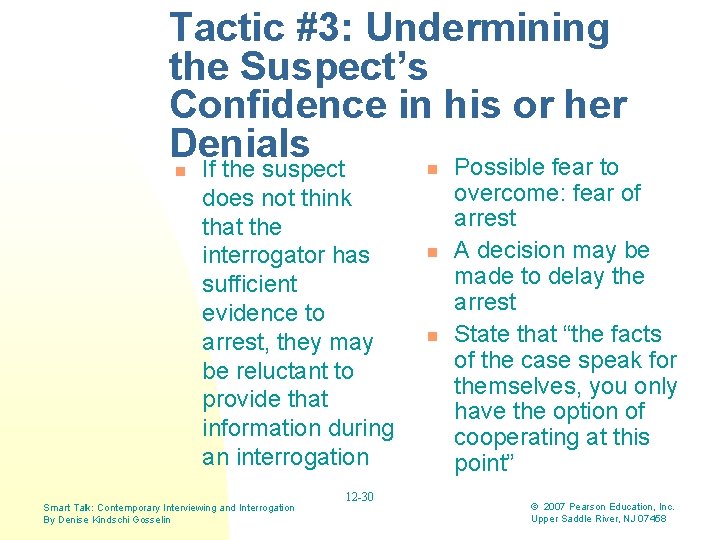
Tactic #3: Undermining the Suspect’s Confidence in his or her Denials Possible fear to n If the suspect does not think that the interrogator has sufficient evidence to arrest, they may be reluctant to provide that information during an interrogation Smart Talk: Contemporary Interviewing and Interrogation By Denise Kindschi Gosselin 12 -30 n n n overcome: fear of arrest A decision may be made to delay the arrest State that “the facts of the case speak for themselves, you only have the option of cooperating at this point” © 2007 Pearson Education, Inc. Upper Saddle River, NJ 07458
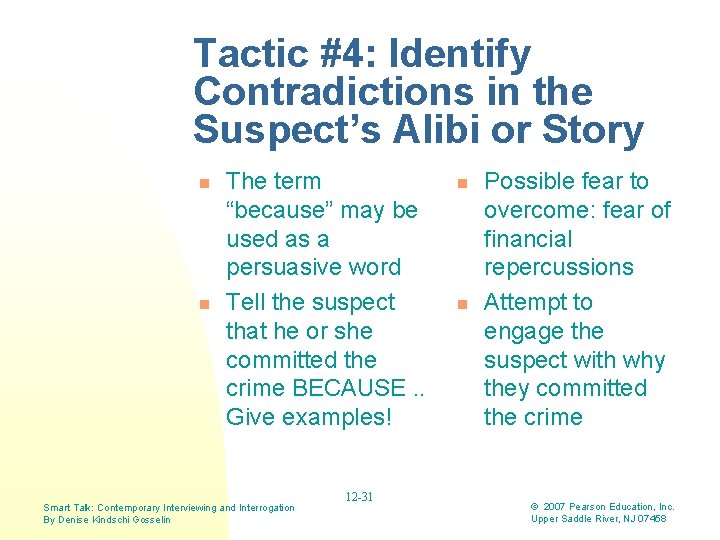
Tactic #4: Identify Contradictions in the Suspect’s Alibi or Story n n The term “because” may be used as a persuasive word Tell the suspect that he or she committed the crime BECAUSE. . Give examples! Smart Talk: Contemporary Interviewing and Interrogation By Denise Kindschi Gosselin 12 -31 n n Possible fear to overcome: fear of financial repercussions Attempt to engage the suspect with why they committed the crime © 2007 Pearson Education, Inc. Upper Saddle River, NJ 07458
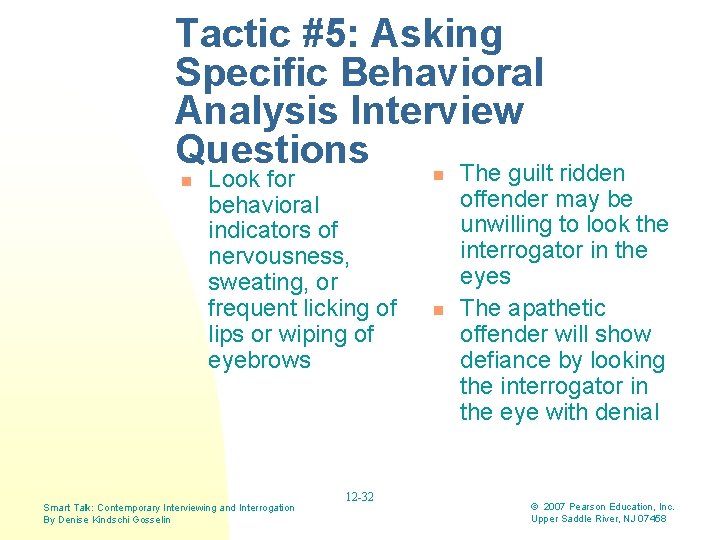
Tactic #5: Asking Specific Behavioral Analysis Interview Questions The guilt ridden n Look for behavioral indicators of nervousness, sweating, or frequent licking of lips or wiping of eyebrows Smart Talk: Contemporary Interviewing and Interrogation By Denise Kindschi Gosselin 12 -32 n n offender may be unwilling to look the interrogator in the eyes The apathetic offender will show defiance by looking the interrogator in the eye with denial © 2007 Pearson Education, Inc. Upper Saddle River, NJ 07458
Tactic #6: Appealing to the Importance of Cooperation n n Face the repercussions of the criminal act with the offender and suggest they start over through cooperation Alternatively, minimize the repercussions and be compassionate Smart Talk: Contemporary Interviewing and Interrogation By Denise Kindschi Gosselin 12 -33 n n Possible fear to overcome: loss of job Loss of status or employment loss is a considerable fear to overcome, determine which approach will maximize cooperation © 2007 Pearson Education, Inc. Upper Saddle River, NJ 07458
Tactic #7 Offering Moral Justifications and Facesaving Excuses n n Minimize the crime and never refer to it by the legal term Encourage the suspect to express guilt, remorse, or anger towards the victim Smart Talk: Contemporary Interviewing and Interrogation By Denise Kindschi Gosselin 12 -34 n n n Possible fear to overcome: shame Use empathy to overcome the fear of shame Ask why the offender did the act to allow for face-saving excuses © 2007 Pearson Education, Inc. Upper Saddle River, NJ 07458
Tactic #8: Confront the Suspect with False Evidence of Guilt n n This approach makes sense when there is more than one person involved in the crime Information provided by one partner can be embellished on and presented as fact to the other Smart Talk: Contemporary Interviewing and Interrogation By Denise Kindschi Gosselin 12 -35 n n n Possible fear to overcome: blame The suspect who played a minor part will be fearful of taking all of the blame Suggest that the evidence points to him, this is the chance to share the blame with others © 2007 Pearson Education, Inc. Upper Saddle River, NJ 07458
Tactic #9: Praising or Flattering the Suspect n n n Look for evidence that the suspect is insecure Did the suspect appear to take pleasure in the act? Praise and flattery may be a very successful tool to obtain a confession Smart Talk: Contemporary Interviewing and Interrogation By Denise Kindschi Gosselin 12 -36 n n Possible fear to overcome: insignificance Praise and supportive statements convey a positive judgment to the suspect © 2007 Pearson Education, Inc. Upper Saddle River, NJ 07458
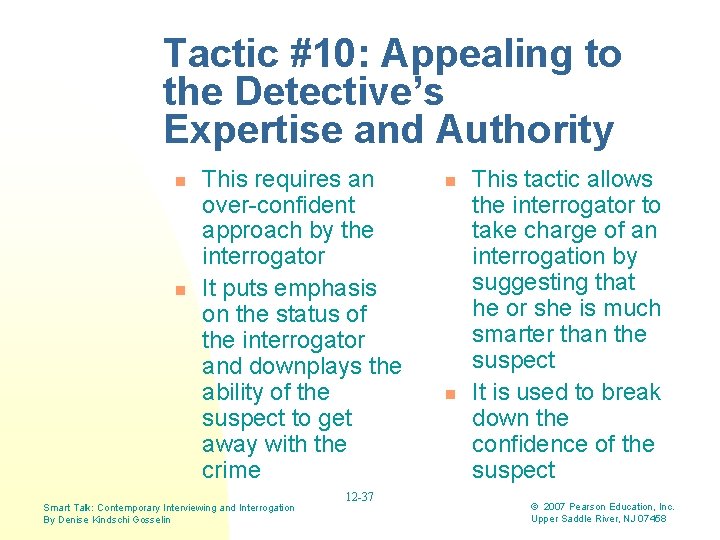
Tactic #10: Appealing to the Detective’s Expertise and Authority n n This requires an over-confident approach by the interrogator It puts emphasis on the status of the interrogator and downplays the ability of the suspect to get away with the crime Smart Talk: Contemporary Interviewing and Interrogation By Denise Kindschi Gosselin 12 -37 n n This tactic allows the interrogator to take charge of an interrogation by suggesting that he or she is much smarter than the suspect It is used to break down the confidence of the suspect © 2007 Pearson Education, Inc. Upper Saddle River, NJ 07458
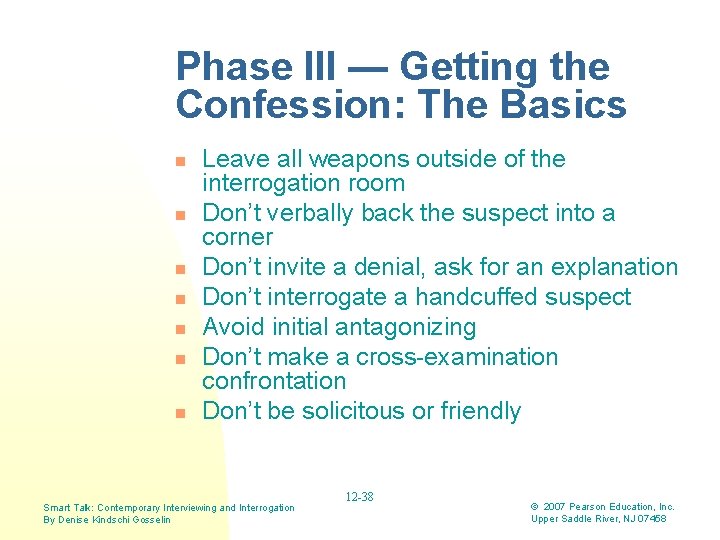
Phase III — Getting the Confession: The Basics n n n n Leave all weapons outside of the interrogation room Don’t verbally back the suspect into a corner Don’t invite a denial, ask for an explanation Don’t interrogate a handcuffed suspect Avoid initial antagonizing Don’t make a cross-examination confrontation Don’t be solicitous or friendly Smart Talk: Contemporary Interviewing and Interrogation By Denise Kindschi Gosselin 12 -38 © 2007 Pearson Education, Inc. Upper Saddle River, NJ 07458
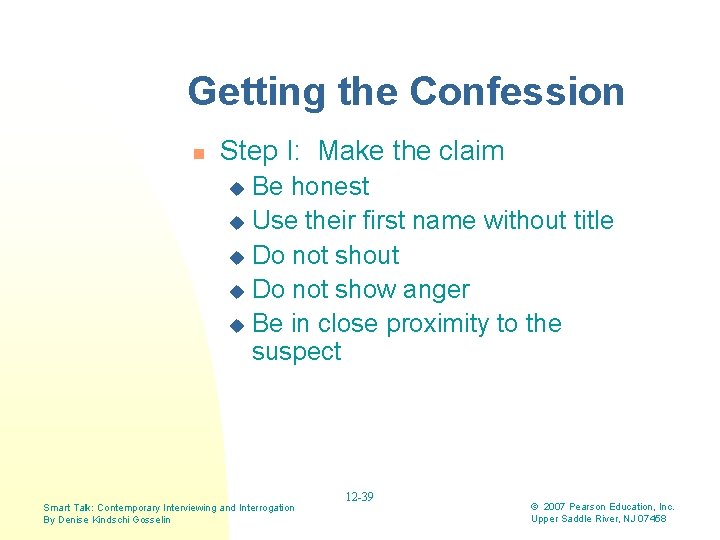
Getting the Confession n Step I: Make the claim Be honest u Use their first name without title u Do not shout u Do not show anger u Be in close proximity to the suspect u Smart Talk: Contemporary Interviewing and Interrogation By Denise Kindschi Gosselin 12 -39 © 2007 Pearson Education, Inc. Upper Saddle River, NJ 07458
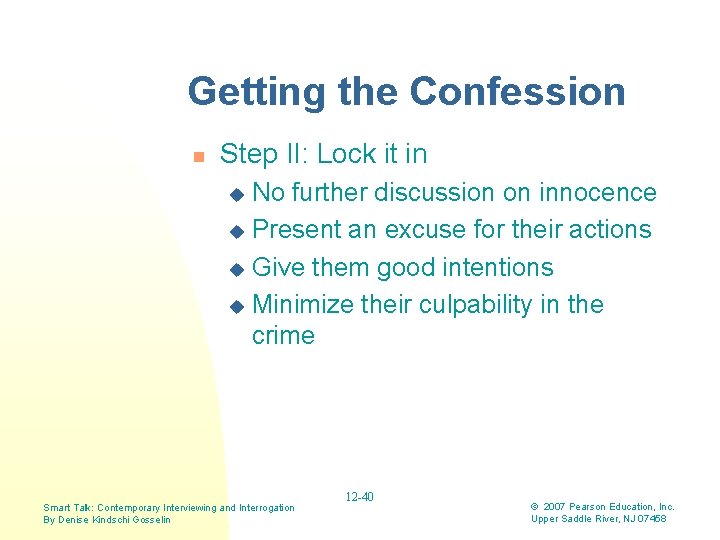
Getting the Confession n Step II: Lock it in No further discussion on innocence u Present an excuse for their actions u Give them good intentions u Minimize their culpability in the crime u Smart Talk: Contemporary Interviewing and Interrogation By Denise Kindschi Gosselin 12 -40 © 2007 Pearson Education, Inc. Upper Saddle River, NJ 07458