
Techniques for Emotion Classification Julia Hirschberg COMS 49956998
Techniques for Emotion Classification Julia Hirschberg COMS 4995/6998 Thanks to Kaushal Lahankar
Papers for Today • Cowie: “Describing the emotional states expressed in speech”, 2000 • Satoh et al: “Emotion clustering using the results of subjective opinion tests for emotion recognition in Infants’ cries”, 2007 • Nisimura et al: “Analyzing dialogue data for real-world emotional speech classification”, 2006
Cowie ’ 00: Describing the emotional states expressed in speech • Emotions are not easily captured in words • A suitable descriptive system for emotions does not exist as of yet. • Objective - To encourage the speech community towards standardization of key terms and descriptive techniques.
What to Study? • Fullblown emotions – Natural discrete units which can be counted and possess distinct boundaries • Emotional states – An attribute of certain states. E. g. – “Her voice was tinged with emotion”. • Emotional systems • How does each distinction influence research?

Cause and effect type descriptors • Cause type – What are the emotion-related internal states and external factors causing speech to have particular characteristics? – Focus attention on physiological systems which can be used to describe emotions • Effect type – Describes effect characteristics above would be likely to have on typical listener – Favor describing emotional states in terms of categories and dimensions that people find natural
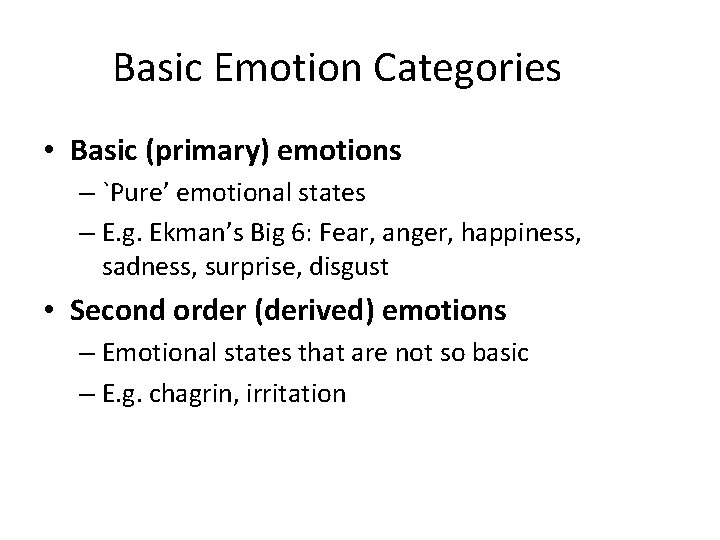
Basic Emotion Categories • Basic (primary) emotions – `Pure’ emotional states – E. g. Ekman’s Big 6: Fear, anger, happiness, sadness, surprise, disgust • Second order (derived) emotions – Emotional states that are not so basic – E. g. chagrin, irritation
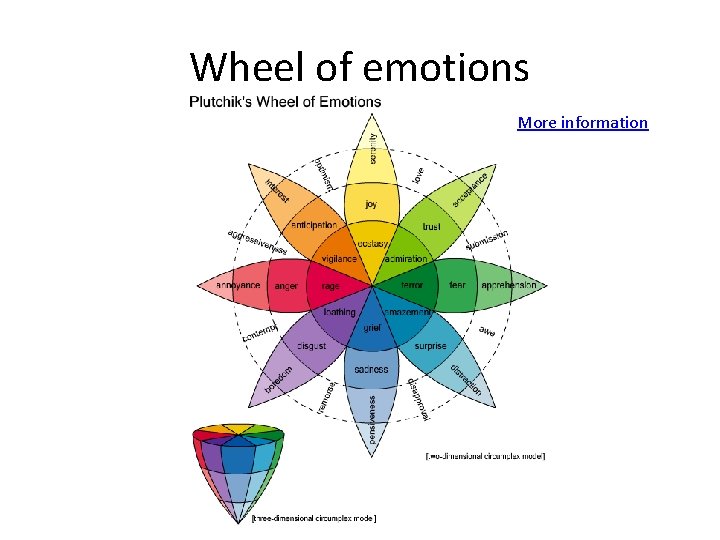
Wheel of emotions More information
Other Representations • Need to come up with a complementary representation that offers ways of drawing fewer, grosser distinctions to make things such as acquiring speech co-relates manageable • Feeltrace might be such a system?
Emotion Related States • Emotion-property : – Property ‘belonging to’ a type of emotion – Being frightening: emotion-property for fear • Emotion terms surrounded by terms that resemble them but are different – Called emotion related terms – States associated with them called emotion related states
The states discussed • Attitude – Categorization along an evaluative dimension – Appraisal • Arousal – Degree of involvement
Biological Representations • Assumption: – Descriptions of emotions are surrogates for descriptions of physiological states. – Can we replace verbal descriptions with physiological parameters? • Which theory does this reflect? • Pros and cons?
Continuous Representations • Represent emotions in 2 -D space in terms of Evaluation (X axis) and Activation (Y axis). • Dimensions can be increased to represent the relationships which lie very close in the 2 -D space. • Pros and cons?
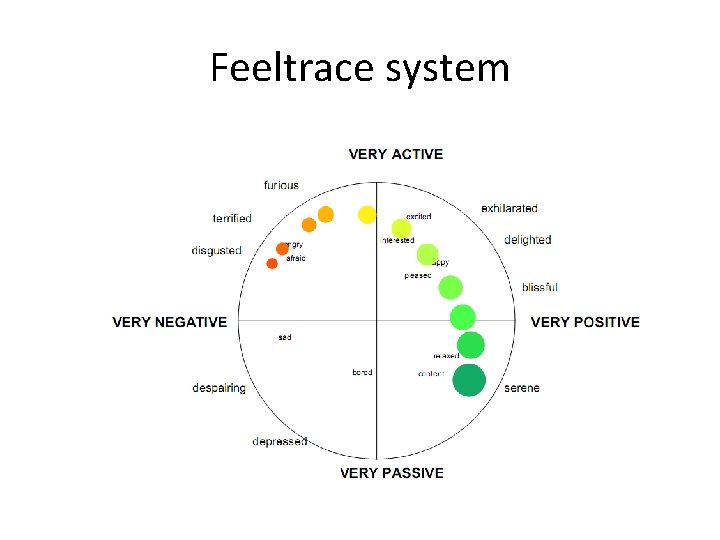
Feeltrace system
Structural Models • Cognitive approach to describing emotions • Based on hypothesis that distinct types of emotion correspond to distinct ways of appraising the situation evoking the emotion
Timing • Short-lived or long-lived state – Sadness vs. grieving
How are Underlying Emotional Tendencies Expressed? • Restraint – Display rules • Ambivalence • Humour • Simulation
Tools for Describing Emotions • Naturalistic Database – Belfast Naturalistic Database annotated using Feeltrace • Basic Emotion Vocabulary • Consider also – Whissell’s Dictionary of Affect in Language (DAL): demo, revised version – Pennebaker’s Linguistic Inquiry and Word Count (LIWC): demo, twitter analysis
Questions
Emotion clustering Using the results of subjective opinion tests for emotion recognition in infant’s cries • Objective – To design an emotion clustering algorithm for emotion detection in infants’ cries • Previous work – Acoustic analysis of an infant’s cries has been performed. – Classification between “hunger” and “sleepiness” has been studied. – Some emotion detection products currently available in the market employ simple acoustic techniques.
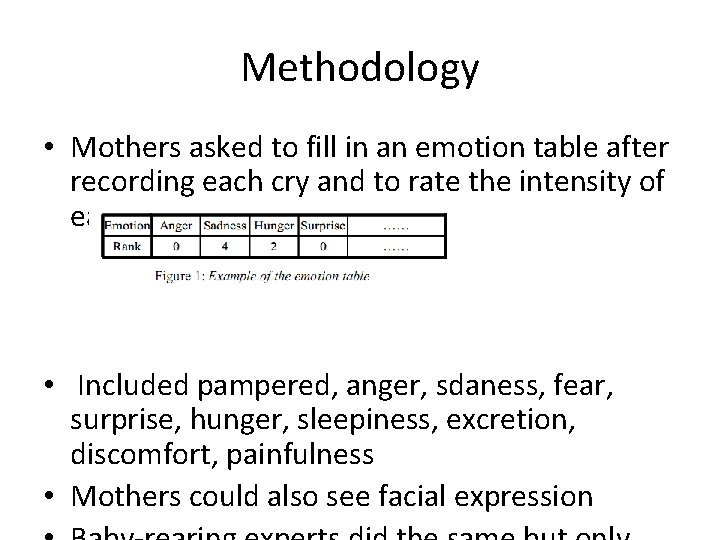
Methodology • Mothers asked to fill in an emotion table after recording each cry and to rate the intensity of each • Included pampered, anger, sdaness, fear, surprise, hunger, sleepiness, excretion, discomfort, painfulness • Mothers could also see facial expression
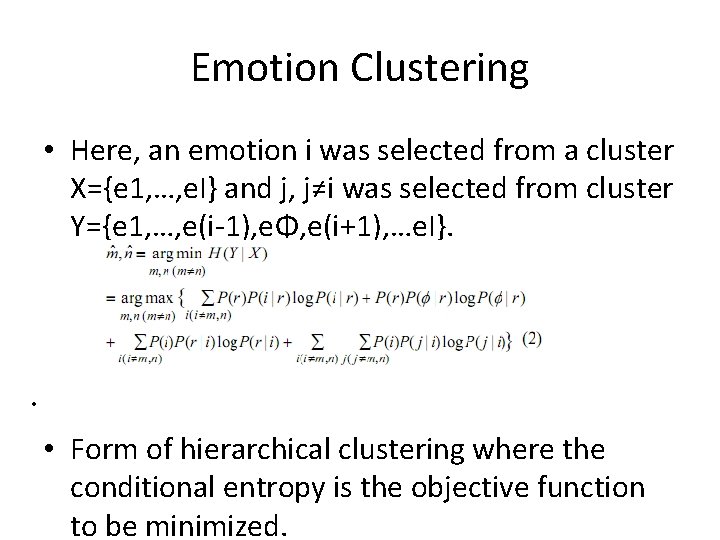
Emotion Clustering • Here, an emotion i was selected from a cluster X={e 1, …, e. I} and j, j≠i was selected from cluster Y={e 1, …, e(i-1), eΦ, e(i+1), …e. I}. • • Form of hierarchical clustering where the conditional entropy is the objective function to be minimized.
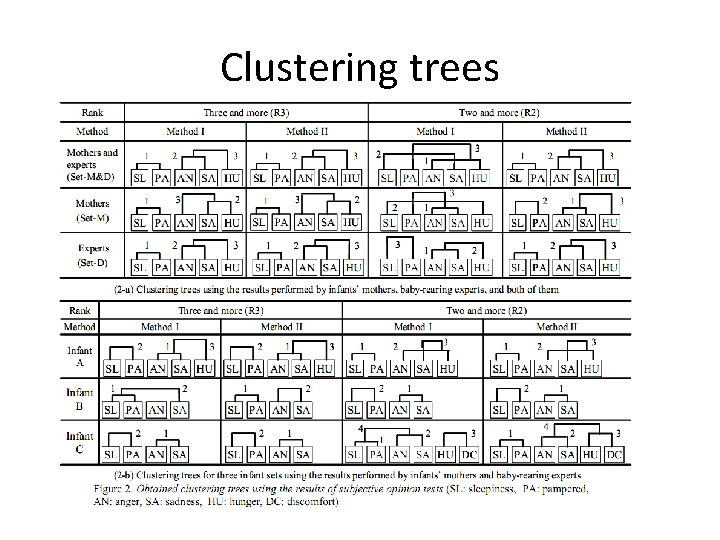
Clustering trees
Emotion Recognition • Find the emotion given the segment sequence of a cry • Determine the probability of the acoustic evidence q occurring when the infant utters the sequence z with the emotion e (argmax(P(q|e, z)_ – Acoustic models for each segment for each emotion cluster – Train HMMs and use to recognize cries – Results with 2 clusters: 75% accuracy
Nisimura et al ’ 06: Analyzing Dialogue Data for Real. World Emotional Speech Classification • Goal: Classify child utterances wrt ‘delightful’ or ‘hateable’ emotions • How did they obtain and annotate the data? • What was the method of analysis? – Factor analysis – Support vector machine – Regression analysis – Jackknife method • What can we conclude from this experiment?
Discussion • Are 10 emotions actually needed? • Instead of relying on the input from babyrearing experts, could the inputs from the mothers have been used? • Is the input data reliable? • Improvements?
- Slides: 25