
Techniques for Dynamic Nuclear Polarization NMR Analysis of
- Slides: 1
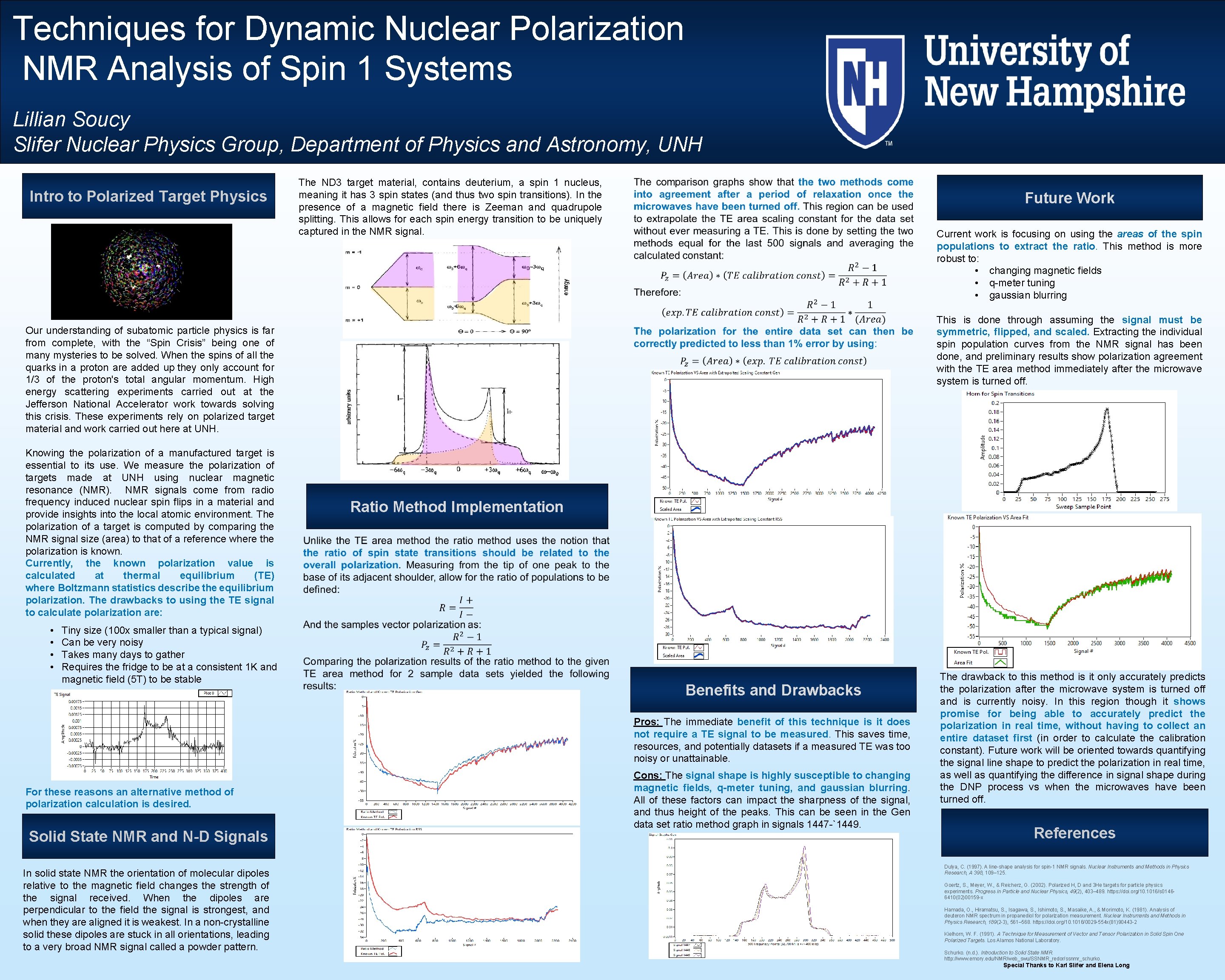
Techniques for Dynamic Nuclear Polarization NMR Analysis of Spin 1 Systems Lillian Soucy Slifer Nuclear Physics Group, Department of Physics and Astronomy, UNH Intro to Polarized Target Physics The ND 3 target material, contains deuterium, a spin 1 nucleus, meaning it has 3 spin states (and thus two spin transitions). In the presence of a magnetic field there is Zeeman and quadrupole splitting. This allows for each spin energy transition to be uniquely captured in the NMR signal. Future Work Current work is focusing on using the areas of the spin populations to extract the ratio. This method is more robust to: • changing magnetic fields • q-meter tuning • gaussian blurring This is done through assuming the signal must be symmetric, flipped, and scaled. Extracting the individual spin population curves from the NMR signal has been done, and preliminary results show polarization agreement with the TE area method immediately after the microwave system is turned off. Our understanding of subatomic particle physics is far from complete, with the “Spin Crisis” being one of many mysteries to be solved. When the spins of all the quarks in a proton are added up they only account for 1/3 of the proton's total angular momentum. High energy scattering experiments carried out at the Jefferson National Accelerator work towards solving this crisis. These experiments rely on polarized target material and work carried out here at UNH. Knowing the polarization of a manufactured target is essential to its use. We measure the polarization of targets made at UNH using nuclear magnetic resonance (NMR). NMR signals come from radio frequency induced nuclear spin flips in a material and provide insights into the local atomic environment. The polarization of a target is computed by comparing the NMR signal size (area) to that of a reference where the polarization is known. Currently, the known polarization value is calculated at thermal equilibrium (TE) where Boltzmann statistics describe the equilibrium polarization. The drawbacks to using the TE signal to calculate polarization are: • • Tiny size (100 x smaller than a typical signal) Can be very noisy Takes many days to gather Requires the fridge to be at a consistent 1 K and magnetic field (5 T) to be stable Ratio Method Implementation Benefits and Drawbacks Pros: The immediate benefit of this technique is it does not require a TE signal to be measured. This saves time, resources, and potentially datasets if a measured TE was too noisy or unattainable. For these reasons an alternative method of polarization calculation is desired. Solid State NMR and N-D Signals Cons: The signal shape is highly susceptible to changing magnetic fields, q-meter tuning, and gaussian blurring. All of these factors can impact the sharpness of the signal, and thus height of the peaks. This can be seen in the Gen data set ratio method graph in signals 1447 -`1449. The drawback to this method is it only accurately predicts the polarization after the microwave system is turned off and is currently noisy. In this region though it shows promise for being able to accurately predict the polarization in real time, without having to collect an entire dataset first (in order to calculate the calibration constant). Future work will be oriented towards quantifying the signal line shape to predict the polarization in real time, as well as quantifying the difference in signal shape during the DNP process vs when the microwaves have been turned off. References . In solid state NMR the orientation of molecular dipoles relative to the magnetic field changes the strength of the signal received. When the dipoles are perpendicular to the field the signal is strongest, and when they are aligned it is weakest. In a non-crystalline solid these dipoles are stuck in all orientations, leading to a very broad NMR signal called a powder pattern. Dulya, C. (1997). A line-shape analysis for spin-1 NMR signals. Nuclear Instruments and Methods in Physics Research, A 398, 109– 125. Goertz, S. , Meyer, W. , & Reicherz, G. (2002). Polarized H, D and 3 He targets for particle physics experiments. Progress in Particle and Nuclear Physics, 49(2), 403– 489. https: //doi. org/10. 1016/s 01466410(02)00159 -x Hamada, O. , Hiramatsu, S. , Isagawa, S. , Ishimoto, S. , Masaike, A. , & Morimoto, K. (1981). Analysis of deuteron NMR spectrum in propanediol for polarization measurement. Nuclear Instruments and Methods in Physics Research, 189(2 -3), 561– 568. https: //doi. org/10. 1016/0029 -554 x(81)90443 -2 Kielhorn, W. F. (1991). A Technique for Measurement of Vector and Tensor Polarization in Solid Spin One Polarized Targets. Los Alamos National Laboratory. Schurko. (n. d. ). Introduction to Solid State NMR. http: //www. emory. edu/NMR/web_swu/SSNMR_redor/ssnmr_schurko. Special Thanks to Karl Slifer and Elena Long