
TECHNION ISRAEL INSTITUTE OF TECHNOLOGY Electrical Engineering Department







- Slides: 19
TECHNION - ISRAEL INSTITUTE OF TECHNOLOGY Electrical Engineering Department Software Systems Lab Persistent chat room Authors: Hazanovitch Evgeny Hazanovitch Alex Instructor: Eddie Bortnikov
Project background Now there are two types of multi-user collaboration: • Synchronous collaboration (Chat) - conversation in real time, history of messages is not recorded • Problem: User is not able to see messages that were sent since he was absent • Asynchronous collaboration (Forum) - the history of messages is recorded • Problem: Non real-time experience • Our goal: • Get the best of all worlds
Goal n Create chat room application that records all messages in chat and gives users ability to see a history of the messages. n Develop a framework for automated software agents that will allow implementing more services for rich collaboration experience
Problem and Solution Network Solution: Problem: §Lets Software Agent In the connect middle of important conference that runs on remote computer One §of. Software users may want to leave § Connects to chat like regular user So he§ Receives will loseand therecords important dialogue chat messages
Project Deliverables n Automated Software Agents Join the session as regular users n Can perform standard chat functions n Perform specific functions n Modular approach for developing rich services n Do not require extensions of existing software n n Persistent Chat room Application n Uses a SW agent for recording & retrieving chat data
Features enabled by the SW agents technology n n n Persistent chat Games Online translation Photo sharing Voice and Video conferencing Censoring
Persistent chat room What is Persistent chat room application? Persistent chat room application is a standard application for multi-user conferencing, with new feature. Standard features: § Instant messaging § Chat creation § Friends list managing New feature: § Messages recording
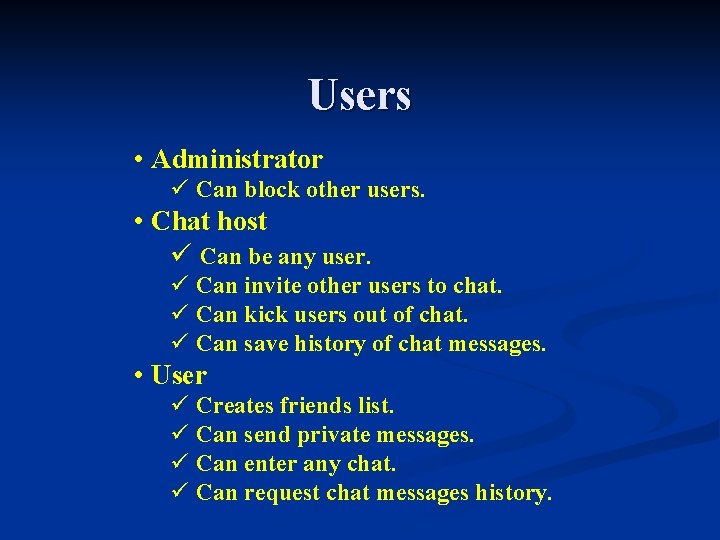
Users • Administrator ü Can block other users. • Chat host ü Can be any user. ü Can invite other users to chat. ü Can kick users out of chat. ü Can save history of chat messages. • User ü Creates friends list. ü Can send private messages. ü Can enter any chat. ü Can request chat messages history.
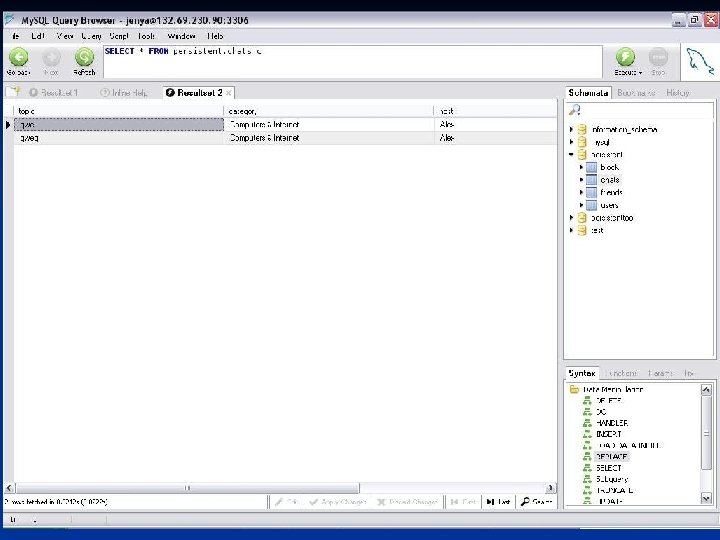
Implementation • Server based groupware application. • Uses SIP (Session initiation protocol). The protocol is used for: §Session initiation. §Sending short text messages. • Messages divided into different types (Chat message, Private message etc. ) • Uses My. Sql database to store information.
SW agent implementation SW agent requires new message types to perform specific functions n In spite of that there is no need to extend server’s software n Message semantics are transparent to server n New messages will be handled by client application n So we may need to install plug-in on client application n
Recording tool as example of SW agent User’s request for chat history Message of new type must be forwarded to recipient. The message will be handled by client application. “View history” • New message type • Recipient is SW agent “History” • New message type • Contains history block • Recipient is Evgeny
Recording tool implementation n Software Agent. Invited to chat. Receives and stores all the messages in chat. Ø Ø n Receives requests from users for chat history. Ø Ø n Stores messages in blocks. Uses My. Sql database. Current block is sent to every user when he enters chat. Every user can request for other blocks Chat host can archive current block.
Future work Voice and video conferencing n Recording of voice & video conferences n That is a goal of our next project. . .