
Technicians First Guide and Workbook Section 18 Maintenance
Technician’s First Guide and Workbook Section 18: Maintenance Inspection Basics (2)
Furnaces First the furnace cabinet is checked to make sure all panels and fasteners are in place before and after the inspection of the furnace is completed. The clearance from combustible materials must be at least equivalent to the OEM’s requirements. If not, it should be reported (or junk moved, and reason/fire hazard reported to homeowner). Additionally, anything in the following lists that is found to be out of order or incorrect should be noted and included in the maintenance report. This section starts by covering maintenance items that are common on all furnaces in the Furnace Electrical and Furnace Blower Assembly sections. Then there are three more sections that cover additional maintenance tasks that are specific to Gas Furnaces, Oil Furnaces, and Electric Furnaces.
Furnace Electrical Components For all furnaces the following are included in an electrical inspection: • Inspect electrical disconnect box and terminals. • Check for proper grounding. • Measure and record line voltage. • Inspect and test relays and contactors. • Inspect electrical connections. • Inspect motor capacitors (report worn or bulging capacitors). • Record all motor nameplate data and operating amperage draw.
Furnace Blower Assembly For all furnaces the following are included in a blower assembly inspection: • Verify and record the airflow across the heat exchanger (or through the blower assembly). • If applicable test variable frequency motor drive for properation. • If applicable inspect fan belts and pulleys for wear and tear. • For fan motor make sure it is installed properly and the shaft bolt is tight. • Make sure the blower fan blades are clean, and the blower is properly aligned in the housing. • Inspect condensate drains for properation.
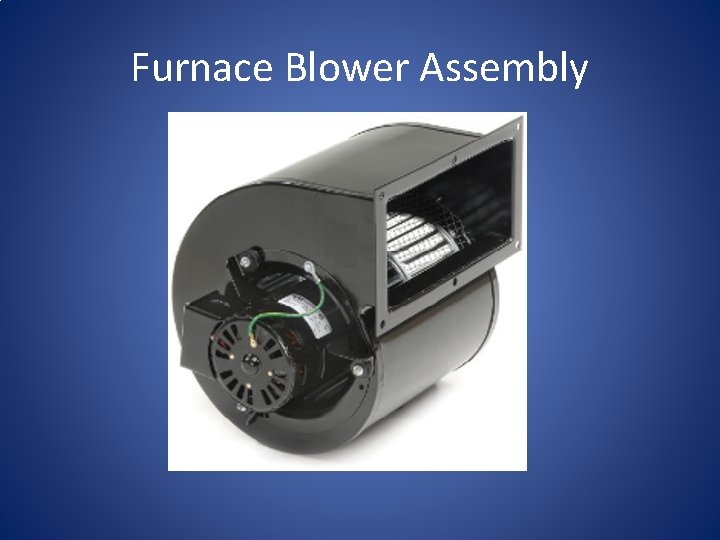
Furnace Blower Assembly
Condensate Removal All condensate drains should be checked to make sure they are clear and draining properly.
Gas Combustion Furnaces (1) Items found should be documented and items needing additional service should be highlighted. Additional combustion related tasks for gas furnaces: • Inspect burner for blockage and/or signs of moisture damage or corrosion. • Test inducer fan motor and blower assembly. • Inspect Heat Exchanger for signs of corrosion, fouling, and structural problems (cracks, bulging, holes). Measure and record temperature across the heat exchanger. • Look for signs of corrosion on the burners • Check igniter with an ohm meter inspect for cracks verify spark gaps are correct.
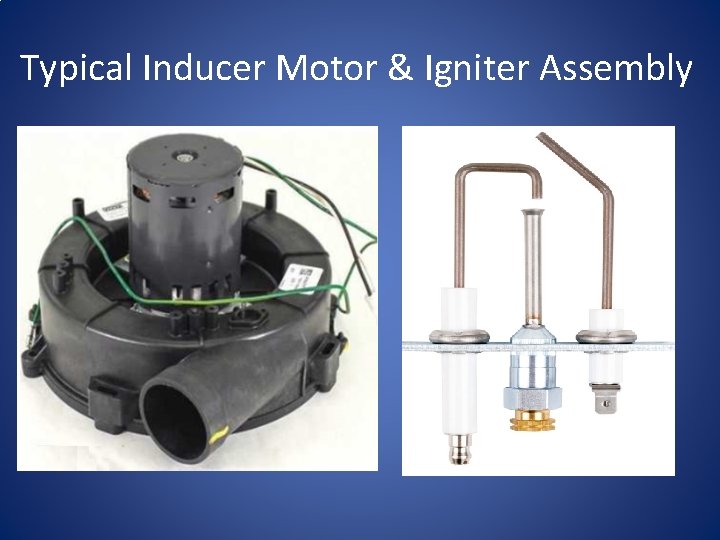
Typical Inducer Motor & Igniter Assembly
Gas Combustion Furnaces (2) • Measure and record inlet gas pressure adjust manifold as necessary. • Inspect ceramic flame probes for cracks. • Test main burner for ignition safety and for flame sequence. • Verify the combustion air is set properly. • Perform a combustion test. Inspect vent piping and connections note any blockage, water corrosion, or signs of cracks or leaks. • Verify proper support and slope for vent piping. • Report and/or remove combustible materials placed too close to vent piping.
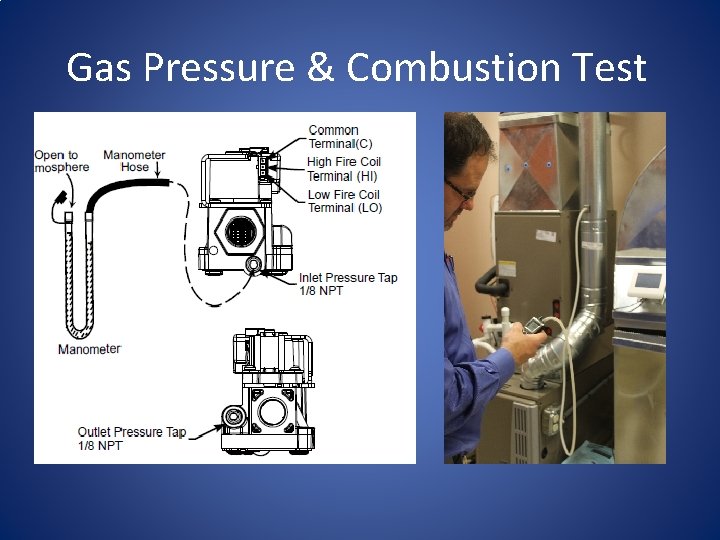
Gas Pressure & Combustion Test
Oil Combustion Furnaces (1) Items found should be documented and items needing additional service should be highlighted. Additional combustion related tasks for oil furnaces: • Inspect combustion chamber for cracks or structural damage. • Inspect Heat Exchanger for signs of corrosion, fouling, and structural problems (cracks, bulging, holes). Measure and record temperature across the heat exchanger. • Inspect burner gaskets. • Replace oil nozzle, verify size and spread. • Inspect oil nozzle head, electrodes and ceramic insulation and verify spark gap and positioning.
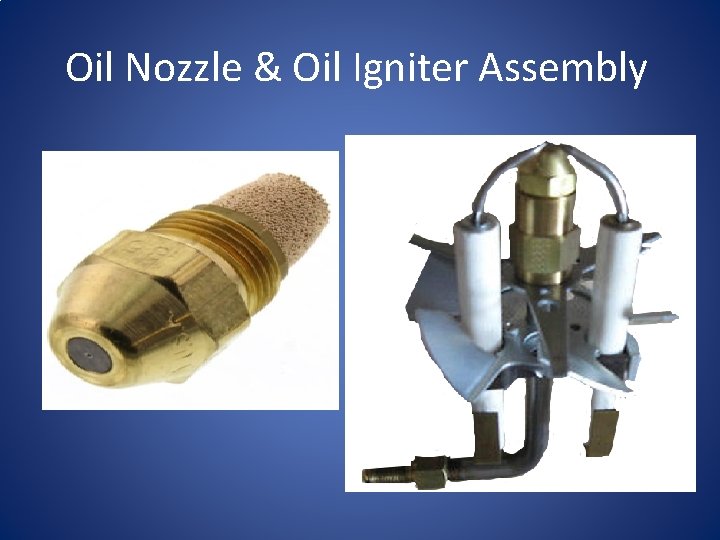
Oil Nozzle & Oil Igniter Assembly
Oil Combustion Furnaces (2) • Inspect oil nozzle head, electrodes and ceramic insulation and verify spark gap and positioning. • Measure and record photo-cell (cad-cell) resistance. • Replace fuel Filter. • Measure and record oil pressure. • Test burner motor and assembly for correct operation. • If air is suspected of being in the oil line: bleed oil line until the air is removed. • Inspect oil pump and lines for signs of leaks. • For systems with a return line verify the oil is returning to the tank. • Measure and record ignition transformer’s secondary voltage.
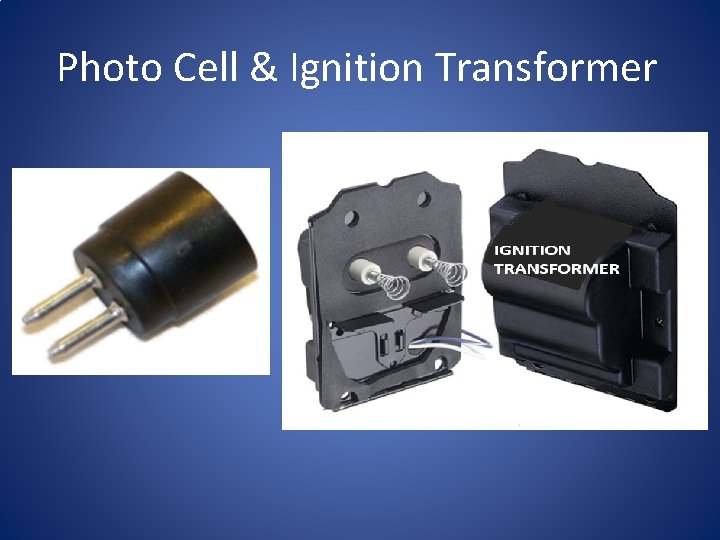
Photo Cell & Ignition Transformer
Oil Combustion Furnaces (3) • You should now be able to explain why an annual maintenance inspection is required for gas and oil furnaces. • Measure temperature difference across the heat exchanger. • Verify primary burner control safety timing is within OEM specifications. • Inspect vent piping and connections note any blockage, water corrosion, or signs of cracks or leaks. • Verify proper support and slope for vent piping. • Report and/or remove combustible materials placed too close to vent piping.
Lessons Learned • You should now be able to explain what type of expansion device equipment must have for a subcooling refrigerant charge test to be done. • You should now be able to identify a gas furnace in the field. • You should now be able to identify an oil furnace in the field. • You should now be able to explain how the combustion igniters work for gas and oil furnaces. • You should now be able to explain why a combustion test should be done annually.
- Slides: 16