
Technicians First Guide and Workbook Section 15 System
Technician’s First Guide and Workbook Section 15: System Installation Basics (3)
Refrigerant Charging Background For any system the best way to know the refrigerant charge is correct is to have an empty system that is in a vacuum of 500 microns or less and to weigh it in using an accurate scale. However, most residential systems come with a factory charge in the condenser and instructions if more refrigerant is needed due to the length of line sets or the evaporator & condenser coil combination selected. Original equipment manufacturers (OEM) provide technicians with charge checking instructions based on superheat and sub cooling. Those two procedures will be covered in sections below.
Refrigerant Charging Warning Before charge can be tested, airflow across the indoor/evaporator coil must meet HVAC equipment manufacturer’s specifications.

Superheat Test The superheat method is used on units with the following types of metering devices: • Fixed orifice (a hole that is calibrated for size), • Piston metering device • Cap-tube
Superheat Test (cooling only) This test can’t be done on a heat pump in heating mode. Manufacturers provide an acceptable range for the superheat (generally between 5ºF and 20ºF dependent on ambient and indoor wet-bulb temperatures) and an acceptable temperature split. For example, plus or minus two degrees. Generally, to perform this test, dry bulb outside temperature needs to be 55ºF or higher. However, equipment manufacturer’s directions may vary and should be consulted.
Superheat Test Procedure (1) Technicians will need a temperature measurement device that can be attached to refrigerant lines to take three temperature readings in order to use the manufacturer’s superheat tables. They are: dry bulb outdoor air temperature, entering condenser coil temperature, and the wet bulb temperature of the return air at the air handler.
Superheat Test Procedure (1) Superheat must be measured with the Compressor and evaporator blower fan must be operating in their maximum position at 100% (also called full load conditions) Ideally the charge shall be evaluated on a representative design day for the location. Ambient conditions surrounding the outdoor unit should be noted on the startup record. Many manufacturers offer technical support hotlines and they can help in determining superheat values when conditions are beyond the range of the provided chart. Note: The technician needs to return and check superheat when outside temperatures are in the acceptable range.
Superheat Test Procedure (2) An accurate temperature measurement must be taken on the suction line near the service port. It is important to make sure that the pipe has been cleaned. A temperature probe should then be attached (strapped or clamped mechanically see Figure 94) to the top of the pipe, completely insulated, and taped so that the temperature is as close to the refrigerant temperature in the pipe as possible.
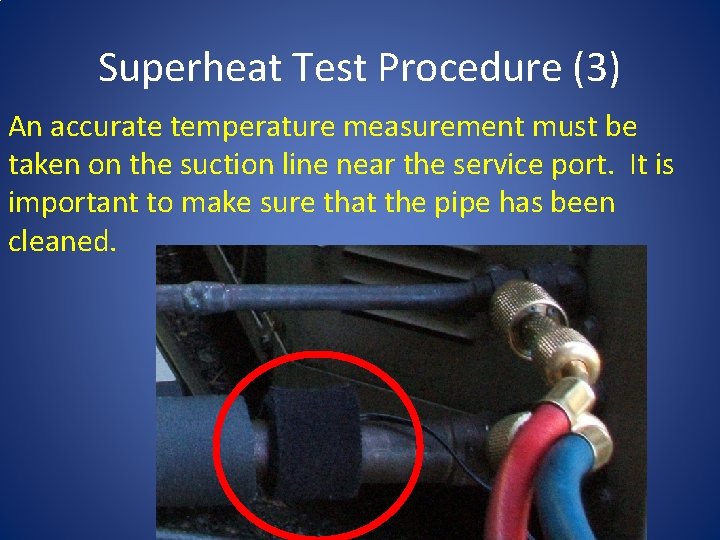
Superheat Test Procedure (3) An accurate temperature measurement must be taken on the suction line near the service port. It is important to make sure that the pipe has been cleaned.
Superheat Test Procedure (4) The suction line pressure is taken at the compressor service port. For residential units, two pounds is added to the gauge reading to account for line losses across the evaporator (The 2 lbs. is based on the pressure drop across the evaporator coil caused by line loss for R-22, for other refrigerants, or on commercial units, follow the equipment manufacturer’s directions). The resulting total pressure is converted to saturation temperature, using a vapor temperature chart. If the pressure gauge is rated for the refrigerant in the system, the vapor saturation temperature can be read on the corresponding temperature band by visually adding the two pounds and reading across the dial.
Superheat Test Procedure (5) Two exceptions: • Some modern digital manifolds are designed to calculate and directly read SH, all corrections are made automatically (see Figure 95). • Follow HVAC equipment manufacturer’s instructions when using tables/graphs provided with the equipment because the two-pound correction may be included in their numbers. Note: Some manufacturers do not publish superheat, instead they publish the required pressure in cooling or vapor pressures in heating at various suction pressures.
Superheat Test Procedure (6) Superheat is the difference between the measured suction line temperature readings and the temperature obtained by the pressure conversion (Simply stated, the lower temperature is subtracted from the higher). Using the equipment manufacturer’s charts and readings taken, determine if the superheat is within 5ºF of the equipment manufacturer’s required superheat value for the condition. Note: Some manufacturers do not publish subcooling, instead they publish the required pressure in cooling or vapor pressures in heating at various suction pressures.
Superheat Test Evaluation (1) If the measured superheat is not within 5 OF of the equipment manufacturer’s required superheat value, take the following action: 1. If the Superheat is higher, than the manufacturer’s specified range: add a couple of ounces of refrigerant, wait 15 minutes, and read again. 2. If the Superheat is lower, than the manufacturer’s specified range: refrigerant will need to be removed and placed in a new recovery cylinder, or one with the same type of refrigerant in it. Wait 15 minutes and repeat the test.
Lessons Learned • You should now be able to explain why weighing in a charge is the most accurate method for verifying a correct charge is in a HVAC system. • You should now be able to explain what type of expansion device equipment must have for a super heat test to be done. • You should now be able to explain how to perform a super heat test. • You should now be able to explain what to do when the super heat is high or low.
- Slides: 14