
Technical Trade Studies for a Lunar Penetrator Mission
- Slides: 19
Technical Trade Studies for a Lunar Penetrator Mission Alan Smith 1, Rob Gowen 1, Yang Gao 2, and Phil Church 6 1 2 ILEWG-9 Conference, Sorrento, Oct 22 -26, 2007 6
Contents § § § Introduction to Penetrators Moon. LITE Mission Technical Trade Studies Program Status Summary & Conclusions ILEWG-9 Conference, Sorrento, Oct 22 -26, 2007
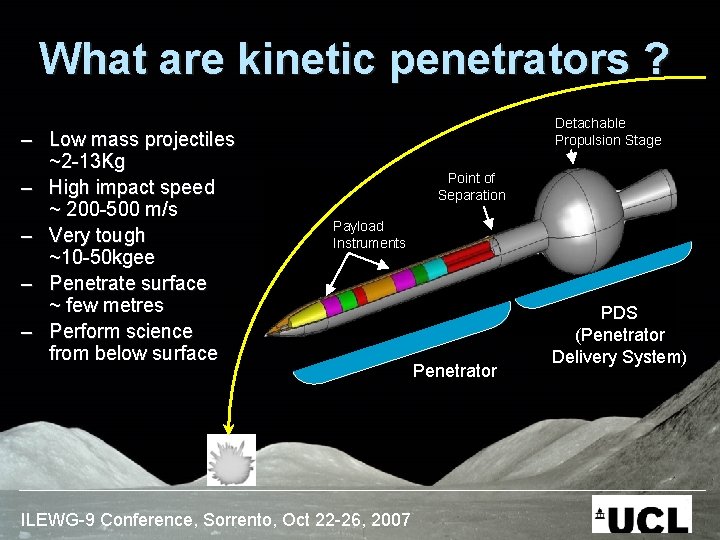
What are kinetic penetrators ? – Low mass projectiles ~2 -13 Kg – High impact speed ~ 200 -500 m/s – Very tough ~10 -50 kgee – Penetrate surface ~ few metres – Perform science from below surface Detachable Propulsion Stage Point of Separation Payload Instruments ILEWG-9 Conference, Sorrento, Oct 22 -26, 2007 Penetrator PDS (Penetrator Delivery System)
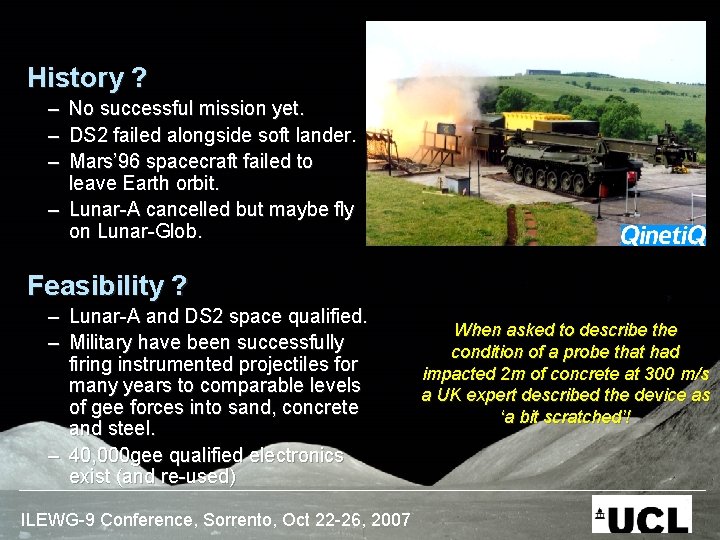
History ? – – – No successful mission yet. DS 2 failed alongside soft lander. Mars’ 96 spacecraft failed to leave Earth orbit. – Lunar-A cancelled but maybe fly on Lunar-Glob. Feasibility ? – Lunar-A and DS 2 space qualified. – Military have been successfully firing instrumented projectiles for many years to comparable levels of gee forces into sand, concrete and steel. – 40, 000 gee qualified electronics exist (and re-used) ILEWG-9 Conference, Sorrento, Oct 22 -26, 2007 When asked to describe the condition of a probe that had impacted 2 m of concrete at 300 m/s a UK expert described the device as ‘a bit scratched’!
Impact Test ILEWG-9 Conference, Sorrento, Oct 22 -26, 2007
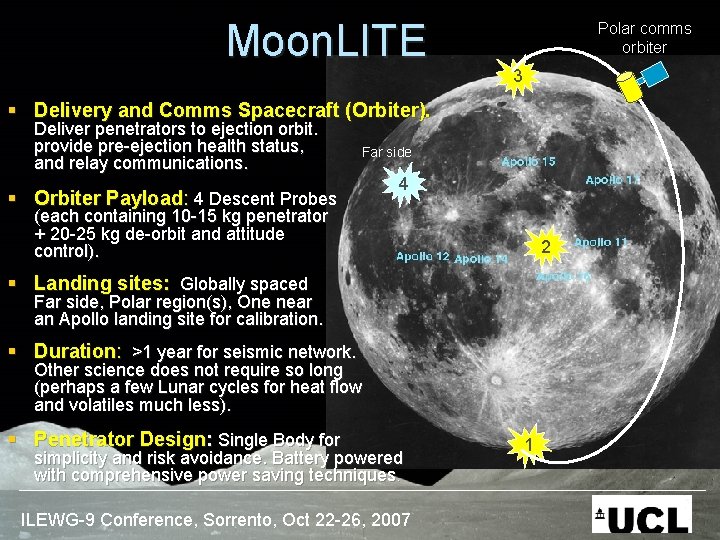
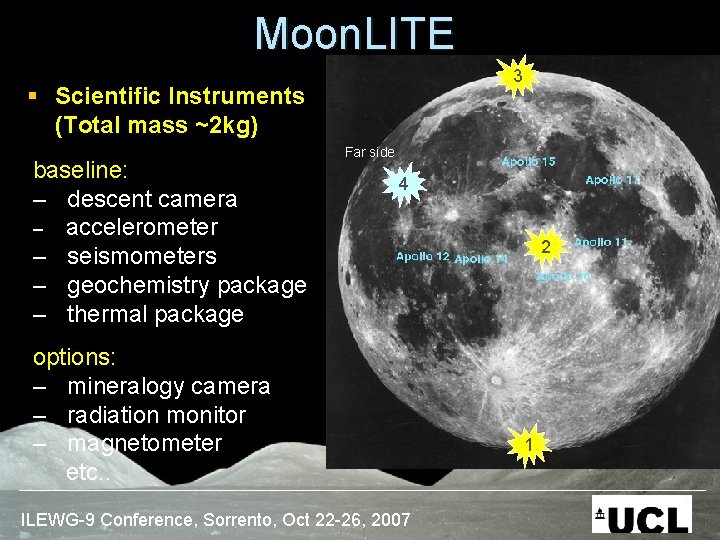
Moon. LITE Polar comms orbiter 3 § Delivery and Comms Spacecraft (Orbiter). Deliver penetrators to ejection orbit. provide pre-ejection health status, and relay communications. Far side § Orbiter Payload: 4 Descent Probes 4 (each containing 10 -15 kg penetrator + 20 -25 kg de-orbit and attitude control). 2 § Landing sites: Globally spaced Far side, Polar region(s), One near an Apollo landing site for calibration. § Duration: >1 year for seismic network. Other science does not require so long (perhaps a few Lunar cycles for heat flow and volatiles much less). § Penetrator Design: Single Body for simplicity and risk avoidance. Battery powered with comprehensive power saving techniques. ILEWG-9 Conference, Sorrento, Oct 22 -26, 2007 1
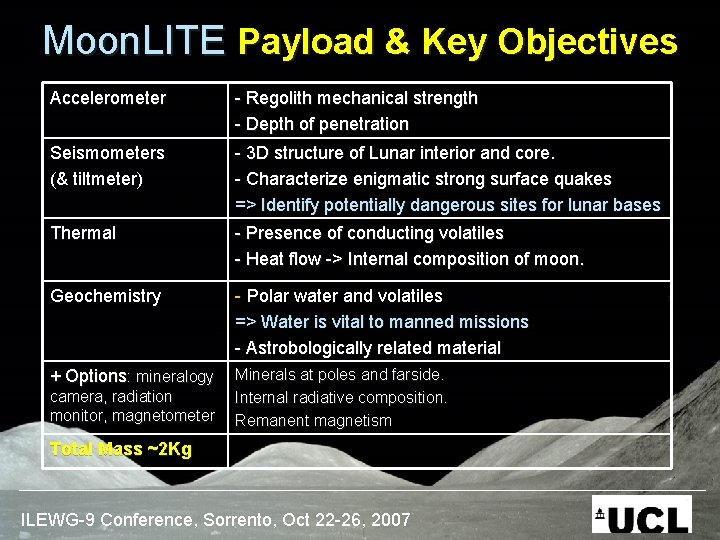
Moon. LITE Payload & Key Objectives Accelerometer - Regolith mechanical strength - Depth of penetration Seismometers (& tiltmeter) - 3 D structure of Lunar interior and core. - Characterize enigmatic strong surface quakes => Identify potentially dangerous sites for lunar bases Thermal - Presence of conducting volatiles - Heat flow -> Internal composition of moon. Geochemistry - Polar water and volatiles => Water is vital to manned missions - Astrobologically related material + Options: mineralogy Minerals at poles and farside. Internal radiative composition. Remanent magnetism camera, radiation monitor, magnetometer Total Mass ~2 Kg ILEWG-9 Conference, Sorrento, Oct 22 -26, 2007
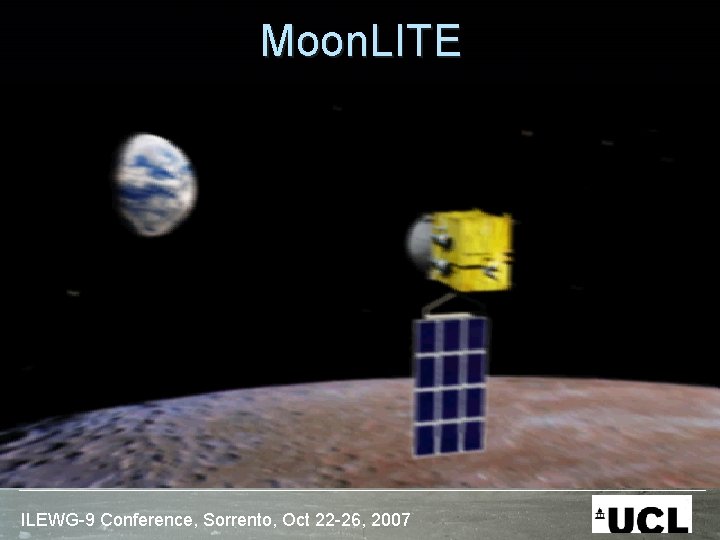
Moon. LITE ILEWG-9 Conference, Sorrento, Oct 22 -26, 2007
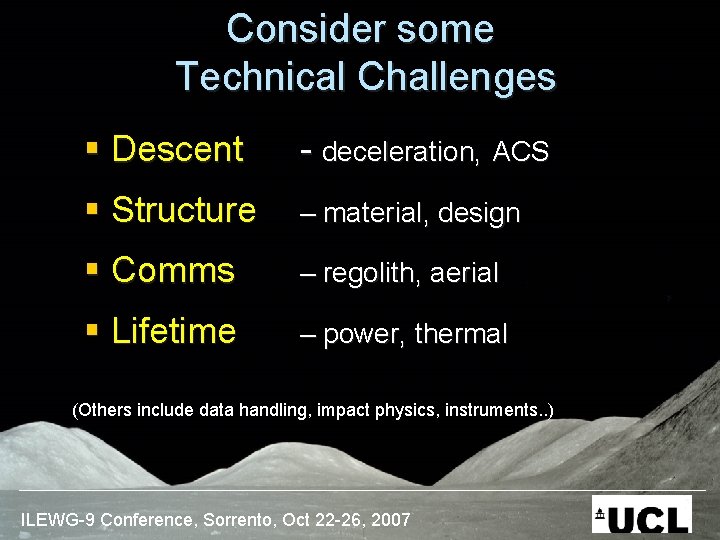
Consider some Technical Challenges § Descent - deceleration, ACS § Structure – material, design § Comms – regolith, aerial § Lifetime – power, thermal (Others include data handling, impact physics, instruments. . ) ILEWG-9 Conference, Sorrento, Oct 22 -26, 2007
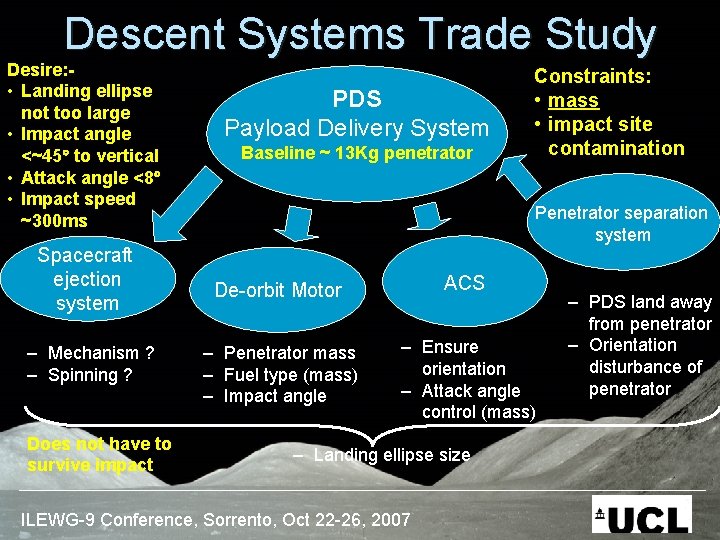
Descent Systems Trade Study Desire: • Landing ellipse not too large • Impact angle <~45 to vertical • Attack angle <8 • Impact speed ~300 ms Spacecraft ejection system – Mechanism ? – Spinning ? Does not have to survive impact PDS Payload Delivery System Baseline ~ 13 Kg penetrator Constraints: • mass • impact site contamination Penetrator separation system De-orbit Motor ACS – Penetrator mass – Fuel type (mass) – Impact angle – Ensure orientation – Attack angle control (mass) – Landing ellipse size ILEWG-9 Conference, Sorrento, Oct 22 -26, 2007 – PDS land away from penetrator – Orientation disturbance of penetrator
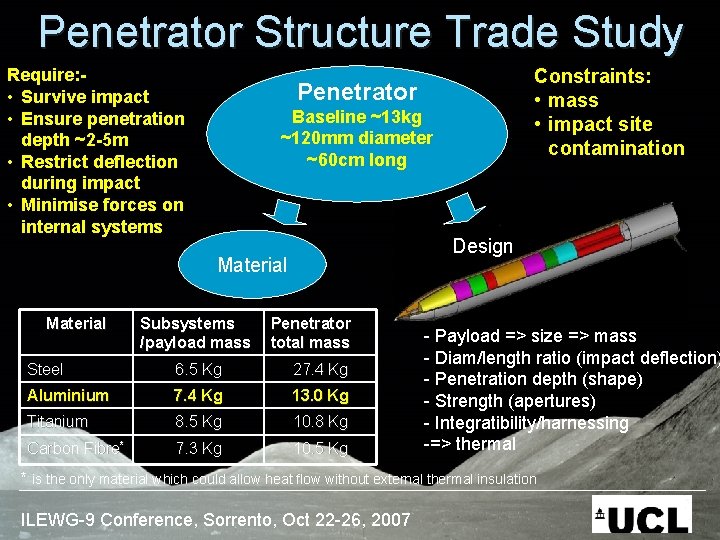
Penetrator Structure Trade Study Require: • Survive impact • Ensure penetration depth ~2 -5 m • Restrict deflection during impact • Minimise forces on internal systems Penetrator Baseline ~13 kg ~120 mm diameter ~60 cm long Design Material Constraints: • mass • impact site contamination Subsystems /payload mass Penetrator total mass Steel 6. 5 Kg 27. 4 Kg Aluminium 7. 4 Kg 13. 0 Kg Titanium 8. 5 Kg 10. 8 Kg Carbon Fibre* 7. 3 Kg 10. 5 Kg - Payload => size => mass - Diam/length ratio (impact deflection) - Penetration depth (shape) - Strength (apertures) - Integratibility/harnessing -=> thermal * is the only material which could allow heat flow without external thermal insulation ILEWG-9 Conference, Sorrento, Oct 22 -26, 2007
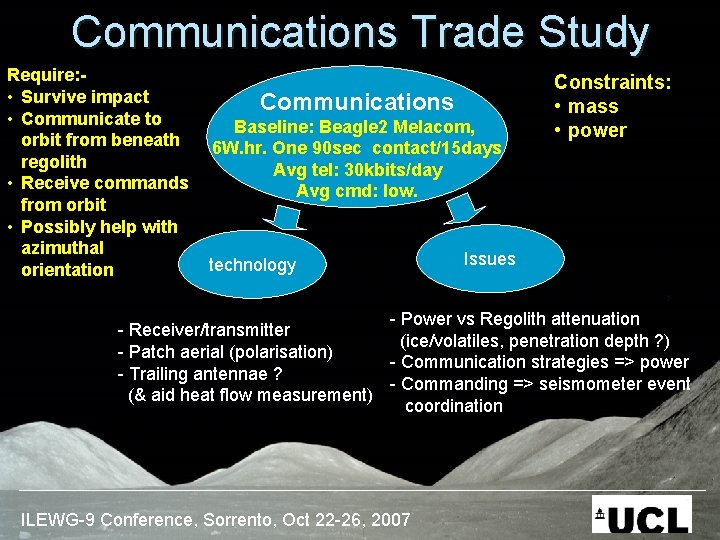
Communications Trade Study Require: • Survive impact • Communicate to orbit from beneath regolith • Receive commands from orbit • Possibly help with azimuthal orientation Communications Baseline: Beagle 2 Melacom, 6 W. hr. One 90 sec contact/15 days Avg tel: 30 kbits/day Avg cmd: low. technology Constraints: • mass • power Issues - Power vs Regolith attenuation - Receiver/transmitter (ice/volatiles, penetration depth ? ) - Patch aerial (polarisation) - Communication strategies => power - Trailing antennae ? - Commanding => seismometer event (& aid heat flow measurement) coordination ILEWG-9 Conference, Sorrento, Oct 22 -26, 2007
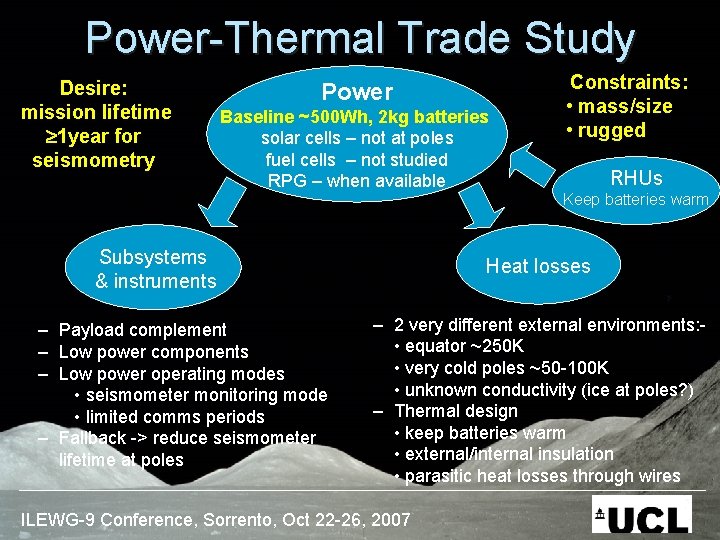
Power-Thermal Trade Study Desire: mission lifetime 1 year for seismometry Power Baseline ~500 Wh, 2 kg batteries solar cells – not at poles fuel cells – not studied RPG – when available Subsystems & instruments – Payload complement – Low power components – Low power operating modes • seismometer monitoring mode • limited comms periods – Fallback -> reduce seismometer lifetime at poles Constraints: • mass/size • rugged RHUs Keep batteries warm Heat losses – 2 very different external environments: • equator ~250 K • very cold poles ~50 -100 K • unknown conductivity (ice at poles? ) – Thermal design • keep batteries warm • external/internal insulation • parasitic heat losses through wires ILEWG-9 Conference, Sorrento, Oct 22 -26, 2007
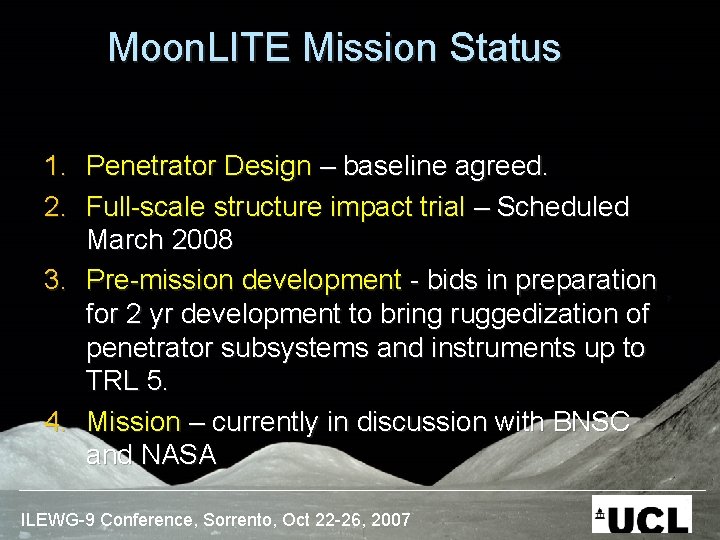
Moon. LITE Mission Status 1. 2. Penetrator Design – baseline agreed. Full-scale structure impact trial – Scheduled March 2008 3. Pre-mission development - bids in preparation for 2 yr development to bring ruggedization of penetrator subsystems and instruments up to TRL 5. 4. Mission – currently in discussion with BNSC and NASA ILEWG-9 Conference, Sorrento, Oct 22 -26, 2007
Finally… For further information email: as@mssl. ucl. ac. uk or see http: //www. mssl. ucl. ac. uk/planetary/missions/Micro_Penetrators. php …the Moon. LITE penetrators have the potential to make major contributions to lunar science. Ian Crawford, 2007. ILEWG-9 Conference, Sorrento, Oct 22 -26, 2007
- End - ILEWG-9 Conference, Sorrento, Oct 22 -26, 2007
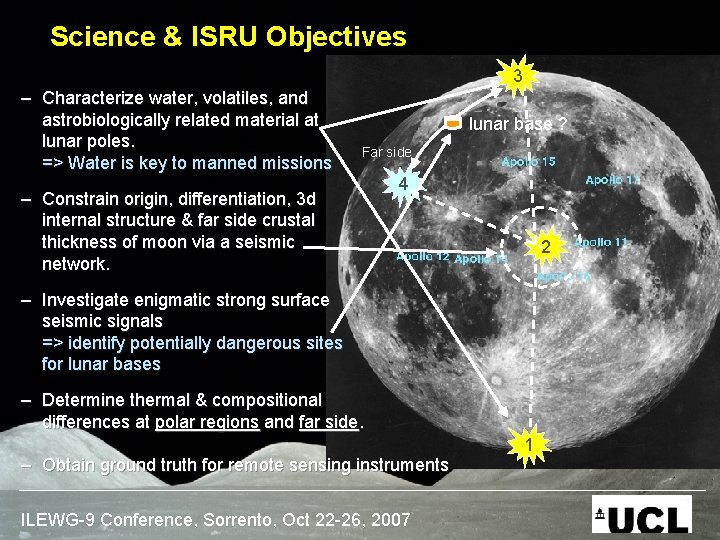
Science & ISRU Objectives 3 – Characterize water, volatiles, and astrobiologically related material at lunar poles. => Water is key to manned missions lunar base ? Far side – Constrain origin, differentiation, 3 d internal structure & far side crustal thickness of moon via a seismic network. 4 2 – Investigate enigmatic strong surface seismic signals => identify potentially dangerous sites for lunar bases – Determine thermal & compositional differences at polar regions and far side. – Obtain ground truth for remote sensing instruments ILEWG-9 Conference, Sorrento, Oct 22 -26, 2007 1
Moon. LITE 3 § Scientific Instruments (Total mass ~2 kg) baseline: – descent camera – accelerometer – seismometers – geochemistry package – thermal package Far side 4 options: – mineralogy camera – radiation monitor – magnetometer etc. . ILEWG-9 Conference, Sorrento, Oct 22 -26, 2007 2 1
Mission Lifetime Trade Study § 1 year lifetime desired for seismic network § Power Supply – ~500 Wh. Default is Batteries (~2 kg) – Solar cells <- no good at poles – Fuel cells (not studied) – RTG (when available) § Power Usage – efficient communications, low power seismometer pre-event monitoring, low power systems. § Thermal Issues – heat loss, especially at poles where temperatures expected ~50 -100 K & unknown external material conductivity. – Insulation (surface coating, internal) – Parasitic heat loss through wires – RHUs (to heat batteries -> extend lifetime) – Fallback reduced (seismometer) lifetime at poles. ILEWG-9 Conference, Sorrento, Oct 22 -26, 2007