
Technical theatre THE DESIGN PROCESS ESSENTIAL QUESTIONS How
- Slides: 43
Technical theatre THE DESIGN PROCESS
ESSENTIAL QUESTIONS �How is collaboration important in Technical Theatre? �How do the elements of Technical Theatre work together to realize the director’s vision?
THE DESIGN PROCESS TO DESIGN IN THEATRE YOU MUST… �Be expressive - Express yourself through the guidelines of the script �Be unique - Bring something special to the stage �Be a problem solver – actors, directors �Be a team player – coordinate the needs of many areas �Be able to balance art and function �Be able to handle criticism �Be a visionary – see images, rather than words
CREATIVITY Creativity is “artistic or intellectual inventiveness” What does that mean? WHY IS IT DIFFICULT TO BE CREATIVE? �no chance to be �lack of inspiration �set standards
CREATIVITY Components of Creativity � Fluency To produce many ideas; verbal & non verbal � Flexibility Different approaches to problems � Elaboration Adding details to an idea � Originality Uniqueness; nonconformity of thought or action
THE DESIGN PROCESS 7 STEP DESIGN PROCESS 1. 2. 3. 4. 5. 6. 7. Commitment Analysis Research Incubation Selection Implementation Evaluation
THE DESIGN PROCESS COMMITMENT �Commit to the project 110% �To the script first �To the concept second �If 2 nd guess now, will 2 nd guess entire process
THE DESIGN PROCESS ANALYSIS �Script analysis 1 st reading – 1 st impressions of script 2 nd reading – take general notes; inspirations 3 rd reading – details & mechanical info �Production Information Budget Schedule theater facility
THE DESIGN PROCESS RESEARCH �Background Research Given Circumstances �Conceptual Research Solving production problems within the production concept. Devise several ways to meet each challenge.
THE DESIGN PROCESS INCUBATION �Time to let the new ideas “hatch”. �Don’t “actively” think about it. Let it sit awhile and then come back to it. SELECTION �Narrowing down your ideas into specific choices within the concept. �Think collectively. �Foresee the “big picture”
THE DESIGN PROCESS IMPLEMENTATION �Stop planning and start doing �All design work must be completed. EVALUATION �Takes place every step of the way and after the show is over. �What was the most successful? �What would you change?
THE DESIGN PROCESS PRODUCTION STYLE �A manner of producing a play in which all production elements adhere to a common set of artistic/philosophical characteristics. �Must identify the PRODUCTION STYLE before developing a concept!
THE DESIGN PROCESS PRODUCTION STYLE �Style is an impression – not reality a time period (Elizabethan, Medieval, 1920’s) est styles: Romantic, Expressionism, Industrialist HOW DO YOU SHOW IT VISUALY ON STAGE? �Elements of Design �Principles of Composition
ELEMENTS OF DESIGN �Line �Shape �Mass �Color �Texture
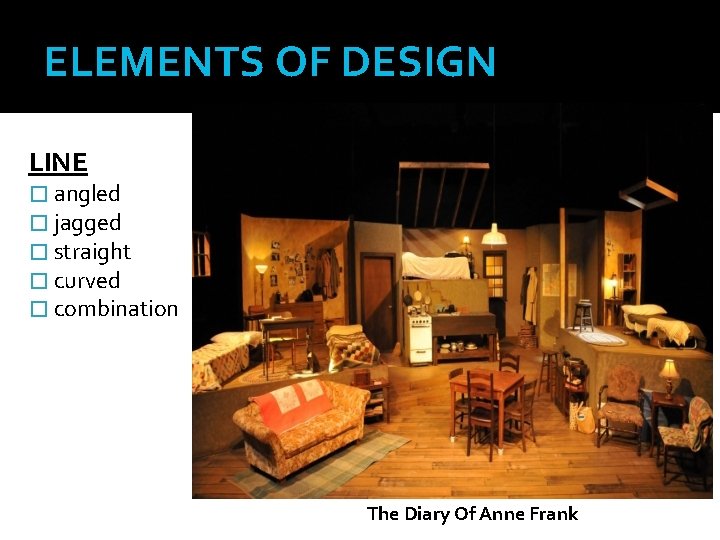
ELEMENTS OF DESIGN LINE � angled � jagged � straight � curved � combination The Diary Of Anne Frank
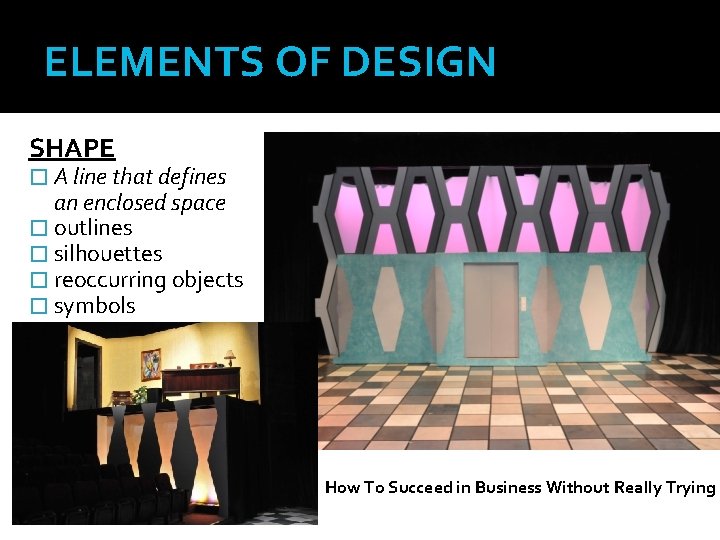
ELEMENTS OF DESIGN SHAPE � A line that defines an enclosed space � outlines � silhouettes � reoccurring objects � symbols How To Succeed in Business Without Really Trying
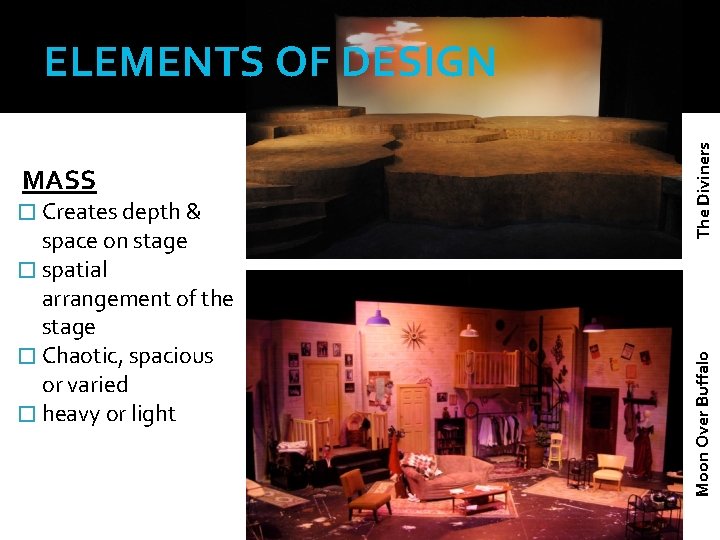
� Creates depth & space on stage � spatial arrangement of the stage � Chaotic, spacious or varied � heavy or light Moon Over Buffalo MASS The Diviners ELEMENTS OF DESIGN
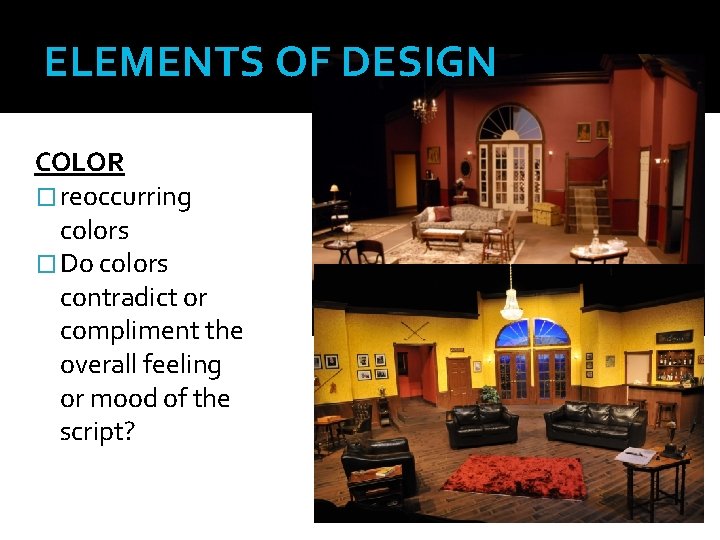
ELEMENTS OF DESIGN COLOR � reoccurring colors � Do colors contradict or compliment the overall feeling or mood of the script? See How They Run
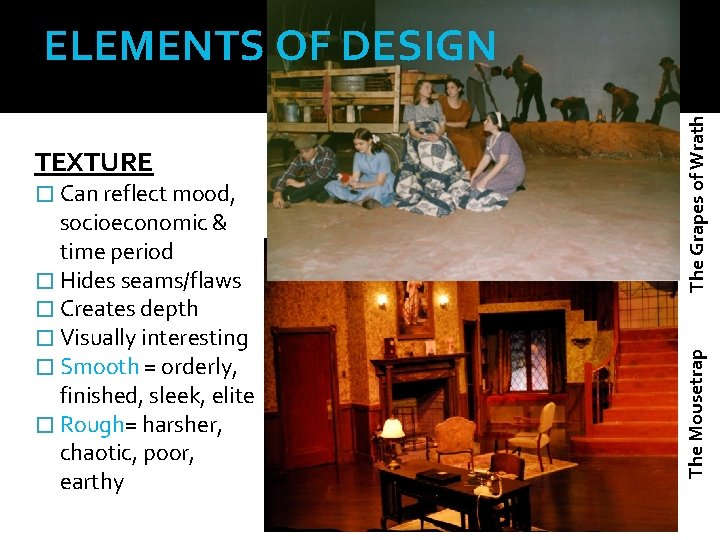
� Can reflect mood, socioeconomic & time period � Hides seams/flaws � Creates depth � Visually interesting � Smooth = orderly, finished, sleek, elite � Rough= harsher, chaotic, poor, earthy The Mousetrap TEXTURE The Grapes of Wrath ELEMENTS OF DESIGN
PRINCIPLES OF COMPOSITION �Unity �Harmony �Contrast �Variation �Balance �Proportion �Emphasis
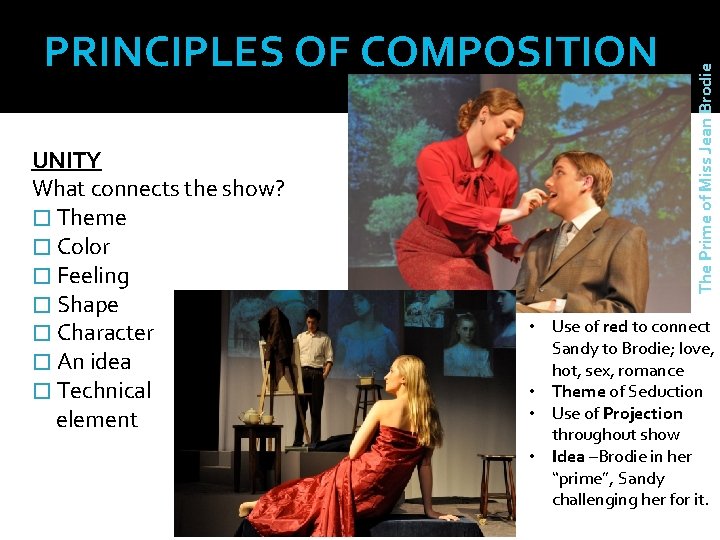
UNITY What connects the show? � Theme � Color � Feeling � Shape � Character � An idea � Technical element The Prime of Miss Jean Brodie PRINCIPLES OF COMPOSITION • Use of red to connect Sandy to Brodie; love, hot, sex, romance • Theme of Seduction • Use of Projection throughout show • Idea –Brodie in her “prime”, Sandy challenging her for it.
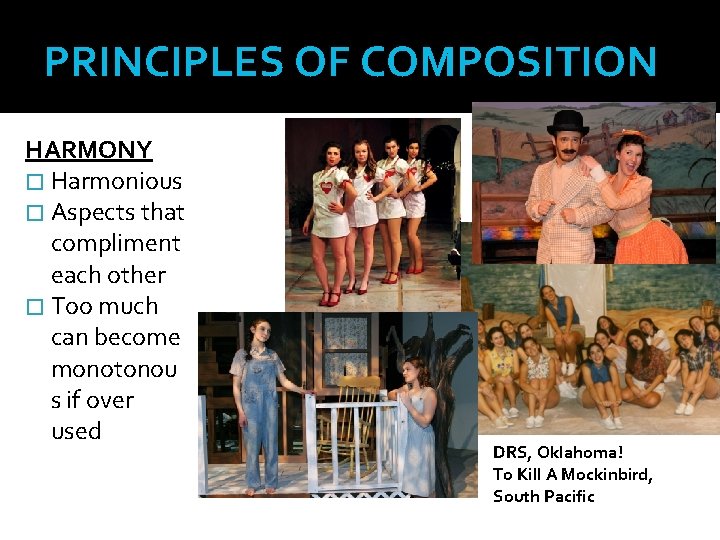
PRINCIPLES OF COMPOSITION HARMONY � Harmonious � Aspects that compliment each other � Too much can become monotonou s if over used DRS, Oklahoma! To Kill A Mockinbird, South Pacific
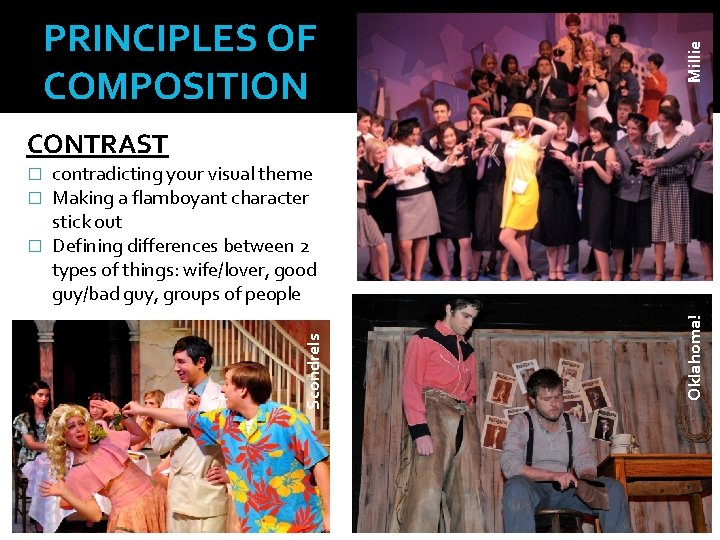
Millie PRINCIPLES OF COMPOSITION CONTRAST contradicting your visual theme Making a flamboyant character stick out � Defining differences between 2 types of things: wife/lover, good guy/bad guy, groups of people Oklahoma! Scondrels � �
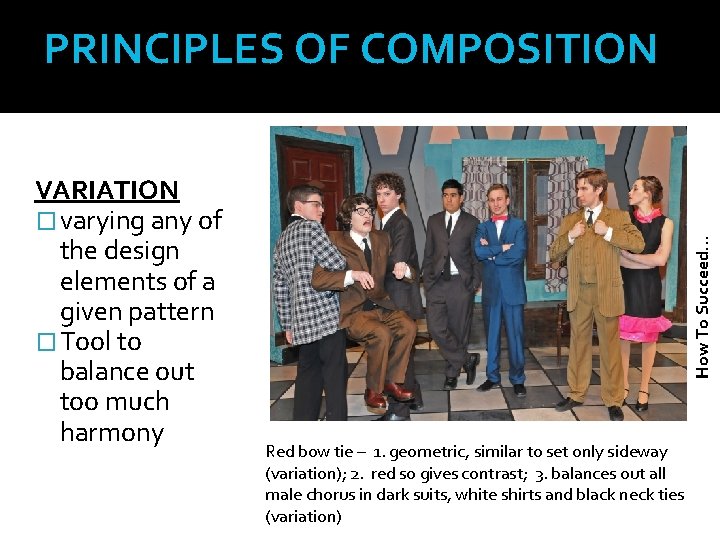
VARIATION � varying any of the design elements of a given pattern � Tool to balance out too much harmony How To Succeed… PRINCIPLES OF COMPOSITION Red bow tie – 1. geometric, similar to set only sideway (variation); 2. red so gives contrast; 3. balances out all male chorus in dark suits, white shirts and black neck ties (variation)
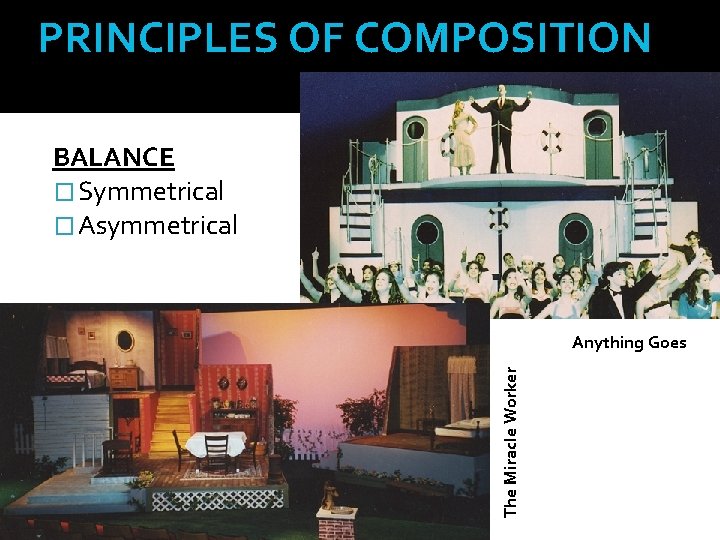
PRINCIPLES OF COMPOSITION BALANCE � Symmetrical � Asymmetrical The Miracle Worker Anything Goes
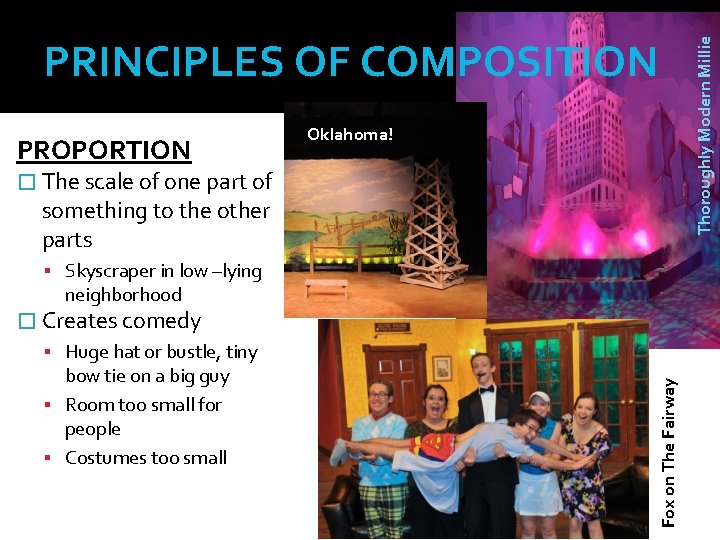
PROPORTION Oklahoma! � The scale of one part of something to the other parts Skyscraper in low –lying neighborhood � Creates comedy bow tie on a big guy Room too small for people Costumes too small Fox on The Fairway Huge hat or bustle, tiny Thoroughly Modern Millie PRINCIPLES OF COMPOSITION
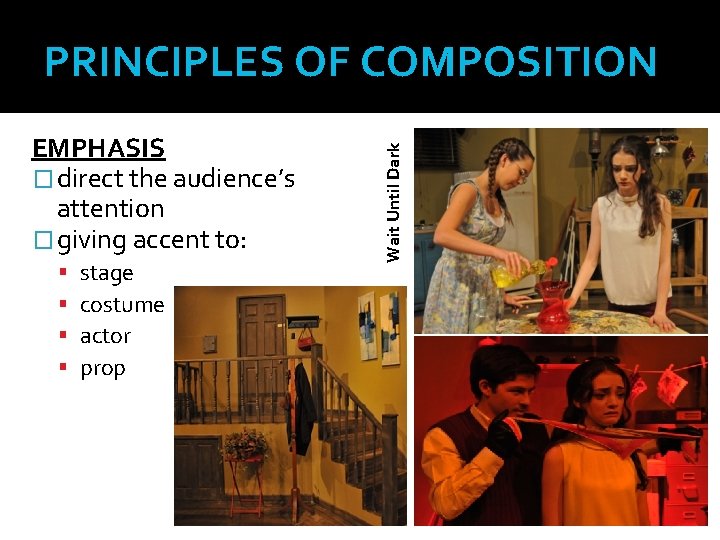
EMPHASIS � direct the audience’s attention � giving accent to: stage costume actor prop Wait Until Dark PRINCIPLES OF COMPOSITION
PRODUCTION CONCEPT WHAT IS A PRODUCTION CONCEPT? It is the central creative idea that unifies all designing aspects of the production
PRODUCTION CONCEPT WHY IS IT IMPORTANT? �Unifies all the areas of technical design in a production �Allows all designers to work towards a common goal, so that all the pieces of the puzzle fit well together. �Allows a designer to have a place to begin designing from in which all his ideas can relate to. �Becomes a visual interpretation of the playwright’s words.
PRODUCTION CONCEPT HOW IS A CONCEPT DEVELOPED? A designer should take into consideration many aspects of the script before designing; including the: �mood and spirit of the play �the historical period �local and season of the play �personality of the characters �visualize themes - images and abstract thinking You must unblock your thinking, overcome tunnel vision, avoid stereotyping and be selective.
PRODUCTION CONCEPT WHAT ARE THE STEPS INVOLVED IN CREATING A PRODUCTION CONCEPT? 1. Analyze the GIVEN CIRCUMSTANCES. 2. Analyze the ELEMENTS OF DESIGN in relation to the script’s theme and idea. 3. Analyze the PRINCIPLES OF COMPOSITION in relation to the script’s theme and idea. 4. Take all the information gathered in steps 1, 2 and 3 and formulate the PRODUCTION CONCEPT.
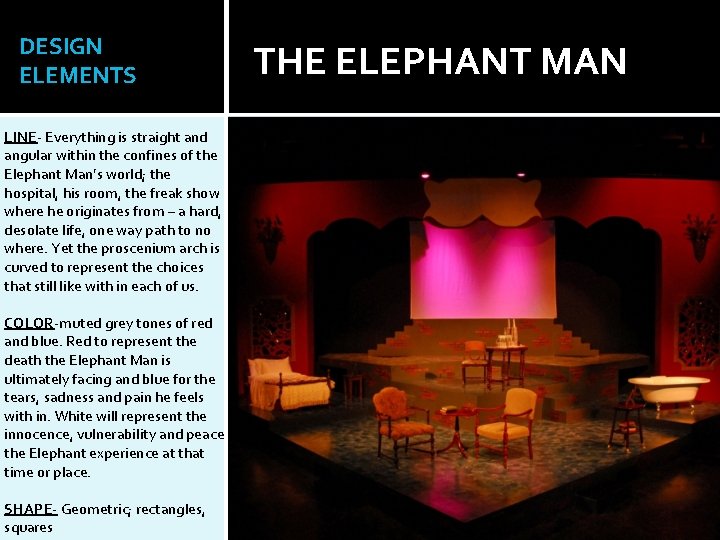
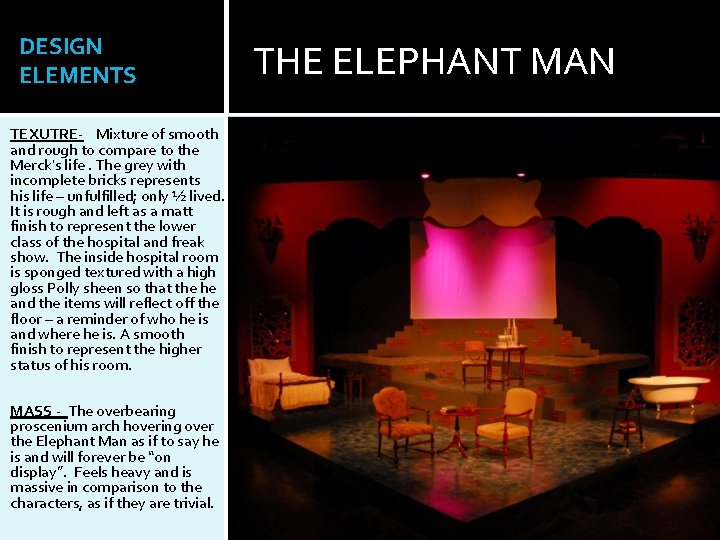
DESIGN ELEMENTS LINE- Everything is straight and angular within the confines of the Elephant Man’s world; the hospital, his room, the freak show where he originates from – a hard, desolate life, one way path to no where. Yet the proscenium arch is curved to represent the choices that still like with in each of us. COLOR-muted grey tones of red and blue. Red to represent the death the Elephant Man is ultimately facing and blue for the tears, sadness and pain he feels with in. White will represent the innocence, vulnerability and peace the Elephant experience at that time or place. SHAPE- Geometric; rectangles, squares THE ELEPHANT MAN
DESIGN ELEMENTS TEXUTRE- Mixture of smooth and rough to compare to the Merck's life. The grey with incomplete bricks represents his life – unfulfilled; only ½ lived. It is rough and left as a matt finish to represent the lower class of the hospital and freak show. The inside hospital room is sponged textured with a high gloss Polly sheen so that the he and the items will reflect off the floor – a reminder of who he is and where he is. A smooth finish to represent the higher status of his room. MASS - The overbearing proscenium arch hovering over the Elephant Man as if to say he is and will forever be “on display”. Feels heavy and is massive in comparison to the characters, as if they are trivial. THE ELEPHANT MAN
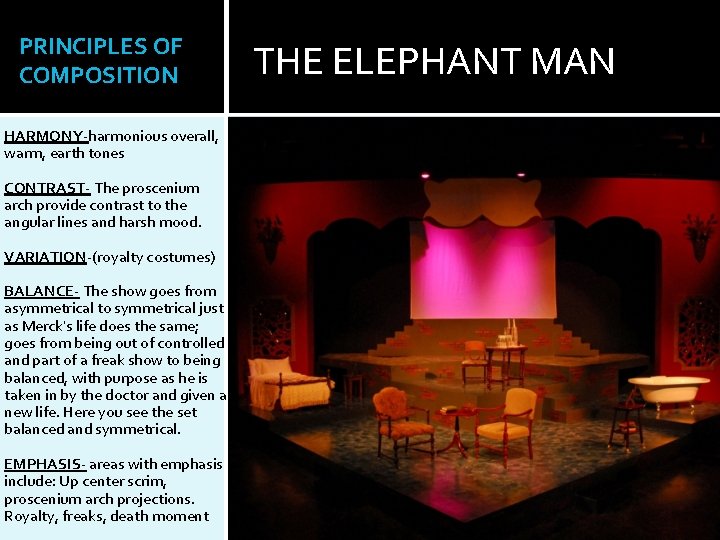
PRINCIPLES OF COMPOSITION HARMONY-harmonious overall, warm, earth tones CONTRAST- The proscenium arch provide contrast to the angular lines and harsh mood. VARIATION-(royalty costumes) BALANCE- The show goes from asymmetrical to symmetrical just as Merck's life does the same; goes from being out of controlled and part of a freak show to being balanced, with purpose as he is taken in by the doctor and given a new life. Here you see the set balanced and symmetrical. EMPHASIS- areas with emphasis include: Up center scrim, proscenium arch projections. Royalty, freaks, death moment THE ELEPHANT MAN
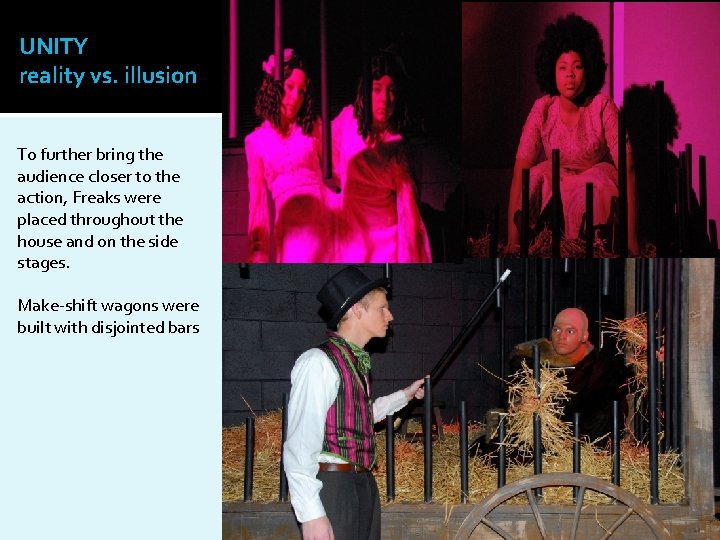
UNITY reality vs. illusion To further bring the audience closer to the action, Freaks were placed throughout the house and on the side stages. Make-shift wagons were built with disjointed bars
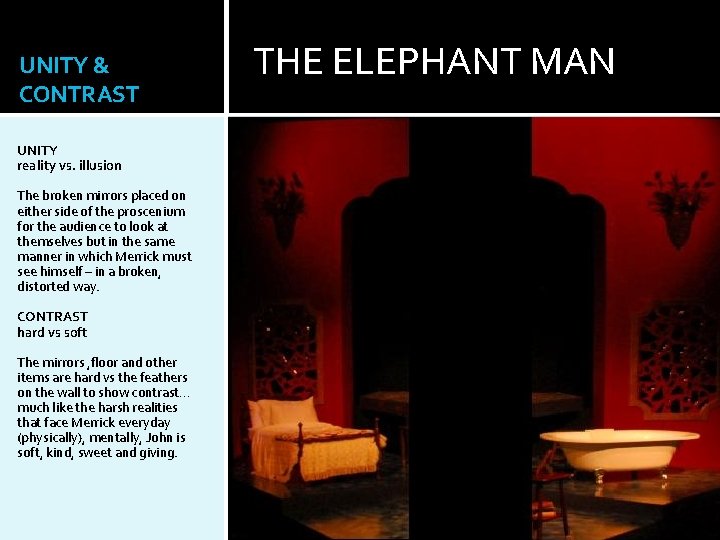
UNITY & CONTRAST UNITY reality vs. illusion The broken mirrors placed on either side of the proscenium for the audience to look at themselves but in the same manner in which Merrick must see himself – in a broken, distorted way. CONTRAST hard vs soft The mirrors , floor and other items are hard vs the feathers on the wall to show contrast… much like the harsh realities that face Merrick everyday (physically), mentally, John is soft, kind, sweet and giving. THE ELEPHANT MAN
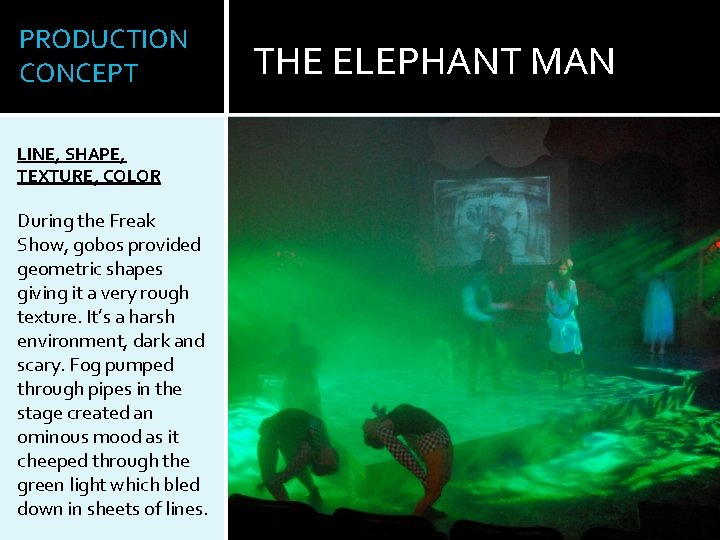
PRODUCTION CONCEPT LINE, SHAPE, TEXTURE, COLOR During the Freak Show, gobos provided geometric shapes giving it a very rough texture. It’s a harsh environment, dark and scary. Fog pumped through pipes in the stage created an ominous mood as it cheeped through the green light which bled down in sheets of lines. THE ELEPHANT MAN
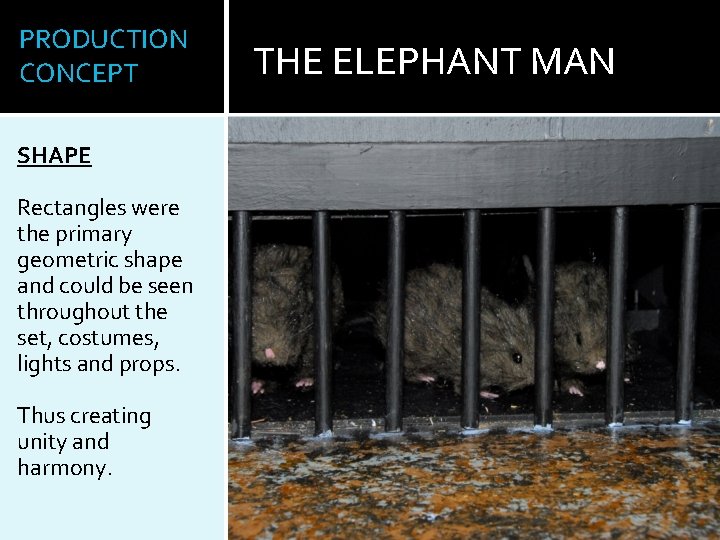
PRODUCTION CONCEPT SHAPE Rectangles were the primary geometric shape and could be seen throughout the set, costumes, lights and props. Thus creating unity and harmony. THE ELEPHANT MAN
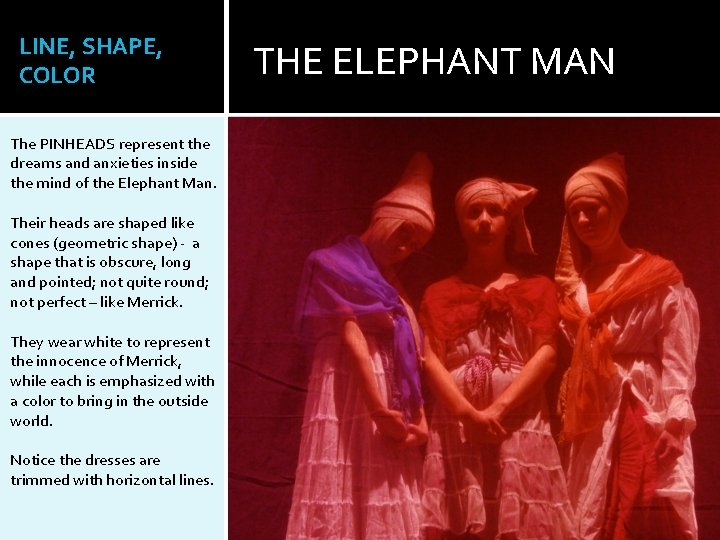
LINE, SHAPE, COLOR The PINHEADS represent the dreams and anxieties inside the mind of the Elephant Man. Their heads are shaped like cones (geometric shape) - a shape that is obscure, long and pointed; not quite round; not perfect – like Merrick. They wear white to represent the innocence of Merrick, while each is emphasized with a color to bring in the outside world. Notice the dresses are trimmed with horizontal lines. THE ELEPHANT MAN
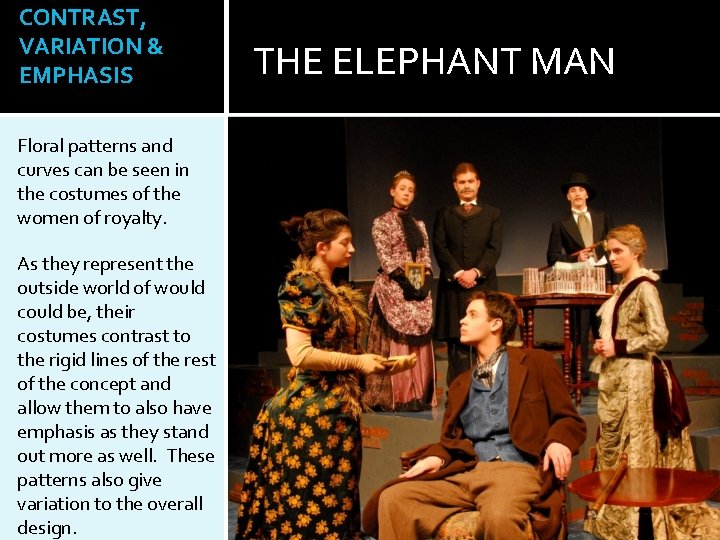
CONTRAST, VARIATION & EMPHASIS Floral patterns and curves can be seen in the costumes of the women of royalty. As they represent the outside world of would could be, their costumes contrast to the rigid lines of the rest of the concept and allow them to also have emphasis as they stand out more as well. These patterns also give variation to the overall design. THE ELEPHANT MAN
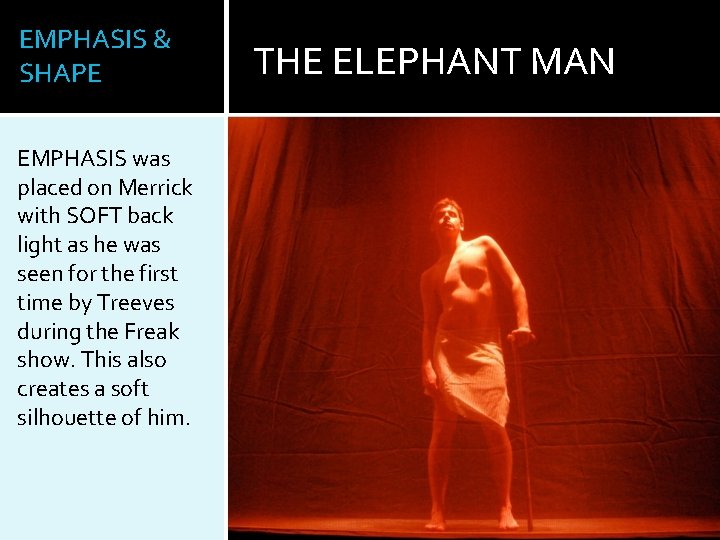
EMPHASIS & SHAPE EMPHASIS was placed on Merrick with SOFT back light as he was seen for the first time by Treeves during the Freak show. This also creates a soft silhouette of him. THE ELEPHANT MAN
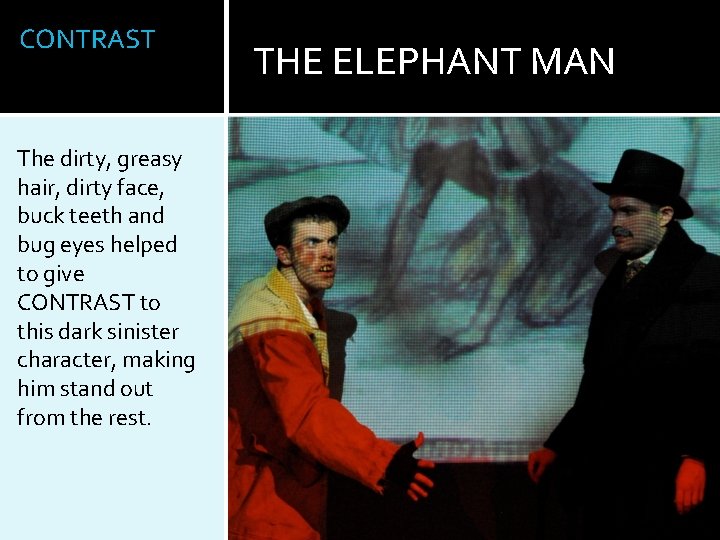
CONTRAST The dirty, greasy hair, dirty face, buck teeth and bug eyes helped to give CONTRAST to this dark sinister character, making him stand out from the rest. THE ELEPHANT MAN
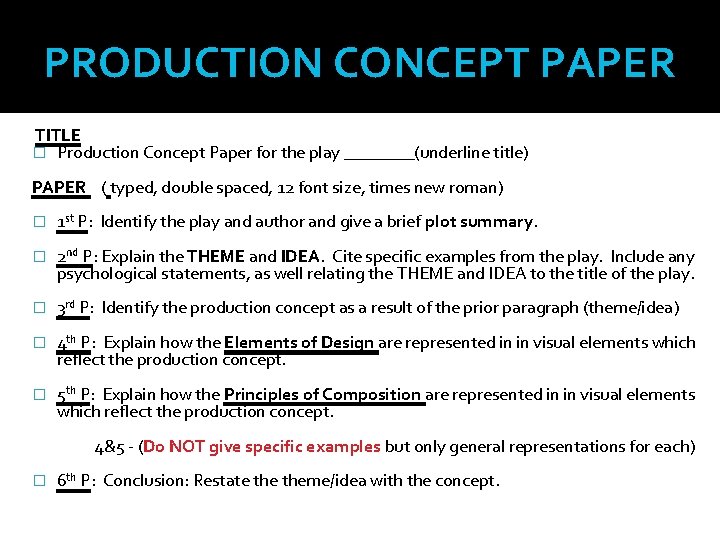
PRODUCTION CONCEPT PAPER TITLE � Production Concept Paper for the play ____(underline title) PAPER ( typed, double spaced, 12 font size, times new roman) � 1 st P: Identify the play and author and give a brief plot summary. � 2 nd P: Explain the THEME and IDEA. Cite specific examples from the play. Include any psychological statements, as well relating the THEME and IDEA to the title of the play. � 3 rd P: Identify the production concept as a result of the prior paragraph (theme/idea) � 4 th P: Explain how the Elements of Design are represented in in visual elements which reflect the production concept. � 5 th P: Explain how the Principles of Composition are represented in in visual elements which reflect the production concept. 4&5 - (Do NOT give specific examples but only general representations for each) � 6 th P: Conclusion: Restate theme/idea with the concept.