
Technical theatre SCENIC CONSTRUCTION SCENIC CONSTRUCTION WICKED Scenery
- Slides: 39
Technical theatre SCENIC CONSTRUCTION
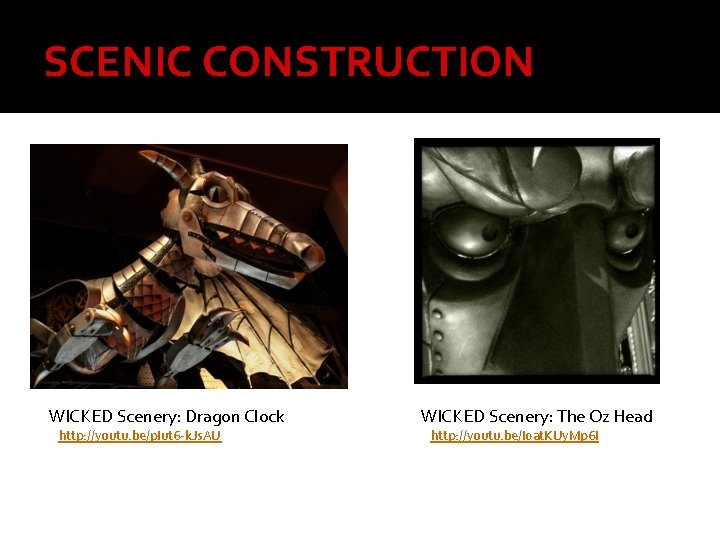
SCENIC CONSTRUCTION WICKED Scenery: Dragon Clock http: //youtu. be/p. Iut 6 -k. Js. AU WICKED Scenery: The Oz Head http: //youtu. be/I 0 at. KUy. Mp 6 I
CHARACTERISTICS OF SCENIC CONSTRUCTION �Short term construction �Rapid construction �Possible re-use �Built in one place and used in another �Built in units �assembled with temporary joining �Finished one 1 side only �Light weight �Strong for safe usage & moving �Constructed as inexpensively as possible
CONSTRUCTION CONSIDERATIONS �Is it stock scenery to be reused? �Must it support weight? �Does ti have to be moved during a scene shift? Or action? �How much does the audience see?
SHOP SAFETY 1. ALWAYS KEEP EQUIPMENT IN GOOD WORKING CONDITION. 2. MAINTAIN A CLEAN AND ORGANIZED WORKING ENVIRONMENT. AVOID CREATING HAZARDS: Nails, screws sticking up Not cleaning up properly Leaving tools out Leaving tools left on Over loading power 3. NEVER EAT OR DRINK NEAR ANY POWER TOOLS.
SHOP SAFETY 4. DO NOT OPERATE ANY EQUIPMENT WITHOUT PROPER TRAINING AND ADULT SUPERVISION. 5. SAFETY GOGGLES ARE REQUIRED AT ALL TIMES WITH POWER TOOLS. 6. DO NOT WEAR LOOSE CLOTHING. 7. SECURE LONG HAIR UNDER A CAP OR TIE IT BACK. 8. USE THE PROPER TOOL FOR THE PROPER JOB. 9. UNDERSTAND YOUR LIMITATIONS. 10. WEAR CLOSED-TOE, HARD-SOLE SHOES AT ALL TIMES.
SHOP SAFETY 11. ALWAYS UNPLUG A POWER TOOL BEFORE CHANGING A BLADE OR BIT. 12. WHEN WORKING WITH MATERIALS THAT EMIT FUMES, GO OUTSIDE. 13. REPORT ANY DAMP OR WET CONDITIONS IMMEDIATELY. 14. KNOW THE LOCATION OF THE CLOSEST FIRE EXTINGUISHER. 15. KNOW THE LOCATION OF THE CLOSEST FIRST AID BOX. 16. USE COMMON SENSE. BE AWARE OF YOUR SURROUNDINGS. BE SMART, STAY FOCUSED ON YOUR TASK!
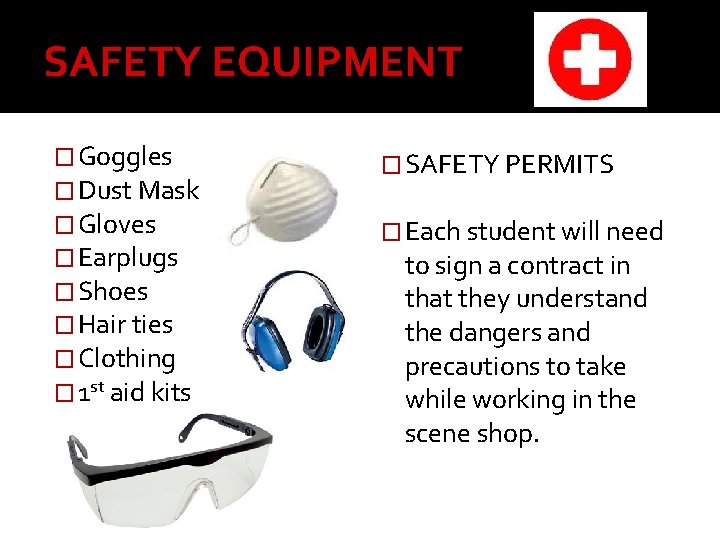
SAFETY EQUIPMENT � Goggles � Dust Mask � Gloves � Earplugs � Shoes � Hair ties � Clothing � 1 st aid kits � SAFETY PERMITS � Each student will need to sign a contract in that they understand the dangers and precautions to take while working in the scene shop.
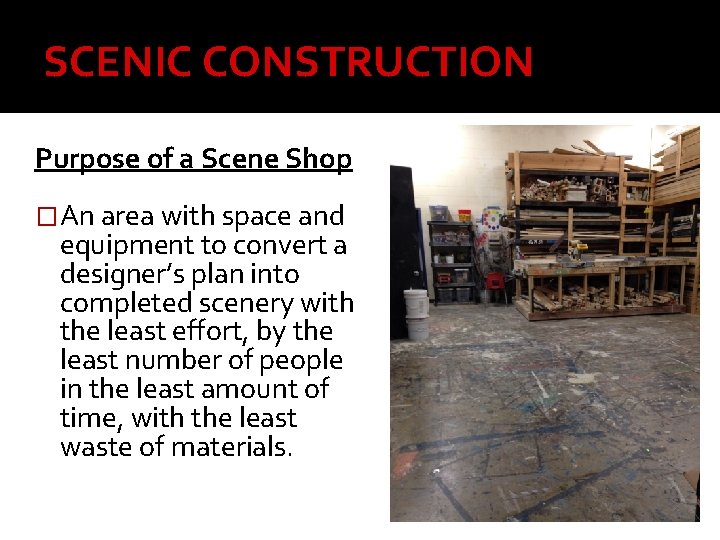
SCENIC CONSTRUCTION Purpose of a Scene Shop �An area with space and equipment to convert a designer’s plan into completed scenery with the least effort, by the least number of people in the least amount of time, with the least waste of materials.
SCENE SHOP Two factors that influence the organization and set up of a scene shop… SIZE � Stage � Shop � Company Carpentry Shop Tour -The Grand Theatre http: //youtu. be/qwq. VXMAq. Gbo FLOW � Receiving & storage of materials � Measuring/marking � Cutting � Working up � Assembly/framing � Covering � Painting � Trial set up � Loading out
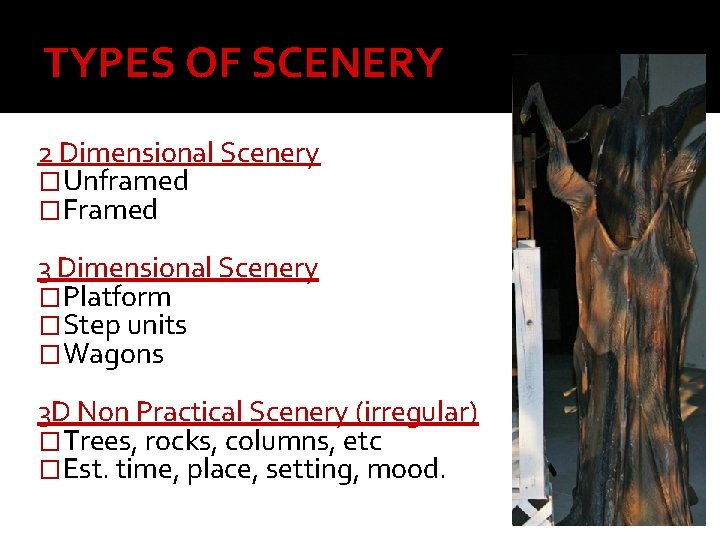
TYPES OF SCENERY 2 Dimensional Scenery �Unframed �Framed 3 Dimensional Scenery �Platform �Step units �Wagons 3 D Non Practical Scenery (irregular) �Trees, rocks, columns, etc �Est. time, place, setting, mood.
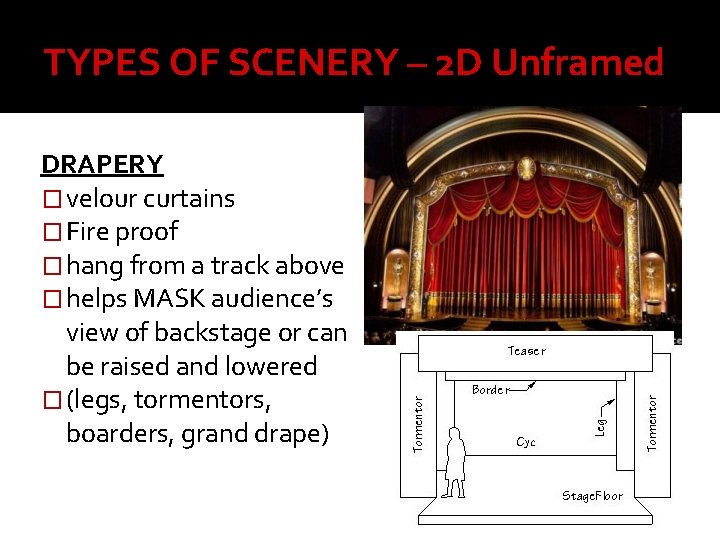
TYPES OF SCENERY – 2 D Unframed DRAPERY � velour curtains � Fire proof � hang from a track above � helps MASK audience’s view of backstage or can be raised and lowered � (legs, tormentors, boarders, grand drape)
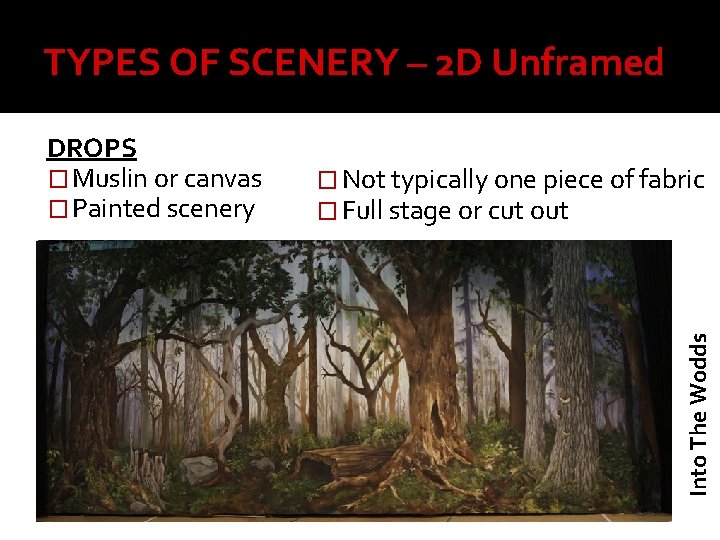
TYPES OF SCENERY – 2 D Unframed � Not typically one piece of fabric � Full stage or cut out Into The Wodds DROPS � Muslin or canvas � Painted scenery
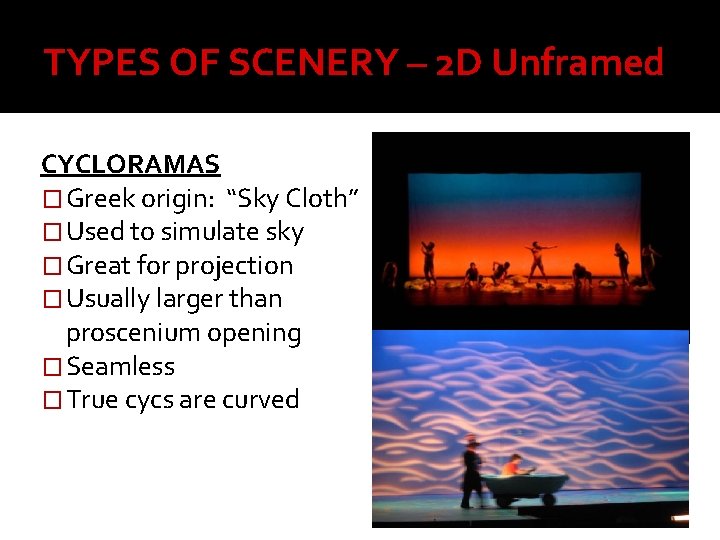
TYPES OF SCENERY – 2 D Unframed CYCLORAMAS � Greek origin: “Sky Cloth” � Used to simulate sky � Great for projection � Usually larger than proscenium opening � Seamless � True cycs are curved
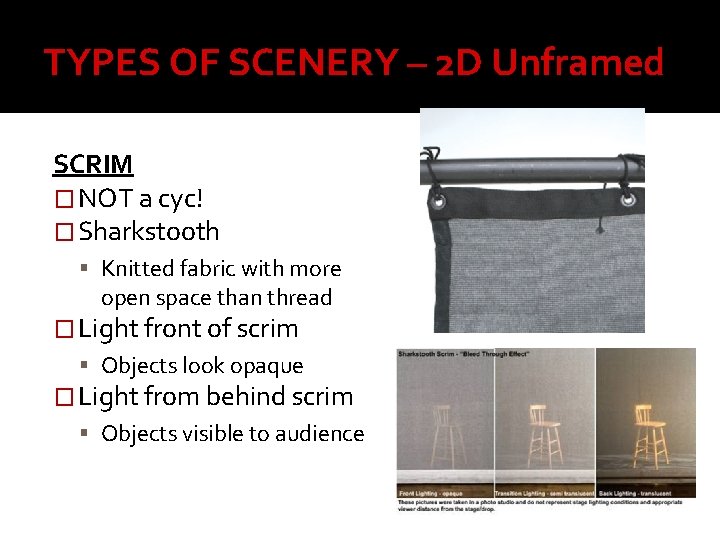
TYPES OF SCENERY – 2 D Unframed SCRIM � NOT a cyc! � Sharkstooth Knitted fabric with more open space than thread � Light front of scrim Objects look opaque � Light from behind scrim Objects visible to audience
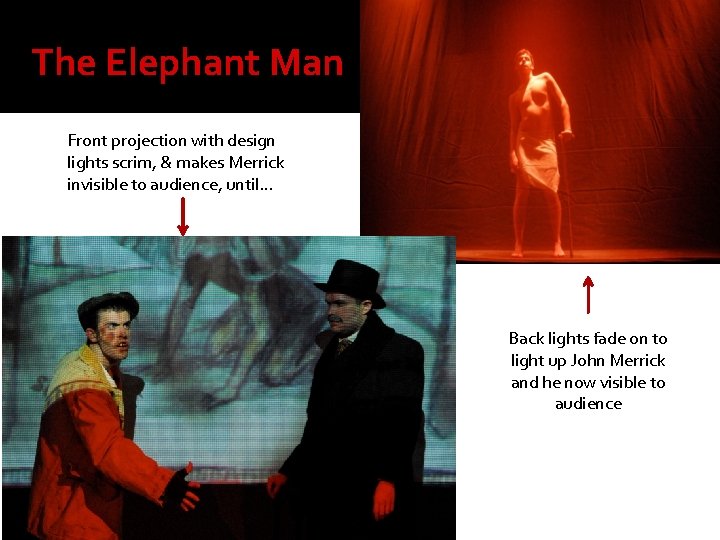
The Elephant Man Front projection with design lights scrim, & makes Merrick invisible to audience, until… Back lights fade on to light up John Merrick and he now visible to audience
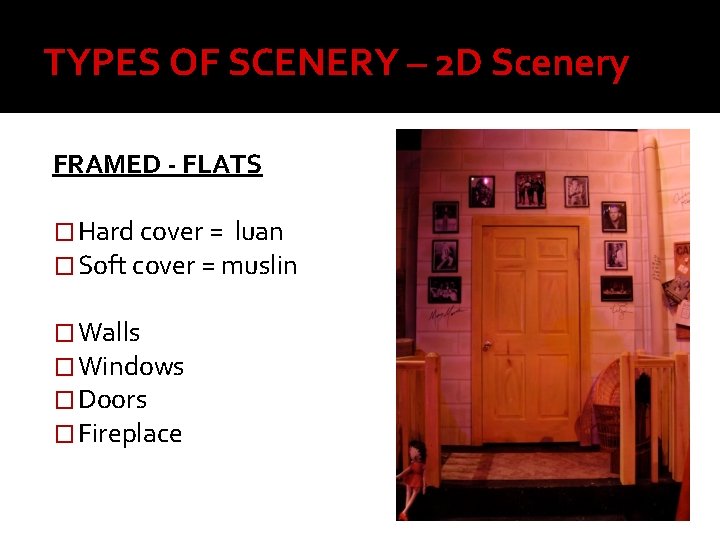
TYPES OF SCENERY – 2 D Scenery FRAMED - FLATS � Hard cover = luan � Soft cover = muslin � Walls � Windows � Doors � Fireplace
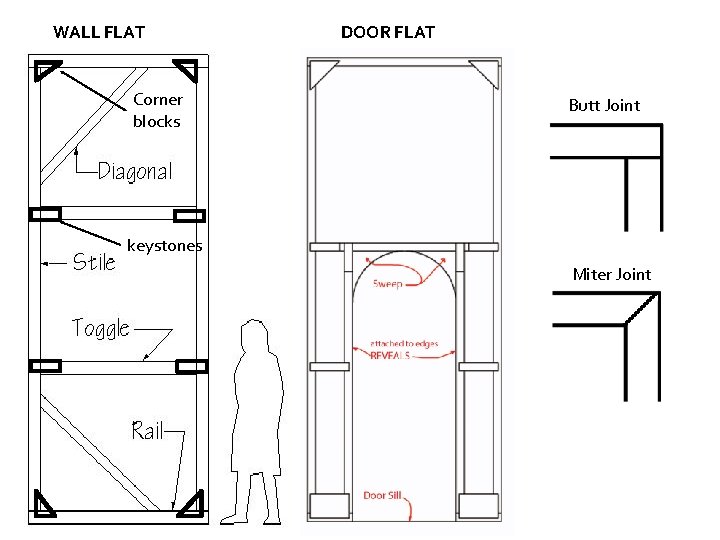
WALL FLAT Corner blocks DOOR FLAT Butt Joint keystones Miter Joint
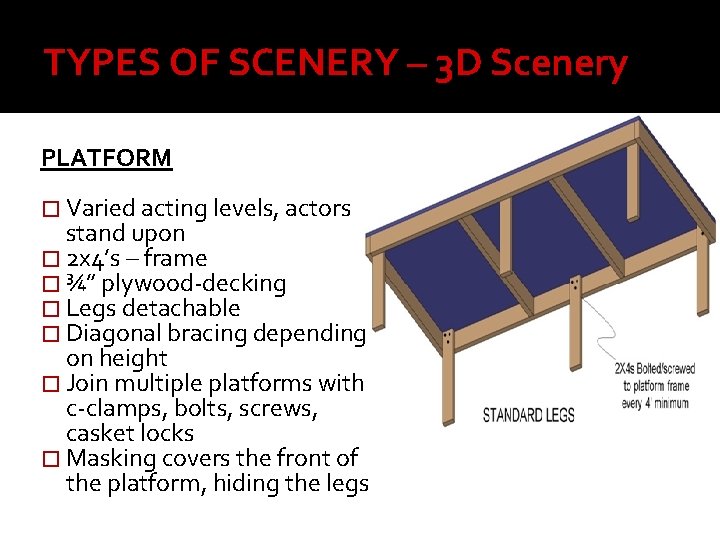
TYPES OF SCENERY – 3 D Scenery PLATFORM � Varied acting levels, actors stand upon � 2 x 4’s – frame � ¾” plywood-decking � Legs detachable � Diagonal bracing depending on height � Join multiple platforms with c-clamps, bolts, screws, casket locks � Masking covers the front of the platform, hiding the legs
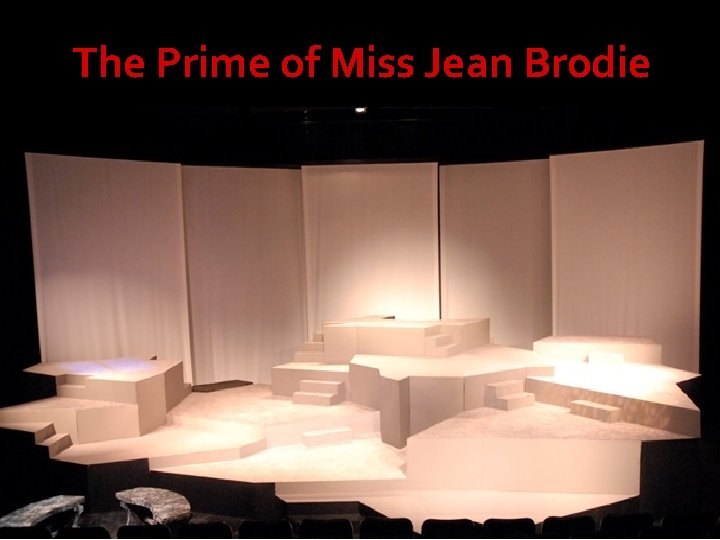
The Prime of Miss Jean Brodie
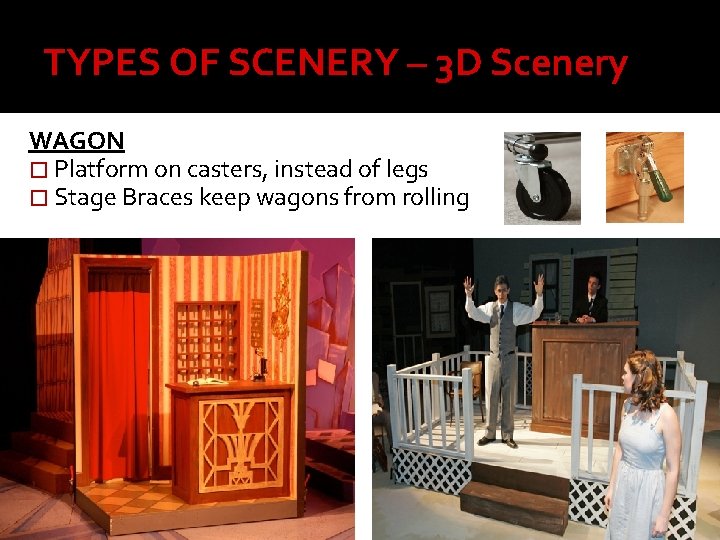
TYPES OF SCENERY – 3 D Scenery WAGON � Platform on casters, instead of legs � Stage Braces keep wagons from rolling
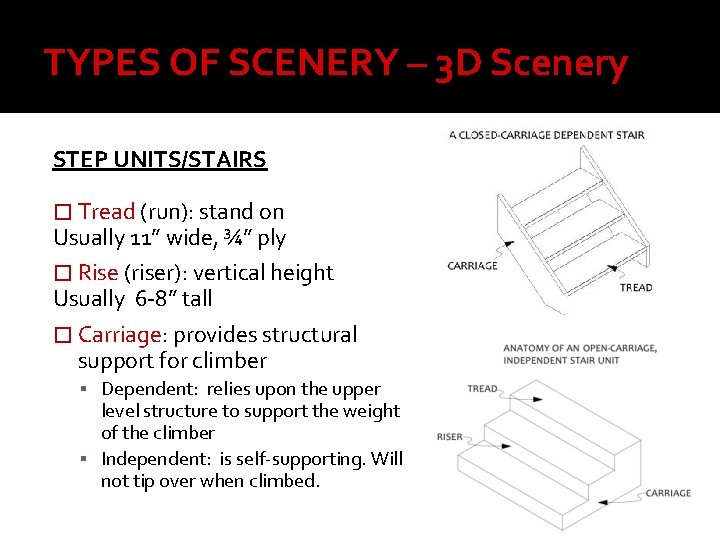
TYPES OF SCENERY – 3 D Scenery STEP UNITS/STAIRS � Tread (run): stand on Usually 11” wide, ¾” ply � Rise (riser): vertical height Usually 6 -8” tall � Carriage: provides structural support for climber Dependent: relies upon the upper level structure to support the weight of the climber Independent: is self-supporting. Will not tip over when climbed.
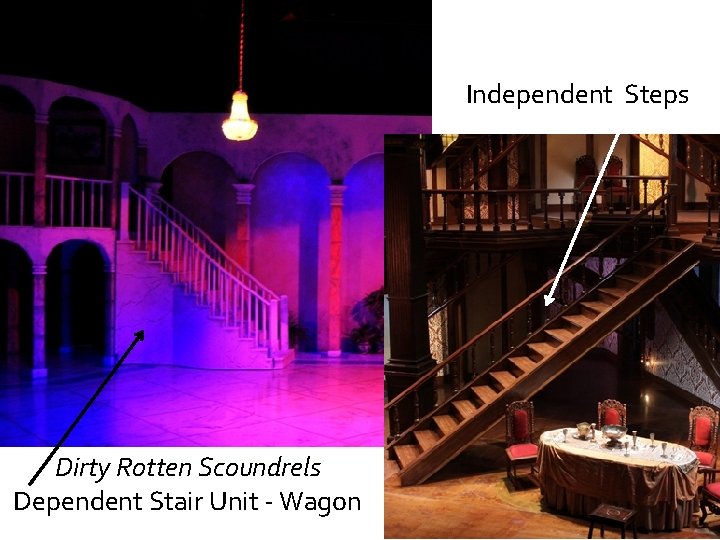
Independent Steps Dirty Rotten Scoundrels Dependent Stair Unit - Wagon
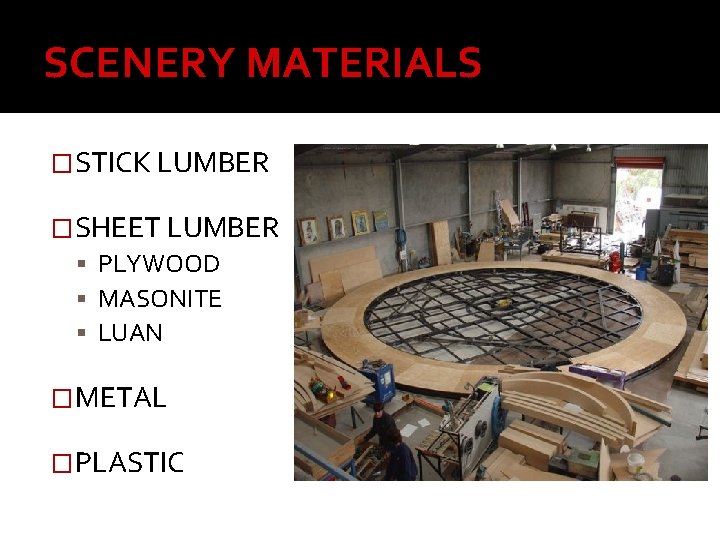
SCENERY MATERIALS �STICK LUMBER �SHEET LUMBER PLYWOOD MASONITE LUAN �METAL �PLASTIC
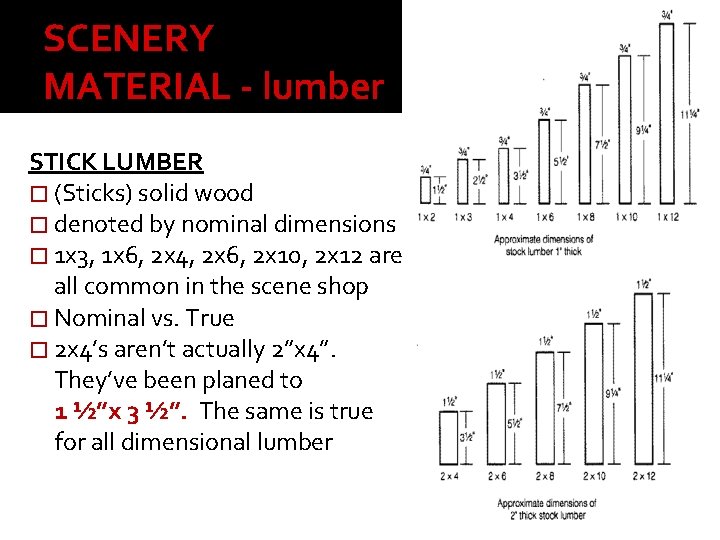
SCENERY MATERIAL - lumber STICK LUMBER � (Sticks) solid wood � denoted by nominal dimensions � 1 x 3, 1 x 6, 2 x 4, 2 x 6, 2 x 10, 2 x 12 are all common in the scene shop � Nominal vs. True � 2 x 4’s aren’t actually 2”x 4”. They’ve been planed to 1 ½”x 3 ½”. The same is true for all dimensional lumber
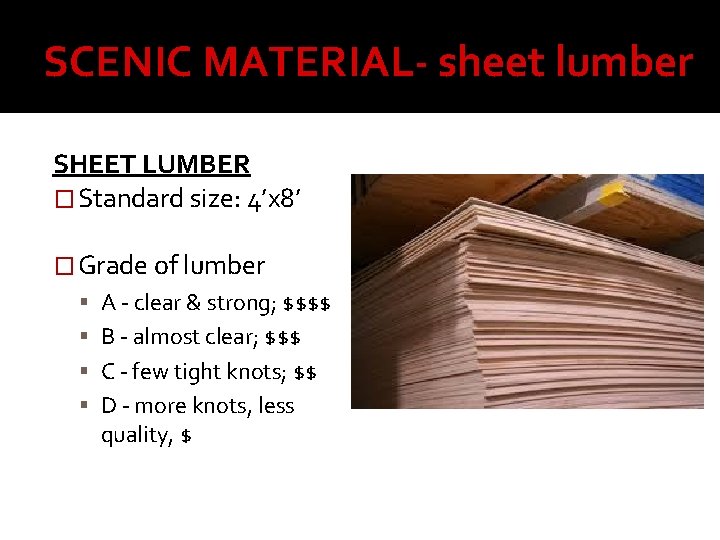
SCENIC MATERIAL- sheet lumber SHEET LUMBER � Standard size: 4’x 8’ � Grade of lumber A - clear & strong; $$$$ B - almost clear; $$$ C - few tight knots; $$ D - more knots, less quality, $
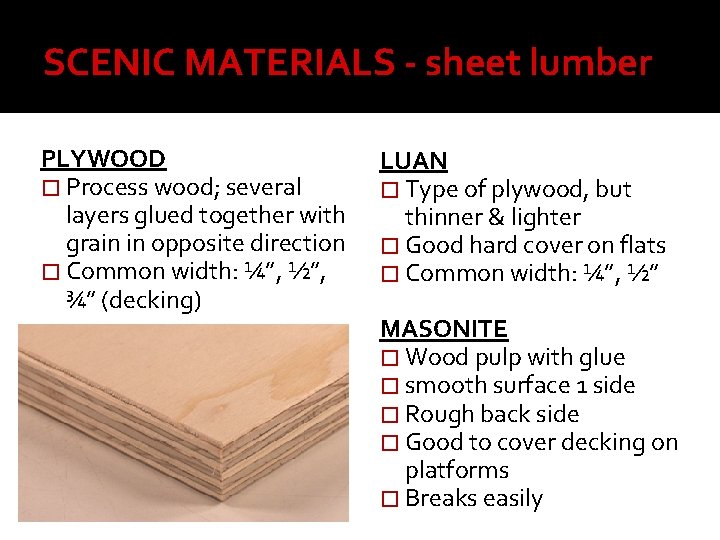
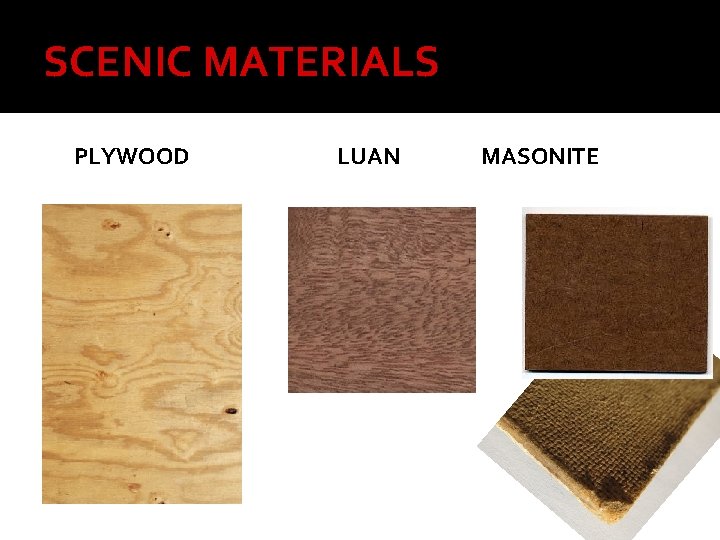
SCENIC MATERIALS - sheet lumber PLYWOOD � Process wood; several layers glued together with grain in opposite direction � Common width: ¼”, ½”, ¾” (decking) LUAN � Type of plywood, but thinner & lighter � Good hard cover on flats � Common width: ¼”, ½” MASONITE � Wood pulp with glue � smooth surface 1 side � Rough back side � Good to cover decking on platforms � Breaks easily
SCENIC MATERIALS PLYWOOD LUAN MASONITE
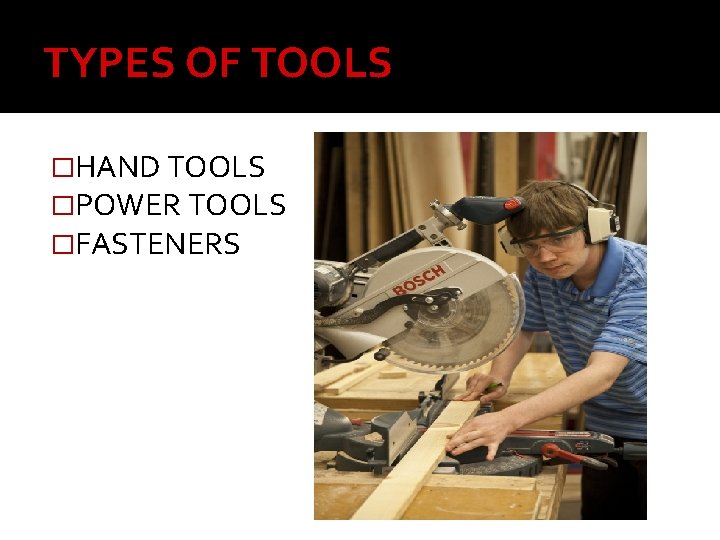
TYPES OF TOOLS �HAND TOOLS �POWER TOOLS �FASTENERS
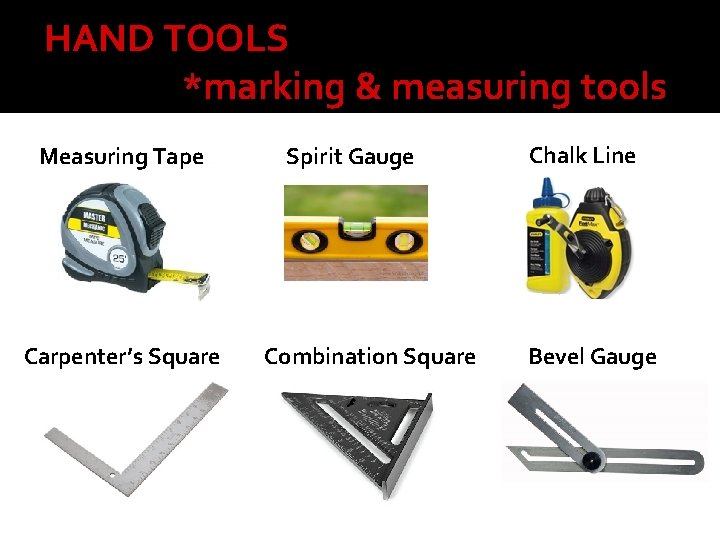
HAND TOOLS *marking & measuring tools Measuring Tape Carpenter’s Square Spirit Gauge Combination Square Chalk Line Bevel Gauge
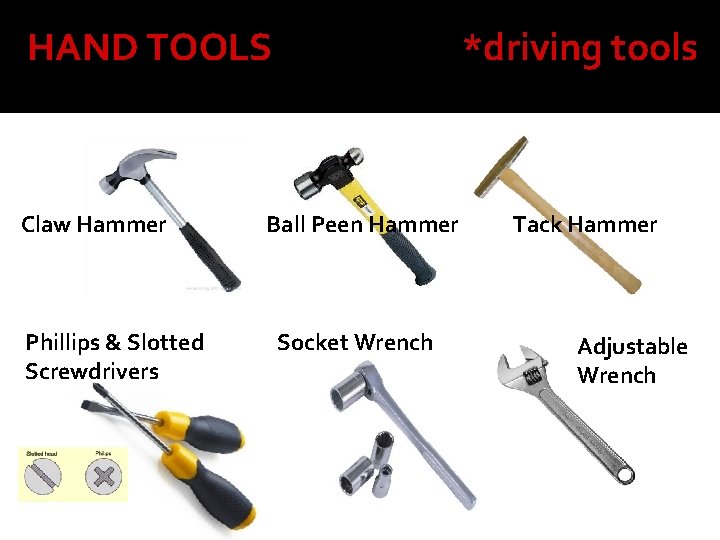
HAND TOOLS Claw Hammer Phillips & Slotted Screwdrivers *driving tools Ball Peen Hammer Socket Wrench Tack Hammer Adjustable Wrench
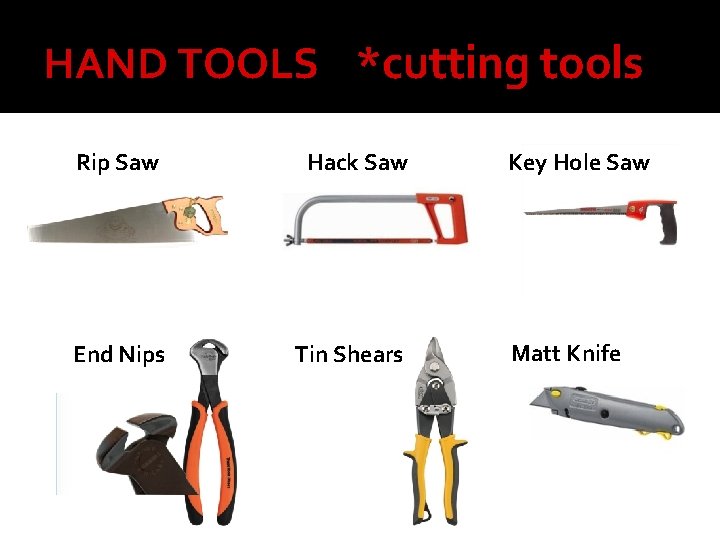
HAND TOOLS *cutting tools Rip Saw Hack Saw End Nips Tin Shears Key Hole Saw Matt Knife
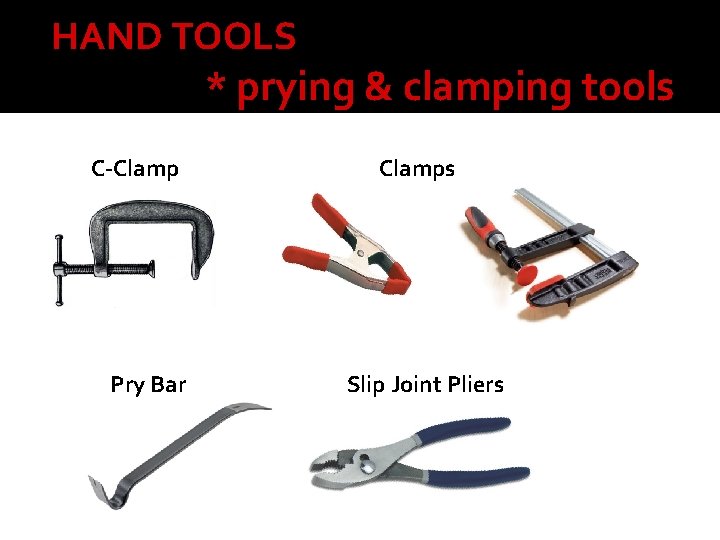
HAND TOOLS * prying & clamping tools C-Clamp Pry Bar Clamps Slip Joint Pliers
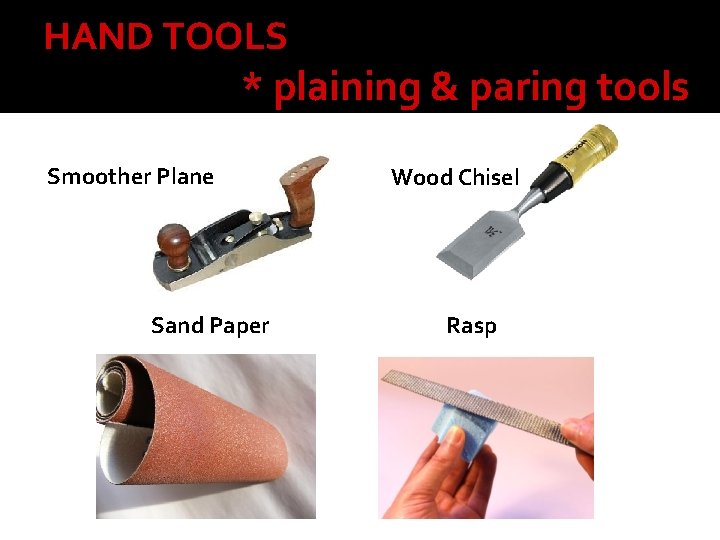
HAND TOOLS * plaining & paring tools Smoother Plane Sand Paper Wood Chisel Rasp
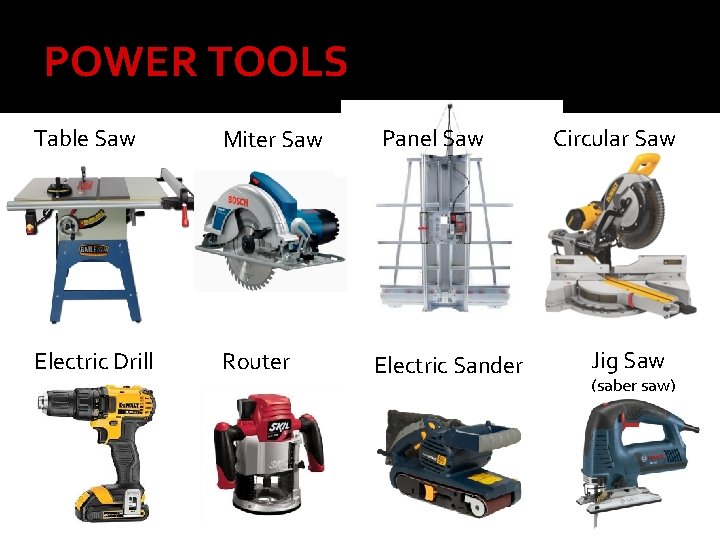
POWER TOOLS Table Saw Miter Saw Electric Drill Router Panel Saw Electric Sander Circular Saw Jig Saw (saber saw)
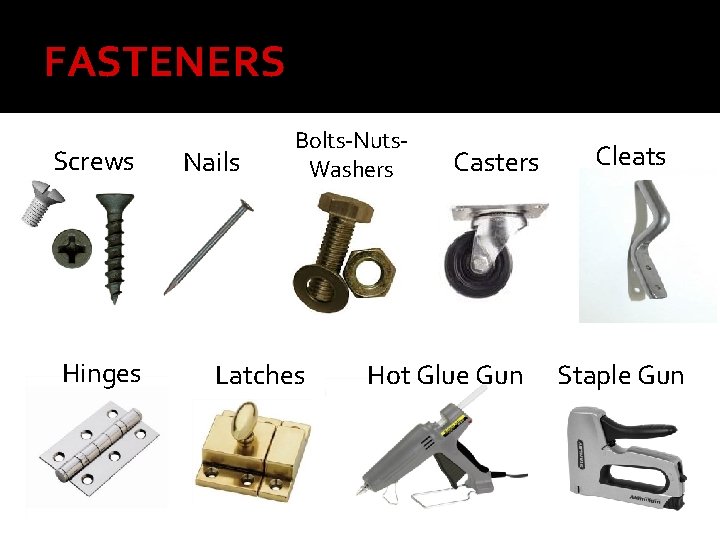
FASTENERS Screws Hinges Nails Bolts-Nuts. Washers Latches Casters Hot Glue Gun Cleats Staple Gun
SCENIC DESIGN PRODUCTION � MASTER CARPENTER Interprets Scenic Designer’s Front, Rear and Detail Elevations Oversees the building of the scenic design � SET CREW Builds set � Building the Set for CLYBOURNE PARK on Broadway http: //youtu. be/sl. BUx-LBPa. A
SCENIC DESIGN PROJECT PT 2 SCENIC DESIGN PRODUCTION SCENIC DESIGN APPLICATION � Front � Construct a ¼ scale elevation with measurements & cut list details model of a stock scenery piece from your show.
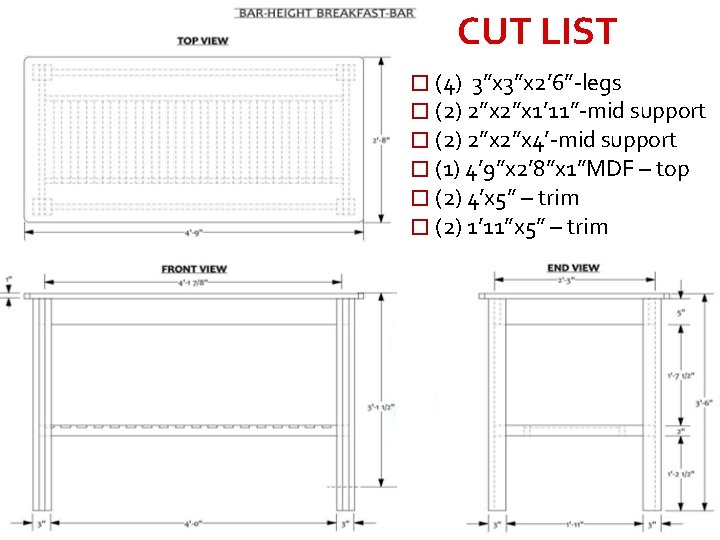
CUT LIST � (4) 3”x 2’ 6”-legs � (2) 2”x 1’ 11”-mid support � (2) 2”x 4’-mid support � (1) 4’ 9”x 2’ 8”x 1”MDF – top � (2) 4’x 5” – trim � (2) 1’ 11”x 5” – trim