
Technical Theater l Set and Prop Design l



- Slides: 31
Technical Theater l. Set and Prop Design l. Lighting Design l. Sound Design l. Costume Design l. Makeup
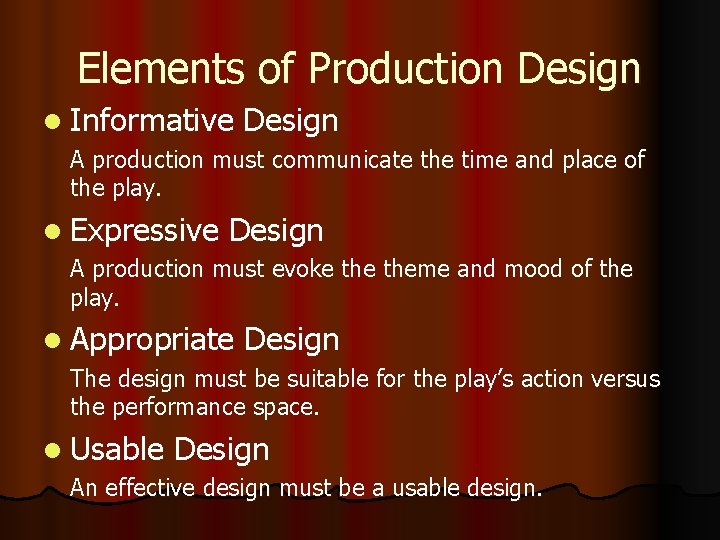
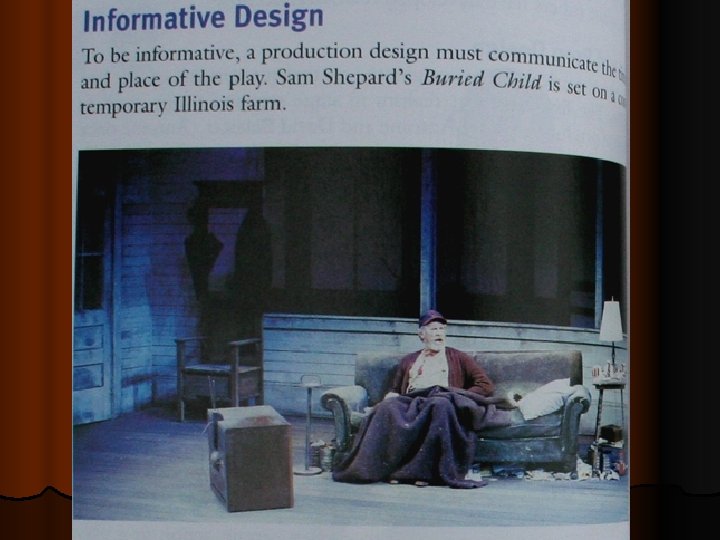
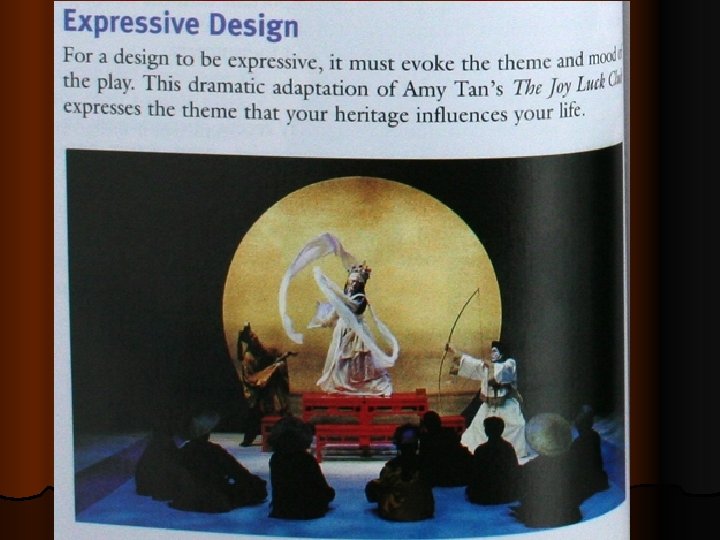
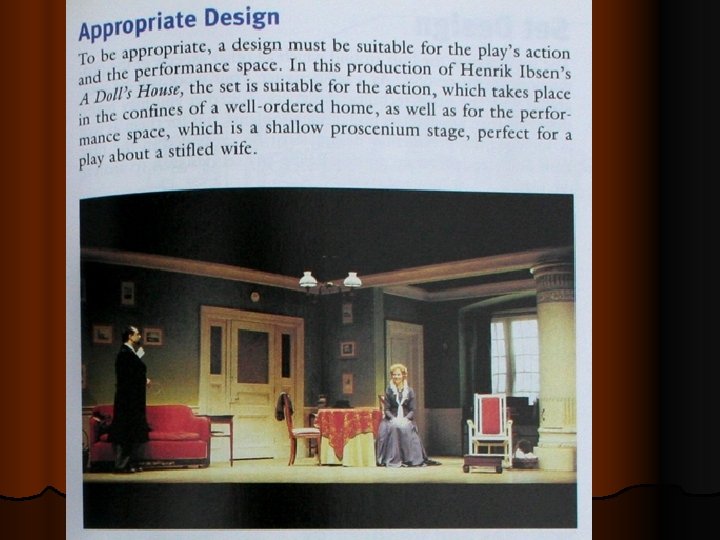
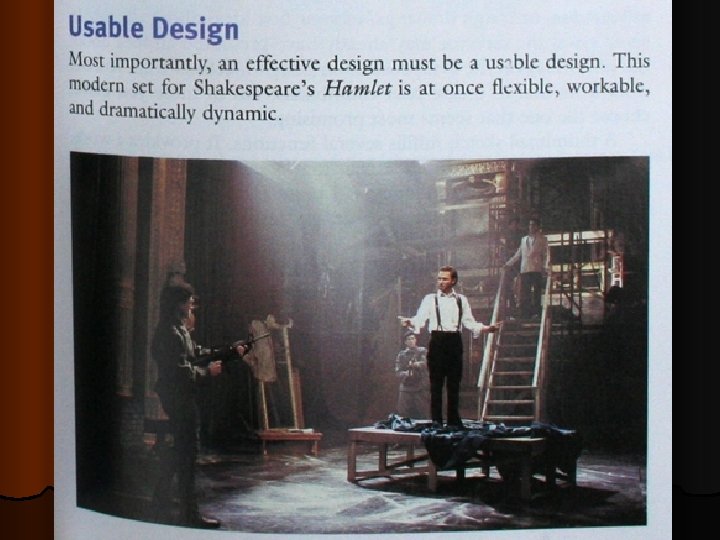
Elements of Production Design l Informative Design A production must communicate the time and place of the play. l Expressive Design A production must evoke theme and mood of the play. l Appropriate Design The design must be suitable for the play’s action versus the performance space. l Usable Design An effective design must be a usable design.
Set Design l Modern theatrical design originated in two different movements of the late 1800’s: l 1. Realism in sets and props. Ex: Producer Andre Antoine once hung beef carcasses onstage to make a butcher shop more realistic. l 2. Reaction against realism, suggesting that a play’s environment should convey a dramatic feeling, not just a historically or geographically accurate setting.
Pro Set Designers l http: //www. usa 829. org/index. php? option =com_content&task=view&id=25&Itemid =36 l http: //alexanderdodgedesign. com/ l http: //abartek. net/portfoliohome. html l http: //www. artrotchdesigns. com/Glengarr y. html
Set Design l Script Analysis – read script as soon as possible, discuss with director and other designers, work within production concept l Consider the time, place, style of the play. Create some sketches or collect some pictures that suggest the setting and style. l Evaluate the performance space for possiblities and problems.
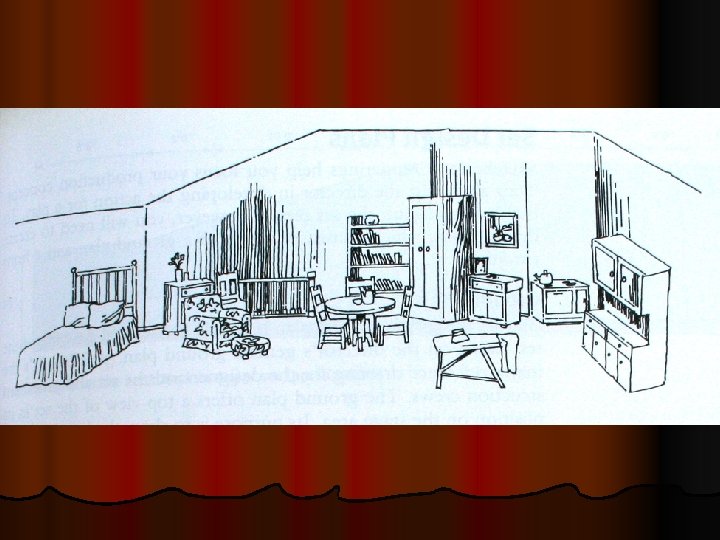
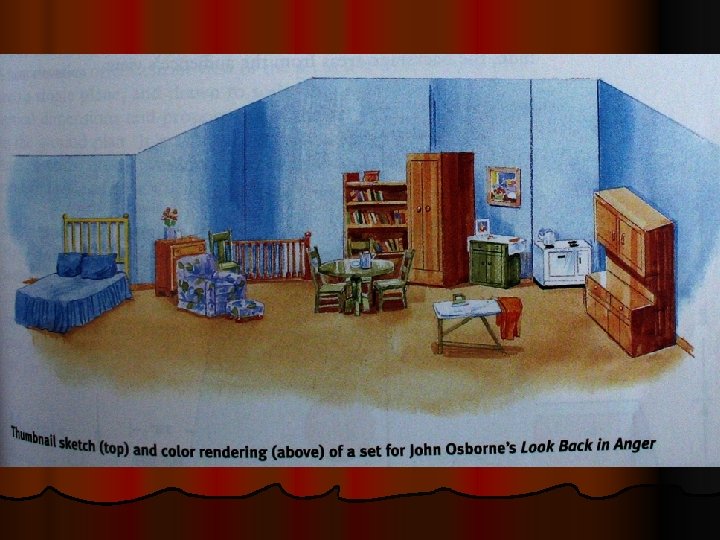
Thumbnail Sketches l Thumbnail sketches are rough drawings of your first ideas for the set. l Make sure to communicate with the director about blocking requirements. l After the sketch has been made, presented, discussed, and modified, use it to create a color rendering.
Color Rendering l Use colored pencil, paint, pastels, marking pens, or a computer graphics program to create a color rendering. l Draw them to scale – drawn at a fixed ratio to the full size of that item. If your drawing is at a scale of ½” to 1’, ½” on your drawing will equal 1’ on the set. l Most theatrical design plans are done on a ½” or ¼” scale.
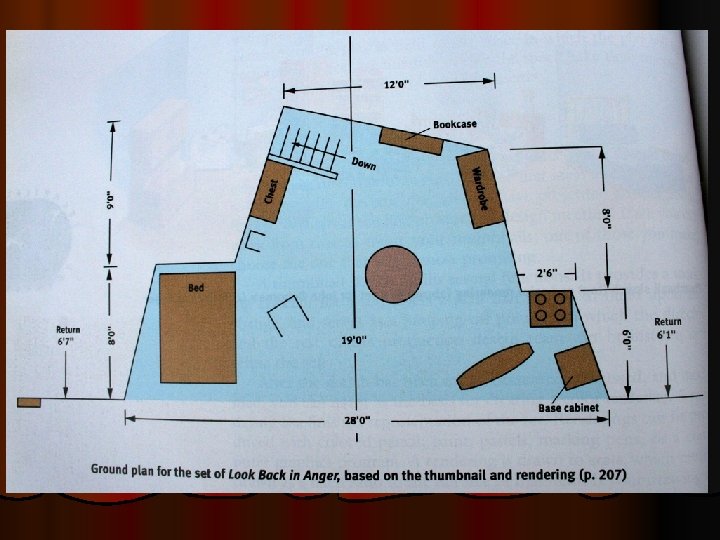
Set Design Plans – Ground Plan l To gather, build, and position the set pieces, you need to create design plans. These include a ground plan and a front elevation. l Ground plan – a scale, top-view drawing of the set based on the director’s requirements. The purpose is to show the location, position, and measurements of set pieces on the stage.
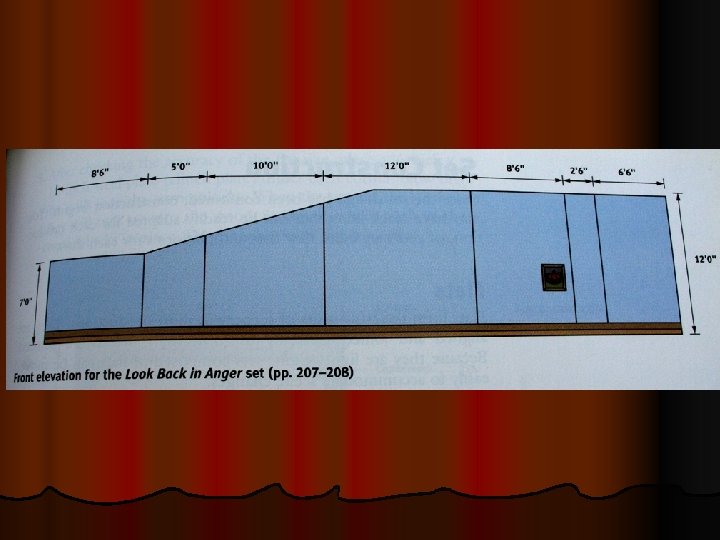
Set Design Plans – Front Elevation l Front Elevation – front view of the set, drawn to scale. Should show the style and decorative features of walls, doors, windows, and fireplaces. l (If you need them…)Don’t forget about backing – flats, draperies, and drops which hide the backstage area from the audience’s view.
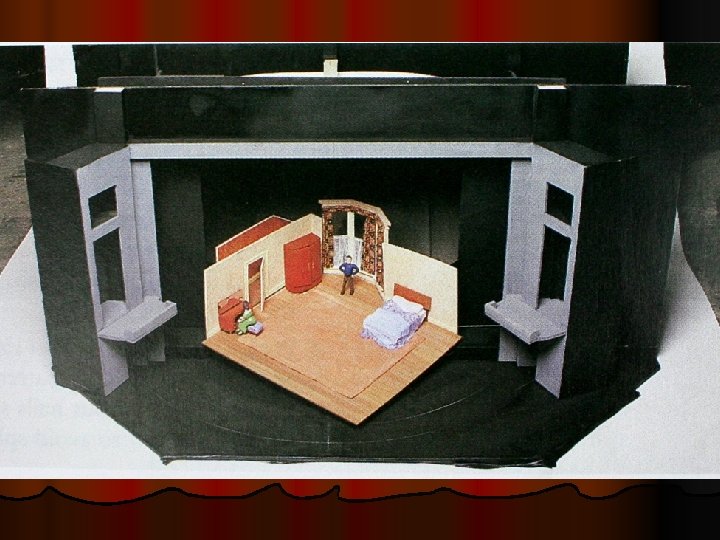
Set Design Plans - Production Model Example production model from the play, Glen Gary, Glen Ross. l http: //www. artrotchdesigns. com/Glengarry. html The production model is a complete scale model created in 3 -D using foam core board, cardboard, popsicle sticks, toothpicks, etc. It is painted and includes all set pieces (tables, chairs, park benches, etc. ). The designer must be creative in his/her use of materials. It is suggested that when looking for materials, you look in your own trash can. Anything and everything can serve for set pieces and materials.
Directors – choose your set designer (3 min) Set Designers – You must complete the entire process: Step 1: Thumbnail Sketches & Color Rendering Step 2: Ground Plan & Front Elevation Step 3: Production Model l l Assignment #1 Thumbnail Sketches and Color Rendering Rubric Working within blocking requirements /20 Working within the production concept /10 Approval of the director /10 Creativity /10 /50
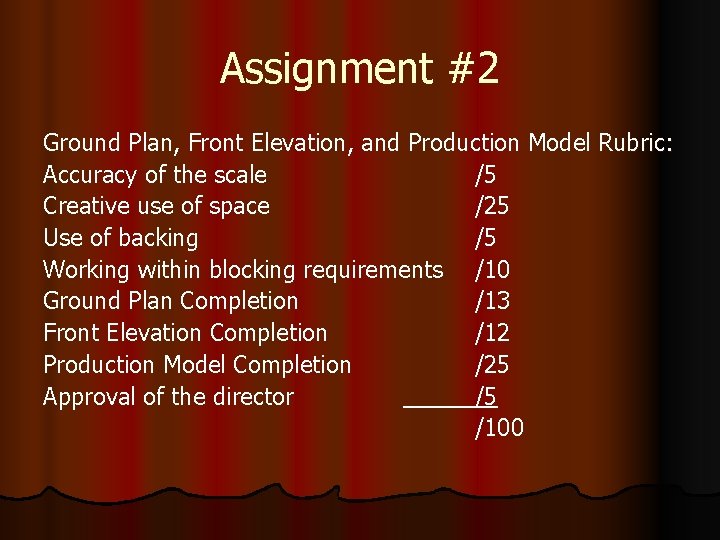
Assignment #2 Ground Plan, Front Elevation, and Production Model Rubric: Accuracy of the scale /5 Creative use of space /25 Use of backing /5 Working within blocking requirements /10 Ground Plan Completion /13 Front Elevation Completion /12 Production Model Completion /25 Approval of the director /5 /100
Costume Design l Work closely with director l Analyze script l Consider effect of color on mood l May use color to denote relationships between characters l Consider era and create sketches and color renderings. l Costume crew makes, builds costumes
Costume Design l l Because each costume has several pieces and each character may have several costumes, the costume crew must be extremely organized. To keep track of the costumes, costumers create a costume plot. Costumes may be pulled, rented, bought, borrowed, or built. Costumers hold fittings before the show to make sure that costumes fit and for design approval from the director.
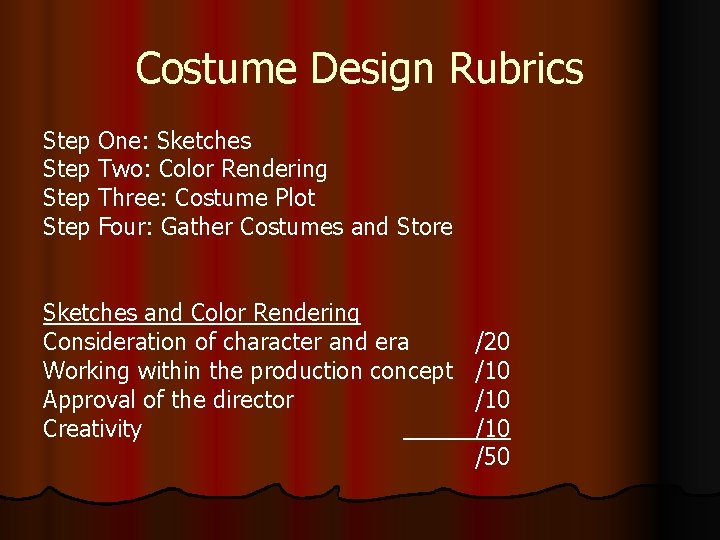
Costume Design Rubrics Step One: Sketches Step Two: Color Rendering Step Three: Costume Plot Step Four: Gather Costumes and Store Sketches and Color Rendering Consideration of character and era Working within the production concept Approval of the director Creativity /20 /10 /10 /50
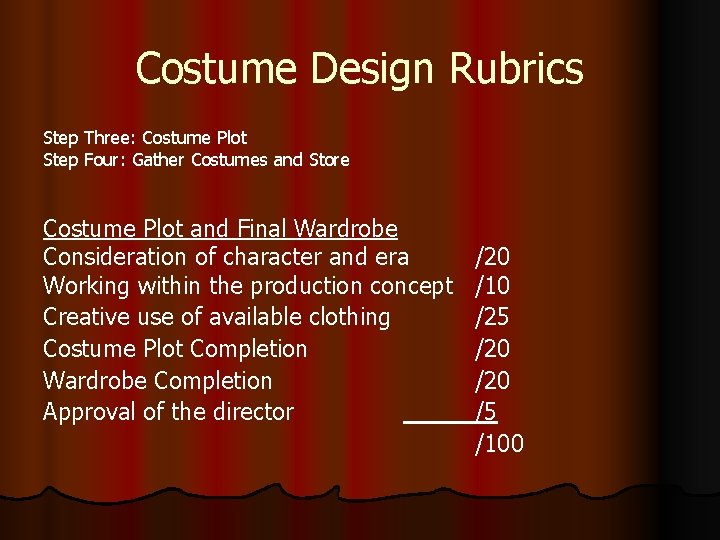
Costume Design Rubrics Step Three: Costume Plot Step Four: Gather Costumes and Store Costume Plot and Final Wardrobe Consideration of character and era Working within the production concept Creative use of available clothing Costume Plot Completion Wardrobe Completion Approval of the director /20 /10 /25 /20 /5 /100
Prop Design Set props – furniture, appliances, rugs help establish the era and financial status of characters l Decorative props – curtains, pictures, linens, knickknacks, magazines offer clues about lifestyle. l Hand props – used by the characters in the performance: books, telephones, bottle, etc. Should suggest personality traits of the characters. l
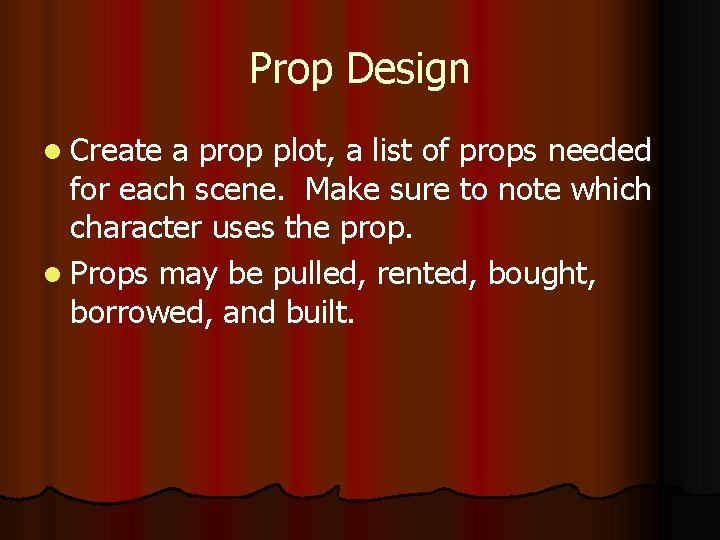
Prop Design l Create a prop plot, a list of props needed for each scene. Make sure to note which character uses the prop. l Props may be pulled, rented, bought, borrowed, and built.
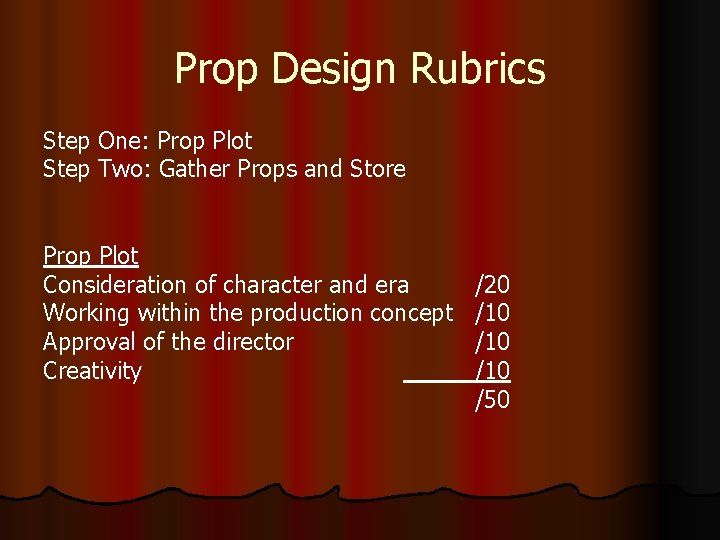
Prop Design Rubrics Step One: Prop Plot Step Two: Gather Props and Store Prop Plot Consideration of character and era Working within the production concept Approval of the director Creativity /20 /10 /10 /50
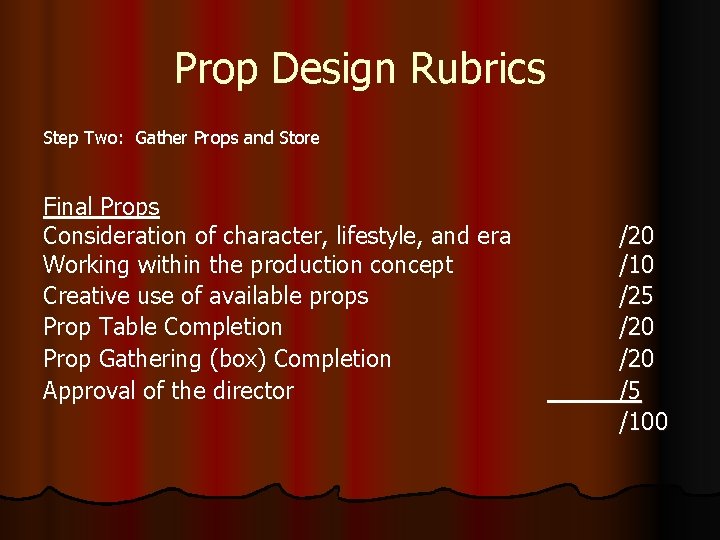
Prop Design Rubrics Step Two: Gather Props and Store Final Props Consideration of character, lifestyle, and era Working within the production concept Creative use of available props Prop Table Completion Prop Gathering (box) Completion Approval of the director /20 /10 /25 /20 /5 /100